
Category: This great Nation & Its People
When the M1 Carbine (officially the United States Carbine, Caliber .30, M1) began to reach American combat units in late 1942, the handy little rifle quickly gained a reputation as the “soldier’s pet”.
And why not? The little M1 Carbine weighed just 5.8 pounds (loaded with a 15-round magazine) and was only 35.6” long. By 1942 standards, it was a semi-automatic sweetheart.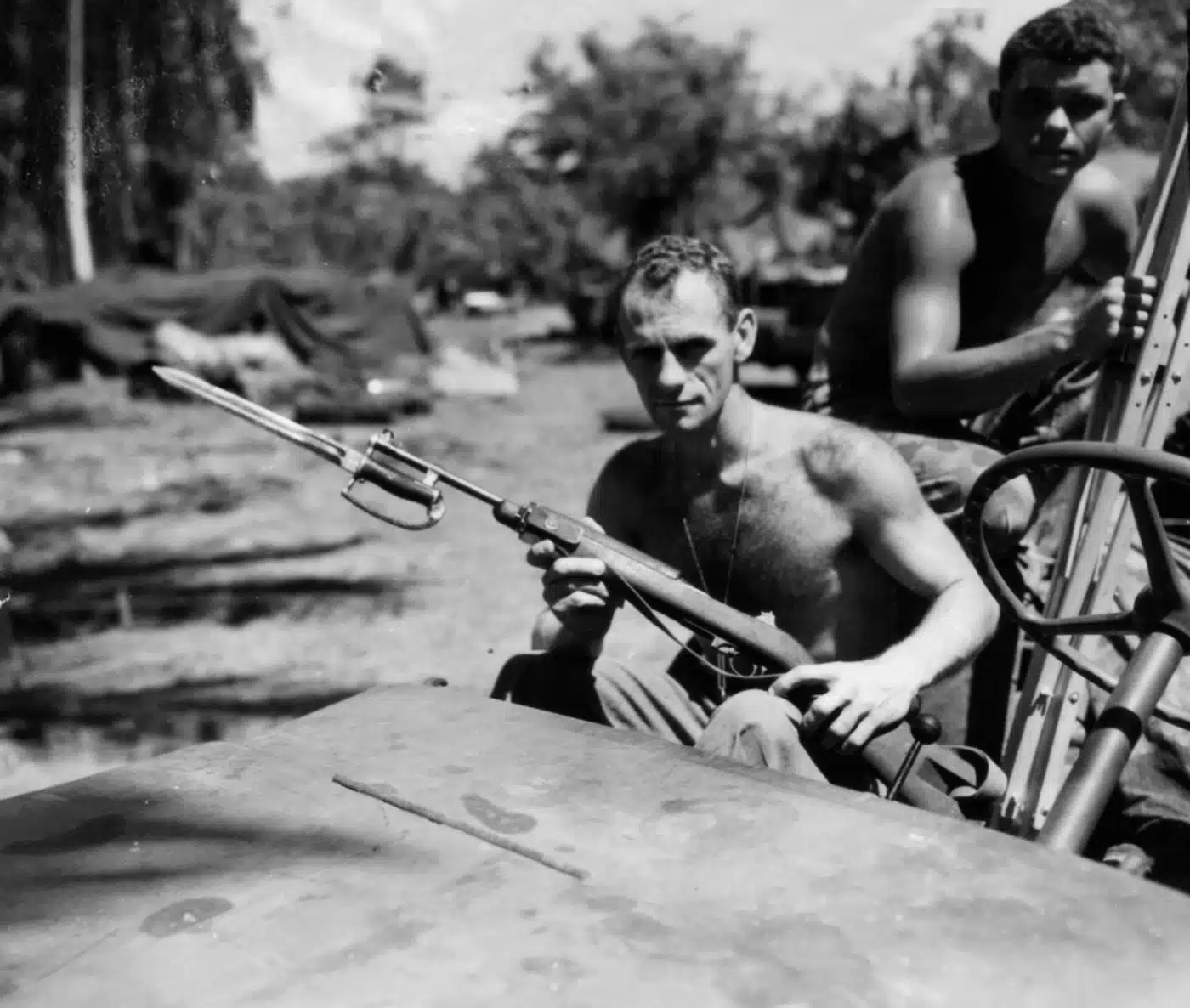
Consequently, as the Carbine quickly made its way from its intended role as a weapon for officers and specialist troops (like artillerymen, tankers, and paratroops) into the hands of the long-suffering infantrymen, the G.I.’s penchant for customization created some interesting field modifications for their new favorite rifle.
They had plenty of opportunities — there were 6.1 million carbines made during World War II, and they were issued in every combat theatre.
Bayonets
M1 Carbines equipped with a bayonet lug did not appear until the final weeks of the war, but that doesn’t mean that American troops weren’t creating their own bayonets for the Carbine in the field.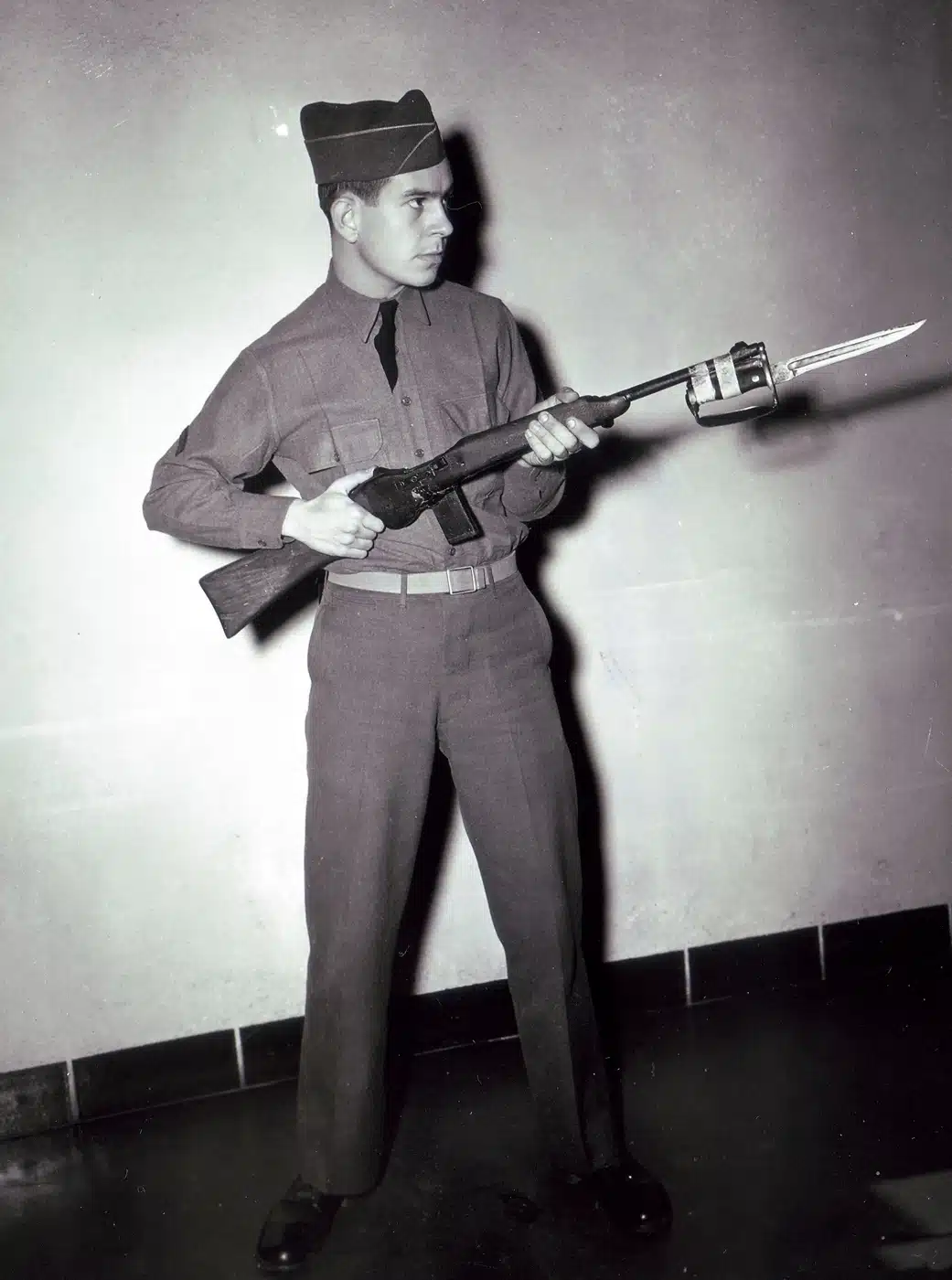
Ultimately, the M3 fighting knife was transformed into the M4 bayonet for use on the M1 Carbine. The official design appears to follow along with improvised bayonets created in the field.
Flash Hiders
During the war, the T23 (later designated M3) flash hider was developed for use with the M3 Carbine and its infrared sniperscope. Only a handful of the M3 Carbines saw service by the war’s end, and consequently few of the M3 flash hiders were in use until the Korean War.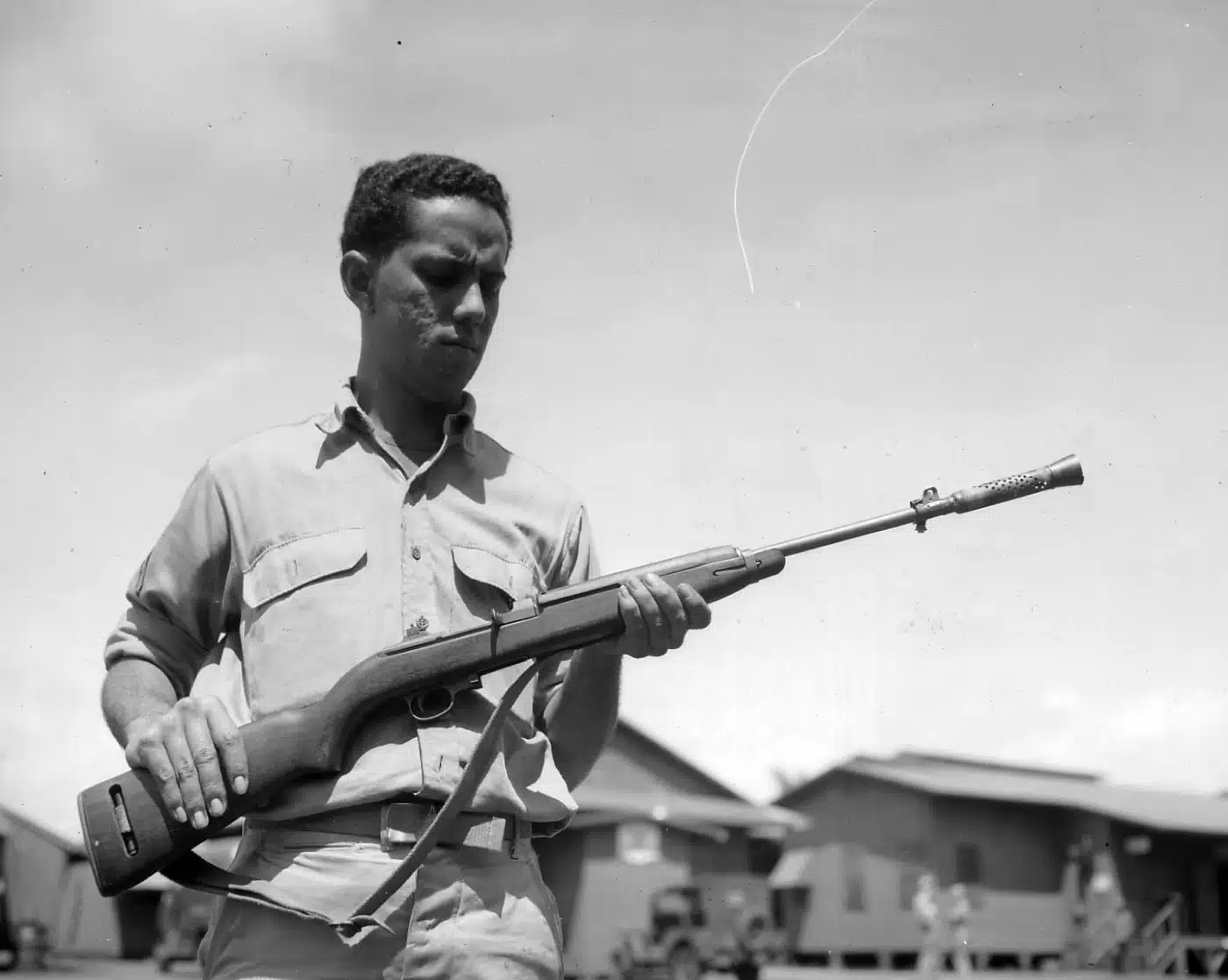
Even so, I managed to find a pair of photos of a field-made flash hider from an Army unit in the Philippines. Different units experimented with flash hider/compensator combinations for their carbines, the flash hider for use in close-quarters night fighting, and the compensator for Carbines field-modified for fully automatic fire.
The Clip Carrier
By late 1944, the twin-magazine “stock pouch” was fitted to many carbines — giving troops quick access to three 15-round magazines without using an ammunition belt. In the spring of 1945, a semi-official “clip carrier” was introduced in small numbers in Germany.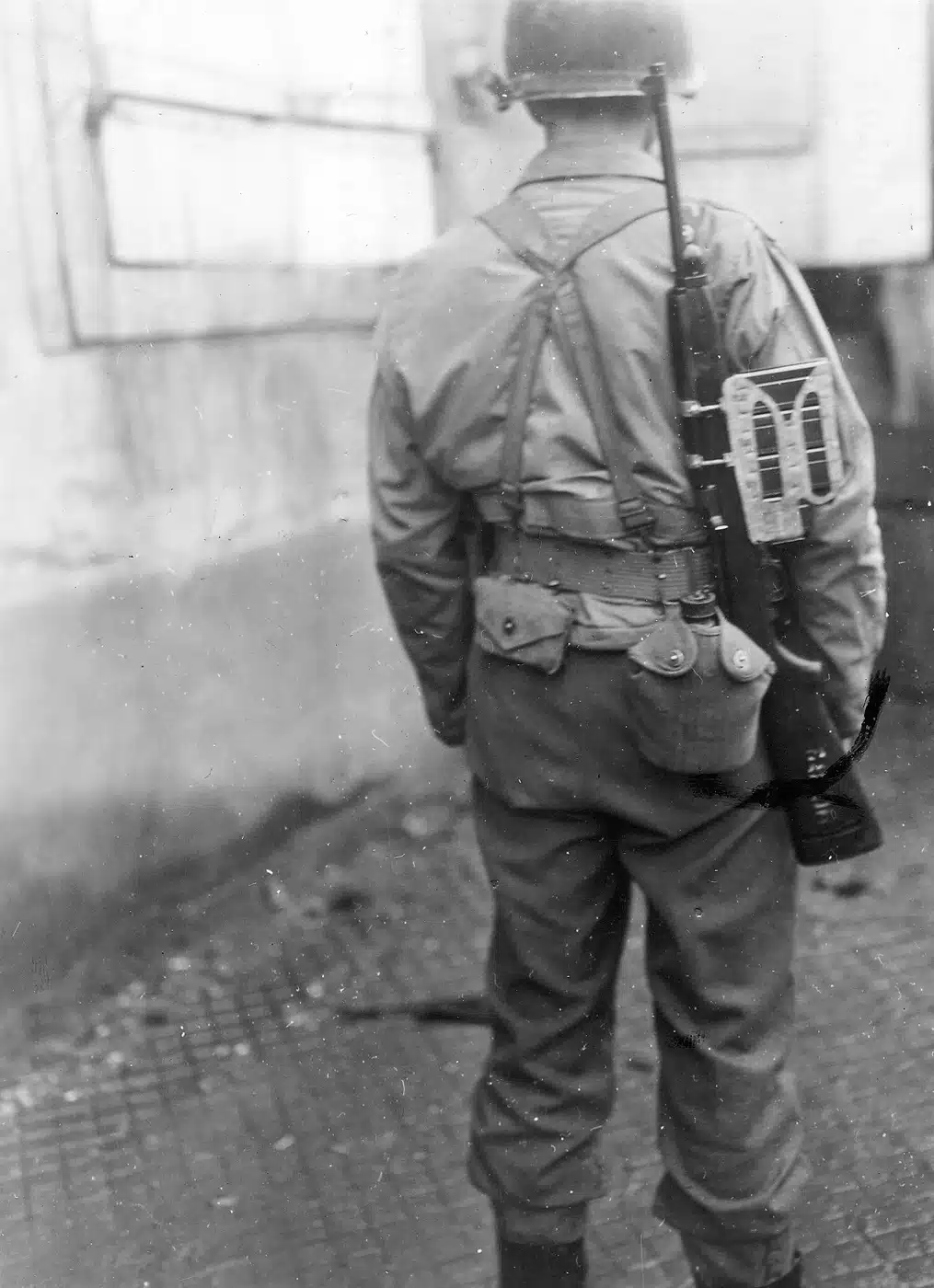
The unusual ammunition clip carrier allowed three additional 15-round magazines to be carried forward of the normal 15-round magazine in the mag-well (60 rounds total).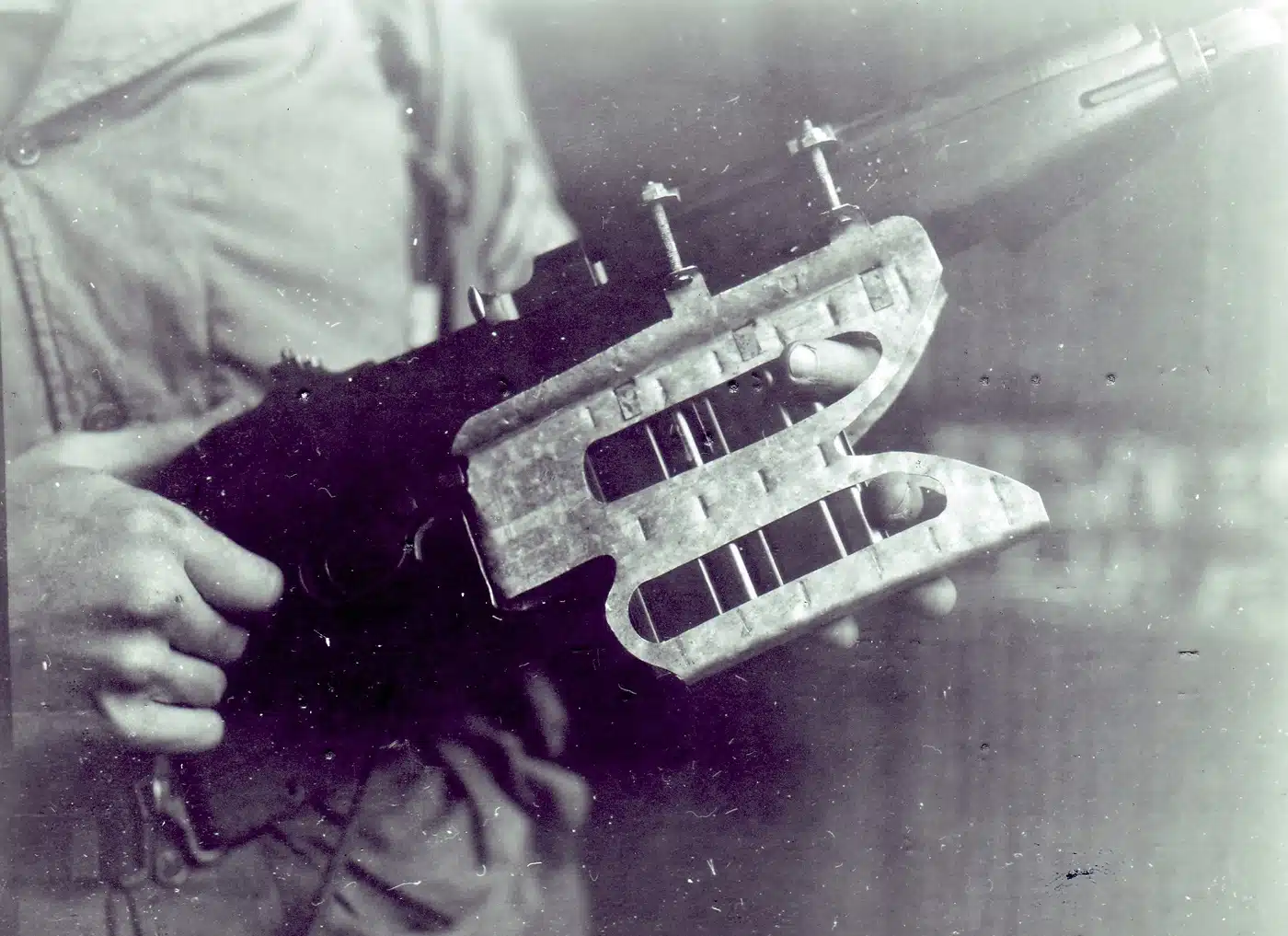
he U.S. War Department’s “Combat Lessons No. 8” describes the device:
This ammunition clip carrier was designed by T/4 Pierce S. Priest, for use with the .30 caliber carbine M1. When the carrier is fully loaded, the exhausted clip is removed in the usual manner and a fresh clip placed in position for insertion by pressure exerted with fingers of the left hand at the front of the carrier. When the carrier is partially loaded, operation is the same except that the fingers of the left hand are inserted at the side of the carrier.
Cut-Down Carbine
Units with access to tools often experimented with converting an M1 Carbine to full-auto fire. Likewise, the already small carbine was sometimes cut down even further to create an oversized pistol, or machine-pistol.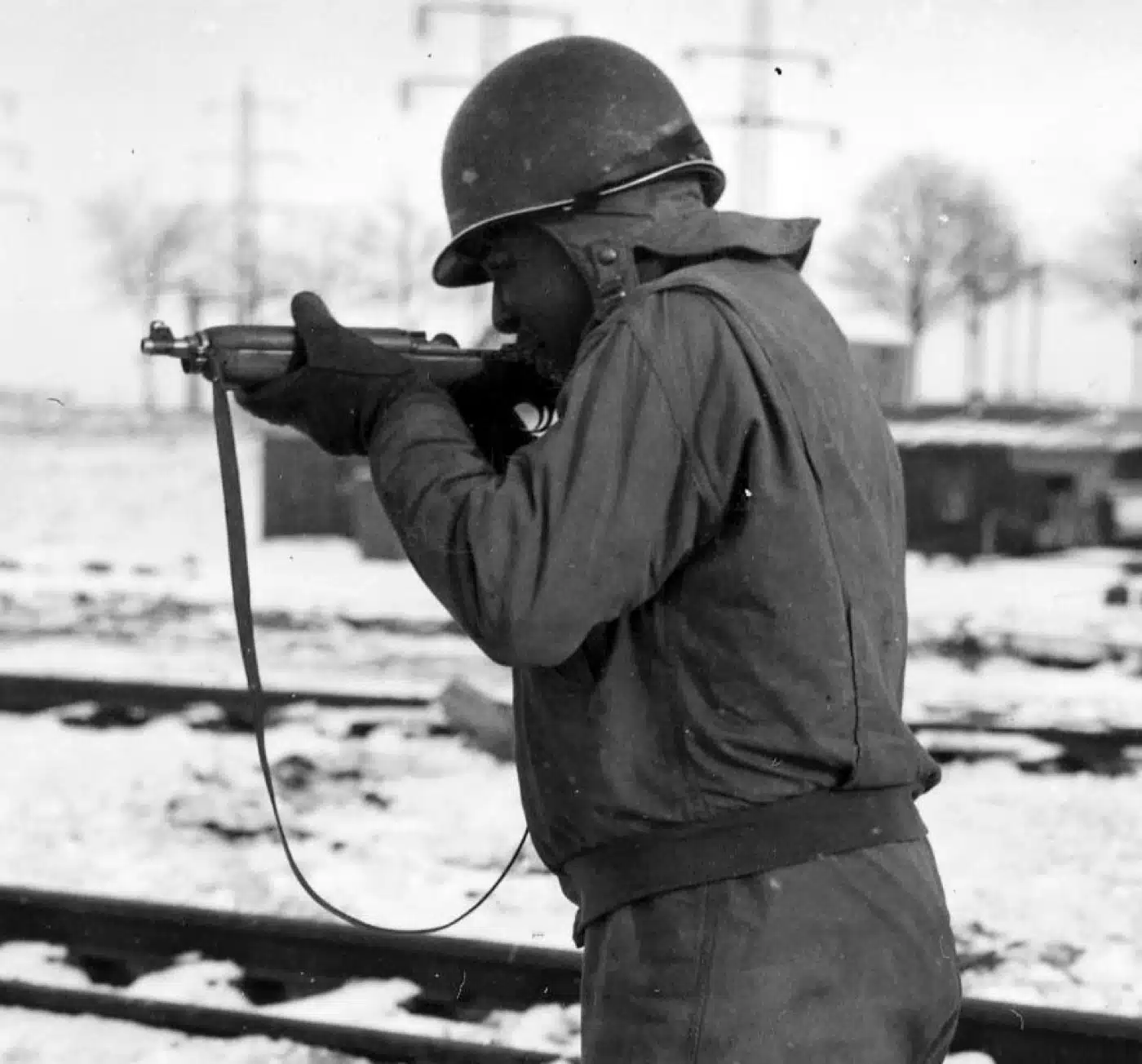
During the 1960s, both Iver Johnson and Universal created commercial variants of the M1 Carbine cut down to pistol length for sale in the USA. It seems likely that the G.I. field modifications were popular enough for postwar manufacturers to “productize” them.
Bandolier-Sling
As a photo researcher, I can tell you that I often find interesting images of firearms modifications or adaptations that ask more questions than they answer. Back in 2006, I published a photo study of the M1 Carbine in action. In that book, I included a couple of photos that showed Marines on Okinawa with a unique sling that doubled as a bandolier for their Carbines. I didn’t say much about it in the captions, as I had no reference to describe specifically what it was.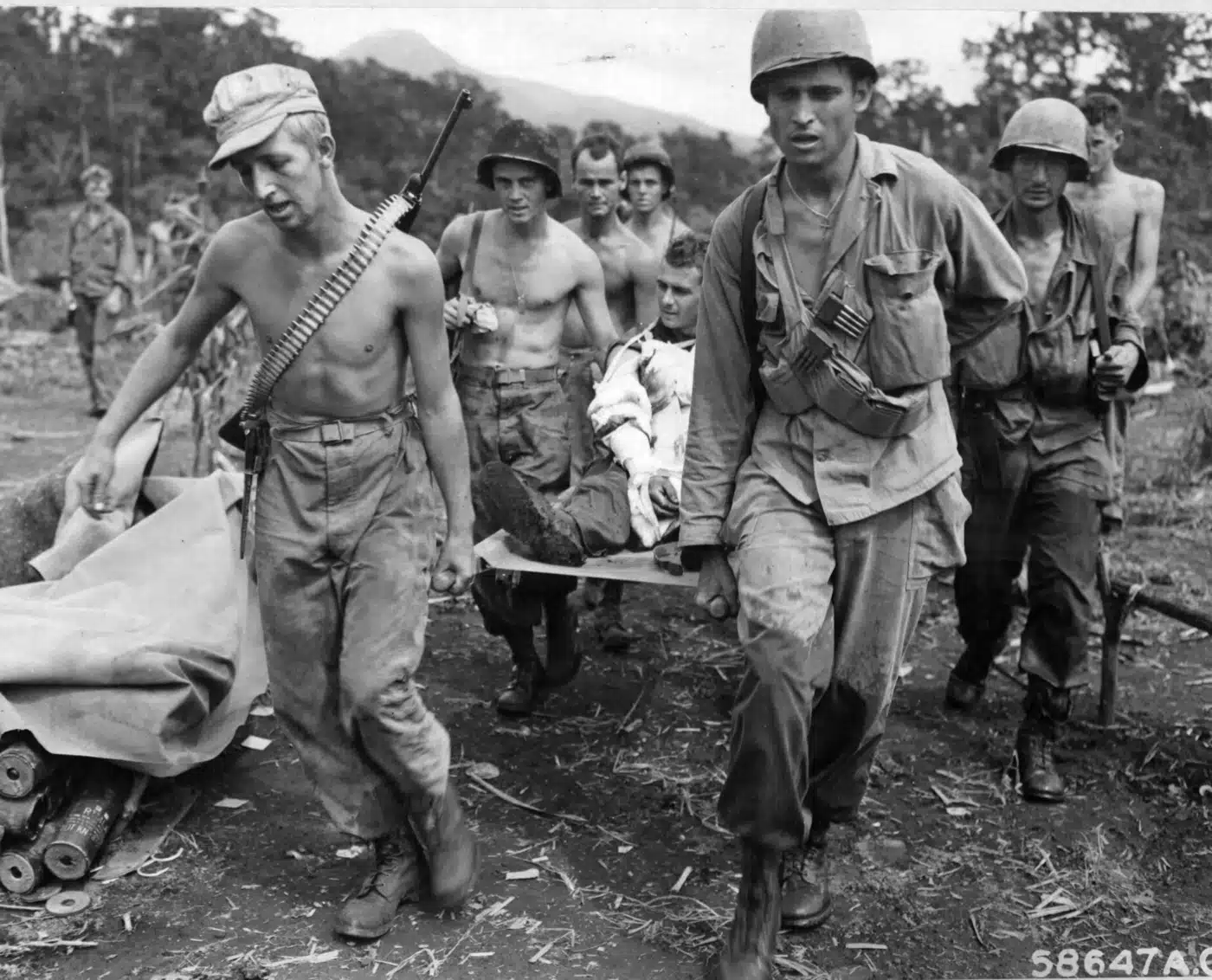
In the summer of that year, I sat down with renowned gun researcher Dolf Goldsmith. Dolf looked at those images, and quickly asked that a box of .30 Carbine cartridges along with the web ammunition belt for a Browning M1917 .30 caliber machine gun be brought to him. With both of those in hand and an M1 Carbine on the table, Dolf broke down the “mystery sling”.
The Marines had used a web ammo belt (for the .30 cal M1917 machine gun), and the .30 Carbine rounds held in there perfectly. The newly made sling did the same job as the standard type, while providing the user with about 30 rounds of loose ammunition. All of the materials were readily available, and the conversion was relatively simple to complete.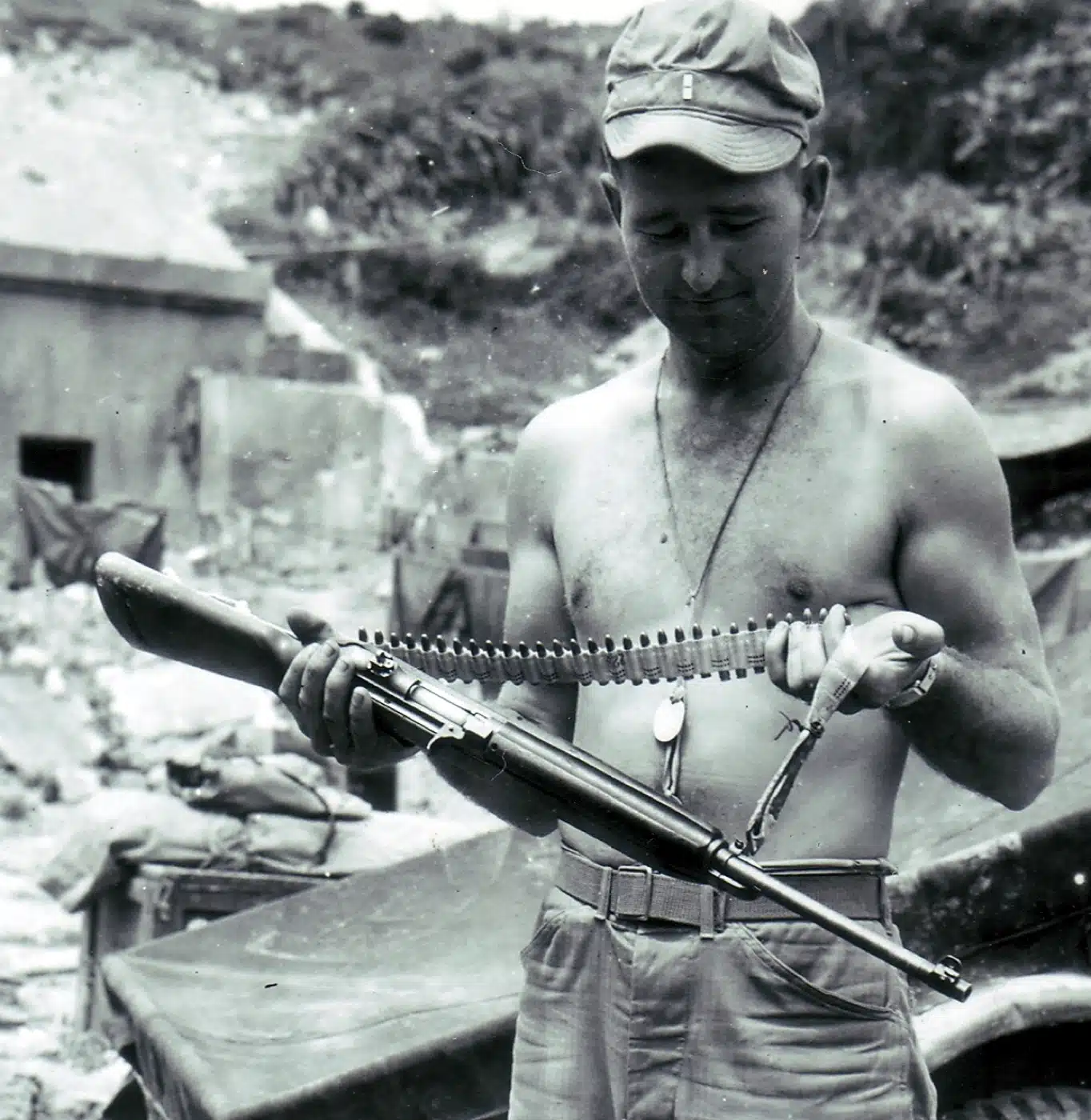
The next expert I talked to took in all the available information, and then shot back some questions that I could not answer. I reviewed the bandolier-sling photos with the leading M1 Carbine expert, the late Larry Ruth. After a little thought, Larry had this to say: “I think you and Dolf have figured out what it is and how it was made. That makes perfect sense. But I wonder why it exists at all?”
Solving the Mystery
Apparently, the bandolier-sling concept intersected with some research that Larry was conducting on M1 Carbine magazines. Then he hit me with another question: “In all your photo research and collecting, have you found any images that show empty carbine magazines laying discarded on the battlefield?” I thought about it a bit and concluded that I had not.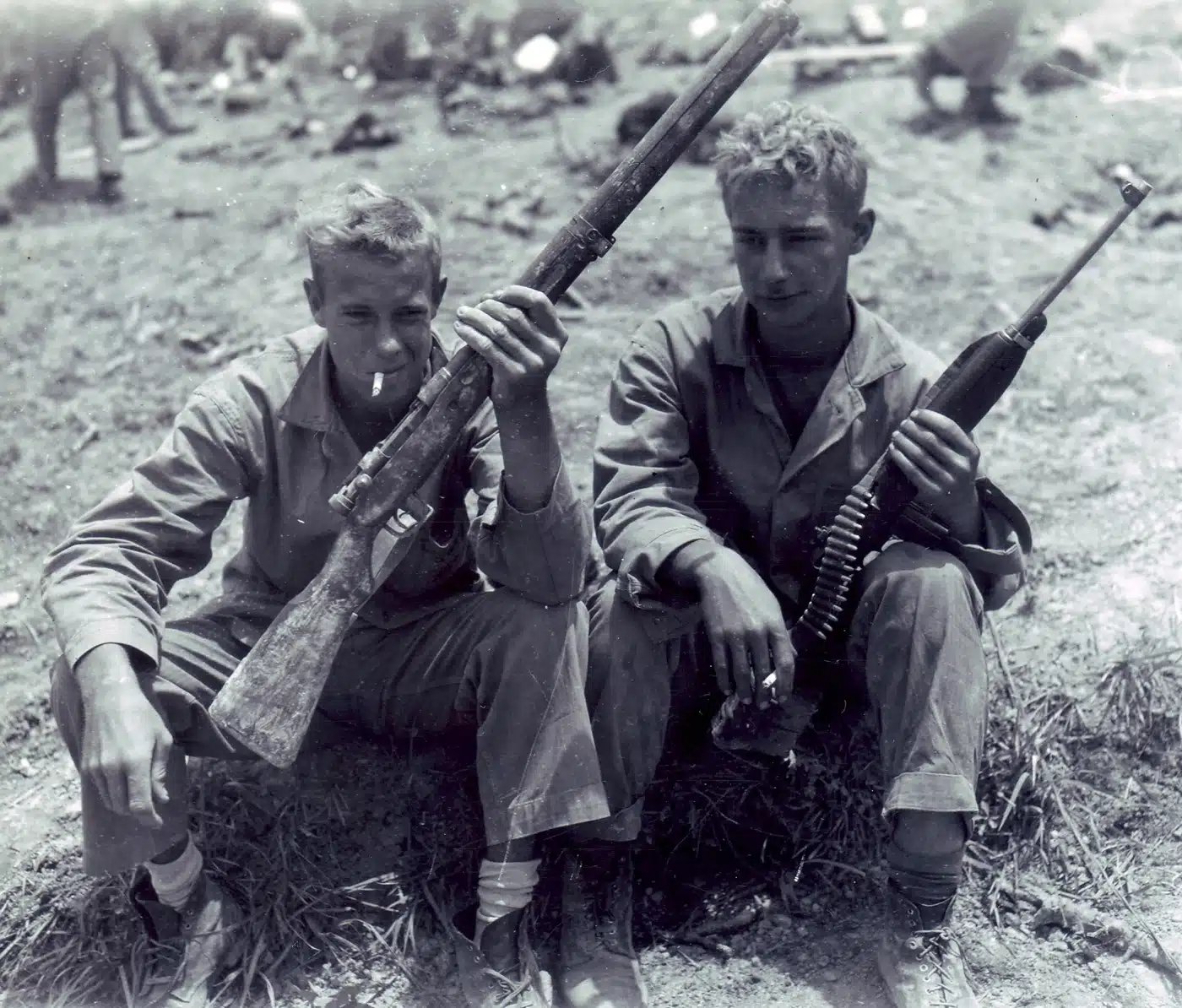
Larry went on to explain that although there were millions of spare magazines made for the Carbine during the war — enough that individual magazines should have been expendable. Even today, you can find examples of 15-round magazines that are still unopened in their factory wraps. Larry went on to say that he had not seen images that showed discarded carbines mags, and furthermore, he had no anecdotal evidence of empty Carbine magazines treated as disposable by Marines, or G.I.s, or anyone. I asked several WWII combat veterans that used the M1 Carbine, and all that any of them could remember was that when a carbine magazine was empty, they put it in their pocket to eventually reload and use it again.
It was the mathematics of production and distribution of M1 Carbine magazines that wasn’t adding up for Larry. The fact that U.S. combat troops went to the time and trouble to create a sling that doubled as an ammunition bandolier (particularly late in the war when production was at its peak) appeared to be a symptom of a U.S. Ordnance problem with distribution.
The concept of a bandolier-sling would never have come up if American combat troops had enough Carbine magazines that they could confidently discard the empties in a firefight. It seems like a minor point, but it was next-level thinking on Larry’s part, and it also showed that American troops could invent tactical-level solutions for strategic-level problems. Also — spoiler alert — we won the war, so it is unlikely that anyone bothered to investigate it after August of 1945.
In the years after, I have found more images of the carbine bandolier-sling, and while all of them are shown on rifles in the Pacific Theater of the war, not all of them were taken by Marines. Army units used the same modification. This modification may have been used in the ETO or MTO, but I have no photographs to prove it.
Conclusion
So there you have it, a round-up of some of the more interesting adaptations applied to the M1 Carbine by troops in the field. Necessity is truly the mother of invention, and Americans have always acquitted themselves well when it comes to creativity in times of need.
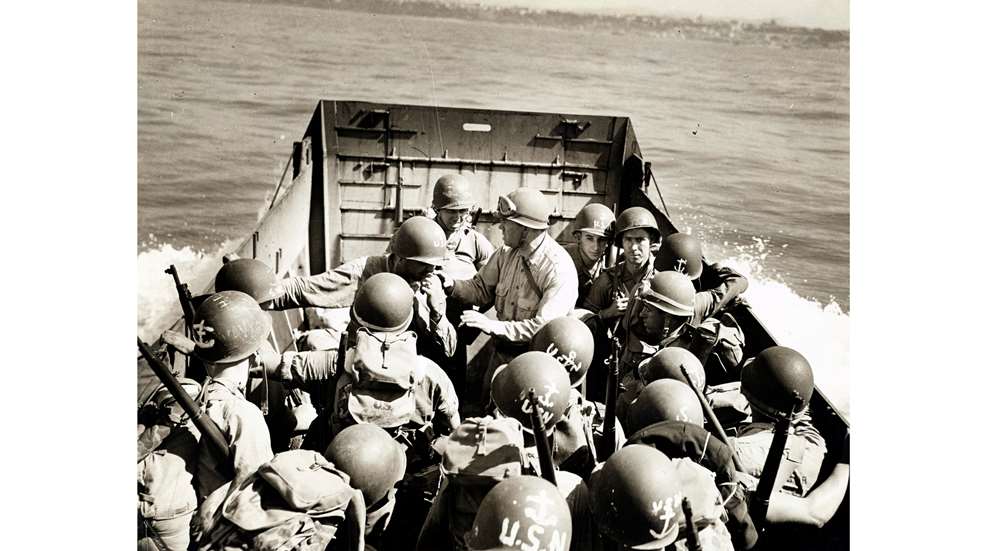
Landing on Sicily in a Higgins Boat, these Coastguardsmen are armed with M1903 Springfield rifles.
Image courtesy of National Archives.
During 1940, the war in North Africa began as a Mediterranean side show. By the time that Rommel’s forces threatened Egypt and the Suez Canal in July 1942, the desert war had become a crisis. The British victory at El Alamein, and the Anglo-American landings in Algeria a few months later, put an ever-tightening squeeze on the Afrika Korps.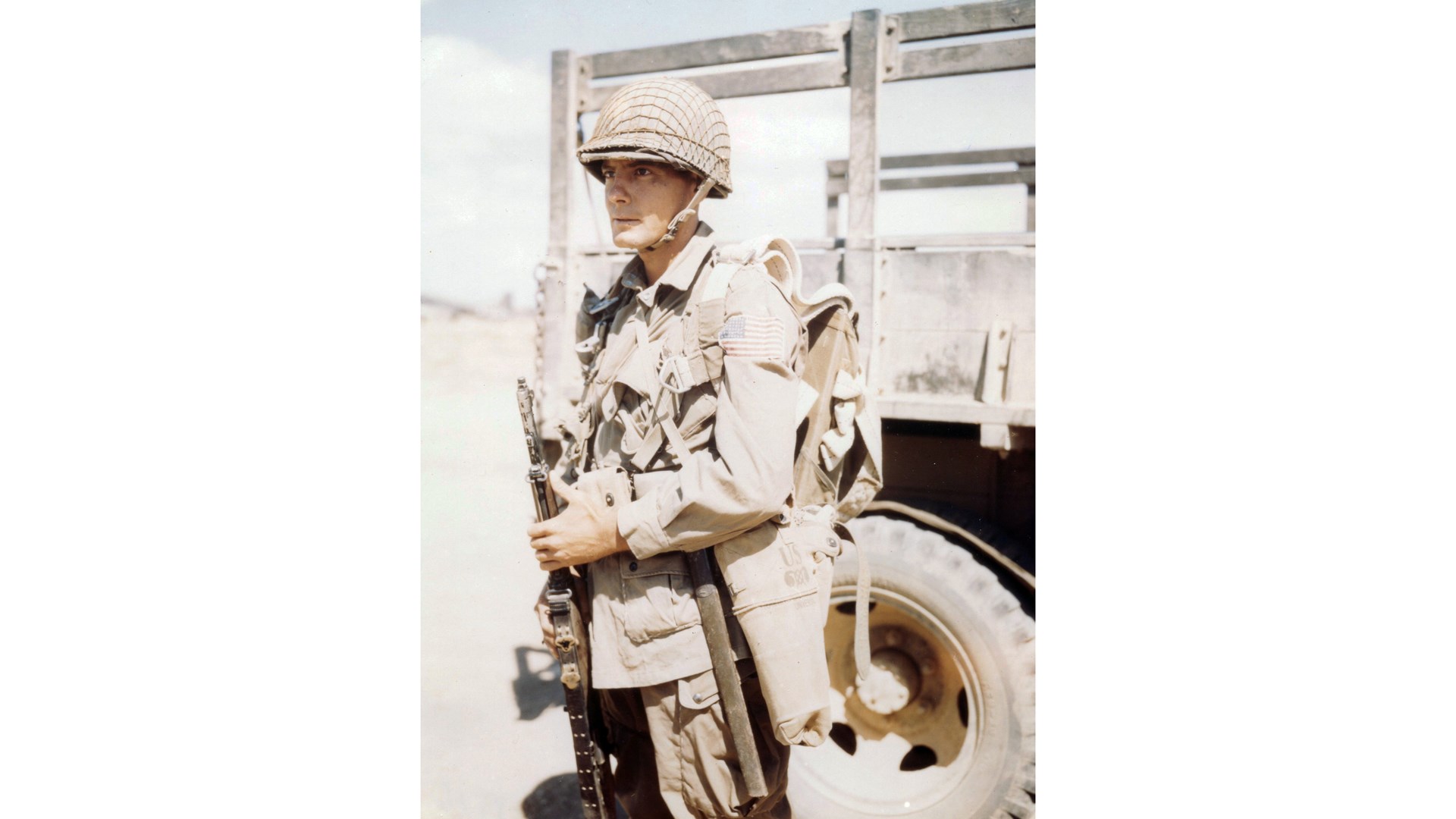
In the North African dust, this member of the 82nd Airborne Division, shown above with the M1 Garand rifle, is ready for the paratroop assault on Sicily. Image courtesy of National Archives.
When Axis forces in North Africa were forced to surrender during May 1943, the path to an Allied invasion of occupied Europe was clear—Italy was the target. The western Allies could fulfill their promise to Stalin and the Soviets that a true invasion of Axis Europe was in the making. Winston Churchill is noted to have initially described Italy as “the soft underbelly of Europe.” U.S. 5th Army commander General Mark Clark later described Italy as a “tough old gut.” Whatever the description, the stepping stone to Italy was Sicily. Strangely, the Germans didn’t quite believe it.
A Serving Of Mincemeat
Even though Sicily was clearly the most accessible landmass for the Allies to invade, British intelligence successfully convinced the Germans, including Hitler himself, that any attack on Sicily was merely a feint. “Operation Mincemeat” cleverly misled the Germans into believing that Greece and Sardinia were the focus of the upcoming Allied attacks—and reinforcements were sent anywhere in the Mediterranean area but Sicily. “Mincemeat” was also one of the reasons why Hitler cut short the massive Kursk offensive on the Russian front, in order to make troops available to counter an Allied invasion in the Balkans. Meanwhile, there was significant distrust growing between Germany and Italy, and Hitler was loath to rely on Italian troops, even in the defense of their own home territory.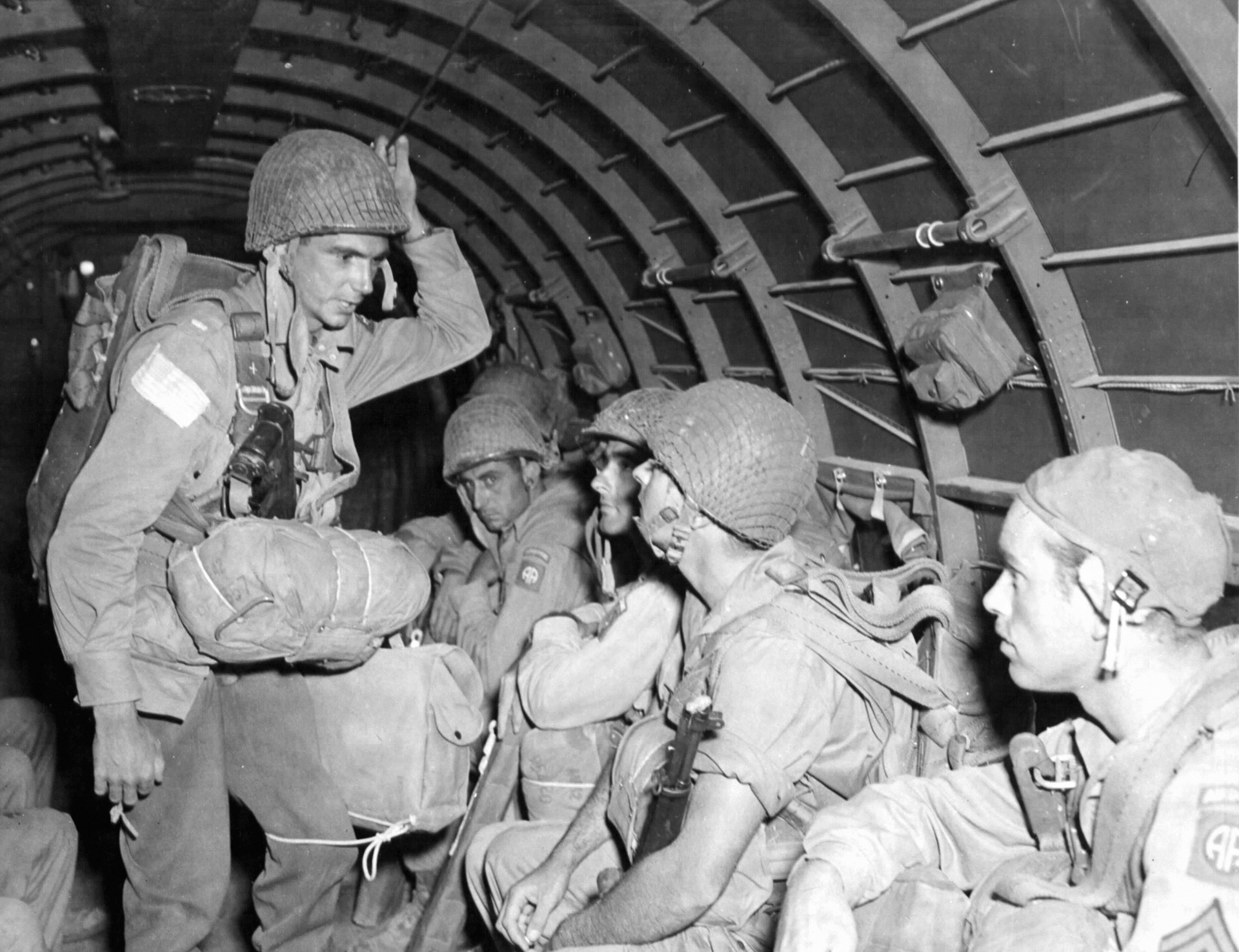
The first parachute assault of the 82nd Airborne Division came on July 9, 1943, over Sicily. The standing paratrooper carries an early M1A1 carbine with a folding stock. Image courtesy of National Archives.
Even with many factors in their favor, particularly momentum, Allied troops would be attempting a combination of sophisticated operations to assault enemy territory in Sicily by sea and air. Coordinated beach landings and paratroop assaults would test American and British combined skills like never before.
Maturing American Forces
Before the invasion, dubbed “Operation Husky,” Allied air forces pounded Axis airfields across Sicily, destroying more than 300 German and Italian planes, and leaving just two airstrips operational by the time of the landings. Ammunition dumps and logistic centers were repeatedly bombed, while the coastal defenses were left untouched to leave the enemy guessing about landing beaches. Even with the extensive preparatory bombardment, the Axis troops were still in position—and the Italians would be fighting for their home territory.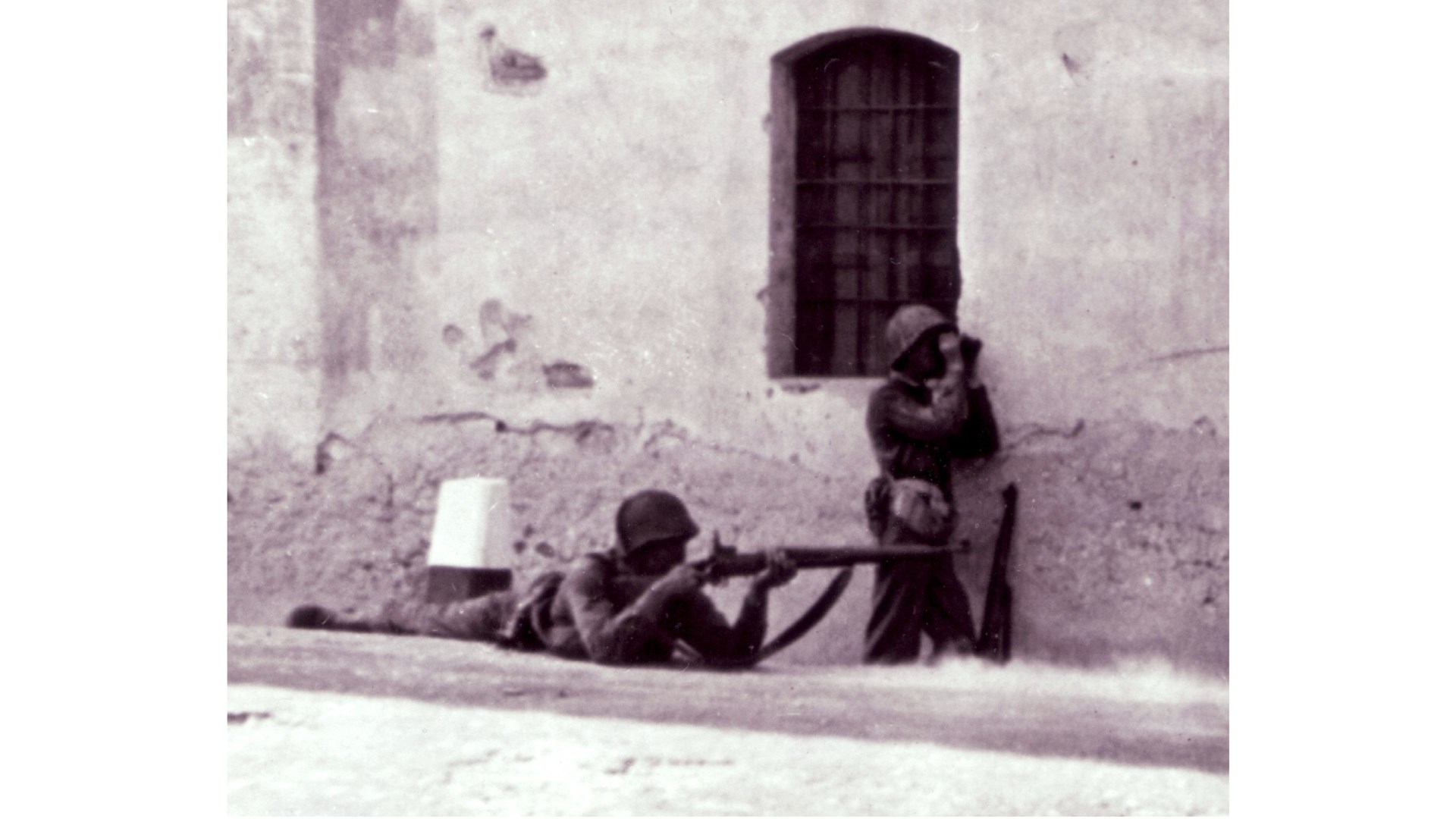
A rare appearance of the .30-cal. M1917 “Enfield” rifle in combat during World War II. This U.S. artilleryman (shown above) takes aim on the streets of a Sicilian town. Image courtesy of National Archives.
America’s paratroopers were ready for their first major battle, and airborne landings began after dark on July 9th. Powerful winds conspired to widely scatter the 82nd Airborne Division between Gela and Syracuse. Even so, the All-Americans rallied and attacked enemy strongpoints and cut communications. The paratroopers showed grit and initiative, and the airborne concept quickly showed promise. Specialized firearms for the airborne infantry, including the relatively new M1 carbine, offered a competitive advantage.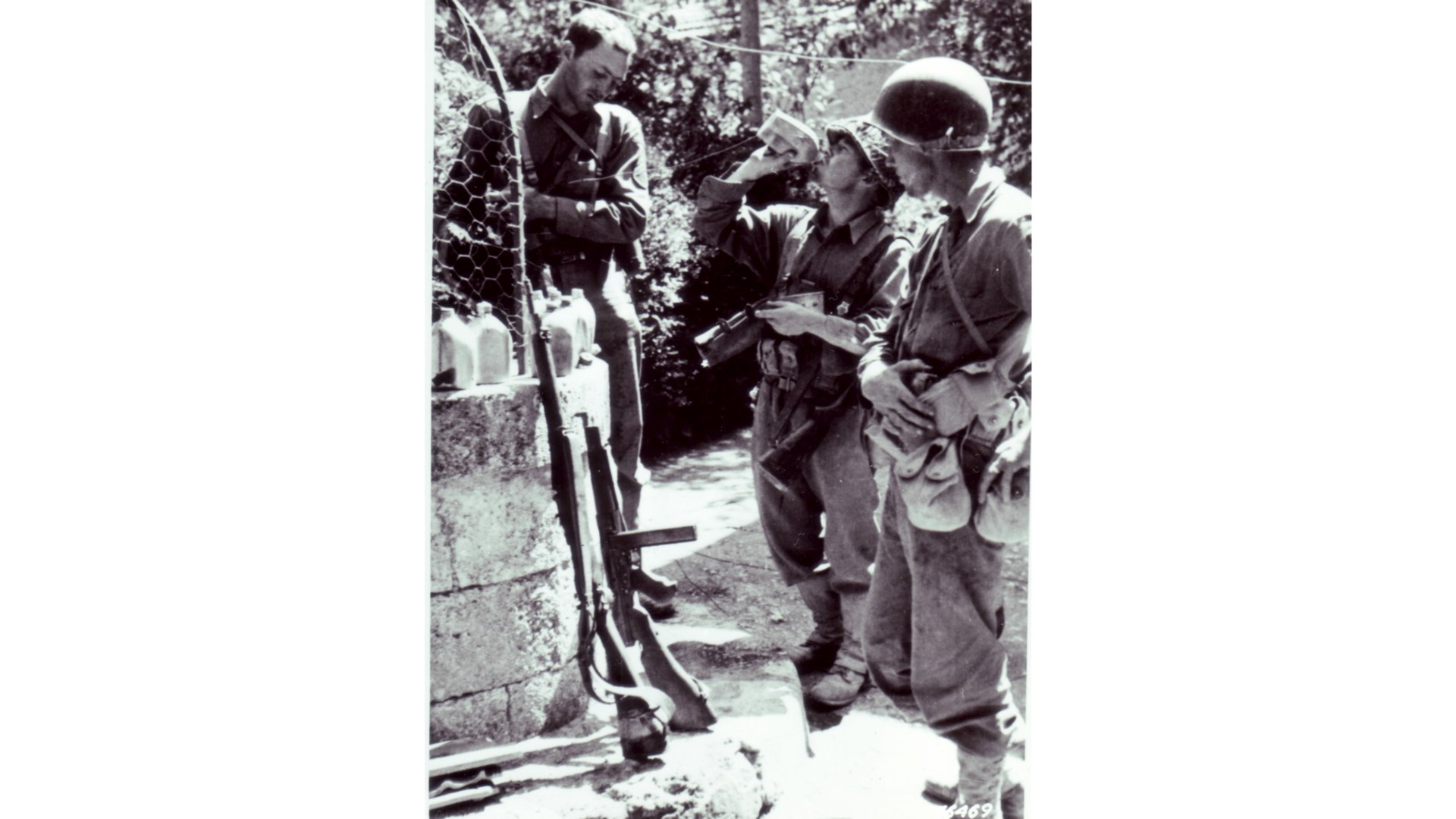
The old and the new: The G.I.s carry a wide range of small arms on Sicily, including an M1 Thompson SMG, an M1903 Springfield rifle, and an M1 Garand rifle. The semi-automatic M1 was still being integrated into combat units in the Mediterranean theater of operations until well into 1944. Image courtesy of National Archives.
The seaborne landings featured extensive use of the Landing Craft, Vehicle, Personnel (LCVP or Higgins Boat) and the new DUKW amphibious truck. Both provided stellar performance delivering men and supplies from ship to shore throughout the campaign, and Operation H
usky was a powerful learning experience and building block for later amphibious operations in the MTO and ETO.
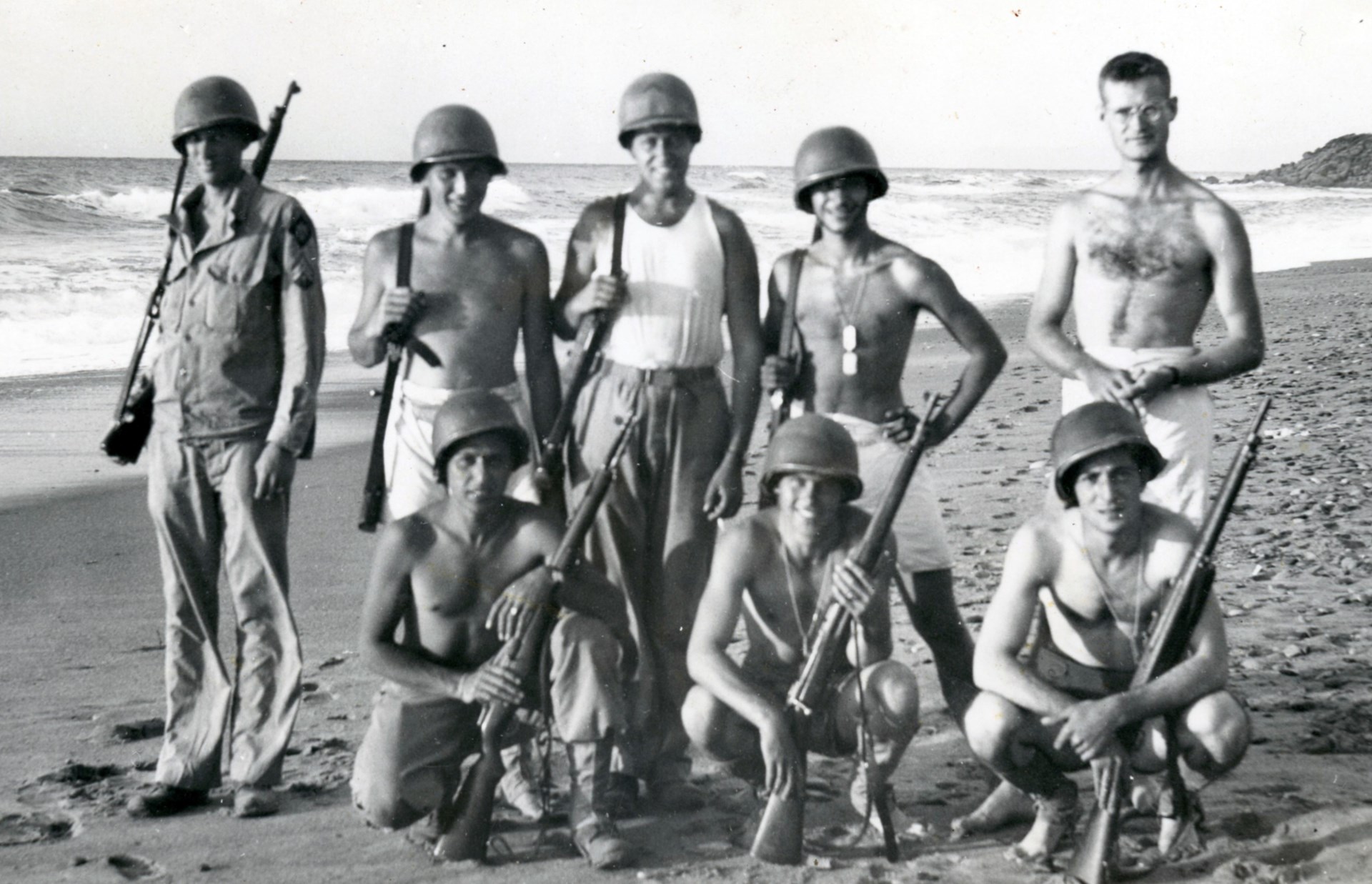
Enjoying the sun and surf on a Sicilian beach, these GIs carry a mix of M1 Garand and M1903 Springfield rifles. Image courtesy of author.
But even the best plans don’t survive contact with the enemy, and Operation Husky was no different. Despite hopes to the contrary, several Italian coastal defense units fought well. Italian tanks and infantry attacked the Gela beachhead on July 10th, and again on the 12th. U.S. naval gunfire helped save the day on those occasions, breaking up the Italian assaults with 5″ and 6″ artillery fire support.
At the port of Licata, the U.S. 3rd Infantry Division took the town and then held it against a strong Italian counterattack. Casualties were high, with nearly 100 men killed, but the fresh American troops improvised, adapted and carried on to victory.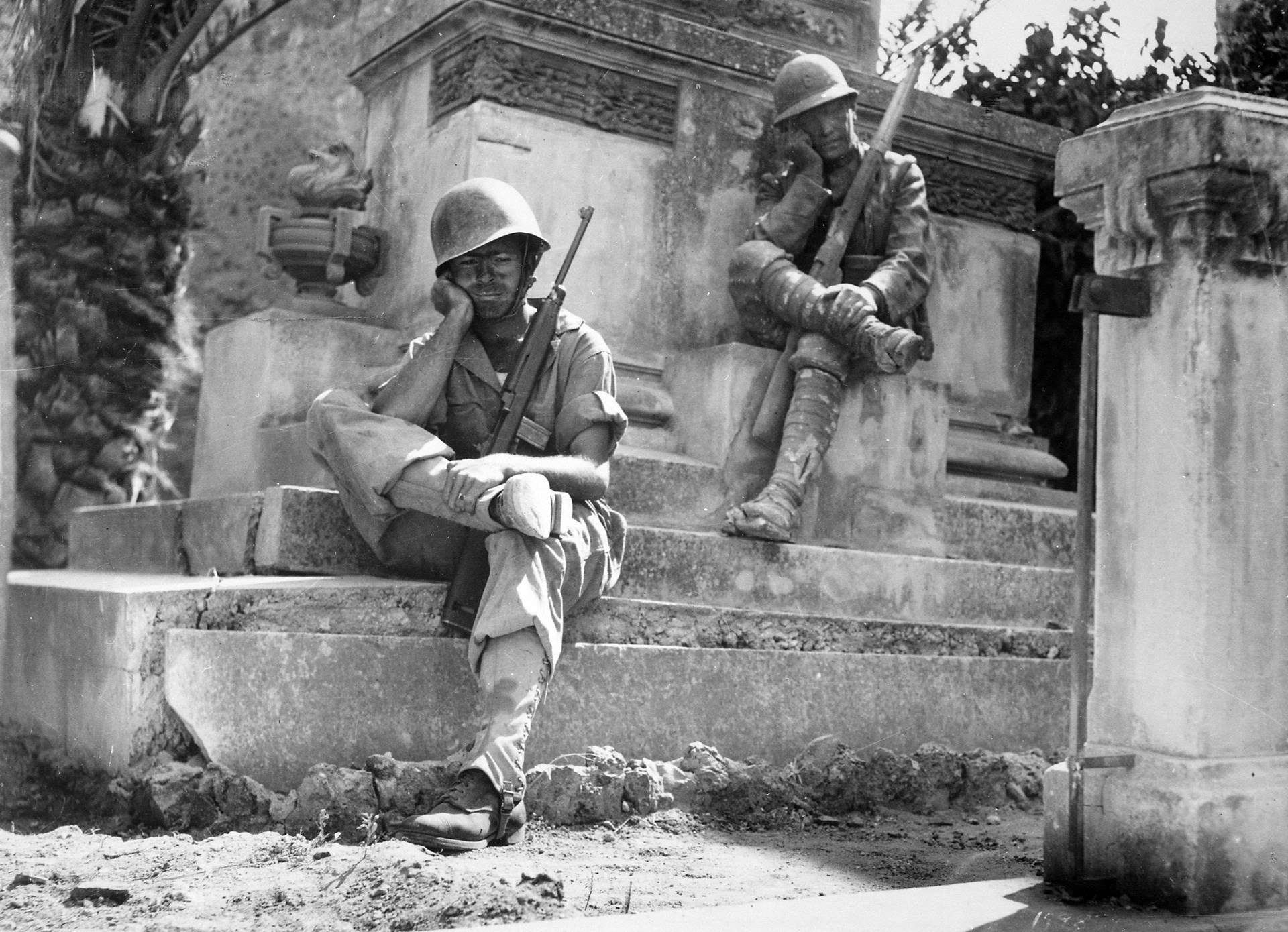
New Guns Earn Their Stripes While Some Legends Fade
As U.S. troops took on larger combat roles, American-made arms began to make their presence felt. By the summer of 1943, more American infantrymen in the MTO were carrying the M1 Garand rifle. Photos of the action on Sicily show more of the semi-automatic M1 rifles than they do the older (but still deadly) bolt-action M1903 Springfield rifle. American infantry firepower was steadily growing, as more Browning Automatic Rifles were reaching the troops, along with lighter, air-cooled .30-cal. Browning M1919A4 machine guns.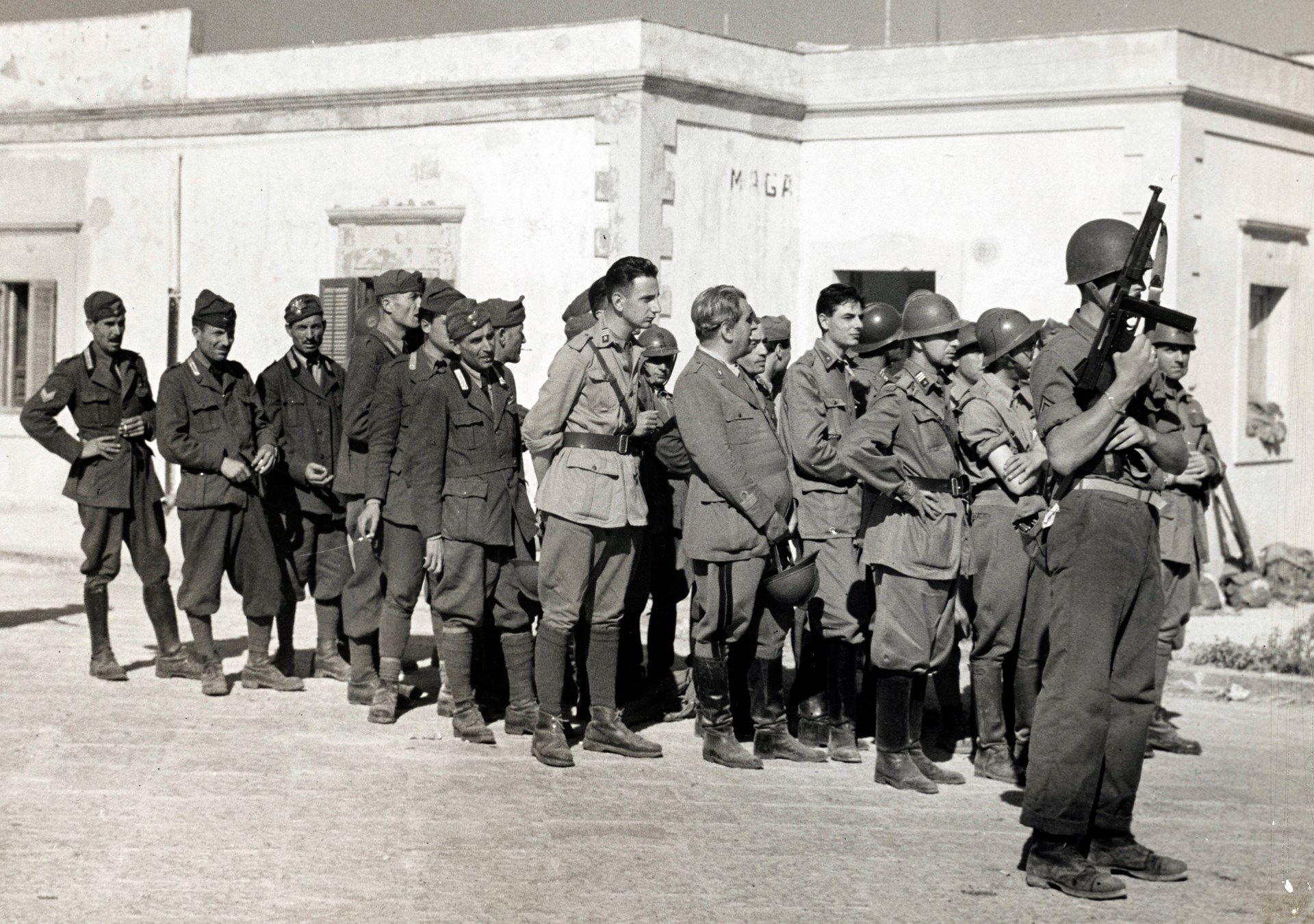
Glad to be out of the war, this mixed bag of Italian POWs is guarded by a U.S. Coastguardsman armed with an M1A1 Thompson SMG. Image courtesy of National Archives.
The invasion of Sicily also saw the first significant use of the M1 carbine (.30 Carbine), mostly in the hands of the 82nd Airborne Division paratroops. Among the Carbines were M1A1 folding stock variants, a firearm specifically designed for paratroops. Also, a small number of the improved Bazooka, the M1A1 (and its more reliable M6A1 rocket) were issued in the Sicilian campaign—giving the G.I.s a measure of infantry anti-tank defense. The M1A1 bazooka was credited with destroying four Panzer IV medium tanks and was even reported to have knocked out one of the vaunted German Tiger I tanks on the streets of Biscari.
Even so, the Bazooka had not yet won over all the troops—an after-action report from Sicily reads: “Most of the officers prefer the rifle grenade to the Bazooka as a close-range antitank weapon.”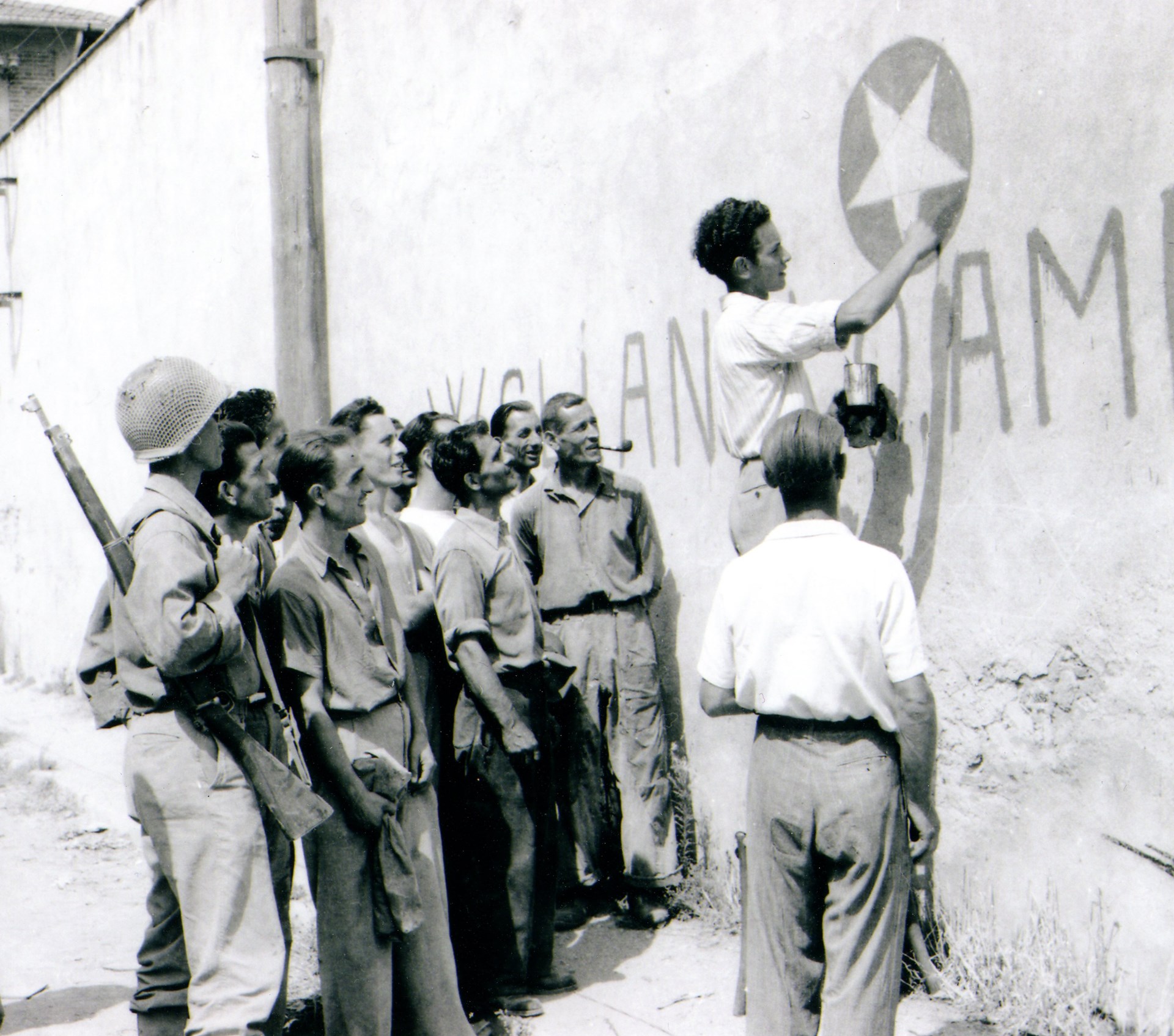
Sicilian civilians welcoming U.S. troops during late July 1943. The dusty G.I. carries a classic M1903 Springfield rifle. Image courtesy of National Archives.
American troops were growing more experienced with every action, and the telling effect of U.S. infantry firepower was described in Army’s “Report of Operations” on the Sicilian Campaign:
“The German will invariably counterattack immediately after dawn and is very adept in supporting this with artillery and mortar fire. The infantry starts to attack between 800-1000 yards and comes forward at a continuous fast walk using marching fire or firing from the halt, or from the kneel.
In no case where our infantry utilized the full power of their rifle did the German counterattack get home. In fact, our troops looked forward to the German counterattack as the surest and most effective way of killing Germans.
If the observers from the batteries are in contact, it frequently is possible to stop the counterattack by a combination of percussion and air bursts. Only one case is known where the German, stopped by artillery fire, resumed his attack. Normally, he moves forward until human nature can stand no more and then quits. While going forward he shoots a great deal and makes all the noise he can. However, his small arms fire is of little value.”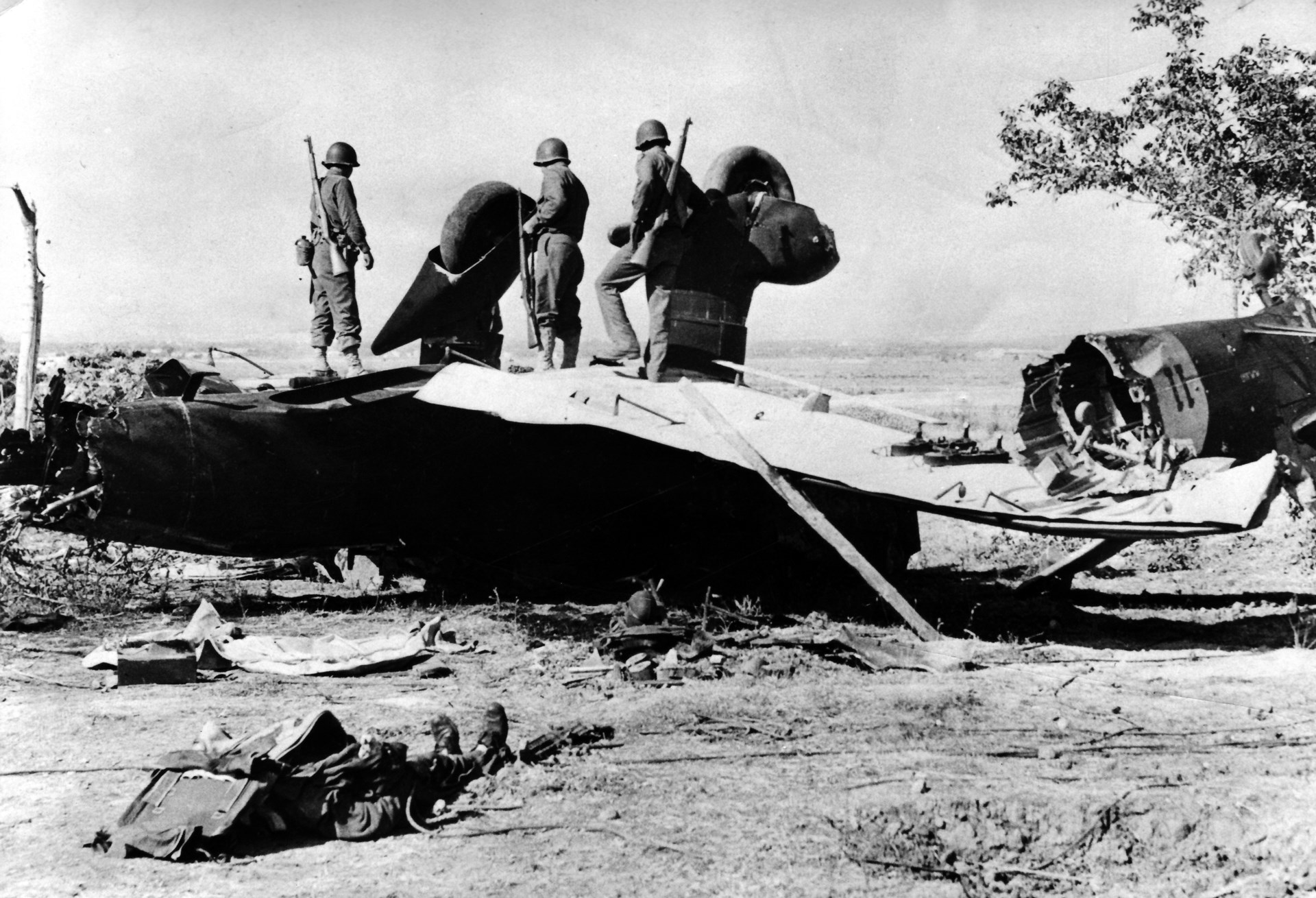
No longer a threat: U.S. troops examine the wreck of Junkers Ju 87 “Stuka” dive bomber, destroyed on Sicily. This aircraft was in Italian service, where the Stuka was called “Picchiatello.” Image courtesy of National Archives.
As the Allies advanced across Sicily, the spirit of the war was changing. For example, one of the German icons of the Blitzkrieg era was no longer relevant on the battlefield, as a US intelligence report noted:
“The German Ju 87 or “Stuka” dive bomber has served its usefulness, lost its terror, and will probably not be seen in future operations.” G.I.s noticed that the sunny skies above contained fewer Axis planes, and when they appeared, American fighters and AA guns usually drove them off.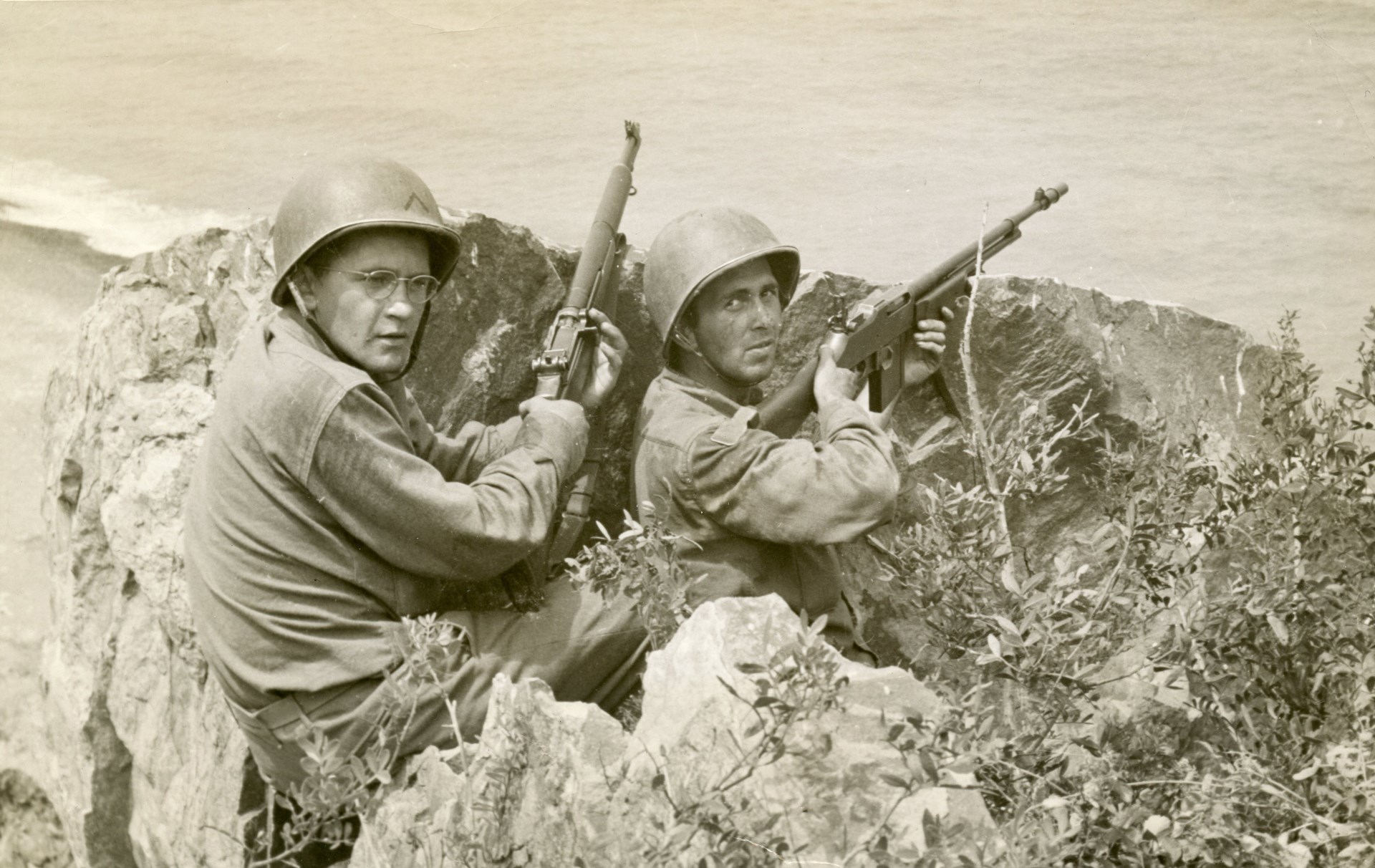
U.S. infantrymen on the north coast of Sicily during August 1943, guarding against a potential counterattack. Image courtesy of author.
American morale grew stronger, and General Patton famously raced with British Field Marshal Montgomery to be the first to reach Messina. Along the way, U.S. G-2 provided this assessment of Axis morale on Sicily:
“Morale of the German prisoners interrogated indicates it is low and of a defeatist nature. Morale of the Italian prisoners is apparently higher, while the native population has invariable welcomed the advance of American troops.”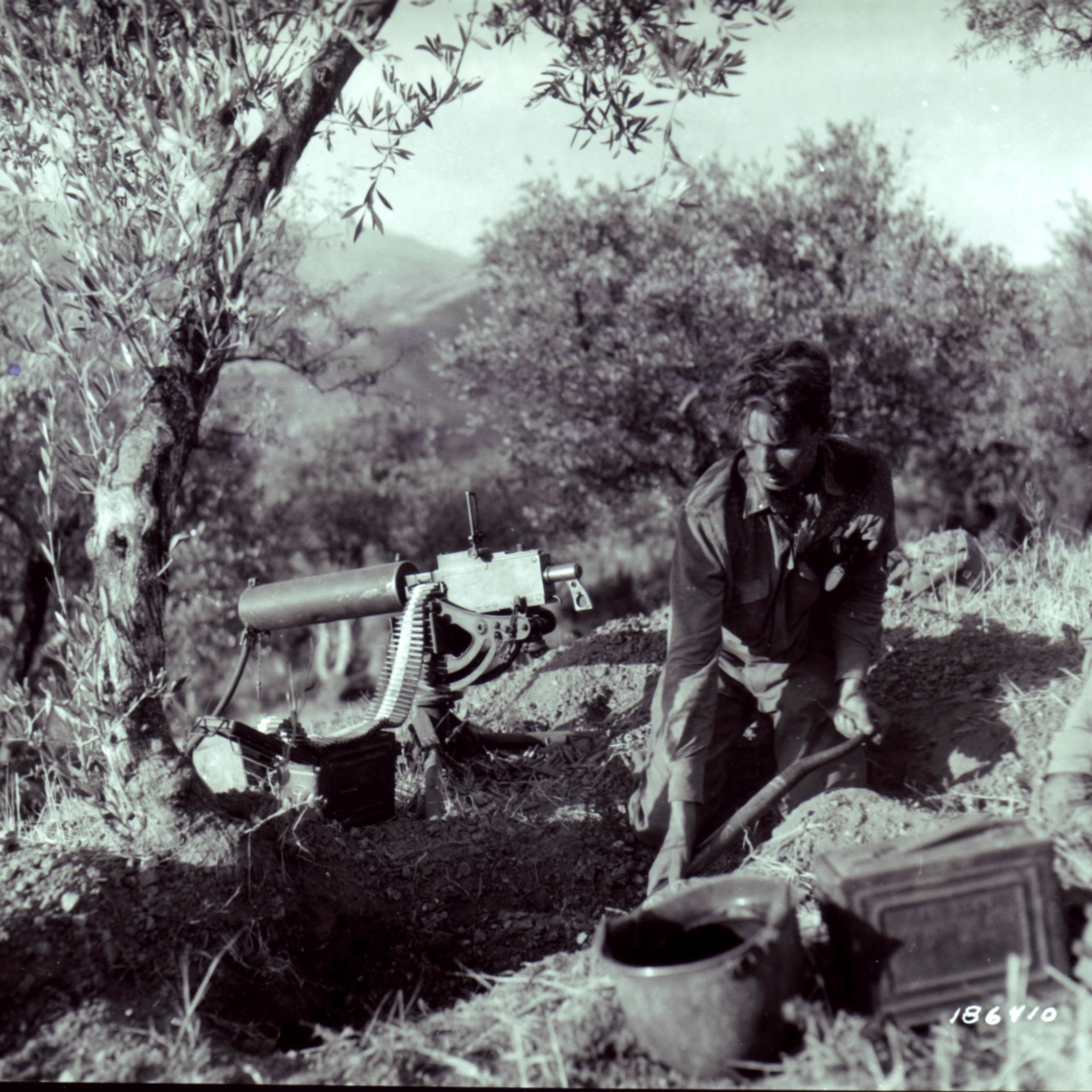
Preparing for a German counterattack during Patton’s drive to Messina, this machine gunner of the 30th Infantry Regiment scrapes out a hasty firing position for his Browning .30-cal. M1917 water-cooled MG. Image courtesy of National Archives.
Growing Distrust
As the Allies advanced in Sicily, the Italian government began to lose confidence in Mussolini. On July 24, 1943, the Duce was summoned before the Fascist National Council, where he suffered through a vote of no-confidence. The next day, Mussolini met with King Victor Emmanuel and was dismissed from his position as prime minister. As he left the meeting, Il Duce was arrested, and taken to the first in a series of secret locations. When news of his downfall was broadcast to the Italian people, many celebrated, anticipating the end of the war for Italy. Meanwhile, the Italian army remained intact in the field, loyal to their king.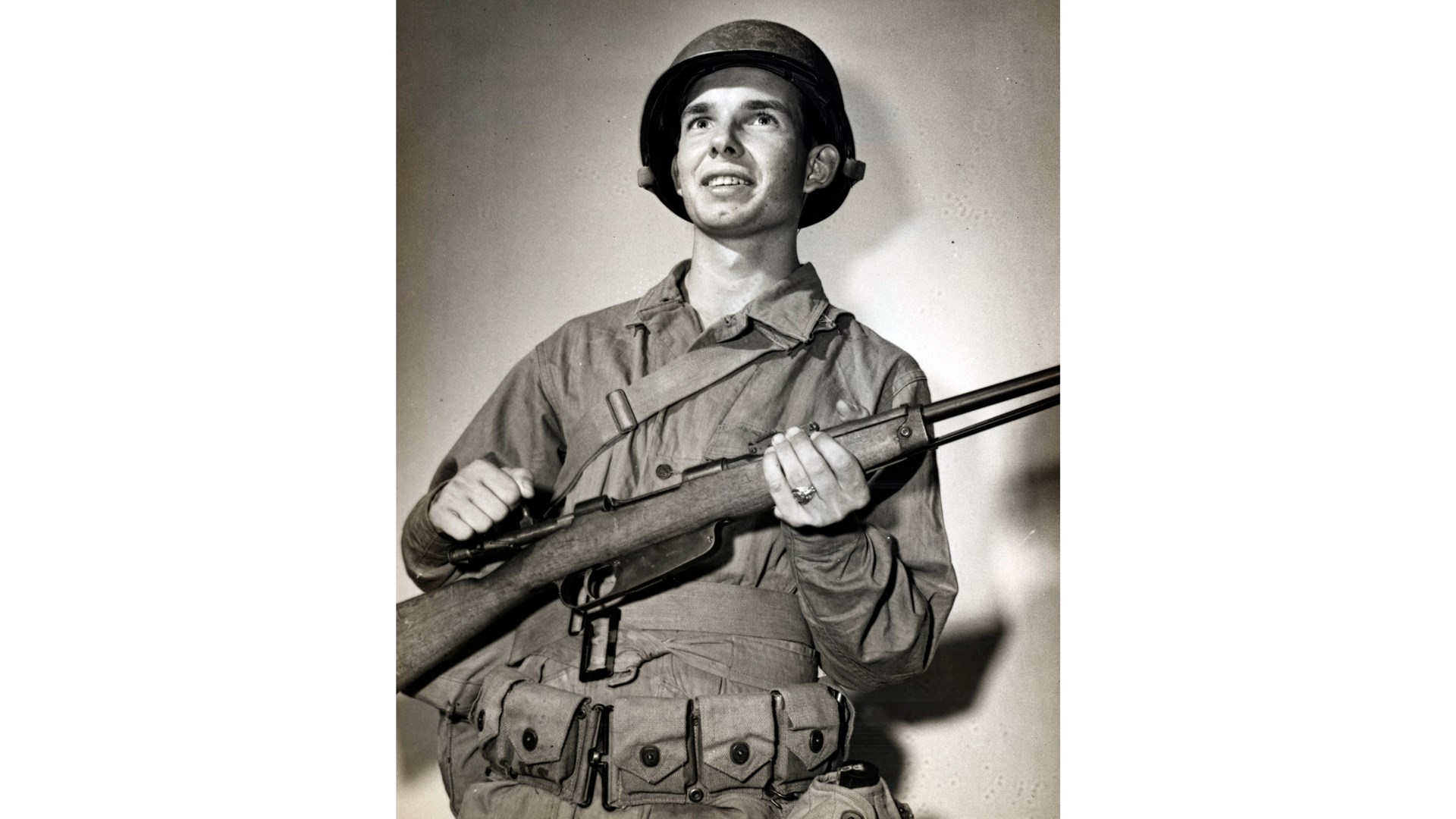
A U.S. Coastguardsman proudly displays his war trophy, an Italian Carcano M91 carbine (6.5×52 mm). Image courtesy of National Archives.
From Hitler on down to the lowest ranks of the German military, there was little faith or trust in their Italian allies. On the Italian side, the Germans seemed increasingly like prison guards than they were partners. More and more Italians began to consider Allied troops, particularly Americans, as more friend than foe.
Excerpts from orders captured from the Herman Goering Division in early August 1943, provide some insight into the growing Axis rift, and the declining tactical situation:
Instructions for further fighting in Sicily:
-No roadblocks or demolitions will be manned by Italians.
-No Italians will be allowed to disturb troop movements, either civilians or soldiers. Every Italian and all Italian equipment is to be cleared from the streets (except those Italians who have been fighting and who will still fight).
-Destroy all materials which cannot be carried. Burning material is forbidden on account of hostile aircraft. The best procedure is to blow up the material.
The final command on the list is the most telling, as well as the most sinister:
The strictest discipline must govern. Shoot all who fail to obey.
America’s Fighting Men Coming Of Age
Taking advantage of an extremely heavy concentration of anti-aircraft guns on the narrow strait of Messina, Axis forces began a general evacuation from Sicily, beginning on August 11th. By August 18th, the Italians had removed more than 60,000 men to the mainland, while the Germans evacuated more than 50,000, along with 47 tanks. But while the Germans could briefly celebrate saving valuable men and equipment, they still suffered more than 4,000 dead, and about 10,000 captured. Worse still, they were soon to lose Italy as an ally.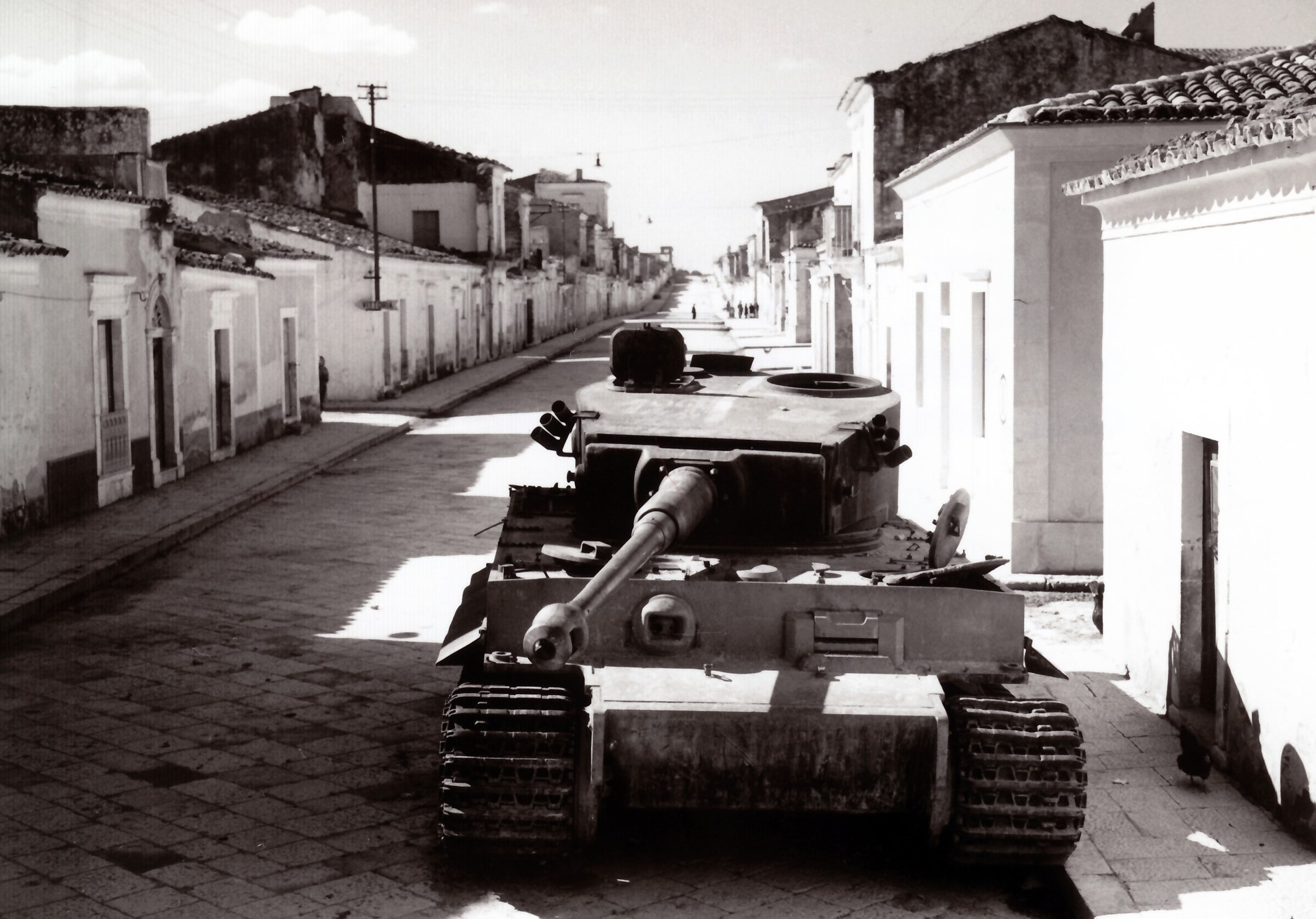
The massive German Pzkw VI Tiger I, knocked out on the streets of Biscari, Sicily. Sixteen of these 60-ton tanks were lost during the campaign on Sicily. Image courtesy of National Archives.
With Mussolini imprisoned, and more than 116,000 of their soldiers captured on Sicily, Italy was on the brink of collapse. Sicily fell on August 17th, and the Italian surrender soon followed. Fascist Italy came to an end on Sept. 3, 1943, with the signing of the Armistice of Cassibile. In early 1944, the Italian co-belligerent army was formed, fighting alongside the Allies until the end of the war.
U.S. forces suffered nearly 10,000 casualties during the campaign in Sicily. It was a steep price to pay for the hard-knocks education of a new global fighting force. But Sicily was taken, and Italy was knocked out. The door to the initial invasion of Europe was open. The U.S. 7th Army report on the battle of Messina concluded:
“The fall of Messina was the fall of Sicily itself. Thirty-eight days after the landings, the campaign had ended. The first United States field army to fight as a unit in this war had accomplished its mission with complete success. Long hard months of training and of battle experience, the vast productive power of America, and the courage and vision of its leaders had combined to demonstrate to the world that the unprepared nation of two years before had arrived on the scene of battle as a full-fledged fighting power.”
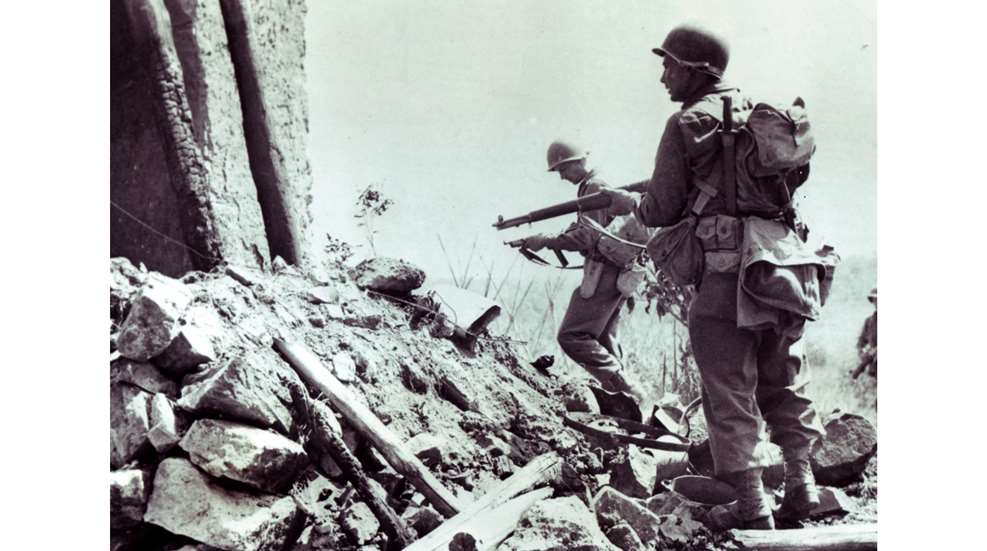
Marching fire: M1 rifle at Velletri, Italy, May 1944.
Images courtesy of National Archives and Records Administration.
As important as it was, the Allied campaign in Italy during World War II is often overlooked by contemporary historians. From the invasion of Italy at Salerno in early September 1943, and continuing through June 1944, the advances in the rugged Italian mountains were the “second front” that the western Allies had promised to execute in order to take pressure off the Soviets.
Winston Churchill had initially described Italy as “the soft underbelly” of Europe. After months of an uphill slog against well-entrenched Germans, U.S. Lt. Gen. Mark Clark described Italy as a “tough old gut,” where the defenders held most of the advantages. After the Allied landings in Normandy, the Italian campaign was rarely featured in newspaper headlines. Even so, the lessons learned by U.S. troops fighting in Italy were put to good use in the later fighting in France.
While American infantry small arms were the finest created during World War II, the road to victory over Germany was built on the ingenuity and tactical innovations of the GIs. An in-depth report on the fighting in the Italian campaign was prepared shortly after the war by “Headquarters 15, G-3 Section,” of Army Group Italy. The following excerpts from that report provide an account of American infantry firepower in Italy from 1943-1945, in the words of the troops themselves.
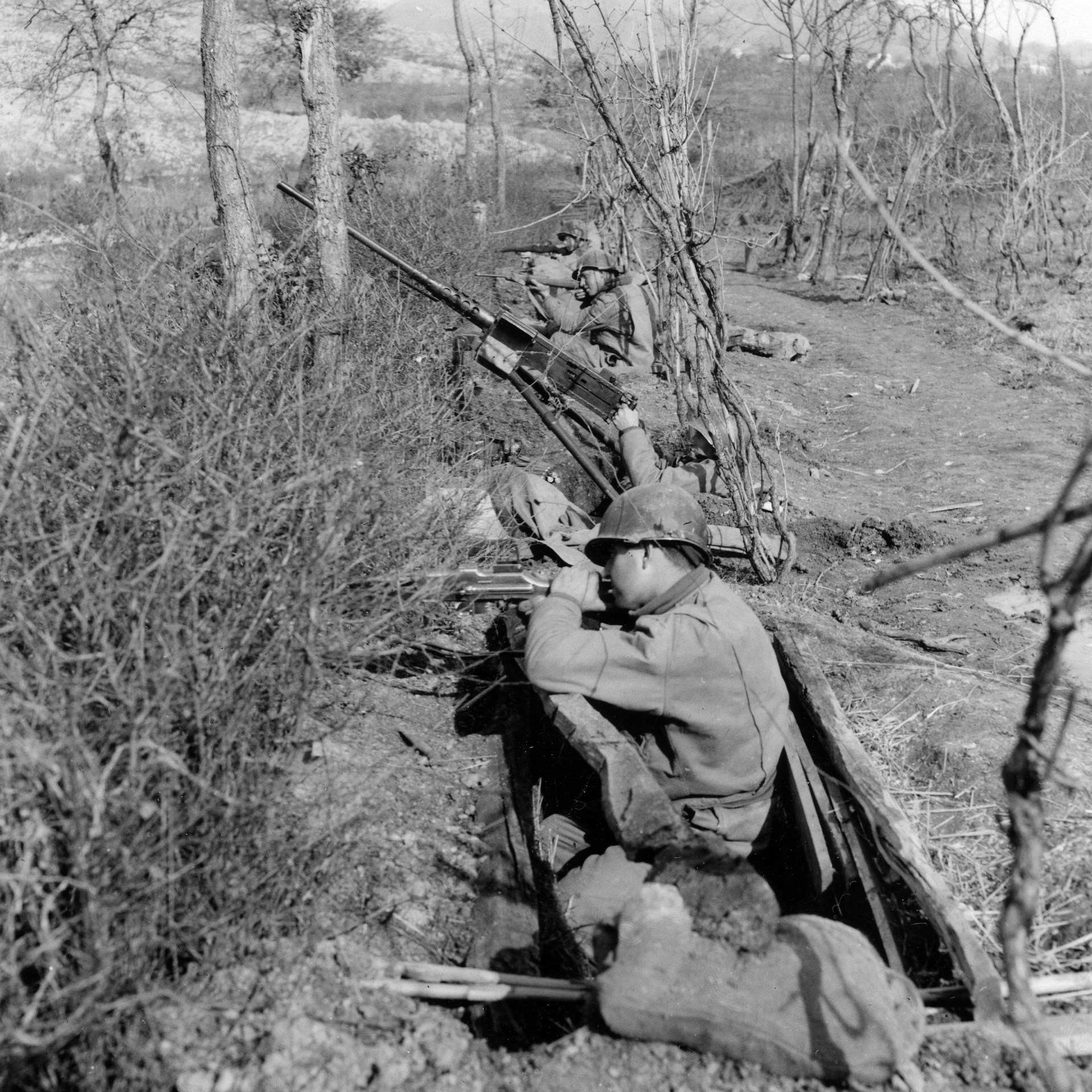 Use Of .50 Cal Machine Guns
Most of the firing was indirect and at night. Targets selected were usually supply trails, avenues of approach, probable assembly areas, and the immediate vicinity of buildings used by the enemy or believed to be occupied. These targets were usually located from ground OP’s, maps, aerial photos, and from POW information. Supply and communication routes were sprayed continuously during the night by short bursts from different guns. POW reports indicated that Germans were considerably harassed by this type of fire since they could not tell when, or from where it was coming. In some instances the 50 caliber guns were used very effectively to fire directly into the openings of caves in cliffs.
Indirect fire with the Browning M2 .50-cal. machine gun: At the River Rapido, February 1944.
The use of the .50 Cal. guns in harassing the enemy proved very effective in that it restricted his movements on trails and roads and prevented him from supplying his troops with ease or security. In some instances MGs were placed in the second story of a building away from the door or window and sandbags used to give them a firm base. A blanket or burlap was used to screen the opening so that the smoke and flash would not disclose the gun position. Range cards were accurately prepared for each MG position, and each key man had a copy.
Browning .30 Caliber Machine Gun Fire
Light MGs delivered most of the short and some medium range fire, and were mostly used on the frontline. They were used to cover avenues of approach during defensive periods, or during periods of reorganization in the offensive. They were also used in establishing a base of fire for maneuvering riflemen.
Most of the medium range firing was done in connection with offensive movements. The normal use of medium range fire was to cover the flanks and to place fire on probable enemy positions, while the riflemen maneuvered to assault these positions.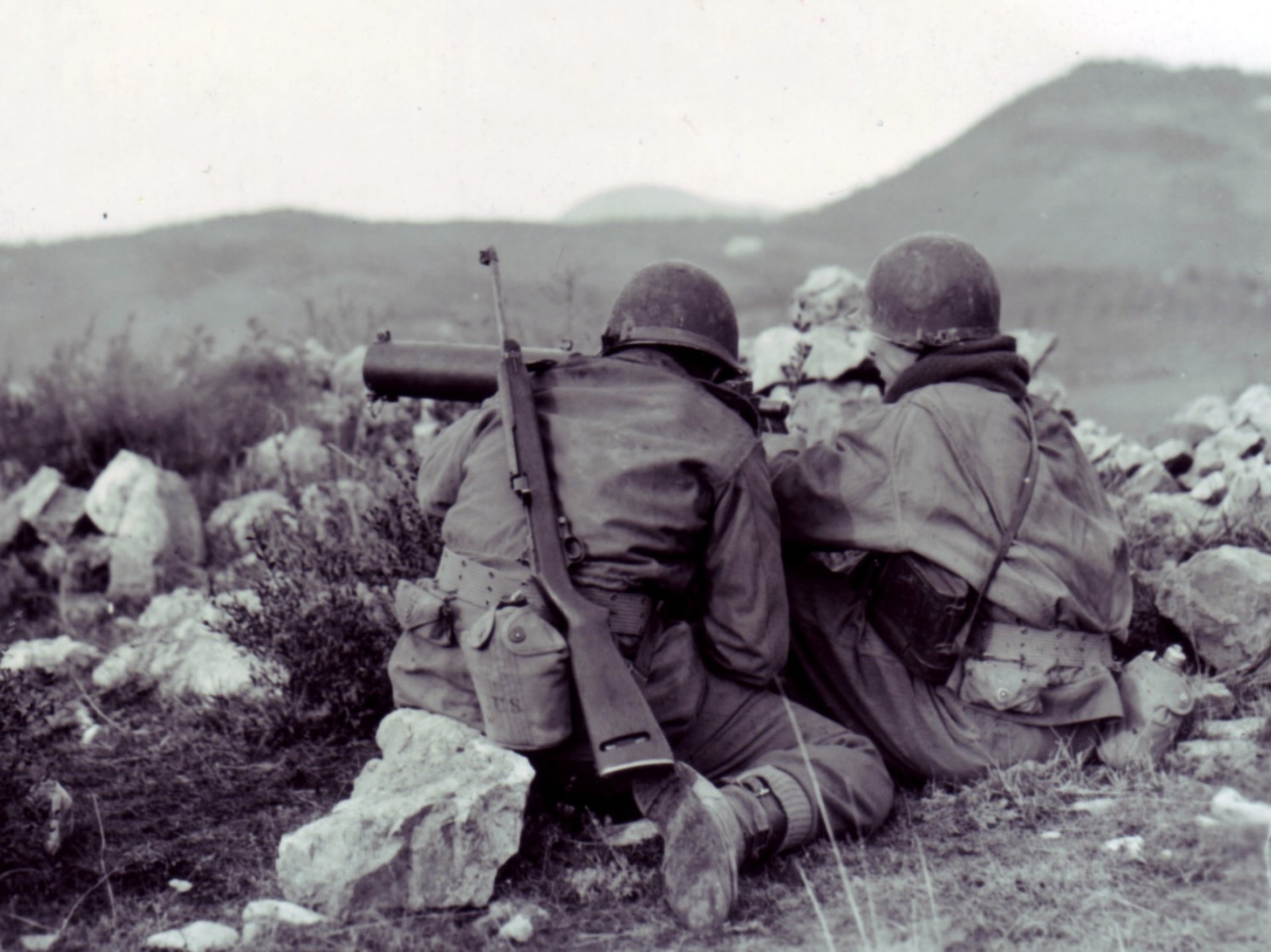
The Browning M1917A1 .30-cal. machine gun in action near Filetole. Note the assistant gunner is armed with an M1 carbine.
Long range MG fires were generally used in the defense for harassing missions, the targets being road junctions, trails, supply routes and probable assembly areas. These fires were usually delivered at night. In a few instances during the offensive, on terrain covered with thick under brush, HMGs were used to deliver long range harassing fires. This was done since, due to the undergrowth, no targets for these weapons presented themselves, close to the front line. This fire was placed on probable routes of withdrawal’ and on routes of supply.
Very little indirect firing except harassing was done with the .30 caliber HMG. Due to the rugged terrain our guns almost invariably could be placed in positions from which direct fire could be delivered, or which afforded partial defilade.
The Heavy MG Cal .30 Compared To The LMG Cal .30 (*The Browning M1917 compared to the Browning M1919A6)
In fast-moving situations the LMG is considered the better weapon because of its maneuverability and lighter weight. More ammunition can be carried by its crew, and it has been found that fire is never sustained long enough to injure the barrel.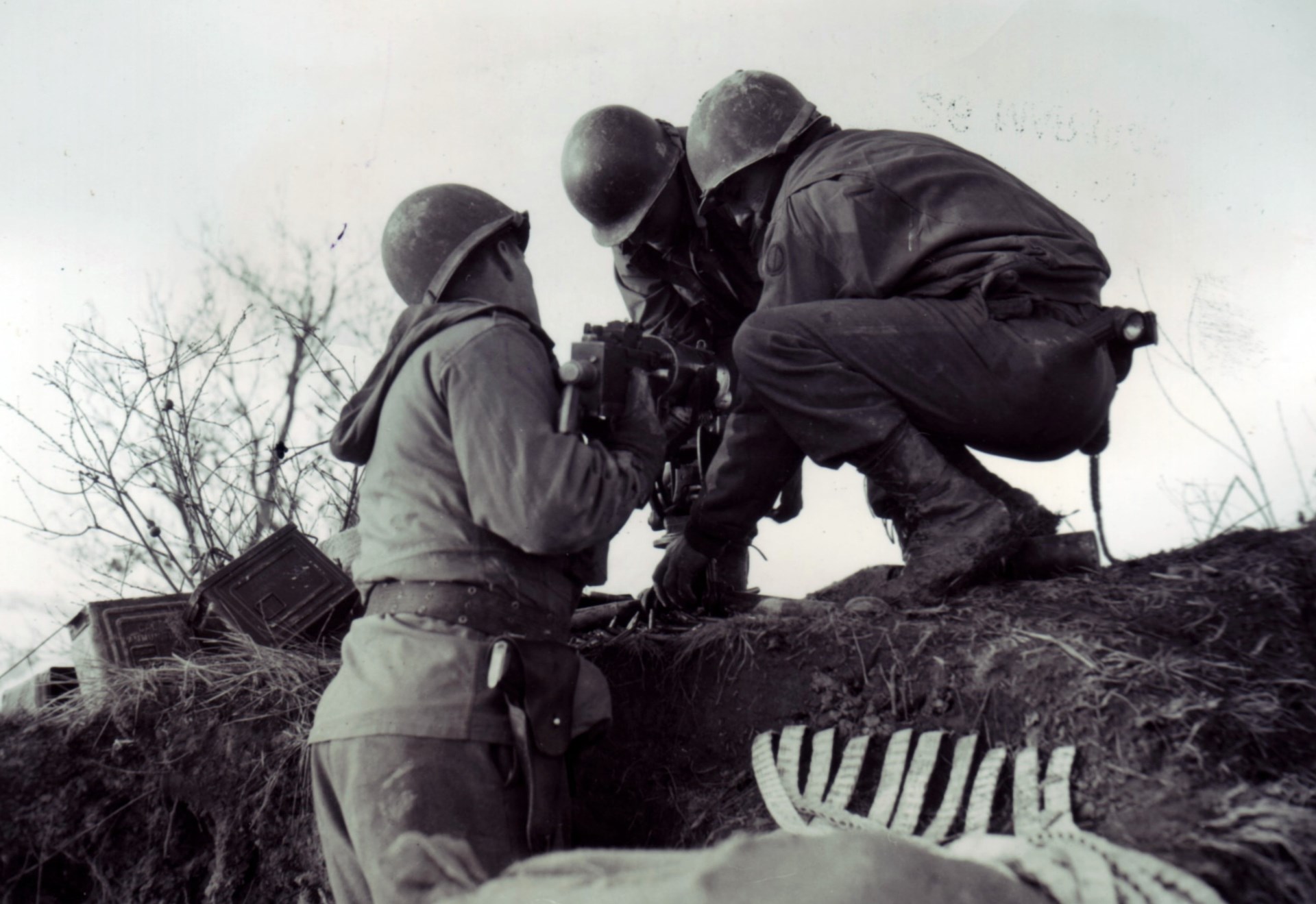
Moving a complete M1917 machine gun, the “heavy Browning,” took several men to carry the 100+ lb. combination of the gun (with water), tripod and basic load of ammunition.
The HMG has proven its value in defensive situations and for overhead fire. Rifle company commanders preferred the addition of one LMG, and the dropping of one 60mm mortar in the weapons platoon, since normally only two 60mm mortars were used. They also favored an increase in personnel of the LMG squad to provide additional ammunition supply and to provide replacements for the LMG squad casualties which were heavy.
The following modifications to the LMG were found desirable:
- A modification on the front barrel bushing. This device did not lock securely enough and was too easily lost. By the addition of two small link chains on either side of the bushing, which will fasten by insert pin on to the bipod or jacket, the bushing will always be secure. Loss of this bushing is a serious matter as the gun will not fire automatically without it.
- Adoption of metal or plastic link-type ammunition belt. The cloth belt was highly unsatisfactory when exposed to wet weather. The resultant swelling of the cloth did not permit smooth feeding and automatic fire.
- Adoption of the German principle for change-over of the barrel; the German method is smoother, faster and easier.
The BAR
The BAR has proved an excellent weapon and needs no modification. There were no complaints as to its mechanical functioning and very few stoppages were reported. Most officers suggested adding 6 more BARs to the Company without adding to the number of magazines per BAR team.
Many suggested leaving off the bipod to save weight, figuring that in a defensive situation, when the bipod is of greatest value, machine guns (lights or heavies) could be brought up to provide defensive fire. The LMG with bipod and shoulder rest was considered excellent but should not replace the BAR, whose firepower is ample if handled by a man who really knows how to use it. The BAR was unanimously acknowledged to be the backbone of the infantry squad.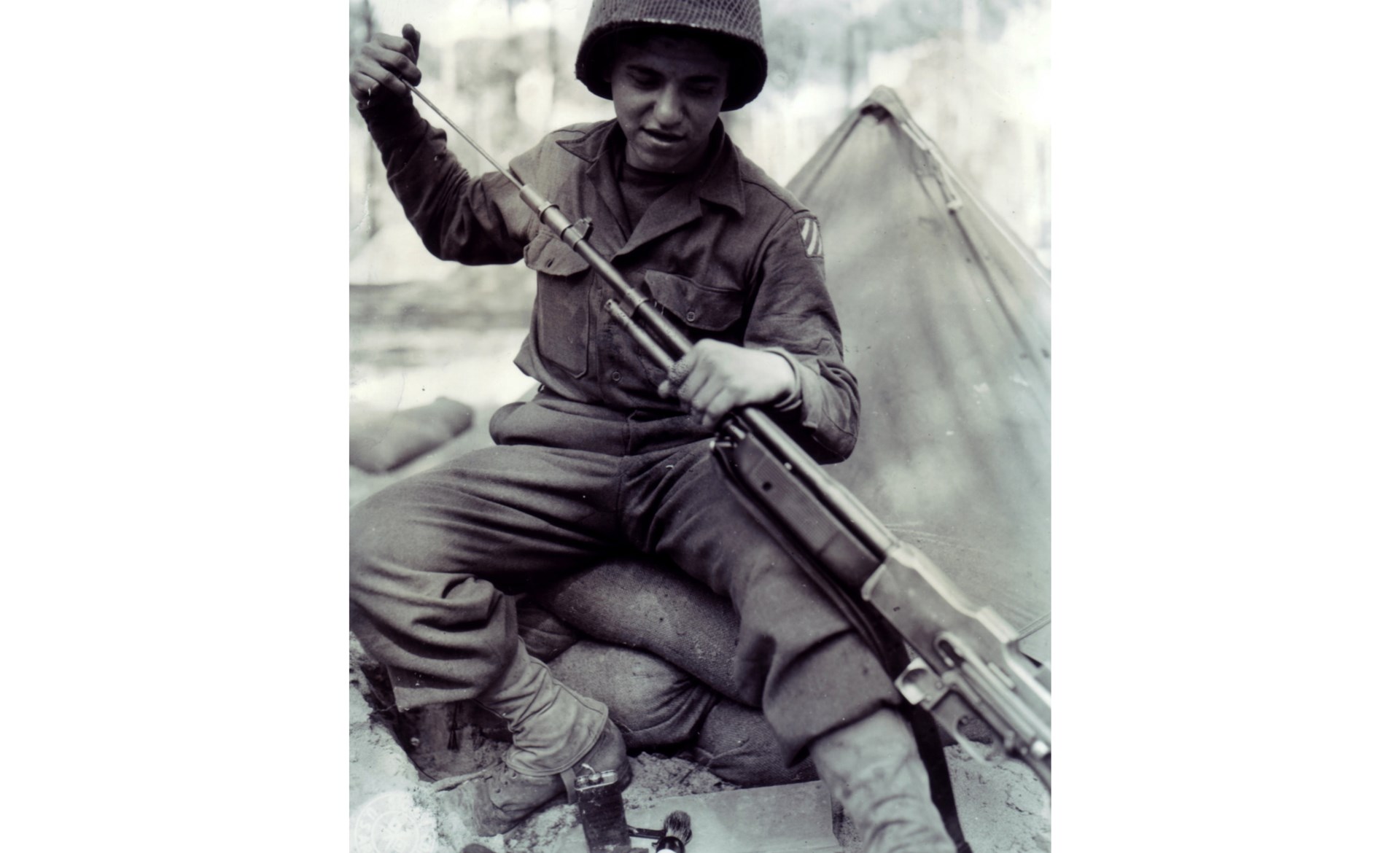
BAR cleaning at the Nettuno beachhead, April 1944.
Related experiences of junior officers and NCOs indicated that the Germans also held this view. In all infantry engagements the enemy constantly gave priority attention to the BAR in the squad. The BAR was credited with the disruption of many enemy counterattacks. Consequently, our present BAR and LMG with bipods and shoulder stock attachments are considered highly satisfactory. Here again as with other weapons, the need of a flash-less and smokeless powder is paramount.
The M1 Carbine, Submachine guns, And The M1911 Pistol
The Carbine, cal. 30, proved to be an excellent weapon for firing at short ranges. Its modified sight which permits changes in range and deflection greatly increased its accuracy. Most small unit leaders who were at times drawn into a fire fight preferred the carbine to the automatic pistol because of its accuracy and longer range; they usually preferred it to the SMG because of its lesser weight.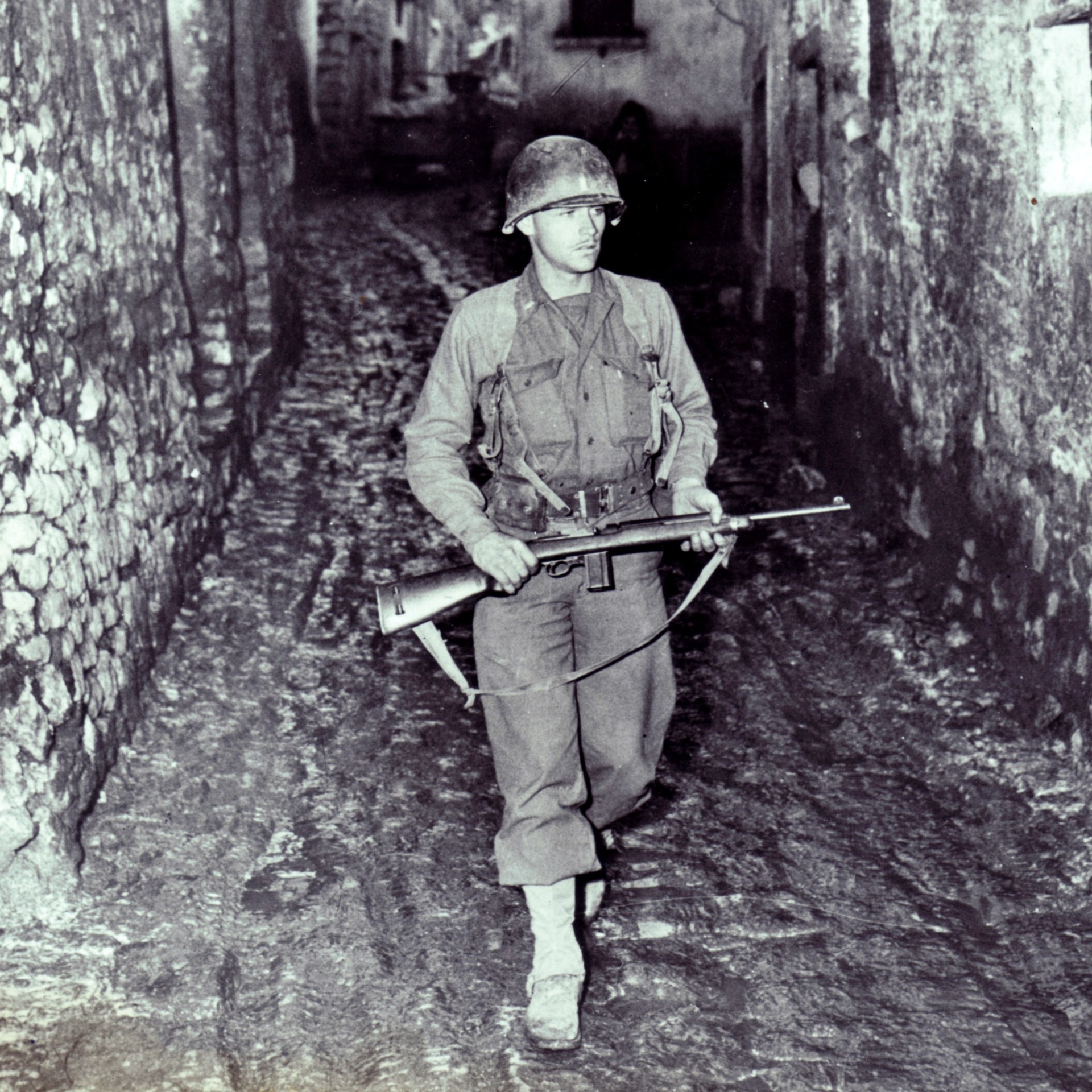
The SMG proved to be invaluable in fighting in areas covered by dense foliage, in village and street fighting, in clearing out houses, and for use on patrols. Though its range is limited, its great volume of automatic fire made it an excellent weapon for covering small areas where the targets were indistinct or fleeting. Its large volume of fire, delivered at close range, had a great demoralizing effect on the enemy.
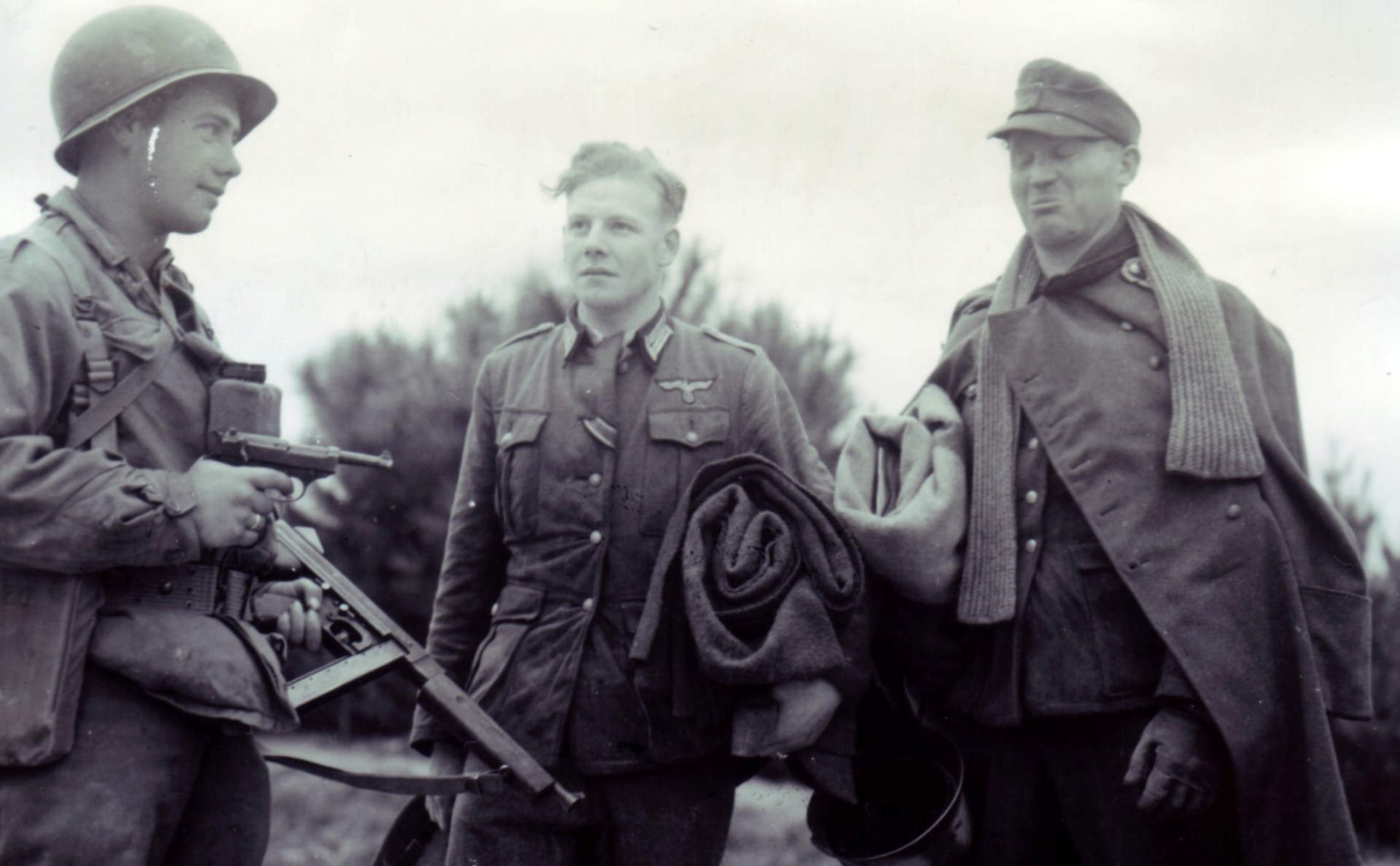 The Thompson SMG with German prisoners—near Littorio, Italy, April 1944.
The automatic pistol, cal. 45, proved to be a good weapon for the purpose for which it was intended—personal protection against an enemy at close range. It is not considered to be a suitable weapon for leaders of small infantry rifle units. However it was the opinion of most infantrymen that men armed with the rocket launcher, men in MG and mortar crews, radio operators, and wire crews should be armed with the pistol. A carbine or rifle hampers these men in their movements and in the handling of their primary weapons or equipment.
A pistol is believed to be sufficient for their self protection, and allows them greater freedom of movement.
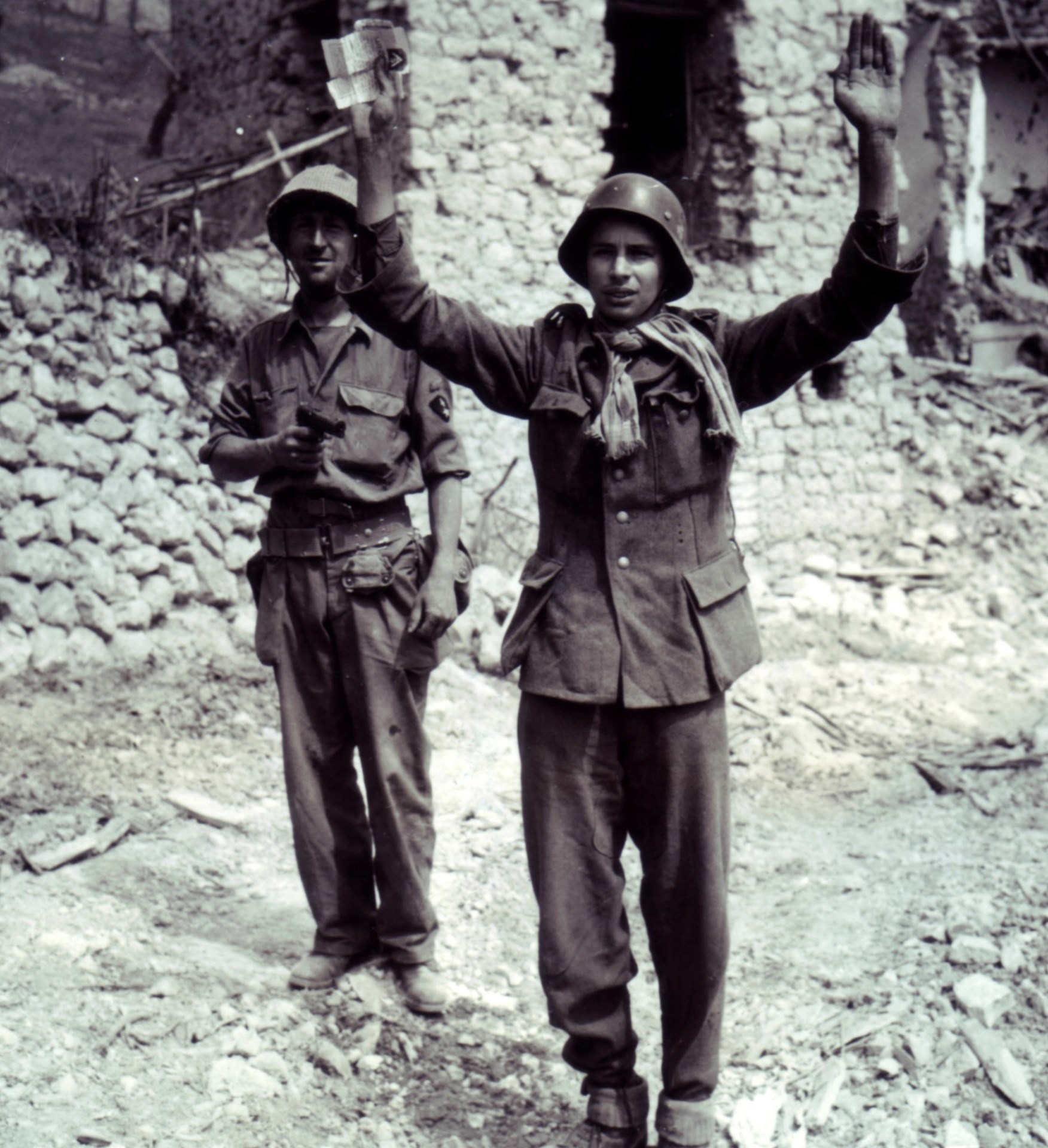 A French Army soldier bringing in a prisoner at pistol-point with the M1911, Castelforte, Italy during May 1944.
Use Of The Bayonet
The bayonet was rarely used in the Italian campaign, and many men disposed of them during advances. In the few instances where bayonet assaults were carried out, they were successful and completely demoralized the enemy. Our troops always preferred to shoot, and it was seldom that close enough fighting was encountered so that the bayonet could be used.
Grenades
Grenades were used extensively by all infantry units with excellent results. The fragmentation hand grenades were very effective for close-in fighting, for stopping hostile assaults, mopping up pill boxes and MG positions, and for clearing houses. In the attack and on patrols, infantry soldiers habitually carried at least two fragmentation hand grenades. The fragmentation rifle grenade was also very effective, and, with a little training, soldiers became very accurate in its use. It was used against groups of personnel in the open, against MG positions, and in clearing houses by firing through open doorways and windows. Frequently it was used in conjunction with AT grenades in attacking occupied houses; AT grenades were fired through doors or windows and the rifle grenades fired close to the house to inflict casualties as the occupants came out.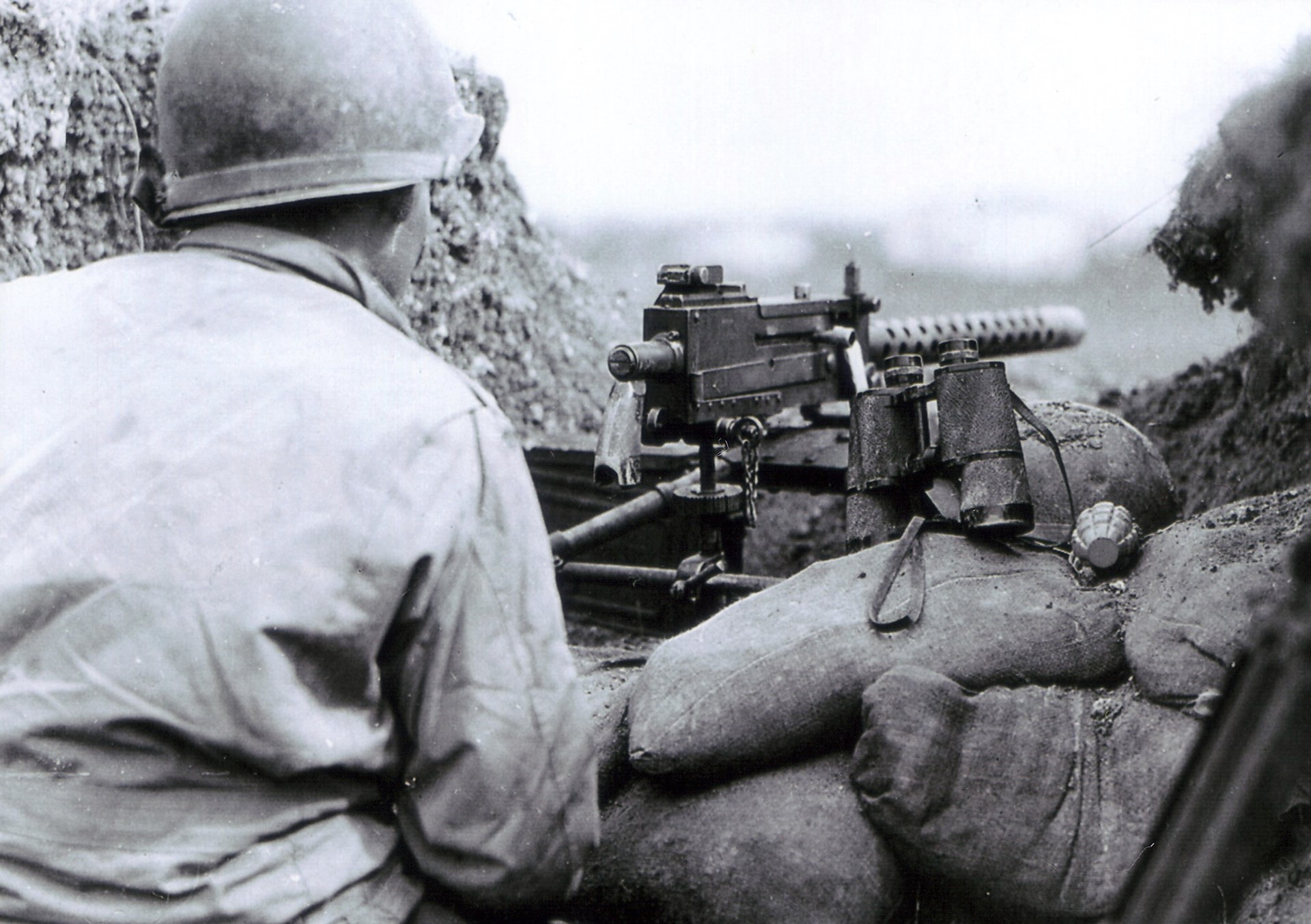
The Browning M1919A4 .30-cal. machine gun in position near Anzio during early 1944. Note the binoculars and grenade at the ready.
The AT grenade was effectively used against armored vehicles, pill boxes, houses, and dug in gun positions. This grenade had a terrific concussion effect as well as “penetrating power”. In one instance the use of AT grenades broke up a three tank attack on a company position at a time when artillery support was not available. In another instance a light tank was knocked out and the crew killed by’ hits from two AT grenades.
The smoke (WP) grenade was very effective in clearing the enemy from caves and dugouts, where at times fragmentation grenades would not do the job. On occasions they were used as incendiaries. Some preferred the WP grenade to the fragmentation grenade for general use.
The offensive grenade was used very little when fragmentation grenades were available. Troops found the fragmentation grenade could do the same job as the offensive grenade, and do it better.
Assault Team Weapons
Assault teams armed with the rifle, the BAR, and the Bazooka were employed to a great extent against fortified houses and dugouts. The BAR formed the nucleus of the team. It was usually employed with a few riflemen as a base of fire, while the building was being investigated. The bazooka rocket had little effect on thick stone or concrete walls but was very effective through doors and windows. In many instances the anti-tank grenade -was used effectively in the same manner.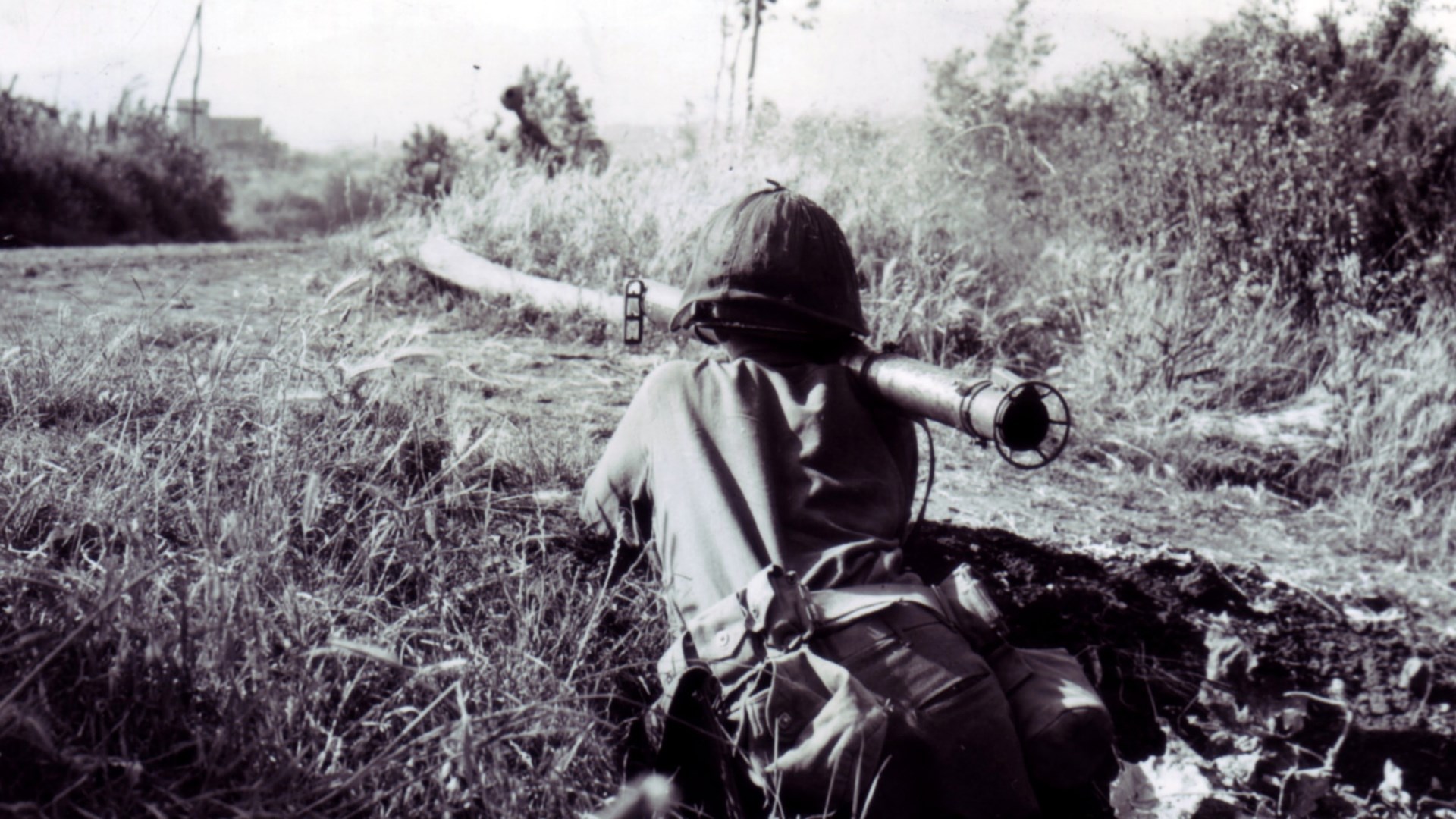 The 2.36″ Bazooka, in use with the 36th Infantry Division at Velletri, Italy during May 1944.
The flame thrower was seldom used as an additional weapon in such assault teams. It was found that they were not essential in attacking houses since the Bazooka rocket or the anti-tank grenade fired through the door or window of a house usually sufficed. The flamethrower, however, was used to great advantage in assaulting pillboxes or well-protected dugouts, since the bazooka rocket or the anti-tank grenade failed to penetrate their reinforced walls.
One reason for not using the flamethrower to a great extent was the lack of specialist operators. To operate it successfully in combat the soldiers must be proficient with the weapon and be able to keep it in proper adjustment. It was generally believed that these specialists should come from combat engineer units, and should be made available to, the infantry when needed.
“Marching Fire”
The mountainous terrain afforded very few opportunities for marching fire. Objectives were often a considerable distance apart and separated by deep ravines. It was often necessary for advances to be made in single file and a platoon front was, seldom possible. Much of the Italian terrain consisted of extremely steep slopes, rocky or terraced, where a swift advance was impossible.
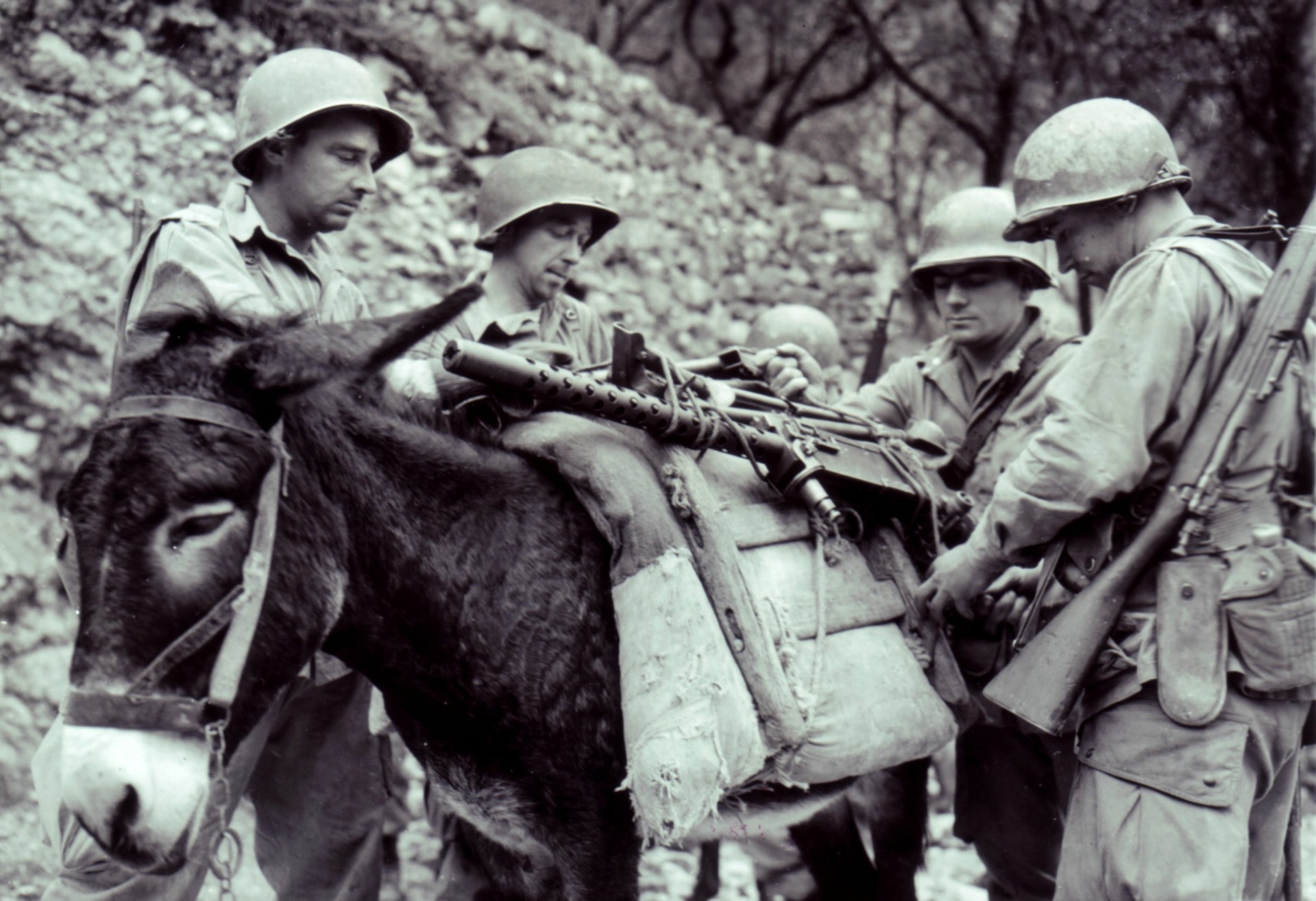 A Browning M1919A4 strapped to the GIs most effective form of transport in the Italian mountains. Note that the muleskinner at right is armed with an M1903 Springfield rifle—commonly found in Italy until well into 1944. Photograph taken in Venafro, Italy, December 1943.
The enemy usually occupied positions that were well selected, dug in and camouflaged, and his exact location was extremely difficult to determine. A slow advance strongly supported by fire was found necessary under these conditions.
When attacking down ridge lines, over reasonably open terrain or on hills easily accessible to foot troops, assault fire was used very effectively, by our troops. Commanders and troops alike favored its use where conditions warranted. Casualties inflicted by enemy small arms fire were not as severe when assault fire was used in the attack as they were when other methods of advance were employed. The issue of additional ammunition for these assault fire engagements was not found necessary.
Comparing .30 Caliber AP And Ball Ammunition
Both AP and ball caliber .30 ammunition were very effective when employed on targets for which they were designed. The armor-penetrating quality of AP ammunition was desirable during the period the enemy was employing numerous light vehicles and strafing planes. During that period frontline leaders requested an increase in AP ammunition. Both AP and ball ammunition were carried.
Ordnance reports indicated the following comparison between AP and ball ammunition:
- AP ammunition was not as effective against personnel as ball ammunition in that it did not have the same splattering effect. AP ammunition made a clean hole through flesh and bone, whereas ball ammunition frequently ricocheted from heavy bones and caused greater tissue damage.
- AP caused more damage to the bores of rifles and MGs, than did ball ammunition.
- Ballistic qualities of AP and ball ammunition up to medium range were practically the same.
- AP ammunition was more effective against lightly armored vehicles.
The use of a single type of ammunition (AP) was preferable to using both types, and after the fall of 1943 only AP was shipped to the theater. However, both ball and AP were used thereafter to utilize existing stocks of ball ammunition.
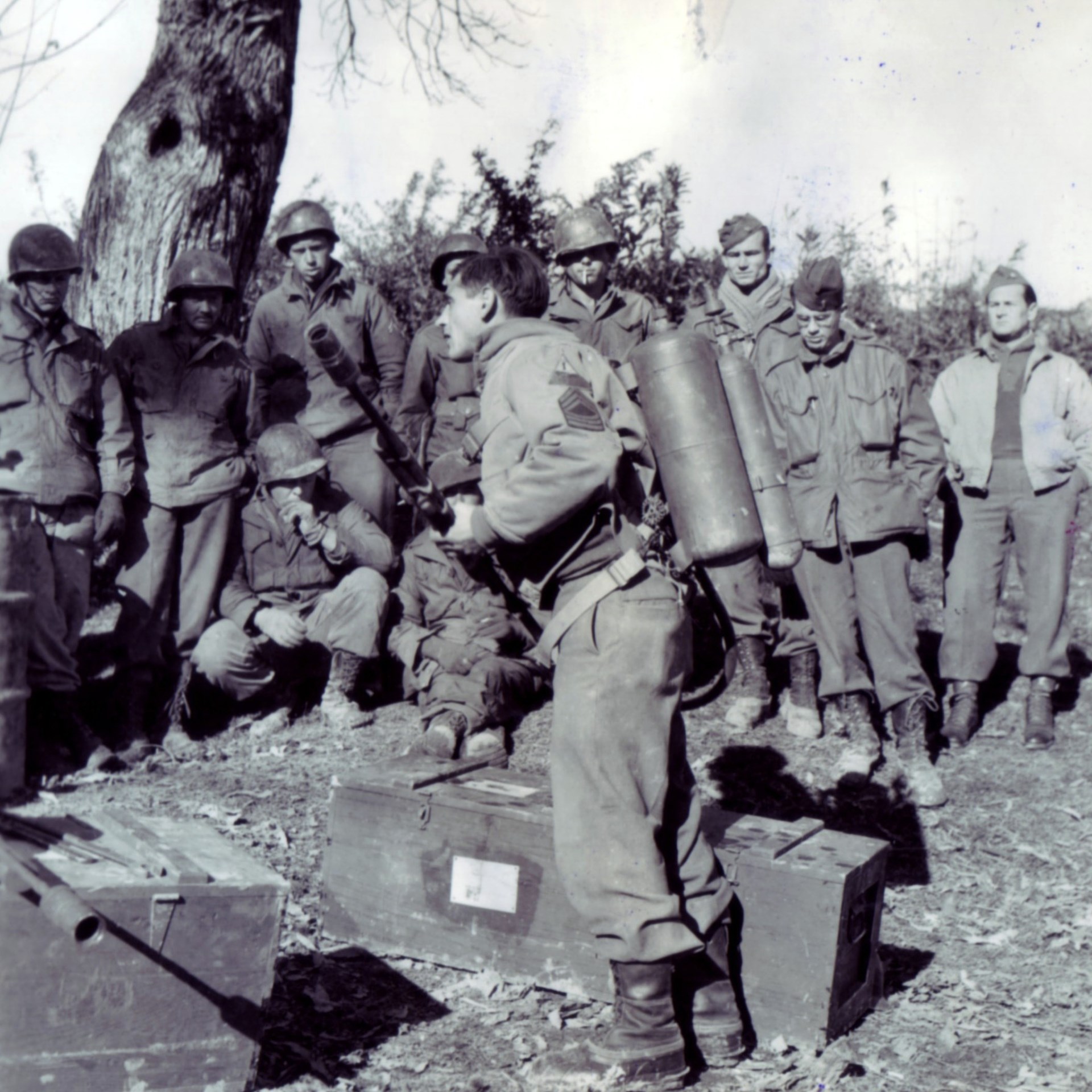 A 1st Armor Division Master Sgt. demonstrating the M1A1 flamethrower in Italy during November 1944. Detailed training with the finicky flamethrower was critical to their success in combat.
Machine guns, at positions difficult to resupply, maintained a supply of 25,000 rounds per section of heavy machine guns, and 20,000 rounds per section of light guns. In positions more easily resupplied, 12,000 rounds per section for both the light and heavy machine guns were usually maintained.
Positions that were supplied by mule train experienced a great deal of difficulty in protecting machine gun ammunition from the weather. On long hauls, mules could not carry a case
(1,250 round.) on each side so the cases were opened and split, thus exposing the ammunition to the weather. It was also impossible to keep moisture away from ammunition stored in positions. Belts became wet and ammunition, corroded so that it could not be used. A constant resupply was necessary to replace ammunition rendered unserviceable by the weather.
Training All Combat Infantrymen In The Use Of All Infantry Weapons
It was found in combat operations that men lacked sufficient knowledge of weapons other than the one with which they were armed. In particular, a general lack of familiarity with the Bazooka, rifle grenade and BAR was prevalent. On occasions squads were without a BAR due to casualties, and the lack of ability of other members of the squad to take over and man the weapon.
Some unit commanders felt that in a rifle company, the men of a platoon should be trained only in the weapons (both crew served and individual) of that particular type of platoon. Their argument was based on their experience that rarely did they transfer personnel from a weapons platoon to a rifle platoon and vice versa.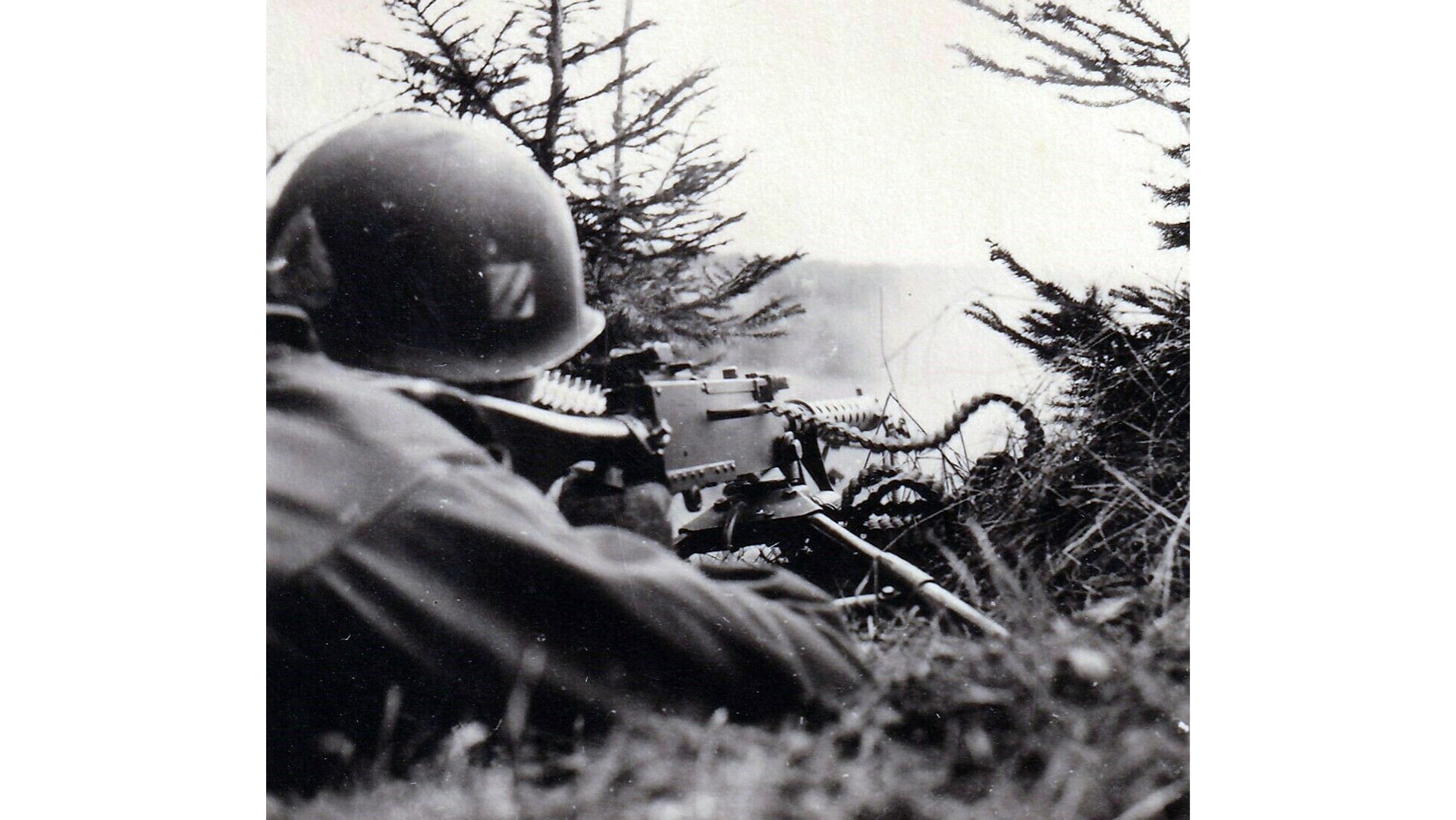
The Browning M1919A6 machine gun (on an M2 tripod) in action with the 3rd Infantry Division in Italy during 1945. Image courtesy of The General George Patton Museum.
Others felt that all personnel in a rifle company should receive training in all weapons of the company in their experience, due to numerous casualties in their weapons platoons, it was necessary at times to use rifle platoon personnel to man crew-served weapons. Inasmuch as personnel had not been trained on crew-served weapons they could be used in the weapons platoon only as ammunition carriers. All agreed that transfers from the weapons platoon to rifle platoons were rare.
Marksmanship Training
Most officers and non-commissioned officers were satisfied that the training in marksmanship which our troops received was sound and practical. It made good shots of average soldiers and provided a sound foundation for firing on the transition range and for combat firing. They felt that this basic training in marksmanship was essential to give the soldier confidence in his rifle and in his own ability. Opinion was unanimous that more time and emphasis must be given to firing at field targets. It was also pointed out that although our training had made soldiers proficient at hitting targets that they could see, it had not emphasized the importance of, or the necessity for picking out and firing at probable targets in areas from which they were receiving enemy fire.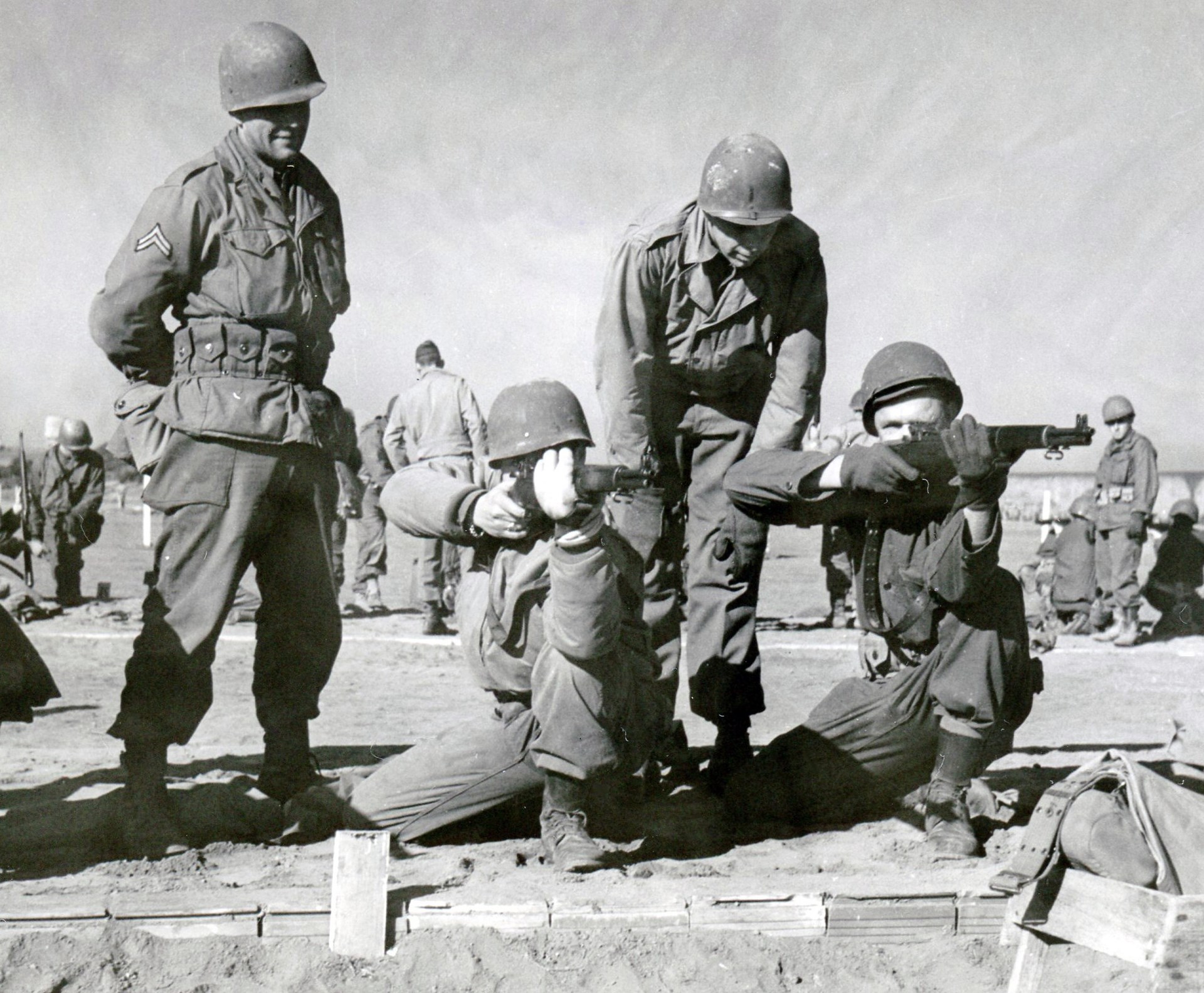
Advanced marksmanship training with standard infantry arms, particularly the M1 rifle, proved essential as replacement troops filled the ranks. Italy, spring 1945.
A Big GI Punch In The Gut
The campaign in Italy was an infantry war, and for most of the fighting up the Italian “boot,” the Germans held the high ground. There were few opportunities for an Allied end-around or an armored breakthrough or a tide-turning paratroop assault. Consequently, America had to rely on the quality of its infantry arms and the spirit of its fighting men.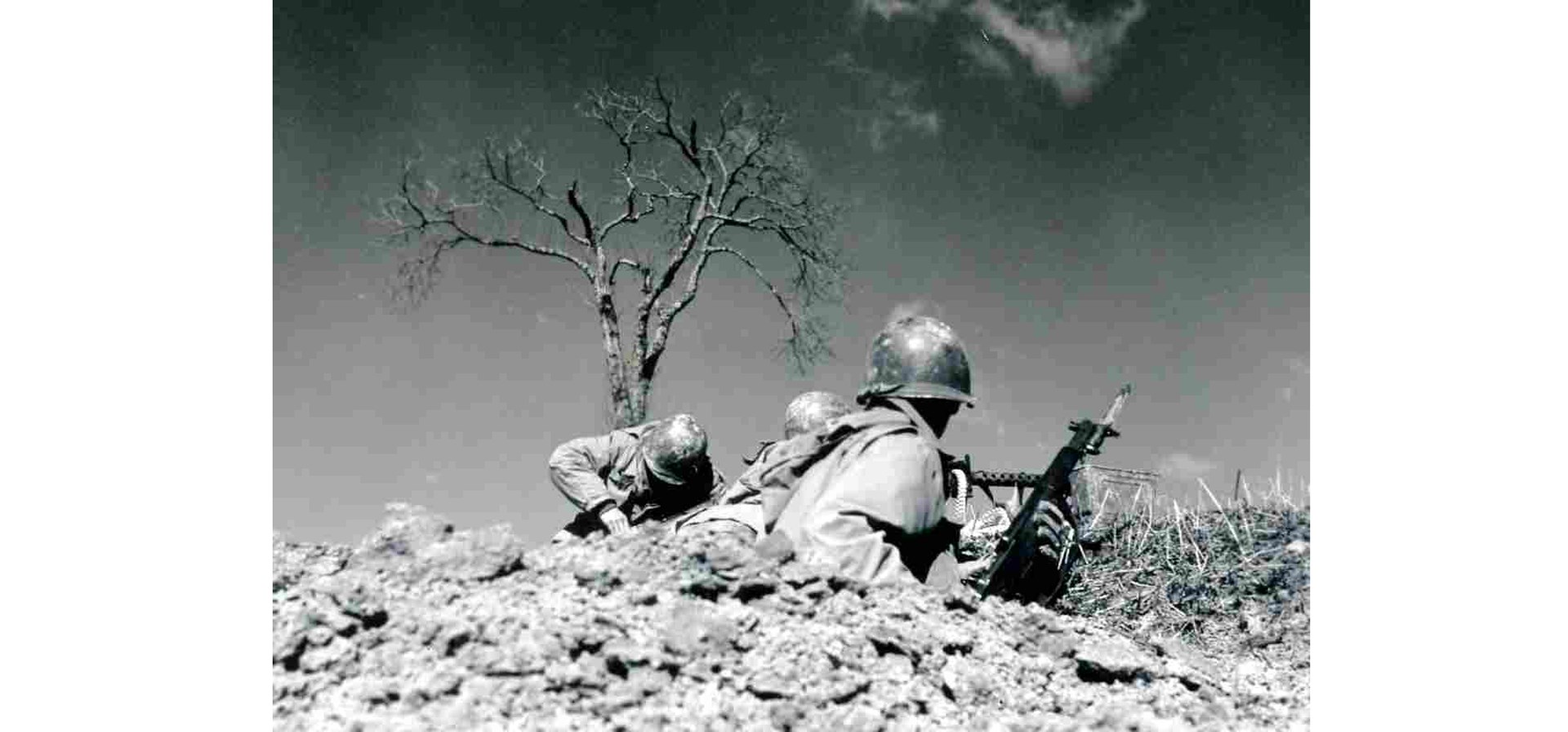
Use of the bayonet was rare, but when it was used, the positive effects on American morale and fighting spirit was highly valuable. With the 10th Mountain Division in Italy during early 1945.
The 20-month fight on the Italian mainland cost nearly 120,000 American casualties. In the end, Germans troops were driven off one hilltop after another, slugged in the guts by an army that could climb higher, endure greater hardships and still shoot straighter.
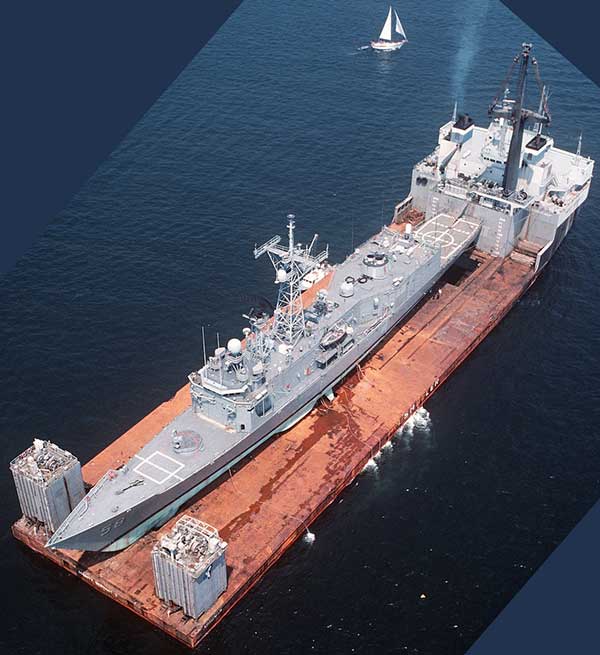 This is the U.S. guided missile frigate Samuel B. Roberts after striking an Iranian mine. This floating dry dock helped keep the crippled vessel afloat after the attack. (Source/Public domain)
Leadership is a big deal, particularly on the national stage. A nation’s resources or its innate strength really do not matter. If you have weak, feckless leadership, the world will walk all over you. By contrast, lesser nations, if deftly led, can still accomplish truly great things.
Part of the perennial problem is our unique system. It has been said that the American system of governance is the second worst on the planet. It is simply that everybody else ties for first. The rub is that our current political system does not naturally select for the best leaders. It selects for the most productive fundraisers. That is the reason Americans of eras past were led by the likes of Theodore Roosevelt, while today, we get whatever it is we have now.
In 1988, Ronald Reagan was President of the United States. While the Gipper and I had some fundamental philosophical disagreements over the machinegun ban of 1986, Reagan was the last American president to seem truly real to me.
I realize he was an actor but listening to his speeches and studying the way he rolled, that guy really did passionately love America. He also was not afraid to unlimber the big stick when the situation demanded it.
This is the Iranian frigate Sahand burning from stem to stern after an
attack by aircraft of the U.S. Navy Carrier Air Wing 11. Fifty-five Iranian sailors perished in the inferno. (Source/Public domain)
The Event
On 14 April 1988, the American guided missile frigate USS Samuel B. Roberts was on routine patrol in international waters in the Persian Gulf when it struck a sea mine. The resulting explosion snapped the keel of the ship and punched through the hull. Only through the skillful and aggressive actions of the captain and her crew was the ship saved. Miraculously, no American lives were lost.
Subsequent assessment of the serial numbers of similar mines recovered in the area showed them to have come from the same lot as a batch seized on an Iranian barge the previous year. Once Reagan was convinced that it was the Iranians who were behind the mining, he let slip the dogs of war. Four days later, the U.S. Navy got busy.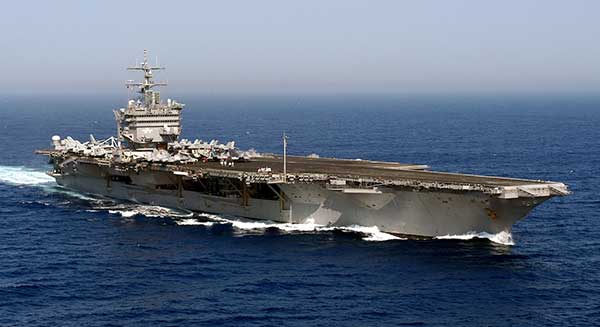
This is the nuclear-powered aircraft carrier USS Enterprise. Big E formed the backbone of the naval strike group that helped put the holy smackdown on the Iranians after they mined the Persian Gulf.
The Players
Ever since the Islamic Revolution in 1979, the Iranians have not played well with others. They are one of the world’s foremost exporters of terrorism, supplying arms and support to Hamas in Gaza, Hezbollah in Southern Lebanon, and the Houthis in Yemen, to name but a few.
I really cannot fathom what their philosophical problem might be. They always seem to have some furry turd psychopath calling the shots over there, and it shows.
In 1988, the Iran-Iraq War was still raging apace. Amidst the backdrop of such unfettered chaos, Uncle Sam’s Navy unleashed hell in the form of Operation Praying Mantis. The Navy brought four destroyers, one guided missile cruiser, three frigates, one amphibious transport dock and a nuclear-powered aircraft carrier to the party.
Twenty-four hours later, the U.S. Navy had sunk one Iranian frigate, one gunboat and three heavily armed speedboats. We had also crippled a second frigate, destroyed a pair of weaponized oil platforms and blew the wing off of an Iranian F4 Phantom jet.
U.S. forces then intentionally backed off to give the Iranians a chance to quit with dignity. American casualties were limited to two Marine aviators tragically lost when their AH-1T Sea Cobra gunship accidentally crashed into the sea while flying under night vision goggles. Strangely, we did not get much mischief out of the Iranians for quite some time after that decidedly one-sided exchange.
Ruminations
We Americans comprise 4% of the world’s population, yet we are responsible for 25% of the planet’s productivity. Though hardly the largest, ours is hands down the most formidable military in human history. We have spawned more Nobel laureates than the next five countries combined. I don’t mean to be so crass as to trumpet American exceptionalism, but we are objectively exceptional. Unfettered freedom really does work.
Right, wrong or otherwise, strength is the only thing that bad men understand. The world just runs better when everyone fears America. A world without a strong America is like recess without a teacher. In that space, the bullies have the run of the place. It’s a hop, skip and a jump from there to the “Lord of the Flies.” We see such unchecked evil on display in places like Ukraine and Sudan every day on the news.
I don’t pretend to tell anybody how to vote. You don’t want or need my advice, and nobody cares what I think anyway. I do wish Theodore Roosevelt was running for President in 2024. However, today’s Theodore Roosevelts have more sense than to seek that job. These days we’ll just need to work with what we’ve got. Regardless, be informed and vote carefully. The world desperately needs a strong America, whether it acknowledges that fact or not. These elections matter … a lot.
Captain Edwin O. Fisher from 362nd Fighter Group – 377th Fighter Squadron, in his P-47D, #42-26919, nicknamed “Shirley Jane III”, talking to another pilot.
Fisher had the distinction of shooting 3 V-1’s in wartime career. He got all of them on the same day, June 29, 1944. In a 35 day period (July 5th -August 9th, 1944), Fisher swatted down a total of 7 confirmed kills on Luftwaffe Me109s and Focke-Wulf Fw 190s to become the 377th’s only ace of the war. This photo was taken at Rennes-St. Jacques Airfield in early Autumn 1944, with an impressive tally on display!

The Japanese seized the Caroline Islands in Micronesia in 1914, and established a naval base on the island of Truk within it in 1939. As the primary anchorage for the Imperial Japanese Navy’s 4th Fleet, Truk was soon transformed into a fortress.
Truk seemed the perfect spot. Offering a natural protected harbor with ready access to nearby deep water, Truk played home to dozens of Japanese warships and merchant vessels. Along the way, the Japanese built five major airfields and a seaplane base. The associated layered air defenses made the place seem impregnable.

American forces called Truk the “Japanese Pearl Harbor.” With the tide of the Pacific War gradually turning in the favor of the Allies, Adm. Ray Spruance ordered Vice Adm. Marc Mitscher’s Fast Carrier Task Force 58 to deal with Truk. They called the two-day aerial assault over February 17-18, 1944, Operation Hailstone.
The Attack
With his five fleet carriers and four light escort carriers in position along with seven battleships and numerous lesser vessels, Mitscher cranked up the party with a heavy fighter sweep that appeared over the island 90 minutes before dawn on the 17th. Dozens of American Hellcat fighters flew in low to avoid rudimentary radar coverage, achieving complete surprise. A total of 30 of the 80 Japanese fighters that launched in response went down in flames.
The Japanese based some 300 warplanes at Truk. Arrayed against this formidable force were around 500 state-of-the-art American carrier aircraft flown by well-trained, seasoned crews. By early afternoon on 17 February, the Japanese were no longer able to mount any serious aerial resistance. That’s when the proper pummeling began.

Japanese commanders appreciated that this had the makings of a disaster, so they ordered all of the ships that were able to make for the mouth of the lagoon to escape. American Dauntless dive bombers and Avenger torpedo bombers queued up to do the deed. However, the Japanese still had plenty of fight left in them.
These carrier air groups cratered the runways on Truk’s several airfields and scattered fragmentation and incendiary bombs among the enemy aircraft on the ground. They divided up the ships remaining the harbor and blew them to pieces. An Avenger piloted by Lt. James Bridges struck the fully loaded ammunition ship Aikoku Maru. The subsequent massive explosion obliterated the vessel and consumed Lt. Bridges’ plane as well.
Fallout
Despite having achieved tactical surprise, the area around Truk lagoon positively bristled with anti-aircraft guns. Many of the these fast-firing weapons were difficult if not impossible to target from the air. They took a heavy toll on attacking American aircraft. As the first day unfolded, the waters around the base filled with downed American aircrew in small rafts.

This was not a particularly desirable place to be. The Japanese were notorious in their ill treatment of Allied prisoners. As an example, during the battle of Midway, every TBD Devastator of Torpedo Squadron 8 was shot down. Those crews that survived to be picked up by Japanese escorts were interrogated, weighted down, and thrown overboard. Only Ensign George Gay survived by hiding underneath a seat cushion as the battle raged around him. Word of this had gotten around. Nobody much wanted to be captured by the Japanese.
Pilots and gunners improvised sails and sea anchors in an effort to distance themselves from the fighting. American submarines were dispatched to gather survivors. One of the subs was the USS Tang skippered by Lt. Cmdr. Richard O’Kane, who went on to earn the Medal of Honor.

In addition to the submarines, American commanders dispatched O2SU Kingfishers to assist in the hunt. These floatplanes launched from U.S. battleships and cruisers via compact steam catapults to be recovered via crane while underway. The Kingfisher was used for search and rescue as well as spotting the fall of shot for long-range surface engagements. This day, the Kingfisher crews were going to ask a lot of their ugly slow little planes.
The Rescue
Lt. John Dowdle and Lt. j.g. John Burns flew the two Kingfishers that searched the surrounding seas for downed aviators. Burns operated off of the battleship USS North Carolina. Spotting a downed Hellcat pilot, Dowdle landed his Kingfisher and taxied up close to take him aboard. However, sea swells were around five feet. An unexpected gust of wind caught the flimsy plane and flipped it over. Now Dowdle, his radio operator Robert Hill, and the downed Hellcat pilot clung madly to the overturned floatplane.

Seeing his fellow sailors in dire straits, Burns landed his Kingfisher and took the three aviators aboard. There was no room for the men in the plane and it was too overloaded to fly, so he taxied to the nearby Tang and offloaded his survivors. Then he went back to work.
By now, the air attacks against Truk had resumed in earnest. Burns spotted another downed Hellcat pilot followed by the crew from an Avenger. He landed and taxied his floatplane from spot to spot, at first having the survivors lash their life rafts behind the aircraft. However, whenever he gained any speed at all, the tiny little rafts just swamped in the wake of the plane. He therefore had the waterlogged men simply climb about the struggling machine and cling to its wings.
By now the combination of the severe sea state and the massive load of humanity conspired to the beat the Kingfisher to pieces. The main pontoon began to leak, and the plane developed a severe list.
With the valiant floatplane now badly taking on water, Burns nursed the crippled machine back to the Tang where everyone transferred onboard. Kane sent Burns and his radioman below so they wouldn’t have to watch and sank the Kingfisher with fire from his deck gun.
The War’s Not Over…
Submarines are notoriously cramped, and this one was now packed with waterlogged aviators. Lt. j.g. Burns had personally rescued 10 downed American aircrewmen, something that earned him the Navy Cross—the Navy’s second-highest award for valor in combat.

The rescued survivors tried to make themselves useful and tagged along for the rest of the Tang’s combat patrol. Upon her return to Pearl Harbor, Lt. Cmdr. Kane dropped off Burns and the rest of the rescued men. Before they departed somebody snapped a picture of them all arrayed around the conning tower.
History has glamorized the Second World War because we have had the luxury of doing so. Thanks to John Burns, 10 Americans who would otherwise have been lost survived to go home, make families, and just live. He was indeed a hero among heroes.