Category: Soldiering
| Brigadier General, United States Marine Corps |  |
Back in the Old Corps, at a time when the average Leatherneck stood 5’8″ and weighed scarcely 148 pounds, young Bo Harllee, a square-jawed, hard-nosed, independent thinker from rural Florida, was already larger than life — a strapping 6’2″, 197 pounds. He came by his commission the hard way, after being discharged from the Citadel for excessive demerits, and later tossed out of West Point (where he stood second in his class, but was deemed “too strong, too colorful, too willful, too independent a character”) for “deficiencies in discipline.” He distinguished himself in action during the Philippine Insurrection of 1899 as a 22 ‘year old’ Corporal with the 33rd U.S. Volunteer Infantry. And on February 2, 1900, he finished first among all applicants in the competitive examinations for commissioning in the United States Marine Corps. He was commissioned a year ahead of his less colorful classmates at West Point. As a Marine, Bo Harllee was always surrounded by controversy. He was very nearly court-martialed a number of times — especially when, in 1917, on the eve of our reluctant entry into World War I, he testified before Congress: “… The biggest challenge, the most serious problem if war should come, will be working off the old dead wood which has risen to the top by the passage of time.” (Politically correct he was not.) He retired a Colonel in 1935 but he was advanced to Brigadier General (a distinction awarded for his valorous service) in 1942. He was laid to rest at Arlington National Cemetary by an escort of 8th & I Marines, in November 1944. He is buried next to our 13th Commandant, Major General John A. Lejeune. So, who was Bo Harllee? Well, he was “The Father of Rifle Practice,” regarded in his own time as our nation’s preeminent authority on small arms marksmanship training; the first Marine officer to qualify Expert with the service rifle. He was our first Public Affairs Officer, opening the Marine Corps’ very first “publicity office,” in Chicago, Illinois, where he revolutionized our recruiting service (and was frequently under investigation by Headquarters Marine Corps). He was “first to fight” — a superb combat leader as a Marine who distinguished himself in action in the Philippines, in China during the Boxer Rebellion, at Vera Cruz, and in Cuba, Haiti, and in Santo Domingo, Dominican Republic. So when John A. Lejeune needed someone to ensure the success and survival of his radical invention, the Marine Corps Institute, he knew precisely who to turn to: Lieutenant Colonel William C. Harllee. And so it was that Bo Harllee became another “first” — the first Director of MCI. On February 2, 1995, 95 years to the day after Bo Harllee earned his commission, we celebrated, at Lejeune Hall in the Historic Washington Navy Yard, the 75th Anniversary of the Founding of the Marine Corps Institute. And high tribute was paid to the immortal John A. Lejeune, the founding father of MCI. But all these years later, much of what is ours to celebrate is really attributable to a lesser known, always controversial and colorful, unsung “giant” of our Corps — the man General Lejeune judiciously picked to pull it off and “make it happen,” Bo Harllee. “… Without Harllee’s power to defy tradition, without his tremendous drive and vitality, the success of General Lejeune’s school, might not have been so successful … The success of the program was largely due to the intelligent, fiery, and even rebellious nature of Colonel Harllee.” (Marine Corps Gazette, February 1950). Brigadier General William C. Harllee, U.S. Marine Corps, had a dream of making America a nation of marksmen. With strong ties to the National Rifle Association, he first taught the Marines how to shoot, then the Navy, and later soldiers, civilians & women. He became known as ‘the Father of Rifle Practice’ in the Marine Corps.” |


A real hard ass, who seen and done a lot of very hard things. I think that this is 1941 and the liberation of Ethiopia from the Italians. But I could be wrong! Grumpy

Author’s note: I penned this piece months before the recent Russian invasion of Ukraine. While Vladimir Putin has shown himself to be a proper world-class villain, the story of the young Russian soldier depicted here remains nonetheless poignant. My prayers are with the brave people of Ukraine.
Why do soldiers fight? The movies and government propagandists would have us believe it is for grand causes. Young folk go to war to free people from oppression or defend their homeland against soulless invaders. To a degree that is true. Soldiers may indeed go to war for such stuff as this. However, what keeps them in the suck is invariably their friends.

It’s tough to capture in prose the nature of the relationships you develop in the military. The Army is really, really good at this. As an institution the Big Green Machine takes young impressionable people, makes them collectively miserable, and then subjects them to some corporate threat. That threat can be a city full of bloodthirsty terrorists, a miserable protracted field exercise, or some sadistic drill instructor. This time-proven technique is what turns a mob into a tribe. A mob is a chaotic ineffective rabble. A tribe can become a shockingly efficient killing machine.

This process is indeed timeless. Whether it is Leonidas’ Spartans arrayed at the Hot Gates or an SAS team on a Scud-hunting mission in Iraq, once you are part of the family there is literally no limit to the sacrifice some members of the tribe will make on your behalf. It’s actually quite the beautiful thing up close.

There is a reason young people make the best soldiers. Old guys think too much. However, when you’re nineteen your entire world can be your friends and the moment. That can lead to some of the most extraordinary stuff.
Background

Alexander Prokhorenko hailed from the village of Gorodkhi in Orenburg Oblast. He completed secondary school in 2007 and was accepted into the Orenburg Higher Anti-Aircraft Missile School. A year later the Missile School closed and Prokhorenko transferred to the Academy of Military Air Defense of the Armed Forces of the Russian Federation where he thrived. He graduated with honors and assessed into the Special Operations Forces of the Russian Federation as an advanced aviation gunner. Alexander Prokhorenko was a Spetsnaz operator.

Prokhorenko was likely what we might call a JTAC (Joint Terminal Attack Controller) for tactical aviation. In the US military organization, organic forward observers are artillery troops whose mission it is to call for and direct artillery fire at the whim of the ground force commander.
Back when I wore the uniform there were also Brigade-level ALO’s (Air Liaison Officers). I have no idea how they do it now, but in my day ALO’s were typically Air Force pilots who, for some unfathomable sins, were assigned to Army units to help coordinate air support for ground troops. One of the most effective I ever knew was actually a B52 pilot. The JTAC is the guy on the ground with a radio who talks the strike assets onto targets taking care to avoid hitting friendly forces. Everybody loves the JTAC. They are the guys who bring the serious pain.

Modern combined arms military operations are incredibly complex. To be maximally efficient the overall commander synergistically employs armor, rotary-wing fire support, fast movers, artillery, and a dozen other major components of the overall whole to close with and obliterate the enemy. During Russian military operations in Syria in 2016 Alexander Prokhorenko played a part in one of these overarching missions.
The Setting

I’ll not attempt a detailed explanation of the geopolitics behind Russia’s involvement in Syria. Part of that stems from the observation that this is a complex region characterized by alliances of both convenience and blood that reach back millennia. More importantly, however, is the fact that I don’t understand it well at all myself.

Bashar al-Assad is a really bad guy who has even used chemical weapons against his own people in a ruthless bid to remain in power. Oddly, Bashar al-Assad is trained as a physician. His title is President of Syria, but he’s really a king. He inherited power from his father, Hafez al-Assad, in 2000 and has since done literally whatever it took to retain his throne.

Bashar went to med school in Damascus and did a residency in Ophthalmology in London. His older brother Bassel was being groomed for the dictatorship but died unexpectedly in a car crash in 1994. This unfortunate turn of events forced young Bashar to give up a promising career in eye surgery to join the family despot business. The Russians are aligned with al-Assad’s regime.

Arrayed against them, among a few others, was ISIS. There were and are scads of revolutionary splinter groups trying to throw off the al-Assad mantle of tyranny, but ISIS was the 400-pound gorilla in the room. ISIS hates pretty much everybody. They are the agents of chaos. They just want to watch the world burn.

Interestingly, one of the reasons ISIS is just so bloody horrible is that they want to see the entire planet turn against Islam. This seems counter-intuitive, but to their warped corrupt calculus the more persecution they can foment against Muslims the more Muslims they can radicalize to their dark satanic cause. Like the Japanese fanatics against whom we fought during the island campaigns in WW2, the most efficient way to address ISIS combatants on the battlefield is just to blow them away and be done with it.

You really don’t want to get caught by these guys. ISIS has a nasty habit of publicly decapitating their POWs or, for truly special occasions, burning them alive in cages to create gory snuff films for their adoring audiences back home. When he deployed to fight in Syria with Russian Federation forces in 2016, Alexander Prokhorenko knew all this.
The Event

Syria is a simply ghastly place. I’ve never been there myself, but I have friends who have and to a man they agree. In March of 2016 the Syrian Arab Army launched an offensive to retake Tadmur, a strategically significant town near the ancient ruins of Palmyra in central Syria. While Syrians were doing most of the dirty work during this tidy little bloodletting, Russian air support is what kept things lively. Alexander Prokhorenko was tasked to keep the Russian ground attack assets cycling in support of Syrian Army troops.

Prokhorenko was set up on high ground doing his job when he was discovered by ISIS militants. Surrounded, low on ammunition, and out of options, he called in an airstrike on his own position. Prokhorenko was killed along with his attackers.

There was a purported transcript of Prokhorenko’s final transmissions that made the rounds on the Internet. This has since been reliably discredited. The Russians are notorious propagandists. However, this in no way diminishes Senior Lieutenant Prokhorenko’s selflessness and dedication.
The Weapons

The story of the Kalashnikov rifle should be holy dogma was anyone reading stuff like this. While the AK47 and subsequent 1956-era AKM did indeed reflect the state of the art for their day, by the 1970’s the Kalashnikov and the relatively heavy 7.62x39mm round it fired were getting a bit long in the tooth. The answer was the AK74 and the 5.45x39mm cartridge.

The 5.45x39mm round fires a long, skinny 53-grain bullet to around 2,900 feet per second. While the Russians have fielded a variety of rounds in this chambering, the 7N6 is likely the most common. This bullet includes a small mild steel penetrator followed by a lead core all wrapped in a jacket made from gilding metal. Gilding metal is a form of brass that is much higher in copper than zinc. The manufacturing process leaves a small air space in the nose of the projectile underneath the jacket.

The aggregate effect is to place the center of gravity well to the rear. This causes the bullet to tumble viciously upon impact with a soft target and creates simply epic wounds. The Mujahideen who first faced this round in Afghanistan after the 1980 Soviet invasion thought the bullets contained explosives.

The most common assault rifle used by the Russians in Syria during this time was the AK74M. A modernized version of the original AK74, the AK74M featured a side-folding polyamide stock and a variety of tweaks to the original design to include a smooth top cover. The AK74M in Spetsnaz service frequently sported an underbarrel GP-25, GP-30, or GP-34 grenade launcher. These launchers were philosophically similar to the American M203 but loaded from the muzzle.
The Rest of the Story

Kurdish YPG forces eventually recovered Prokhorenko’s body more than a month later. There is a rumor circulating that the Russians traded several captured fighters for Prokhorenko’s corpse. The young warrior’s body arrived in Moscow on April 29, 2016.


At the time of his death, Prokhorenko was married, and his wife was pregnant. A street and school have been renamed in his honor in Orenburg. In 2016 musicians from St. Petersburg’s Mariinsky Theater orchestra played in the Roman Theater at Palmyra in Syria. ISIS had used this same site to execute Syrian soldiers before they were crushed by the accumulated combat power of pretty much the entire planet. The concert was dedicated to the hallowed memory of Alexander Prokhorenko.

Admiration and accolades poured in from around the globe. Prokhorenko was posthumously awarded the Hero of the Russian Federation, Russia’s highest award for gallantry in combat. In September of 2017 a marble statue of Prokhorenko was unveiled in the Park of Honor and Dishonor on the shores of Lake Vagli Sotto. Prokhorenko’s legacy will no doubt motivate young Russians to go off and fight and die in their own wars for generations to come.

I get it. There is little I would not have done had my country asked back when I was young and full of fire and vinegar. Above all else this is the reason our politicians must make sober responsible decisions concerning the application of military power. Our young soldiers are indeed our most precious assets.
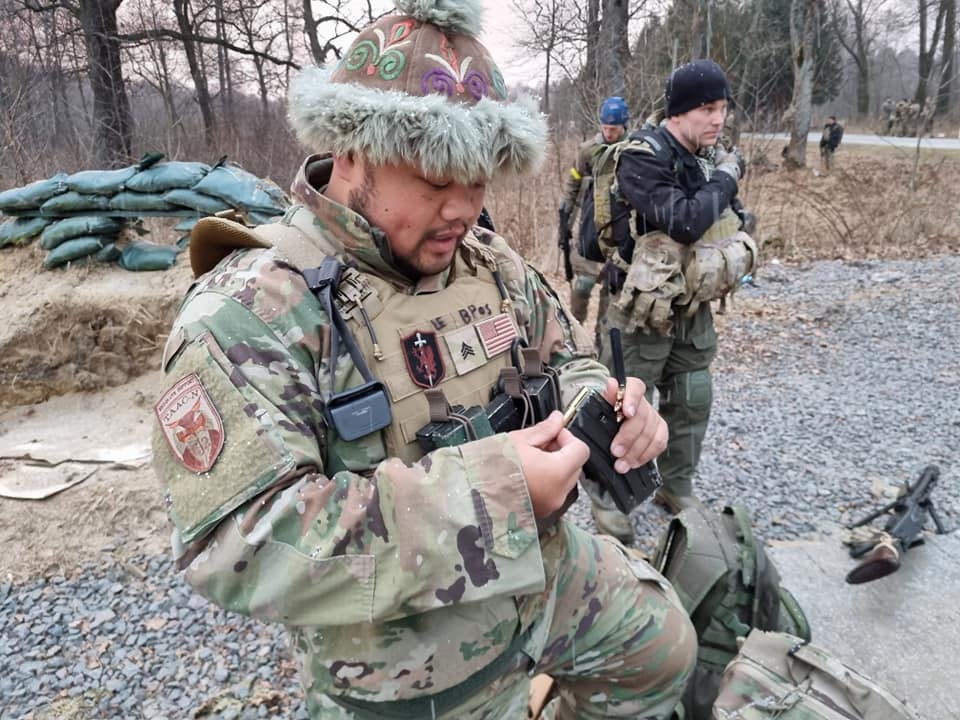
HIEU LE, WHO SERVED WITH THE US MILITARY IN AFGHANISTAN, SAID HIS COMBAT EXPERIENCE DID NOT PREPARE HIM FOR THE HORRORS OF THE FRONT LINE IN UKRAINE. PHOTO: HIEU LE
This story contains graphic descriptions of death and human remains.
When wave after wave of Russian cruise missiles rained down on the Yavoriv training base in Western Ukraine in the early hours of March 13, it was an attack of major strategic significance.
The sprawling military base sits just 10km from the Polish border and NATO territory, and has played host to several drills between the military bloc and Ukrainian forces in recent decades. Since the Russian invasion of Ukraine started, on Feb. 24, it has also played host to thousands of recently arrived foreign recruits into the Ukrainian Foreign Legion, the newly-created international arm of the country’s armed forces.
Adam was one such new recruit there the day of the bombardment. The Polish carpenter, who asked to use only his first name for security reasons, had only been in Ukraine for a matter of days when he was awoken at around 4AM that Sunday morning by exploding missiles. Emerging from his tent, he witnessed utter carnage unfolding around him—including one soldier who had been severely maimed by a blast.

“His face was burned out. He didn’t have hands, both of them. He was walking like a zombie,” Adam said. “He’s calling you to help, but what can you do? You cannot do nothing for him, you know that he’s dead already, that he’s just running on adrenaline.”
Speaking to VICE World News on Sunday from Krakow, having only crossed the border back into Poland two days earlier, Adam is now able to reflect on the gravity of his experience. Now safely back in his home country after serving two weeks as a unit commander, he is among the first wave of returning Foreign Legion volunteers able to offer firsthand testimony of the front line as a foreign soldier.

While celebrated stories of foreigners brave enough to venture into a war zone are plentiful, little has been heard yet from those who have emerged from the other side. Adam and other Foreign Legion recruits told VICE World News harrowing tales of death and destruction that marred the short stints in which they were in Ukraine, carrying home with them severe trauma as they shed light on the brutal and chaotic nature of events on the ground
“I was exposed to much more things in my first three days [in Ukraine] than the whole tour in Afghanistan,” said the 35-year-old, who served for six months in the country in 2012. “If, right now, [someone] told me you are going on a mission to Afghanistan, I would say: ‘Why do you want to give me a vacation?’”
Reflecting on the hours-long Russian attack on Yavoriv, which killed 35 Ukrainians and up to 180 “foreign mercenaries” according to Kremlin sources, Adam is still able to find a silver lining. The number of foreign recruits dwindled significantly when, in the aftermath of the explosion, Ukrainian officers gave them an opportunity to turn back and leave the country.
“There were a lot of adventure seekers. There were lots of people saying they were in the army and the military. But I think there were just a bunch of liars as well,” Adam said. “But we were actually very happy that this happened before we got to Kiev. Because that was the best selection of the people that you could fucking imagine—the best one.”

ADAM’S UNIT PATROLLING AT A DESTROYED BRIDGE IN KIEV. PHOTO: HIEU LE
Another foreign recruit who survived the bombardment that day and pushed on to the Ukrainian capital is Hieu Le.
Originally from the Bay Area of California, the Vietnamese-American sold noodle soup in Medellin, Colombia until three weeks ago, when he was compelled to act by an impassioned speech from Ukrainian President Volodymyr Zelenskyy calling for foreign recruits to help in the resistance fight.
When he spoke to VICE World News late last week, he was sitting in a hotel room in the Polish capital Warsaw with another Legionnaire from the U.S. Both men had arrived in Ukraine separately on March 9, before leaving the country together on March 22.
Le, a soft-spoken 30-year-old, was a soldier in Adam’s unit of around 20 men. He too had completed a nine-month tour in Afghanistan in 2012, also working as a counterintelligence agent in the country for more than three years before leaving for Medellin in 2020 when COVID-19 struck.
“The distinct risk of catching a bullet in the back from some criminal guys [on your side] was a lot higher than comfortable.”
Like Adam, he said his previous combat experience prepared him only so much when confronted with the asymmetric nature of warfare in Ukraine, where Russia has bombarded towns and cities with rockets as President Vladimir Putin launched the largest military offensive in Europe since World War II.

“Even those with military experience, you’ve got to realise that there isn’t a war that has been fought like this in a long time,” Le said. “What’s different with the US military and all the other NATO militaries—they’re spoiled. When it comes to fighting a war, they have air support, medivac, logistics, all kinds of different levels of intelligence, and support. Here in Ukraine, we had none of that.”
Both Adam and Le described the anxiety that accompanies urban warfare, something Le equated with fighting “in a forest.” The men’s home base, which Adam estimated housed more than a thousand foreign troops—Georgians, Americans, Brits, Eastern Europeans and even South Americans—at an undisclosed location in Kiev, offered little more in terms of refuge due to the perennial threat of shelling.
“If you know anything about the war right now, you know that urban [warfare] is basically hell,” Le said. “Surrounded by the enemy—so many enemies, so much armour. You’d be walking, then you run into enemy armour.”
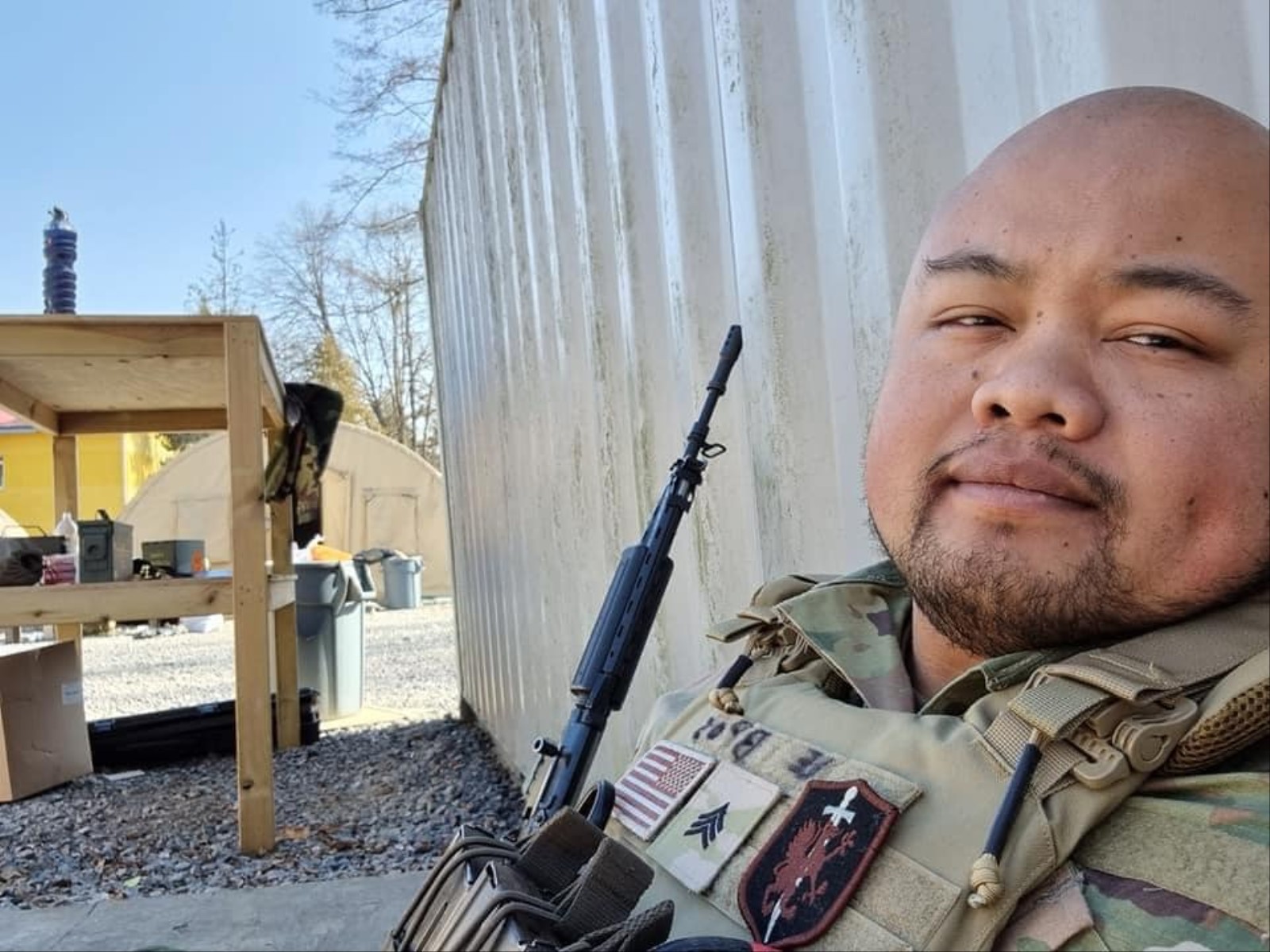
HIEU LE SOLD VIETNAMESE NOODLE SOUP IN MEDELLIN, COLOMBIA UNTIL THREE WEEKS AGO. PHOTO: HIEU LE
Firm figures are hard to come by, but in early March the Ukrainian Defense Ministry estimated that 20,000 people had volunteered to join its foreign forces, hastily created three days after the invasion as the International Legion of Territorial Defense of Ukraine. Outlets have reported that contracts have been handed to foreign recruits restricting them from leaving the legion until the war is over. Le, however, says it was “actually amazing how many chances that the Ukrainians give you to leave.”
But while commending the “impressive” Ukrainian resistance and everything achieved by the Foreign Legion in a short space of time, Le also described a lack of structure and leadership in its ranks. This is something he says has resulted in unnecessary casualties, and could be remedied by embedding a Ukrainian officer in every unit.
These issues with discipline manifested within the walls of the barracks, according to Le, as he described a looming threat of violence from one unruly and ill-disciplined collection of troops. Americans and Brits who claimed to be ex-special forces, these soldiers antagonised, threatened and assaulted fellow Legionnaires during his time there, Le says. Both he and Adam suspected substance abuse among those men, while unconfirmed accounts of looting and even the shooting of stray dogs on missions began circulating in the barracks.

As the days ticked on, Le’s sense of anxiety grew as he remained constantly vigilant for enemy attacks, while beginning to doubt his safety even among his own men. He said they represented a minority of volunteers—“psychos and criminals” drawn to Ukraine not to help the country, but in order to have a “free pass to kill people and act a fool.”
“There were a lot of people that didn’t want to go on mission with these guys, because they just were untrustworthy,” he said. “The distinct risk of catching a bullet in the back from some criminal guys [on your side] was a lot higher than comfortable.”
VICE World News could not independently verify Le’s accounts of reckless behaviour on missions, but Adam confirmed that all five men had been removed from the Legion by the time he had left the country. He also emphasised that these men represented outliers among an otherwise harmonious group of foreign fighters, and that the Ukrainian government was making efforts to stamp out poor behaviour in its foreign ranks. The American soldier whom Le had travelled to Warsaw with, who had been physically assaulted by one of the men, confirmed he left due to fears for his safety among his own soldiers, but declined to give a full interview.
“Because of rigor mortis, we had to break his legs and his arms to get him in there. These cars are super small here in Europe. It was pretty gruesome, I’ll never forget it.”
For Le, however, it was not solely for these reasons that he called an end to his time in Ukraine after two weeks. To explain that decision, he soberly recalls the events of one mission in meticulous detail, after which he knew he had experienced enough.
Patrolling a forest in western Kiev on March 18, Adam’s unit encountered the body of a Georgian soldier from their barracks killed by rocket fire. Unwilling to leave him behind, both Adam and Le helped carry his stiff, lifeless corpse 8km through thick forest to the nearest road. There, Le would search his uniform for ID, writing down on a piece of scrap cardboard his name, details and date of death, before lifting him into a waiting vehicle.
“Because of rigor mortis, we had to break his legs and his arms to get him in there. These cars are super small here in Europe,” Le said. “It was pretty gruesome, I’ll never forget it.”
He described the sorrow he felt seeing other Georgian soldiers paying their respects to the body. This experience with death would prove too traumatic to bear repeating, and Le would depart the country days later, saying he “did not realise how much it would affect me.”

SOLDIERS FROM ADAM’S UNIT CARRYING THE BODY OF A FALLEN GEORGIAN SOLDIER. PHOTO: HIEU LE
“You know, it’s a sombre moment. And it was, for me, too much. I never wanted to do that again. It was…,” he said, pausing. “It was absolutely heartbreaking.”
Adam, for whom it was the second encounter with death within a week, recalls the incident in characteristically jovial fashion. This, he says, is his way of coping.
“This is my reaction for whatever happened over there. This is my stress management. I’m doing that for me,” Adam said. “I think it’s fine if someone wants to judge this. Go ahead. I don’t care. But if I’m gonna be about to cry all the time about this, well, what’s the point?”
Adam, who left in part due to those tensions in the barracks, isn’t ruling out a return to Ukraine. He’s currently lobbying to raise money for scopes, thermal and night vision goggles—equipment he says would be a “game changer” for urban warfare in Kiev.

Le is now spending time travelling in Europe in order to process what he has experienced before returning to Colombia to resume his life selling noodle soup. He says he is mentally preparing for similar feelings he felt when he returned from Afghanistan, where “no one cared and nothing changed.”
He warns against those without military experience going to Ukraine, “as you will probably quit after the first air strike.” On his social media posts that have since gone viral wherein he details his experience, Le has faced criticism—in part from soldiers he had served with—for leaving the country after two weeks.
He reiterates several times that this critique comes from a place of ignorance. Still, you can see that, given all that he has endured, the harsh words from his peers sting.
“I try not to take it too personally, because they don’t know. They really don’t know this is an entirely different type of conflict,” he said. “The only thing I really have to say to those guys is they have the opportunity to come here too. And they didn’t.”