Category: Soldiering

In his popular 1925 book, Fix Bayonets and Other Stories, John W. Thomason described a fictional character strikingly similar to a real Old Corps Marine. In “Special Cases,” Thomason provides a snapshot of a group of officers on the eve of the assault on Blanc Mont in October 1918, characterizing “Edward Hawkes” as far more educated and polished than most of his contemporaries. A veteran of service in the ranks, Hawkes is rumored to have served in Great Britain’s Brigade of Guards; perhaps he even held the Queen’s Commission. Some believed dark secrets shrouded the past of this fine old Leatherneck.
Thomason notes that he drinks only the best wines from his personal crystal goblet; to Hawkes’ dismay, his fellow officers drink vin ordinaire from metal canteen cups. He has earned a reputation as a popular and kindly mentor to the young officers who flocked to the colors when America declared war on Germany.
During the course of the gathering, Hawkes discloses misgivings about his chances for survival when the 5th Marines assault the chalky massif the following morning. He digs a bandana out of his musette bag and unwraps it to reveal three decorations: Medal of Honor, Distinguished Service Cross, and Croix de Guerre. He then wraps them for mailing. To the surprise of his drinking companions, Hawkes asks that the parcel be sent to his wife should he fail to survive the next day’s assault.
Hawkes Is Hulbert
Any officer of the World War I era would immediately recognize the fictional Hawkes as the legendary Gunner Hulbert. Even though the young officers of the 4th Brigade (Marine), American Expeditionary Forces (AEF) knew him best as an officer, most Old Corps Marines (pre-1917) likely remembered Hulbert as one of the few sergeants major on the muster rolls.
Henry Lewis Hulbert looked every bit the fighting man. He stood well over six feet tall and, after almost two decades as a soldier of the sea, weighed scarcely more than when he enlisted. At age 51 on the eve of the Blanc Mont attack, he had a face darkened by years of tropical suns and fierce winds from duty at sea. His white mustache and eyebrows seemed to have been pasted on the bronzed face. While his fellow officers appeared wont to let their personal appearance slip while in the field, Hulbert kept his leather shined and brass polished.
Over his multi-faceted career, Hulbert held every enlisted rank from private to sergeant major, with a Good Conduct Medal and a promotion earned during each enlistment. He advanced rapidly from gunner to second lieutenant to first lieutenant, and his prowess on the battlefields of France resulted in a recommendation for promotion to captain. Not unlike many Old Corps Marines, Hulbert had found a new home and a new life as a Leatherneck following disastrous and disappointing missteps as a young man.
Many enlistees who answered the call to the colors after the Civil War were recent immigrants with a limited education; some could speak little or no English. But unlike most of them, Hulbert was British and better educated than even the majority of officers. Born on 12 February 1867 in Kingston-Upon-Hull to a wealthy Yorkshire family, he matriculated from the posh Felsted School in 1884. He entered the British colonial service with an assignment in Malaya as a clerk and storekeeper in the state of Perak.
Early Troubles
His superior performance soon garnered the attention of Robert Douglas Hewett, the state auditor for Perak; as a bonus, Hulbert also caught the eye of Hewett’s sister. Marriage, fatherhood, and promotions followed in rapid succession. Sadly, however, he allowed his good sense to slip below his beltline.
Hulbert began a romantic attachment with his wife’s younger sister, and the two were caught in flagrante delicto. His life crumbled with lightning speed: dismissal from the colonial service, a discrete divorce, and the auction of his property. Banished from Malaya, he booked passage to Skagway on the Alaska Territory panhandle to seek his fortune in the Klondike gold fields, but failed to find it. Just before the Spanish-American War, Hulbert turned up in San Francisco. Down at the heels, perhaps worrying about the source of his next meal and bed, he enlisted for five years on 28 March 1898.
Recruit training for the 31-year-old private followed at nearby Mare Island, then orders to the Marine guard in the USS Philadelphia. The protected cruiser steamed to Hawaii to show the flag at ceremonies for the annexation of the islands to the United States.
Then, in March 1899, she deployed south in a hurried response to the growing confrontation in Samoa. In the harbor of Apia, the Philadelphia joined three British warships and a lone German corvette. During the previous two decades, Great Britain, Germany, and the United States had come to loggerheads over the sovereignty of the these remote islands. The Berlin Treaty granted the right to supervise the government of Samoa to all three foreign powers.
Heroics in Samoa
The senior British captain and the admiral commanding the American Pacific Squadron met on 6 March; they agreed to demand that the warring Samoan factions abide by the Berlin Treaty and to use force, if necessary, to enforce their ultimatum. Long considered a catalyst for the Samoans’ disruptive political behavior, the Germans were left out of any discussions.
On 13 March, a landing party of 50 American Leathernecks and Bluejackets deployed ashore and bivouacked in the jungle for the night. But no one slept; loud war chants and drums sounded until dawn. A British force established a fortified position between the beach and Apia, while the Americans continued to hike inland to protect the U.S. consulate. A day later, Bluejacket reinforcements arrived from the Philadelphia. The combined force took up positions around the consulate.
By then, the American consul had decided to evacuate with his family. Part of the landing force retired with them, plus several anxious American and British citizens, to the Philadelphia. The remainder of the landing force, consisting of a Bluejacket contingent and First Lieutenant Constantine M. Perkins’ Marines, remained as a rear guard.
On 15 March, the British and American ships shelled the jungle behind Apia, believing it to conceal most of the Samoan insurgents. In response, Samoan dissidents struck the British outpost, killing three sailors. Beginning the next night, disgruntled Samoans probed the defenses around the consulate for more than a week; Perkins sent volunteers out to ambush any Samoan snipers foolish enough to approach the consulate.
On 1 April, the entire American landing party deployed to capture or kill the hostile natives and bring the confrontation to an end. Three American Navy officers and Perkins led a force of 20 Marines and 36 Bluejackets east to Faglii, then onto a German plantation. A large force of fierce Samoan warriors attacked, brandishing huge war clubs and long knives as they charged the defenders. A bullet killed one of the American Navy officers instantly, while the other two appeared to suffer serious wounds.
Hulbert hacked his way to the wounded officers to determine if either was still alive, but both were dead. Perkins took charge of the landing force and led the evacuation to the beach with the survivors. Private Hulbert, along with Sergeants Michael J. McNally and Bruno A. Forsterer, volunteered to man a rearguard position with the landing force’s lone machine gun.
When the gun jammed, the men used their rifles and bayonets to keep the Samoans at bay. With each of them suffering wounds by then, Hulbert held off the Samoans while Forsterer and McNally joined the remainder of the force behind a hastily constructed defensive position at the water’s edge.
Medal of Honor
During the mêlée two American Navy officers had died, and the Samoans beheaded their corpses. The Samoans cut the ears off the seven dead Sailors and the lone Marine casualty. Hulbert, along with Forsterer and McNally, earned the Medal of Honor for their heroism that day.
The Philadelphia joined the three British ships in shelling the island and then left the area on 21 May. Hulbert received orders terminating his tour at sea near the end of February 1902. He had earned the stripes of both corporal and sergeant during his first enlistment, a feat remarkable in an era of stingy promotions.
Major General Commandant Charles Heywood ordered Hulbert to the barracks at Mare Island but soon detached him to join the Marine guard in the USS Concord. The patrol boat steamed south that fall in response to political unrest in Colombia’s troublesome province of Panama.
Although only a sergeant at the time, Hulbert served as the small detachment’s first sergeant. The Marines deployed ashore at Panama City and departed only when the disputing parties agreed to respect American lives and property. In September, Hulbert reported back to Mare Island, where he served as a drill instructor at the basic training facility. He returned to sea again in the protected cruiser USS Boston, however, when the Panamanian rebels declared their independence from Colombia late in the fall of 1902.
On 28 February 1903, Hulbert took up new duties as the Mare Island brig warden coincident with his re-enlistment a month later. That fall, he reported to the Marine guard in the USS Wisconsin. By then he had earned the stripes of a first sergeant. During the more than two years he served in the battleship, the Wisconsin steamed with the Asiatic Fleet and carried the fleet commander’s flag.
At the conclusion of Hulbert’s perfunctory tour of duty at sea, Major General Commandant George F. Elliott ordered him to the barracks at Annapolis, Maryland, and the School of Application as acting sergeant major; his permanent promotion to that rank followed on 19 May 1908.
In 1910, Hulbert received orders to the Marine Corps’ largest barracks, at the Philadelphia Navy Yard. While there, he married the daughter of Lithuanian immigrants, Victoria Cecelia Akelitys, with whom he had a daughter. During that tour, Hulbert enjoyed the confidence and admiration of the barracks commander, Colonel George Barnett, and deployed with him to Cuba in 1911 as the sergeant major of the 1st Provisional Marine Brigade. Hulbert re-enlisted for another four years after returning to Philadelphia. He deployed again to Cuba with a brigade in 1912.
In an unusual gesture, Hulbert requested a reduction in rank to gunnery sergeant to qualify as an English instructor for foreign-born recruits at the barracks in Washington for a year. But on 1 May 1914, he reported for duty on the personal staff of Major General Commandant George Barnett; restoration of his old sergeant major rank followed quickly, and Hulbert re-enlisted for another four years. Two years later, Congress passed the Naval Act of 1916, authorizing appointments to the rank of warrant officer.
Hulbert the Gunner
Brigadier General John A. Lejeune, assistant to the major general commandant and chairman of the warrant officer selection board, recommended the elderly non-commissioned officer with enthusiasm. Hulbert passed a written test with perfect marks in every area. On 29 January 1917, he received his discharge in anticipation of an appointment as the Marine Corps’ first gunner (warrant officers to serve in one of the combat arms). For some unexplained reason, his appointment was dated 24 March 1917, while all of the other appointments to gunner or to warrant officer for quartermaster and adjutant duties did not take effect until 19 October the same year.
With the U.S. declaration of war against Germany, Hulbert began to badger the major general commandant for an assignment to a unit deploying to France. At first, Barnett rebuffed the request because he had already passed age 50. But the major general commandant’s Naval Academy classmate, Colonel Charles A. Doyen, had reached age 58, and Barnett selected him, despite a history of alcohol abuse, to command the first regiment of Marines to deploy to France.
Hulbert continued to press his case, and Barnett finally relented. The old war horse received orders to the 66th Company, 1st Battalion, 5th Marines, just before the regiment organized at the Philadelphia Navy Yard for embarkation. On 14 June 1917, the regiment sailed for Europe.
By mid-summer of 1917, the 5th Marines were under canvas in France. Using his engineering skills, Hulbert supervised construction of billets and a rifle range for his battalion. Later in 1917, when the 6th Marines and the 6th Machinegun Battalion arrived, all of the Marines became part of the 4th Brigade, 2nd Division, AEF.
Doyen pleaded with General John J. Pershing, commander-in-chief of the AEF, for a name that reflected the brigade’s lineage; thus, the 4th Brigade (Marine), AEF became its official nom de guerre. Its baptism of fire came with the third of the German spring offensives in 1918. All too quickly the Germans advanced through the ranks of the French pouilu, mostly hors de combat by 1918.
By the end of May, enemy infantry had crossed the Marne and stood poised to capture Paris. Pershing loaned three American divisions to the French to help stem the onslaught, and they deployed to Chateau Thierry. In an obscure piece of tended forest, the Marine brigade halted the enemy drive in its sector and then moved into Belleau Wood to eject the Germans.
Hulbert earned a Distinguished Service Cross during the intense combat that followed. On 6 June, he suffered two wounds and was subsequently gassed. Evacuated from the battlefield, he returned from a field hospital to his company ten days later. Over half of the brigade incurred wounds or made the ultimate sacrifice by the time the most costly engagement in the Marine Corps’ colorful history ended on 26 June 1918.
A Swim across the Marne
Legend purports that Hulbert learned too late of his required attendance at an awards ceremony at division headquarters, at which no less a luminary than General Pershing would preside. Failing to secure motorized transport, Hulbert borrowed a horse and took off at a gallop. As he gazed across the Marne, he could see elements of the division already drawn up for the ceremony. The closest bridge was too far away, so, the legend goes, he simply dismounted and swam across the river. Supposedly, as he fell into the ranks of heroes, he saluted Pershing and said: “Sir, the order [for the parade] is at 2:30; it is 2:29 and a half.” Pershing pinned a Distinguished Service Cross on the soaking-wet Hulbert’s chest.
Despite the licking endured during the offensives launched in the spring of 1918, the German high command struck again in Champagne. After the Huns again failed in achieving their objective, the Allies deployed to assist the French in cutting the enemy supply line leading from Soissons to Chateau Thierry.
The 4th Brigade (Marine), AEF moved into position just south of Soissons on 18 July. Over the next two days, it suffered almost 2,000 casualties; included in that melancholy number of wounded was Hulbert. He had advanced from gunner to second lieutenant. By late August and the deployment to reduce the St. Mihiel salient, he wore the silver bars of a first lieutenant.
The U.S. First Army, 19 American and 4 French divisions, assembled to reduce the salient that had been held by the Germans since 1914. An intense bombardment began before dawn on 12 September 1918; at first light, the forces of the AEF maneuvered to eliminate the pesky salient. By nightfall on the 13th, the offensive had ended. Because the Germans had already begun evacuation, the attacking force suffered few casualties while capturing a great deal of material and large numbers of prisoners. Nonetheless, commanders reported a total of 132 dead and 574 wounded Marines.
Showdown at Blanc Mont
As the Allies wheeled and maneuvered in preparation for the Meuse-Argonne Offensive to strike the death knell for the German forces, Pershing loaned two American divisions to the French; by then, an advance by the XX Corps had ground to a halt at the Massif du Blanc Mont, a formidable hill mass bristling with enemy machine gun emplacements. Three French divisions had failed to surge over the crest of Blanc Mont.
By then, Lejeune had succeeded to command of the 2nd Division, AEF with his promotion to major general. He promised the commander of the 4th French Army that the 2nd Division, AEF, could seize Blanc Mont; as Lejeune and his staff revealed the attack plans to seize the contested terrain, Hulbert should have had every reason to feel uneasy about his chances for survival. The division staff had devised a daring but complicated plan of attack that proved costly. The 4th brigade would strike up the left side of the masiff, while the 3rd brigade attacked simultaneously in an oblique thrust from the right side.
The Leathernecks of the 4th Brigade and the Doughboys of the 3rd Brigade began the assault on 3 October behind a rolling barrage of artillery that began at dawn. Both brigades bypassed the Bois de la Vipère, a heavily fortified triangular-shaped German strongpoint situated between them.
The next day, as the Marines on the left flank continued to fight their way up the masiff, the French division assigned to advance with it on the left failed to keep pace. Worse, the Poilu advanced and retreated repeatedly, resulting in a see-saw effect on the battlefield. Murderous German machine gun fire tore into the exposed ranks of the 5th Marines, inflicting heavy casualties.
In his fictional account of the battle, Thomason recounts walking with Hawkes (Hulbert) that morning toward their respective company jumping-off points and then being taken under fire by a German machine gun.
Both hugged the ground, but the nickel-plated slugs found Hulbert and sucked the life out of him. Thomason recalled that the gallant old warrior died with his eyes closed and a pleasant expression on his face. Hulbert earned a posthumous Navy Cross at Blanc Mont to add to his Medal of Honor (Samoa), Distinguished Service Cross (Belleau Wood), and four awards of the Croix de Guerre (Chateau Thierry, Soissons, St. Mihiel, Blanc Mont).
Initially interred in the American cemetery at Argonne, Hulbert’s remains were re-interred at Arlington National Cemetery. The Department of the Navy christened the destroyer USS Hulbert (DD-342) in his honor in 1920. The ship’s bell and Hulbert’s personal decorations are displayed today on the quarterdeck of Mitchell Hall at the Marine Corps Infantry Officers’ School, Quantico, Virginia.
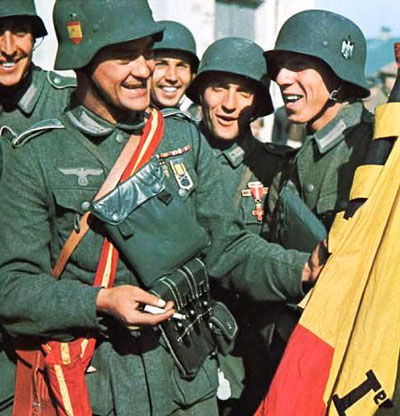
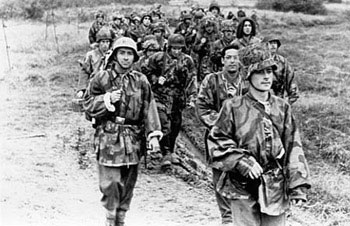
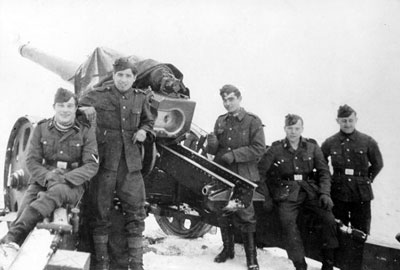
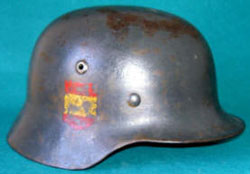
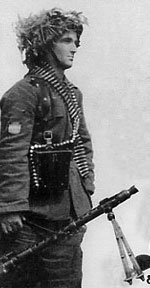
This was a pretty smart move on Franco’s part. In that he kept out of WWII, made Hitler happy, sent folks who were either folks who just love to fight or some of his local enemies. And as an added plus he would be fighting Stalin.
Another follow evil bastard, who had supported the losing /opposing side in the just ended Spanish Civil War. If anything the man never drew a stupid breath! Grumpy
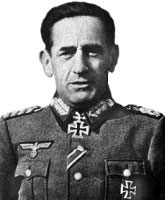
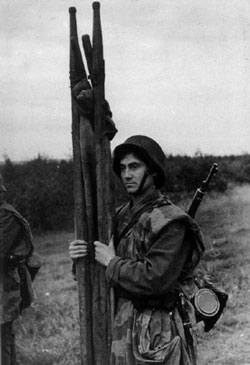
PS here is a bit more about these guys!
|
|



|
In this, John Buxton’s first print, we see troops of the British Royal American Regiment seeking a moment of sanctuary from exhaustion and thirst. It is September 1758 along the high ledges of Laurel Ridge approaching Loyalhanna Creek, where Fort Ligonier will eventually be constructed. An army commanded by General John Forbes with his Second-in-Command Lieutenant Colonel Henry Bouquet are constructing an inland road through the Pennsylvania wilderness. Their objective is to capture the French stronghold located at the forks of the Ohio River known as Fort Duquesne. This “Forbes Road” was a different route than that made by Braddock’s army which was unsuccessful in its attempt to remove the French from the Fort three years earlier. The Forbes Road however was successfully |