
Guard Duty for a squared away US Doughboy in the the trenches of WWI
Guard Duty for a squared away US Doughboy in the the trenches of WWI

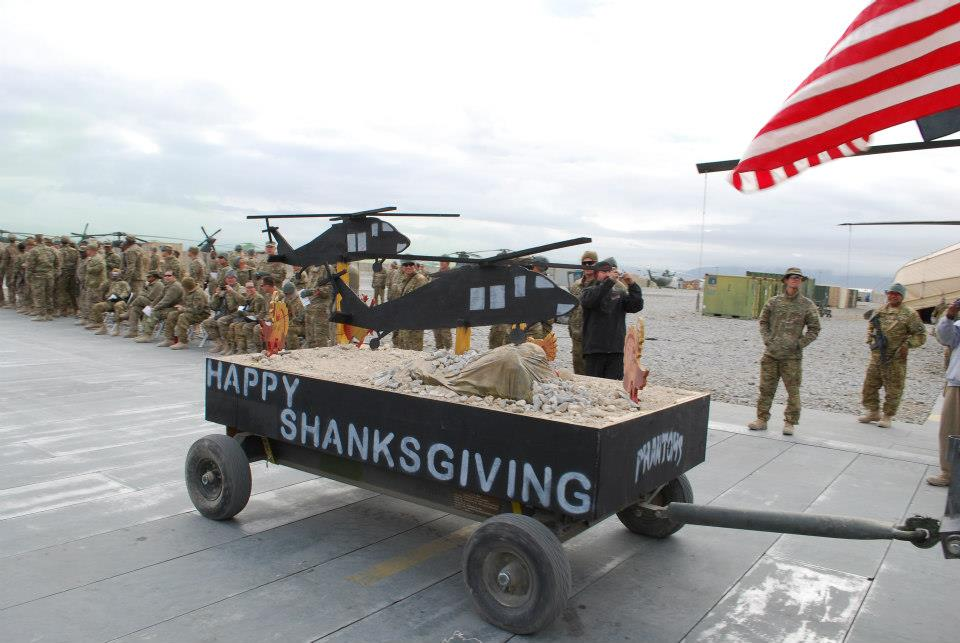
Spending the holidays on deployment is a tough part of military life. On top of being separated from friends and family, the soldiers of the 101st Combat Aviation Brigade, 101st Airborne Division (Air Assault) were deployed to the infamous FOB Shank during Thanksgiving 2012. The Forward Operating Base, located in eastern Afghanistan, was one of the most heavily rocketed in the country during the war. To bring some holiday cheer to their deployment, 5-101 held a Thanksgiving Day Parade at the FOB: a “Shanksgiving” Day Parade. Special thanks to the The War Murals project for pulling this all together on Reddit!

This float sums up Thanksgiving at FOB Shank quite nicely. The CAB flies the UH-60 Black Hawk, depicted here in Team America livery, as well as the CH-47 Chinook and AH-64 Apache helicopters. Also depicted are Thanksgiving-themed Taliban turkeys launching footballs from a mortar tube. Indirect fire, or IDF, was extremely common at FOB Shank. Whoever came up with this float found some serious creativity at the bottom of a Rip It can.
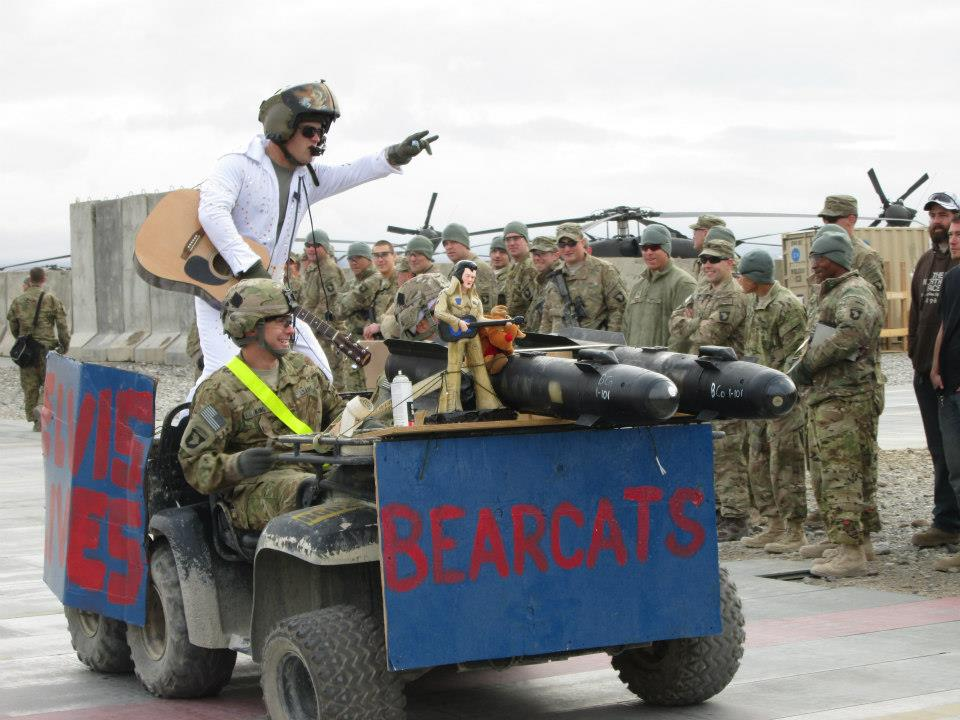
B Co., 1st Battalion, 101st Aviation Regiment brought the King to FOB Shank with their float named “Elvis Lives.” If the sign on the side and the figure in front weren’t enough, one soldier dressed up as Elvis himself with a white rhinestone jumpsuit and guitar. For good measure, the Bearcats strapped two AGM-114 Hellfire missiles to their float.
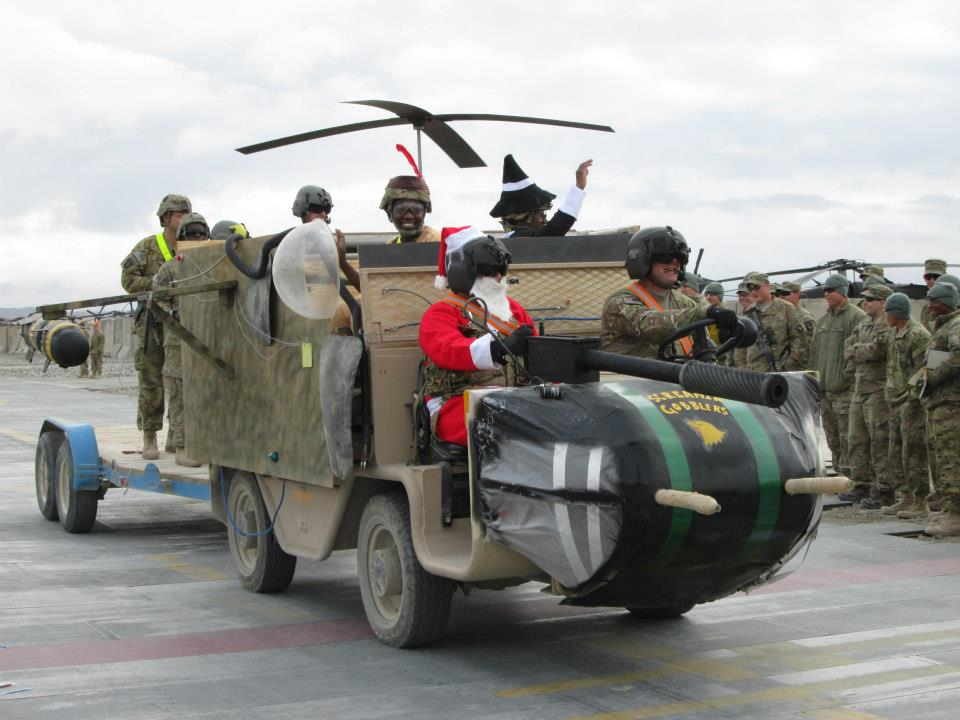
There’s a lot to unpack with this float. First, you have Santa on a .50-cal reminding everyone that Christmas is right around the corner. Behind him are what appear to be a Pilgrim and Native American, representing the Thanksgiving theme. The helicopter float overall appears to be a hybrid of a CH-47 in front and UH-60 in back. However, the keen-eyed viewer will note that the iconic 101st Airborne Screaming Eagle depicted on its nose actually reads “Screaming Gobblers,” maintaining the Thanksgiving theme.
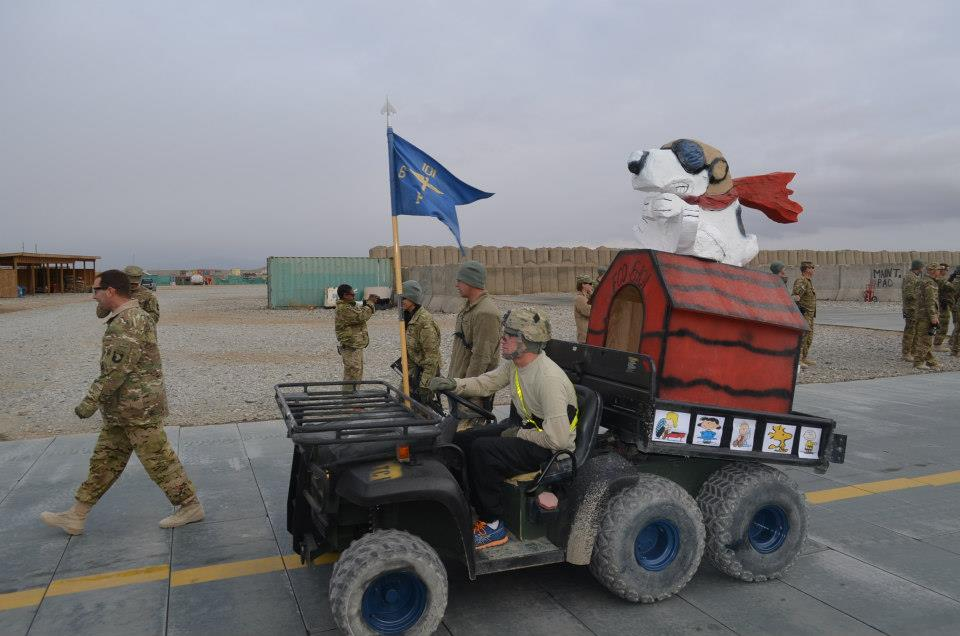
No Thanksgiving Day Parade is complete without America’s favorite cartoon Beagle, and FOB Shank didn’t disappoint. F Co., 6th Battalion, 101st Aviation Regiment topped their float with Snoopy in his WWI Flying Ace persona piloting his doghouse. The float’s sides depict other Peanuts characters including Charlie Brown, Lucy, and Woodstock.
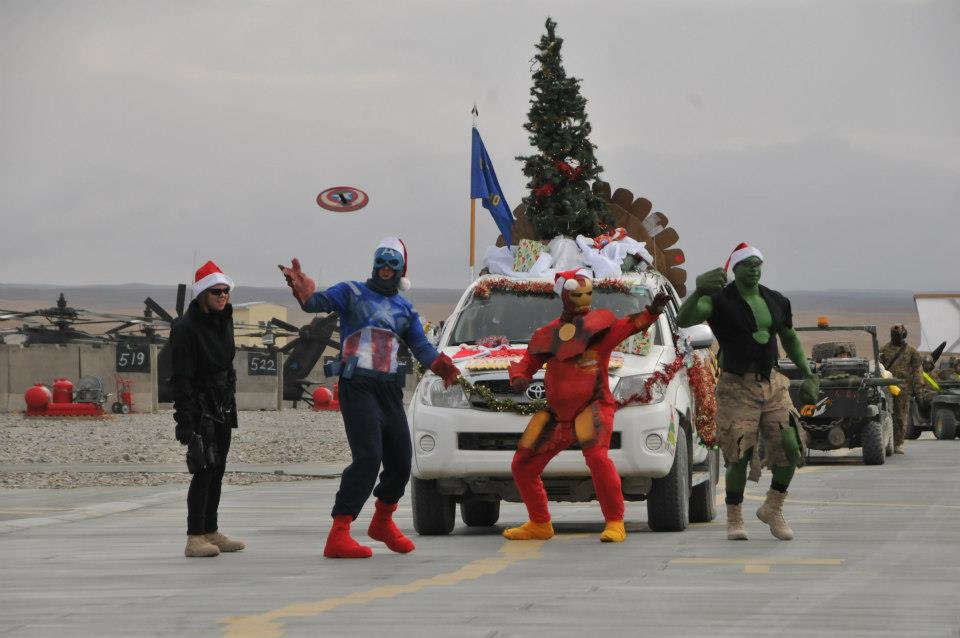
The summer of 2012 saw the release of the first Avengers movie. With their first big on-screen collaboration, characters like Captain America, Iron Man, The Hulk and Black Widow saw an explosion in popularity. Naturally, the 101st CAB included the Avengers in their Thanksgiving Day Parade, topped with Santa hats to keep the festive theming.
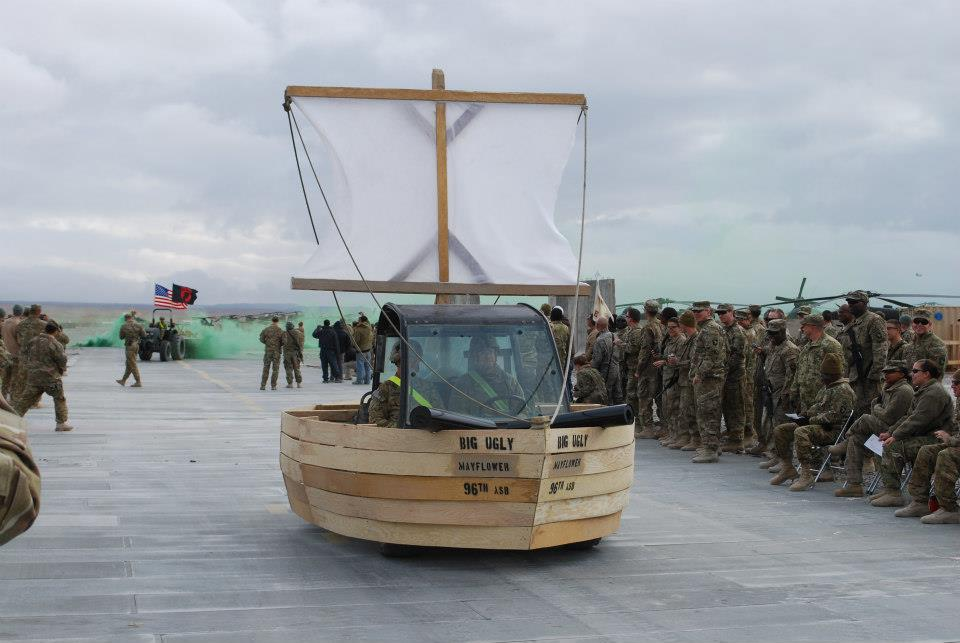
B Co., 96th Aviation Support Battalion’s float was a simple yet impressive representation of the famous Mayflower, the ship that brought the Pilgrims to the New World in 1620. The float is even marked with the company’s nickname, “Big Ugly.”

With this Santa-themed float, the Screaming Eagles depicted Saint Nick in a sandbag-fortified four-wheeler. With all the IDF that FOB Shank received, even Santa Claus could use the extra cover. Still he didn’t forget to bring presents for the troops deployed there. This float was actually named the champion of the parade.



In addition to the parade, FOB Shank transformed its stores into a Black Friday shopping center. Favorite retailers from back home like Target, Walmart and Best Buy were depicted as overlays on the existing storefronts. While there weren’t any doorbuster sales on TVs or gaming consoles, the added taste of home was a nice touch to round out Thanksgiving 2012.
Feature Image: 5-101, 5th Battalion, 101st Aviation Regiment “Eagle Assault” Facebook
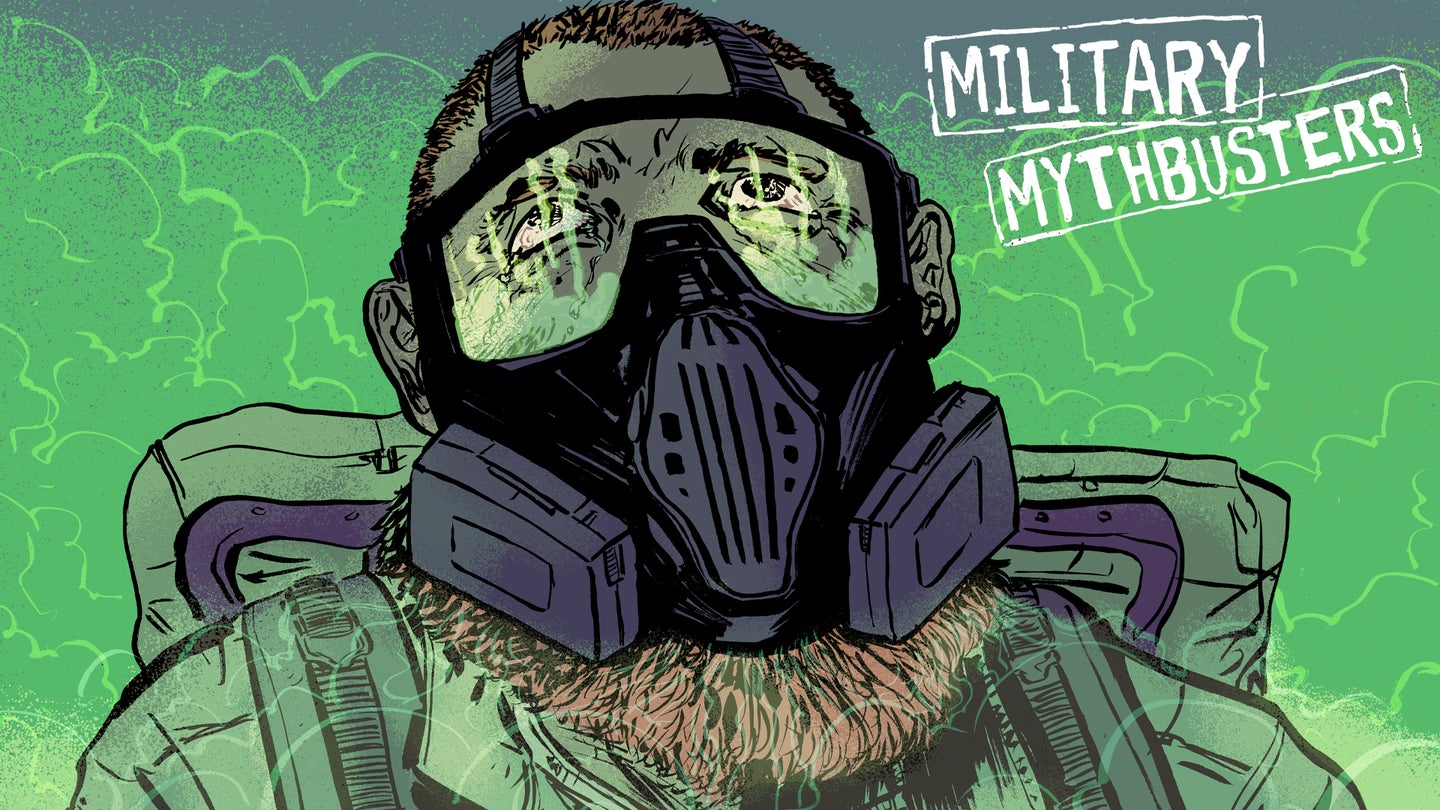
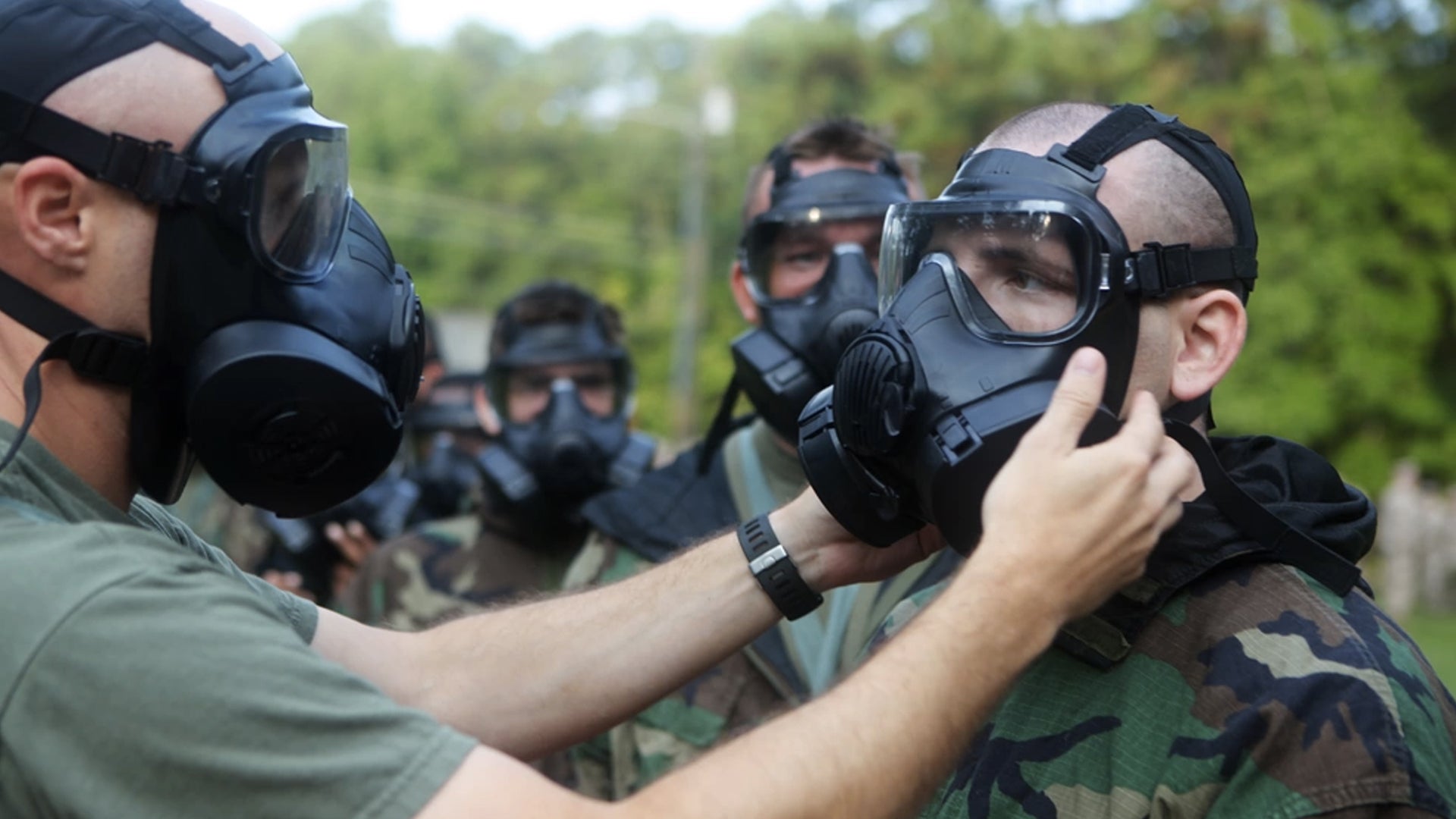
For decades, U.S. military leaders have prohibited service members from growing beards, arguing that facial hair not only disrupts a clean, professional appearance, but also interferes with the seal of a gas mask, oxygen mask or other devices that service members wear to survive hazardous environments. While many military leaders defending the beard prohibition have repeated the claim that beards break gas mask seals, one Air Force doctor has found no direct scientific evidence to support it.
“It’s an unsubstantiated claim,” said Lt. Col. Simon Ritchie, a dermatologist who last year published a study on the beard prohibition’s discriminatory effect on Black airmen. While supporters of current Air Force policy “may have anecdotal evidence of one to five people who they see fail the fit test,” he said, “that can’t be extrapolated to hundreds of thousands of airmen.”
Anecdotal evidence is useful, Ritchie said, but in his years of analyzing the issue he has yet to find an up-to-date, scientifically rigorous study showing that neatly trimmed facial hair impacts the seals of military gas masks.
“In the scientific community, anecdotes are the lowest level of evidence for making recommendations,” the doctor said. “A lot of the consensus papers and position papers on this rely on expert opinion, but none of it is based on an actual scientific study like ‘hey, let’s have people put a M-50 mask on and study that.’”
More scientific evidence is needed to inform the military’s grooming standards, Ritchie said, because the current policies have a discriminatory effect on service members of color. Adhering to the Air Force’s prohibition on beards is difficult for many Black airmen who have a medical condition called pseudofolliculitis barbae. Also known as razor bumps, PFB is a skin condition that makes shaving painful and can lead to permanent scarring if the skin is not allowed to heal. Men of any race can have PFB, but the condition is commonly found among Black men.
The Air Force issues shaving waivers to airmen who, for medical or religious reasons, are not able to shave in line with regulations, and many airmen with PFB receive waivers. However, those waivers might harm the airman’s career prospects due to a long-standing cultural aversion to facial hair in the military.
“Male beard growth beyond that allowed by USAF regulation can cast members in a negative light as it can be considered unprofessional,” wrote Ritchie and his fellow researchers in their study, which found an association between shaving waivers and a “significantly longer” time between promotions.
The promotion system is not necessarily inherently racially biased, the authors cautioned. But it is biased against facial hair, “which will likely always affect the promotions of Blacks/African-Americans disproportionately because of the relatively higher need for shaving waivers in this population.”
You don’t have to suffer from PFB to hate the military’s current policies against facial hair. Unofficial Air Force social media pages are filled with posts written by airmen who are sick of shaving their faces every day and wonder why they have to keep doing it. Many are familiar with the argument that beards prevent a gas mask seal, making it even more odd that there is no direct evidence to back up the claim.
“I won’t speculate, but suffice to say I don’t know,” where the belief that facial hair interferes with a gas mask seal comes from, Ritchie said.
Subscribe to Task & Purpose Today. Get the latest in military news, entertainment, and gear in your inbox daily.
There are some clues out there. While Ritchie could not find an exact date for when beards were first prohibited in the military, he said those policies began to be implemented after World War I, when gas warfare and gas masks emerged on the battlefield. There have been some exceptions. For example, according to U.S. Naval Institute News, sailors were allowed to wear short, trimmed hair, beards and mustaches from the 1880s to the 1960s. The policy was loosened for sailors serving on submarines or in cold climates due to the shortage of freshwater for shaving and the cold temperature, respectively.
In the 1970s, then-Chief of Naval Operations Adm. Elmo Zumwalt loosened the Navy’s facial hair policy even further because he thought it would make the Navy seem less square, thereby improving recruiting and retention. But in 1984, then-CNO Adm. James Watkins banned beards entirely, claiming that they prevented proper seals with emergency breathing apparatuses, which is especially important given how sailors train extensively to fight fires aboard their ships.
“However, the blunt-speaking Secretary John Lehman said that it was simply due to aesthetics,” USNI News wrote. “Lehman said that master chiefs had been complaining that beards made the Navy look ‘extremely un-uniform’ so it was decided that having clean-shaven sailors would bring ‘a general sharpening of appearance.’”
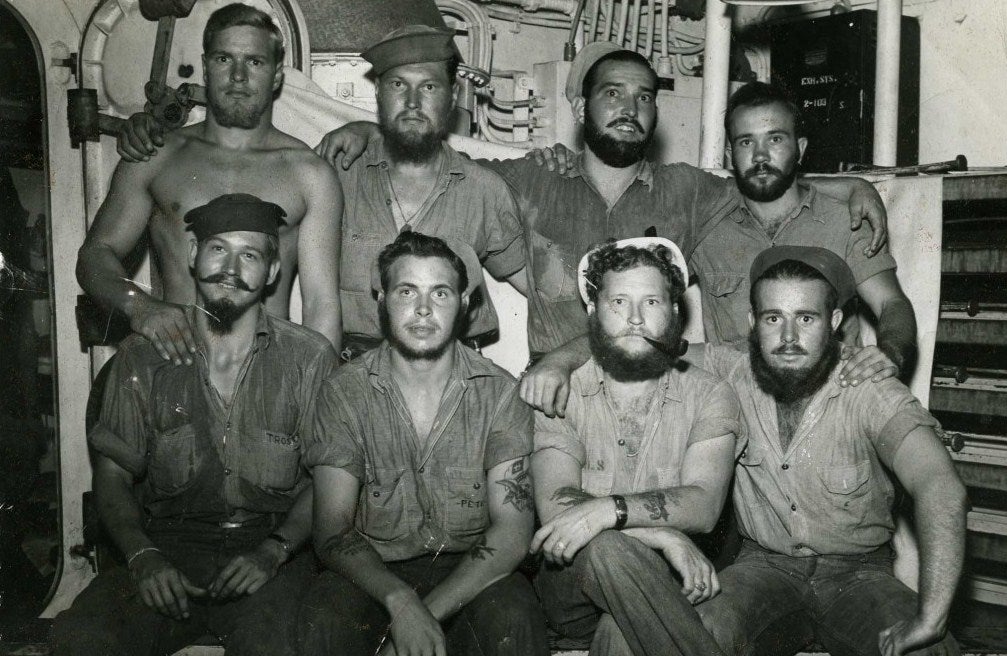
This led to sailors shaving their heads in protest and threatening to send their whiskers to Watkins, USNI News wrote, but the policy remained. On the Army side, it is widely written that the service began prohibiting facial hair to fit with gas mask seals during and after World War I, though this reporter could not find official documents to support this. But more than a century later, there appears to be little direct evidence that links facial hair to poor gas mask fit. While there are plenty of studies that show the deleterious effect of facial hair on gas mask or respirator seals in the civilian world, there are no studies Ritchie could find that gauge how neatly trimmed beards hold up in modern-day M-50 military gas masks.
“These studies are for the civilian population, where there’s a range of thickness, curliness and length that may influence the results,” he said. “It’s tough to look at that and say ‘hey, case closed.’”
In contrast to the civilian world, airmen with shaving waivers are allowed a quarter-inch of facial hair at most, so a study would have to be limited to that length or below for it to be applicable in the Air Force, Ritchie explained.
Still, the United States military is not the only one with men in its ranks. In fact, several other NATO countries such as Canada, Germany and Norway permit service members to wear beards. Surely they must have studied the effect of facial hair on gas masks? Apparently not, said Ritchie, who is stationed at Ramstein Air Base, Germany and so has had plenty of chances to chat with NATO partners about their whisker policies.
“They also can’t point to actual studies,” Ritchie said, “but they can point to lived experience.”
The NATO officers who spoke with Ritchie reported seeing no negative impact of facial hair on oxygen masks for air crew, he said. The airman added that the Royal Canadian Air Force has also had zero physiological events related to beards since the Canadian military first allowed service members to sport them in 2018. Beards also have not been a problem for students from foreign militaries who go through the Euro-NATO Joint Jet Pilot Training program at Sheppard Air Force Base, Texas, Ritchie said.
“The Aircrew Flight Equipment folks at Sheppard we spoke to have had zero problems fitting a bearded pilot,” he said. “We’ve had Sikhs go through that program and people from NATO who have beards for personal preference.”
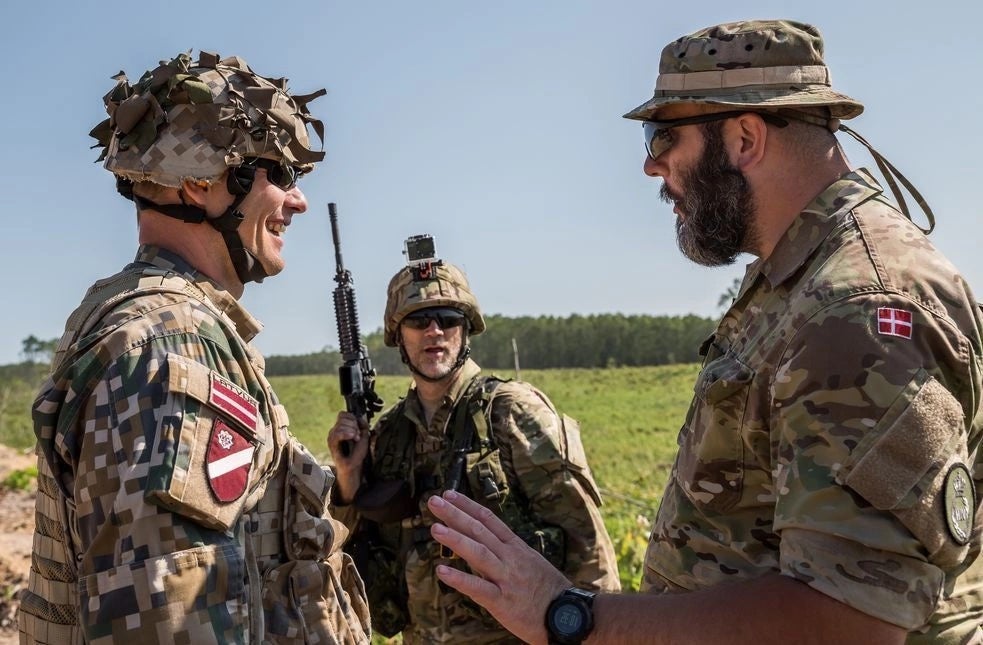
These anecdotes all regard oxygen masks for aviators, so it would be too bold to extrapolate that the same rings true for gas masks, Ritchie explained. Still, it’s a start, and there is also a recent study from the civilian world that could indicate positive outcomes for beard-hopefuls in the U.S. military. The 2018 study showed that facial hair negatively influences the fit factor for half-face negative-pressure respirators as the hair gets longer and more dense. However, beard-wearers can still “achieve adequate fit factor scores even with substantial facial hair in the face seal area,” the study authors wrote. In fact, 98% of the study participants who had an eighth-inch of beard passed the fit test. Those results are encouraging because the respirators used in the study are pretty close to the M-50 gas masks used in the military today in terms of material and fit, Ritchie said.
“I would consider this to be the closest scientific evidence that we have to answer the relevant question we’re facing,” he explained.
Even some clean-shaven service members struggle with sealing a gas mask or oxygen mask. One Air Force C-130 aviator told Task & Purpose that aircrew flight equipment specialists have a machine that tests the aircrew’s oxygen masks “and it can be a huge pain making sure that thing is sealed up perfectly on your face,” he said.
“I have always been clean-shaven and it can be a challenge,” he added, and Ritchie has seen the same problem in his research.
“Not everyone with a shaved face has a good seal,” he said. “Different kinds of faces affect the seals.”
While no scientific study has established the minimum facial hair length that controls PFB, Ritchie has found through his clinical experience of having treated thousands of airmen with the condition that one-eighth inch is almost always sufficient. The Air Force can conduct studies testing that length’s effect on a gas mask seal. As it turns out, a study on facial hair and gas masks would be simple to execute.
A study of this nature would require only 100 to 150 service members, Ritchie said. Participants would be asked to grow facial hair to a given length, maybe a quarter of an inch. They would be fit-tested for a gas mask and given a detailed assessment on the exact amount of air passing through the seal. Then the participants would be given a clipper, trim down to an eighth-inch, repeat, and then do it all again one more time while clean-shaven. The good thing about the study is that it controls for differences in facial structure.
“If people have problems fit testing while clean-shaven, then that might mean facial hair is not the problem,” Ritchie explained.

Now the only thing left to do is to get the Air Force to conduct a study. Ritchie said that his Air Force Times op-ed on the subject in October 2021 got the attention of the Air Force’s Barrier Analysis Working Group, which works to make the service more inclusive. Several senior leaders of the branch also support the work Ritchie is doing, he said. But it is not clear at this point when that support will translate into actually pulling off a study.
“We don’t have to hire RAND or Booz Allen Hamilton to do it, but the Air Force needs to want it to happen,” he said.
If the Air Force does follow through with a study, it could be the first service to do so: Ritchie said he was not aware of any other service conducting such a test. Still, even if the Air Force conducts a study; and if the study finds that trim eighth-inch beards do not affect gas mask seals; and if the Air Force abolishes its prohibition on beards, there would still be decades of institutional bias against beards standing in the way. Even one of the branch’s most beloved former senior leaders, retired Chief Master Sgt. of the Air Force Kaleth Wright, said he spent 29 of his nearly 32-year career opposed to facial hair in his service.
“I was the typical senior leader chief that didn’t think airmen with a shaving waiver belonged in the front office,” he said in April on a panel discussion on male grooming standards in the Air Force. “I had opportunities to hire all kinds of folks and I was adamant about not hiring somebody with a shaving waiver, just because I fell into that category of ‘this is Air Force policy, it’s not professional.’”
Wright said he took that position despite suffering from shaving irritation himself. He eventually learned how to shave in a way that would not irritate his skin, so he believed that if airmen with shaving waivers just did what he had done then they could be clean-shaven too.
“I was willfully ignorant about the impact it was having on young Black men,” he said. “Some of it was because I just ignored it, some of it was because I wanted these young men to do what I did: just suck it up and figure it out and you’ll be fine.”
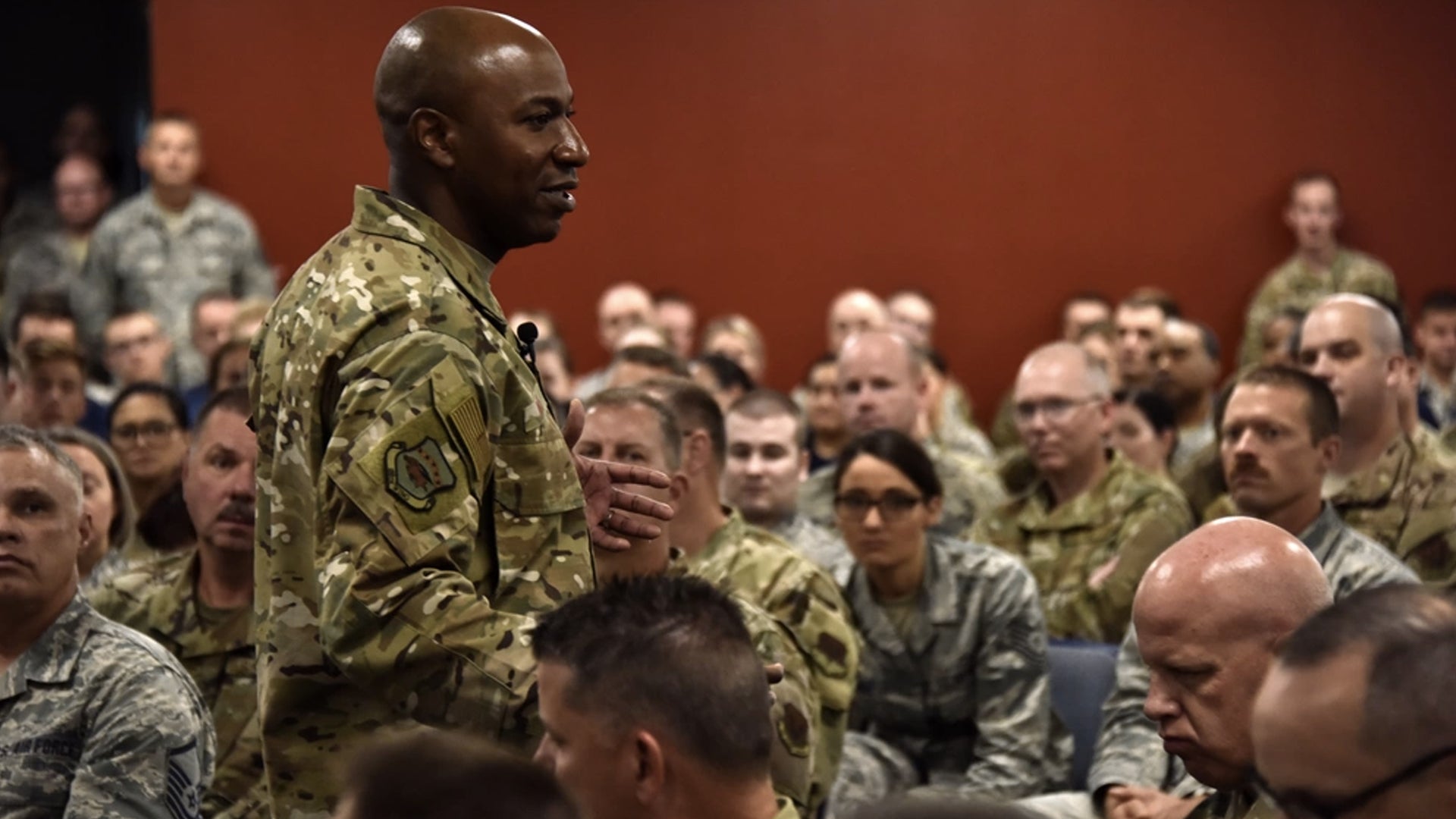
It was only until his time as the top enlisted leader of the Air Force that he realized how, for some airmen, being clean-shaven is impossible without immense pain and skin damage. That realization, along with new data from scientists like Ritchie, convinced Wright to make “a complete 180 on the issue,” he said. The tough part is that most people with power in the Air Force have not made that pivot.
Changing policy, “that actually is the easy part,” Wright said. “The real challenge is ‘how do you change the culture, not just in the Air Force but in the services period.’”
The leaders who are biased against beards in the Air Force are not going to figure out how to work with a new policy allowing beards, Wright cautioned. Instead, “they’re going to shake their heads and find a way to write people with beards off.”
A mere eight days after the panel, a White technical sergeant at Luke Air Force Base, Arizona allegedly texted a Black senior airman with a shaving waiver saying that he was not being considered for a position because “the Air Force is looking for somebody of white complexion,” according to a text exchange shared on the popular Facebook page Air Force amn/snco/nco.
“We personally do not feel as if you are a good choice for the squadron,” the technical sergeant said. “You currently have a shaving waiver which isn’t a professional image, and I think the air force is looking for somebody of white complexion and with the image that the air force needs.”
The matter is currently under investigation by base leadership, but it seems to underline Wright’s point that many people with power in the Air Force will find ways to oppose airmen with beards even if those beards are allowed in the service. That opposition may not always be because leadership is explicitly racist. Like Wright, they might just be working as they’ve been taught within an institution that was built and is still largely led by one group of people.
“The Air Force is run by old White men,” Wright said. “Even if we allow airmen to wear beards, it’s going to be mostly Black men who wear beards. And even if it’s within the policy, commanders will still find a reason to not hire them, to not select them for opportunities, for promotion.”
Still, today’s military culture may not be tomorrow’s. One of those self-identified ‘old white guys,’ Maj. Gen. Kenneth Bibb, is proof of that. At the panel discussion, Bibb recalled saying that airmen with shaving waivers could not “be at the gate, you’re not going to represent my wing … I don’t want you on my Honor Guard.
“Man that hurts now that I think about the words that I said and the guidance that I gave,” said Bibb, who commands the 18th Air Force.
Making airmen feel welcome is a readiness issue, Bibb said: it opens the branch up so that more people can help accomplish the Air Force mission. The general has asked airmen with shaving waivers to share their stories and the anguish they’ve experienced, including one technical sergeant who tried so hard to shave in order to conform with regulations that he needed surgery because he had damaged his face.
“I’ll be the first airman to grow a beard,” if the Air Force drops its prohibition of them, Bibb said. “I think we have to take away the stigmatism that goes with this. Even if you change the rules, if we don’t see leaders that have beards,” then there will still be a stigma.
Wright agreed with the general.
“If generals and senior leaders are wearing beards and it becomes a normalized thing then maybe we weed out all of those folks who would find various ways to exclude folks anyway,” he said.
It’s a learning process, Ritchie said. The Air Force, and the modern military in general, was built a certain way around beards, and it might not have to be that way anymore.
“There’s a quote from Maya Angelou: do your best until you know better, and then do better,” he said. “Everybody should be able to change, to evolve positions and not feel like pride is in the way.”
David covers the Air Force, Space Force and anything Star Wars-related. He joined Task & Purpose in 2019, after covering local news in Maine and FDA policy in Washington D.C. David loves hearing the stories of individual airmen and their families and sharing the human side of America’s most tech-heavy military branch. Contact the author here.

For anyone who grew up in the post-World War II era, his was a household name, one synonymous with “hero,” and “soldier.”
Audie Murphy was known as “the most decorated combat soldier of World War II.”A quintessential soldier, a master of the tools and tactics of ground warfare, he literally wrote the book on military valor—an autobiography entitled, “To Hell and Back.”
He starred in the movie adaptation, too.
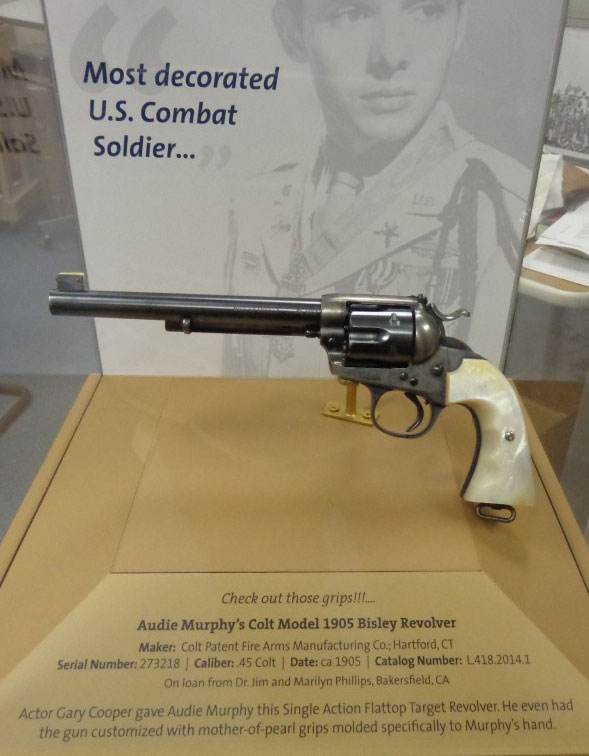
This week, the Buffalo Bill Center of the West, located in Cody, WY, announced that Murphy’s .45 caliber Colt Model 1905 Bisley flattop target revolver—a gift from western film legend Gary Cooper—is on display to the public in its Cody Firearms Museum. The single-action revolver features mother-of-pearl grips that Cooper had molded to perfectly fit Murphy’s hand. Dr. Jim and Marilyn Phillips of Bakersfield, CA, have loaned the firearm to the Center for a period of one year.
In 1942, Murphy lied about his age to join the infantry at 17, after the Marines and paratroopers denied his application due to his small stature. Rising to the rank of First Lieutenant, he fought in nine major campaigns throughout Europe. His gallantry is even more impressive given that victory in Europe was achieved before his 21st birthday.
On January 26, 1945, at the edge of a forest in France, Murphy’s company was pinned down, outnumbered and facing annihilation by a column of German tanks supported by infantry. Ordering his men to retreat into the forest, Murphy commandeered the .50 caliber machine gun on a burning tank destroyer. While directing American artillery over his field telephone, Lt. Murphy swept the German tanks with deadly fire. Shells bursting and bullets ricocheting all around him, and the tank destroyer threatening to explode at any moment, Audie Murphy continued to fire until the enemy force broke and ran.
For his incredible acts of bravery and valor, Audie Murphy received the Medal of Honor. The accompanying citation reported 50 German soldiers killed or wounded and stated, “Lieutenant Murphy’s indomitable courage and his refusal to give an inch of ground saved his company from possible encirclement and destruction and enabled it to hold the woods, which had been the enemy’s objective.”
After the war, Murphy became a Hollywood star, albeit reluctantly, appearing in more than 40 films and receiving critical acclaim for his role in the 1951 movie version of Stephen Crane’s Civil War novel “The Red Badge of Courage.”
Murphy was known to suffer from Post-Traumatic Stress Disorder (PTSD), known then as “combat fatigue,” sharing his struggles and bringing early awareness to the issue. His advocacy for increased government research and funding for veterans with PTSD was honored by the 1973 dedication of the Audie L. Murphy Memorial VA Hospital in San Antonio, TX.
Murphy was 45 when he died in a private plane crash near Roanoke, VA. On June 7, 1971, he was buried at Arlington, where his grave remains one of the most-visited at the National Cemetery.
Lewis Burwell Puller is a Marine Corps legend and American hero. Nicknamed “Chesty” for his burly physique, he was one of the most combat-hardened leaders in military history and saw action in Haiti, Nicaragua, WWII, and Korea. The winner of five Navy Crosses and many other medals, he will always be remembered as a fierce warrior and proud patriot.
One area of Chesty’s life that deserves more scholarly research is his southern heritage. He was born in Virginia in 1898 and was raised on stories of the Confederacy. His grandfather, John Puller, was killed while riding under Jeb Stuart at the battle of Kellys Ford in 1863. Local veterans told young Chesty about his grandfather’s bravery, as John had stayed atop his saddle long after having his midsection torn apart by a cannon. After his grandfather’s death, federals burned the Puller home and his grandmother was forced to walk ten miles, through a sleet storm, for help.
Puller was proud of his ancestry, and his southern roots ran much deeper than The War Between the States (his term of choice for the “Civil War”). His family had come to Virginia in the early 1600s and he could trace back relatives to the colony’s House of Burgesses. Chesty noted that he was also a relative of Patrick Henry, George S. Patton, and that he had a great-uncle named Robert Williams, who deserted the south to join the federal army (the Virginia portion of the family stopped speaking to Williams after this, and he later went on to marry the widow of Stephen A. Douglass). Another famous cousin of Puller’s, named Page McCarthy, was a Confederate captain that fought the last legal duel in Virginia and killed his opponent.
The Confederacy and its legacy left a lasting impression on a young Chesty. As a boy, he witnessed Robert E. Lee Jr. bring a buggy by his home weekly to sell eggs and vegetables to support the Lee family. Puller’s favorite Confederate was Willis Eastwood, who rode with his grandfather and became mayor of West Point. In addition, the Puller home was filled with pictures of great Confederates like Robert E. Lee and Stonewall Jackson.
As a southerner, Chesty also learned the importance of land and self sufficiency. After his father’s death in 1908, Chesty began trapping to support his family. He would capture muskrats, sell the hides for fifteen cents each and then sell the carcasses to poorer families for five cents. He also would catch local crabs and sell them for twenty five cents a dozen. By the age of twelve, young Puller had killed his first turkey and also learned how to hunt rabbits. After his military fighting career was over many years later, Chesty noted that he learned more about the art of war by hunting and trapping, than he learned from any school. He insisted that the skills he learned as a kid, living off the land, saved his life many times in combat.
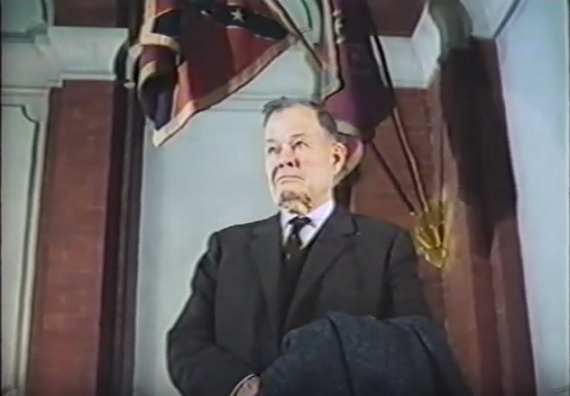
Puller had spent his entire childhood admiring the military leaders of the south. In particular, he loved Stonewall Jackson and he admired the large statue of Jackson that stood at VMI, where Jackson was formerly a professor. One of Puller’s most prized possessions was a copy of George Henderson’s biography of Stonewall Jackson, which Chesty had read repeatedly. He underlined most of the text, wrote Jackson’s famous quote “Never take counsel of your fears.” The book also contained notes on the casualties of Chesty’s men at Guadalcanal and his medals. It was referred to so frequently that it was embedded with dirt and held together with bicycle tape. In many ways, Lewis Puller and Stonewall lived parallel lives. They were both proud Virginians that scored low on VMI’s marks, yet were unmatched in the leadership on the battlefield. Chesty also frequently visited the tomb of Robert E. Lee at Washington and Lee University campus. A documentary, directed by John Ford and narrated by John Wayne, titled “Chesty: A Tribute to a Legend” features scenes of an elderly Chesty visiting the tomb of Lee.
In the tradition of many other famous southerners, Chesty also had an appreciation for the classics. At a young age, he picked up a copy of Caesar’s Gallic Wars and even translated it from Latin. All of these experiences (living off the land, being raised on stories of the south, an interest in military leadership early on) would help mold Chesty into an ideal soldier.
Chesty exemplified the southern military tradition by having an unsurpassed sense of duty to his country, and by being a fierce warrior. The military excellence of the south can be traced back to before the American Revolution. George Washington and Francis Marion, for example, both gained their initial combat experience in the French and Indian War. It could be argued that Chesty was a more efficient leader than both of these men. Contrary to popular myth, Washington was not a great tactician or leader and his victory at Yorktown can really be attributed to the French. One of Washington’s most memorable moments is enduring hardship at Valley Forge, which Chesty Puller compared to his experience in Korea by saying:
“Our forefathers at Valley Forge have been mentioned here tonight as the often are. Well, I can tell you that Valley Forge was something like a picnic compared to what your young Americans went through at the Chosin Reservoir, and they came out of it fine. It never was anything like twenty-five below zero at Valley Forge, either.”
Francis Marion, known as the “Swamp Fox,” used guerilla tactics and partisan warfare to fight the British in South Carolina. This type of fighting drove the British out of the Carolinas and into Virginia, where they eventually surrendered. This method of warfare today is referred to as “maneuver warfare” and has been officially adopted as the Marine Corps doctrine. Marine Corps tactics and the history of southern warfare go hand-in-hand; even today, Parris Island, South Carolina is the main training center for the Marines on the east coast and graduates at least 17,000 men and women per year.
The concept of maneuver warfare is defined by the Corps as “warfighting philosophy that seeks to shatter the enemy’s cohesion through a variety of rapid, focused, and unexpected actions which create a turbulent and rapidly deteriorating situation with which the enemy cannot cope.” This was exactly how Chesty was operating in Nicaragua, Haiti, Korea, and the Pacific.
Southern men like Francis Marion and Nathan Bedford Forrest also implemented these ideas of hitting the enemy hard and fast, with accurate firepower. All of the great southern military leaders, from Washington and Marion, to Lee, Jackson, and Forrest, and then finally to Chesty, were also beloved by their men. Washington got his men through Valley Forge by making sure they had a cup of rum each day and making himself visible to the troops. Francis Marion’s men were unpaid and soldiered on their own accord. Forrest will always be remembered for his battle philosophy of being “first with the most.” Lee and Jackson were men of unshakeable faith and inspirational leadership.
Chesty is still frequently quoted in the Marine Corps, with men carrying on his quotes like “We’re surrounded? Good, now we can fire at those bastards from every direction.” On another occasion, when testing a flamethrower, Puller asked “Where the hell do you put the bayonet?” so that he could stab the enemy after burning them. Puller will always be remembered for his courage and actual presence among his men. Many leaders from Puller’s day were promoted on the basis of their letter-writing ability, and literally gave orders from station wagons, far from the front lines. Chesty, on the other hand, appealed to his men’s senses and spiked morale by his presence. He made sure his men had good chow, shelter, and preferred taking care of matters hands on.
After the Korean War, Chesty’s popularity soared. This presence, combined with his straightforward honesty, soon made him many enemies in Washington. In his early military days, Chesty was chasing bandits and collecting tributes from other countries. By the Vietnam era, Marines were being used to pay tributes to other countries. Chesty was not afraid to call it like he saw it and comment on the misuse of the military. He was a proud believer in esprit de corps, which is love for one’s military machine above all else. Puller did not believe in using the military to give money to countries, especially in the case of billions we will probably never be paid back. He firmly related this belief to his understanding of southern history in a never-before transcribed 1959 speech where he stated:
“I can remember when our great president, Andrew Jackson, sent a navy ship to Italy and gave its captain orders to fire a few shots over the city, send a detail ashore, and collect what they owe us. He fired a few shots over the town, he didn’t have to send the Marines ashore to go and get it. By God, they brought the money out.”
Puller also commented that the military was fighting to sustain war in Vietnam, not to win. He also openly criticized the devaluation of the American dollar, the move away from the gold standard, and inflation. All of these topics were discussed in his 1959 speech, where Chesty openly lamented the upward-spiraling cost of living, combined with the devaluation of the dollar–things which he argued were causing the production of counterfeit currency. He stated that the military was also increasing its expenditures on unnecessary things like private baths for each soldier. Even with all of his dissatisfaction, he always kept his home open to Marines and continued to volunteer for service into his 60s.
Devastation struck Chesty’s family after his only son, Lewis B. Puller Jr., lost both legs and parts of his hands in Vietnam. This occurred after years of Chesty’s critical comments of United States policy, and resulted in Chesty’s desire to offer his own ideas to make the country stronger. One solution Chesty suggested to improve the United States world-wide presence was to give less money to scientists, and put money towards putting young men in schools around the world. This would integrate young Americans into other cultures, help them truly learn languages, and give the United States an advantage in trade and communications.
When we examine Chesty through the lens of his southern heritage, his life and actions begin to make a lot more sense. His combat skills were second to none and reminiscent of men like Francis Marion, Stonewall, and Nathan Bedford Forrest. His devotion to liberty are reminiscent to men like Washington and Lee. Also like a true southerner, Chesty believed in limited government and low taxation. Puller may not have been the best public speaker or man of letters. But he was and will always be a true son of the south. His own history deserves just as much examination as his military leadership.

War exposes the best and worst humanity has to offer. Armed conflict has been a catalyst for some of the most egregious human behavior. It has also been the engine behind history’s most compelling examples of selflessness and valor.

The heroes that wars create are typically venerated by the societies they protect. We rightfully respect and admire those who were willing to risk everything for a cause or, more commonly, for their friends. Humans are tribal creatures. There is little we would not do for our tribes.

There is something visceral about the last stand. A small forlorn band bereft of support arrayed against insurmountable odds fighting to the last simply strikes a primal chord. Examples are well-documented. The Hot Gates at Thermopylae, Custer’s slaughter, and the Alamo stand out. These many tales of selfless bravery are profound and powerful. One lesser-known example is the siege of Bukit Kepong.

Malaysia is a country in Southeast Asia with a current population of around 32 million people. That makes Malaysia the 43rd-most populous nation in the world at present. Today Malaysia is a federal constitutional monarchy consisting of thirteen states and three federal territories. Malaysia shares land and maritime borders with Thailand, Singapore, Vietnam, and Indonesia.

The Malayan Emergency was a rare example of a sweeping fight by a recognized international superpower against a dedicated guerrilla insurgency that ended fairly well for the superpower. In Vietnam once and Afghanistan twice the insurgents ground the superpowers down over time until they eventually took their toys and went home. In Malaya, the pro-independence Malayan National Liberation Army (MNLA) communists were arrayed against the military forces of the British Empire and the Commonwealth. The MNLA fought to eject the British and establish a communist regime in Malaya. Commonwealth troops fought to resist communist expansion and preserve British economic and colonial interests. The MNLA called the conflict the Anti-British National Liberation War.

Interestingly, the British referred to this sordid fight as the Malayan Emergency. They used this terminology because had they declared it a war British insurers would have failed to pay damages. Then as now, acts of civil war were not typically covered under insurance policies.

Bukit Kepong is a small village on the Muar River some 59 km from the town of Johor. During the Emergency, MNLA guerrillas enjoyed a great deal of support among rural villagers who long felt themselves to be oppressed by the colonials. To combat the insurgency the government established a series of police stations in these small communities. The police station in Bukit Kepong was a wooden frame structure housing both the local constabulary and their families. On February 23, 1950, there were 25 police officers present.

A group of between 180 and 200 insurgent fighters under the leadership of one Muhammad Indera staged around the quiet station in the predawn darkness. Indera was also widely known as Ahmad as well as Mat Indera. The local police commander was SGT Jamil Mohd. Many of the officers’ wives and children were also present in and around the facility.

The communist attack was ferocious and sudden. Several police officers fell in the early exchanges, but SGT Mohd quickly got organized. Outnumbered 8 to 1 and taken by surprise, the policemen fought back valiantly.

After the initial exchanges the police force was heavily blooded. Muhammad Indera called for a brief ceasefire and demanded the police officers surrender. Mohd categorically refused. In fact, two of the newly-minted widows took up their dead husbands’ arms and continued the fight.

Time was not on the side of the attackers. With each passing hour, the possibility of an official government relief force grew more troublesome. Now desperate to crush the official resistance, Indera grew more ruthless.

The communist forces captured the wife of one of the defenders and threatened her at gunpoint to force a surrender. The surviving policemen responded that they would never surrender no matter the circumstances. Indera then captured Fatimah Yaaba, another policeman’s wife, along with her young daughter. When the defenders still remained resolute the communists executed both the woman and the child.

After an exchange of fire that had by now gone on for several hours only three policemen and a village guard remained alive. By this point, the insurgents had gotten close enough to set the wooden structure alight. The police station and adjoining barracks were soon fully involved. Two women and their children died in the blaze.

Unable to withstand the searing heat any longer, the four surviving policemen charged out of the burning structure, guns a’blazing. They assaulted through the communist positions, killing three insurgents in the process. Now five hours after the initial shots were fired Muhammad Indera and his band of terrorists melted back into the jungle.

It was tough to determine precisely which weapons were used in this fight. Period photographs showed an eclectic mixture of World War 2-era Allied weapons in use by both sides. An alternative, obviously less reliable, source was a 1982 movie produced about the incident titled, appropriately enough, Bukit Kepong.

Surviving photographs of the police officers showed them armed with American M1 carbines as well as Mk V Sten submachine guns and British Lee-Enfield rifles. The Lee-Enfields were both Mk I and Mk IV versions. The movie also included Bren Mk I light machineguns and M1A1 paratrooper carbines.

Per the movie, the policemen all carried Enfield No 2 Mk I revolvers. The communist leader Muhammad Indera is armed with an American M1911 pistol. The final assault involves the use of British-issue Mills bomb hand grenades as well. While the attention to detail in the film appears to be laudable, I have no way to know if the specifics of the weapons were truly spot on or not.

The combined combatant nations produced enough small arms ammunition during WW2 to shoot every man, woman, and child on the planet forty times. In the years following the end of the war, much of the world was covered in a thin patina of surplus small arms. These weapons found their way into countless brushfire war zones like that of the Malay Emergency. Particularly in places like Malaysia where the world’s superpowers were involved, literally countless WW2 surplus rifles, pistols, SMGs, handguns, and machineguns were pumped into the fight.

The noise of the firefight carried for kilometers across the dank jungle valleys, alerting nearby police outposts of the attack. A neighboring village chief named Ali Mustafa led thirteen lightly-armed auxiliary policemen from Kampung Tui to investigate. These auxiliaries were little more than poorly-trained villagers with sporting arms like single barrel shotguns. Mustafa’s modest force was ambushed about 500 meters from the flaming police station by communist guerillas.

Two of the auxiliaries were killed, and Mustafa ordered several of his troops to retreat while the remainder held the line against the communists now threatened from two directions. While they were prevented from relieving the besieged defenders of Bukit Kepong, their presence did help hasten the communists’ retreat.

A second relief force arrived via sampan from nearby Kampung Durian Chondong soon after the communist retreat. They moved to render aid to the survivors and secure the area. Their arrival at around 10 am–nearly six hours after the initial shots were fired–signaled the end of the exchange.

Only four policemen out of the original twenty-five survived the battle. All four were wounded. Nine family members ultimately survived the blaze. Some forty of the attacking communists died during the firefight.

In the aftermath of the guerrilla attack, the British authorities placed a bounty of M$75,000 on his head, a substantial amount for the day. On the evening of October 14, 1952, roughly two and one-half years after the attack, Indera was invited to a meeting of several acquaintances in Kampung Seri Medan. While there he was served tempeh, a traditional Javanese food made from fermented soybeans, and coffee laced with datura. Datura is a genus of poisonous plant in the nightshade family. The psychoactive substance in datura can cause respiratory depression, cardiac arrhythmias, delirium, hallucinations, and even death in sufficient doses. Once unconscious, Indera was given over to the British authorities.

Indera was charged with coordinating the Bukit Kepong assault and convicted. The following January he was hanged at the Taiping Prison. In August of 2011, a controversial Malaysian politician named Mohamad Sabu controversially claimed during a speech in Gelugor, Pelang, that Indera had been a hero for fighting with the communists to throw off British rule.

Sabu’s speech ignited a firestorm of controversy and was rightfully interpreted as an attack on the legacy of the heroic policemen who had died in the assault. The following month unknown assailants splashed Sabu’s home with kerosene and set it alight. In September of 2011, Mohamad Sabu was formally charged with aggravating the image of the police and their families pursuant to Section 500 of the Malaysian penal code. He was released on bail pending legal proceedings. If convicted he was eligible for up to two years imprisonment for his inflammatory statements. I was unable to ascertain the outcome of his trial. By contrast, over on this side of the pond you can be an ill-informed jerk and get your own talk show. Free speech is an amazing engine indeed. It’s a weird old world.