Category: Soldiering
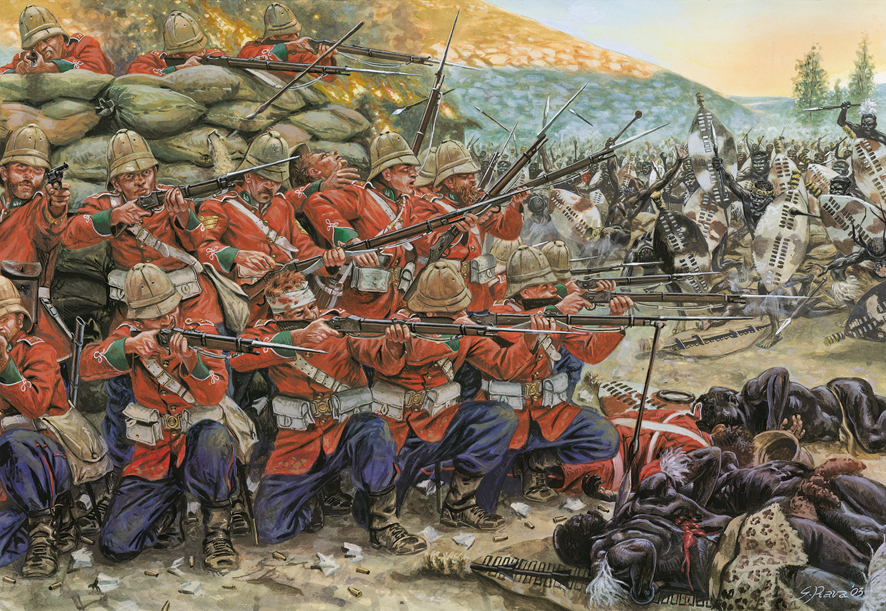 Rorkes Drift 1879, 1st Anglo-Zulu War South Africa

The oldest son of Léon Constant Ghislain Carton de Wiart and his wife Ernestine Wenzig, Adrian Carton de Wiart was born on May 5, 1880, in Brussels, Belgium. Carton de Wiart was raised in a world of privilege, but he was never soft. Rumors swirled during his childhood that the young man was actually the illegitimate son of Belgian King Leopold II. As the child matured his time was split between Belgium and England.

When Adrian was six his parents divorced. His mother married Demosthenes Gregory Cuppa later that same year. This fact has no bearing on the story. I simply thought Demosthenes was one of the coolest names I had ever heard. After the divorce, Adrian’s father moved with him to Cairo. There he learned to speak Arabic.

Adrian’s father remarried, and the boy was dispatched to an English boarding school. This was considered de rigueur for young men of means during this time. He ultimately found himself at Balliol College in Oxford. However, in 1899 Carton de Wiart dropped out of school to go to war.

In a familiar refrain, Adrian lied about his age to get into uniform. In short order, he found himself in South Africa during the Second Boer War. In all the excitement of enlisting, training, and deploying to an active war zone, Adrian neglected to notify his father that he had joined the military. Soon after his arrival in Africa, he was wounded in the groin and belly and evacuated back to England. When his father found out that Adrian had left Oxford to fight in Africa he was livid. Adrian returned to Oxford after he recovered, but this didn’t last, either.

Soldiering was in his blood, and Carton de Wiart sought out chaos. He was granted a commission in the Second Imperial Light Horse and in 1901 made his way back to South Africa. The following year he was posted to India. While there he became enamored with the fine art of pig-sticking.
A Curiously Horrible Hobby

Pig sticking was popular among young British Army officers with more balls than brains. The Indian boar was known as the Andamanese pig and stood roughly three feet at the shoulder. Heavily tusked, these rangy animals topped out at around 300 pounds. Pig stickers took these ghastly beasts with long boar spears. These spears included a rigid cross guard to keep the enraged porker from sliding up the spear once he was pithed to rip the hunter’s heart out with his dying breath.

Of pig-sticking and young soldiers, an unknown military official of the era had this to say, “A startled or angry wild boar is…a desperate fighter [and therefore] the pig-sticker must possess a good eye, a steady hand, a firm seat, a cool head, and a courageous heart.”

I actually know a petite young lady in my modest little Southern town who likes to hunt wild pigs with dogs and a big honking knife. In a crowd, you would take her for a cheerleader. However, she is obviously insane.

Much like his American doppelganger, Theodore Roosevelt, Carton de Wiart viewed physical setbacks as fuel for personal improvement. In the wake of his battlefield injuries, he embraced physical fitness as a remedy for lurking weakness. Though an inveterate gentleman around the ladies, he was also known for his coarse diction when it was just guys. He was later described as, “A delightful character who must hold the world record for bad language.”

In 1908 he married the Countess Friederike Maria Karoline Henriette Rosa Sabina Franziska Fugger von Babenhausen. Once again, there’s no real point to including her here beyond the obvious observation that hers was an absolutely epic name. Together they had two daughters. Imagine having to ask this guy permission to date his little girl…

At the outset of the First World War, Carton de Wiart was posted to British Somaliland to face the Dervish leader Mohammad bin Abdullah. History has come to refer to this character as the “Mad Mullah.” While serving in the Somaliland Camel Corps, Adrian was shot twice in the face. These injuries cost him his left eye and part of his ear. If you’re counting, that should be four major wounds thus far. In 1915 he was awarded the Distinguished Service Order.

After having been shot in the gut, the groin, and the ear and earning a handsome eye patch in lieu of an actual left eye, most combat veterans married to a wealthy Countess would rightfully retire to the family estate to draft their memoirs. By contrast, as soon as he could travel, Carton de Wiart caught a handy steamer for France and the largest war the world had ever seen.

Carton de Wiart commanded three separate infantry battalions and later a brigade. He caught bullets in his ankle and skull during the Battle of Cambrai. At the Battle of Passchendaele, he was shot in the hip and then later in the leg. At Arras, he took yet another round to the ear. He was wounded on seven separate occasions after he got to France.

In 1915 Adrian was shot in the left hand and duly reported to the unit surgeon. His hand was in quite a state, so de Wiart demanded the physician amputate his fingers so he could get back to the war. When the doctor refused the exasperated officer simply tore them off himself.

Carton de Wiart got his brigade a mere three days before the end of the war. Upon his arrival at his new command, the war-weary unit fell in for inspection. A man who was there said this of their new commander’s general demeanor, “Shivers went down the back of everyone in the brigade, for he had an unsurpassed record as a fire eater, missing no chance of throwing the men under his command into whatever fighting happened to be going…He arrived on a lively cob with his cap tilted at a rakish angle and a shade over the place where one of his eyes had been.”

The observer reported that the newly-minted brigadier was also missing a limb and had eleven wound stripes on his uniform. The first man in line for inspection noted that Carton de Wiart, despite having only one eye, ordered him to get his bootlace changed.

While a Lieutenant Colonel commanding the 8th Battalion of the Gloucestershire Regiment in 1916, Carton de Wiart earned the Victoria Cross, his nation’s highest award for bravery in combat. His citation reads, “For most conspicuous bravery, coolness and determination during severe operations of a prolonged nature. It was owing in a great measure to his dauntless courage and inspiring example that a serious reverse was averted. He displayed the utmost energy and courage in forcing our attack home. After three other battalion Commanders had become casualties, he controlled their commands, and ensured that the ground won was maintained at all costs. He frequently exposed himself in the organization of positions and of supplies, passing unflinchingly through fire barrage of the most intense nature. His gallantry was inspiring to all.”
We’re Just Getting Warmed Up

After the war, Carton de Wiart was posted to Poland as part of the British-Poland Military Mission. Poland was at that time in conflict with the Russians, the Lithuanians, the Ukrainians, and the Czechs. Throughout his time in Poland, de Wiart faced peril aplenty. In 1920 while out on an observation train his party was attacked by Red Army cavalry. De Wiart posted himself on the footplate of the train and repelled the mounted troopers with his revolver. At one point he fell off of the moving train only to quickly reboard. You recall that throughout it all the man only had the one hand and a single eye.

Carton de Wiart retired in December of 1923 to the estate of a Polish friend in the Pripet Marshes. Of the next period of his life, he later said, “In my fifteen years in the marshes I did not waste one day without hunting.”

In the summer of 1939 with the Nazis preparing to invade, de Wiart was recalled to active duty. When the Germans overran his estate they stole his fishing tackle, gun collection, furniture, and clothing. De Wiart narrowly escaped through Romania after an attack by the Luftwaffe that killed the wife of one of his aides. By now the old soldier was angry.

Carton de Wiart commanded Commonwealth forces during a running fight across Norway culminating in a desperate seaborne evacuation led by Lord Louis Mountbatten. Afterward, he briefly commanded a division in Northern Ireland before being dispatched to Yugoslavia as head of the British-Yugoslavian Military Mission. While en route in a Vickers Wellington bomber, the plane crashed into the sea about a mile short of Italian-controlled Libya. The 60-year-old, one-armed British Major General was knocked unconscious in the crash, but came to once doused in the cold water of the Mediterranean. He swam to shore but was captured by Italian forces on the beach.

During his subsequent incarceration as a POW, Major General de Wiart attempted to escape five times. One attempt to tunnel out of his camp occupied him for seven months. He once successfully remained loose for eight days disguised as an Italian peasant. This was all the more impressive considering he had only one arm, one eye, sundry obvious scars, and didn’t speak Italian.

Once the Italians decided they would abandon the Nazis they requested de Wiart serve as their emissary to the British Army. In this capacity, he needed fresh clothes and was sent to Rome at government expense for a fitting. Though he distrusted the Italian tailors, he said that he, “Had no objection provided he did not resemble a gigolo.”

We lack the space to do this man justice. After the Italian surrender, de Wiart was posted through China, India, and Egypt in a variety of official roles. Along the way, he was appointed Knight Commander of the Order of the British Empire.

When passing through Rangoon, de Wiart tripped on a coconut mat and tumbled down stairs, fracturing several vertebrae in his back and rendering himself yet again unconscious. With a little time in a Burmese hospital he recovered. His first wife died in 1949. Two years later he married a woman 23 years his junior. Carton de Wiart finally retired for real to Aghinagh House in Killinardish, Ireland. He died in the summer of 1963 at the age of 83, a British hero of the sort about whom ballads are crafted.

On January 8, 2022, Aleksander Tarnawski turned 101 years old. 101 years prior he had entered the world kicking and screaming in Słocin in the Rzeszów poviat in Poland. At age seventeen, Tarnawski graduated from the gymnasium in Chorzów. He then enrolled in the University of Lviv studying Chemistry. The following year the entire world conflagrated.

Poland suffers from some of the most lamentable geography. Poland is on the way to any number of juicy geopolitical targets and has suffered from some of the most deplorably unneighborly neighbors. Like most of the young males of his generation, Aleksander Tarnawski soon found himself swept up in the war.

Tarnawski was not drafted in time to serve during the German invasion, but he was eventually arrested by the Soviet NKVD. At this time in this place, the NKVD didn’t need much of an excuse to arrest or even kill you. After presenting his documents from the University of Lviv he was ultimately released.

Tarnawski’s was the first generation of modern Poles to come of age in a free nation. When commenting on his mindset and that of his comrades he said this, “During my childhood and youth, after so many years of captivity, patriotism and the need to sacrifice oneself for the motherland were the main slogans. And if a young man like me grew up in such an atmosphere, it was as it is.”

Poland fell to Germany in 35 days. Their dedicated professional army was outnumbered by more than two to one. The overwhelming combat power of the Wehrmacht secured the nation on October 6, 1939. 874,700 Poles were hors de combat. 66,000 gave their lives in defense of their country…in 35 days. By comparison, we lost 58,000 troops in ten years’ worth of intense combat in Vietnam.

Traveling with a large number of refugees fleeing the Nazis, Aleksander Tarnawski made his way across the border to Hungary. After a stint in a Hungarian refugee camp, he crossed into France, where he reported to the WKU recruiting point. From there he was assigned to the 1st Infantry Regiment of the 1st Grenadier Division.

By now the Nazi blitzkrieg seemed irresistible. With the collapse of the Allied armies on the continent, Tarnawski was one of the lucky few to escape across the English Channel to Britain. Upon his arrival, the young man immediately began training to take the fight back to the Germans.

Once in Great Britain Tarnawski trained as an armor soldier. One day in mid-1943 he was approached by a Polish Colonel who asked if he would like to return to Poland. He explained, “I was 22 at the time, and secondly, there was a war all over the world, and I was sitting here idly, I agreed to go to Poland without hesitation.” Aleksander Tarnawski had just assessed into the Cichociemni.

The Cichociemni were the commandos of the Polish underground. The word roughly translates to, “The Silent Unseen.” Their mission was to infiltrate occupied Poland, coordinate and execute resistance operations, and kill Germans.

Drawn from all units of the Polish Armed Forces not under German subjugation, they knew they were volunteering for the most dangerous work of the war. Tarnawski trained in the art of close combat, silent killing, demolitions, covert communication, and spycraft under the tutelage of the British Special Operations Executive.

Tarnawski’s training included extensive physical fitness and the expert use of a wide variety of German, Russian, Polish, Italian, and British weapons. They trained to covertly emplace mines while learning cryptography, land navigation, and advanced marksmanship techniques. They learned about life in German-occupied Poland covering everything from curfews and military laws to contemporary fashion trends. Their hand-to-hand training was based on jujitsu.

Of 2,413 candidates, only 605 passed the training course. Among them were fifteen women. Of those, some 579 qualified for operational assignments. 344 of those trained operators were eventually deployed to Poland. 113 of these were ultimately killed in action.

On the night of April 16, 1944, Aleksander Tarnawski climbed aboard a four-engined Halifax bomber from the 300th Bomber Squadron at the Allied airbase in Brindisi, Italy, as part of Operation Weller 12 under Captain Edward Bohdanowicz. After an uneventful night combat insertion near the Polish village of Baniocha at Gora Kalwaria outside Warsaw, Tarnawski went to work. He was ultimately assigned to the Nowogródek District of the Home Army.

The Polish Home Army was designated the Armia Krajowa or AK for short. Their general mandate was to make life as miserable as possible for the German occupation forces. As the Soviet Red Army got closer to the Polish border the AK got more audacious in their combat operations.

This mandate was both incredibly complex and unimaginably dangerous. With support from the Cichociemni and Allied logistics, AK operatives conducted sabotage and direct action raids, emplaced mines, and established supply caches to support their sweeping insurgency efforts. The largest coordinated resistance operation of WW2 was the Warsaw Uprising that kicked off on August 1, 1944, under the direction of the AK. The Warsaw Uprising was part of the overarching Operation Tempest.

For sixty-three days Polish unconventional troops engaged in raging combat with German forces with little to no outside support. The Red Army had drawn up alongside the eastern suburbs of the city on Stalin’s orders and refused to assist the initiative. Stalin knew that the subjugation of Poland would be a necessary part of his post-war plans for conquest. Allowing the Germans to crush the Polish Home Army dovetailed perfectly into his dark schemes.

The Poles began the operation with nearly 49,000 men under arms. However, these were generally highly motivated but poorly trained irregulars armed with little more than a scrounged weapon and a handful of ammunition or a grenade. Arrayed against them were as many as 25,000 battle-hardened Wehrmacht and SS troops amply supplied and equipped with state of the art weapons.


During the course of the fight, the Poles employed two captured German Panther tanks, a Hetzer assault gun, and a pair of armored half-tracks. The Germans for their part had dozens of armored vehicles at their disposal along with Ju 87 Stuka dive bombers. The end result was a massacre.

More than 15,000 Polish resistance fighters died in the fight, while another 15,000 were captured. 5,660 Polish First Army soldiers became casualties. Balanced against that the Germans suffered as many as 17,000 killed or missing. There was as many as 200,000 civilian dead. Once the fighting abated the Germans came in and systematically leveled the city. The breadth of destruction precluded reliable numbers.


The Polish AK fought with whatever they could scrounge. They improvised armored vehicles out of civilian trucks and widely employed the Błyskawica submachine gun. A crude Sten-like weapon, the Błyskawica was the only standardized, mass-produced weapon to be built in occupied Europe during the war. The gun fired 9mm Para at around 600 rpm from a 32-round box magazine. Roughly 700 copies were built in underground workshops in Poland.

Throughout his time in occupied Poland, Aleksander Tarnawski undertook difficult and hazardous covert missions and also trained AK soldiers in the combat skills they needed to face the Germans. In slightly more than a year in combat Tarnawski earned the Polish Cross of Valor four times. He left the military as a Major.
The Rest of the Story

After the war, Tarnawski got a job with Polish Radio in Warsaw. Despite the chaos of active special operations service against the Nazis, he still retained his passion for Chemistry. He subsequently landed employment as a lab assistant in the Walenty Wawel coal mine in Ruda Slaska. From there, Tarnawski earned a Masters Degree in Chemical Engineering from the Silesian University of Technology.

Tarnawski eventually served as an assistant professor at the Institute of Non-Ferrous Metals in the 1960’s. He then earned a position as Senior Laboratory Engineer at the Institute of Plastics and Paints in Gliwice where he worked until he retired in 1994. Along the way he was married, widowed, and remarried, this time to a fellow Chemistry professor. Together they had a daughter who eventually earned her own PhD in Economics.

In September 2014, at age 94 at Książenice near Grodzisk Mazowiecki, fully seventy years after being dropped into Poland at night from a British Halifax bomber, Aleksander Tarnawski made one last parachute jump. This time he hit the silk with former and current GROM operators. GROM is short for Grupa Reagowania Operacyjno-Manewrowego which loosely translates to “Group for Operational Maneuvering Response.” I’m told this also means, “Thunder.”

Formally activated in 1990, GROM is one of five special operations units of the Polish Armed Forces and is respected around the world within the specops community. GROM is named in honor of the Silent Unseen of the WW2-era Polish Home Army. GROM operators are colloquially referred to as “The Surgeons” for their recognized capabilities at precision direct action operations.

As of January 2022, Major Tarnawski was the last survivor of those original 344 Cichociemni sent into combat during World War 2. After fighting the Germans undercover for more than a year and facing the likely prospect of torture and horrible gory death at any moment, Tarnawski went back to school and spent his entire professional life making the world a better place. He also saw to it that his daughter was educated and productive as well.

As amazing as his story was, Aleksander Tarnawski was typical of his generation. Those crusty old guys grew up with absolutely nothing and then faced literally unimaginable challenges. They not only prevailed in the face of such profound adversity but also thrived. Today’s crop of perennially-offended, easily-breakable social justice snowflakes would do well to learn from their example.


Everybody dies. That’s an easy thing to digest in the abstract. When you’re young, fit, and healthy it is often even comical. However, when the situation grows dire all that comedy is excised. Having seen my share I have been surprised at how many folks, even really old people, find the event so unexpected. Death is a big deal, and it warrants a little forethought.

The average life expectancy in America is 78.57 years. We all presume we will drift off quietly in our sleep and be too old to care. However, death comes for many in much darker more sordid ways.

There is little more viscerally horrifying than the prospect of being eaten alive. Getting gobbled up by some massive predator would actually likely be faster and less agonizing than a lot of the other alternatives. However, on a primal level, most folks just don’t want to end up as food. For several hundred Japanese grunts pulling garrison duty on an obscure island in the South Pacific in 1945, however, their gory demise was indeed extra horrible.
The Setting

The Imperial Japanese Army captured Ramree Island, a 520-square mile landmass off the coast of Rakhine State in what is today known as Myanmar, in 1942. The island is separated from the mainland by a narrow strait that averages a mere 150 meters across. For three years this Japanese garrison saw little to no action. In January of 1945, however, they would earn their combat pay.

In 1945 the garrison consisted of around 1,000 men assigned to the Japanese 54th Division and commanded by one Kanichi Nagazawa. On 21 January a flotilla containing the battleship HMS Queen Elizabeth, the escort carrier HMS Ameer, the light cruiser HMS Phoebe, and three British destroyers opened up on Japanese artillery positions established in caves overlooking the proposed landing beaches. This armada was supported by American B24 Liberators, B25 Mitchells, and P47 Thunderbolt fighter bombers.

By this point in the war, the Japanese were most typically staging their primary defenses inland in-depth, so the assault force landed essentially unopposed. The real chaos would come later. Two small craft struck mines, but the invasion itself was otherwise uneventful. As the Indian troops under Brigadier RD Cotterell-Hill advanced, however, the Japanese defenders put up a spirited fight.

A joint force comprised of Indian Infantry along with Royal Marines outflanked the Japanese positions, rendering them untenable. In response, the Japanese defenders fell back intending to join a second, larger element on the opposite side of the island. To do so, however, these battle-weary Japanese troops had to traverse 16 kilometers’ worth of fetid mangrove swamp.
Like a Bad Movie

By the time the Japanese defenders struck out into the swamp, the British had the entire area surrounded. Realizing the plight of the defenders to be hopeless, the British addressed the retreating men via loudspeakers entreating them to surrender. Alas, the Japanese during WW2 didn’t do a great deal of surrendering. The stage was set for Something Truly Horrible. A British soldier named Bruce Wright who later became a naturalist of some renown described the proceedings thusly—

“That night [of 19 February 1945] was the most horrible that any member of the M. L. [motor launch] crews ever experienced. The scattered rifle shots in the pitch black swamp punctured by the screams of wounded men crushed in the jaws of huge reptiles, and the blurred worrying sound of spinning crocodiles made a cacophony of hell that has rarely been duplicated on earth. At dawn the vultures arrived to clean up what the crocodiles had left….Of about one thousand Japanese soldiers that entered the swamps of Ramree, only about twenty were found alive.”
The Weapons

The Japanese fought World War 2 with what were arguably the best and worse Infantry weapons in the world. The Type 26 revolver and Type 94 pistol were inexplicably wretched. Though the Type 26 was meticulously well crafted, there was no positive cylinder stop to keep the cylinder properly indexed. Bumping the gun could rotate the cylinder such that the next shot might fall over an empty chamber.

The Type 94 is universally extolled as the worst combat handgun in military history. The grip tapers down so it feels like it is going to squirt out of your hand when you grasp it tightly. The magazine floorplate is not positively retained, so it can slip off and spill the contents of the magazine out of the butt. Most importantly, the transfer bar is exposed on the side of the gun. This means a good squeeze on the side will fire the weapon without the trigger having been touched. The same result can be elicited by setting the gun down vigorously on an uneven surface. Wow.

Japanese machineguns were heavy, reliable, and beautifully crafted. However, they used three different cartridges, two of which looked pretty much the same on the outside. The logistics of trying to keep all those guns fed across the vast Pacific theater would be unimaginably daunting. The Type 99 rifle, however, was a superb example of the military art.

In 1939 the Japanese designed a new bolt-action service rifle to replace the previous Type 38. They found that the 7.7x58mm Arisaka cartridge used in their machineguns was vastly superior to the 6.5x50mm round fired by the Type 38. The Imperial Japanese Army simply adapted the proven Type 38 design to fire the new round. Ultimately some 3.5 million copies were produced at nine different arsenals.

The Type 99 was produced in four distinct variants. The most common was the Type 99 Short Rifle. A limited production Type 99 Long Rifle was fielded as well. Additionally, there was a Type 99 Sniper variant equipped with a fixed-power optic. One version incorporated an offset optic mount and straight bolt handle that would accommodate stripper clips loaded from above. A second variant had a bent bolt and a centerline scope mount that necessitated rounds be loaded one at a time. There was a takedown paratrooper version of the basic rifle as well.

The Type 99 was the first mass-produced Infantry arm to include a chrome-lined bore for use in fetid jungle climes. Early versions of the Type 99 were meticulously executed with a variety of curious ditzels of dubious tactical utility. The first marks featured a pressed steel action cover, a flimsy folding wire monopod, and a bizarre antiaircraft sight with fold-out wings. This contrivance was intended to help Infantrymen on the ground determine proper lead for enemy aircraft crossing laterally. All of this stuff was deleted from production by the end of the war.

The safety on the Type 99 was a meticulously knurled knob located on the rear aspect of the bolt. To manipulate this device, one would press inward with the palm and rotate the knob 1/8 turn. This design seems clumsy when compared to the simple safety lever of the British Lee-Enfield or German Mauser designs.


As the war progressed and the full force of the massed B29 raids took their toll on Japanese industry the quality of the Type 99 rifle dropped off precipitously. These late-war versions were known as “last ditch” rifles. Such crude examples typically had no finish on the steel, rough tooling marks, and a simple fixed aperture rear sight. The oversized safety knob was left rough and unfinished, while the crude wooden buttplate was held in place via nails rather than screws. Many of these late-war rifles used a length of hemp rope in lieu of a sling as well.

Each Type 99 rifle included a chrysanthemum engraved on the receiver ring signifying personal ownership by the Emperor. Many to most examples sold today have had the mum ground off as a sign of respect for the defeated monarch. I have read that General MacArthur himself mandated this practice in an effort at smoothing out the occupation. Examples with intact mums command markedly higher prices as a result. Tests conducted by the NRA after the war comparing bolt-action rifles showed the Japanese Type 99 to be the strongest action used by any combatant nation during the conflict.
Aftermath

The numbers are disputed, but the generalities are reliable. The battle went on for six weeks. Of roughly 1,000 Japanese troops who retreated into the swamp, some 500 made it across the waterway to the mainland. Another 20 were captured. The rest were consumed by the island. Some likely succumbed to sharks while crossing to the continent, while others undoubtedly fell to British fire and disease. A not insubstantial number, however, were indeed eaten by crocodiles.

Around 1,000 people each year are estimated to succumb to crocodilians of all species today. The saltwater crocs endemic to Ramree Island in 1945 would have reached twenty feet or more and weighed some 2,000 pounds.

The Guinness Book lists the carnage in Ramree Island’s mangrove swamps as the worst example of crocodile predation on humans in history. There were 500 or so troops who remained unaccounted for that night. Theirs was an undeniably ghastly end.
