Category: Soldiering

Thomas Jackson’s great grandparents were criminals. John Jackson and Elizabeth Cummins were both convicted of larceny in England and were punitively dispatched to the New World in 1749 alongside 150 other convicts. On the voyage across the Atlantic, John and Elizabeth fell in love.
Once their obligatory bond service was complete in 1755 they were married. Their grandchild Thomas Jonathan Jackson was born in 1824 in Clarksburg, Virginia. He was the third child of Julia and Jonathan Jackson. In his youth, Thomas went by the nickname “The Real Macaroni,” though the origins and significance of that term are not well understood.
Typhoid took his six-year-old sister in 1826 and his father some three weeks later. The boy’s remaining sister Laura Ann was born the day after her father died. Thomas and Laura Ann were close as children, but Laura Ann ultimately sided with the Union. Thomas grew to become a Confederate General of some renown. As a result, their relationship remained fractured until his death.
Military Service

Thomas Jackson entered the US Military Academy in 1842. Jackson’s lack of formal education hamstrung him upon his arrival at West Point, but his legendary dogged determination compensated. He graduated 18th out of 59 in his class of 1846.
Jackson got his formal introduction to war in Mexico. As a young officer, he distinguished himself at Chapultepec. For a decade starting in 1851 he taught at Virginia Military Institute where he was unpopular with his students. Along the way he was twice married. His first wife died in childbirth. His second, Mary Anna Morrison, lived until 1915. When the South seceded in 1861 following the attack on Fort Sumter, Thomas Jackson threw his lot in with the Confederacy.
In July of that year, Jackson commanded a brigade at the First Battle of Bull Run. At a critical moment in the fight, Jackson beat back a determined Union assault. Barnard Elliot Bee, himself a distinguished Confederate General who ultimately lost his life in combat, referred to Jackson as a “stone wall” in the face of the enemy. The name stuck.
After an initial setback attributed to flawed intelligence, Stonewall Jackson dominated the Shenandoah Valley campaigns of 1862. Through truly exceptional tactical acumen, Jackson and his troops defeated three separate Union armies in the field. He exercised his martial gifts at places like Harper’s Ferry, Antietam, and Fredericksburg, developing for himself a reputation as a cunning and insightful combat leader. At Chancellorsville Jackson’s 30,000 Confederates launched a devastating surprise attack against the Federal flank that drove the Union troops back fully two miles.
The General’s Theology
Thomas Jackson has been described as a fanatical Presbyterian. His deep and sincere faith drove everything about his life while making him all but fearless in battle. He once opined, “My religious belief teaches me to feel as safe in battle as in bed. God has fixed the time for my death. I do not concern myself about that, but to be always ready, no matter when it may overtake me…That is the way all men should live, and then all would be equally brave.”
Like most exceptional personalities, Jackson was also a bit strange. He held a lifelong belief that one of his arms was longer than the other. He would frequently hold the perceived longer of the two aloft for long periods in an effort at equalizing his circulation.
General Jackson highly valued sleep and was known to fall asleep at times while eating. His prior service as an artillery officer had severely damaged his hearing. This made communication difficult at times. He also had an abiding passion for fresh fruit like peaches, watermelons, apples, and oranges. His real weakness, however, was lemons. When they could be found Jackson would frequently gnaw whole lemons in an effort at soothing his digestion. General Richard Taylor, son of President Zachary Taylor and a colleague, wrote, “Where Jackson got his lemons ‘no fellow could find out,’ but he was rarely without one.”
Stonewall Jackson and Slavery
No information age treatise of a prominent Confederate can be complete without dragging slavery and race into the narrative. In the late 1850s, Jackson owned six slaves. Three of these–Hetty, Cyrus, and George–were received as part of a dowry from Mary Anna’s father upon their marriage. Two others supposedly requested that Jackson purchase them based upon his purported kindly local reputation. Of the two, Albert was purchased and worked to gain his freedom. Amy served as the Jackson family cook and housekeeper. The sixth was a child with a learning disability who was received as a gift from an aged widow.
In what was considered a fairly radical move for the day, in 1855 Jackson organized and taught Sunday School classes for blacks at his Presbyterian Church. Of this ministry, Pastor William Spotswood White said, “In their religious instruction he succeeded wonderfully. His discipline was systematic and firm, but very kind…His servants reverenced and loved him, as they would have done a brother or father…He was emphatically the black man’s friend.” I obviously cannot speak to what any of that was really like, but Reverend White was clearly a fan. Not diminishing the repugnant nature of slavery as an institution, but it was clearly a different time.
The Death of Stonewall Jackson
After a wildly successful engagement against Joe Hooker’s forces during the Battle of Chancellorsville, Jackson and his staff were making their way on horseback back through friendly lines. They encountered sentries from the 18th North Carolina Infantry who mistook the party for Union cavalry. The pickets shouted, “Halt, who goes there?” but fired before receiving an adequate response.
Frantic remonstrations from the command group were answered by Confederate Major John D. Barry’s command, “It’s a damned Yankee trick! Fire!” During the course of the two volleys, Stonewall Jackson was struck three times.
Two rounds shattered Jackson’s left arm. One ball entered at the left elbow and exited near the wrist, while another struck his left upper arm three inches below the shoulder. A third ball struck his right hand and lodged there. Several members of Jackson’s staff along with their horses were killed. The poor visibility and incoming artillery fire added to the confusion. Jackson was dropped from his stretcher at least once during the subsequent evacuation.
Battlefield medicine during the Civil War was unimaginably crude in comparison with today’s state of the art. The standard treatment in the face of significant damage to an extremity was amputation. As there were no safe and effective anesthetics available these surgical procedures were typically fast, frenetic, and fairly imprecise.
A Confederate surgeon named Hunter McGuire took the arm, and Jackson was moved to the nearby Fairfield Plantation for recovery. Thomas Chandler, the plantation owner, offered the use of his home. However, Jackson, ever concerned about imposition, insisted he be maintained in a nearby office building instead.
The germ theory of disease had not yet come to drive battlefield surgery, so secondary infections of combat wounds were ubiquitous. Jackson developed a fever and pneumonia as a result of his injuries and succumbed eight days later. As the end approached he said, “It is the Lord’s Day; my wish is fulfilled. I have always desired to die on Sunday.”
General Jackson’s final words, uttered in a delirium immediately preceding his demise, lend further insight into the man’s character. Attended by Dr. McGuire and a trusted slave named Jim Lewis, his final words were, “Order A.P. Hill to prepare for action! Pass the infantry to the front rapidly! Tell Major Hawks…” Then he paused and uttered, “Let us cross over the river, and rest under the shade of the trees.” Stonewall Jackson then breathed his last.
The fatal bullet was ultimately recovered and identified as a .69-caliber projectile. Union troops in this area typically fielded .58-caliber weapons. The 18th North Carolina Infantry was most commonly armed with older larger-caliber muskets. This discovery sealed the suspicion that Jackson had been felled by friendly fire. This was one of the first incidents wherein forensic ballistics identification was used to establish the circumstances surrounding a violent death.
While the American Civil War ultimately saw the introduction of cartridge-firing repeating rifles like the Henry and Spencer, most combatants on both sides were armed with single-shot, muzzleloading rifled muskets of various flavors. Union troops had the luxury of greater standardization due to their more advanced state of industrialization, while Confederate units frequently had to make do with a hodgepodge of weapons. Regardless, in this particular circumstance, the science of ballistics told an unfortunate tale.
The Rest of the Story
Upon learning of his friend’s injury Confederate General Robert E. Lee wrote, “Could I have directed events, I would have chosen for the good of the country to be disabled in your stead.”
He sent this message to Jackson via a courier after his surgery, “Give General Jackson my affectionate regards, and say to him: he has lost his left arm but I my right.”
When told of his death Lee confided to a friend, “I am bleeding at the heart.”
The Battle of Gettysburg took place a mere two months after the death of General Jackson. As any student of Civil War history will attest, Gettysburg was an iffy thing indeed. The entire outcome of the war potentially turned on a handful of decisions made under the most arduous of circumstances.
Had Stonewall Jackson been at Lee’s side during the chaotic maelstrom of Gettysburg the battle might very well have turned out differently. Had Lee’s Army of Northern Virginia been able to take the day and subsequently march on Washington, Lincoln could have been forced to sue for peace on the steps of the White House at the point of a Confederate bayonet. Had that been the case our world would obviously be all but unrecognizable today. Sometimes the most momentous events turn on the smallest things.
Ripping down historical monuments in a fit of emotion strikes me as viscerally unsettling. In 2001 the Taliban blew up the 6th-century Buddhas of Bamiyan and were rightfully reviled as a result. It really should be possible to appreciate historical figures without dogmatically embracing the causes they represented or obliterating the evidence of their existence.
For all have sinned, even in modern woke America. If left intact alongside contextual information these monuments could serve as object lessons to enlighten generations yet to come. If freedom from moral stain becomes a prerequisite for veneration then I fear we may be destined to become a nation bereft of monuments.
Categories
Special Operators: Mossad, Israel
Categories
Para Reg Old Boys
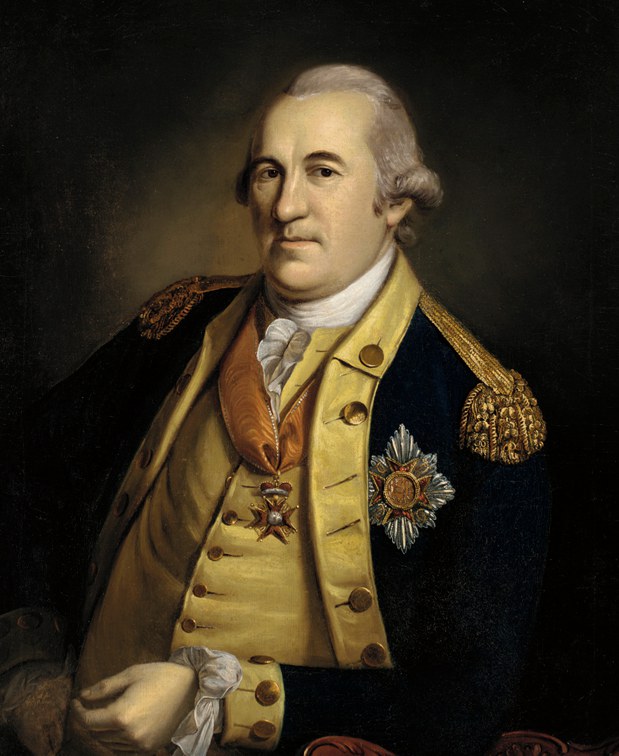
Baron Friedrich Wilhelm von Steuben
by Charles Wilson Peale, 1780
Von Steuben was born in Magdeburg fortress where his father was an engineer lieutenant in the military in 1730. Most of his adolescent years were spent in Russia, but with his father at the age of 10, they returned to Germany. He was schooled in Breslau by Jesuits and by the age of 17…was a Prussian officer in the military. He was a member of an infantry unit and a staff officer in the Seven Years War, later being made a member of the General Staff serving in Russia periodically. His service was commendable enough that he was eventually given assignment with Frederick the Great’s headquarters.
His experiences as a General Staff member in the Prussian Army gave him a wealth of knowledge that heretofore was unheard of, even in the British and French armies of the period. His training would eventually bring to the American soldiers the technical knowledge necessary to create an army.
At the age of 33, in 1763, Steuben was discharged as a captain from the army, for reasons that are only speculative. The following year he received his “Baron” title when he became chamberlain at the Petty Court of Hohenzollern-Hechingen. He was the only courtier to accompany his incognito prince to France in 1771, hoping to borrow money. Failing to find funds, they returned to Germany in 1775, deeply in debt. Looking for work to reverse his fortunes, von Steuben tried employment in several foreign armies including Austria, Baden and France. He discovered that Benjmin Franklin was in Paris and that possibly, he could find work with the Continental Army in America.
Steuben traveled to Paris in the summer of 1777. As luck would have it, he was endorsed for service by the French Minister of War (Count de St. Germain) who fully realized the potential of an officer with Prussian General Staff training. Steuben was introduced to General Washington by means of a letter from Franklin as a “Lieutenant General in the King of Prussia’s service,” a certain exaggeration of his actual credentials. He was advanced travel funds and left Europe from Marseilles.
On September 26th, 1777, he reached Portsmouth, New Hampshire and by December 1st, was being extravagantly entertained in Boston. Congress was in York Pennsylvania, after being ousted from Philadelphia for the winter and on February 5, 1778, Steuben was with them.
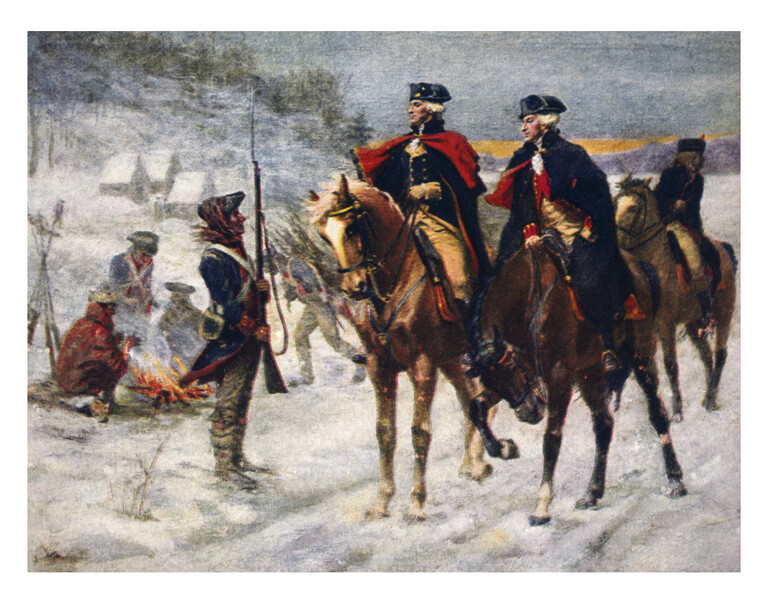
They accepted his offer to volunteer, without pay for the time, and on the 23rd of the same month, Steuben was reporting for duty to General Washington at Valley Forge. Steuben did not speak English, but his French was such that he could communicate with some of the officers. Washington’s aide-de-camp, Alexander Hamilton as well as Nathanael Greene were a great help in this area. The two men assisted Steuben in drafting a training program for the soldiers which found approval with the Commander-in-Chief in March.
How did the men at Valley Forge become an army? Steuben began with a “model company,” a group of 100 chosen men and trained them…they in turn successively worked outward into each brigade. Steuben’s eclectic personality greatly enhanced his mystique.
He trained the soldiers, who at this point were greatly lacking in proper clothing themselves, in full military dress uniform, swearing and yelling at them up and down in German and French. When that was no longer successful, he recruited Captain Benjamin Walker, his French speaking aid to curse at them FOR HIM in English.
His instructions and methods have a familiar ring, nor is this strange when we consider that much of what is done today stems from his teachings. To correct the existing policy of placing recruits in a unit before they had received training, Von Steuben introduced a system of progressive training, beginning with the school of the soldier, with and without arms, and going through the school of the regiment. Each company commander was made responsible for the training of new men, but actually instruction was done by selected sergeants, the best obtainable.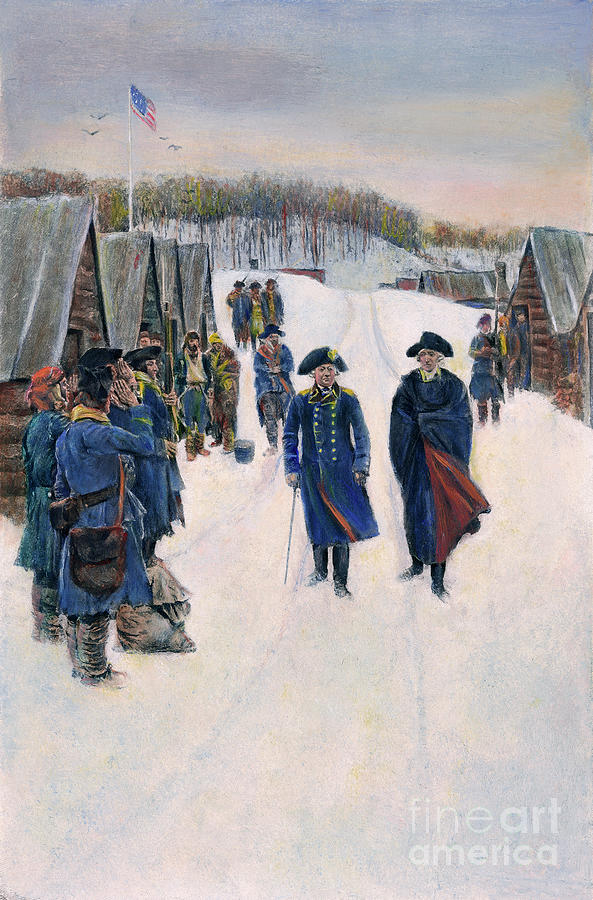
Warfare in the Eighteenth Century was a comparitively simple matter, once the battle was joined. Combat was at close range, massed-fire melee, where rapidity of firing was of primary importance. Accuracy was little more than firing faster thatn the opposing line. Much of the Regulations dealt with the manual of arms and firing drills. But battle was close-order drill, and speed of firing could only be obtained by drilling men in the handling of their firearms until the motions of loading and firing were mechanical. Firing was done in eight counts and fifteen motions.
Fire! One Motion.
Half-Cock — Firelock! One Motion.
Handle — Cartridge! One Motion.
Prime! One Motion.
Shut — Pan! One Motion.
Charge with Cartridge! Two motions.
Draw — Rammer! Two motions.
Ram down — Cartridge! One Motion.
Return — Rammer! Two motions.
Complicated as they seem, the new firing regulations were much simpler than those used by foreign armies and they speeded up firing considerably. The bulk of the fighting in the Revolutionary War was a stand up and slug match. The winning side was the one that could get in a good first volley, take a return fire and re-load faster than its foes. Once the individual could handle himself and his musket he was placed in groups of three, then in groups of twelve, and taught to wheel, to dress to the right and to the left. Alignment and dressing the ranks was emphasized but only because proper alignment was necessary for smooth firing.
Another program developed by Steuben was camp sanitation. He established a standards of sanitation and camp layouts that would still be standard a century and a half later. There had previously been no set arrangement of tents and huts. Men relieved themselves where they wished and when an animal died, it was stripped of its meat and the rest was left to rot where it lay. Stueben laid out a plan to have rows for command, officers and enlisted men. Kitchens and latrines were on opposite sides ot the camp, with latrines on the downhill side. There was the familiar arrangement of company and regimental streets.
The results of the army training were in evidence by May 20, 1778 at Barren Hill and then at Monmouth (ending June 28th). Washington recommended an appointment for Steuben as Inspector General on April 30th, and on May 5th, Congress approved it. It was Steuben serving in Washington’s headquarters in the summer of 1778 who was the first to report the enemy was heading for Monmouth. During the winter of 1778-1779, Steuben prepared “Regulations for the Order and Discipline of the Troops of the United States,” also known as the “Blue Book.” It’s basis was the plan he devised at Valley Forge.
The following winter (1779-1780) his commission was representing Washington to Congress regarding the reorganization of the army. He later traveled with Nathanael Greene-the new commander of the Southern campaign.
He quartered in Virginia since the American supplies and soldiers would be provided to the army from there. He aided the campaign in the south during the spring of 1781, culminating in the delivery of 450 Virginia Continentals to Lafayette in June. He was forced to take sick leave, rejoining the army for the final campaign at yorktown. At Yorktown his role was as commander of one of the three divisions of Washington’s troops.
He gave assistance to Washington in demobilizing the army in 1783 as well as aiding in the defense plan of the new nation. He became an American citizen by act of Pennsylvania legislature in March 1784 (and later by the New York authorities in July 1786). He was discharged from the military with honor on March 24, 1784.
He established residency in New York where he became a very prominent figure. His business acumen was not very keen, and he found himself in difficult financial condition once more. The primary reason was most likely the fact he was living off the prospect of financial compensation from the United States government which was unrealized until June of 1790 when he was granted a yearly pension of $2,500.
His financial problems were not ironed out until Alexander Hamilton and other friends helped him gain a “friendly” mortgage on the property he was given in New York (about 16,000 acres). He died a bachelor in 1794, leaving his property to his former aides, William North and Benjamin Walker.