
Category: Soldiering
June Day – First Monday in June The Election of Officers & Sergeants of the Ancient and Honorable Artillery Company 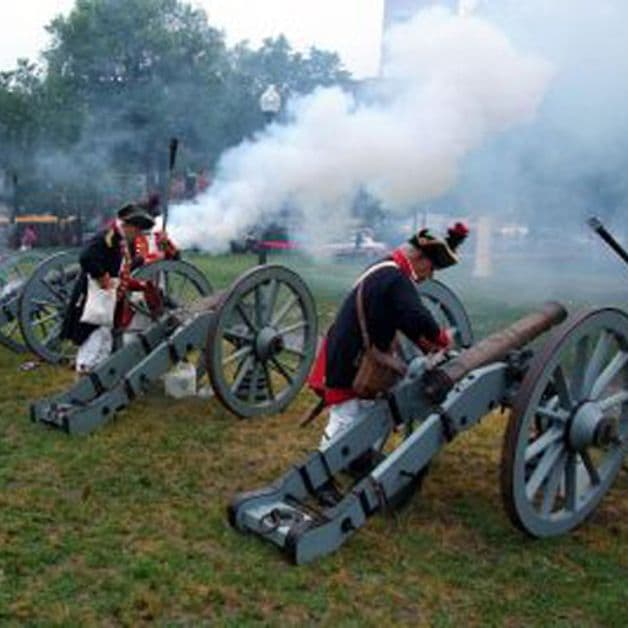
A parade precedes the AHAC Company election. The Company marches from their Headquarters in Faneuil Hall to the Granary Burial Ground on Tremont Street. At the cemetery they lay a wreath at the grave-site of Robert Keayne the First Captain Commanding of the Company.
The parade then proceeds to The Cathedral Church of St. Paul on Tremont Street for a memorial service for recently deceased members.The parade then reconvenes and proceeds to Boston Common. At the Common the drumhead elections is reenacted for officers and 12 elected Sergeants. The ballots are distributed, collected and placed upon the drumhead, which is located in front of the Company. Drumhead Election Ceremony 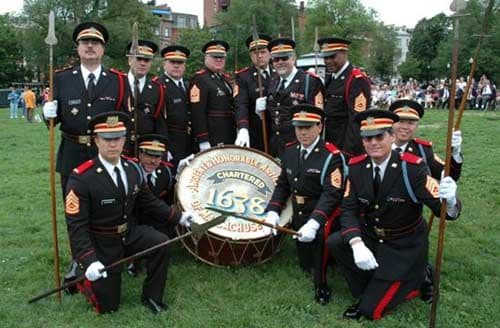
MA Governor Issues Commissions
Out-going officers tender their resignations to the Governor of the State of Massachusetts, the Commander-in-Chief, and newly elected Officers receive their commissions. The election is an reenactment of the first election and has continued without interruption since 1638. The parade then reconvenes and proceeds to a local downtown hotel.
The 101st Field Artillery Regiment mass. national Guard is the direct descendant of this Unit.


Categories
Marine Mortars

The Queen’s Truncheon is a ceremonial staff carried by the Royal Gurkha Rifles that serves as the equivalent of and is carried as the Colour. It is made of bronze and silver. The top represents the minaret of Delhi Palace with three Gurkhas standing on it supporting the Queen’s crown above their heads.
The minaret contains a pair of crossed kukris and carries the inscription “Main Picqet Hindoo Rao’s House, Delhi 1857”. The Truncheon is a unique emblem upon which recruits swear allegiance to the Regiment and the Crown.[1]
During the Indian Rebellion of 1857, the 8th (Sirmoor) Local Battalion made a particularly notable contribution. During the four-month Siege of Delhi, they defended Hindu Rao‘s house, losing 327 out of 490 men. During this action they fought side-by-side with the 60th Rifles and a strong bond developed.[2][3]
After the rebellion the 60th Rifles pressed for the Sirmoor Battalion to become a rifle regiment. This honour was granted then next year (1858) when the battalion was renamed the Sirmoor Rifle Regiment and awarded a third colour.[4]
In 1863 Queen Victoria presented the regiment with the Queen’s Truncheon, devised by Charles Reid,[5] as a replacement for the colours that rifle regiments do not usually have.[6]
The Sirmoor Rifle Regiment eventually became the 2nd King Edward VII’s Own Gurkha Rifles (The Sirmoor Rifles), retaining possession of the Truncheon until 1994, when it was amalgamated with the other three British Gurkha regiments as The Royal Gurkha Rifles.
The new regiment took possession of the Truncheon on permanent loan from the 2nd Gurkhas, and maintains the tradition of using it in place of colours
“What is the coolest line in history?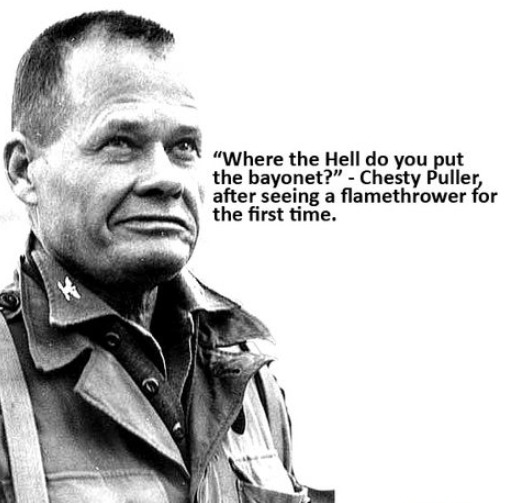
U. S. Marine Lt. Gen. Lewis “Chesty” Puller is arguably the toughest sonuvabitch that ever walked this Earth.
Chesty Puller started at the bottom, as a rank private in the Marine Corps. He climbed the ranks as he fought guerrillas in Nicaragua and Haiti; slogged through many nasty engagements through World War II; and the hell that was the Korean War.
It wasn’t until he suffered a stroke in 1955 and forced retirement that slowed him down. He was admired by the men under his command, and feared by his opponents on the battlefield.
He was also a fount of cool, quotable lines:
- “You don’t hurt ’em if you don’t hit ’em.”
- “Hit hard, hit fast, hit often.”
- “All right. They’re on our left; they’re on our right; they’re in front of us, and they’re behind us. They can’t get away this time.”
- “Son, when the Marine Corps wants you to have a wife, you will be issued one.”

|
|

|
|

|
|

|
|

|
|

|
|

|
|

|
|

|
|

|
|

|
|

|
|

|
|

|
|

|
|

|
|

|
|

|
|

|
|

|
|

|
|

|
|

|