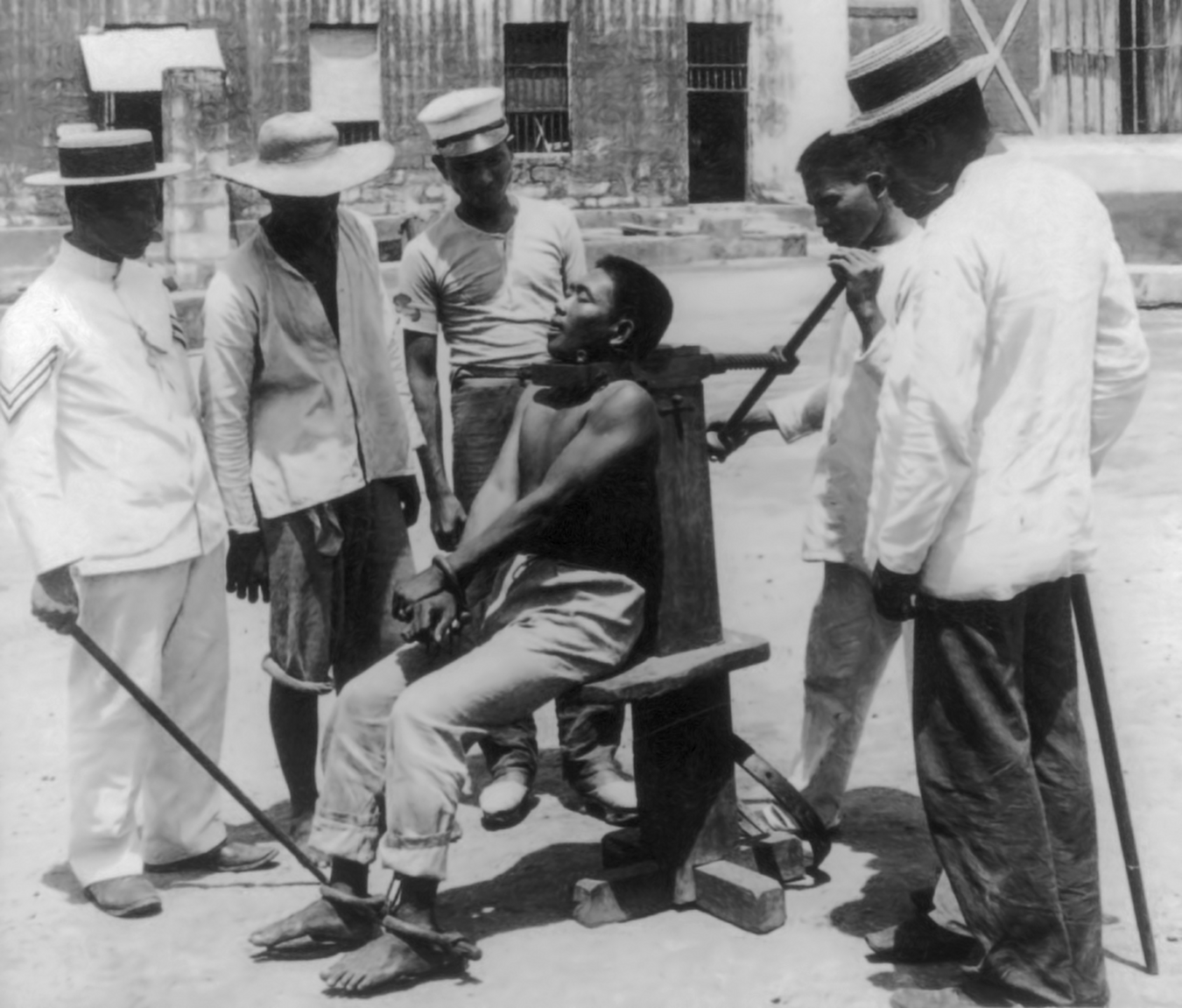
A 1901 execution at the old Bilibid Prison, Manila, Philippines
Opening Disclaimer
I have to put the disclaimer and warning at the beginning of this article. The reason is very simple. Even a Martial Artist operating on an Expert Level of control of hands, elbows, knees and feet can underestimate the destructive power of weapons if they are not intimately used to them.
Weapons multiply force, that is why they are so dangerous to the human body. Even if you are used to choking techniques, a simple leather belt used to hold up your pants, if placed around the neck, can cause severe damage if used with the same force as a choke not using a mechanical device like a belt.
And yes, when you use a belt or a rope, it is a mechanical device used to multiply the force of a choke. It has no moving parts, it is still a mechanical device when attached to your hands.
What I would strongly suggest you do if you wish to train how to defeat these rear attacks is to construct a padded post to practice on.
If you use a live training partner, once the loop goes over the neck, STOP! Any attempt to throw or take down could cause severe injury, the vital structures of the neck are easily damaged, any number of incredibly serious injuries could occur, up to and including paralysis and/or death.
And, keep in mind, with a cutting garrotte, there is absolutely, positively NO WAY WHATSOEVER to practice safely with it so do not even attempt to do so.
I cannot be held responsible for your own negligent attitude, I’m writing this, I’m not doing it with you, you understand… You are strongly advised to seek Professional, safe Instruction in whatever methods you wish to study.
You are on your own, I do not advocate or condone you practicing these things. They are, in a very real way, put up here for historical purposes and for very advanced Martial Arts practitioners, including Marines and Soldiers who might find the history and information useful.
Do NOT practice these things unless you are using an inanimate “Dummy” or a padded post.
Is The Garrotte a Legitimate Self-Defense Tool?
Some people have a heavy opinion on this issue. They have opinions as to the legitimacy of the garrotte as a tool of self-preservation. Others have strong opinions as to the definition of “garrotte.”
[I’m not going to debate the spelling, I’m using Col. Rex Applegate’s spelling of the word and whenever you see me use something different, it’s a typo.]
Some people say, “Well, the garrotte is a…” and then they define it to the exclusion of anything else. The simple fact of the matter is, a “Garrotte” was an execution device that was utilized in Spain up until the mid-1970s. A few other countries used it now and again. And there were many different types of garrottes used as execution devices.
When someone says, “The garrotte is only a killing weapon…” Technically, they are correct, but they are not usually speaking of the execution device that was once used for Capital Punishment, therefore, they are incorrect in reality.
The number one deciding factor is intent. How you use it. You can use some “garrottes” as a Flexible Weapon with no intent whatsoever to kill.
The garrotte had a couple of different forms. One had a metallic collar that was placed around your neck and the collar had a threaded hole that a bolt was inserted through. On the other end of the bolt was a large “T” handle for the executioner.
The condemned was seated in a chair, the collar placed over a wooden post and the head of the prisoner, then, the executioner began to tighten the contraption until your neck was crushed or your vertebrae were dislocated, broken or crushed.
Later versions had a blade that ran through the bolt for what was thought to be a “mercy killing.” The blade was slipped between the vertebrae, severing the spinal cord.
In a pinch, the improvised garrotte could be a seat, wooden post, strong cord and a metal bar. The noose being affixed around the post and neck of the condemned, the bar could be inserted and the cord twisted until death occurred. Much like using a tourniquet and stick.
These are “garrottes.” The important thing to remember is, if someone says, “No, that’s not a garrotte, this is a garrotte…” And they are speaking in absolutes or anything other than an execution device, they’re incorrect. More on that later.
Other “Garrottes”
So, if we exclude the execution devices, what is left? If we do exclude the execution devices, any flexible or semi-flexible weapon that cuts the air off by compressing and/or crushing the trachea, severs (up to and including complete decapitation) the trachea and other vital structures (carotid arteries, jugular veins, vagus nerve, etc.) or breaks the neck, we have a list of items that have been used as a “garrotte.”
One Point of View: The Debate
I was once involved in a debate with a person who insisted that a “True Garrotte” would be a “cutter.” Meaning, a piano wire or guitar string garrotte. The wire being so fine that it would cut into the structures rather than compress/crush them.
If we trace the lineage of these hand held devices back to the origin of the word, as I did above, we see the “Original Garrotte” did nothing of the sort. The “Original” killed by compression and/or crushing and sometimes neck fracture.
Yet, I consider the “cutters” a form of garrotte because there is modern history to back that up. However, the “cutter” type of garrotte is not a “true” garrotte. It’s just another type of garrotte.
The “Cutter”
Back before delicatessens had slicer machines, the cheese was usually cut by a wire. Yes, a “Cheese Cutter” was basically a wire with two handles. As far as I can tell, this is where the “Modern Cutter Garrotte” came from. The source is Melton’s “Clandestine Warfare.”
The British SOE and American OSS used these devices, to what degree I do not know. Some wire garrottes with machined and knurled brass handles (for enhanced grip) were manufactured and issued. They are in the OSS Weapons Catalog, as well as other references…
Gigli bone saws were also used as “Survival Saws” as well as “Cutter” Garrottes during World War Two.
The “Crusher”
“The Garrotte. Thugs in India have long been known for their method of strangling, called garrotting. It can be executed with a rope, strong cord or a piece of twisted cloth about three feet long with a noose in one end. This is a garrotte. Properly applied, it produces a deadly, silent strangle.
Slip the noose over the forefinger of the right hand so that the loop lies down across the palm toward the little finger. Close the right hand and pick up the free end of the cord with the left hand, so that the thumb and fingers are on the inner side of the cord and the end is even with the little finger.
Approach the victim from the rear and, opening the right hand, throw the loop over his head with the left. Use the left hand to draw the noose through the right hand until it is nearly taut about the neck.
Then close the right hand about the noose at the back of the victim’s neck and twist as you would in applying a tourniquet. With your hand against the back of his neck and your right arm stiff, the victim is held at arm’s length and is unable to free himself from the strangling cord or to reach his attacker.
A hard pull to the rear at this point will make the victim fall backward and cause his chin to fold down over the cord, thus adding his own body weight to the pressure of the strangle.” ~Col. Rex Applegate, Kill or Get Killed

In the illustration above you can see the finishing position of what Applegate describes. The right hand is INSIDE the loop, when the loop is pulled tight around the neck and your hand, a fist is made with the open hand then the fist is cranked counterclockwise.
Much like a stick in a tourniquet. The palm is open and oriented UP, then closed into a fist and oriented DOWN.
What Colonel Applegate was describing was the method and weapon of the ancient Thugee Cult of India. This is where we get our slang word of “thug.” The word “Thug” comes from the Hindi verb, “thaglana,” which means, “to deceive.”
I do not know if the garrotte described above contained a rupee or not. There is another line of thought that there was more than one way to strangle with a scarf [rumal]. And that was, a rupee or rupees [coins] were tied into the end of the scarf to give it weight so it could be thrown around the neck and then the strangle was initiated.
In fact, more than a line of thought, there is proof of this from the period of British Occupation of India when the British suppressed the Thugee Cult and executed and imprisoned thousands of Thugs.
Throwing the Japanese Fighting Chain, which is weighted, in such a way that the chain is propelled around the neck is also throughout Japanese Martial Arts that focus on the Manrikigusari/Kusarifundo.
In “Kill or Get Killed,” Applegate then mentions the “Stick Strangle.” This is a triangular method where the stick is held in reverse grip and inserted under the chin from behind (or from the front)…John Steyers covered this Stick Strangle in his book, “Cold Steel.”
Then, he addresses other methods of strangulation:
“The Cord Strangle. Another type of strangulation, as old as history in the Far East, is accomplished with any light cord or wire of good tensile strength, about 18 inches long. The thinner the cord or wire, the quicker will be the effectiveness.
Tie a loop at each end of the cord, or tie small wooden blocks on the ends, so that a secure grip can be taken. Approaching the man from the rear, throw him off balance, as with the stick [strangle], with your right foot against the inside of his right knee.
With a hand on each end of the cord (the cord held taut), bring the cord over the victim’s head and back against the throat. Cross the hands at the rear of the neck and apply pressure both ways. Strangulation is quick and silent…” ~Applegate
You will notice that Col. Applegate describes the cord/wire as being taut when going over the head. During the approach, the arms would not be crossed. After the garrotte is thrown over the head, the arms would then cross at the wrists/forearms.
Imagine holding your hands out in front of you as if you are preparing to clap your hands together. Then, with your right palm, touch your left elbow and simultaneously, with the left palm, touch your right elbow.
The forearms are parallel to one another. That is the motion you make. This also takes a shorter cord/wire to use effectively. The wrists/forearms are crossed after the loop has been thrown over the head, not before.
This is actually a weaker garrotting method than having the arms crossed on the approach as is currently taught in the U.S. Army’s Combatives Manual, 21-150 where the arms are crossed at the wrists/forearms on the approach.
Then when the loop is thrown over the head of the enemy, the arms are jerked apart. This is much stronger.
There is another, older way of achieving the same position without approaching with the arms already crossed. It was depicted in the U.S. Navy’s World War Two Hand to Hand Combat Manual for Naval Aviators, the famous “V-5” manual. This is shown below.

Notice that as the years passed, not much changed. This is the U.S. Army’s Field Manual 21-150 marked December 1971. Showing the same, basic method.

In this method, your left hand makes a cross-body movement and is positioned at the back of the enemy’s right shoulder.
The right hand holding the other end of the garrotte is then looped over the head of the enemy in a semi-circular, counterclockwise motion and then the arms are pulled apart.
Take downs, Using the Enemy’s Weight
There are four basic ways to take someone to the ground immediately following any of these maneuvers.
#1 Pulling straight downward and back.
#2 Kicking the back of the knee and pulling back and down.
#3 Knee strike to the lower back and a pull backwards and down.
#4 A quick turn of the body where you are back to back with the enemy and the enemy is hoisted off of his feet to complete the crush. This is the movement that can possibly result in decapitation if a “cutter” garrotte is used.
In Closing…
So, is the garrotte a legitimate tool of Self-defense? That was the original question. The answer to the question is, it all depends on what type of garrotte you are going to use really.
I cannot imagine going through the trouble of carrying something with such a single purpose as a “cutting” garrotte. That is a specific type of weapon and the only outcome from the proper use of one is death of the opponent, and that is going to be carried out from behind almost exclusively, as in Sentry Removal.
Any belt, length of rope, cord, a telephone cord, whatever is at hand, can be a garrotte. You can carry a very strong bandana or scarf with that being carried with the intent to be used as a flexible weapon. A jacket or light coat can be used as a garrotte, like the belt, it is a common, every day item. The every day items that are all around us points to flexible weapons being really viable and valuable Self-defense tools.
Anything other than a “cutting” garrotte can be used with lethal or non-lethal intent. So, if you make an improvised garrotte from 550 ParaCord, what you do with it will be the deciding factor.
Now, we can break this down and go to Part Two, “The Flexible Weapon.” Before we do, here is a series of pictures showing just a few methods. Some are not “Classical Garrotte” Techniques. They are still very important. It also shows what can be done totally unrelated to a rear attack, or, a response if the enemy turned to face you. What if someone were trying to Garrotte you from behind? This shows you how the weapon might be used against you if you thwarted the rear attack and you turned to face the attacker.

Always remember, the only way to defend against a weapon and develop real, demonstrable skill, is to know how the weapon is used. It is for that reason I wrote this article.

Rope cannot be banned, and criminals can always find weapons anyway, but could you defend yourself against these methods? That is the question…
In that last series of illustrations, you can substitute a jacket or a belt and you can still see the viability of the techniques. You do not have to tote around a “Garrotte,” and always remember, the criminals don’t have to either.
Stay safe. Train safe.
[Drawings are altered from U.S. Army Combatives Manual, Public Domain]
Don Rearic
ãDonRearic.com
Category: Soldiering

Operation Overlord. In the overall pantheon of cool military names, Overlord flirts with perfection. The term projects the sort of gravitas demanded of the event.

June 6, 1944, was a Tuesday. From the comfortable vantage of my favorite writing chair, it is tough to comprehend the truly timeless significance of D-Day. Comprising the largest amphibious invasion in human history, on that fateful morning, some 156,000 Allied ground troops supported by another 195,700 sailors seized a foothold on mainland Europe. Never before had there been such a single seminal moment that so starkly reflected the struggle between the forces of good and evil.

Europe was engulfed in darkness. For four long years, mainland Europe had endured under the heel of the Nazi jackboot. In 1940 Hitler’s thugs had waltzed across France and the Low Countries like they owned the place. As D-Day approached Dwight David Eisenhower’s boys now stood poised to give the Germans a healthy dose of perspective.

It cost the Allies more than 10,000 casualties to acquire title to that precious beachfront property in Normandy, all in that single day. Of those thousands of casualties, some 4,414 were confirmed dead. We lost 185 Sherman tanks. Casualties on the German side ran somewhere between 4,000 and 9,000. So many of them were buried underneath untold tons of rubble that the final tally was known only to God.

Around 15,000 Frenchmen died in the pre-invasion bombardment. Roughly the same number perished in the crossfire during the invasion. In aggregate that’s more folks than live in my thriving little Southern town. The French equivalent of every man, woman, and child in Oxford, Mississippi, died to evict the Germans from Western France. Through the lens of history, it is easy to overlook such extraordinary stuff as that.
Drilling Down

Those numbers are the purview of the Generals, politicians, and historians. The few men I have known well who were there gave a very different perspective. Their world was much, much smaller. One gentleman, a member of the 5th Ranger Battalion who landed in the first wave, described events as utter chaos. They cared little for strategy. Life is distilled down to resisting death whenever possible and killing the enemy. It was here on that blood-soaked beach that General Norman Cota coined the epic phrase, “Rangers, lead the way!”

In times of such unimaginable madness, a man’s true nature bubbles forth. Many self-described brave men turn out cowards, while some of the more quiet sort show unimaginable resolve. Such combat is the ultimate crucible. It burns away the dross and leaves a man’s core character exposed for all to see.

Of the 83,115 British troops who landed as part of Operation Overlord only one man earned the Victoria Cross. Abbreviated VC, the Victoria Cross is England’s highest award for valor in the face of the enemy. It is the British equivalent of our own Medal of Honor, and it is not easily acquired.
British Backbone

Stanley Hollis was born in Middlesbrough, North Riding of Yorkshire, England, in 1912, six years before the end of the First War to End All Wars. As a child, he worked in his parents’ shop selling fish and chips. At age 17 he apprenticed as a ship’s navigator, making regular voyages to the western coast of Africa. He contracted blackwater fever, a particularly vile malarial variant, and was forced to quit the merchant marine.

Hollis came home, married, and started a family. In 1930 he enlisted in the Territorial Army, the British counterpart to our Army National Guard. With the outbreak of WW2, he deployed to Europe with the British Expeditionary Force. He narrowly escaped during Operation Dynamo, the evacuation of Dunkirk. Dynamo may be the second coolest military operation name ever contrived.

Hollis fought at El Alamein with Montgomery’s Eighth Army and was subsequently wounded during the invasion of Sicily in 1943. This was but one of multiple combat wounds Hollis received during the war. He was shot or hit with shrapnel so many times his men came to think him unkillable.

On June 6, 1944, Hollis had recovered sufficiently to join the 6th Green Howards as they stormed Gold Beach. Serving as a Company Sergeant Major Hollis moved forward with his troops. In their rush to get off the beach, the British inadvertently overlooked a pair of German fortifications.

Realizing that these active emplacements now threatened the flank of the British invasion force, CSM Hollis charged the first, his Sten gun blazing. Once he reached the pillbox under heavy fire he shoved the muzzle of his Sten through the embrasure and emptied his magazine. Leaping atop the fortification he swapped magazines, threw a Mills bomb through the back door, and emptied his second magazine behind it. In the process, he killed two of the German defenders and captured the rest.

Hollis immediately indexed to a nearby slit trench and supporting fighting position, singlehandedly taking another 26 prisoners. Later that day Hollis led an assault on a heavily fortified position that included a field piece and several MG42 machineguns. Seizing a PIAT gun, Hollis fired upon the German cannon from a range of 50 meters. This attack was ultimately repulsed, but two of his men were pinned down in the aftermath.

Hollis then rushed back into the enemy fire, this time with a Bren gun. He distracted the German defenders long enough for his men to escape. In the process, he threw a Mills bomb but forgot to prime it. The German defenders, however, did not appreciate this. As they scattered in the face of the inert grenade Hollis charged their position and cut them down with his Bren.
The Weapons

The Sten gun was a desperation weapon developed by Reginald Shepherd and Harold Turpin while working at the Enfield Small Arms Factory. The name Sten is a portmanteau combining elements of all three names. Designed in 1940 specifically to be inexpensive and easy to produce, the Sten was intended to help stave off the expected seaborne invasion by the Germans. More than 4 million copies were produced, making the Sten the second most-produced SMG of the war after the Soviet PPSh.

The Sten was manufactured in five different marks during the war. The Mk IIS and the Mk VS were the world’s first operational sound suppressed SMGs. The Sten fed on a ghastly side-mounted double-column, single-feed magazine and cycled at a sedate 500 rounds per minute. At a time when an American M1928A1 Thompson cost $200, the Sten ran about $11. That’s roughly $200 today.

The PIAT (Projector, Infantry, Anti-Tank) was technically a spigot mortar. Designed to replace the obsolete Boys antitank rifle, the PIAT was a 32-pound beast of a thing. While the published maximum effective range was 115 yards, in reality, the weapon was only reliable out to about half that. However, it did launch a shaped charge warhead that, when it detonated properly, was quite effective at penetrating German armored vehicles.

The PIAT benefitted from not having any backblast upon firing, but the recoil was said to be murderous. The gun itself contained a massive spring that kicked the 2.5-pound round out. The recoil force from firing would theoretically re-cock the heavy action. 115,000 copies were built.

The Mills bomb was the standard British hand grenade from 1915 into the 1980s. More than 75 million were produced. The Mills bomb was named after William Mills and produced at the Mills Munitions Factory in Birmingham. This patented design was based upon a previous Belgian grenade contrived by a Captain Leon Roland. There actually resulted in a most acrimonious row over patent rights.

The Mills bomb evolved over time. It was eventually configured such that it could be fired from a rifle equipped with a grenade discharger cup. The serrations in the grenade body were included to make the bomb easier to grip, not to enhance fragmentation.

The Mills bomb was a defensive grenade. This means that it produced a large volume of lethal fragments. By contrast, the German stick grenade was an offensive grenade that produced a great deal of blast but not so many fragments. A competent British Tommy was expected to throw a Mills bomb between 15 and 27 meters. The effective range of the grenade’s fragments was on the order of 90 meters.

The Bren gun was developed from the Czech ZB vz.26 light machinegun in the mid-1930s. Chambered for the British standard .303 cartridge and cycling at around 500 rpm, the Bren was one of the most reliable and effective light machineguns of the war. After WW2 the British rechambered the Bren for 7.62x51mm and redesignated it the L4A4. In this configuration modernized Bren guns served all the way through the First Gulf War.
The Rest of the Story

Three months after the D-Day invasion CSM Hollis was wounded once more, this time in the leg. He was subsequently evacuated back to England. He received his Victoria Cross a month later from the hand of King George VI himself. After the war ended, like so many of those great old heroes, Stanley Hollis simply wanted to have a life.

Hollis worked as a sandblaster at a local iron works before opening a motor repair business. He spent five years as a ship’s engineer from 1950 until 1955. Apparently earning your nation’s ultimate award for gallantry in combat trumps a little malaria.

The man needed some stability. Stanley Hollis took over the operation of the “Albion” public house in Market Square, North Ormesby. Under his management, the name of the pub was changed to “The Green Howard” after his wartime combat unit.

Stanley Hollis never fully recovered from his wartime injuries. His children later reported that he carried ample German shrapnel as well as a couple of bullets around in his body for the rest of his life. If he stood too long at the pub his leg and foot wounds would purportedly begin to bleed spontaneously. On February 8, 1972, CSM Stanley Hollis, VC, died. He was fifty-nine years old.

A commemorative plaque followed, as did a bronze statue of Hollis with his Sten gun. A Middlesbrough school was renamed Hollis Academy in his honor in 2016. Stanley Hollis’ Victoria Cross is on display in the Green Howards Museum in Richmond, North Yorkshire, today. We just don’t seem to make guys like that anymore.


When you’ve been living like a farm animal and haven’t removed
your clothes in a month this is what heaven looks like.
Human beings are waterproof, and personal comfort is a state of mind. I actually used to believe tripe like that. Among the big three survival requirements of food, water and shelter, I always kind of felt that shelter was more a desirable luxury than an absolute necessity. That was then. Nowadays, were I to sleep on the ground I wouldn’t be able to walk upright for a week afterwards.
The winter is the primary training time in the arctic reaches of Alaska. Our mission was cold weather combat operations, so that was naturally the best time to train. That unfortunate mantra acquainted me with some of the most ghastly weather.
I’m a skinny guy from Mississippi. A really cold day down where I live was maybe 30 degrees Fahrenheit. Then, Uncle Sam sent me to Alaska just to give me a little perspective.
Our first winter in Fairbanks it snowed 144 inches. New math tells us that is 12 feet. The coldest it got while I was stationed there was 62 degrees below zero, and we were in the field. If I never see another snowflake, it will be too soon.
Our field training exercises typically lasted three or four weeks. We would load up all of our killer gear and deploy to some remote wasteland to stage our tactical missions day or night. Not that this mattered a whole lot. It’s always dark up there in the wintertime, anyway. I’ve flown night vision goggles above the arctic circle at noon.
It’s tough to get worked up about much more than basic survival at fifty below zero. Aircraft and vehicles become instantly cold-soaked once you shut them down. In a survival situation you have to dig a big hole in the snow for a shelter because crawling into the snow is actually markedly WARMER than being outside.
Each arctic tent nominally housed ten guys and included a Yukon stove that would run on most anything flammable. We most typically used jet fuel. Once you got that stove cooking it made the most mesmerizing sound. We called it “Yuking.” As each drop of fuel hit the burner plate, atomized, and burned it made a pleasant little pop. Just thinking about that sound right now brings a smile.
Even wide open that stove still had a hopeless task. The tents were canvas, after all, and the outside air temperature was fifty below. As a result I would go an entire month without being warm. Under such sordid circumstances I’m living proof that you can indeed survive, but you’ll never be comfortable.
Once we finally got back to garrison we still had to clean and stow absolutely everything. You never knew when you might be called upon to go to war. Before anybody went home it was staged and ready to rock again. I’d come dragging into the house after a month in the field in the arctic as filthy as a feral pig and utterly exhausted. When finally the magical time arrived my precious bride was ready.
If you’ve read this column for long you should have a decent idea as to my personality and comportment. I describe myself as a high-effort, high-payoff sort of guy. However, living with me has got to be a chore most onerous. My wife does so with grace and poise.
We had a routine. I’d dump my filthy killer gear inside the door and strip down to my skivvies for hugs from my wife and kids. As that was the first time I had come out of those clothes in a month I cannot imagine how they could stand it. I then retreated to the shower.
We lived on post at Fort Wainwright. All the inhabited buildings were heated by a central heating facility that pumped hot ethylene glycol through underground pipes to keep the dwellings and facilities habitable. Our house had the neatest heat exchanger in the basement that provided hot water from this central boiler. We literally never ran short of hot water. You could run the hot tap for a week, and it would never cool off. That first shower back in the World typically lasted about an hour and a half. By the time I wrapped up, I was too weak to stand.
I would then dry off as best I was able and wriggle into a bathrobe before slithering downstairs to the dining room. There, my precious bride had a massive pot of her signature steaming hot chili and some ice-cold Coke waiting. I would eat that stuff until I literally thought I might explode. Now swollen up like a toad, I would crawl into bed and sleep the sleep of the dead.
I have no idea what heaven will be like. While details are scant, I have it on reliable information that the company will be great and everything else will be comparably awesome. However, I fear I might be just a wee bit disappointed if off in a corner someplace there’s not an immortal shower and some of my wife’s signature holy chili. That mystical combination sure seemed heavenly to me.
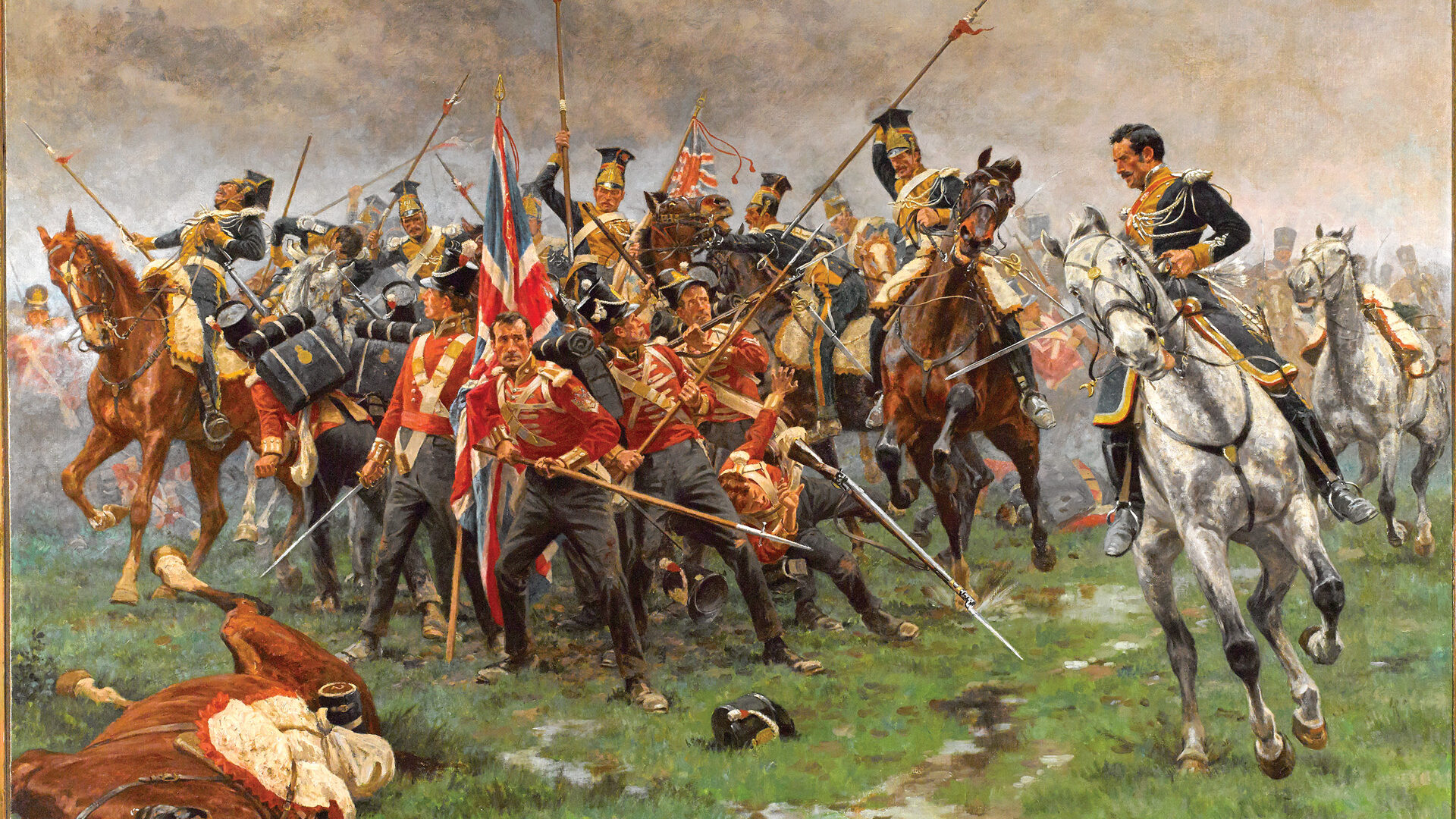
The defense of the Colours of the 3rd Foot – The Buffs at the Battle of Albuera during the Peninsular War in 1811.

James Montgomery Doohan was born on March 3, 1920, in Vancouver, British Columbia. His father was a veterinarian, pharmacist, and dentist who developed an early form of high-octane gasoline. Starting in 1946 Doohan took on roles as a voice actor for radio, developing a reputation for his broad range of accents and dialects. Over the next decade, he performed in more than 4,000 radio programs.


In the mid-1950s, James Doohan played forest ranger Timber Tom in the Canadian version of Howdy Doody. Oddly, at the same time, William Shatner was playing Ranger Bill in the American version of the show. Both men later appeared together on the Canadian TV series Space Command.

Over the years Doohan played a wide range of roles on screens both large and small. However, the one part for which he is best remembered is that of Montgomery Scott, the chief engineer on Star Trek‘s starship Enterprise. Though he was neither Scottish nor an engineer, James Doohan’s depiction of the longsuffering Starfleet officer created a cinematic icon.

While auditioning for the part before Gene Roddenberry, the creator and producer of Star Trek, Doohan suggested that all the best engineers were Scottish. He personally chose the first name of Montgomery to honor his grandfather. The resulting beloved character became a fixture across three years’ worth of live-action television, an animated series, and seven major films.

Doohan’s vocal range was indeed remarkable. He voiced a variety of entities on the TV series to include Sargon in “Return of Tomorrow,” the M-5 in “The Ultimate Computer,” the Mission Control Voice in “Assignment: Earth,” and the Oracle in “For the World is Hollow and I have Touched the Sky.” He voiced a total of fifty different characters during the animated series to include as many as seven in a single episode. He also contributed heavily to the development of both the Vulcan and Klingon languages for the films.

The Trekkie truly committed to his craft might appreciate, however, that throughout the run of both the TV shows and movies, Doohan takes care with how he positions his hands. However, in “The Trouble with Tribbles” we do get a quick glance. James Doohan was missing his right middle finger. The tale of how he lost that digit is indeed fascinating.
A Young Man Goes to War

Doohan’s father was an alcoholic who made life miserable for Jimmy and his three older siblings. At age nineteen, Doohan enlisted in the Royal Canadian Artillery and was assigned to the 14th (Midland) Field Battery of the 2d Canadian Infantry Division. He was later commissioned a Second Lieutenant and assigned to the 14th Field Artillery Regiment of the 3d Canadian Infantry Division. In 1940 he was deployed to England. By 1944 he was ready to go to war.

LT Doohan landed on Juno Beach on June 6, 1944, alongside 14,000 other Canadian troops. Juno was one of five invasion beaches designated as part of Operation Overlord, the Allied invasion of Normandy. Opposing the invading Canadians were two battalions of the German 716th Infantry Division with elements of the 21st Panzer in reserve near Caen. The initial landing was a fairly bitter thing. One in every eighteen Canadian assault troops became casualties that first day.

LT Doohan led his men across the beach strewn with antitank mines and personally killed a pair of German snipers. Doohan was ultimately in combat less than 24 hours. At around 2300 that first evening the young Canadian officer was making his way between a pair of Allied positions when an inexperienced Bren gunner fired at the noise. Doohan caught a total of six not-so-friendly .303 rounds.

Doohan took four rounds to his left knee and leg and one to the chest. The sixth round blew off the middle finger on his right hand. The chest wound would have undoubtedly been fatal had it not struck a glancing blow that deflected off of a cigarette case Doohan kept in his left breast pocket. The case had been a gift from his brother. Doohan joked later in life that he was one of the few people for whom smoking had actually saved his life.
The Guns

LT James Doohan’s No 4 Lee-Enfield rifle was an evolutionary development of the Short Magazine Lee-Enfield (SMLE) with which Commonwealth forces fought the First World War. These Tommies called their SMLE rifles “Smellies.” The SMLE was itself a development of the previous Lee-Metford.

The No 4 Lee-Enfield was cheaper and faster to produce than the WW1-era weapon. Fed from either a detachable ten-round box magazine or top-fed stripper clips, the No 4 also cocked on closing and had an abbreviated 60-degree bolt throw. These attributes made the Lee-Enfield arguably the fastest bolt-action military rifle ever produced. In 1914 a British musketry instructor named SGT Snoxall put 38 rounds inside a 12-inch target at 300 yards in 60 seconds, a record that purportedly stands even today.

The Bren gun was a license-produced development of the Czech ZGB-33 light machinegun. The name “Bren” is a portmanteau combining Brno, the Czech city where the gun was first designed, and Enfield, the location of the British Royal Small Arms Factory. The ZGB-33 was itself developed from the previous Zb vz.26 designed by Czech designer Vaclev Holek.

Originally adopted in 1935, the Bren fired the rimmed .303 British cartridge and weighed about 23 pounds. The gun’s sedate 500 rpm rate of fire, its superb reliability, and its quick-change barrel made it an efficient and effective support weapon. The Bren fed from the top via a sharply curved 30-round box or a 100-round pan magazine. However, the latter was a bit ungainly in action. All members of the rifle squad would typically pack spare magazines for the Bren.

In the 1950’s the British re-barrelled the Bren gun to fire the NATO-standard 7.62x51mm round and designated it the L4A4 LMG. This variant served through the war in the Falklands. Final production of the Bren by the Indian Ordnance Factories continued until 2012.

Though expensive and fairly heavy, the Bren has been described as the best light machinegun of its era. Filling roughly the same tactical space as did the American BAR, the Bren benefitted from its quick-change barrel and increased magazine capacity. The L4A4 version used a magazine that was interchangeable with those of the L1A1 SLR rifles employed by British forces at the time.
The Rest of the Story

LT Doohan obviously recovered from the wounds he incurred on D-Day. Afterward, he was selected for pilot training and graduated from Air Observation Course 40 alongside eleven other Canadian artillery officers. Doohan trained to fly the Taylorcraft Auster Mark V observation aircraft. He was assigned to the 666 Air Observation Post Squadron RCAF at Andover, England, in support of the 1st Army Group Royal Canadian Artillery.

Captain Doohan soon developed a reputation for his daring at the controls of his nimble little spotter plane. Once in the late spring of 1945 while flying a Mark IV Auster on the Salisbury Plain north of Andover he came across a series of telegraph poles. Doohan then slalomed his little plane back and forth around the poles, in his words later, “to prove it could be done.” He was strongly reprimanded for this stunt. He left the Canadian Army shortly after the end of the war.

Many of the Star Trek cast, particularly Leonard Nimoy, resented being type-cast in those roles. James Doohan did also strive for a time to shake off the inevitable baggage that came with playing such a popular character. However, he eventually came to embrace his Scotty persona and was a popular fixture at conventions for decades. Most of his film and TV roles after Star Trek included some reference or parody to his most famous part.

William Shatner who played Captain Kirk was notoriously difficult. The strained relationship between Shatner and the rest of the cast is beautifully parodied in the simply spectacular spoof Galaxy Quest. If you have any interest in classic science fiction at all and haven’t yet seen Quest then stop what you’re doing immediately and go watch it. You’ll thank me later.

Doohan once said of Shatner, “I like Captain Kirk, but I sure don’t like Bill.” Of the original cast, Doohan was the only one who refused to be interviewed for Shatner’s Star Trek: Memories books about the show and subsequent films. I’m not too proud to admit to having read and enjoyed both tomes. By their final convention appearance together in 2004 Doohan and Shatner seemed to have mended their relationship.

Jimmy Doohan was married three times and had seven children. Like most Hollywood personalities, his personal life was tumultuous. However, it was of his contributions in the Real World that Doohan was most proud. Doohan once corresponded with a young fan who was contemplating suicide. After subsequently meeting at a Star Trek convention Doohan’s encouragement and support not only got the young woman through her emotional slump but inspired her to complete engineering school. At James Doohan’s final stage appearance before his death in 2005 at age 85 Astronaut Neil Armstrong told him, “From one old engineer to another, thanks, mate.”

 A native of the Mississippi Delta, Will is a mechanical engineer who flew UH1H, OH58A/C, CH47D, and AH1S aircraft as an Army Aviator. He has parachuted out of perfectly good airplanes at 3 o’clock in the morning and summited Mount McKinley, Alaska, six times…always at the controls of an Army helicopter, which is the only way sensible folk climb mountains. Major Dabbs eventually resigned his commission in favor of medical school where he delivered 60 babies and occasionally wrung human blood out of his socks. Will works in his own urgent care clinic, shares a business build-ing precision rifles and sound suppressors, and has written for the gun press since 1989. He is married to his high school sweetheart, has three awesome adult children, and teaches Sunday School. Turn-ons include vintage German machineguns, flying his sexy-cool RV6A airplane, Count Chocula cereal, and the movie “Aliens.”
Categories
The Cream of the Cream

Categories
Sureeeeeee!

Lee-Enfield Rifle: The Long Arm of the British Empire and the story of Lachhiman Gurung

The Nepalese Gurkhas are legendary fighters who have served the British crown for generations.
 Lachhiman Gurung seemed an unremarkable sort. He stood all of four feet eleven inches tall when he left his village to buy cigarettes for his father and ended up enlisting as a Gurkha in the service of the British Empire on a whim. However, on May 12, 1945, deep in a Burmese jungle Lachhiman Gurung proved that sometimes some of the most remarkable stuff comes in compact packages.
Gurung’s fighting position was at the foremost vanguard of his unit’s defensive emplacements standing ready against a pending Japanese attack. When the Japanese came they led with 200 seasoned assault troops. In fairly short order Gurung was alone, the rest of his mates either dead or dying.

 Once the Japanese troops got within hand grenade range they began pelting Gurung’s position with grenades. Gurung picked up the first two and threw them back at his attackers. When he hefted the third it detonated in his hand, removing most of his right hand, blinding his right eye, and peppering his body and face liberally with shrapnel. Where most normal humans would have the good grace to just lay down and die, Gurung unsheathed his Kukri knife, shoved it into the ground at the lip of his foxhole, and announced to the Japanese that they would get no further than that knife. He then hefted his Lee-Enfield rifle, chambered a round with his left hand, and invited the Japanese to see what it was like to, “Come fight a Gurkha.”

At only 4 feet 11 inches tall, Lachhiman Gurung did not seem like a particularly imposing figure. However, behind a Lee Enfield rifle he wrought sheer havoc upon attacking Japanese forces despite grievous wounds.
The Japanese accepted Gurung’s offer. For the next four hours, Lachhiman Gurung ran his bolt-action Lee-Enfield rifle one-handed, setting the rifle down to work the bolt or reload with his left hand before taking it up again to kill more Japanese. When the Japanese got close enough to overrun his position Gurung would lay down, let them come in close, and then jump up to cut them down at point blank range, all the while running his bolt-action rifle with his single remaining hand.
When he was finally relieved, there were thirty-one dead Japanese soldiers in and around Gurung’s fighting position. He was heard by nearby troops shouting, “Come and fight! Come and fight! I will kill you!” in an effort at taunting the Japanese in closer. Lachhiman Gurung was awarded the Victoria Cross, Britain’s highest award for valor in combat, for his actions that night in the sweltering Burmese jungle. The fanatical defense of that forlorn combat outpost by a single Nepalese Gurkha, himself less than five feet tall, demonstrated to all involved that a single determined man with a rifle can be a formidable combat implement.
The Gun

The SMLE No 1 armed British troops throughout World War I and into World War II. Many Commonwealth soldiers used this reliable bolt-action repeater through the end of the conflict.
 The Lee-Enfield rifle was first adopted in 1895, and it soldiered on through a variety of marks until it was finally supplanted by the L1A1 variant of the FN FAL in 1957. More than 17 million of the guns saw service. Possession of a Lee-Enfield rifle marks one as a warlord of distinction in Afghanistan even today. Designed by a Scotsman named James Paris Lee, the Lee-Enfield superseded the Lee-Metford rifle. Its longevity in service is exceeded solely by the Russian Mosin-Nagant.
The Lee-Enfield in its sundry guises fed from a detachable ten-round box magazine. However, in action troops were trained to charge the rifle from the top via either loose rounds or five-round stripper clips. Early SMLE (Short Magazine Lee-Enfield) No 1 versions featured a pivoting magazine cutoff plate that only allowed the weapon to be fired one round at a time. Troops who carried the SMLE referred to it affectionately as the “Smelly.” At the time it was introduced it was thought the magazine cutoff might reduce the British troops’ tendencies toward profligate ammunition expenditure. As mechanical restrictions on one’s onboard ammo supply are typically not terribly popular in combat this superfluous appendage was deleted in short order.
 The Lee-Enfield sported rear-locking lugs along with a short bolt throw. In addition, the action cocks on closing while most competing designs cock when you open the bolt. This all conspired to give the Lee-Enfield rifle an exceptionally high rate of fire in the hands of a trained rifleman. British soldiers were trained to fire between twenty and thirty aimed shots per minute as part of a “Mad Minute” exercise. This maneuver was intended to apply maximum fire to an area in as short a period as possible. The current record for performance with a Lee-Enfield rifle is held a British Army rifle instructor named Snoxall who hit a twelve-inch target at 300 meters 38 times in sixty seconds.

The SMLE’s vital statistics are inscribed on the wrist of the weapon. This particular example was produced in 1914 and bears the inscription “GR” for “George Rex.”

The SMLE feeds from a 10-round detachable box magazine.
For all its remarkable performance the SMLE No. 1 was an expensive rifle to produce. The SMLE soldiered on in Imperial service throughout World War II, particularly among Commonwealth troops. It was an SMLE No. 1 Mk III that Lachhiman Gurung wielded that night in Burma. However, after Dunkirk the Brits needed something they could produce a little faster. Enter the simplified No. 4 Lee-Enfield. The No 1 and the No. 4 can be easily discerned at a glance by their muzzle bosses. The No. 1 has a stubby nose. The No 4 sports a small bit of barrel protruding out the front. Each rifle accepts a different bayonet.

Early No. 1 SMLE rifles sported sights that were graduated out to 2,000 yards.

Despite its detachable magazine, the SMLE rifle was intended to be charged from the top via stripper clips. Early models had the magazine attached to the rifle via a short length of chain to prevent its loss.

My SMLE No. 1 rifle has had a cracked forearm meticulously repaired.
The No. 4 came in several variations but most featured simplified flip-adjustable rear sights and somewhat cruder construction. Early SMLE No. 1 rifles had sights graduated out to 2,000 meters. Troops of this era were trained to use their rifles for massed volley fire as well as indirect fire over obstacles. There are numerous anecdotes of German troops in WWII believing they were under attack from machineguns when in reality they were simply being subject to the massed fire from trained British riflemen.
The No. 5 Mk 1 became known as the Jungle Carbine. This Lee Enfield rifle sported a shorter barrel, cut-down stock, and lightening cuts to make the rifle as lightweight as possible. All this conspired to enhance the Lee-Enfield’s already prodigious recoil.
The No. 5 Mk 1 (T) was the dedicated sniper version of the No. 4 Lee Enfield. Equipped with a wooden cheekpiece and a 3.5X telescopic sight, this superb sniper rifle served throughout WWII and Korea. The accuracy requirements for these rifles demanded that they place 7 out of 7 shots within a 5-inch circle at 200 yards.

Early SMLE No 1 rifles sported a magazine cutoff feature that mandated that the rifle be loaded one round at a time. This superfluous device was deleted in short order. Early SMLE No 1 rifles sported a magazine cutoff feature that mandated that the rifle be loaded one round at a time. This superfluous device was deleted in short order.
 I have a friend who was shot in the chest by a Chinese sniper wielding a captured No. 5 Mk 1 (T) during the Korean War. My buddy was wearing a brand new flak jacket at the time. The round struck the 1911A1 pistol he was carrying in a shoulder holster before deflecting into his flak vest, leaving him bruised but otherwise unhurt.
The wrist of the Lee Enfield rifle typically holds the gun’s vital statistics. The “GR” marking stands for “George Rex,” the British monarch reigning during the production of most of these early guns. These rifles were produced at a variety of facilities on several continents to include plants in the US and Canada. The Lee-Enfield saw service everywhere the British fought during the first half of the 20th century.

The No. 4 Lee Enfield rifle was the definitive WWII model. It was cheaper and faster to build than the WWI-era No. 1.

The rear sight on the No. 4 is a simple flip aperture.

This No. 4 is a Canadian version built in 1943 at the Long Branch arsenal.

The No. 4 Lee Enfield sports a stubby bit of barrel out the snout. The No. 1 has a flattened nose cap. This is the easiest way to differentiate the two rifles at a glance.

The shortened No. 5 Lee Enfield included a conical flash suppressor and was called the Jungle Carbine.

The German Kar 98k cocks on opening. The Lee Enfield cocks on closing. This makes the British rifle faster in action.
Post Script

From left to right—the American .30-06, the British .303-in Rimmed, and the German 7.97x57mm Mauser.
Lachhiman Gurung’s primary complaint after the protracted night action that decimated his unit and cost him an eye and an arm was that his injured arm kept attracting flies. He ultimately healed and returned to his native Nepal as a farmer. In time he immigrated to the UK.
In 2008 the UK adopted a policy that revoked the rights of some Gurkha veterans who retired prior to 1997 and lived in the country. The actual term used was that the Gurkhas had “failed to demonstrate strong ties to the UK.” In response, Lachhiman Gurung hefted his ludicrously huge rack of medals and headed for Britain’s’ High Court. In a classic “Don’t Make-Me-Come-Over-There” moment, this rugged little half-blind one-armed man showed the members of the court the face of true dedication and got the onerous law overturned. Lacchiman Gurung died of natural causes in 2010 at age 92.

Lacchiman Gurung lived out his days in the UK as a hero. When ill-advised legislation threatening to strip Gurkha veterans of their benefits he rucked up again and made things right. I wouldn’t want this little half-blind one-armed man after me.
The Lee-Enfield rifle was the backbone of the British armed forces for more than half a century. Rugged, powerful, accurate, and fast, this classic bolt-action rifle and the rimmed .303-inch cartridge it fired expressed the will of the English people at the farthest reaches of their influence. In the hands of extraordinary men like Lachhiman Gurung the Lee-Enfield was the long arm of the British Empire.

The Lee Enfield No. 5 Mk 1 (T) was the scoped sniper version of the rifle. It saw service throughout WWII and Korea.

Technical Specifications
No. 4 Lee Enfield Rifle
Caliber .303 British Mk VII SAA Ball–Rimmed
Weight 9.06 lbs
Length 44.45 in
Barrel Length 25.2 in
Feed System 10-Round Detachable Box Magazine/5-Round Charger Clips
Sights Fixed and Adjustable Aperture Sights