Categories
All About Guns California Related Topics

The Issue of Gun Control, that you usually don't hear on the TV ETC.

Image result for guns banned by the Gun Control Act of 1968
Related image
Now I know that this one is going to get a lot of folks fired up. I include myself on this one also.
As frankly I think that this law and the laws about Gold Ownership and taking the US off the silver standard. Were  the starting point when the United States started its decline as a Freedom Loving Nation.Image result for Gun Control Act of 1968 guns banned by
Since it allowed the Federal Government to stick it long nose into Folks business that it has no business with. Also it give all of Governments both State & Federal. A nice bit of tax money.
But here is a couple of things that is never mentioned by anybody.

  1. It’s too late to ban guns. As there is just too many of them & nobody really knows where or who owns them.
  2. Even if they were outlawed. A lot of folks will not turn theirs in no matter what.
  3. Most guns in the US of A are very seldom used in any kind of crime. Criminals have a rent a gun program These guns do most of the killings.
  4. Almost most guns used in killing are stolen & either used by the Crazy folks, gang bangers, suicides, drunks or drug users. Or it’s in the heat of the moment.
  5. We as a nation just do not want to pay for serious mental health programs. Especially since so few of the programs actually work.
  6. The 1st gun laws were used to disarm the newly freed slaves after the Civil War / Reconstruction.
  7.  I am convinced that a lot of powerful folks want us disarmed. So that they can do whatever they want to us.
  8. There is a very old Anglo Saxon Tradition of shooting at Government folks that get way out of line. So I think that it’s a good thing that the Government is a little afraid of the taxpayer instead of the other way around.
  9. Yes there is a lot of fear mongering out there! As since we all know that besides Sex. That fear is a highly motivational tool.Related image

 
Here is some more information to chew upon!Image result for guns banned by the Gun Control Act of 1968
 
Now I know that California has a very long history of trying to repeal the 2nd Amendment. As shown here:

A Timeline of California Firearms Laws

Based on a post from Librarian, of Calguns; subsequent additions by Sean Newton.

Effective Date Bill Penal Code Law
1917 ??? ??? California’s first concealed carry permit law. Very hard to find data on – requesting further input!
1923? ??? ??? 1-day waiting period on all handgun purchases.
1924 ??? 12025 Concealed carry permits updated to a ‘uniform’ may-issue system; all permits under 1917 law invalidated. Goal: to disarm Hispanics and Chinese (see below).
1956 ??? ??? 3-day waiting period on all handgun purchases.
1965 ??? ??? 5-day waiting period on all handgun purchases.
1967 ??? PC12031 Prohibitions enacted against loaded weapons carried in public, regardless of concealment / openness. This was an emergency bill passed after the Black Panthers stood around the state legislature with loaded weapons.
1976 ??? ??? 15-day waiting period on all handgun purchases.
1 Jan 1990 ??? 12275 Roberti-Roos, original ‘assault weapon’ list
1 Jan 1991 ??? None All firearms purchases and transfers, including PPTs and at gun shows, must go through DROS.
1 Apr 1994 ??? None ‘Basic Firearms Safety Card’ enacted; required to buy handguns. Ended 1 Jan 2003
1994 ??? None Federal Assault Weapons Ban begins.
1997 ??? ??? Handgun waiting periods were reduced to 10 days from 15.
1 Jan 1998 ??? 12001 Mandatory registration of all handguns acquired out of state.
1 Jan 2000 ??? 12276.1 Perata’s SB23 ‘feature based’ AW ban takes effect.
1 Jan 2001 ??? 12131 “Safe gun” list mandating drop tests for handguns.
1 Jan 2003 ??? None BFSC replaced by ‘Handgun Safety Certificate’; added ‘safety demonstration’ and ‘proof of residency’ for handgun purchases
2004 ??? None Federal Assault Weapons Ban ends. CA rifles may once again have bayo lugs + threaded muzzles. Some California AW’s are allowed new features (MAK-90s may use normal stocks, etc)
1 Jan 2005 ??? 12280 50 BMG rifle ban passed
1 Jan 2006 ??? 12280 50 BMG rifle ban active; no new 50BMG rifles
1 Jan 2006 ??? ??? Pistols must have LCI or mag disc. safety to be added to ‘safe handgun roster’
1 Jan 2007 ??? ??? Pistols must have LCI and mag disc. safety to be added to ‘safe handgun roster’
1 Jan 2007 ??? ??? AB2728 removed Attorney General’s ability to add onto the ‘assault weapon’ lists, and added alternate ‘infraction’ prosecution route for assault weapons (instead of felony prosecution)
1 Jul 2008 ??? ??? CFLC system requires all dealer-to-dealer transfers to use a CA DOJ verification number for all transfers.
??? 2010 SB1080 / SB1115 CPC Reorganization of California Penal Code, including renumbering of most firearms related sections.
??? 2011 AB819 ??? Allows DROS fund fees to be spent at DOJ’s whim; paved road for APPS squad.
1 Jan 2012 2011 AB144 ??? Banned open carry of unloaded handguns.
??? 2011 SB610 ??? Requires “good cause” to be evaluated before CCW applicants pay for training; prohibits mandatory liability insurance policies.
1 Jan 2013 2012 SB1315 ??? Authorized LA County to enact laws on replica guns as an exception to state firearms pre-emption.
1 Jan 2013 2012 AB1527 ??? Banned open carry of unloaded long guns.
1 Jan 2014 2011 AB809 ??? Long gun registration passed into law.
1 Jan 2014 AB48 32310-32311 Acquisition of new magazine rebuild kits banned
1 Jan 2014 AB231 25100, 25110, 26835 Crime of criminal storage of firearm in third degree created, basically banning loaded, unlocked guns anywhere a child ever goes. Unclear if the prohibited person language made it into the CPC or not.
1 Jan 2014 AB711 DFG regs Require the Department of Fish and Game to mandate non-lead ammunition for all hunting activities. Timeline of actual prohibition taking effect is unclear, but prior to July 1 2015.
1 Jan 2015 SB683 CPC 16535 Replaces the Handgun Safety Card with a Firearms Safety Card, as all new gun purchases – including long guns and C&R – must be registered.
1 Jan 2015 AB1964 CPC 32100 Alters the ‘Single Shot Exemption’ to no longer apply to temporarily altered semi-autos, as well as most bolt action, and break-action handguns.
1 Jan 2016 SB1014 ??? Adds “Gun Violence Restraining Orders” to the list of ways to become a prohibited person in California.
1 July 2017 Prop63
  • 2008 saw the passage of a bill which mandated micro-stamping for all new handgun purchases made in 2010(?) and beyond, when the technology is available from multiple vendors and without patent encumberance. This last bit is significant in that it is unlikely to happen, thus this provision is unlikely to become active.
  • Perata’s SB23, the ‘aw’ feature test bill, was effective 1 Jan 2000. It also includes the threaded barrel on pistols and the large (standard) capacity magazine language, same date. PC 12276.1
  • ‘Basic Firearms Safety Certificates’ were required from 1 April 1994 to 1 Jan 2003, when it was replaced by the ‘Handgun Safety Certificate’. That’s also the date for the ‘safety demonstration’ and the ‘proof of residency’

Contributor Credit

  • In addition to providing the entire initial content for this timeline, Librarian also wrote to the DOJ about FFL sales – their answer: “Effective January 1, 1991, all firearms purchases and transfers, including private party transactions and sales at gun shows, must be made through a licensed dealer under the Dealer Record of Sale (DROS) process.”
  • http://www.firearmsandliberty.com/cramer.waiting.html is the source material for the 1923, 1956, and 1965 dates. Identified by Bulgron of Calguns.
  • Redhorse, of Calguns, placed the handgun waiting period reduction (15 days to 10) in 1997. Previously it was thought to have happened in either 1991 or 1997.
  • Dean Weingarten dug up a useful link on the 1923 concealed carry law, which lead me to http://californiaccw.org/files/sf-chronicle-article.htm

Leads on Clarification

  • 1917 handgun law: Excerpt from http://www.crimefree.org.za/Role-players/Criminologist/Kopel/RTC-history.htm – “At least one state, California, replaced an existing statute with the Uniform Act. See Statutes of California Passed At The Extra Session of the Forty-First Legislature, (San Francisco, Bancroft-Whitney: 1916), p. 221, to see the differences and similarities between the 1917 California concealed handgun statute, and the Uniform Act adopted by California in 1923.”

Sources

[quote=San Francisco Chronicle, July 15th 1923]NEW FIREARMS LAW EFFECTIVE ON AUGUST 7
Existing Licenses Inoperative After Dec. 31 1924; Uniform System
IS AIMED AT LAWLESS
Possible Unconstitutionality of Clause Provided for in Drafting
Stringent regulations against carrying concealed firearms or explosives, and prohibition against possession of other deadly weapons become effective on August 7, under the Hawes bill signed by Governor Richardson.
The new measure will install a uniform licensing system for carrying concealed weapons. Licenses now in existence will become inoperative December 31, 1924.
O. K. URGED
Aimed at disarming the lawless, the bill provides exemptions and exceptions to preserve the rights of those using firearms for competition or hunting or for protection in outing trips. It was largely on the recommendation of R. T. McKissick, president of the Sacramento Rifle and Revolver Club, that Governor Richardson approved the measure.
McKissick classes it as a measure that introduces “an element of sanity into firearms legislation, so as to provide adequate punishments upon an increasing scale for the habitual gunman and, at the same time, permit law-abiding citizens to continue to own firearms for home defense and other legitimate uses.”
BILLS SIMILAR
The bill, according to McKissick follows almost literally one offered in the United States Senate by Senator Capper and advocated by associations interested in the manufacture, sale and legitimate use of pistols and revolvers, as a model for a uniform bill to be introduced in each State. “It is frankly,” he says, “an effort upon the part of those who know something about firearms to forestall the flood of fanatical legislation intended to deprive all citizens of the United States the right to own and use, for legitimate purposes, firearms capable of being concealed upon the person.”
The new measures change existing law by making the carrying of barred weapons such as blackjacks, a felony instead of a misdemeanor. The provision against carrying explosive also is new.
ACT EXPLAINED
Possible unconstitutionality of the provision against possession of weapons by non-naturalized residents was admitted in McKissick’s letter to the Governor urging signing of the bill, but he pointed out that if this clause should be held invalid the rest of the act will not be affected and that if it can be sustained that it will have a “salutary effect in checking tong wars among the Chinese and vendettas among our people who are of Latin descent.”
The provision for additional sentences where weapons are used in committing a felony is one with a sliding scale. The first time the added penalty is from five to ten years; the second from ten to fifteen; the third from 15 to 25 years, and only on the fourth offense it is possible to add more than 25 years to the sentence imposed for the crime itself.[/quote]
— SeanNewton – 28 Aug 2006

A Timeline of California Firearms Laws

Based on a post from Librarian, of Calguns; subsequent additions by Sean Newton.

Effective Date Bill Penal Code Law
1917 ??? ??? California’s first concealed carry permit law. Very hard to find data on – requesting further input!
1923? ??? ??? 1-day waiting period on all handgun purchases.
1924 ??? 12025 Concealed carry permits updated to a ‘uniform’ may-issue system; all permits under 1917 law invalidated. Goal: to disarm Hispanics and Chinese (see below).
1956 ??? ??? 3-day waiting period on all handgun purchases.
1965 ??? ??? 5-day waiting period on all handgun purchases.
1967 ??? PC12031 Prohibitions enacted against loaded weapons carried in public, regardless of concealment / openness. This was an emergency bill passed after the Black Panthers stood around the state legislature with loaded weapons.
1976 ??? ??? 15-day waiting period on all handgun purchases.
1 Jan 1990 ??? 12275 Roberti-Roos, original ‘assault weapon’ list
1 Jan 1991 ??? None All firearms purchases and transfers, including PPTs and at gun shows, must go through DROS.
1 Apr 1994 ??? None ‘Basic Firearms Safety Card’ enacted; required to buy handguns. Ended 1 Jan 2003
1994 ??? None Federal Assault Weapons Ban begins.
1997 ??? ??? Handgun waiting periods were reduced to 10 days from 15.
1 Jan 1998 ??? 12001 Mandatory registration of all handguns acquired out of state.
1 Jan 2000 ??? 12276.1 Perata’s SB23 ‘feature based’ AW ban takes effect.
1 Jan 2001 ??? 12131 “Safe gun” list mandating drop tests for handguns.
1 Jan 2003 ??? None BFSC replaced by ‘Handgun Safety Certificate’; added ‘safety demonstration’ and ‘proof of residency’ for handgun purchases
2004 ??? None Federal Assault Weapons Ban ends. CA rifles may once again have bayo lugs + threaded muzzles. Some California AW’s are allowed new features (MAK-90s may use normal stocks, etc)
1 Jan 2005 ??? 12280 50 BMG rifle ban passed
1 Jan 2006 ??? 12280 50 BMG rifle ban active; no new 50BMG rifles
1 Jan 2006 ??? ??? Pistols must have LCI or mag disc. safety to be added to ‘safe handgun roster’
1 Jan 2007 ??? ??? Pistols must have LCI and mag disc. safety to be added to ‘safe handgun roster’
1 Jan 2007 ??? ??? AB2728 removed Attorney General’s ability to add onto the ‘assault weapon’ lists, and added alternate ‘infraction’ prosecution route for assault weapons (instead of felony prosecution)
1 Jul 2008 ??? ??? CFLC system requires all dealer-to-dealer transfers to use a CA DOJ verification number for all transfers.
??? 2010 SB1080 / SB1115 CPC Reorganization of California Penal Code, including renumbering of most firearms related sections.
??? 2011 AB819 ??? Allows DROS fund fees to be spent at DOJ’s whim; paved road for APPS squad.
1 Jan 2012 2011 AB144 ??? Banned open carry of unloaded handguns.
??? 2011 SB610 ??? Requires “good cause” to be evaluated before CCW applicants pay for training; prohibits mandatory liability insurance policies.
1 Jan 2013 2012 SB1315 ??? Authorized LA County to enact laws on replica guns as an exception to state firearms pre-emption.
1 Jan 2013 2012 AB1527 ??? Banned open carry of unloaded long guns.
1 Jan 2014 2011 AB809 ??? Long gun registration passed into law.
1 Jan 2014 AB48 32310-32311 Acquisition of new magazine rebuild kits banned
1 Jan 2014 AB231 25100, 25110, 26835 Crime of criminal storage of firearm in third degree created, basically banning loaded, unlocked guns anywhere a child ever goes. Unclear if the prohibited person language made it into the CPC or not.
1 Jan 2014 AB711 DFG regs Require the Department of Fish and Game to mandate non-lead ammunition for all hunting activities. Timeline of actual prohibition taking effect is unclear, but prior to July 1 2015.
1 Jan 2015 SB683 CPC 16535 Replaces the Handgun Safety Card with a Firearms Safety Card, as all new gun purchases – including long guns and C&R – must be registered.
1 Jan 2015 AB1964 CPC 32100 Alters the ‘Single Shot Exemption’ to no longer apply to temporarily altered semi-autos, as well as most bolt action, and break-action handguns.
1 Jan 2016 SB1014 ??? Adds “Gun Violence Restraining Orders” to the list of ways to become a prohibited person in California.
1 July 2017 Prop63
  • 2008 saw the passage of a bill which mandated micro-stamping for all new handgun purchases made in 2010(?) and beyond, when the technology is available from multiple vendors and without patent encumberance. This last bit is significant in that it is unlikely to happen, thus this provision is unlikely to become active.
  • Perata’s SB23, the ‘aw’ feature test bill, was effective 1 Jan 2000. It also includes the threaded barrel on pistols and the large (standard) capacity magazine language, same date. PC 12276.1
  • ‘Basic Firearms Safety Certificates’ were required from 1 April 1994 to 1 Jan 2003, when it was replaced by the ‘Handgun Safety Certificate’. That’s also the date for the ‘safety demonstration’ and the ‘proof of residency’

Contributor Credit

  • In addition to providing the entire initial content for this timeline, Librarian also wrote to the DOJ about FFL sales – their answer: “Effective January 1, 1991, all firearms purchases and transfers, including private party transactions and sales at gun shows, must be made through a licensed dealer under the Dealer Record of Sale (DROS) process.”
  • http://www.firearmsandliberty.com/cramer.waiting.html is the source material for the 1923, 1956, and 1965 dates. Identified by Bulgron of Calguns.
  • Redhorse, of Calguns, placed the handgun waiting period reduction (15 days to 10) in 1997. Previously it was thought to have happened in either 1991 or 1997.
  • Dean Weingarten dug up a useful link on the 1923 concealed carry law, which lead me to http://californiaccw.org/files/sf-chronicle-article.htm

Leads on Clarification

  • 1917 handgun law: Excerpt from http://www.crimefree.org.za/Role-players/Criminologist/Kopel/RTC-history.htm – “At least one state, California, replaced an existing statute with the Uniform Act. See Statutes of California Passed At The Extra Session of the Forty-First Legislature, (San Francisco, Bancroft-Whitney: 1916), p. 221, to see the differences and similarities between the 1917 California concealed handgun statute, and the Uniform Act adopted by California in 1923.”

Sources

[quote=San Francisco Chronicle, July 15th 1923]NEW FIREARMS LAW EFFECTIVE ON AUGUST 7
Existing Licenses Inoperative After Dec. 31 1924; Uniform System
IS AIMED AT LAWLESS
Possible Unconstitutionality of Clause Provided for in Drafting
Stringent regulations against carrying concealed firearms or explosives, and prohibition against possession of other deadly weapons become effective on August 7, under the Hawes bill signed by Governor Richardson.
The new measure will install a uniform licensing system for carrying concealed weapons. Licenses now in existence will become inoperative December 31, 1924.
O. K. URGED
Aimed at disarming the lawless, the bill provides exemptions and exceptions to preserve the rights of those using firearms for competition or hunting or for protection in outing trips. It was largely on the recommendation of R. T. McKissick, president of the Sacramento Rifle and Revolver Club, that Governor Richardson approved the measure.
McKissick classes it as a measure that introduces “an element of sanity into firearms legislation, so as to provide adequate punishments upon an increasing scale for the habitual gunman and, at the same time, permit law-abiding citizens to continue to own firearms for home defense and other legitimate uses.”
BILLS SIMILAR
The bill, according to McKissick follows almost literally one offered in the United States Senate by Senator Capper and advocated by associations interested in the manufacture, sale and legitimate use of pistols and revolvers, as a model for a uniform bill to be introduced in each State. “It is frankly,” he says, “an effort upon the part of those who know something about firearms to forestall the flood of fanatical legislation intended to deprive all citizens of the United States the right to own and use, for legitimate purposes, firearms capable of being concealed upon the person.”
The new measures change existing law by making the carrying of barred weapons such as blackjacks, a felony instead of a misdemeanor. The provision against carrying explosive also is new.
ACT EXPLAINED
Possible unconstitutionality of the provision against possession of weapons by non-naturalized residents was admitted in McKissick’s letter to the Governor urging signing of the bill, but he pointed out that if this clause should be held invalid the rest of the act will not be affected and that if it can be sustained that it will have a “salutary effect in checking tong wars among the Chinese and vendettas among our people who are of Latin descent.”
The provision for additional sentences where weapons are used in committing a felony is one with a sliding scale. The first time the added penalty is from five to ten years; the second from ten to fifteen; the third from 15 to 25 years, and only on the fourth offense it is possible to add more than 25 years to the sentence imposed for the crime itself.[/quote]
— SeanNewton – 28 Aug 2006
——————————————-

Shameful History of “Gun Control” in the U. S.

Published by the Law Offices of Bruce Colodny
By Bruce Colodny, The California Gun Attorney
Copyright © 2017


Have you ever stopped to think about the history of “gun control” laws in the United States? If not, you should. Why? Today’s oppressive gun control laws have their roots in racism. That’s right, “gun control” in the United States, the darling of the liberal Democratic Party and their allies in the media, began in the 19th Century and was directed primarily at blacks.
Prior to the Civil War, virtually all “gun control” laws were enacted in the slave states principally due to the fear of firearms in the hands of free blacks and slaves who might rebel against their masters. After the Civil War ended in 1865, “gun control” expanded as a result of the enactment of the so-called “Black Codes” or “Jim Crow” laws intended to continue to oppress the newly-freed slaves.
A few decades later, in the early 20th Century, racism was again the catalyst for calls for new “gun control” laws. New York’s infamous Sullivan Law was passed. If you read the newspapers from that time period, you will find articles about the perceived “dangers” of allowing access to firearms by the then-current wave of immigrants, the Poles, the Italians, the Jews, etc. Isn’t it ironic that today’s liberals support a doctrine rooted in racism and prejudice?
A generation later, a movement for more “gun control” again arose and took a dangerous, expanded approach that continues to the present day, the media campaign of fear. Remember your history. In the early 1930’s, the news media reported on a rash of Mid-Western bank robberies by the likes of Bonnie & Clyde, John Dillinger, etc.
What happened next? “Gun control” expanded from the states to the Federal level. The National Firearms Act of 1934 (the “NFA”) was passed virtually outlawing machine guns, silencers and short- barreled rifles and shotguns. disturbingly, the original proposed version of the NFA, also included handguns.
Let’s move ahead 30 years, to 1963. Here we find the real root of today’s “gun control” movement, the assassination of President John F. Kennedy. The news media explodes with calls for “gun control” and a ban on mail order gun sales.
In 1966, a madman climbs a tower at a Texas college and starts shooting. There are renewed media calls for “gun control”, but the pro-gun forces keep their finger in the dike until 1968 when there’s a double whammy, the assassinations of Martin Luther King in April and Bobby Kennedy in June. The media goes wild and the end result is the Federal Gun Control Act of 1968, greatly restricting the interstate transfer of firearms.
Now fast-forward another 20 years to 1989. The pattern repeats itself when Patrick Purdy shoots up the schoolyard in Stockton, California, killing and injuring young students. The media goes crazy and the California legislature follows. The end result…three big losses in California: The Roberti-Roos Assault Weapon Control Act of 1989 is enacted, certain misdemeanor convictions now impose a 10 year ban on firearms possession, and the waiting period is expanded from handguns to also cover rifles and shotguns.
This same pattern of high profile murder followed by the immediate calls of anti-gun politicians and the media for “effective, reasonable gun control” repeated itself just recently.  Just remember the “news reports” following the tragic shooting at Columbine High School and the Valley Jewish Community Center.
Madmen engage in mass killings and the liberals and their allies in the media urge new laws to disarm the citizens whom the police cannot protect, all the while ignoring our cherished Second Amendment rights.  This is why I label the history of “gun control” in the United States as shameful.
Categories
All About Guns Cops Darwin would of approved of this! Related Topics

Surprise, Surprise! FBI: Concealed Carriers Stopped 8 Percent of Active Shooter Incidents in the Last Two Years

by JORDAN MICHAELS
A new report from the FBI has found that of the 50 “active shooter incidents” in 2016 and 2017, individuals with valid firearm permits successfully stopped four of them.
While that may not sound like a large percentage, concealed carry holders actually outperformed their representative segment of the population. The three million Americans who carry a handgun every day represent only .9 percent of the people living in the U.S., but CCL holders stopped 8 percent of the active shooter situations in the past two years. If a greater percentage of the population carried a firearm for self-defense, more incidents like these might have been cut short.

SEE ALSO: Suppressed CDC Survey Indicates Over 2 Million Defensive Gun Uses Per Year… in 1998

The FBI defined “active shooter incidents” as when “one or more individuals actively engaged in killing or attempting to kill people in a populated area.” The feds didn’t include gang- or drug-related incidents, and analysts relied on official law enforcement investigative reports (when available), FBI holdings, and publicly available resources when gathering data.
Here’s a brief description of each incident in which a CCL holder stopped the suspect:

  • On September 28, 2016, at 1:45 p.m., Jesse Dewitt Osborne, 14, armed with a handgun, allegedly began shooting at the Townville Elementary School playground in Townville, South Carolina. Prior to the shooting, the shooter, a former student, killed his father at their home. Two people were killed, including one student; three were wounded, one teacher and two students. A volunteer firefighter, who possessed a valid firearms permit, restrained the shooter until law enforcement officers arrived and apprehended him.
  • On September 24, 2017, at 11:15 a.m., Emanuel Kidega Samson, 25, armed with two handguns, allegedly began shooting in the parking lot of the Burnette Chapel Church of Christ in Antioch, Tennessee. After killing one person, the shooter entered the church and shot six people. A citizen who attempted to subdue the shooter was pistol-whipped. During the altercation, the shooter accidently shot himself. While the shooter was preoccupied, the citizen, who possessed a valid firearms permit, retrieved a handgun from his car and held the shooter at gunpoint until law enforcement arrived. One person was killed; seven were wounded. The shooter was apprehended by law enforcement.
  • On November 5, 2017, at 11:20 a.m., Devin Patrick Kelley, 26, armed with a rifle, exited his vehicle and began shooting outside the First Baptist Church in Sutherland Springs, Texas. He then entered the church and continued shooting at members of the congregation. The shooter exited the church and was confronted by a citizen who possessed a valid firearms permit. The citizen shot the shooter twice, causing the shooter to drop his rifle and flee the scene in his vehicle. The armed citizen, together with the owner of a pickup truck, pursued the shooter. The chase ended when the shooter’s vehicle struck a road sign and overturned. Twenty-six people were killed; 20 were wounded. The shooter committed suicide with a handgun he had in his vehicle before police arrived.
  • On November 17, 2017, at 4:30 p.m., Robert Lorenzo Bailey, Jr., 28, armed with a handgun, allegedly began shooting in the parking lot of Schlenker Automotive in Rockledge, Florida. The manager of the auto repair shop and an employee, both possessing valid firearms permits, exchanged gunfire with the shooter. One person was killed; one was wounded. The shooter, shot twice during the exchange, was held at gunpoint by the manager until law enforcement arrived and took him into custody.

The FBI recorded another incident in which the CCL holder forced the suspect to flee, but the suspect began shooting at a different location soon after.

SEE ALSO: New Yorker’s Adam Gopnik, “Guns, however, have an almost entirely symbolic function. No lives are saved. No intruders are repelled. The dense and hysterical mythology of gun love has been refuted again and again.”

The study only reports one incident in which an armed citizen was wounded while attempting to intervene, which works to discredit the argument that CCL holders always end up getting shot when they try to stop a suspect.
These incidents represent only a small fraction of the millions of defensive gun uses each year, but they nonetheless suggest the good that armed law-abiding citizens can accomplish. If 20 percent of Americans carried a handgun every day rather than .9, perhaps all or most of these mass casualty events could have been averted.

Categories
Cops Fieldcraft Related Topics

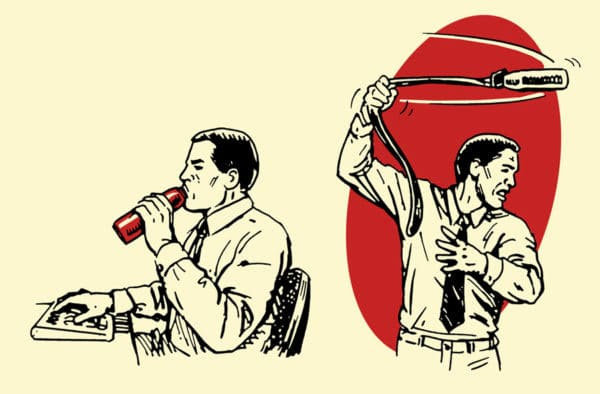
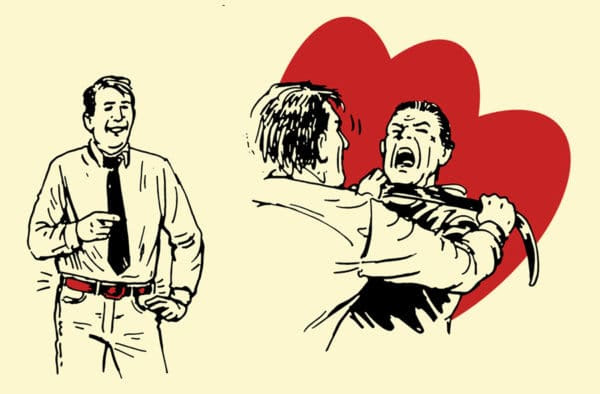
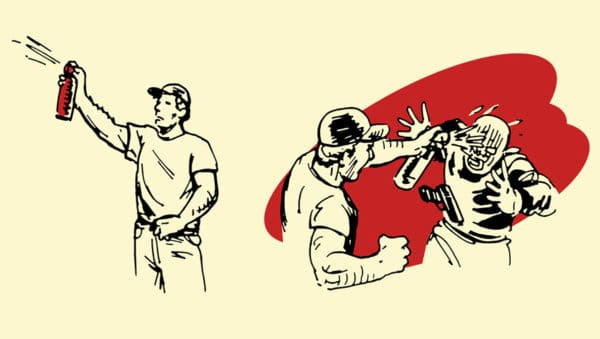
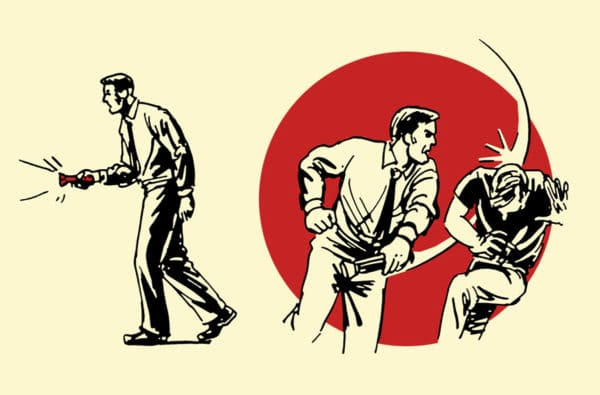
How to Turn 12 Everyday Items Into Improvised Weapons

Brett and Kate McKay | January 11, 2017

Manly SkillsTactical Skills
coffee pot improvised weapon illustration

“Be polite, be professional, but have a plan to kill everybody you meet.” –General James “Mad Dog” Mattis

While rare, violence often strikes when you least expect it. To counter violent attacks, you need to be fast and furious. Hand-to-hand combatives are a great tool to have up your sleeve to quickly dispatch an attacker, but you should always be looking for force multipliers—tools that make your counterattacks even more painful, damaging, and effective.
Having some sort of defensive weapon—be it a firearm, knife, or spray—as part of your EDC is never a bad idea, but sometimes you don’t have one on you (like when you’re in an area that prohibits weapons), your attacker has taken or knocked your weapon away, or you’re in a position that makes drawing your weapon hard to do.
Thankfully, you’re constantly surrounded by potential weapons that can be quickly accessed to counter violent attacks. To find and employ them, you just need to hone the most important weapon in your arsenal—your mind.
In the right hands, seemingly innocuous, everyday items can be turned into lethal weapons. Such a transformation just requires violating those objects’ Aristotelian telos—the end for which they were made. If your life is on the line, I don’t think old Aristotle would mind.
Below we offer 12 suggestions of everyday objects that can be turned into improvised weapons. Use this as a jumping off point to think of how other objects could save your life in a pinch.
When you’re out and about in public, practice scanning your environment and considering what might be used as a weapon if needed. Think of it as creating mental models for your OODA Loop so you can win the fight if/when it comes your way.

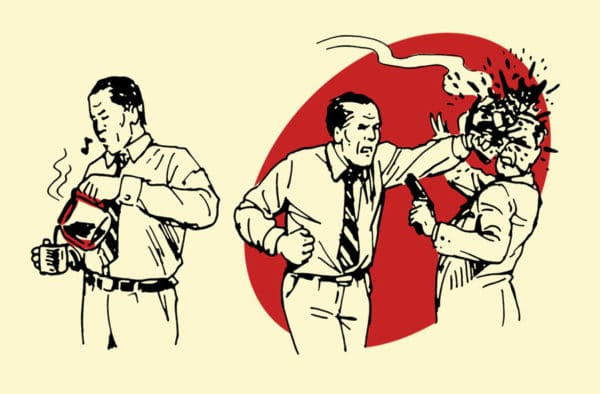
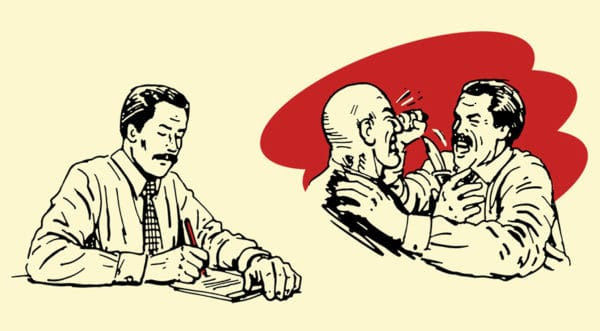
Pot of Hot Coffee

man pouring coffee pot improvised weapon illustration
There’s nothing like the smell of coffee brewing when you first wake up in the morning. And if you’re ever attacked while pouring your cup of joe, you can take comfort in the fact that you’re not just holding something wonderfully fragrant, but a great weapon as well.
Smash the pot into your attacker’s face. The blunt force will stun him, the shards of glass will embed in his kisser, and the scalding hot coffee will make him wish he stayed home that morning.

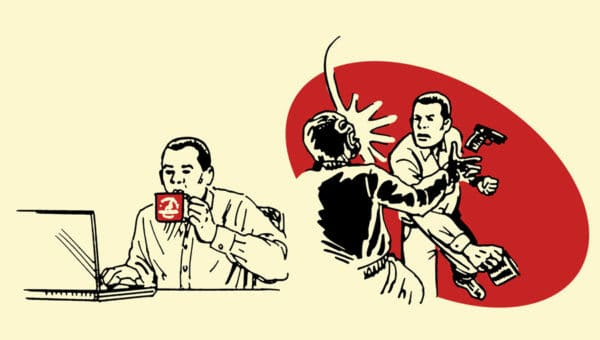
Coffee Mug

coffee mug improvised weapon illustration
Same principle as the coffee pot, just on a smaller scale. Throw the hot coffee from your mug into the attacker’s face and then proceed to bash him in his fleshy mug with caffeinated ferocity.

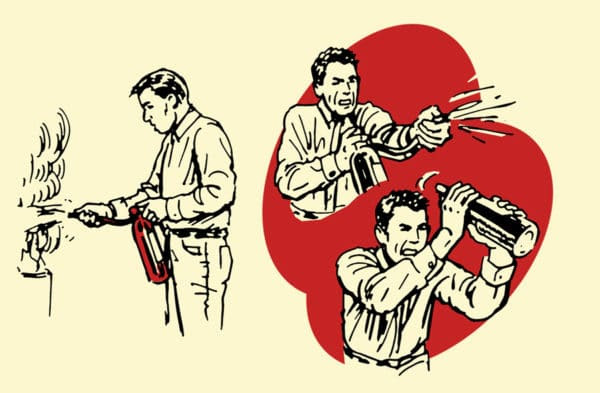
Fire Extinguisher

fire extinguisher improvised weapon illustration
Fire extinguishers cannot only save your life in a fire, but in a violent attack as well. Spray the assailant in the face to temporarily distract him and disrupt his OODA Loop. While he’s figuring out what’s going on, forcefully bludgeon him in the head with the extinguisher’s canister.

A Pen

use a pen as an improvised weapon illustration
In the right hands, the pen can indeed be mightier than the sword. A stainless steel pen like this Zebra number can be used to stab an assailant. Hold it with an overhand grip and aim for vulnerable parts of the body like the face and throat. If you really want to up your writing-implement-as-weapon game, get a true tactical pen like this Smith & Wesson.

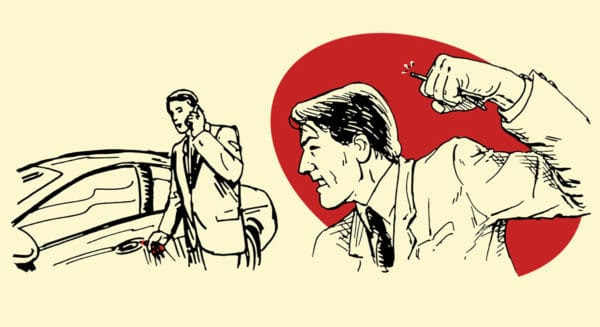
Keys

car keys improvised weapon self-defense illustration
Your keys can start your car or let you into your house. They can also savagely maim a violent attacker. Hold the keys in your hand so their points are coming out between the fingers of your fist. Proceed to punch your attacker in vulnerable parts of the body like the face and throat.

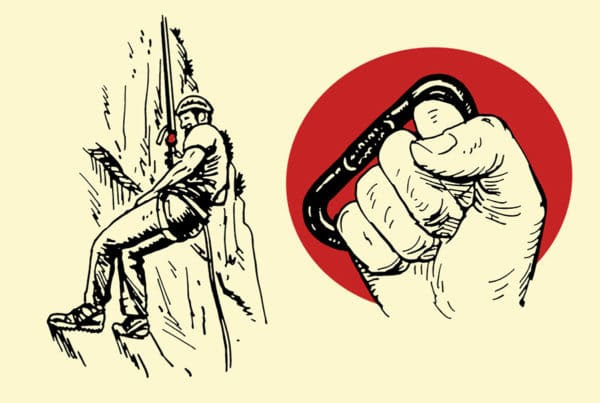
Locking Carabiner

climbing carabiner improvised weapon self-defense illustration
Carabineers are an important tool for mountain climbers and have become a go-to key holder for action-oriented gents. They can also serve as field-expedient knuckledusters in a pinch. If you want to use a carabiner as an improvised weapon, make sure it’s big enough to fit around your fist and has a locking collar (to prevent it from snapping open while you punch a mo’ fo’). While aluminum carabineers should be able to withstand the impact, for added strength, use a steel one.

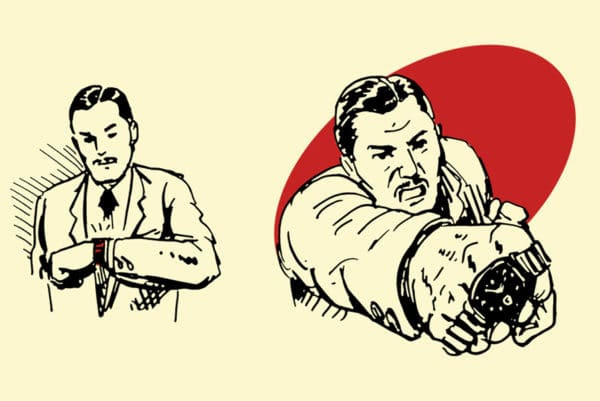
Wristwatch

wristwatch improvised weapon self-defense illustration
For a variation on the above, turn your metal wristwatch into a quick-n-dirty knucklebuster by holding the bracelet inside your fist, and positioning its face across your middle knuckles. James Bond uses his Rolex Oyster Perpetual in this way to knock out a bad guy in On Her Majesty’s Secret Service. Keep in mind that the impact of this move will likely break your timepiece. Bond was able to write off the destruction of his watch to his expense account. You won’t. Of course, losing your wristwatch will be a small price to pay if it saves your life.

Aluminum Water Bottle

water bottle improvised weapon self-defense illustration
An aluminum water bottle helps you stay hydrated while avoiding all those testosterone-lowering xenoestrogens found in plastic bottles. It can also be used to inflict blunt force trauma on a violent attacker. Ideally, you want the bottle to have some liquid in it in order to give your makeshift club more heft and weight. Bash your assailant’s head and face with it.
If you’ve got some time and if your bottle has a key ring, put your belt through the ring and tie it off. You’ve got yourself a medieval flail.

Belt

belt improvised weapon self-defense illustration
Just as you should remember that your belt should match the color of your shoes, you should also remember that it can be used as a weapon in a pinch.
First, you can use a belt the same way parents used to employ it on their kids back in the day—for whoopins. But unlike its use in dishing out old fashioned corporal punishment, you’re not going to hold back on your attacker. Give him the ass whoopin’ of a lifetime. Make sure he gets the buckle end of the belt. Aim for the face. The advantage of using a belt as an improvised bludgeon is not only the significant damage it can inflict, but the distance it allows you to put between you and your attacker.
The second way you can use a belt as a weapon is as a force multiplier when strangling an assailant.

Hornet Spray

hornet spray improvised weapon self-defense illustration
I got this improvised weapon idea while interviewing Navy SEAL Clint Emerson. Hornet spray is pepper spray on steroids. The former can usually shoot up to 20 feet and provides a much more directed stream than you find with the latter. What’s more, the chemical used in hornet spray is much more potent than pepper spray and can potentially permanently blind an attacker.
Keep in mind, that due to the possible maiming effects of hornet spray, one should only use it in life-threatening situations (like during a home invasion). Using hornet spray as an everyday self-defense tool is illegal in most jurisdictions.

Flashlight

flashlight improvised weapon self-defense illustration
Every man should not only carry a flashlight, but know how to use it in a tactical scenario. Not only can it help you find stuff in the dark and act as a deterrent to would-be attackers, it can also be used as a weapon. Maglite Heavy Duty D Cell flashlightsmake for a great makeshift billy club, and many specialized tactical flashlights end with a serrated or toothed bezel that can be used as an improvised striking device during an attack. After you’ve shined the bright light of a high-powered flashlight in your attacker’s eyes and disoriented him, strike his face with the toothed bezel as hard as you can. The motion should be like forcefully stamping him with a giant rubber stamp.

Smartphone

smartphone improvised weapon self-defense illustration
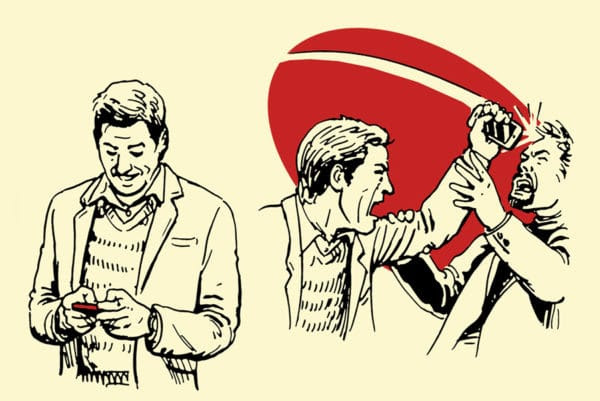
Today’s smartphones have been designed to take a beating; consequently, they can be used to give a beating.
Tightly grasp your smartphone in your hand and slam the edge and corners of it into vulnerable parts of the body like the eyes, nose, and neck.
You could also put your phone in a sock or other piece of clothing to make an improvised sap—a weighted impact weapon.
Whether you’re at home, the office, or out on the town, everyday objects that could be turned into weapons are all around you. Should you find yourself facing a violent threat, be ready to grab something and win the fight.

Categories
Related Topics

How to build a fire from wet wood

Related image
 
A very useful skill when one is out in the field!Image result for a campfire
I can guarantee that your companions will really & quickly learn to like you a whole lot more!
Image result for a campfire

Categories
Related Topics The Green Machine

The man who could of Shot Hitler? Maybe

World War One: The British hero who did not shoot Hitler

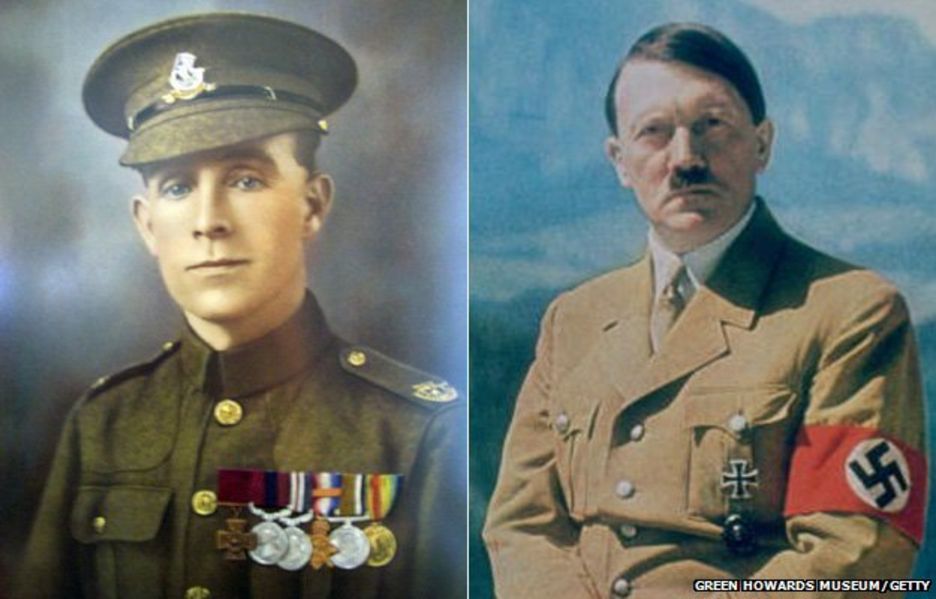
Tandey and HitlerImage copyright GREEN HOWARDS MUSEUM/GETTY
Image caption In 1938, Adolf Hitler himself is said to have told British Prime Minister Neville Chamberlain that Pte Henry Tandey had spared his life 20 years before

Henry Tandey became the most decorated private soldier in World War One. His bravery though, would be eclipsed in the run up to World War Two by allegations he had spared Adolf Hitler’s life, in 1918. But, is the story accurate?

The two events were separated by 20 years. On 28 September 1918, Pte Tandey earned the Victoria Cross “for most conspicuous bravery and initiative” at the fifth Battle of Ypres.
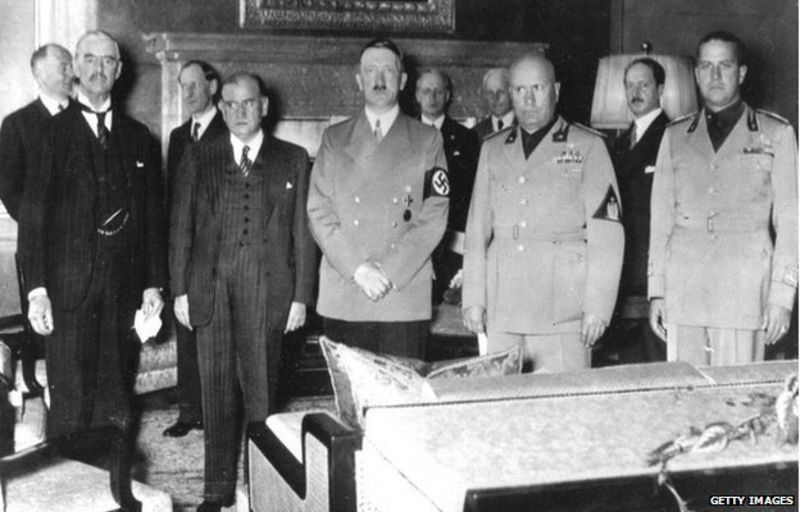
Twenty years later, Hitler himself is said to have planted the seeds of the legend during a visit to the Fuhrer by British Prime Minister Neville Chamberlain, in his doomed attempt to secure “peace for our time”.
He apparently seized on the fact that along with many of his fellow soldiers, Pte Tandey had tempered justice with mercy, refusing to kill unarmed, injured men in cold blood. The leader of the Third Reich claimed he was one of those spared.

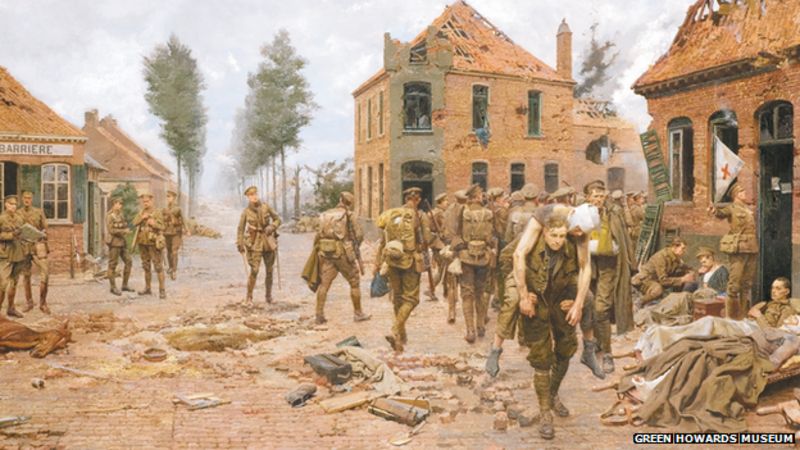
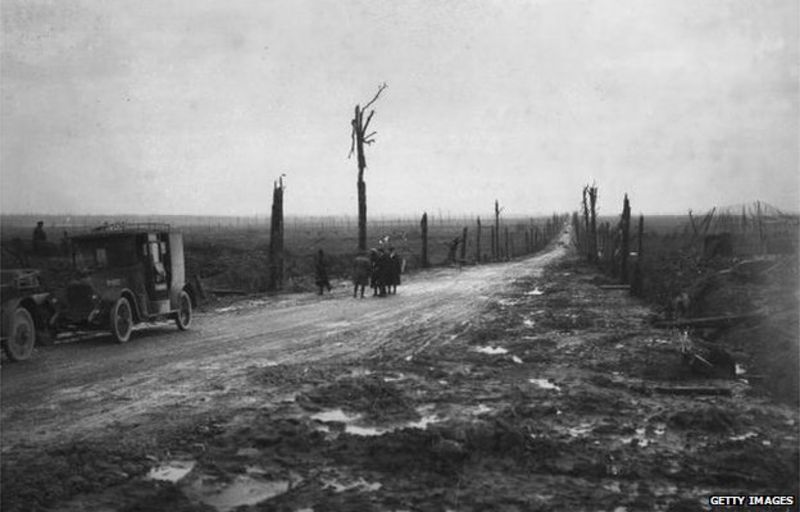
At his Bavarian retreat the Berghof, Chamberlain noticed a picture on the wall of Hitler’s study, depicting a scene from a battle at Menin crossroads in 1914. The soldier in the foreground was apparently Pte Tandey, carrying a fellow soldier to safety.
Hitler told Chamberlain the soldier had pointed a gun at him but spared him.
“That man came so near to killing me that I thought I should never see Germany again,” Hitler is alleged to have said.
“Providence saved me from such devilish accurate fire as those English boys were aiming at us.”
The museum of the Green Howards – Pte Tandey’s regiment, which commissioned the painting in 1923 from Italian war artist Fortunino Matania – confirmed a copy was hanging at Hitler’s retreat.

Newspaper-style clipping
Image captionThe story created compelling headlines

The museum has a letter from Hitler’s adjutant, Capt Fritz Weidemann, thanking them: “The Fuehrer is naturally very interested in things connected with his own war experiences. He was obviously moved when I showed him the picture.”
The painting’s route to Hitler’s wall was fairly convoluted, centring on one of his staff, a Dr Otto Schwend, who had received a postcard of the painting from a British soldier whom he had befriended in WW1.

Painting of Menin crossroadsImage copyrightGREEN HOWARDS MUSEUM
Image captionHitler owned a copy of Fortunino Matania’s painting of a post-battle scene at Menin crossroads

Hitler had apparently claimed to recognise in it a soldier he met in 1918, but the painting depicts a battle that actually took place in 1914.
Dr David Johnson, Pte Tandey’s biographer, throws more doubt on the story.

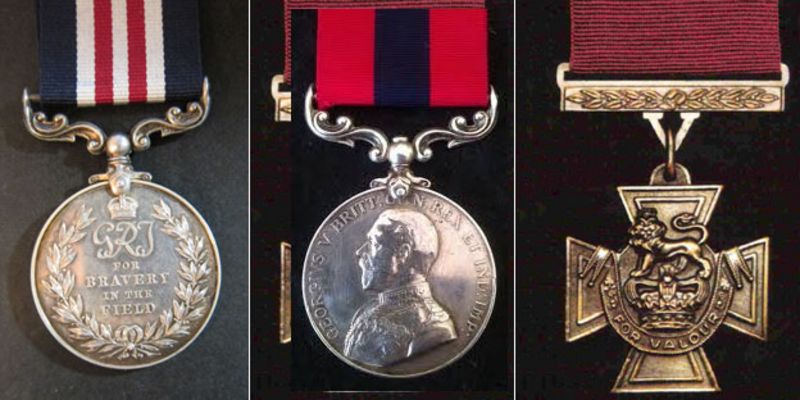
Military medal, DCM (medal) Victoria Cross (medal)Image copyrightFAIR USAGE
Image captionPte Tandey was awarded the Military Medal, the Distinguished Conduct Medal, and the Victoria Cross. He was also mentioned five times in despatches

He pointed out that even if the date were accurate it would have been unlikely for Pte Tandey to have been recognisable from the painting. He had been injured during the 1918 battle, and in contrast to the painting, would have been “extremely dishevelled and covered in mud and blood”.
Perhaps even more compellingly, Dr Johnson argues there was no way Pte Tandey and L/Cpl Hitler could have crossed paths.
On 17 September, Hitler’s unit had been moved about 50 miles (80km) north of Pte Tandey’s, which was in Marcoing, near Cambrai in northern France.

Photograph of Menin RoadImage copyrightGETTY IMAGES
Image captionMenin Road in the aftermath of battle. Fortunino Matania’s painting depicts Pte Tandey at Menin crossroads, where a first-aid station was based

The meeting of the men was supposed to have happened on 28 September 1918, but papers at the Bavarian State Archive show Hitler had been on leave between 25 September and 27 September.
“This means that Hitler was either on leave or returning from leave at the time or with his regiment 50 miles north of Marcoing,” Dr Johnson said.
He also said it was not likely that Hitler had been simply confused.

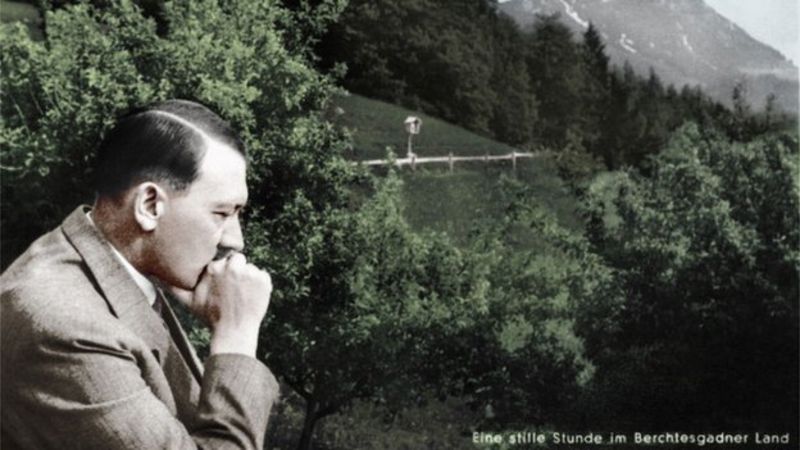
Hitler looking pensiveImage copyrightGETTY IMAGES
Image captionThe Matania painting was seen by Chamberlain when he visited Hitler’s Bavarian house in 1938

“It’s likely he chose that date because he knew Tandey had become one of the most decorated soldiers in the war,” said Dr Johnson.
“If he was going to have his life spared by a British soldier, who better than a famous war hero who had won a Victoria Cross, Military Medal and a Distinguished Conduct Medal in a matter of weeks?

“With his god-like self-perception, the story added to his own myth – that he had been spared for something greater, that he was somehow “chosen”. His story embellished his reputation nicely.”
It was another detail that also set alarm bells ringing, Dr Johnson said.

No telephone

On returning to Britain, Mr Chamberlain is alleged to have phoned Pte Tandey to pass on details of the exchange he had with Hitler.
He was out at the time, so a nephew apparently took the call.
Dr Johnson is highly sceptical the call was made, not least because Mr Chamberlain was a very busy man.
“I can’t see him spending time tracking down and telephoning a Private,” he said.
“He also sent long and detailed letters to his sisters and kept diaries. Nowhere in his papers was the Tandey affair mentioned.”
British Telecom archives add more doubt – Pte Tandey did not have a telephone.
But the story has persisted, having probably first come to light at a regimental event in 1938 where, Dr Johnson said, Pte Tandey was told by an officer who had heard it from Mr Chamberlain.
“We don’t know whether Tandey was taken to one side and told privately – or whether it was a jocular part of an after-dinner speech, or something like that,” he said.
Pte Tandey himself was noncommittal about it. He acknowledged he had spared soldiers on 28 September, and was initially prepared to entertain the idea – but always made a point of saying he needed more information to confirm it.

Chamberlain and Hitler conferenceImage copyrightGETTY IMAGES
Image captionPreparing to sign the 1938 Munich Agreement: (l-r) Chamberlain; French Prime Minister Daladier; Hitler; Mussolini and Italian Foreign Minister Count Ciano

He was quoted in an August 1939 edition of the Coventry Herald as saying: “According to them, I’ve met Adolf Hitler.
“Maybe they’re right but I can’t remember him.”
But a year later, he appeared to be more certain, when a journalist approached him outside his bombed Coventry home, asking him about his alleged encounter with Hitler.
“If only I had known what he would turn out to be,” Pte Tandey is quoted as saying.

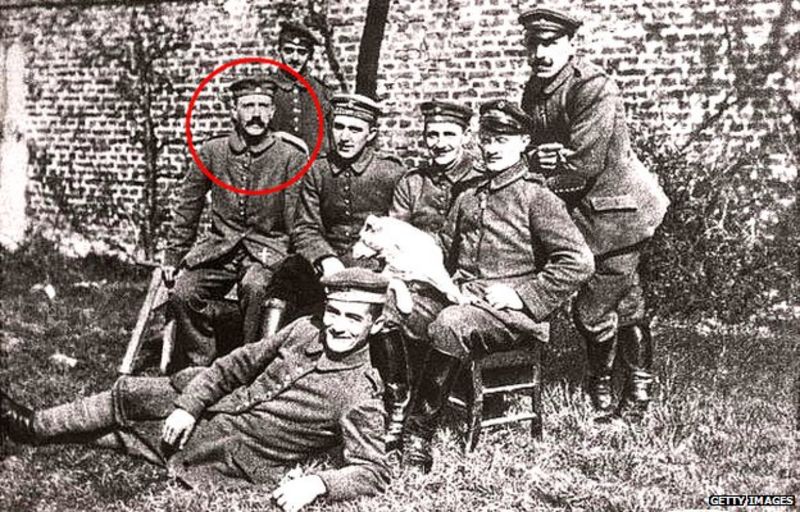
Hitler and his WW1 comrade soldiersImage copyrightGETTY IMAGES
Image captionAdolf Hitler would look considerably different 20 years later

“When I saw all the people and women and children he had killed and wounded I was sorry to God I let him go.”
The newspapers seemed to say it all:
“Nothing Henry did that night could ease his sickening sense of guilt.”
“It was a stigma that Tandey lived with until his death”
“He could have stopped this. He could have changed the course of history”
However, there is no evidence, not even anecdotal, he was either hounded or avoided after the claims.

‘Extremely dishevelled’

“It must be remembered that this was a low point for the country and for Coventry, and Henry can be excused for feeling a little sorry for himself and emotional after the sights he had witnessed,” Dr Johnson said.
“We must not forget that in 1918, no-one knew who Hitler was. Why would Henry remember and regret that specific encounter, especially when Hitler would also have been extremely dishevelled and covered in mud and blood, not looking like he did 20 years later.
“It might be equally true that the journalist concerned took Henry’s comments out of context, which might go some way to explaining his distrust of the press.”

London Gazette clippingImage copyrightLONDON GAZETTE
Image captionPte Tandey’s bravery was documented in the London Gazette


Henry Tandey

From Wikipedia, the free encyclopedia
Henry Tandey
Pte Tandey VC DCM MM.JPG

Private Henry Tandey VC, DCM, MM
Birth name Henry Tandy
Born 30 August 1891
LeamingtonWarwickshire
Died 20 December 1977 (aged 86)
CoventryWest Midlands
Allegiance  United Kingdom
Service/branch  British Army
Years of service 1910–1926
Rank Sergeant
Unit The Yorkshire Regiment (Green Howards) (1910–18)
West Riding Regiment (Duke of Wellington’s Regiment) (1918–26)
Battles/wars World War I
Awards Victoria Cross
Distinguished Conduct Medal
Military Medal
Mentioned in Despatches (5)

Henry Tandey VCDCMMM (born Tandy, 30 August 1891 – 20 December 1977) was an English recipient of the Victoria Cross, the highest award for gallantry in the face of the enemy that can be awarded to British and Commonwealth forces. He was the most highly decorated British private of the First World War and is most commonly remembered as the soldier who spared Adolf Hitler’s life during the war. Born with the family name of Tandy, he later changed his surname to Tandey after problems with his father,[1][vague]therefore some military records have a different spelling of his name.

Early life[edit]

Henry Tandey was born in LeamingtonWarwickshire, the son of a former soldier whose wife had died early in their child’s life. He spent part of his childhood in an orphanage before becoming a boiler attendant at a hotel.

Military service[edit]

Tandey enlisted into the Green Howards Regiment on 12 August 1910. After basic training he was posted to their 2nd Battalion on 23 January 1911, serving with them in Guernsey and South Africa prior to the outbreak of World War I.[2] He took part in the Battle of Ypres in October 1914, and was wounded on 24 October 1916, at the Battle of the Somme. On discharge from hospital he was posted to the 3rd Battalion on 5 May 1917, before moving to the 9th Battalion on 11 June 1917. He was wounded a second time on 27 November 1917, during the Battle of Passchendaele. After his 2nd period of hospital treatment he returned to the 3rd Battalion, on 23 January 1918, before being posted to the 12th Battalion on 15 March 1918, where he remained until 26 July 1918. On 26 July 1918 Tandey transferred from the Green Howards to The Duke of Wellington’s (West Riding Regiment). He was posted to their 5th Battalion on 27 July 1918.

Distinguished Conduct Medal[edit]

On 28 August 1918, during the 2nd Battle of Cambrai, the 5th Battalion was in action to the west of the Canal du Nord. Tandey was in charge of one of several bombing parties on the German trenches. As the forward parties were being held up Tandey took two men and dashed across open ground (No man’s land) under fire and bombed a trench. He returned with twenty prisoners. This action led to the capture of the German positions and Tandey was awarded the Distinguished Conduct Medal (DCM) on 5 December 1918, the citation read:

34506 Pte. H. Tandey, 5th Bn., W. Rid. R.
(T.F.) (Leamington). He was in charge of a reserve bombing party in action, and finding the advance temporarily held up, he called on two other men of his party, and working across the open in rear of the enemy, he rushed a post, returning with twenty prisoners, having killed several of the enemy. He was an example of daring courage throughout the whole of the operations.[3]

On 12 September the 5th Battalion was involved in an attack at Havrincourt, where Tandey again distinguished himself. Having rescued several wounded men under fire the previous day,[4] Tandey again led a bombing party into the German trenches, returning with more prisoners. For this action Tandey was awarded the Military Medal (MM) on 13 March 1919.[5]

Victoria Cross[edit]

Tandey was 27 years old and a private in the 5th Battalion Duke of Wellington’s (West Riding) Regiment when he performed the actions which earned him the Victoria Cross (VC).
On 28 September 1918, during a counter-attack at the canal, following the capture of MarcoingFrance, his platoon was stopped by machine-gun fire. Tandey crawled forward, located the gun position and with a Lewis gun team, silenced it. Reaching the canal crossing, he restored the plank bridge under heavy fire. In the evening, he and eight comrades were surrounded by an overwhelming number of the enemy. Tandey led a bayonet charge, fighting so fiercely that 37 of the enemy were driven into the hands of the remainder of his company. Although twice wounded, Tandey refused to leave until the fight was won,[6] eventually going into hospital for the third time on 4 October 1918.
An eyewitness, Private H Lister, recounted the episode:

On 28th September 1918 during the taking of the crossing over the Canal de St. Quentin at Marcoing, I was No.1 of the Lewis gun team of my platoon. I witnessed the whole of the gallantry of Private Tandey throughout the day. Under intensely heavy fire he crawled forward in the village when we were held up by the enemy MG and found where it was, and then led myself and comrades with the gun into a house from where we were able to bring Lewis gun fire on the MG and knock it out of action. Later when we got to the canal crossings and the bridge was down, Pte Tandey, under the fiercest of aimed MG fire went forward and replaced planks over the bad part of the bridge to enable us all to cross without delay, which would otherwise have ensued. On the same evening when we made another attack we were completely surrounded by Germans, and we thought the position might be lost. Pte Tandey, without hesitation, though he was twice wounded very nastily, took the leading part in our bayonet charge on the enemy, to get clear. Though absolutely faint he refused to leave us until we had completely finished our job, collected our prisoners and restored the line.[4]

His VC was gazetted on 14 December 1918, the citation read:

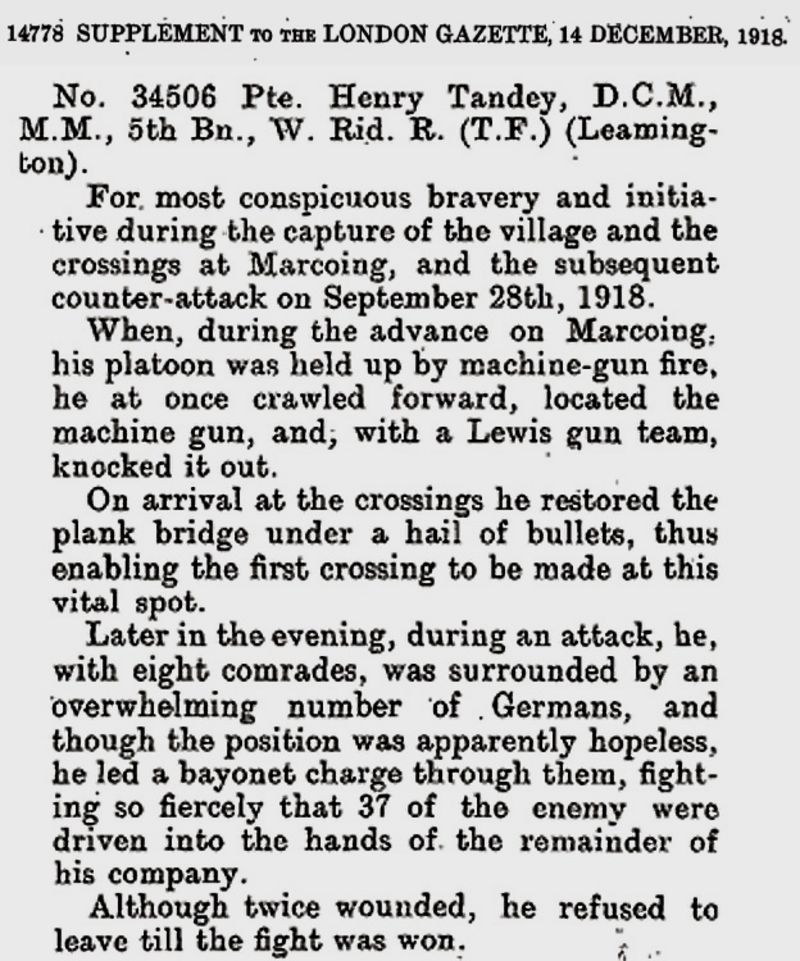
No. 34506 Pte. Henry Tandey, D.C.M., M.M., 5th Bn., W. Rid. R. (T.F.) (Leamington).
For most conspicuous bravery and initiative during the capture of the village and the crossings at Marcoing, and the subsequent counter-attack on September 28th, 1918. When, during the advance on Marcoing, his platoon was held up by machine-gun fire, he at once crawled forward, located the machine gun, and, with a Lewis gun team, knocked it out. On arrival at the crossings he restored the plank bridge under a hail of bullets, thus enabling the first crossing to be made at this vital spot.
Later in the evening, during an attack, he, with eight comrades, was surrounded by an overwhelming number of Germans, and though the position was apparently hopeless, he led a bayonet charge through them, fighting so fiercely that 37 of the enemy were driven into the hands of the remainder of his company.
Although twice wounded, he refused to leave till the fight was won.[7]

Hitler incident[edit]

Although disputed, Adolf Hitler and Tandey allegedly encountered each other at the French village of Marcoing. The story is set on 28 September 1918, while Tandey was serving with the 5th Duke of Wellington’s Regiment, and relates that a weary German soldier wandered into Tandey’s line of fire. The enemy soldier was wounded and did not even attempt to raise his own rifle. Tandey chose not to shoot. The German soldier saw him lower his rifle and nodded his thanks before wandering off. That soldier is purported to have been Adolf Hitler.[8][9][10] The author David Johnson, who wrote a book on Henry Tandey,[11] believes this story was an urban legend.[12]
Hitler apparently saw a newspaper report about Tandey being awarded the VC (in October 1918, whilst serving with the 5th Battalion Duke of Wellington’s (West Riding) Regiment), recognized him, and clipped the article.[10]
In 1937, Hitler was made aware of a particular Fortunino Matania painting[13] by Dr Otto Schwend, a member of his staff. Schwend had been a medical officer during the First Battle of Ypres in 1914. He had been sent a copy of the painting by a Lieutenant Colonel Earle in 1936. Earle had been treated by Schwend in a medical post at the Menin Crossroads and they remained in touch after the war.[14]
The painting was commissioned by the Green Howards Regiment from the Italian artist in 1923, showing a soldier purported to be Tandey carrying a wounded man at the Kruiseke Crossroads in 1918, northwest of Menin. The painting was made from a sketch, provided to Matania, by the regiment, based on an actual event at that crossroads. A building shown behind Tandey in the painting belonged to the Van Den Broucke family, who were presented with a copy of the painting by the Green Howard’s Regiment.[15]
Schwend obtained a large photo of the painting. Captain Weidemann, Hitler’s adjutant, wrote the following response:

“I beg to acknowledge your friendly gift which has been sent to Berlin through the good offices of Dr. Schwend. The Führer is naturally very interested in things connected with his own war experiences, and he was obviously moved when I showed him the photograph and explained the thought which you had in causing it to be sent to him. He was obviously moved when I showed him the picture. He has directed me to send you his best thanks for your friendly gift which is so rich in memories.”

Apparently Hitler identified the soldier carrying the wounded man as Tandey from the photo of him in the newspaper clipping he had obtained in 1918.[16]
In 1938, when Neville Chamberlain visited Hitler at his alpine retreat, the Berghof, for the discussions that led to the Munich Agreement, he noticed the painting and asked about it. Hitler replied:

“That man came so near to killing me that I thought I should never see Germany again; Providence saved me from such devilishly accurate fire as those English boys were aiming at us.”[17]

According to the story, Hitler asked Chamberlain to convey his best wishes and gratitude to Tandey. Chamberlain promised to phone Tandey in person on his return, which apparently he did. The Cadbury Research Centre, which holds copies of Chamberlain’s papers and diaries, has no references relating to Tandey from the records of the 1938 meeting.[18][19] The story further states that the phone was answered by a nine-year-old child called William Whateley.[20]William was related to Tandey’s wife Edith. However, Tandey at that time lived at 22 Cope Street, Coventry, and worked for the Triumph Motor Company. According to the company records, they only had three phone lines, none of which was at Tandey’s address. British Telecommunications archive records also have no telephones registered to that address in 1938.[21]

Post-war service[edit]

On 13 March 1919 a supplement to the London Gazette announced that Tandey had been awarded the Military Medal(MM).[5] The following day he was discharged from service and only one day later he re-enlisted into the Duke of Wellington’s 3rd Battalion on a ‘Short Service Engagement’. Three days later (18 March 1919) he was promoted to acting lance corporal. He remained with the 3rd Battalion on ‘Home Service’ until 4 February 1921, when he transferred to the 2nd Battalion. Four days later on 8 February 1921 he requested to revert to the rank of private.
Tandey served with the 2nd Battalion in Gibraltar from 11 April 1922 to 18 February 1923, in Turkey from 19 February – 23 August 1923 and finally in Egypt from 24 August 1923 until 29 September 1925. He was finally discharged from the army on 5 January 1926.
In addition to his major awards Tandey had also been Mentioned in Despatches on five occasions. He was personally decorated by King George V at Buckingham Palace on 17 December 1919.[2]

Post-war years[edit]

Tandey returned to Leamington and married. In 1940, during the Coventry Blitz, his home was bombed by the Luftwaffe. A journalist approached him outside his bombed Coventry home, asking him about his alleged encounter with Hitler. “If only I had known what he would turn out to be,” Tandey is quoted as saying. “When I saw all the people and women and children he had killed and wounded I was sorry to God I let him go.” However, there is no evidence, not even anecdotal, he was either hounded or avoided after the claims.[22]
Tandey became a Police sergeant at the Standard Triumph Works, Fletchamstead a position he held for 38 years. [23]
Tandey died in 1977, childless, at the age of 86. At his request, he was cremated and his ashes buried in the Masnieres British Cemetery at Marcoing, France, on 23 May 1978, by his undertaker Pargetter and Son.[24] Due to French laws it was not permissible for his ashes to be scattered, or any form of ceremony or commemoration made to him.[25]
Henry Tandey Court, on Union Road, in Leamington, is named after him. It was originally a workshop and builders yard of Mr. G.F.Smith, who built St. Marks Church and Vicarage.[26]
blue plaque was installed outside the Angel Hotel in Regent Street, where Henry Tandey was born in 1891 and where he attended the local St Peter’s School.[27][28]

Medals[edit]

Tandey donated his medals to the Duke of Wellington’s Regiment Museum in Halifax, West Yorkshire. On special occasions and parades he would sign them out to wear. During the last period that he had signed them out, he died. Unaware that the medals should have been returned to the museum, the medals were auctioned at Sotheby’s in London by his wife and a private collector subsequently purchased them. They were presented to the Green Howards Regimental Museum (the regiment in which he had earlier served), by Sir Ernest Harrison OBE, at a ceremony in the Tower of Londonon 11 November 1997, twenty years after Tandey died.[29]
A copy of Tandey’s Victoria Cross is now displayed at the Green Howards Regimental Museum in Richmond, North Yorkshire. Along with others, the original VC is kept in a local bank vault.
On 6 June 2006 The Green Howards and the Duke of Wellington’s (West Riding) Regiment amalgamated with the Prince of Wales’s Own Regiment of Yorkshire to form the Yorkshire Regiment.

UK Victoria Cross ribbon bar.svg UK Distinguished Conduct Medal ribbon.svg UK Military Medal ribbon.svg 1914 Star BAR.svg
British War Medal BAR.svg Victory Medal MID ribbon bar.svg Defence Medal BAR.svg GeorgeVICoronationRibbon.png
UK Queen EII Coronation Medal ribbon.svg QEII Silver Jubilee Medal ribbon.png[30] [31]

Ribbon Description Notes
UK Victoria Cross ribbon bar.svg Victoria Cross (VC) 14 December 1918
UK Distinguished Conduct Medal ribbon.svg Distinguished Conduct Medal(DCM) 5 December 1918
UK Military Medal ribbon.svg Military Medal (MM) 13 March 1919
1914 Star BAR.svg 1914 Star With Clasp “5th Aug – 22nd Nov 1914”
British War Medal BAR.svg British War Medal
Victory Medal MID ribbon bar.svg Victory Medal With Mentioned in dispatches Oakleaf
Defence Medal BAR.svg Defence Medal Awarded for his Service as an Air Raid Warden in Coventry during the Blitz.
GeorgeVICoronationRibbon.png King George VI Coronation Medal 1937 – Given to all living recipients of the Victoria Cross.
UK Queen EII Coronation Medal ribbon.svg Queen Elizabeth II Coronation Medal 1953 – Given to all living recipients of the Victoria Cross and the George Cross.
QEII Silver Jubilee Medal ribbon.png Queen Elizabeth II Silver Jubilee Medal 1977 – Given to all living recipients of the Victoria Cross and the George Cross.

References[edit]

  1. Jump up^ Johnson, David (2012). One Soldier And Hitler, 1918. Gloucestershire: the History Press. p. 20. ISBN 978 0 7524 6613 2.
  2. Jump up to:a b http://www.firstworldwar.com/features/tandey.htm
  3. Jump up^ “No. 31052”The London Gazette (Supplement). 3 December 1918. p. 14454.
  4. Jump up to:a b Brereton, JM; Savory, ACS (1993). “World War 1, 1918”. The History of the Duke of Wellingtons (West Riding) 1702–1992. Halifax : The Duke of Wellington’s Regiment. p. 254. ISBN 0-9521552-0-6.
  5. Jump up to:a b “No. 31227”The London Gazette. 11 March 1919. p. 3430.
  6. Jump up^ Brereton, JM; Savory, ACS (1993). “”34507 Pte Henry Tandey”, appendix IV”. The History of the Duke of Wellingtons (West Riding) 1702–1992. Halifax : The Duke of Wellington’s Regiment. p. 396. ISBN 0-9521552-0-6.
  7. Jump up^ “No. 31067”The London Gazette (Supplement). 13 December 1918. p. 14778.
  8. Jump up^ “World War I 1918 British soldier allegedly spares the life of an injured Adolf Hitler”This Day in History. History.com. Retrieved 3 October 2015.
  9. Jump up^ Morpurgo, Michael (3 October 2015). “Michael Morpurgo on the soldier who could have stopped a world war with one shot”. The Times Newspaper. Retrieved 3 October 2015.
  10. Jump up to:a b Godl, John (22 August 2009). “How a Right Can Make a Wrong”FirstWorldWar.com. Retrieved 3 October 2015.
  11. Jump up^ Johnson, David (1 October 2013). One Soldier and Hitler, 1918: The Story of Henry Tandey VC DCM MM. Spellmount Publishers Ltd. ISBN 978-0752466132.
  12. Jump up^ “Did British soldier spare Hitler’s life in WWI?”. BBC News. 2 March 2014. Retrieved 3 October 2015.
  13. Jump up^ http://victoriacross.files.wordpress.com/2007/03/tandey.jpg
  14. Jump up^ Johnson, David (2012). One Soldier And Hitler, 1918. Gloucestershire: the History Press. p. 149. ISBN 978 0 7524 6613 2.
  15. Jump up^ Johnson, David (2012). One Soldier And Hitler, 1918. Gloucestershire: the History Press. pp. 149–150. ISBN 978 0 7524 6613 2.
  16. Jump up^ gazettelive.co.uk
  17. Jump up^ Johnson, David (2012). One Soldier And Hitler, 1918. Gloucestershire: the History Press. p. 150. ISBN 978 0 7524 6613 2.
  18. Jump up^ http://www.birmingham.ac.uk/facilities/cadbury/documents/personal-archives-guide.pdf
  19. Jump up^ Johnson, David (2012). One Soldier And Hitler, 1918. Gloucestershire: the History Press. p. 146. ISBN 978 0 7524 6613 2.
  20. Jump up^ Johnson, David (2012). One Soldier And Hitler, 1918. Gloucestershire: the History Press. p. 144. ISBN 978 0 7524 6613 2.
  21. Jump up^ Johnson, David (2012). One Soldier And Hitler, 1918. Только правда ли всё это судите сами. Gloucestershire: the History Press. p. 145. ISBN 978 0 7524 6613 2.
  22. Jump up^ http://www.bbc.co.uk/news/uk-england-28593256
  23. Jump up^ Triumph Works Archive
  24. Jump up^ Johnson, David (2012). One Soldier And Hitler, 1918. Gloucestershire: the History Press. p. 127. ISBN 978 0 7524 6613 2.
  25. Jump up^ Johnson, David (2012). One Soldier And Hitler, 1918. Gloucestershire: the History Press. p. 128. ISBN 978 0 7524 6613 2.
  26. Jump up^ St Marks Church – Early Leamington
  27. Jump up^ Lemington Courier, 2 Oct 2012 – Hero soldier permanently remembered in Leamington
  28. Jump up^ Courier, 28 Aug 2011 – Birthplace of Leamington hero to be given blue plaque
  29. Jump up^ “Henry Tandy”. firstworldwar.com. Retrieved 2010-06-29.
  30. Jump up^ Duke of Wellington’s Regiment Website, VC Recipients. List of medals awarded – Henry Tandy Archived 3 February 2014 at the Wayback Machine.
  31. Jump up^ [1]
General

External links[edit]

Categories
All About Guns Related Topics

A Blast from the Past!

Categories
Related Topics

CAMP PERRY SEES MAJOR IMPROVEMENTS TO HISTORICAL BUILDINGS IN 2018

By Ashley Brugnone, CMP Writer
CAMP PERRY, Ohio – The Camp Perry National Guard Training Base, home of the National Trophy Pistol and Rifle Matches since 1907, is currently undergoing significant upgrades to some of the most celebrated areas of the grounds.
“There will be a different feel when people come onto post,” said MAJ Michael Yates, base operations manager of the Camp Perry facility since 2014.
Since his time at Camp Perry, MAJ Yates has overseen a considerable amount of projects totaling multi-millions of dollars, which have included structural, functional, aesthetic and historical developments. He admitted the renovations being conducted in 2018 have been years in the making – featuring major additions to base facilities and a substantial restoration in the historical theatre.
“We’re doing so much to continually improve the post and make it better,” he said. “Our predecessors have made it better, and we want to take it from there and continue to make it that much better for everyone to use.”
He added, “It’s been a century-plus of things going on here – people training up for World War I, to a POW camp for Italian and German prisoners during World War II, to all the different schools and people, soldiers, shooters coming through here. We want to ensure that they understand that we always keep an eye to this and want to show our legacy. Not only holding to it, but improving on it. That’s what we strive for.”
Even with the significant construction going on this year at Camp Perry, there is still plenty of improvements in store as MAJ Yates and his crew continue to plan for the future.
“There will be more to come,” he said.
Below is a summary of the major projects going on at Camp Perry in 2018.

The berms at 300 and 600 yards were redone to allow more comfort for competitors.

300 and 600 Yard Shooting Berms on Rodriguez Range
Completed in November 2017, improvements were made on all of the berms by adding more room on top, to help those who train and hold competitions. MAJ Yates and his team partnered with the 200th Red Horse, Air National Guard Unit within the Ohio National Guard on the project – setting a solid 10-foot shooting platform to ensure everyone will be more comfortable.

The old lakeside cottages are being replaced with new structures that all allow a view of the lake.

“The Point Project”
The old lakeside cottages, located behind the beach on base, are being phased out. The nearby tennis courts have been removed, and roads and walkways have also been repaved. Five new cottages are being built – totaling $2.25 million from the capital budgets.
All new infrastructure has been put into the area, including brand new sewer, water, electric and gas lines. The cottages will sleep eight, with three bedrooms, twoand angled positioning of the buildings to give every one a view of the lake from the porch to the kitchen.
“They are absolutely fantastic. Everyone gets a great view,” said MAJ Yates.
The modular style homes were built in a warehouse and brought in two parts, then set up and put together. The homes are designed with insulated style siding, plus insolation within to make them comfortable during the winter months.
Offering competitive pricing that is more affordable than the surrounding areas, the new cottages will be available to rent at Camp Perry 365 days out of the year.
“This is the best kept secret in all of Ohio,” said MAJ Yates. “People will get to see what a great stay Camp Perry is. It’s going to be a great upgrade to the facilities.”
MAJ Yates will be requesting for fiscal year 2019-2020 capital budgets to finish the rest of the cottages and replace existing buildings – demoing the rest and adding in 10 more houses.
The new cottages are planned to be finished some time in the spring.
The last cottages were built in the 1950s, based around tent pads that used to be on the grounds in the early days of Camp Perry. According to MAJ Yates, they were not energy-efficient and needed winterized – it was just time for an upgrade.
“We have done the best we possibly can with those facilities, and they have been great to us in the past, but it was time to make a step forward and to give everyone a great place to go to enjoy all of the local surrounding areas,” he said. “This is going to benefit everyone.”
The Club House next door can hold 350 people for parties and events. Located on the water, with a chapel on post and the cottages right next door, Camp Perry has become a sought-after destination for weddings.

The mural of the auditorium and other historical aspects will remain in the theatre, along with the addition of past photos and other Camp Perry artifacts.

The Hough Theatre
Considered one of the most exciting projects on base, the Hough Theatre has received upgrades to entranceways, restrooms, seating, lighting and the interior as a whole – totaling $1.3 million. Some of the stage is being improved upon as well, including the orchestra pit, and existing offices and classrooms backstage will be updated, with the hopes of being utilized in the future.
“We have worked heavily with the state historical and preservation society to ensure that we have the historical feel to the auditorium itself, but with modern comforts,” said MAJ Yates.

The old auditorium seats of Hough Theatre were torn out and will be replaced with more up-to-date seating. Construction on the Hough Theatre will not only improve the auditorium interior, but will also enhance classrooms and other areas of the building.

The original theatre seats were completely gutted from the building. The new seating will have the effect of the historical seating, but with more padding and comfort – designed for the modern world. The famous mural cascading across the walls around the theatre will remain intact, with much of the interior upgraded or kept as-is.
“It’s an amazing facility, and to bring it up to where it deserves to be is fantastic,” said MAJ Yates.
The Hough Theatre is an important landmark in the history of Camp Perry. Originally the second brick facility built on the post, the inside has seen many distinguished guests during its century-old reign, including countless military and civilian heroes like General John Pershing after World War I and Bob Hope.
The new entranceway of the theatre will throw homage to its incredible history, displaying true photos and artifacts for guests to enjoy. With a projected completion date slotted for the spring, the building will be ready in time for the National Matches ceremonies.
“This has been many years in the coming, and I’m really excited to see what this is going to look like,” said MAJ Yates.
Reconstruction to Bldg 2009
Camp Perry’s Bldg 2009, the long, large building before the historical park when entering base to the north, has undergone an exterior renovation for $640,000.
First constructed in 1903, a new roof, exterior doors and windows have all been installed on the building. MAJ Yates worked with a historical society to again ensure the facility was restored to the times, with modern upgrades, but still within the guidelines of historical restoration.
“Keeping with our history is a big part of what we do here at Camp Perry. We work with our environmental department and state historical society. Everything that we do here, we ensure that we hold to our historical section,” he said.
Demolition Across the Post
Demolition of the rest of the old POW huts by existing two-story barracks on the west side of post will continue until completion. Eight other facilities will also be coming down to clean up post, ridding those that are not used or are passed where they are able to be reutilized. The project should be completed in June 2018.

Categories
All About Guns Anti Civil Rights ideas & "Friends" Related Topics

Some Possible Good News for Americas Gunmakers

Very soon, Smith & Wesson, which made these guns shown at a 2016 trade show in Las Vegas, and other manufacturers of commercially available guns and rifles will likely be able to sell their products overseas with less red tape, as oversight of most such exports is expected to move from the State Department to the Commerce Department.
Very soon, Smith & Wesson, which made these guns shown at a 2016 trade show in Las Vegas, and other manufacturers of commercially available guns and rifles will likely be able to sell their products overseas with less red tape, as oversight of most such exports is expected to move from the State Department to the Commerce Department. John LocherAP

Gunmakers, with sales slumping at home, ready for eased export rules

April 17, 2018 05:00 AM

Homeowners Born Before 1985 Are Getting a Huge Reward
SPONSORED CONTENT

If you own a home, you should read this. Thousands of homeowners did this yesterday, and banks are furious! Do this now before it’s…

Categories
Anti Civil Rights ideas & "Friends" Related Topics

Hawaii – Well I thought it was interesting!

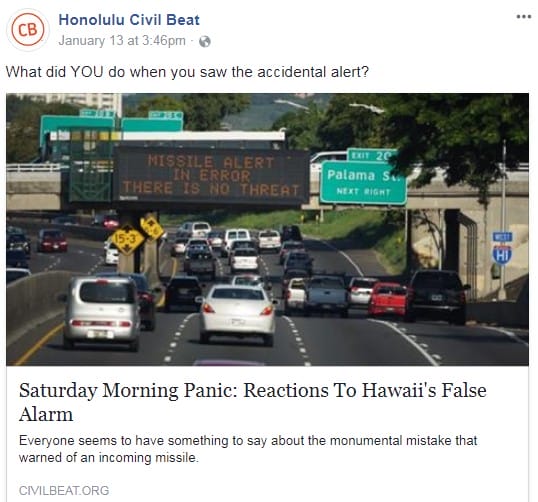
Hawaii Missile Alert Screw-Up Highlights Dangerous Anti-Gun Culture Planning Flaws

What kind of pervasive incompetence requires retractions like this?

USA – -(Ammoland.com)- “BALLISTIC MISSILE THREAT INBOUND TO HAWAII. SEEK IMMEDIATE SHELTER. THIS IS NOT A DRILL,” the Hawaii Emergency Management Agency warned cellphone users Saturday. Television viewers saw a more detailed alert:

“If you are indoors, stay indoors. If you are outdoors, seek immediate shelter in a building. Remain indoors well away from windows. If you are driving, pull safely to the side of the road and seek shelter in a building or lay on the floor.”

Panic was widespread. People presuming they were doomed bid terrified and sorrowful goodbyes to loved ones. A video emerged of parents putting their child in a storm drain.

Why would anyone assume this to be a false alarm?

And as terrorized residents learned almost 40 minutes later, it was a false alarm. An employee performing a routine internal shift change test on the alert system had chosen the wrong drop-down menu option.
Oops, our bad.  Gilda Radner’s Emily Litella character comes to mind. And yeah, as bad as this was, it merits ridicule, as satire site The Onion notes.
Why a system was set up that did not require verification and approval before alerting the entire network is a valid question. Equally valid is both the outrage and the scorn Hawaii’s government is receiving for inexcusable incompetence – not just on the part of the employee, but on the lack of adequate management systems, procedures and controls that would allow such a monumental foul-up to occur in the first place. It’s only through dumb luck that people did not have heart attacks.
And as further corroboration to the observable truism that for “progressives” every day is Opposite Day, Hawaii’s government, which only supposedly exists to protect lives, property and freedom, once more endangered all.
I asked friend and colleague George Pace, who lives in Hawaii, for a recount of his experience, partially included here:

“As for the actual preparedness, I wouldn’t want you to sit through the hour-long civil defense video, which includes many minutes of purely speculative political blather about North Korea, but basically there is no public plan for an immediate ‘take shelter’ order, as was issued yesterday. Most of the buildings here on the Big Island (Hawaii) are either wood frame or made entirely of corrugated metal (roof and walls… yeah, even Home Depot, etc.). The only heavy-duty masonry constructions in downtown Hilo are the county and state buildings (of course, spare no expense for government buildings!) and, as you can well imagine, they were all closed on Saturday. One report said that people attempted to take shelter at a Walmart on Oahu but that the store locked its doors so no one could take shelter there (the suggestion is that if you are in a car you pull over and attempt to take shelter in a building).
“Also some of the alarm sirens went off on Oahu, which the government officials claimed didn’t happen. When it was pointed out to them, at the live news conference, that some of them did their response was ‘Oh. Really? We’ll have to look into that.’
“I happened to be downtown doing my Saturday shopping errands and did see some people who were visibly distraught, but most people seemed to be just waiting for more information, and of course the 911 lines were busy, and the cops lines were busy, and the civil defense lines were busy, etc., so no one could find anything out. I listened to all the radio stations and there was not a word about it, I guess they figured ‘Hey, we’re all gonna die in the next 10 minutes (the time allotted between the warning and strike), so what better way to go that listening to hits of the 70s, 80s, and 90s’?”

See anything obvious missing from this “survival list”?

The Hawaiian state government’s emergency preparedness guidelines are equally deficient. Note the total lack of any discussion on having the means of defense, that is, on having adequate firearms, ammunition and training to deal with catastrophic disasters that will leave people on their own for untold lengths of time.
No, of course a gun won’t defend against North Korea launching a nuke, but there would be plenty of survivors of such an attack. They would have an almost unimaginably horrible aftermath to deal with, one in which emergency responders would be triaged to where focused efforts could be best employed. And anticipating substantial desertions like we saw in New Orleans during Hurricane Katrina hardly seems unreasonable.
Whole areas would be left on their own, and increasingly desperate people who have not stored food, water and supplies as recommended – not to mention  opportunistic looters and other predators – could soon be looking for those who have. With civil authority tied up with the most demanding emergencies, there’s not that much to dissuade those who would take from others by force. That’s because Hawaii as a whole has encouraged an anti-gun culture, and that’s more than corroborated by near total Democrat dominance and by the draconian gun laws and effective absence of “ordinary” citizens bearing of arms.

Sometimes, this is what it takes.

As a personal tangentially-related aside, I lived in Los Angeles during the riots. The lesson evidently still lost on residents (who continue to vote in the same types of politicians) is how people suddenly realized they didn’t have a gun when they needed one — and Mayor Tom Bradley ordered a suspension in ammuntion sales. Also lost on most L.A. voters is the lesson of the Korean community, protecting itself when those tasked with “law enforcement” were nowhere to be found.
Don’t expect to see a sea change in lessons learned, either in Hawaii or in any of America’s Democrat strongholds and urban areas, the most vulnerable to mass disaster. Instead, expect to see more demands for citizen disarmament everywhere, by the same impotent control freaks that not only are utterly incapable of providing protection, but often times, are the ones whose policies and incompetence cause the threat to arise in the first place.
Expect to see more weasel words and promises that he cannot possibly keep from Gov. David Ige and the bloated bureaucracy he presides over.


About David Codrea:David Codrea
David Codrea is the winner of multiple journalist awards for investigating / defending the RKBA and a long-time gun owner rights advocate who defiantly challenges the folly of citizen disarmament.
In addition to being a field editor/columnist at GUNS Magazine and associate editor for Oath Keepers, he blogs at “The War on Guns: Notes from the Resistance,” and posts on Twitter: @dcodrea and Facebook.

Categories
Fieldcraft Other Stuff Related Topics

Street Fighting – Some ideas

Street fights were much more common when I was a kid. Sometimes they just happened and you could not avoid it. Some kids were genuine dickheads, but for the most part we were just feeling each other out and trying to find out who the toughest kids were. Today, boys are being encouraged to be helpless and run to an authority figure. We called them “rats” back in the day. The very real danger of gun violence and retaliation have now made street fights much more hazardous. Pussyhats and psychopaths with a penchant for revenge are now everywhere.

Let’s forget all of that for a moment and pretend it’s 1950 and the shit is about to go down. Before that moment happens you must make an honest assessment of yourself. Are you prepared for this physically, and have you been in a fist fight before?
I had two younger brothers growing up and I “played” with them daily. That meant a lot of punching to the chest and arms, and a lot of wrestling because most fights go to the ground. Fast forward to today. Do you know how to properly make a fist? Do you know how to use your arms to protect your head? Can you “stuff” a wrestler’s takedown? Are you aware of footwork and head movement? Have you ever hit a heavy bag? Those things in my opinion are basic hand-to-hand fighting skills.

If you’ve never been in a fight before, your heart will be pumping like never before and you’ll be nervous as fuck. Assuming you didn’t bring this event upon yourself you need to begin to assess your opponent. Weapons are an immediate deal breaker unless you are better armed. Your best strategy at that point is to create distance and use obstacles like cars and buildings to cover your escape. Run, period.
If this is a straight up fist fight you have to consider the condition of your opponent. Does he seem bigger, stronger, super fit and not nervous at all? In that case you need to escape as well or fight dirty. Most likely the person in front of you is just as nervous, and physically unprepared for conflict as you are, but this business has to get done.
If you did not choose this confrontation, but you know you’re in it and there’s no getting out of it, follow some age old advice, “Strike first, strike hard and don’t stop striking until the fight is done”. Your jab is essential, it’s a short, straight punch that delivers a message while not exposing you too much. It also doesn’t waste too much energy. Guys who have no idea what they are doing will throw wild “haymaker” type punches and typically charge you to get their arms around you.
Moments into the fight you will feel light headed, your lungs and muscles will start to scream at you. You must become your own Drill Sergeant and demand fighting spirit from yourself. Remember, the other guy is exhausted too. A nice upper cut or hook punch can be a great finisher, aim for the side of the chin or underneath the chin if possible.
If the guy goes to grab you, push him off with both hands as hard as possible and follow up with a stiff jab. Whatever you do, protect your genitalia at all costs. Forget about honor and fighting fair and all that once upon a time bullshit, fuckers will pull your hair, bite you and grab your balls as soon as they feel like they are losing.

Assuming you have not gotten your ass kicked by this point, there should be a lull in the fight. Chances are you are both feeling like you’re breathing through a straw and that may very well lead to an end to hostilities. Do not expect to knock your man out. That shit only happens in scripted movies and bullshit television.
If you are ready to disengage keep your hands up and back away slowly, do not turn your back, ever! If he’s cool with parting ways try to round a corner or something then take off running. This way you are clear of the action and your adrenaline dump will go straight to your feet. If he’s still game however you need to charge in there and drive one straight down the pike. This is called initiative.
By taking the initiative you force your opponent to respond to you. If successful you may want to try a flurry of punches to end the fight. The tactic is to overwhelm them into a psychological defeat. You’ll know when the guy is beaten, he’ll be covering up and want nothing to do with you. Make your exit post haste and just be thankful you’re not the one on the ground.

Back to reality!

This little exercise is to get you to think about what it’s like to be in a real fight. Don’t be foolish enough to believe that it can’t happen. By visualizing the conflict you take some of the emotion out of it; the fear out of it. You also need to ask yourself if you are prepared to fight to the death in extreme circumstances. Desperate, hungry people can turn your world upside down. Don’t believe me? Check out what is happening in Venezuela right now.

Ultimately the best way of preparing to defend yourself is to find a good instructor or trainer and learn how to defend yourself. There are many good boxing and MMA gyms out there that can help train you the right way. Do your homework, make sure they are friendly and the place is clean and well organized. Make sure you have a good feeling about the instructor or trainer. The manly art of self-defense is just that. There are no dangerous weapons, only dangerous people. Be the weapon!
Read Next: 4 Improvised Weapons To Look Out For During A Fight