Category: Real men
 |
It was a hot summer in Laredo. True, all summers in Laredo are hot, but that one in the mid-1960s seemed exceptionally so because I was there, working day and night, as a Special Agent for U.S. Customs. The smuggling of narcotics into the U.S. was rampant, and a handful of guys like me was devoted to making this business as unprofitable as possible.
This was a tough task because most dope smugglers worked out of the U.S., traveled to Mexico to “connect” for their contraband there, and then delivered it back across the river or had it delivered to a point in the States. The policy of the Mexican government was not to permit American investigators to operate inside their republic, making it very difficult for us to know what was happening in the narcotics trade there. If Mexican rules were occasionally stretched, such stretching was for a good cause.
Just at sundown one July evening, I parked my disguised government car behind the Lincoln Bar and Restaurant in the thriving border city of Nuevo Laredo, Mexico. I hadn’t eaten or slept since the previous day and was thinking in terms of a double shot and a rare steak. I entered the Lincoln and went to my favorite corner table. It was situated where I could watch other crowded tables and especially the long standup bar.
I spotted Dobe Grant lifting a glass of tequila at the far end of the bar. I sent a waiter to fetch my old friend to my table just as my own drink was delivered. We shook hands as he sat down.
“Been lookin’ for you out at Turkey Track, Skeet. You busy?
“I sure hope you been catchin’ some of those dope-sellin’ bastards. When you gonna get caught up enough to come out for a visit?””Maybe soon, Dobe. We just finished a big case this evening. I’m going home for some rest as soon as I eat.”
While we were talking, a slim and neatly dressed Mexican boy entered the restaurant, looked around, then walked by my table as he headed for the bar. As he passed, a tiny slip of paper was dropped on the tablecloth. Making certain no one but Dobe was watching, I retrieved it. The message was simple: “8:00.”
Dobe said nothing. He had another tequila while I finished my steak. I paid the check, and we departed, heading for my car.
“Where’s your truck, Dobe?” I asked. “Here in the Lincoln parking lot.” Well, it’ll be okay there. Leave it and come with me.”
The wiry, hawk-faced old man silently accepted my invitation and took a seat in my two-toned, white-sidewalled Ford. As I fiddled with the keys, he tapped the shirt pocket where I’d put the note and asked, “Where we goin’ to meet your friend?”
I laughed. “Down by the railroad bridge. He’ll be there before we are. He’s an old informant of mine and a hell of a reliable one. As far as you’re concerned, his name is Chulo.”
Fingering his white moustache, Dobe said, “As far as I’m concerned, he don’t even exist.”
We drove over a potholed dirt street to an open area near a railroad bridge which spanned the Rio Grande. There were no streetlights and no houses. Traffic was nil. I parked by an abandoned adobe building. Within minutes, Chulo entered the car.
Glancing nervously at Dobe, Chulo spoke to me in soft Spanish. A gringo was in town, and he was trying to locate a marijuana dealer. He had talked to several locals and shown a large amount of cash to at least one, but he hadn’t made a purchase. He was driving a black Chevrolet pickup bearing Texas license CSA357.
I thanked Chulo, and he disappeared into the darkness, secure in the knowledge he would be rewarded if we caught the smuggler with a load. But we had to locate him first.
“Can you remember that license number, Dobe?” I asked. “Sure. It’s Confederate States of America three fifty-seven.” “Right. The best place to start looking is out in the zone.”
Like all Mexican border towns, Nuevo Laredo had a zona de toleréncia, a red-light district that was segregated from the rest of the community. In this case, it was actually contained within high concrete block walls through which there was only one exit. Inside this “walled city of sin” were buildings containing madams, prostitutes, murderers, pick-pockets, muggers, con men, and dope dealers.
Dobe grunted in disgust as we drove through the gate, which was guarded by Mexican police. “Damn good place to stay out of,” he grumbled.
The bartender at the Club 45 had occasionally furnished me with bits and pieces of information in the past, so I parked in front of that imbiber’s institution. I didn’t have to ask Dobe whether he was armed.
As I did, he carried a Mexican gun permit provided by Arnulfo Vasques de Villareal, the local commanding general of the army. One thing the general had made us promise when he issued these credentials was that we would not carry firearms into low-class saloons.
Though I hated to do it, I slipped my Browning Hi-Power from beneath my shirt and hid it under the car seat. Eyeing me as though we were both crazy, Dobe did the same with his Colt .45 automatic. Unarmed, we walked into the Club 45 and approached the bar.
We almost made it. As I reached out to place my hand on the mahogany bartop, I was grabbed from behind, and my arms were pinioned to my side. My hat flew off, and something wet brushed my neck. I got an elbow into the ribs of my assailant, then grabbed his wrist and twisted, throwing him to the tile floor. Dobe had grabbed a bottle by the neck and was standing over the prone figure, ready to finish matters.
Holding my attacker down by twisting his arm, I looked him over. His ruddy skin and frazzled blond hair said he was Anglo. His faded Levis, one pants leg caught in a scalloped boot top, and greasy cowboy hat made him a cowboy. I let him go, and two more just like him made their way through the curious crowd to help him to his feet. The threesome stood there, obviously pleased with themselves. They had the look of rodeo hands, and as it turned out, they were. They were also three sheets to the wind.
“Why did you do that?” I politely inquired of the one who’d grappled with me.
“Well, you see, old Jim Bob an’ old Roy an’ I was gettin’ bored. No action at all. An’ they bet me the drinks that I didn’t have the guts to go up to the next big, ugly sonofabitch that walked in the door and kiss him on the neck. That was you. I won–unless of course you want to buy the drinks yourself.”
I gazed at the three smiling, swaying youngsters and was reminded of my own somewhat raucous youth. I retrieved my hat, put it on, and sighed, “I just believe I will.” And I did.
A private visit with the bartender about the truck I was looking for was unproductive, and Dobe and I left the Club 45. Back in my Ford, we made a quick survey of the rest of the zone without results.
Clandestinely, since use of our radios in Mexico was prohibited, I radioed to ascertain if any other U.S. Customs agents were in service. There were, but they were tied up in a surveillance in another case. One officer, young Bill Sessions, broke off and crossed the river to assist Dobe and me.
We divided the list of the known narcotics dealers in Nuevo Laredo and drove by their places of business and homes, still searching for the Texas pickup. Sessions finally spotted it inside the fence at the home of Tacuache, a notorious wholesale dope merchant. He radioed that he’d made the license number, and it was on a black El Camino pickup.
Like Ford Rancheros, El Caminos were ideal vehicles for contraband. With large, paneled-off compartments in their beds and the hollow sidewalls of the beds, they could hold a lot of marijuana and keep it well concealed from a casual inspection.
Having located the El Camino at a dealer’s place, we backed off, crossing into the U.S. and placing “pass and call” lookouts with the Customs inspectors at the International Bridge in Laredo. If the suspect truck arrived there, they were to let it pass with a search and call the agents. This was in case the pickup was not loaded in Mexico, and its driver had arranged to have the marijuana delivered to a point on the American side.
Dobe and I parked on a side street near the bridge. Sessions parked a block away. We settled in to wait. It was almost sunup, and Dobe saw me rubbing my tired eyes.
“I’ve slept since you have, old horse. Grab a few winks. I’ll stay awake and listen for the radio.”
I gratefully settled into the car seat and sank into oblivion. When I awoke, it was midmorning. Sparse traffic moved along our street.
Dobe saw me stir and sit erect, stretching my cramped muscles. The ashtray brimmed with the butts of cigarettes he’d smoked during the shank of the hot night. I contacted Sessions. He was still in place.
Dobe walked to a corner café and returned with two large Styrofoam containers of coffee. This revived us, and we endured our wait with wider eyes.
“If you’re gonna live in this car, you ought to furnish it more comfortable,” Dobe declared.
As the day wore on, Dobe entertained me with tales of his days as an officer during Prohibition, when he had worked along this same troubled stretch of river. We both reflected on how little life changed along the Mexican border, where smuggling had been a way of life for so long.
The day crept by. We changed the position of our car several times so as not to arouse the curiosity of passersby. We stayed near the port of entry in order to pick up on our suspect vehicle quickly when it came.
In the early evening, our radio crackled. My office flashed the news that our El Camino had just entered from Mexico and been passed by the inspectors. Alert now, I drove to the intersection of the main thoroughfare from the International Bridge. Two, three, four cars passed before us, and then there it was, our black Chevrolet, occupied by an Anglo man. After allowing a couple of “buffer” cars to file in between us, I entered the line of traffic behind the suspect; Sessions pulled into line behind us. Dobe sat calmly, his eyes riveted on the pickup.
Instead of leaving town on the San Antonio highway as we anticipated, the El Camino made a sudden turn into the parking lot of a large shopping center. The driver parked near the storefronts, and I passed him, taking a place near an exit about 100 yards away. Sessions took a position on the far side of the lot.
We waited for about two hours. The suspect sat in his pickup. Was a delivery to be made in a crowded parking lot?
As dusk approached, I told Dobe, “If he’s loaded or is going to pick up the load down the road toward San Antonio, he’ll leave here and go right down the freeway. It’ll be hell trying to tail him in the dark in all that traffic.”
At that moment, the suspect got out of his vehicle, locked it, and entered a drugstore.
Without a word, Dobe removed his hat, left my car, and walked briskly across the parking lot to the El Camino. I could barely see him in the lengthening shadows as he pulled his gun and used it to smash the left rear taillight of the black pickup. He returned circuitously to my car, grinning as he got in.
The driver of the El Camino left the store, looking carefully around the parking lot. After a moment’s delay, he got in his truck and drove rapidly from the lot. As we followed, he entered the San Antonio freeway and headed north, staying barely within the 70-mile-per-hour speed limit. Sessions was on our bumper, and I held back, letting the suspect increase the distance between us to about a quarter of a mile.
Where the red plastic of the broken taillight had been, the white bulb glared like a lighthouse beacon. We could have picked him out in traffic if he’d been a mile ahead of us. I grinned and slapped Dobe’s knobby knee.
“Do you think he’s going to meet somebody, Dobe, or is he already loaded?” I asked.
His eyes never left the broken taillight as he replied, “I’m bettin’ he’s already loaded. How long you gonna follow him before we see?”
“Let’s take him out 25 miles or so. If he hasn’t met someone by then, we’ll grab him.”
We raced through the night for another 30 minutes, guided by the bright light. Then I radioed Sessions, “Let’s take him. I’ll come in from the side; you stay close on his tail.”
Pulling up beside the pickup, I hit the siren as Dobe plugged the portable flashing red light into the cigarette lighter and signaled the driver to stop. As the suspect brought the El Camino to a halt, Dobe and I leaped out of the car, pistols in hand.
“Police! Gitcher hands up!” shouted the old rancher, pointing his .45 at the startled suspect. The man took one look at the cowboy-hatted, grizzled figure and did as he was told. We got him out, then spread-eagled and searched him. He was unarmed. Sessions cuffed his hands behind his back, and we began to check out the El Camino.
It was loaded and then some. A wall of plastic-wrapped kilo bricks of marijuana was stacked behind the seat and came level to the top of it. A brightly colored blanket concealed the contraband from outside view. Using a Philips screwdriver, we opened the compartments in the bed, and they were also neatly filled with “keys” of the illicit weed. When we weighed the catch, we would find we’d captured 250 kilograms–more than 500 pounds–of marijuana.
We prepared to return to Laredo.
I was to take the prisoner, a middle-aged ex-convict, in my car, Dobe was to drive Sessions’ car, and Sessions got the load vehicle. Then we found out about the missing keys to the pickup.
“There’s a trick to starting it,” said the prisoner. “Take the cuffs off me, and I’ll reach under the dash and fix the wire.”
Before I could stop him, Sessions started to comply.
“Hold on there,” Dobe said gruffly. He bent under the steering wheel, reached up under the dash, and came up with a loaded and cocked .38 Super Colt automatic.
“This what you’re after, partner? I’m glad you brought it. It’ll get you maybe an extra couple of years.”
Dobe handed me the pistol. We finally managed to start the pickup, which was stolen and hot-wired. We returned in caravan to the office.
Dobe sat near my desk as I interrogated and wrote up the prisoner. The man broke down and told us his whole story.
“It’s been a hard-luck deal from the beginning,” he complained. “I figured on doubling my money fast and got a few friends to invest. They’ll be after me now. That Tacuache charged me almost double what I intended to pay for the grass. Then it took a whole day to round it up and load it. I had tire trouble.
“And then the damnedest thing happened,” he continued. “I was parked at a shopping center, waiting for dark, and decided to buy some cigarettes. While I was in the drugstore, I looked out the window and saw a gray-headed old coot walk up to my pickup, take out a gun, smash the taillight, and walk off. I didn’t want to tangle with no looney with a gun, so I just let him go and got the hell out of there. The whole world’s against me.”
Dobe stood up, his face reddening, and said, “If that’s all you need from me, Skeet, I’ll be headin’ back to the Turkey Track. This city life’s too fast for me.”
Author’s Note: I am constantly asked if Dobe Grant really exits. He does, but not as a single man. He is the essence of at least four old-timers that I know and have known.
When Dobe Grant acts out on the printed page the things that these men have done, and…with the élan, irascibility, courage, and honesty that shrouded them, then Dobe becomes alive.

The Winchester Model 1895, serial number 23576 (top), was presented by Theodore Roosevelt to his friend and commanding officer during the Spanish-American War, Gen. Leonard Wood. As with most of all of his Winchesters, this rifle was embellished. It also has a gold plate engraved with “To Leonard Wood, Governor of Cuba, 12-29-99 from TR.” The Winchester Model 1895 in .405 Win. (bottom) was owned and used by Theodore Roosevelt, Jr.
“The Winchester stocked and sighted to suit myself is by all odds the best weapon I ever had, and I now use it almost exclusively … .”
—Theodore Roosevelt, Hunting Trips of a Ranchman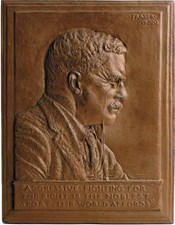
He was a human dynamo. He was the 26th and youngest President of the United States. He was an avid hunter, a Nobel Prize winner, a wildlife conservationist, a war hero, a Life member of the National Rifle Association, the author of 39 books, a father of six and the most gun-savvy man to ever occupy The White House. When it came to gun knowledge or shooting skill, no chief executive, now or then, was his peer.
When it came to firearms he wrote a number of times that his favorite was the Winchester. From his first Winchester, a Model 1876 he ordered when he was 22 years old, to his favorite Model 1895, last used on a river exploration just scant years before his death at the age of 60, Roosevelt’s Winchesters are now legendary and priceless pieces of Americana.

Roosevelt used an 1895 in .405 Win. to take this remarkable rhinoceros during his famous safari of 1909-1910.
Roosevelt, who was fond of exquisite goods, had within his economic means the ability to own any rifle manufactured during the period. Fine English doubles were considered the apex of the sporting world, yet Roosevelt choose an American classic or, perhaps, the rifles he chose helped make them classics.
Roosevelt’s poor eyesight may have been a mitigating factor in his fondness for the arms of Oliver Winchester and his Winchester Repeating Arms Co. He was quoted as saying that he didn’t “know how to shoot well, but I know how to shoot often.”
No gun of the period shot more often or as reliably as did the Winchester—some models were capable of holding as many as 16 cartridges. Roosevelt no doubt enjoyed the capability of having plenty of ammunition in the gun as well as having a firearm that could easily bring each successive round into battery with effortless ease and remarkable reliability.
To a man whose shooting skill was severely hampered by his eyesight—nearsightedness and later blindness in one eye—the fact that a Winchester could be sighted and fired, and fired again without having to remove the gun from his shoulder would have been a welcome feature for this “Bull Moose” of a man.
He special ordered his first Winchesters in the late summer of 1881, possibly to celebrate the publication of his second book, The Naval War of 1812. He ordered a pair of consecutively numbered Model 1876s, and these guns would be similar in composition to nearly every one of the next 20 Winchesters that he ordered. When he wrote “stocked and sighted to suit me,” he meant that the guns should have half-round and half octagonal barrels, pistol-grip, deluxe-checkered stocks, case hardened receivers—sometimes factory engraved—plain triggers, half-magazines, shotgun butts and special sights. Generally, enough special order features were desired by Roosevelt to cause the price of the gun to double!
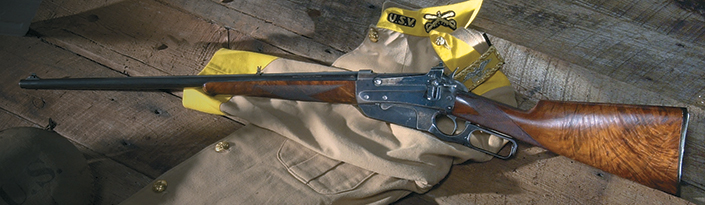
Roosevelt’s love of Winchesters carried over into his days with the “Rough Riders,” and he took a Model 1895 carbine in .30-40 Krag with him to Cuba. This rifle was carried by Tom Berenger when he portrayed Roosevelt in the movie “Rough Riders” and will be part of an upcoming exhibit at the National Firearms Museum.
In the summer of 1883, Roosevelt was hit with a bout of wanderlust that directed his daydreams to the plains of the “Wild West.” He decided to check out the Dakota Badlands along the Little Missouri River. His Winchesters caught the attention of everyone who saw them and they marveled at the exquisite nature of the engraving and checkering.
William Dantz, who remembered meeting Roosevelt, was so impressed by one Winchester that he mistook it for the exceedingly rare 1 of 1,000 model (he never did own one). To those who had grown up on the Plains, Roosevelt was the epitome of an Eastern dude. Dressed in a fringed and embroidered shirt and buckskin pants with a wide-brimmed Boss-of-the-Plains Stetson, he looked the part of the hapless greenhorn that every dime novelist depicted.
Though his trip diary mentions nothing of the two deluxe Winchesters in his personal inventory, he managed in 16 days to bag one bison, a blacktail buck, assorted rabbits, grouse, teal and other such wildlife all with a Sharps .45-cal. 1874 Sporting rifle or a 10-ga. double-barreled shotgun that had been a gift from his brother Elliott. He was so impressed with his guide, Joe Ferris, and the territory he had traveled that he promptly purchased a sizeable ranch and made Ferris a foreman along with fellow guide William Merrifield.
Roosevelt returned east to run for re-election and await the expected birth of his first child who was due in mid-February of 1884. As the winter passed, the re-elected assemblyman began to plan a grizzly bear hunt for his next trip to the Badlands and purchased a second ranch called the Elkhorn, not far from his Maltese Cross ranch purchased the year before.
On Valentines Day, 1884, he received a wire while on the floor of the New York State House in Albany. He rushed home to find that his wife had delivered a healthy baby girl, named Alice Lee, after her mother. However, the heartfelt joy of a first child was quickly diminished as first his mother and then his wife both died within hours of each other. Devastated and heartbroken, he sought solace in the Badlands of the West.
Scheduled to begin his second expedition exactly one year after his first one had begun, he ordered two more Winchesters, an 1873 in .32-20 Win. and another 1876 in .45-75 Win. (the previous two had been in .50-95). Roosevelt had pretty much decided to lose himself in the Dakota Territory and make a go of being a rancher. It was possibly during this trip that Roosevelt made a present of one of those first new Winchesters he had bought in 1881. He had a special gold plate (a motif that he would use repeatedly) engraved and mounted on the butt with an inscription to William Merrifield and it carried the brand of the Maltese Cross ranch.

Crates of Winchester rifles and ammunition marked with the president’s name were packaged for use on his safari of 1909-1910. They were shipped directly to the president’s steamship.
This time, the hunting was to provide Roosevelt’s first taste of dangerous game, a grizzly bear. During the hunt, he and Merrifield came upon the king of North American beasts. He recounted to his sister in a letter: “I shall not soon forget the first [grizzly] I killed. We had found where he had been feeding on the carcass of an elk; and followed his trail to a dense pine forest, fairly choked with fallen timber. While noiselessly and slowly threading our way through the thickest part of it, I saw Merrifield, who was directly ahead of me, sink suddenly to his knees and turn half around, his face fairly ablaze with excitement.
“Cocking my rifle and stepping quickly forward, I found myself face to face with the great bear, who was less than twenty five feet off—not eight steps. He had been roused from his sleep by our approach; he sat up in his lair, and turned his huge head slowly towards us. At that distance and in such a place it was very necessary to kill or disable him at the first fire; doubtless my face was pretty white, but the blue barrel was as steady as a rock as I glanced along it until I could see the top of the bead fairly between his two sinister looking eyes; as I pulled the trigger I jumped aside out of the smoke, to be ready if he charged; but it was needless, for the great brute was struggling in the death agony, and as you will see when I bring home his skin, the bullet hole in his skull was as exactly between his eyes … . This bear was nearly nine feet long and weighed over a thousand pounds.” The trip lasted seven weeks, the longest hunting expedition mounted by the future President until his African Safari of 1909-1910.

Pictured while on a Western bear hunt, Roosevelt is armed with a Model 1894 with a two-thirds magazine and a deluxe cheekpiece stock. He called one of 1894s his “little .30” and used it take an antelope at more than 180 yds. on one particular hunt. He also used a ’94 equipped with a Maxim silencer on varmints at his Sagamore Hill home in New York.
A review of various articles and books, most notably R. L. Wilson’s Theodore Roosevelt—Outdoorsman confirm that he had at least 20 Winchester rifles in his collection. By far, it was the gun for Roosevelt. When it came to presenting a gift to an admired associate or hunting companion, Roosevelt was quick to share his affection for Winchesters with those he honored by his generosity. The Metcalf brothers who had provided the president with a bear hunt in 1902—a hunt that begat the legend of the Teddy Bear—were each presented with identical Model 1886s exactly like the president’s own. Another 1886 was a gift to a man named Holt Collier.
Possibly one of the finest and most historic gifts made by Roosevelt was a Winchester Model 1895, serial number 23576. As with most of all of his Winchesters, this rifle was embellished with a gold plate and was inscribed “To Leonard Wood, Governor of Cuba, 12-29-99 from TR.” At the time of the rifle’s presentation, Roosevelt was governor of New York and Gen. Wood had just accepted the stewardship of the island of Cuba as her governor. Wood was a career army officer and Medal of Honor winner who, in May of 1898, had accepted command of the 1st U.S. Volunteer Cavalry and was somewhat chagrined to find that his second in command was the former assistant secretary of the Navy, Theodore Roosevelt. However, during training in San Antonio and in combat in Cuba, Roosevelt proved himself to be an efficient soldier and inspiring leader. Wood felt confident, when he was called to accept a promotion at the divisional level, that Roosevelt could handle the command of the unit that was now affectionately know as “Roosevelt’s Rough Riders” by the press.
By nightfall of July 1, 1898, Roosevelt had led his men directly into the pages of the history books with their gallant charge up Kettle and San Juan Hills. Roosevelt’s charge won him a place on McKinley’s re-election ticket as vice president, as well as the Medal of Honor. (He was recommended for it in 1898, but due to politics it was denied him. The medal was finally awarded posthumously on January 16, 2001.) He gave his former commander an exquisite 1895 rifle as a token of his esteem when both men were governors.

Theodore Roosevelt’s African safari of 1909-1910 was the president’s biggest and most publicized hunting expedition. Though he used Winchester Model 1895s in .405 Win. on the trip, he is pictured here holding a double rifle.
His son Kermit (at TR’s left) is holding a Model 1895 chambered in .405 Win. It was after this trip that Roosevelt wrote in Scribners Magazine “The Winchester .405 is, at least for me personally, the medicine gun for lions.”
Whenever Winchester introduced a new model, Roosevelt was quick to put it through its paces. He acquired an 1894 similar to all his other rifles in extras and embellishments and used it on an antelope hunt. His “little .30” as he called it, was able to knock down a good sized antelope at a distance of more than 180 yds. After witnessing the fantastic shot and the irrefutable and immediate results, his guide said that the gun was just “aces” in his book! He also used a Model 94 outfitted with a Maxim silencer at his Long Island home “Sagamore Hill” so as not to disturb neighbors when varmints were in need of culling.
Roosevelt’s deeds with his Winchesters are certainly the stuff of legend. You could hardly be expected to find a more colorful figure so strongly linked to something that is now, and in no small measure due to his patronage, considered a household word and so instantly recognizable.
Once, while on a hunting trip, he led in the capture of three riverboat thieves with an 1876 Winchester at the ready. Another time while riding the perimeter of his ranch, he was set upon by a band of restless Sioux. One clear view of his Winchester across the saddle and they soon scattered. He would have been photographed holding a Winchester 1895 carbine atop San Juan Hill during the Spanish-American War had he not given it to another trooper in his unit who was without a rifle at the time.
A prolific writer, he authored hundreds of magazine articles and 39 books, six of which were about his hunting adventures. When it came to Winchesters he heaped praise upon them generously. His biggest and best publicized hunting expedition was the one he made to Africa with son Kermit in 1909-1910. Prior to the public announcement of his trip, Roosevelt’s personal secretary, William Loeb, sent the following letter to Winchester:
“To: The Winchester Repeating Arms Company
From: William Loeb, Jr. Secretary to the President.
Date: July 16, 1908
Gentlemen:
The president is going to Africa … .He probably has all the rifles he needs but his son has not. Before deciding what he will buy, the president would like to see your catalog … Will you send your catalog to the President at Oyster Bay … ?
Signed: Loeb”

Roosevelt special-ordered many of his Winchesters. This Model 1876 carbine has a half-round octagonal barrel, pistol grip, deluxe checkered wood, case hardened receiver and a shotgun style butt.
Such a simple letter started a chain of events that resulted in dozens of exchanges via wire and mail over the next year concerning the rifles and equipment needed for the great expedition to Africa. Far from just wanting a few rifles for Kermit to have along on the safari, Roosevelt ended up having 15 wooden crates full of Winchester rifles, ammunition and spare parts for his expedition shipped by Winchester to his waiting steamer. Of the rifles, he choose the 1895 lever-action in .30-’03 U.S. as well as in .405 Win. to be the highlighted arms of the trip.
The 1895 Winchester was a departure from his standard taste in rifles. Designed by John Browning, the 1895 was the first Winchester to accept the new smokeless “hi-powered” rounds that were now revolutionizing the shooting world.
With a tubular magazine being not only impracticable but dangerous as well when loaded with pointed bullets, Browning developed a rifle action with a box magazine that still allowed the user to get off quick successive shots that would hit harder and farther away with the new “hi-power” rounds.
Roosevelt had seen the awesome effect smokeless cartridges had on battlefield tactics in Cuba in 1898 when his men were subject to withering fire from the new Spanish Mausers that used the smokeless powder. For Roosevelt, the combination of the fast working lever-action and the power the new sporting cartridges packed made the 1895 the perfect rifle.
Introduced in 1904, the .405 Win. cartridge was the most powerful round ever developed for a Winchester lever-action rifle. Roosevelt had to have not one, not two, but three 1895s in .405, and it proved very effective on almost every sort of game in Africa. The big 300-gr. bullet was a hard hitter with an initial muzzle velocity of more than 2230 f.p.s.
In perhaps the best presidential endorsement of any product ever, Roosevelt wrote in Scribners Magazine: “The Winchester .405 is, at least for me personally, the medicine gun for lions.” He created a sensation for the gun that lasts to this day. The .405 was discontinued in 1932. However, rifles chambered in “Teddy’s” caliber continue to bring a high premium over examples that are chambered in a round still readily available. In 2000, Winchester announced the re-introduction of the Browning 1895 in .405 caliber, demonstrating that the spirit of “Big Medicine” is still alive and well.
To Winchester enthusiasts, and to all gun and hunting devotees, Roosevelt will forever be a heroic figure—the perfect example of the responsible hunter, sportsman and shooter. He was an authentic statesman who knew, understood and loved firearms. He comprehended what firearms represent not only to a free society, but to the future of conservation and the sustained use of natural resources.
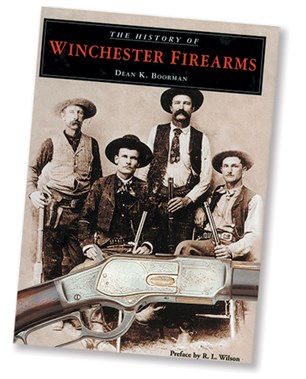
The History Of Winchester Firearms
Winchester is one of the greatest names in firearms, and in his new book, The History of Winchester Firearms, author Dean Boorman tells the story of the guns bearing the Winchester name from the Model 1866 up to the current offerings of the U.S. Repeating Arms Co. Of particular interest is the informative chapter on the development of lever-action arms, including the designs of the Volcanic Repeating Arms Co. and the Henry rifles of the New Haven Arms Co., which were the forerunners of the lever-action rifles so familiar to us today. Chapters cover the military and sporting arms of Winchester, with detailed coverage of the lever-action rifles that are the hallmark of the firm. Other chapters deal with collecting Winchesters, and emphasis is given to the many high-grade and engraved guns produced by the company.
Now for the tasteless memes