Categories
All About Guns One Hell of a Good Fight Our Great Kids Soldiering This great Nation & Its People War

U.S. Rifle M1917 [Sgt. York’s WW1 Medal of Honor Story ] to 500yds: Practical Accuracy

Categories
A Victory! COOL!!!!!!!!!!!!!!!!! Dear Grumpy Advice on Teaching in Today's Classroom Good News for a change! Hard Nosed Folks Both Good & Bad I am so grateful!! Interesting stuff Leadership of the highest kind Manly Stuff One Hell of a Good Fight Our Great Kids Real men Soldiering Stand & Deliver This great Nation & Its People War

Smedley Butler: The Marine Who Earned Two Medals of Honor by Will Dabbs

Major General Smedley Butler collected two Medals of Honor, fought across the globe, battled corruption at home, and later claimed powerful businessmen wanted him at the center of an American coup.

John Wayne portrait illustrating famous Americans who changed their names before the story of Smedley Butler
American movie icon John Wayne likely would not have been nearly so successful had he gone by his given name of Marion. Public domain.

Before Smedley Butler, Let’s Talk About Names

My name is Willis. I might have preferred William, but I didn’t pick it. Mine is a family name. As such things go, it certainly could be worse.

Many famous individuals, particularly actors, often choose a new name if their original names seem insufficiently photogenic. John Wayne entered the world as Marion Robert Morrison. Cary Grant was born Archibald Leach. Michael Caine was Maurice Joseph Micklewhite. Charlie Sheen was Carlos Irwin Estevez. Comedian Jonah Hill was originally Jonah Feldstein. Vin Diesel began life as Mark Sinclair. Diesel changed his name at age seventeen when he became a professional bouncer at a fashionable New York nightclub.

There are countless examples. Famed British actress Helen Mirren was originally Ilyena Lydia Vasilievna Mironov. Olivia Wilde was Olivia Jane Cockburn before she became enamored with the playwright Oscar Wilde. Natalie Portman was Natalie Hershlag, but changed her name in a failed effort at protecting her privacy.

Caryn Elaine Johnson had such a problem with passing gas that her coworkers called her “Whoopi Cushion.” When her show business career began to take off, she adopted Whoopi Goldberg because somebody told her that folks with Jewish-sounding names did better in Hollywood. Apparently, it worked. She’s worth $60 million today.

Major General Smedley Darlington Butler in uniform, the two-time Medal of Honor Marine known as Old Gimlet Eye
Major General Smedley Darlington Butler had a pretty goofy name, but he was one seriously manly man. Public domain.

The point is simply that some names can make surviving Second Grade pretty tough. Despite having been saddled with an objectively awkward moniker, Smedley Darlington Butler went on to do some pretty amazing things.

Butler was one of only two Marines in American history to have been awarded the Medal of Honor twice for two different combat engagements. In 1933, he was also tagged to lead a military coup to overthrow President Franklin Roosevelt. That effort kind of fizzled, but Smedley Butler was nonetheless a simply fascinating guy.

Smedley Butler Before the Legend: A Quaker Goes to War

Smedley Butler was born on 30 July 1881, in West Chester, Pennsylvania. He was the oldest of three sons born to Quaker parents. Butler was an accomplished athlete in High School, serving as captain of his baseball team and quarterback on the gridiron.

He quit school 38 days before his 17th birthday to enlist in the US Marine Corps. His dad was livid, but the young man was terrified he might miss the Spanish-American War. The administrators at his High School had mercy on him and granted him a diploma anyway.

Young Smedley Butler circa 1898 before beginning his legendary Marine Corps career
Like so many young men of his generation, Smedley Butler was prepared to do whatever it took to go to war. In this case, the young Quaker just lied about his age. Public domain.

Smedley’s dad served in the US House of Representatives for 31 years. He was chairman of the House Naval Affairs Committee under Presidents Harding and Coolidge. Having your dad managing the Marine Corps budget likely didn’t hurt the young Jarhead’s career prospects.

The younger Butler lied about his age and was granted a direct commission as a Marine officer. He arrived in Cuba just after the war ended. Butler piddled about the Marine Corps for another year but then mustered out. However, with the Philippine-American War now heating up, the young officer turned around and donned his uniform yet again, this time as a First Lieutenant.

From the Philippines to the Boxer Rebellion

Like many true warriors, Smedley Butler did not handle boredom well. When not in action, he drank excessively. He once got drunk and was relieved of command.

However, in October of 1899, Butler led 300 Marines to seize the town of Noveleta in the Philippines. Though he briefly panicked when his First Sergeant was hit, Butler regained his composure and led his Marines to rout the enemy. Once the carnage abated in the Philippines, Butler headed to China to put down the Boxer Rebellion.

Battle of Tientsin artwork from the Boxer Rebellion where Marine officer Smedley Butler was wounded
There was a time when America looked to its military rather than Hollywood when it needed heroes. Smedley Butler’s combat exploits eventually made it into the papers. Public domain.

During the Battle of Tientsin in the summer of 1900, Lieutenant Butler was shot through the thigh while rescuing a wounded Marine. Despite the grievous nature of his injury, Butler went on to help evacuate several of his troops under fire.

Four enlisted Marines earned the Medal of Honor in this engagement, but Marine officers were, at that time, not eligible for the award. However, Butler was granted the Marine Corps Brevet Medal, which also included a promotion to Captain. He was one of only twenty Marines in the history of the Corps to be so recognized.

Old Gimlet Eye and the Bloody Banana Wars

Having now tasted proper combat, Captain Butler just couldn’t get enough. He fought across Central America and the Caribbean in what has since come to be called the Banana Wars.

Even though Butler and his Marines were protecting American business interests, they still no doubt faced some profoundly fierce combat. Losing Marines in support of the United Fruit Company and similar corporate concerns made a deep and lasting impression.

Smedley Butler with Marine officers at Vera Cruz, Mexico, during the 1914 campaign
Smedley Butler served alongside some legendarily hard men. He is second from the right on the front. Public domain.

In 1903, Butler took a detachment of Marines into Trujillo, Honduras, looking for trouble. Their primary mission was to secure the American consulate there. In a subsequent letter home, he said that he and his Marines were “Prepared to land and shoot everybody and everything that was breaking the peace.”

They landed amidst a 55-hour ongoing firefight between rebels and government forces. They found the American consul hiding in the rafters of the consulate, wrapped in an American flag. Once they got clear of the town with the American diplomat in tow, the opposing forces resumed killing each other.

Smedley Butler and Lieutenant General John Archer Lejeune with Marine officers at Vera Cruz in 1914
Here we see Smedley Butler on the far right. He is sitting next to Lieutenant General John Archer Lejeune. Perhaps that name sounds familiar. Something in the water, maybe? Public domain.

At some point in all this traipsing about the jungle, Smedley Butler contracted a variety of bizarre tropical diseases. While rescuing the American consul, Butler was feverish with something or other and had sunken red eyes.

His men began calling him “Old Gimlet Eye.” A gimlet is either a cocktail made with gin and lime or a small tool designed to bore holes in wood. This was one of several respectful, though unsettling monikers bestowed upon him by his troops.

Vera Cruz and Smedley Butler’s First Medal of Honor

Butler subsequently fought all over South and Central America. He once led his battalion to relieve a besieged city on the island of Grenada while running a 104-degree fever.

In April of 1914, he led his troops in an assault on Vera Cruz, Mexico. The fight roiled across the city and ultimately cost American forces 17 dead and 63 wounded. Along the way, Smedley Butler earned the Medal of Honor.

His citation reads in part, “For distinguished conduct in battle, engagement of Vera Cruz, 22 April 1914. Major Butler was eminent and conspicuous in command of his battalion. He exhibited courage and skill in leading his men through the action of the 22d and in the final occupation of the city.” The rules had obviously been changed by then to allow officers to earn the rarefied decoration.

Haiti and Smedley Butler’s Second Medal of Honor

Six months later, Smedley Butler invaded Haiti. He first arrived in the lawless area around Fort Dipitie with 44 Marines. They were ambushed by a force of 400 indigenous Cacos and, surrounded, fought them off all night long. The following morning, Butler organized an infantry charge that repelled the enemy forces in disarray.

Smedley Butler military decorations showing his two Medal of Honor ribbons
Now here’s something you don’t see every day. This is Smedley Butler’s chest salad. Note the matching Medal of Honor ribbons on the top. Famed General George Patton once opined, “I’d give my immortal soul for that little blue ribbon.”

On 17 November 1915, Butler led an ad hoc battalion of Marines and sailors in an infiltration of Fort Rivière. The subsequent combat was hand-to-hand and pitiless. When they took the fort, 50 Haitians were dead, and Smedley Butler had earned his second Medal of Honor.

Here’s the citation: “For extraordinary heroism in action as Commanding Officer of detachments from the 5th, 13th, 23d Companies and the Marine and sailor detachment from the U.S.S. Connecticut, Major Butler led the attack on Fort Rivière, Haiti, 17 November 1915. Following a concentrated drive, several different detachments of Marines gradually closed in on the old French bastion fort to cut off all avenues of retreat for the Cacos. Reaching the fort on the southern side where there was a small opening in the wall, Major Butler gave the signal to attack, and Marines from the 15th Company poured through the breach, engaged the Cacos, took the bastion, and crushed the Cacos resistance.”

World War I Passed Him By, but Smedley Butler Kept Fighting

Butler was not granted a combat command during World War 1. There were several reasons for this, some political and others practical. Along the way, he had developed a reputation for erratic behavior. Butler subsequently came home to command the Marine Corps Base Quantico, Virginia.

Major General Smedley Butler speaking after leaving the Marine Corps and criticizing American military adventurism
After he left the military, Smedley Butler occupied himself speaking out against American adventurism. Public domain.

From Marine General to Philadelphia’s Crime Fighter

This was a different time. In 1924, W. Freeland Kendrick had been elected mayor of Philadelphia and faced a city awash in Prohibition-driven corruption.

President Calvin Coolidge therefore released General Butler to serve as the city’s Director of Public Safety in charge of both fire and police forces. Butler reassigned his police officers to unfamiliar precincts to upset the inevitable protection rackets he knew to be active.

In his first two days on the job, Butler’s cops raided 900 illegal liquor clubs. He was quoted as having told his officers, “I don’t believe there is a single bandit notch on a policeman’s gun in this city; go out and get some.” I wonder how that might go over today….

The Business Plot: Smedley Butler’s Strangest Battle

Butler eventually retired and became an outspoken critic of war profiteering. In November of 1934, Butler claimed that there was a plot afoot led by prominent American businessmen to field a 500,000-man army of military veterans and march on Washington, depose FDR, and install MG Butler as dictator.

Along the way, Butler named names. The alleged conspirators dismissed the claims as bluff and bluster, but subsequent evidence came to light that lent credence to the plot. Regardless, Butler’s testimony before a House committee drove those behind it back into the shadows. Historians now call this sordid episode the Business Plot.

Brigadier General Smedley D. Butler USMC, legendary Marine and two-time Medal of Honor recipient
Smedley Butler lived hard, and he died hard. He was a legendary Marine. Public domain.

The Fighting Quaker’s Final Years and Legacy

Major General Butler finally retired to Newton Township, Pennsylvania, with his wife. In 1940, he fell ill and was found to be suffering from what was likely stomach cancer. He had a drinking history, and videos I tracked down in preparing this article sounded like he was a smoker as well.

Smedley Butler with the Philadelphia Police baseball team circa 1925
MG Butler also liked his baseball. Public domain.

“The Fighting Quaker,” also known as “Old Gimlet Eye,” succumbed to his disease in June of 1940. He was 58 years old. A real “Break Glass in Case of War” Marine, Smedley Butler was indeed a Leatherneck’s Leatherneck.

Categories
Dear Grumpy Advice on Teaching in Today's Classroom One Hell of a Good Fight War

Henry V of England on the muddy field of Agincourt 1415 AD

This fight was one of the last Battles before gunpowder showed up. Grumpy

Categories
California Good News for a change! HUH! Interesting stuff One Hell of a Good Fight Paint me surprised by this

HUH!!!!!!!!

650-Pound Blue Marlin Caught off San Diego Coast Breaks State Fishing Record

 It took a crew of anglers to land a catch for the record books off the coast of San Diego this week — a 648-pound blue marlin, smashing the California state fishing record.

The sports fishing charter, piloted by 32-year-old captain Alec Stockfelt, showed up at the docks of the Southern California city earlier this week, wowing onlookers as the nearly half dozen fisherman wrestled the giant fish to a weigh station at Fisherman’s Landing.

The previous blue marlin sports fishing title holder weighed in at 395, caught in the waters off San Diego in 2021.

The previous record at that location for any fish caught was some 598 pounds, the captain said.

An adult male grizzly bear weighs about 600 pounds, for comparison.

Anglers and captains expect 2026 to be a robust year for records due to El Niño weather patterns bringing in more exotic sea life.

Marlin belong to a rare group, less than 1% of fish species, that exhibit regional endothermy. They maintain a “heater organ” near the eyes and brain. This organ keeps neural tissue warm even when the fish dives into cold, deep waters to hunt.

In addition, this warm-blooded adaptation gives them a massive neurological advantage. Their visual processing and reaction times remain sharp at depth. Therefore, they can detect and pursue prey far more effectively than their cold-blooded targets.

The Pacific blue marlin world record, caught off Kona, Hawaii in 1982, stands at 1,376 pounds.

Categories
A Victory! All About Guns Anti Civil Rights ideas & "Friends" COOL!!!!!!!!!!!!!!!!! Good News for a change! Hard Nosed Folks Both Good & Bad Interesting stuff Manly Stuff One Hell of a Good Fight Some Red Hot Gospel there! Stand & Deliver

Like It or Not, Trump Is Delivering on the Second Amendment by Scott Witner

Gun owners have plenty of reasons to be skeptical of politicians who suddenly discover the Second Amendment during election season. We’ve been through this before.
Campaign promises are easy. Following through is where things tend to get complicated.

That makes the second Trump administration worth looking at as a whole rather than judging it by whichever gun story happens to be dominating the news this week. There have been missteps, unresolved issues, and a few decisions that deserve criticism. But taken together, what the administration has done on the Second Amendment since returning to office represents a substantial shift in how the federal government approaches gun rights.

And arguably the biggest change isn’t coming from the White House itself.

It’s coming from the Department of Justice.

DOJ Is Actually Litigating for the Second Amendment

For decades, gun owners became accustomed to seeing the Justice Department on the opposite side of Second Amendment cases.

That’s what makes the creation of a dedicated Second Amendment Section within DOJ’s Civil Rights Division so significant.

The section isn’t merely advisory. DOJ says its mission includes investigating alleged patterns of Second Amendment violations by law enforcement, pursuing litigation, filing statements of interest, intervening in cases, and using amicus briefs to advance a broad interpretation of the right to keep and bear arms.

The federal government isn’t simply declining to defend a particular gun-control law. In several cases, it is actively suing state and local governments over restrictions DOJ believes violate the Second Amendment.

That includes challenges involving Los Angeles County’s handling of concealed carry permits, gun permitting practices in the U.S. Virgin Islands, Washington, D.C.’s ban on commonly owned semi-automatic rifles, Denver’s so-called “assault weapons” ban, Colorado’s magazine restrictions, California’s handgun roster and GLOCK restrictions, Virginia’s recently enacted semi-automatic rifle ban, and Montgomery County, Maryland’s expansive “sensitive place” restrictions.

The Denver rifle-ban lawsuit and Colorado magazine-ban lawsuit are particularly notable because DOJ isn’t dancing around the central issue. The government is arguing that commonly owned semi-automatic rifles and standard-capacity magazines are constitutionally protected arms.

That’s the kind of position gun-rights organizations have been arguing in court for years.

It Started With Trump’s Second Amendment Executive Order

On February 7, 2025, President Trump signed an executive order titled Protecting Second Amendment Rights, directing the Attorney General to review federal regulations, guidance, policies, international agreements, and other government actions that potentially infringed on the right to keep and bear arms.

That review included Biden-era firearms regulations and enforcement policies.

What could easily have become another symbolic executive order instead produced tangible changes throughout DOJ and ATF.

Among them was the end of the Biden administration’s so-called “zero tolerance” policy toward Federal Firearms Licensees.

The Department of Veterans Affairs also stopped reporting veterans to NICS as prohibited persons solely because they required fiduciary assistance managing their benefits.

Then there was the creation of DOJ’s Second Amendment Section itself.

Those aren’t campaign promises. They’re changes in federal policy.

ATF Has Been Moving in a Very Different Direction

ATF hasn’t exactly enjoyed a warm relationship with America’s gun owners.

That makes the agency’s current regulatory direction particularly interesting.

In April, DOJ and ATF announced a package containing 34 final and proposed rulemaking actions following the administration’s review of federal firearms regulations.

Some of the proposals are fairly technical. Others could have meaningful consequences for gun owners and FFLs.

ATF has moved to clarify the definition of an “unlawful user of or addicted to” a controlled substance, revise rules governing certain non-over-the-counter firearm transactions, and reconsider other regulations affecting dealers and gun owners.

Instead of searching for increasingly creative ways to expand existing statutory language, the agency is now publicly describing its regulatory work in terms of reducing unnecessary burdens and aligning regulations with current law and court precedent.

That’s quite a change from where ATF was only a few years ago.

The National Firearms Act remains one of the more complicated pieces of the administration’s Second Amendment record.

Congress eliminated the $200 tax on suppressors and short-barreled rifles, removing one of the NFA’s most recognizable burdens. Registration, however, remained.

That created an obvious legal problem.

If the tax that historically justified the NFA’s registration scheme disappears, what exactly is the constitutional basis for continuing to require registration?

That question is now being fought in court.

The administration has also taken positions suggesting suppressors receive at least some Second Amendment protection, an important development for challenges to state laws that ban them outright.

More recently, the government’s handling of the consolidated Silencer Shop v. ATF and Jensen v. ATF litigation has raised even bigger questions about whether DOJ intends to continue defending portions of the NFA registration regime.

TTAG covered the latest development when DOJ allowed the stay to expire, putting Silencer Shop’s NFA injunction into effect.

As of August 2026, that story is still developing.

What happens next could be one of the most consequential Second Amendment developments of Trump’s second term.

The Government Is Showing Up in Other Gun Cases, Too

DOJ’s direct lawsuits aren’t the entire story.

The federal government has also increasingly appeared as an amicus in major Second Amendment litigation.

That includes challenges involving so-called “assault weapon” and magazine bans, ammunition background checks, handgun rosters, and restrictions on where lawful gun owners may carry firearms.

The administration filed briefs in Wolford v. Lopez, for example, challenging Hawaii’s restrictions on carrying firearms on private property open to the public.

It has also participated in litigation involving California’s ammunition background-check system and Massachusetts’ handgun roster.

That matters because the Solicitor General and Justice Department carry institutional weight that another amicus brief from a gun-rights organization simply doesn’t.

It also creates something that has historically been missing from Second Amendment litigation: an executive branch willing to tell courts that state and local governments have gone too far.

There Are Still Reasons to Be Critical

None of this means gun owners should stop paying attention.

The administration’s record isn’t spotless.

DOJ has continued defending some federal gun laws, including portions of the NFA and the Gun-Free School Zones Act. Some of that is expected; the Justice Department ordinarily defends federal statutes. But gun owners aren’t obligated to pretend those positions suddenly become good policy because they’re being defended by a Republican administration.

There have also been questionable litigation decisions.

The government’s position on the scope of relief available to members of organizations involved in Second Amendment lawsuits created legitimate concerns about associational standing.

DOJ’s handling of Benson was another unforced error, with U.S. Attorney Jeanine Pirro’s office urging the D.C. Court of Appeals to rehear a favorable Second Amendment decision en banc.

Then there are the pardons that haven’t happened.

Gun-rights advocates have repeatedly raised the cases of individuals such as Patrick Adamiak and Matthew Hoover. Trump has demonstrated no reluctance to use his pardon and commutation authority elsewhere, making the lack of action in some firearms cases increasingly difficult for supporters to ignore.

There have also been comments from Trump and administration officials following high-profile shootings that haven’t exactly inspired confidence among gun owners.

Look at the Whole Scorecard

The mistake is judging the administration’s Second Amendment record based on one lawsuit, one comment, one ATF rule, or one disappointing decision.

Look at the entire scorecard.

The administration ordered a government-wide review of federal firearms policy. DOJ created a section of its Civil Rights Division specifically dedicated to enforcing the Second Amendment. The Justice Department is suing governments over rifle bans, magazine restrictions, handgun rosters, carry permit practices, and sensitive-place laws. The federal government is filing briefs supporting gun-rights challenges nationwide. ATF has reversed enforcement policies and begun unwinding or reconsidering regulations. Congress eliminated the NFA tax on suppressors and SBRs.

There are still significant fights ahead, particularly over the remaining NFA registration requirements and the administration’s willingness to challenge other federal gun laws.

There are also legitimate criticisms that shouldn’t be dismissed simply because the overall trajectory is favorable.

Gun owners have spent decades fighting against the institutional power of the federal government. For perhaps the first time in the modern Second Amendment era, at least part of that institutional machinery is being pointed in the opposite direction.

Categories
All About Guns Manly Stuff One Hell of a Good Fight Our Great Kids Real men Soldiering The Green Machine This great Nation & Its People War

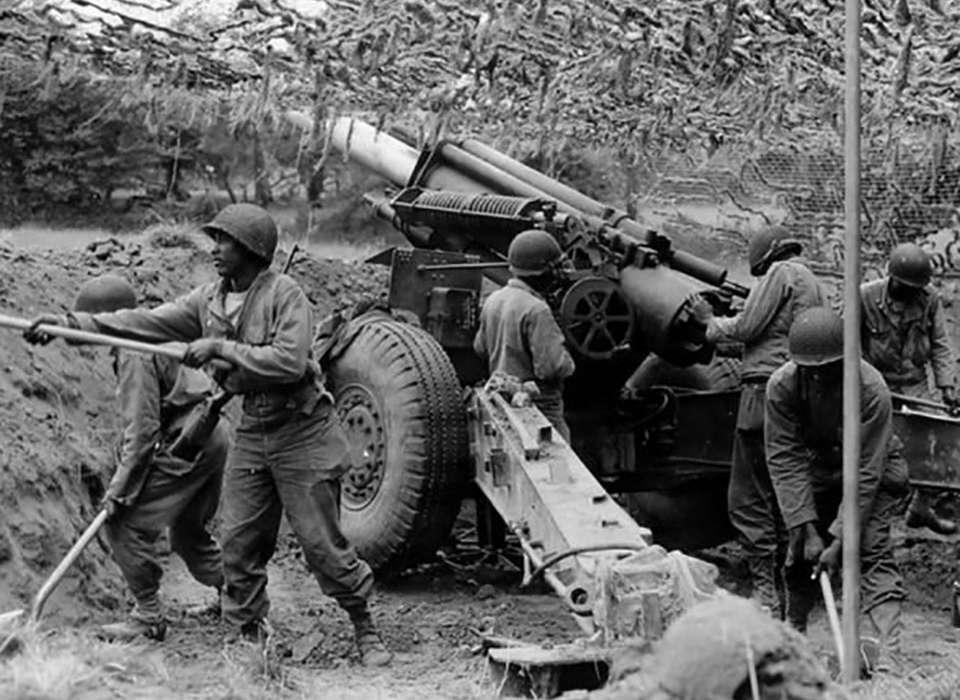
Sacrifice: The 333rd Field Artillery at the Battle of the Bulge

Manning 155mm howitzers, African American gunners sacrificed themselves to defend fleeing infantry. Eleven of them were murdered by the Waffen SS, and then forgotten by the US Army.

Top Image: African American crew of an M1 155mm howitzer in action courtesy of the US Army.

An act of heroic self-sacrifice highlighted the dedicated service of the 333rd Field Artillery Battalion, a segregated African American unit that bolstered American forces in Western Europe during World War II. That sacrifice unfortunately ended in tragedy for 11 American soldiers, murdered in one of the many atrocities committed by German Waffen-SS troops, in this case with particular savagery because the victims were black. Compounding the tragedy, this atrocity was not officially recognized in the United States until many decades after the war had ended.

The 333rd was originally organized as a regiment in 1942, and trained at Camp Gruber, Oklahoma. In 1943, however, it was reorganized as the 333rd Field Artillery Group, consisting of the 333rd and 969th Field Artillery Battalions, both African American units with mostly white officers. Subsequently, two other field artillery battalions would be added to this group. The 333rd and 969th battalions were equipped with the M1 155mm howitzer, a versatile and effective truck-drawn weapon used by the US Army until the Vietnam War, and still in use in some parts of the world today.
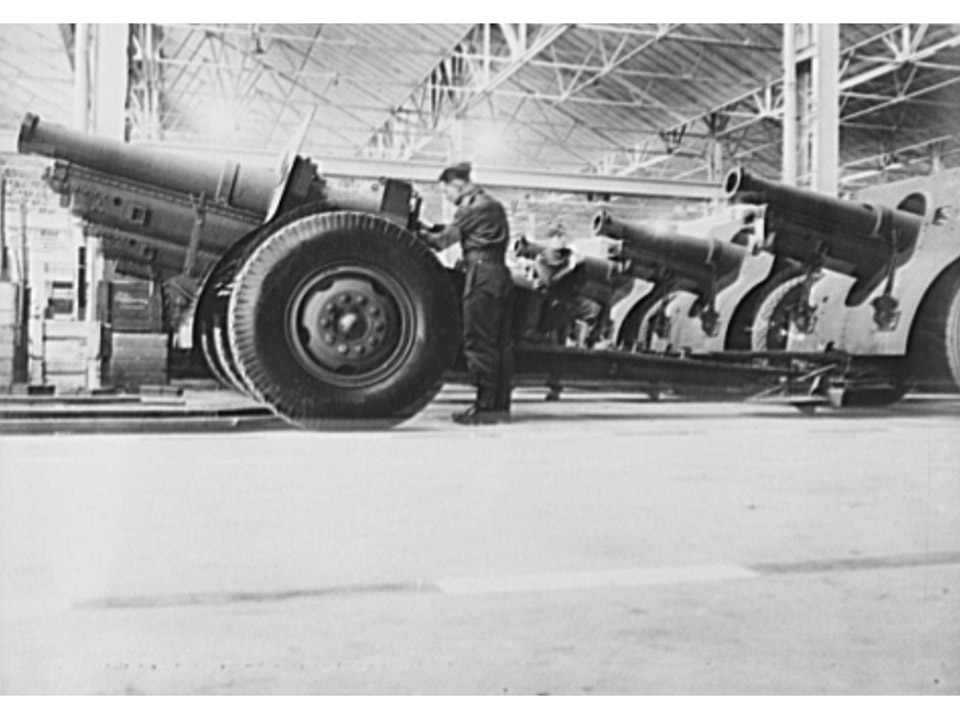
A shipment of 155mm howitzers on their way to Europe. Courtesy Library of Congress.

Arriving in England in February 1944, the 333rd and 969th battalions shipped over to Normandy in July and provided vital artillery support to American forces through months of hard fighting, including at the siege of Brest, France.

By the time the Allies liberated Paris in August, the two battalions were known as some of the most efficient and hard-hitting artillery units in the US Army. In October 1944, the units were assigned to what was assumed to be a quiet front, in support of VIII Corps and the untested 106th Infantry Division in the Ardennes region along the Belgian-German border.
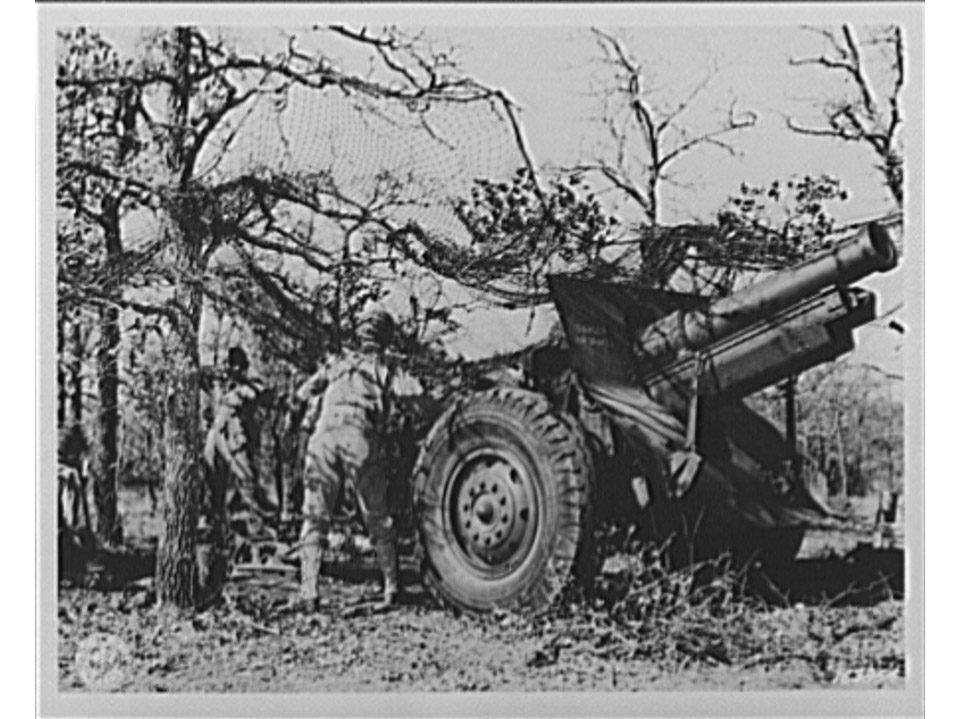
A 155mm howitzer preparing for action. Courtesy Library of Congress.

The 333rd Battalion was deployed around the small town of Schönberg in an atmosphere “tranquil to a point almost approaching garrison conditions,” as a later report would admit. Tired from months of constant service, the men took the opportunity to relax, with a recreation center that included a beer hall, bowling alley, and even a badminton court.

They were preparing a musical theater performance when the German offensive known as the Battle of the Bulge began on December 16.

The 106th Division was quickly thrown into disarray. At some outposts, black artillerymen took up rifles and fought alongside the infantry, in one case beating off a German attack and inflicting serious casualties. The German tide was overwhelming, however, driving through the defending infantry.

Recognizing the seriousness of the crisis, batteries of the 333rd and 969th battalions began pulling back under orders.

The 106th Division’s artillery commander desperately requested, however, that the battalions leave batteries behind to offer continuing support, assuring them that the main lines would be held and that they would be in no danger. He was wrong.
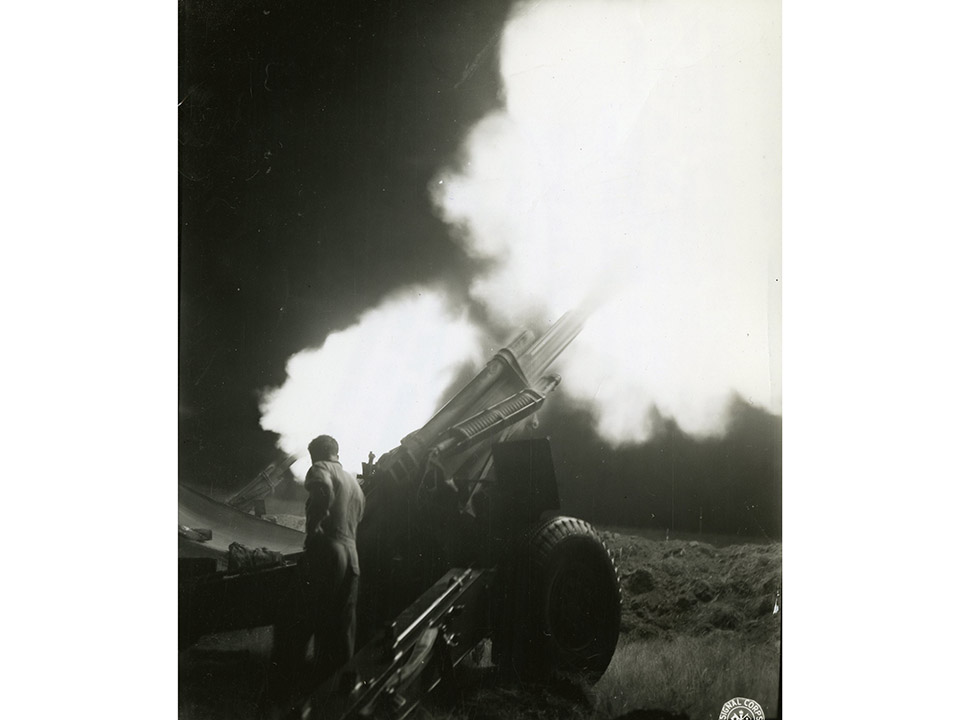
An M1 155mm artillery piece in action, 1945. Courtesy National Archives.

Master Sergeant Floyd Jones, an African American artilleryman serving with the 333rd Group, remembered: “We had just been sitting around awaiting orders when news came of the German breakthrough, so—get ready for action!”

Guns of the 333rd Battalion fired furiously in support of the American infantry, allowing some men to escape who might otherwise have been killed or captured. But the gunners’ heroism came at terrible cost as the Germans broke in among the howitzer positions.

The Germans captured Schönberg and, continuing to advance, shattered much of the 333rd Field Artillery Battalion, killing or capturing half of its men.

Eleven artillerymen escaped the German net and walked 10 miles away to the town of Wereth, where they were sheltered by a local civilian.

A neighbor who was sympathetic to the Germans betrayed them, however, and the Americans had the misfortune to fall into the hands of troops of the 1st SS Leibstandarte Adolf Hitler Panzer Division. Like the men of other Waffen SS divisions, these Germans were deeply indoctrinated in Nazi ideology and regarded their prisoners as racial inferiors.
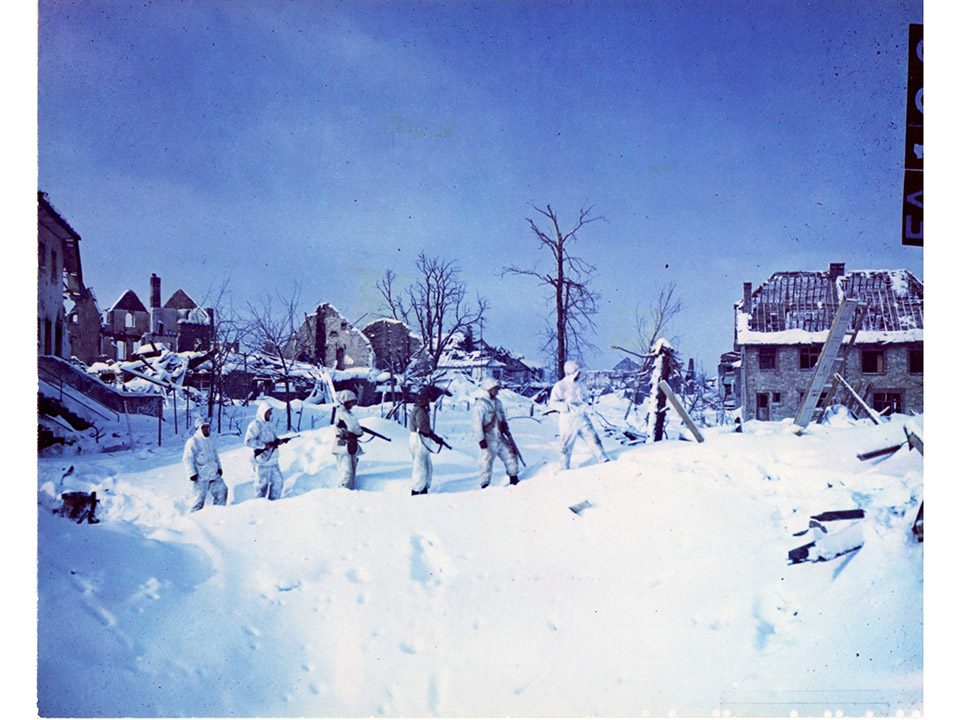
American infantry near St. Vith, Belgium, 1945. Courtesy National Archives.

At 7:00 p.m. on the evening of December 17, the SS men drove their captors into the forest. There they savagely tortured their victims with rifle butts and bayonets before cutting off many of their fingers and running over them with vehicles—whether before or after the Americans were dead is impossible to say. Then they moved on, leaving the bodies behind.

The remnants of the 333rd Field Artillery Battalion fell back, joined with the still-intact 969th Field Artillery Battalion, and participated in the defense of Bastogne.

For its bravery during this action, the 969th received a Presidential Unit Citation—although the members of the 333rd who fought at Bastogne surely deserved to share in the honors.

The 11 men who died at Wereth, however, were ignored. The same US Army investigators who uncovered the atrocity at Malmedy also recovered the full details of what happened at Wereth, including the fact that—unlike the white victims at Malmedy—the black men who died there had been brutally tortured.

But the investigators made no effort to pursue the matter further, taking no testimonies even though many of the local civilians—including those who had sheltered the artillerymen—were still alive and could have provided evidence. In 1949 a subcommittee of the Senate’s Committee on Armed Services conducted a full review of Nazi atrocities during the Battle of the Bulge—and completely ignored the Wereth massacre.

Members of the family who had sheltered the “Wereth Eleven” marked the site of the massacre with a memorial in 1994, and it was expanded 10 years later.

Only in 2017, however, did Congress pass a resolution bestowing “official recognition” on the victims of the massacre: Curtis Adams of South Carolina, Mager Bradley of Mississippi, George Davis, Jr., of Alabama, Thomas Forte of Mississippi, Robert Green of Georgia, James Leatherwood of Mississippi, Nathaniel Moss of Texas, George Motten of Texas, William Pritchett of Alabama, James Stewart of West Virginia, and Due Turner of Arkansas.

Ed Lengel, PhD

Edward G. Lengel is the former Senior Director of Programs for the National WWII Museum’s Institute for the Study of War and Democracy.

Categories
A Victory! COOL!!!!!!!!!!!!!!!!! Good News for a change! I am so grateful!! Leadership of the highest kind Manly Stuff One Hell of a Good Fight Our Great Kids Real men Some Red Hot Gospel there! Stand & Deliver This great Nation & Its People

Makes me proud to be an American !!!!!!!! Grumpy

I’m Going to sleep tonight knowing that we can still breed men like this man !!!!!!!!!! Grumpy

Categories
A Victory! All About Guns Cops Good News for a change! Hard Nosed Folks Both Good & Bad I am so grateful!! Manly Stuff One Hell of a Good Fight Our Great Kids Paint me surprised by this Real men Stand & Deliver This great Nation & Its People

The In-N-Out Shooter Met the WRONG Gun Owner

Categories
All About Guns Good News for a change! Manly Stuff One Hell of a Good Fight Our Great Kids Paint me surprised by this Real men Soldiering Some Red Hot Gospel there! Stand & Deliver The Green Machine This great Nation & Its People War

Helicopter Door Gunners Are Insane

Categories
A Victory! All About Guns COOL!!!!!!!!!!!!!!!!! Dear Grumpy Advice on Teaching in Today's Classroom Hard Nosed Folks Both Good & Bad I am so grateful!! Leadership of the highest kind Manly Stuff One Hell of a Good Fight Our Great Kids Real men Soldiering Stand & Deliver The Green Machine This great Nation & Its People War Well I thought it was neat!

The 26-Minute Dogfight of Chuck Yeager — How an American P-51 Mustang Survived Superior Numbers