Categories
Hard Nosed Folks Both Good & Bad Leadership of the highest kind Soldiering War

The Death of Stonewall Jackson: Lee Loses His Strong Right Arm by WILL DABBS

Thomas “Stonewall” Jackson has been described by some historians as the finest General the United States ever produced.

Thomas Jackson’s great grandparents were criminals. John Jackson and Elizabeth Cummins were both convicted of larceny in England and were punitively dispatched to the New World in 1749 alongside 150 other convicts. On the voyage across the Atlantic, John and Elizabeth fell in love.

18th-century America was a rugged place.

Once their obligatory bond service was complete in 1755 they were married. Their grandchild Thomas Jonathan Jackson was born in 1824 in Clarksburg, Virginia. He was the third child of Julia and Jonathan Jackson. In his youth, Thomas went by the nickname “The Real Macaroni,” though the origins and significance of that term are not well understood.

Thomas Jackson’s commitment to the Confederacy created a schism with his sister that was never mended.

Typhoid took his six-year-old sister in 1826 and his father some three weeks later. The boy’s remaining sister Laura Ann was born the day after her father died. Thomas and Laura Ann were close as children, but Laura Ann ultimately sided with the Union. Thomas grew to become a Confederate General of some renown. As a result, their relationship remained fractured until his death.

Military Service

LT Thomas Jackson served in Mexico after he was commissioned from West Point.

Thomas Jackson entered the US Military Academy in 1842. Jackson’s lack of formal education hamstrung him upon his arrival at West Point, but his legendary dogged determination compensated. He graduated 18th out of 59 in his class of 1846.

Thomas Jackson was a driven instructor at VMI. His students frequently thought him overly demanding.

Jackson got his formal introduction to war in Mexico. As a young officer, he distinguished himself at Chapultepec. For a decade starting in 1851 he taught at Virginia Military Institute where he was unpopular with his students. Along the way he was twice married. His first wife died in childbirth. His second, Mary Anna Morrison, lived until 1915. When the South seceded in 1861 following the attack on Fort Sumter, Thomas Jackson threw his lot in with the Confederacy.

The affectionate moniker “Stonewall” Jackson stuck with him to his death.

In July of that year, Jackson commanded a brigade at the First Battle of Bull Run. At a critical moment in the fight, Jackson beat back a determined Union assault. Barnard Elliot Bee, himself a distinguished Confederate General who ultimately lost his life in combat, referred to Jackson as a “stone wall” in the face of the enemy. The name stuck.

General Thomas Jackson was veritably deified in the Confederacy.

After an initial setback attributed to flawed intelligence, Stonewall Jackson dominated the Shenandoah Valley campaigns of 1862. Through truly exceptional tactical acumen, Jackson and his troops defeated three separate Union armies in the field. He exercised his martial gifts at places like Harper’s Ferry, Antietam, and Fredericksburg, developing for himself a reputation as a cunning and insightful combat leader. At Chancellorsville Jackson’s 30,000 Confederates launched a devastating surprise attack against the Federal flank that drove the Union troops back fully two miles.

The General’s Theology

General Jackson prayed frequently with his staff and men. A truly pious man, Jackson was also acutely self-conscious and ever attempted to avoid the limelight.

Thomas Jackson has been described as a fanatical Presbyterian. His deep and sincere faith drove everything about his life while making him all but fearless in battle. He once opined, “My religious belief teaches me to feel as safe in battle as in bed. God has fixed the time for my death. I do not concern myself about that, but to be always ready, no matter when it may overtake me…That is the way all men should live, and then all would be equally brave.”

Stonewall Jackson’s arm was ultimately interred 115 miles away from the rest of him. The details are coming directly.

Like most exceptional personalities, Jackson was also a bit strange. He held a lifelong belief that one of his arms was longer than the other. He would frequently hold the perceived longer of the two aloft for long periods in an effort at equalizing his circulation.

Behold Stonewall Jackson’s kryptonite. The esteemed General purportedly loved these things.

General Jackson highly valued sleep and was known to fall asleep at times while eating. His prior service as an artillery officer had severely damaged his hearing. This made communication difficult at times. He also had an abiding passion for fresh fruit like peaches, watermelons, apples, and oranges. His real weakness, however, was lemons. When they could be found Jackson would frequently gnaw whole lemons in an effort at soothing his digestion. General Richard Taylor, son of President Zachary Taylor and a colleague, wrote, “Where Jackson got his lemons ‘no fellow could find out,’ but he was rarely without one.”

Stonewall Jackson and Slavery

One man’s hero is another man’s goat. Jackson’s dashing visage adorns the rock face at Stone Mountain, Georgia. Completed in 1974, this sculpture is so large that a grown man could stand in the mouth of the largest of the three horses. These three figures span three full acres across the mountainside.

No information age treatise of a prominent Confederate can be complete without dragging slavery and race into the narrative. In the late 1850s, Jackson owned six slaves. Three of these–Hetty, Cyrus, and George–were received as part of a dowry from Mary Anna’s father upon their marriage. Two others supposedly requested that Jackson purchase them based upon his purported kindly local reputation. Of the two, Albert was purchased and worked to gain his freedom. Amy served as the Jackson family cook and housekeeper. The sixth was a child with a learning disability who was received as a gift from an aged widow.

This is Major Jackson in 1855 when he taught Sunday School to local slaves.

In what was considered a fairly radical move for the day, in 1855 Jackson organized and taught Sunday School classes for blacks at his Presbyterian Church. Of this ministry, Pastor William Spotswood White said, “In their religious instruction he succeeded wonderfully. His discipline was systematic and firm, but very kind…His servants reverenced and loved him, as they would have done a brother or father…He was emphatically the black man’s friend.” I obviously cannot speak to what any of that was really like, but Reverend White was clearly a fan. Not diminishing the repugnant nature of slavery as an institution, but it was clearly a different time.

The Death of Stonewall Jackson

General Jackson fell victim to the fog of war.

After a wildly successful engagement against Joe Hooker’s forces during the Battle of Chancellorsville, Jackson and his staff were making their way on horseback back through friendly lines. They encountered sentries from the 18th North Carolina Infantry who mistook the party for Union cavalry. The pickets shouted, “Halt, who goes there?” but fired before receiving an adequate response.

General Thomas Jackson was considered invincible in his day.

Frantic remonstrations from the command group were answered by Confederate Major John D. Barry’s command, “It’s a damned Yankee trick! Fire!” During the course of the two volleys, Stonewall Jackson was struck three times.

Several of Jackson’s staff officers were killed in that final fateful exchange.

Two rounds shattered Jackson’s left arm. One ball entered at the left elbow and exited near the wrist, while another struck his left upper arm three inches below the shoulder. A third ball struck his right hand and lodged there. Several members of Jackson’s staff along with their horses were killed. The poor visibility and incoming artillery fire added to the confusion. Jackson was dropped from his stretcher at least once during the subsequent evacuation.

These ghastly things got ample exercise in the horrific field hospitals of the Civil War. Roughly 75% of amputation patients ultimately died.

Battlefield medicine during the Civil War was unimaginably crude in comparison with today’s state of the art. The standard treatment in the face of significant damage to an extremity was amputation. As there were no safe and effective anesthetics available these surgical procedures were typically fast, frenetic, and fairly imprecise.

This is the outbuilding where Stonewall Jackson died.

A Confederate surgeon named Hunter McGuire took the arm, and Jackson was moved to the nearby Fairfield Plantation for recovery. Thomas Chandler, the plantation owner, offered the use of his home. However, Jackson, ever concerned about imposition, insisted he be maintained in a nearby office building instead.

Civil War-era hospitals were truly horrible things.

The germ theory of disease had not yet come to drive battlefield surgery, so secondary infections of combat wounds were ubiquitous. Jackson developed a fever and pneumonia as a result of his injuries and succumbed eight days later. As the end approached he said, “It is the Lord’s Day; my wish is fulfilled. I have always desired to die on Sunday.”

This iconic photograph of Stonewall Jackson was shot seven days before his fatal injury.

General Jackson’s final words, uttered in a delirium immediately preceding his demise, lend further insight into the man’s character. Attended by Dr. McGuire and a trusted slave named Jim Lewis, his final words were, “Order A.P. Hill to prepare for action! Pass the infantry to the front rapidly! Tell Major Hawks…” Then he paused and uttered, “Let us cross over the river, and rest under the shade of the trees.” Stonewall Jackson then breathed his last.

The soft lead projectiles fired by Civil War-era arms inflicted truly devastating injuries.

The fatal bullet was ultimately recovered and identified as a .69-caliber projectile. Union troops in this area typically fielded .58-caliber weapons. The 18th North Carolina Infantry was most commonly armed with older larger-caliber muskets. This discovery sealed the suspicion that Jackson had been felled by friendly fire. This was one of the first incidents wherein forensic ballistics identification was used to establish the circumstances surrounding a violent death.

Most Civil War-era long arms were single-shot rifled muskets.

While the American Civil War ultimately saw the introduction of cartridge-firing repeating rifles like the Henry and Spencer, most combatants on both sides were armed with single-shot, muzzleloading rifled muskets of various flavors. Union troops had the luxury of greater standardization due to their more advanced state of industrialization, while Confederate units frequently had to make do with a hodgepodge of weapons. Regardless, in this particular circumstance, the science of ballistics told an unfortunate tale.

The Rest of the Story

The loss of Stonewall Jackson to friendly fire represented an incalculable blow to the Confederate cause.

Upon learning of his friend’s injury Confederate General Robert E. Lee wrote, “Could I have directed events, I would have chosen for the good of the country to be disabled in your stead.”

He sent this message to Jackson via a courier after his surgery, “Give General Jackson my affectionate regards, and say to him: he has lost his left arm but I my right.”

When told of his death Lee confided to a friend, “I am bleeding at the heart.”

Jackson’s service as Lee’s primary Lieutenant could not readily be replaced.

The Battle of Gettysburg took place a mere two months after the death of General Jackson. As any student of Civil War history will attest, Gettysburg was an iffy thing indeed. The entire outcome of the war potentially turned on a handful of decisions made under the most arduous of circumstances.

Lee was forced to fight at Gettysburg without his most capable subordinate. Stonewall Jackson was only 39 years old when he died.

Had Stonewall Jackson been at Lee’s side during the chaotic maelstrom of Gettysburg the battle might very well have turned out differently. Had Lee’s Army of Northern Virginia been able to take the day and subsequently march on Washington, Lincoln could have been forced to sue for peace on the steps of the White House at the point of a Confederate bayonet. Had that been the case our world would obviously be all but unrecognizable today. Sometimes the most momentous events turn on the smallest things.

Here is one of Stonewall Jackson’s monuments being dismantled, brought down by enraged social justice warriors who likely fancy themselves paragons of tolerance.

Ripping down historical monuments in a fit of emotion strikes me as viscerally unsettling. In 2001 the Taliban blew up the 6th-century Buddhas of Bamiyan and were rightfully reviled as a result. It really should be possible to appreciate historical figures without dogmatically embracing the causes they represented or obliterating the evidence of their existence.

For all have sinned, even in modern woke America. If left intact alongside contextual information these monuments could serve as object lessons to enlighten generations yet to come. If freedom from moral stain becomes a prerequisite for veneration then I fear we may be destined to become a nation bereft of monuments.
Categories
Hard Nosed Folks Both Good & Bad Leadership of the highest kind Manly Stuff The Green Machine

General Ridgway 1984 “Soldiers”

Categories
Leadership of the highest kind Soldiering The Green Machine

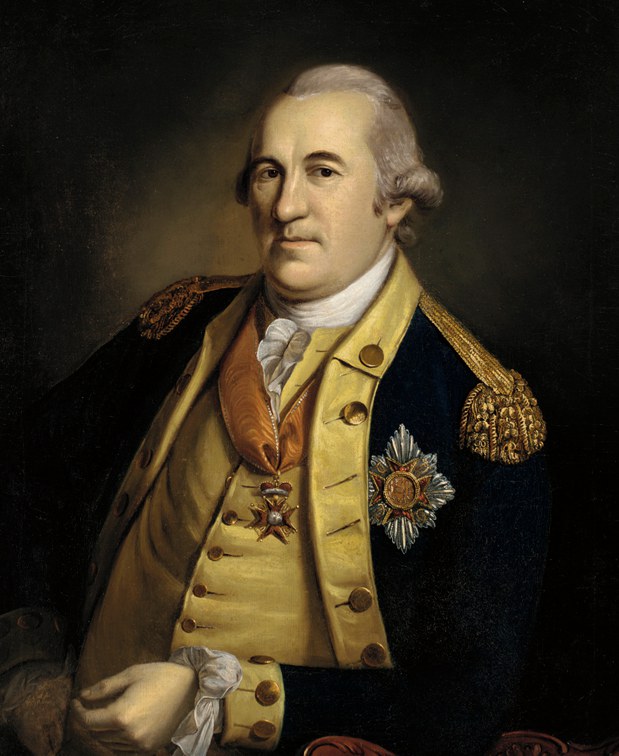
Baron von Steuben


Baron Friedrich Wilhelm von Steuben
by Charles Wilson Peale, 1780

Von Steuben was born in Magdeburg fortress where his father was an engineer lieutenant in the military in 1730. Most of his adolescent years were spent in Russia, but with his father at the age of 10, they returned to Germany. He was schooled in Breslau by Jesuits and by the age of 17…was a Prussian officer in the military. He was a member of an infantry unit and a staff officer in the Seven Years War, later being made a member of the General Staff serving in Russia periodically. His service was commendable enough that he was eventually given assignment with Frederick the Great’s headquarters.

His experiences as a General Staff member in the Prussian Army gave him a wealth of knowledge that heretofore was unheard of, even in the British and French armies of the period. His training would eventually bring to the American soldiers the technical knowledge necessary to create an army.

At the age of 33, in 1763, Steuben was discharged as a captain from the army, for reasons that are only speculative. The following year he received his “Baron” title when he became chamberlain at the Petty Court of Hohenzollern-Hechingen. He was the only courtier to accompany his incognito prince to France in 1771, hoping to borrow money. Failing to find funds, they returned to Germany in 1775, deeply in debt. Looking for work to reverse his fortunes, von Steuben tried employment in several foreign armies including Austria, Baden and France. He discovered that Benjmin Franklin was in Paris and that possibly, he could find work with the Continental Army in America.

Steuben traveled to Paris in the summer of 1777. As luck would have it, he was endorsed for service by the French Minister of War (Count de St. Germain) who fully realized the potential of an officer with Prussian General Staff training. Steuben was introduced to General Washington by means of a letter from Franklin as a “Lieutenant General in the King of Prussia’s service,” a certain exaggeration of his actual credentials. He was advanced travel funds and left Europe from Marseilles.

On September 26th, 1777, he reached Portsmouth, New Hampshire and by December 1st, was being extravagantly entertained in Boston. Congress was in York Pennsylvania, after being ousted from Philadelphia for the winter and on February 5, 1778, Steuben was with them.

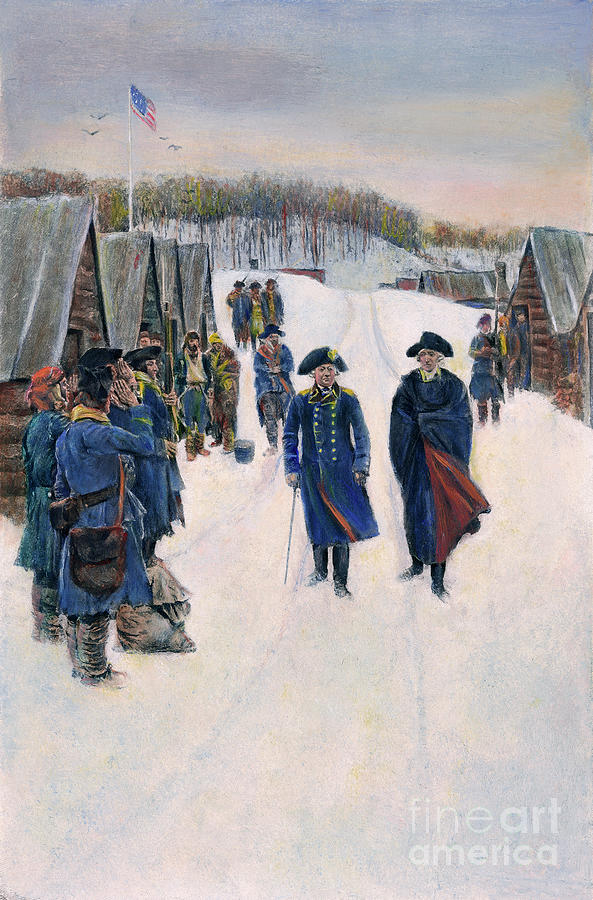
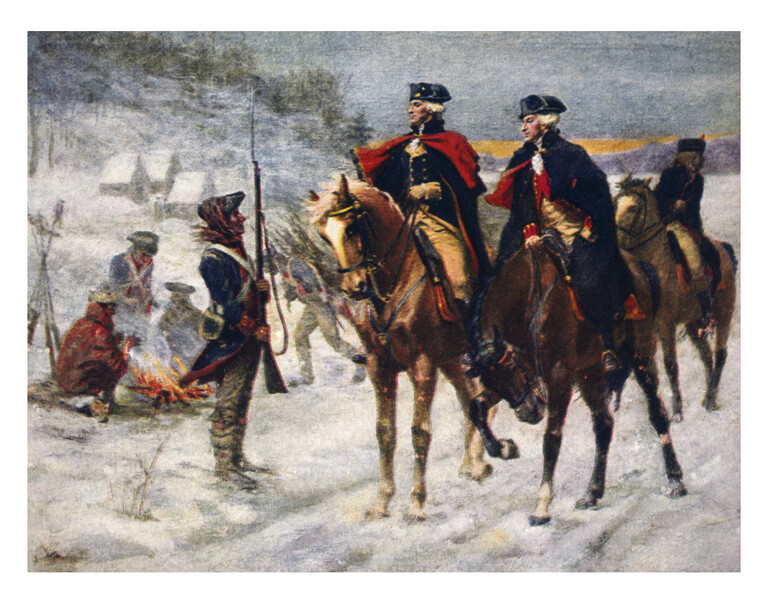
They accepted his offer to volunteer, without pay for the time, and on the 23rd of the same month, Steuben was reporting for duty to General Washington at Valley Forge. Steuben did not speak English, but his French was such that he could communicate with some of the officers. Washington’s aide-de-camp, Alexander Hamilton as well as Nathanael Greene were a great help in this area. The two men assisted Steuben in drafting a training program for the soldiers which found approval with the Commander-in-Chief in March.

How did the men at Valley Forge become an army? Steuben began with a “model company,” a group of 100 chosen men and trained them…they in turn successively worked outward into each brigade. Steuben’s eclectic personality greatly enhanced his mystique.

He trained the soldiers, who at this point were greatly lacking in proper clothing themselves, in full military dress uniform, swearing and yelling at them up and down in German and French. When that was no longer successful, he recruited Captain Benjamin Walker, his French speaking aid to curse at them FOR HIM in English.

His instructions and methods have a familiar ring, nor is this strange when we consider that much of what is done today stems from his teachings. To correct the existing policy of placing recruits in a unit before they had received training, Von Steuben introduced a system of progressive training, beginning with the school of the soldier, with and without arms, and going through the school of the regiment. Each company commander was made responsible for the training of new men, but actually instruction was done by selected sergeants, the best obtainable.

Warfare in the Eighteenth Century was a comparitively simple matter, once the battle was joined. Combat was at close range, massed-fire melee, where rapidity of firing was of primary importance. Accuracy was little more than firing faster thatn the opposing line. Much of the Regulations dealt with the manual of arms and firing drills. But battle was close-order drill, and speed of firing could only be obtained by drilling men in the handling of their firearms until the motions of loading and firing were mechanical. Firing was done in eight counts and fifteen motions.

Fire! One Motion.
Half-Cock — Firelock! One Motion.
Handle — Cartridge! One Motion.
Prime! One Motion.
Shut — Pan! One Motion.
Charge with Cartridge! Two motions.
Draw — Rammer! Two motions.
Ram down — Cartridge! One Motion.
Return — Rammer! Two motions.

Complicated as they seem, the new firing regulations were much simpler than those used by foreign armies and they speeded up firing considerably. The bulk of the fighting in the Revolutionary War was a stand up and slug match. The winning side was the one that could get in a good first volley, take a return fire and re-load faster than its foes. Once the individual could handle himself and his musket he was placed in groups of three, then in groups of twelve, and taught to wheel, to dress to the right and to the left. Alignment and dressing the ranks was emphasized but only because proper alignment was necessary for smooth firing.

Another program developed by Steuben was camp sanitation. He established a standards of sanitation and camp layouts that would still be standard a century and a half later. There had previously been no set arrangement of tents and huts. Men relieved themselves where they wished and when an animal died, it was stripped of its meat and the rest was left to rot where it lay. Stueben laid out a plan to have rows for command, officers and enlisted men. Kitchens and latrines were on opposite sides ot the camp, with latrines on the downhill side. There was the familiar arrangement of company and regimental streets.

The results of the army training were in evidence by May 20, 1778 at Barren Hill and then at Monmouth (ending June 28th). Washington recommended an appointment for Steuben as Inspector General on April 30th, and on May 5th, Congress approved it. It was Steuben serving in Washington’s headquarters in the summer of 1778 who was the first to report the enemy was heading for Monmouth. During the winter of 1778-1779, Steuben prepared “Regulations for the Order and Discipline of the Troops of the United States,” also known as the “Blue Book.” It’s basis was the plan he devised at Valley Forge.

The following winter (1779-1780) his commission was representing Washington to Congress regarding the reorganization of the army. He later traveled with Nathanael Greene-the new commander of the Southern campaign.

He quartered in Virginia since the American supplies and soldiers would be provided to the army from there. He aided the campaign in the south during the spring of 1781, culminating in the delivery of 450 Virginia Continentals to Lafayette in June. He was forced to take sick leave, rejoining the army for the final campaign at yorktown. At Yorktown his role was as commander of one of the three divisions of Washington’s troops.

He gave assistance to Washington in demobilizing the army in 1783 as well as aiding in the defense plan of the new nation. He became an American citizen by act of Pennsylvania legislature in March 1784 (and later by the New York authorities in July 1786). He was discharged from the military with honor on March 24, 1784.

He established residency in New York where he became a very prominent figure. His business acumen was not very keen, and he found himself in difficult financial condition once more. The primary reason was most likely the fact he was living off the prospect of financial compensation from the United States government which was unrealized until June of 1790 when he was granted a yearly pension of $2,500.

His financial problems were not ironed out until Alexander Hamilton and other friends helped him gain a “friendly” mortgage on the property he was given in New York (about 16,000 acres). He died a bachelor in 1794, leaving his property to his former aides, William North and Benjamin Walker.

Categories
Hard Nosed Folks Both Good & Bad Leadership of the highest kind Our Great Kids Soldiering Stand & Deliver The Green Machine This great Nation & Its People War

Happy Birthday, General George S. Patton, C.O. 3rd US Army ETO


Categories
Leadership of the highest kind Real men War

Battalion Commanders in World War 1

Categories
All About Guns Hard Nosed Folks Both Good & Bad I am so grateful!! Leadership of the highest kind Manly Stuff One Hell of a Good Fight Our Great Kids Real men Some Red Hot Gospel there! Stand & Deliver This great Nation & Its People War

A Destroyer that stood alone against Japan

Categories
Leadership of the highest kind War

Which FORGOTTEN Generals from Each Major Fighting Nation Turned the Tide of WW2 Theatres?

Categories
Hard Nosed Folks Both Good & Bad Leadership of the highest kind Soldiering The Green Machine This great Nation & Its People War

Mike Thornton the Seals Seal From the Badass Blog

Mike Thornton

Michael Thornton is a hardcore 30 year-veteran of the United States Navy, a founding member of SEAL Team Six, and one of only three SEALs to receive the Medal of Honor in ‘Nam – an honor he earned in blood on Halloween 1972, when he almost single-handedly battled through enemy territory against a swarming horde of enemy soldiers, charged through a naval artillery bombardment to save his commanding officer from certain death, and then swam three hours through North Vietnamese waters with two wounded guys hanging off his back and a half-dozen chunks of grenade shrapnel lodged in various parts of his abdomen.
If that’s not badass enough for you, then clearly you’ve come to the wrong website.

 
Mike Thornton was born March 23, 1949 in Greenville, South Carolina.  He joined the U.S. Navy and served as a Gunner’s Mate on a couple destroyers, but in 1968 he decided to try his hand at making the Navy’s elite Underwater Demolitions Team – the original precursor to the SEALs.  Training was brutal, exhausting, and unbelievably intense – of the 129 men who signed up for UDT Class 49, only 16 graduated and were accepted into the program.
One of those 16 was Mike Thornton.  Not long after completing one of the most brutal military training courses on the face of the planet, he was assigned to SEAL Team One and deployed to the Republic of Vietnam at the height of the Vietnam War.
Thornton arrived in-country in 1969 and spent the next three years doing a wide variety of super-badass over-the-top Navy SEALs stuff.  He gathered intel on enemy positions, scouted deep behind enemy lines on daring covert missions, captured prisoners when he could, battled enemy forces on the reg, and basically did all that cool Black Ops classified SEAL stuff that was presumably so hardcore and top-secret classified that we’ll likely never really know the full details of all of it.
Team One was at the heart of many of America’s Special Operations in ‘Nam, and in the fall of 1972 this was still very much the case.  In October, 23 year-old Petty Officer Mike Thornton was sent on a mission to the Qua Viet Naval Base in Quan Tri Province on a dangerous mission to gather intel on some NVA positions, capture a few prisoners, and then somehow extract back to friendly lines.  Thornton’s team would consist of himself, three South Vietnamese Special Forces operators, and the unit commander, Lieutenant Thomas Norris, a hardcore Medal of Honor recipient Navy SEAL who was already a legend among the SEALs thanks to a wild mission he’d undertaken a few months earlier when he went undercover deep into enemy territory to rescue a downed American pilot.  Facing extreme danger, and surrounded constantly by a massive force of NVA soldiers, Norris succeeded in extracting not only the pilot, but also the crew of a team that had already gone in to get the pilot and ended up getting pinned down.  The mission was so hardcore that they made a movie out of it – it’s called Bat*21, and Norris was so tough that they got Gene Hackman to play him in the movie.
Needless to say, this was not a crew of guys you wanted to face in a dark alley late at night.

The SEALs deployed first by sailing an ordinary-looking Vietnamese junk boat up a river late at night, then by boarding a small rubber boat and infiltrating enemy lines under the cover of darkness.  Well, unfortunately, the mission started to go sideways right away – the map wasn’t really lining up with what was supposed to be there, and it didn’t take long for Norris and Thornton to realize that they’d landed a little too far into enemy terrirotyr.  So now, instead of scouting temporary enemy fortifications that had been thrown up days before, these guys were now straight in the middle of a hardened network of NVA bunkers that had been designed years ago to repel full-scale assaults by massive formations of enemy troops and armor.
It wasn’t really the kind of place you wanted to be walking around with an American flag patch on your shoulder.
So, ok, the SEALs were off-course, and were now wayyyy deeper in enemy territory then they would have hoped, but a mission is a mission, and these guys were pros.  They immediately went to work – noting bunker positions, troop concentrations, fortifications, vehicles, and radio towers.  They Splinter Celled their way silently and stealthily through the heart of an enemy naval base first by boat, then on foot, collecting tons of valuable intel, all somehow without being detected by the hundreds of hardened veteran NVA troops that now surrounded them from every direction.
Then, over one particular ridgeline, the SEALs saw a couple of NVA guards standing nearby.  They were far enough away from the main base that they could potentially have been grabbed and taken prisoner without alerting the base, so the SEAL team moved in to try and take them into custody.  The two South Vietnamese SEALs grabbed one of the guys, but they weren’t quick enough to grab the second guy – that dude bolted for it and started screaming his damn head off for the NVA to sound the alarm.
Thornton ran him down and capped him with a well-placed pistol round, but it was already too late – the SEAL stopped dead in his tracks as he heard the sound of alarm sirens blaring from a nearby camp.

Thornton ran for it.  By the time he’d reached the spot where his buddies were waiting for him, he was already being run down by a group of roughly fifty NVA soldiers, who immediately started spraying AK-47 gunfire into the jungle all around him.
One of the South Vietnamese SEALs launched a LAW rocket into the middle of the attacking forces, hoping that the resulting explosion would buy the SEAL team a little time to take off and run to the extraction point.
The SEALs were now in a fight for their lives.  They had to get back to their extraction point before they were completely surrounded and overrun by a force that massively outnumbered them.
Fighting through the pitch darkness, facing down presumably hundreds of enemy soldiers, the five Navy SEALs fought the way you’d expect the most badass military force in the world to fight.  They fired, repositioned, fired again, and launched grenades and LAW rockets, constantly changing position in an attempt to confuse the enemy about how many guys they were facing.  The SEALs had the advantage of surprise, and concealment, and the NVA couldn’t just charge in there after them because they couldn’t quite figure out how many guys they were actually facing.  So, through the darkness of the Vietnamese jungle, the Navy SEALs spent the next four hours (!!) battling their way back towards the water.

 
Bullets were zipping through the jungle from every direction as the SEALs made their escape.  Five men against hundreds.  As his ammunition began to run out, Norris (who took up the rear of the SEAL position) ditched his M-16 and took an AK-47 off a dead enemy soldier, using captured ammo to keep up a steady hail of fire back towards the ever-closing NVA troops.  At the head of the column, Mike Thornton raced through pitch-black jungle navigating his team to the extract point.  As dawn began to break and the SEALs approached the beach, Norris got on his radio and called in for two Destroyers to come in and lay down some covering fire.  Shortly after, though, he received a report that heavy fire from fortified NVA shore guns had damaged both Destroyers and drove them back from the coast.  A cruiser was inbound to help, but for now the SEALs were on their own.
Thornton continued to the extraction, firing his M-16 in all directions, until suddenly an enemy grenade landed dangerously close to him.  It exploded, ripping shrapnel through the SEAL.  White-hot shards of splintered steel embedded in his back in six different places, as the concussive force of the blast sent him flying hard into the ground.  With his ears ringing, and his back screaming in pain, Thornton still held on to his weapon, and rolled over onto his back just in time to see four NVA troops running up onto the ridgeline to finish the job – despite every muscle in his body screaming in pain, Thornton still somehow had the calmness and unimaginable skill to take out all four of those guys before they could spray him full of 7.62.
One of the South Vietnamese SEALs rushed over to pick Thornton up, and the SEAL asked what had happened to Tom Norris.  The SEAL responded, “He’s gone.  Let’s go”.  The guy said that Norris’s position had been overrun, he was shot in the head and killed, and the rest of the team had to fall back.  He urged Thornton to get to the beach to extract, because the window to get out of this alive was very rapidly closing, and a US Cruiser was already maneuvering into position to lay down some cover fire.
But Navy SEALs don’t leave a man behind.  And Thornton wasn’t about to start now.

 
With AK-47 fire zipping around him from every direction, Michael Thornton ran 400 yards through a hail of bullets to reach the body of his good friend.  Four NVA troops were standing over the fallen SEAL, but Thornton killed them with his rifle, screaming with rage, and finally fell to his knees at his friend’s side.  Norris was bleeding badly from a gunshot to the head, but Thornton wasn’t about to leave that guy behind.  With enemy troops ripping shots past his head, and blood pouring from grenade wounds in his back, Mike Thornton threw Tom Norris on his shoulders and started to make a run back for the beach.
It was at this point that the U.S. Navy cruiser reached firing position.  And the coordinates the firing teams had were the ones that Tom Norris had given them – at a time when Norris thought he wasn’t going to get out of this fight alive.
The shell landed pretty much right where Norris’s body had been.  The explosion blew Thornton 20 feet through the air, slamming him hard to the beach, ringing his ears, and blurring his vision.  As he lie on the ground, he heard something amazing.  A familiar voice, quiet and fading, but clearly audible even among the gunfire and artillery.
“Mike, buddy.”
Tom Norris was alive.

 
Surging with adrenaline, Mike Thornton jumped back to his feet, threw Norris on his back, and started running to the shore.  With bullets, mortars, and naval artillery chewing up the beach and the trees around him, Thornton ran though the fire, finally reaching the shore, where one of the Vietnamese SEALs also lay wounded from a gunshot to the back.
Thornton grabbed that guy too.  Then he jumped in the water, inflated his life vest, and proceeded to swim through salt water with six grenade wounds in his back for four hours while dragging two seriously wounded men.
The American ship that had been sent to extract the SEALs was preparing to go home, convinced that nobody could have survived that mission, when suddenly they saw a dude in the water shooting his rifle in the air trying to get their attention.  It was Mike Thornton.
Every member of the mission survived.
When Thornton received his Medal of Honor in 1973, Tom Norris was still recovering in the hospital, and they weren’t about to let him leave just to attend a medal ceremony.  So, the day of the ceremony, Thornton went to the hospital, put Norris in a wheelchair, and snuck him out the back door so he could attend.
After Vietnam, Mike Thornton would go on to be a BUD/S instructor in Coronado, where he would train future Navy SEALs, as well as members of the British Royal Marines’ badass Special Boat Service.  He was a founding member of SEAL Team Six in 1980, and retired as a Lieutenant in 1992.  Nowadays there’s a really badass statue of his rescue mission standing outside the SEAL museum in Ft. Pierce, Florida.


Links:
Mike-Thornton.com
NavySEALs.com
Achievement.org
Defense Media Network
Wikipedia
 
Suggested Reading:
Collier, Peter and Nick Del Calzo.  Medal of Honor.  New York: Artisan, 2006.
Dockery, Kevin.  SEALs in Action.  New York: Avon Books, 1991.
Norris, Tom and Mike Thornton.  By Honor Bound.  New York: St. Martin’s Press, 2016.
 

Categories
Leadership of the highest kind The Green Machine This great Nation & Its People Well I thought it was neat! You have to be kidding, right!?!

That Time General Patton Bombed a Live Volcano Did it work as intended? Hard to say. Was it cool? Extremely. BY KYLE MIZOKAMI

volcano bomber

U.S. Air Force
  • In 1935, lava from Hawaii’s Mauna Loa volcano threatened the nearby town of Hilo.
  • Responding to a request by island volcanologists, the U.S. Army Air Service sent planes to bomb the lava flow.
  • Although the scientist who requested the air strike thought it was a success, others weren’t so sure.

One of the U.S. Air Force’s oddest missions was against perhaps its most formidable adversary ever: Mother Nature.

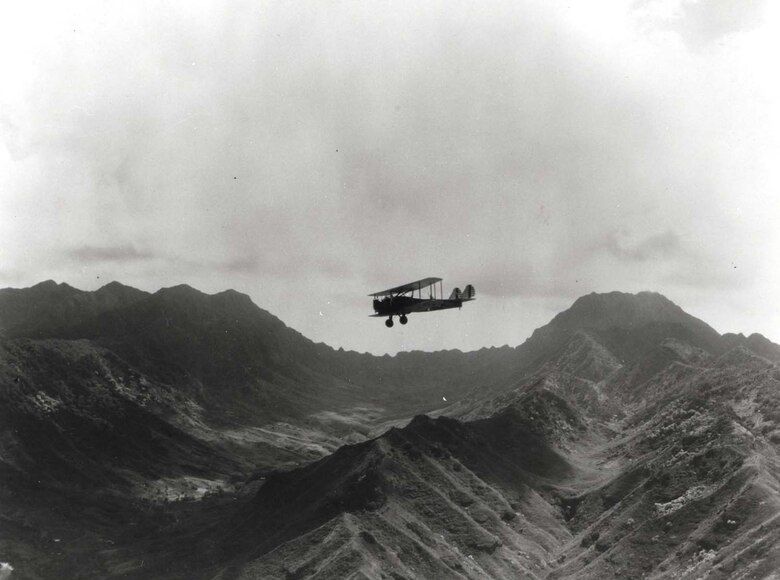
In 1935, lava from the Mauna Loa volcano threatened the nearby seaside town of Hilo, Hawaii. So U.S. bombers, commanded by none other than future Gen. George S. Patton, bombed the lava flow in an attempt to save the town.

Experts were divided on how useful the air strikes ultimately were, but the bombs weren’t the last ones dropped to prevent natural disasters.

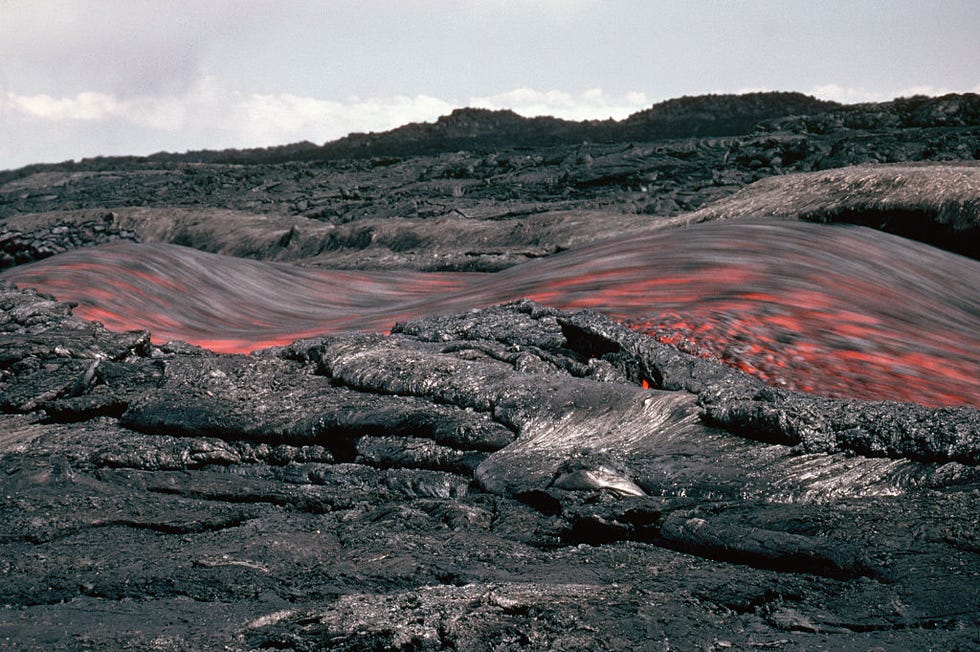
pahoehoe flow

A channel of fast-flowing lava moves through a cooled section of a lava flow. Hawaii, 1984.

Historical//Getty Images

The Hawaiian islands are well known for volcanic activity; the islands themselves were formed by volcanic action over the course of millions of years. The “Big Island” of Hawaii is the home of Mauna Loa, one of the most active volcanoes in the world. It has erupted 33 times since 1843, often adding new territory to America’s 50th state. Indeed, Hawaii is probably the only state in the union that is continuously growing, thanks to volcanoes.

Mauna Loa’s lava flows are closely monitored, but typically harmless. One exception, however, was the 1935 eruption, which unexpectedly flowed north. The eruption started on November 21 and oozed at a rate of a mile a day toward the headwaters of the Wailuku River—the water supply for the town of Hilo. If the volcano cut the supply of fresh water to the town of approximately 20,000 people, the result could be catastrophic.

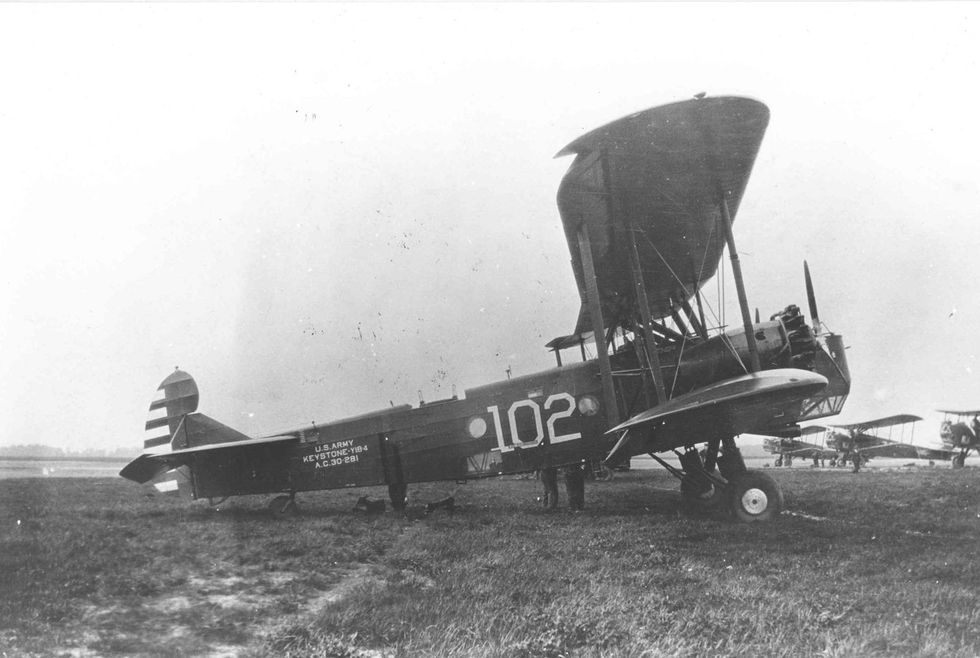
volano bombing b 4 bomber

Keystone Y1B-4 bomber.

Wikimedia Commons

Thomas Jagger, the founder of the Hawaiian Volcano Observatory, appealed to the U.S. Army for help. Jagger wanted the Army Air Service, forerunner of the wartime Army Air Corps and later the U.S. Air Force, to bomb the lava tubes and channels that fed lava in the direction of the river. Nobody thought American bombers could destroy the lava, but they hoped the bombing would divert the flow to another, non-threatening direction.

The mission was assigned to Army Air Service planes based on the island of Oahu and planned by Patton. The commander of the First Provisional Tank Brigade in World War I would of course later go on to command the Third Army in Europe during World War II.

The Hush Kit describes the air strike:

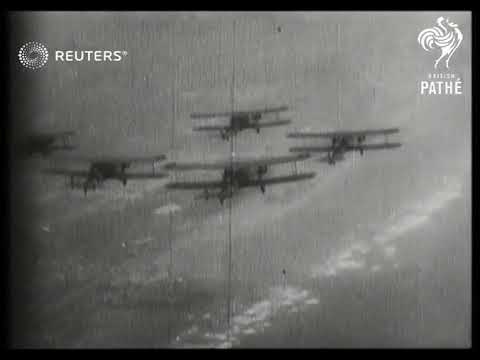
On December 27, 1935, ten Keystone B-3 and B-4 bombers from Luke Field on Ford Island in the middle of Pearl Harbor flew the 200-odd miles to bomb the Humu‘ula lava flow. The bombers dropped 40 bombs, half were high explosive and the rest were WP smoke bombs to mark the impact points. Of the twenty high explosive bombs dropped, sixteen hit the target area and twelve hit the lava tunnel in question.

Here’s video of the planes involved in the air strike:

Jagger observed the air strike from a telescope at the base of Hawaii’s other volcano, Mauna Kea. “The experiment could not have been more successful; the results were exactly as anticipated,” he later told the New York Times. The lava slowed from covering more than 5,000 feet a day to 1,000 feet after the bombing, and the flow stopped entirely on January 2, 1936.

Not everyone shared Jagger’s optimism. Harold Stearns, a U.S. Geologic Survey who flew on the mission, believed the slowing and stopping of the flow was a coincidence. Jagger’s boss, the head of Hawaii National Park, told the Army the day after the attack, “Though we are as yet unable to determine what effect the airplane bombardment achieved … I feel very doubtful that it will succeed in diverting the flow.”

The U.S. Geologic Survey, writing about the incident more than 80 years later, says, “Modern thinking mostly supports Stearns’ conclusion.”

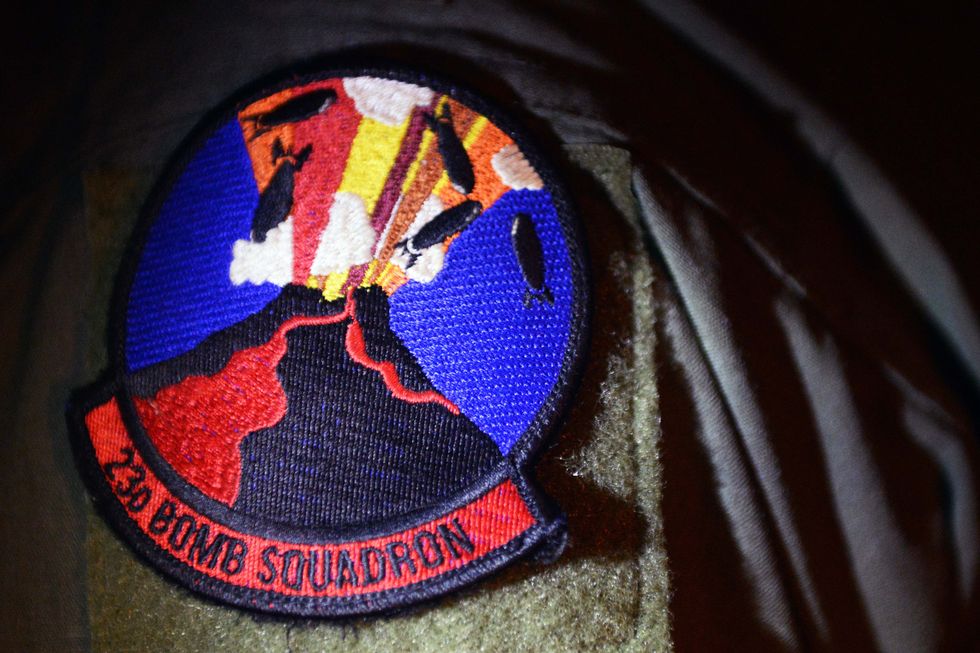
In 2015, the 23rd Bomb Squadron, the unit that flew the mission against Mauna Loa’s lava flow, returned to Hawaii to commemorate the 80th anniversary of the mission. A B-52 bomber assigned to the 23rd Expeditionary Bomb Squadron flew from its temporary base on the island of Guam to Hawaii, a 12-hour mission. The squadron insignia, this Air Force Global Strike Command article notes, still depicts bombs tumbling down onto a volcano.

capt craig quinnett, 23rd expeditionary bomb squadron aircraft commander, sports a 23rd bomb squadron patch dec 28, 2015, at andersen air force base, guam  two b 52 aircrews assigned to the 23rd expeditionary bomb squadron, currently assigned here as part of the us pacific command's continuous bomber presence, conducted a bomber airmen heritage flyover of the mauna loa volcano, hawaii during the tribute flight, crewmembers proudly wore their squadron patch, which displays bombs falling into a volcano  us air force photosenior airman joshua smoot

23rd Bomb Squadron shoulder patch, 2015.

36TH WING PUBLIC AFFAIRS

The 1935 volcano air strike wasn’t the last time mankind trained its weapons of war on nature. Today, Russia and China occasionally send their air forces to bomb frozen rivers, typically to remove dangerously high levels of ice buildup or to allow nearby communities to reconnect with the outside world. And in July 2018, the Swedish Air Force bombed a wildfire on a military training ground, snuffing it out and preventing it from detonating unexploded munitions.

———————————————————————————–      I for one did not know this. That and the man did get around did’nt he? All in all I have to say that the US Taxpayer got themselves a real bargain when they commissioned him into the Army.

Categories
A Victory! All About Guns Leadership of the highest kind One Hell of a Good Fight The Green Machine War

The Wagon Box Fight, 1867 by KERRY DRAKE

Sioux and Cheyenne warriors who gathered west of Fort Phil Kearny on the morning of Aug. 2, 1867, had several reasons to feel confident as they prepared to attack civilian woodcutters and the U.S. Army troops assigned to protect them.

Nine months earlier, Lakota, Cheyenne and Arapaho warriors had attacked troops along the Bozeman Trail about four miles north of the fort, which is located near present-day Story, Wyo, on the east flank of the Bighorn Mountains halfway between the present towns of Buffalo and Sheridan. Tribal leaders sent out a small band of decoys that managed to lure Capt. William J. Fetterman into an area where he and all 80 of his men were ambushed and killed. At the time, it was the worst military defeat ever suffered by the Army on the Great Plains.


wagonbox1.jpg
On Aug. 2, 1867, Oglala Sioux warriors attacked troops and civilian woodcutters replenishing Fort Phil Kearny’s wood supply several miles northwest of the fort. Wikipedia.


Red Cloud’s War

In the summer of 1867, looking to repeat their success, Indians—furious that white men the year before had built three forts along the new Bozeman Trail across their land in the Powder River Basin—planned attacks on two of the forts. The federal government contended the forts and defense of the trail were necessary because the route offered the quickest path to gold mine discoveries in Montana. The conflict became known as Red Cloud’s War.


wagonbox2.jpg
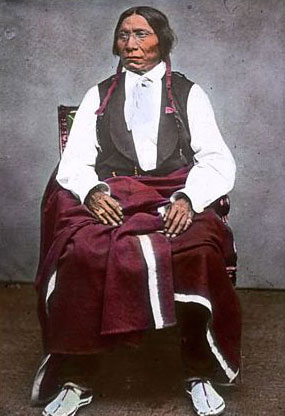
Oglala Sioux Chief Red Cloud led the tribe’s resistance to the U.S. Army’s incursion into the Powder River Basin in the 1860s. Whether he was at the Wagon Box Fight is unclear. First People.


Sioux Chief Red Cloud had vowed to kill every white man found on the Indians’ land. The Indians harassed troops and white travelers more or less continually. The next large attacks after the Fetterman massacre came in August.

One contingent of warriors battled soldiers and civilians at the Hayfield Fight on Aug. 1, 1867, near Fort C.F. Smith on the Bighorn River in southern Montana Territory. Early the next morning, Red Cloud and more than 1,000 warriors gathered and attacked woodcutters and soldiers near a spot about six miles northwest of Fort Phil Kearny.

What happened over the course of six hours on August 2 became known as the Wagon Box Fight, a relatively small battle that became well known for several disparate reasons. It was the Army’s first chance to claim victory after the Fetterman disaster, though in retrospect the fight seems more like a draw. At the time and since, there were widely conflicting reports on the number of Indian casualties, and for this reason too the fight continues to draw the interest of students of the Indian Wars.

Finally, the fight is important in the history of tactics because it was the first time a large force of mounted tribesmen faced sustained fire from relatively rapid-shooting, breech-loading rifles. The warriors’ old tactics of closing fast on horseback for close combat with their enemies no longer worked—and they paid a heavy price.

The wood supply

Hundreds of infantry and cavalry soldiers based at Fort Phil Kearny needed a steady supply of wood from forests on the slopes of the Bighorn Mountains for construction at the fort, as well as a constant supply for fuel for cooking and for the next winter’s heating.

Protecting the contracted civilian woodcutters was thus one of the Army’s most important jobs if the troops were to survive in hostile country. The wood line where the prairie met the mountain forest was about six miles from the fort. Wagon trains of woodcutters and their soldier guards suffered constant small attacks during the entire two years Fort Phil Kearny was in existence.


wagonbox3.jpg
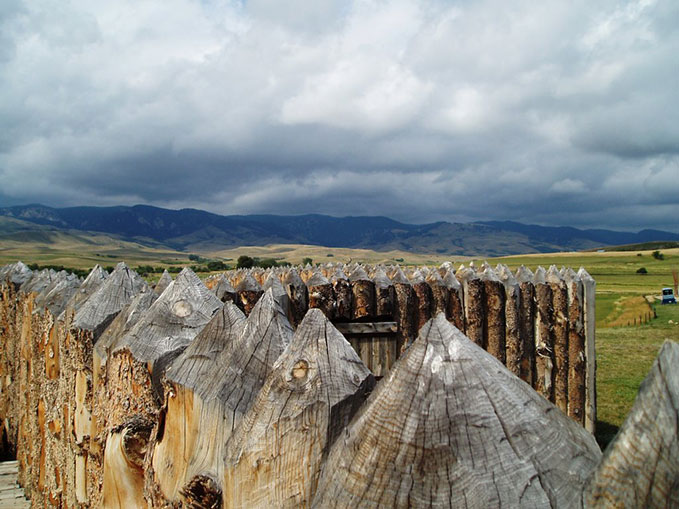
View toward the Bighorn Mountains and the site of the Wagon Box Fight, from the reconstructed stockade of Fort Phil Kearny. Vasily Vlasov, Panoramio.


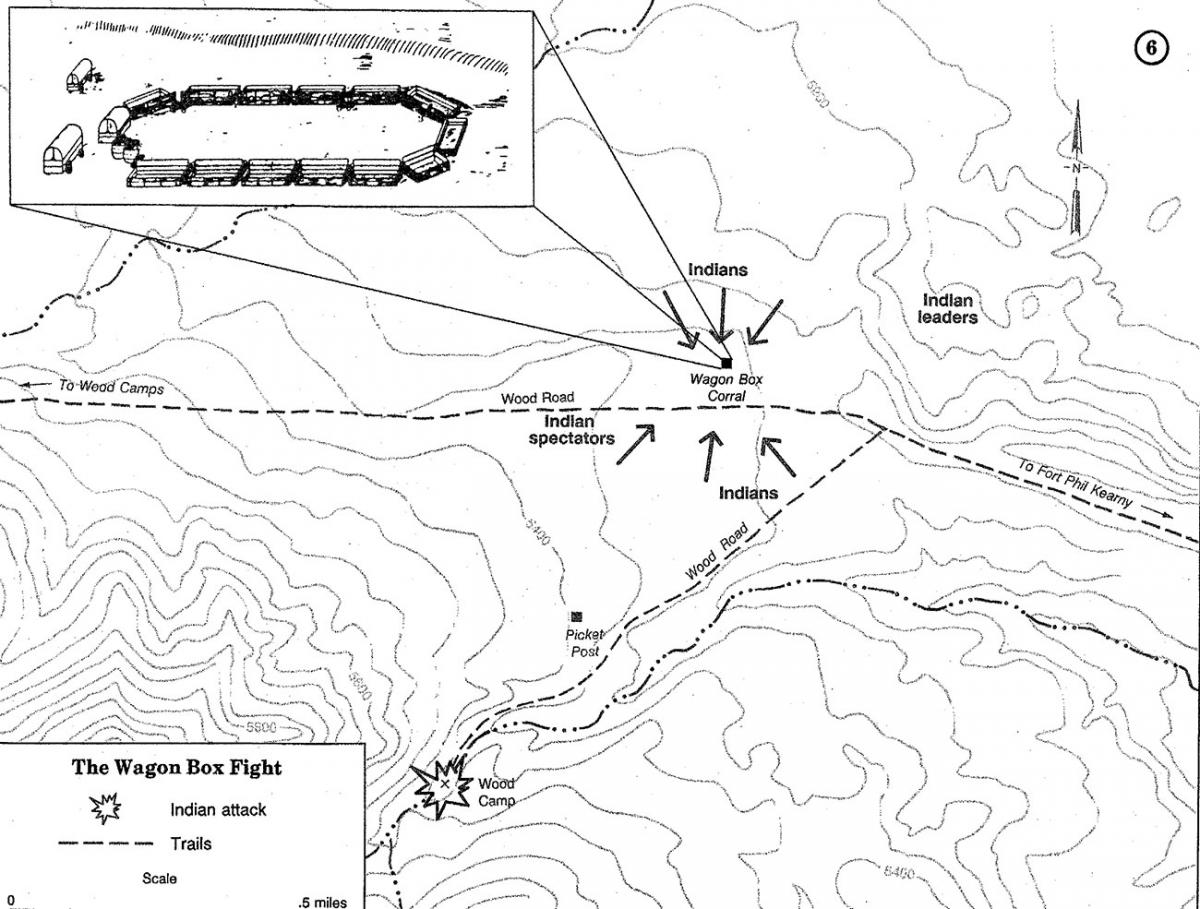
On August 2, the tribes tried something much larger. The Indians held a distinct advantage because their foes had split into two groups. Civilian woodcutters decided to stay at a camp near the wood line, about a mile from a makeshift stock corral the soldiers had fashioned from14 wagon boxes, removed from their running gear and set on the ground. Logs were transported from the woodcutting camp to the fort resting directly on the running gear.

A wagon-box corral

The wagon boxes were 10 feet long, two and a half feet high and four and a half feet wide. The wood was only about an inch thick, with no lining. The boxes eventually served as the main line of defense against a massed Indian force determined to overrun the corral and the 32 men using it as cover.

Capt. James W. Powell was in command of C Company, 26th Infantry, which at the end of July had relieved the company previously guarding the woodcutters, and so his troops were new to the job. He set up operations at the corral.

Early on August 2, Powell sent 13 men out from the corral to guard the woodcutters’ camp and another 14 to escort wagons carrying wood to and from the fort. That left the captain and Lt. John C. Jenness at the corral with 26 enlisted men.

The soldiers at the corral were joined by two civilian teamsters who had left the fort that morning to hunt deer. The pair saw Indian smoke signals and tried to get back to the fort, but wound up at the corral instead.

The first attack

The Indians set their sights on the camp’s mule herd, with 200 warriors on foot trying to scatter the animals, but the mule herders kept the attackers at bay until a new wave of Indians managed to drive off the herd and set fire to the woodcutters’ camp. Simultaneously, about 500 Indians attacked the woodcutters. Then the woodcutters and their soldier guards tried to move toward the fort, bypassing the corral.

Three soldiers and four civilian contractors were killed, but Powell managed to divert the Indians’ attention by mounting an attack on the rear of the Indian force from the corral, which allowed the rest of the woodcutting camp’s occupants to hide in the timber or get to the fort. Within 15 minutes, an estimated 800 Indians on horseback surrounded Powell and his men at the makeshift corral.

Using field glasses to scan the area, Lt. Jenness reportedly told the men he spotted Red Cloud at the top of a hill with other Indian leaders. It has never been verified that Red Cloud was at the scene, and because the lieutenant didn’t know what the man looked like, Jenness may have misidentified another chief.

Trapdoor Springfields

Unlike Fetterman’s troops, who carried muzzle-loaders that could only fire three rounds a minute at most, the men at the wagon boxes were equipped with new breech-loading Springfield trapdoor rifles. Seven hundred of these weapons were brought to the fort a short time before by wood contractor J.R. Porter of the Gilmore & Proctor firm. They could fire 15 to 20 rounds per minute. Unfortunately, there hadn’t been any time for target shooting, and Army weapons training was known to be dubious at best. Still, most of the men managed to at least become familiar with the new rifles in the weeks since the weapons had arrived.


wagonbox4.jpg
New, breech-loading Springfield Model 1866


The soldiers punched two-inch holes into the wooden wagon boxes so they could fire through them. Yokes, bags of grain, kegs and other equipment were stacked between wagons for protection. Some men fired over the tops of the boxes, and blankets covered the tops to hide the men’s positions and provide limited protection from the arrows raining down on them.

The Indians were primarily armed with bows and arrows, lances and war clubs, though some had firearms captured months earlier during the Fetterman attack. They didn’t have much ammunition, however. The soldiers at the Wagon Box Fight began the battle with 7,000 rounds on hand—and this large supply saved their lives.

Once the attack began, most of Powell’s men kept their ammunition in their hats. Although this was convenient, it left their heads exposed to the sun and its sweltering heat. In addition, the troops had to deal with the stench: Indians coated their arrows with burning pitch that set fire to hay and mule and horse dung.

The soldiers’ superior firepower drove back the initial wave of Indians and they retreated to about 600 yards from the corral and spent the next few hours making separate attacks on foot.

A long fight

Powell was at one end of the corral, with Jenness stationed at the other. Participants later reported that a few Indians managed to get within 5 feet of the corral, but none penetrated the barrier.

Jenness was shot in the head and killed, as were two privates, Henry Haggerty and Thomas Boyle. Two other privates were wounded in the fight.

A teamster, R.J. Smyth, later recalled the lieutenant’s bravery during the battle. “Lt. Jenness had just cautioned me not to expose my person, and to hold my fire until I was sure of getting an Indian at each shot,” Smyth said. “He had moved a few feet from my box when he was shot through the head, I think he died instantly. He was a grand, good man, and a fearless officer. I told him to keep under cover. He stated he was compelled to expose himself in order to look after his men.”

Several soldiers wrote firsthand accounts of the ordeal. Sgt. Samuel S. Gibson, who at 18 was the youngest soldier at the corral, recorded the most detailed and dramatic version of the event. He had been dispatched to guard duty at the woodcutters’ camp and had a skirmish with several Indians before he and another soldier made it safely to the corral.

“The whole plain was alive with Indians shooting at us, and the tops of the boxes were ripped and literally torn to slivers by their bullets,” he wrote. “How we ever escaped with such slight loss I have never been able to understand, but we made every shot tell in return, and soon the whole plain in front of us was strewn with dead and dying Indians and ponies. It was a horrible sight!”

Gibson added, “The Indians were amazed at the rapidity and continuity of our fire. They did not know we had been equipped with breech-loaders and supposed that after firing the first shot they could ride us down before we could reload.”


wagonbox5.jpg
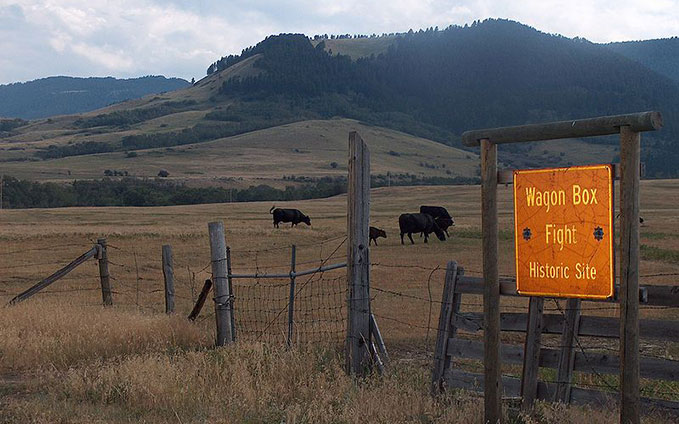
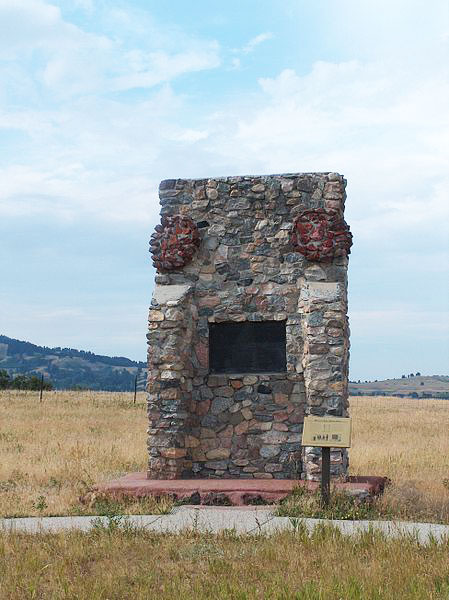
The monument at the site of the Wagon Box Fight was built by the Civilian Conservation Corps in 1936. Wikipedia.


Sometime between noon and 1 p.m., hundreds of warriors led by Red Cloud’s nephew charged the corral on horseback, hurtling toward the wagons in a V-shaped wedge. Powell later recalled that things looked very bleak at that moment, especially because ammunition was running low and his men were exhausted from holding off the Indians for so long.

After Indians on horseback were initially forced to retreat from the corral area, they tried to attack on foot over the next three hours. On Sullivant’s Ridge, a hill to the east, were several hundred Indians out of range who had been watching the battle “like spectators,” but it appeared to Powell that they would enter the fray.

A howitzer rescue

Just at that moment, though, Powell said he heard the sound of a howitzer shell hit and saw a rescue party led by Maj. Benjamin F. Smith, who had 100 men with him.

“The shell fired was in the direction of the Indians [on the hill], but fell short, as I anticipated,” Smith noted in his report, “but [it] seemed to disconcert them as a number of mounted Indians who were riding rapidly toward my command turned and fled.”

The Indians who had been attacking the corral as well as the ones watching the action all retreated.

Smith, arriving at the corral, was shocked to find that most of the men had survived the intense encounter. He had expected them all to be dead. “It was a hard lot to look at. The day was hot and the sun was beating down on them in the wagon beds,” he wrote. “The smoke from their guns had colored their faces and they looked as though they had used burnt cork on their faces.”

Each survivor received a big drink of whiskey from a keg brought along on the rescue mission by the post surgeon, Dr. Samuel M. Horton.

Indian casualties


wagonbox6.jpg
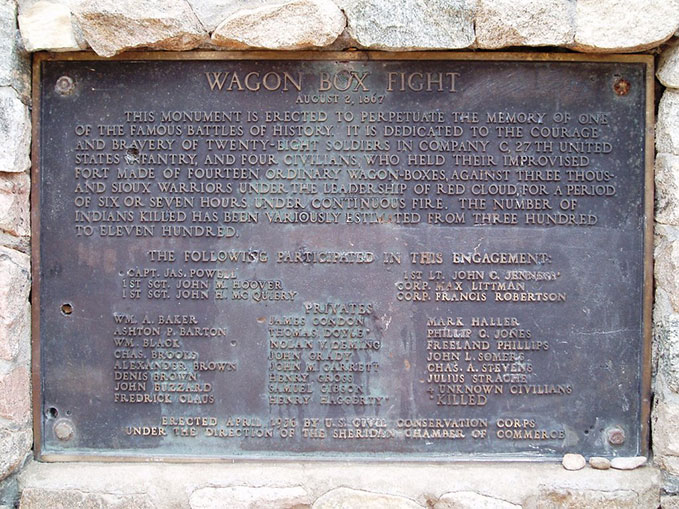
Text on the 1936 monument overstates the number of Indian warriors and casualties. Vasily Vlasov, Panoramio.


Estimates of Indian casualties in the Wagon Box Fight, though, vary enormously; they range from two dead to 1,500. To date no one has come up with a definitive answer about why there is no agreement on the numbers.

“No [other] event has had more wild, inaccurate tales written concerning it,” writer Vie Willits Garber noted in a 1964 Annals of Wyoming article.

Two respected historians–Stanley Vestal and George Hyde–as well as several Sioux leaders said only six warriors were killed and six more wounded.

But there are accounts of people who later talked about the battle with Red Cloud. They said the chief told them that the count was much higher. Gen. Grenville M. Dodge interviewed Red Cloud in 1885, and he told him more than 1,100 Sioux, Cheyenne and Arapahos were killed or wounded at the fight. A Sioux medicine man, whose name was not recorded, visited the post of Col. Richard I. Dodge at North Platte in the fall of 1867. He told the colonel that the total of dead and injured was 1,137, and that figure was widely reported the same year as the battle.

Hyde’s book, Red Cloud’s Folk was published in 1937, based on interviews Hyde had conducted decades earlier. Hyde said that late in his life Red Cloud, who died in 1909, claimed not to remember the Wagon Box Fight at all. The historian said that was unlikely, given the large number of warriors in the battle and the fact that it marked the chief’s last major fight.

In his official report, Powell estimated 60 Indians killed and 120 wounded–figures held up to ridicule by some historians as “wildly exaggerated,” while his Army superiors believed he was being incredibly modest about the body count. Enlisted men at the scene supported much larger claims, with various shooters putting the number of dead between 300 and 800.

The account of at least one Indian warrior, an Oglala Sioux named Fire Thunder, supports the claim of heavy Indian losses. He described “dead warriors and horses piled all around the [wagon] boxes and scattered over the plain.”

In 1969, at a reenactment of the Wagon Box Fight near Sheridan, Wyo., some Indian descendants of the participants claimed Indian casualties were between 1,200 and 1,500.

Hyde said while he knew of no written accounts of the battle by Indians, they did not regard the fight as a defeat. If the reports of six dead and six wounded Indians were accurate, as Hyde believed them to be, he said they inflicted more damage to the white men at the camp and the corral because they killed a total of six soldiers and four civilians, plus capturing a large number of horses and mules.

Aftermath

In the Treaty of Fort Laramie in 1868, with the transcontinental railroad nearing completion and opening up a new, shorter route to the Montana gold fields, the government agreed to abandon the forts on the Bozeman Trail, to make the western half of Dakota Territory a large reservation for the Sioux and to allow the tribes to hunt buffalo in the Powder River Basin of what are now Wyoming and Montana. The tribes burned the abandoned forts shortly after the Army left.

The Wagon Box Fight was the last major battle of Red Cloud’s war against the white men he felt had invaded the land they had promised to his people. Some historians credit the battle with teaching both sides valuable tactical lessons. To the Army, it was now clear that Red Cloud commanded thousands of hostile warriors, not just a small number of malcontents.

The tribes, meanwhile, became convinced that they did not have a chance against large numbers of troops unless they could secure similar firepower, which they did by the time of the Battle of the Little Bighorn in 1876.


wagonbox7.jpg
FortWiki.com. Click to enlarge


RESOURCES

  • Bate, Walter N. “Eyewitness Reports of the Wagon Box Fight.” Annals of Wyoming 41, no. 2 (Oct. 1969): 193-201.
  • FortWiki.com. “Sioux War of 1866-1868.” Accessed Feb. 28, 2014 at http://fortwiki.com/Sioux_War_of_1866-1868.
  • Garber, Vie Willits. “The Wagon Box Fight.” Annals of Wyoming 36, no. 1 (April 1964): 61-63.
  • Hyde, George E. Red Cloud’s Folk: A History of the Oglala Sioux Indians. Vol. 15, The Civilization of the American Indian. Norman: University of Oklahoma Press, 1975, 159-160.
  • Keenan, Jerry. The Wagon Box Fight: An Episode of Red Cloud’s War. Conshohocken, Pa.: Savas Publishing Co., 2000.
  • militaryphotos.net “The Wagon Box Fight August 2, 1867” Accessed Feb. 25, 2014 at http://www.militaryphotos.net/forums/showthread.php?195915-The-Wagon-Box-Fight-August-2-1867.
  • Murray, Robert A. “The Wagon Box Fight: A Centennial Appraisal. Annals of Wyoming 39, no. 1 (April 1967): 105-107.
  • The Powell Project. “James Powell Reports on the Wagon Box Fight.” The commanding officer’s official report after the battle, accessed Feb. 25, 2014 at http://powellproject.tumblr.com/post/52483831856/james-powell-reports-on-the-wagon-box-fight.
  • “The Wagon Box Fight.” Annals of Wyoming 7, no. 2 (Oct. 1930): 394-401.

Illustrations

  • The image of the model 1866 trapdoor Springfield rifle is from Wikipedia. Used with thanks. The photos of the monument and the main sign at the Wagon Box Fight site are also from Wikipedia. Used with thanks.
  • The map of the battle site is from FortWiki.com. Used with thanks.
  • The photo of the monument plaque and the view toward the mountains from the reconstructed Fort Phil Kearny stockade are by Vasily Vlasov, from Panoramio. Used with thanks.
  • The photo of Red Cloud is from First People, a child-friendly site about Native Americans and members of the First Nations, with more than 1400 legends, 400 agreements and treaties, 10,000 pictures, clipart, Native American books, posters, seed bead earrings, Native American jewelry, possible bags and more. Used with thanks.