Category: Gun Info for Rookies

The scenario is often something like this.
Hunter: “What rifle should I bring on my hunt?”
Outfitter: “What do you have?”
Hunter: “I have a new .300 Winchester I bought, but I don’t like it and it’s not very accurate. I also have a .270—I’ve shot a lot of deer with that.”
Outfitter: “How well can you shoot that rifle?”
Hunter: “I can’t hit paper, but I am deadly on anything with hair.”
Outfitter: “Sigh … Just bring the one you can shoot the best.”
When it comes to guns and hunting there are several myths that are repeated too often by gun writers, gun store counter jockeys and shooting range experts. Oftentimes there is a bit of truth in them, but usually it’s lazy thinking.

Shoot the Best Rifle for the Hunt
The advice “take the gun you shoot best” on an important hunt is a great example. Of course, you need to be able to shoot your rifle well. But bringing an inadequate rifle cartridge on an important hunt, just because you won’t bother to master a proper rifle, is a lazy approach to the problem. Also, it’s very likely that the guys who complain they can’t shoot the bigger gun probably are not all that great with any rifle.
The outfitter just wants to fill his hunts and run his business. It’s not his job to teach the hunter about shooting or ballistics. If he has been running hunts for long and knows guns, then he understands. The client is probably an Eastern hunter who shoots whitetails at 50 or 60 yards and is bragging to anybody who will listen about how he has been hunting with that rifle for 15 years and is still using the same box of ammo he bought with the gun. The truth is, the hunter probably isn’t very good with the .270 either, but at least he is not afraid of it.
The outfitters you won’t hear this from are folks running dangerous-game hunts. I know one very experienced brown bear outfitter who tells hunters to bring at least a .375 H&H Mag. or stay home. Nobody in Africa tells you to “just bring the gun you shoot best” for a dangerous game hunt. A .220 Swift will kill a Cape buffalo; it’s been done. But not only is it illegal for dangerous game in many places, only a fool would guide a hunter shooting a completely inadequate cartridge. If you wound an elk with a marginal rifle it’s a lost elk. Heartbreaking to be sure, but nobody dies. A wounded buffalo, bear, lion, leopard, elephant, etc. can break a lot more than your heart. Clients who are stomped and gored don’t tip very well. If the outfitter is stomped, bitten, clawed or gored trying to fix the mess the client made with the wrong gun, he can’t feed his family anymore. If the locals are on the receiving end, the professional hunter can be in danger of losing his business. So they tell you to bring an adequate rifle and leave it to you to figure out how to shoot it. If you fail, they bat cleanup with their rifles. Rest assured, it’s always a big caliber.
Anything less than using a rifle compatible with the game hunted is compromise on a path to failure. If you are booking a whitetail hunt in Saskatchewan and insist on bringing your .243, you open that failure door. Sure, it will kill deer. I have shot a lot of deer with a .243. But with those big-bodied, winter-tough bucks, your odds for a heartbreaking loss go up by a lot. It’s always best to spend a lot of time and a little money to learn how to shoot a proper rifle well.
The problem is recoil. People are scared of hard-kicking rifles. Recoil is a result of the weight of ejecta, which is the weight of bullet and the powder charge and the exit velocity. This is calculated against the weight of the rifle to give the foot-pounds of energy that a shooter feels at the shoulder. It is physics and it’s pretty well fixed. For example, a 9-pound rifle shooting a .243 100-grain factory load will produce 8.46 ft.-lbs. of felt recoil. The same rifle in .300 Winchester Magnum with a 180-grain bullet at the same velocity will produce 27.4 ft.-lbs. of felt recoil. Quite a difference. However, I contend that any adult hunter, barring medical issues, can learn to shoot both rifles with equal accuracy. It’s all a matter of managing the felt recoil and practicing.
There is no reason to be afraid of recoil. It’s not as brutal as people think. The first thing any shooter has to understand is that recoil will not damage you. I once fired a .600 Nitro Express double-barrel rifle and both barrels went off at the same time. That resulted in nearly 300 ft.-lbs. of energy hitting my shoulder. I survived with no lasting effects. In fact, I shot my best whitetail at 409 yards the next morning (with a different rifle of course). So a rifle with just 10 percent of that recoil would seem acceptable to hunt with, right?
The key is to control the effects of the felt recoil; that is what the shooter experiences at his shoulder. There are a lot of ways to do that.
Stock Design
First and probably most important is the stock design. Frankly a lot of factory stock designs fall into the category of, “That’s how we have always done it,” which doesn’t do much to explain why they suck. My first .300 Winchester from far too many years ago pounded me unmercifully. I hated that Remington 700 BDL and was about to sell the gun. Then I got an assignment to write about one of the new synthetic replacement stocks that were emerging on the market. I fitted one of the stocks to my .300 Winnie and I was astounded. It felt and acted like a completely different rifle. The gun became pleasant to shoot and oddly enough it was a lot more accurate. (No doubt that had nothing to do with me no longer flinching.) I was traded out of the gun and I can’t remember who made the stock. I was using a typewriter back then and can’t find the article. (No spell checker with that thing either, it’s a wonder I made it as a writer!)

I have a wildcat, the .358 UMT, which is based on the Remington Ultra Mag cartridge. This gun will push a 225-grain bullet well over 3000 fps. The rifle is pretty light, so in theory, it should kick the snot out of your sinuses. But it does not. Mark Bansner built the gun and it wears one of his High Tech stocks. The first thing everybody who has shot it says is, “Gee, that kicks a lot less than I expected.”
Recently I traded for a .458 Lott custom rifle built on a Mauser action. It was fitted with a beautiful walnut stock. In fact, it is the best piece of wood on any rifle I have ever owned. I shot the rifle seven times and had to quit. The next day I had a black eye and I looked like I had been in the ring with Tyson. (For the record, I think I could take him.)
That experience would lead a lot of people to believe the .458 Lott is too much gun. But, I know better, having shot several of them over the years. The problem is the stock design. The butt on this one is cut at an angle to the bore. (It’s called pitch.) The Monte Carlo comb rises to a point right where it contacts my face. When the gun fires it drives the cheekpiece into my face with considerable force.
So I called Bell and Carlson and ordered a new stock to tame this beast. I will miss the “pretty” wood stock, but I wanted this gun to hunt with, not look at.
Another often repeated myth is that a synthetic stock makes a gun feel like it kicks less because it absorbs the recoil energy. I have written it myself. But, that was a while back and I no longer entirely believe it—or at least the part about the stock absorbing recoil energy. I think that theory got started back when we were replacing stocks on existing firearms. The stocks we put on, like the stock on my .300 Winchester, were designed better to mitigate recoil. Everybody assumed it was the synthetic aspect that was changing the felt recoil when in reality it was probably the design. Today a lot of companies are installing cheap injected-molded stocks with the same flawed design as their old wood stocks. Those I have shot seem to kick just as hard as the guns with wood stocks.

A wide butt plate that is square to the bore reduces the beating on your face. A stock with a lot of pitch on the recoil pad, like a lot of factory guns and my pretty .458 stock, use the pitch angle like a cam when the gun fires. It forces the muzzle up and the comb smacks your cheekbone. With a square (or nearly square) pitch, the gun recoils straight back and spares your pretty face. This also keeps the muzzle rise down and helps speed the next shot. The comb should be straight or sloping slightly forward so the gun recoils away from your cheek. Again, this keeps your face from taking a beating. The stock should of course have one of the newer high-tech recoil pads to cushion your shoulder and to absorb some of the recoil energy. A wide butt also helps dissipate the recoil; a thin butt pad will hurt you. It’s important, too, that the stock fits you. If you are very large with long arms or are on the small side, then the factory stock designed for the “average” person is not going to fit well. Have a competent gunsmith adjust the length of pull to fit your body size.
Add Weight
The weight of a gun is a huge factor in felt recoil. The heavier the gun, the less you feel the recoil. But, you have to carry a hunting gun, so it’s a compromise. If you just walk to your deer stand and sit down, you may use a much heavier rifle than if you are elk hunting and climbing mountains all day.
You may want to add a mercury recoil-reducing tube, or even two. My .416 UMT has three. These sealed tubes are filled with high-viscosity and heavy, liquid mercury to absorb some of the recoil energy. Mercury is heavy, 13.53 grams per cubic centimeter, while lead is 11.34. Remember, “A body at rest wants to stay at rest”? Using that law of physics, the mercury tube reduces recoil. Installation is easy for a DIY hunter or inexpensive for a gunsmith to do. Brownells sells the tubes in a variety of sizes. You can also order one installed in a new Bell and Carlson stock from the company’s factory as I did with the new stock on my .458 Lott. They are safe, as the mercury is sealed inside the metal tube.

I have also used a redneck gunsmith, poor man’s approach to adding weight by mixing No. 9 shotgun pellets with fiberglass-infused Bondo. I find or create space in the stock and fill it with the mixture. I have a .375 RUM, a very hard kicking cartridge, that I added weight to in this way. It tamed the recoil and the rifle survived a safari in Tanzania for Cape buffalo and several more hunts for a lot of other game.
Customize the Muzzle
A good muzzle brake will greatly reduce recoil. Many factory-produced rifles now are sold with brakes installed. Most gunsmiths can install one on your rifle. However, a brake is very loud; so loud that a lot of guides and professional hunters will not allow them on a hunt. One approach is to use the brake to practice and then remove it before the hunt and screw on a thread protector in its place. Recoil is not as noticeable when you are shooting at game. Just make sure you re-zero your rifle as point of impact can change.

Mag-na-Port is a process that cuts two or more trapezoid slots into the barrel. This allows the gas to rush out of them like a jet to reduce muzzle rise and recoil. Accuracy and velocity are not affected. I have rifles that are Mag-na-Ported and they are not anywhere near as loud as a brake. I highly recommend this on any brutish hunting rifle. (I plan to send my .458 Lott to be Mag-na-Ported.)
A suppressor can help, too. Lately, American hunters are catching up with much of the rest of the world and are using suppressors (also called silencers) for hunting. Suppressors are still, foolishly, a National Firearms Act (NFA) regulated item so you must get permission from the government and pay them $200 for the privilege of protecting your hearing. But, it’s worth the trouble. Hunters love them not only because they reduce noise, but also because a suppressor greatly reduces felt recoil. Think of it as a brake that’s wearing a muzzle to shut it up. If you buy yours from Silencer Central, the company will handle all the paperwork. I did and it was simple and easy.
Use Low-Recoil Ammo
Using low-recoil ammo can help ease you into learning the rifle. Just be sure to switch to full-power ammo for the last several practice sessions before the hunt.
There was a time when most of the major ammo makers offered low-recoil ammo in many rifle cartridges. I think the last man standing is Hornady with its Custom Lite Reduced Recoil ammo.
Handloading is perhaps the best way to tailor the reduced-recoil ammo to your needs. Hodgdon offers instructions on its website.

Or you can turn to a custom loading company. Nyati Inc. specializes in reduced-recoil ammo for big-bore rifles. I tested its ammo some years ago for a magazine article and found the quality and performance from the custom loader to be excellent.
Another source is Phil Massaro, a name often seen as a byline in this magazine. Phil also owns Massaro Ballistic Labs, which is a custom handloading company. He can load reduced-recoil ammo for your specific rifle. I have tested Phil’s ammo in several rifles and have found it to be high quality and highly accurate.
I would be remiss if I didn’t note that during this time of ammo and component shortages these sources may not be able to supply what you need right away. So order early and be prepared to wait.
Tame Bench Sessions
The most common time that a hard-recoiling rifle will hurt you is when you are shooting off a bench. But a bench session is necessary to evaluate ammunition and to zero the rifle. The best solution I have tried is the Lead Sled. I like the simplicity of the original design the best. I keep hearing those repeated rumors about how the Lead Sled will break scopes or split stocks. I have literally fired thousands of rounds from hundreds of rifles, including a .500 Nitro Express, on a Lead Sled and have never experienced a single problem. I think that’s another one of those myths that keeps being repeated without any actual experience.
Just make sure you use a Lead Sled correctly and fill the tray with bags of lead shot. I had a friend who bought one and complained bitterly that it didn’t work very well. He brought it one day to shoot with me. He was setting it up and, trying to help, I looked in his truck.
“Where is your lead?” I asked.
“What lead?”
He never was big on reading directions.
I think shooting from the bench is crucial to preparing the rifle. But, with a big kicker, the sooner you get off the bench and start shooting from field positions the sooner you will realize this rifle is not so bad.
Use Proper Shooting Technique
Learn to shoot with the proper stance, which will help you absorb recoil. Spread your feet shoulder-wide with your off-side (left side for a right-handed shooter) foot forward so the heel is even with the strong-side toe. Lean forward a little and shift about 60 percent of your weight to the front foot. Keep the weight on your toes, not your heels. The knees are bent slightly and the toes point to the right of the line to the target. The right leg (right-handed shooter) is behind and almost straight, with a slight bend so the knee is not locked and with the toes pointed about 90 degrees to the line of sight to the target. Put the buttstock on your shoulder, fitting it in the pocket formed when you roll your shoulder forward, and lean forward a bit to firm up your stance. This weight-forward stance will let you manage recoil and you will think that you are shooting a much different rifle than you had on the bench. You may learn more nuanced shooting techniques down the road. For now, remember a PAST recoil pad shield can help take the sting off your shoulder regardless which technique you use.

Practice a little bit, a lot of times. How much depends on you. I have fired 75 rounds or more in a short practice session with guns as big as the .500 NE. That was too much. I suggest 10 rounds to start. Then shoot more as it becomes more and more comfortable.
I know ammo is expensive (and hard to find right now) but shooting is the only way to learn the rifle. Mitigate the recoil and then practice shooting. It won’t be long before you are shooting much better than you ever did with that wimpy little .270!
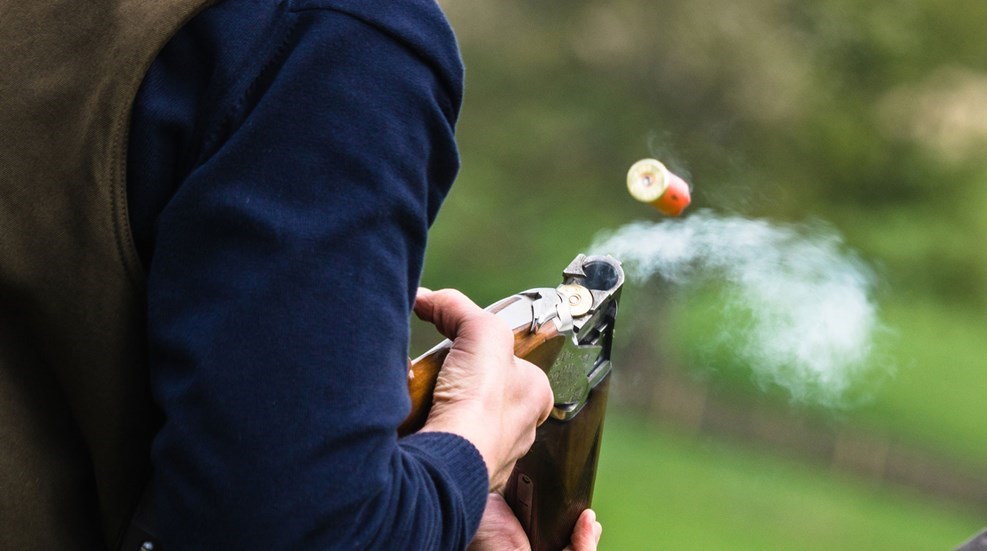
Firearm actions are one of the three basic parts of a firearm: action, stock and barrel. Actions of a firearm did not exist until the mid-to-late 1800s. Prior to the development of modern actions, firearms had locks. This is where the old phrase, “Lock, stock and barrel,” originated from.
Before you can understand the different types of actions, you need to know what an action does. The action of a firearm performs three functions; it loads, fires and ejects the cartridge or shotshell.
There are five common action types: bolt, lever, break, pump and semi-automatic. Firearms are often referred to according to the type of action they possess. Understanding the different action types not only makes you a more educated shooter but also a more responsible gun owner.
Bolt Action
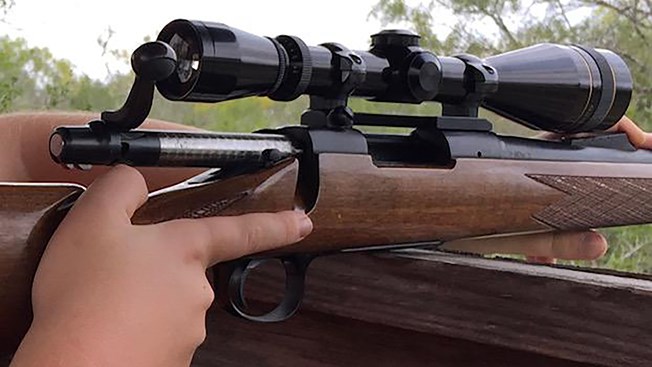
The bolt-action rifle is the preferred action of most hunters and long-range shooters. Bolt actions are not exclusive to rifles. They can also be used in shotguns. Bolt-action shotguns can be used for goose and crane hunting and are usually found in 10- or 12-gauge. Bolt-action shotguns are also used in conjunction with rifled barrels for deer hunting.
Bolt-action rifles are usually identified by the presence of the bolt handle that extends from the breech area of the receiver. The bolt handle is attached to the actual bolt. The bolt of the firearm is the component that contains the firing pin. It also contains components such as extractors, which make it possible to cycle spent cartridges out of the firearm and load new ones.
The bolt is operated by rotating the bolt handle up and then pulling to the rear. This resets the firing pin. As the bolt is closed or pushed forward, it picks up a cartridge or shell from the magazine. When the bolt reaches its most forward travel position, the bolt is rotated down. There are locking lugs that secure the bolt in place for firing. These lugs prevent the bolt from blowing back, and force all the expanding gasses out of the muzzle.
Bolts are not exclusive to bolt-action rifles and shotguns. Bolts are also found in lever, pump and semi-automatic actions. Bolt handles in these firearms are referred to as charging handles.
Lever Action
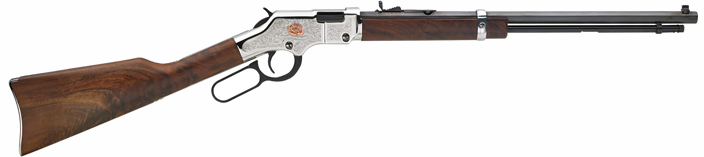
Lever-action rifles have a special place in the history of the American West. These types of actions are still very popular among hunters. Lever-action rifles are also used in the Cowboy Action Shooting and Single Action Shooting Society (SASS). Henry Rifles manufactures a popular lever-action .410 shotgun.
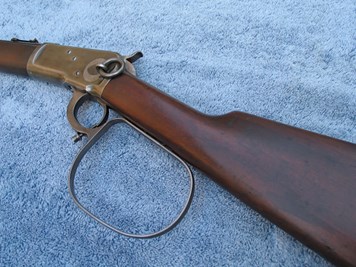
Lever-action firearms are identified by a lever under the receiver. The lever is a solid piece and consists of two parts. The forward part of the lever is the trigger guard, and the larger rear part is a loop for the middle, ring and the pinky finger. On some lever action firearms, the finger loop of the lever can be very large. Chuck Connors made the large loop lever action rifle popular in his series, The Rifleman.
The lever action is operated by using three fingers to rotate the lever downward. The lever pivots just forward of the trigger at the guard, so that when it is rotated, the trigger is exposed. When the lever is opened, the bolt is moved to the rear and extends past the end of the receiver. Opening the lever resets the firing pin. When the lever reaches its most downward position, the spent cartridge or shell is extracted from the chamber and thrown clear of the breech. As the lever is closed, it picks up a new cartridge or shell from the magazine and feeds it into the chamber. The firearm cannot be fired until the lever is fully closed.
Break Action
Most break-action firearms are shotguns. Break-action shotguns can be single-barreled or double-barreled. Double-barreled shotguns are either over-and-unders or side-by-sides. There are also break-action rifles. Break-action rifles are either single-barreled or side-by-sides. There are even break-action firearms that are both rifles and shotguns. These are usually over-and-unders. Of these, one barrel is chambered for a shotgun shell and one barrel is chambered for a rifle cartridge.
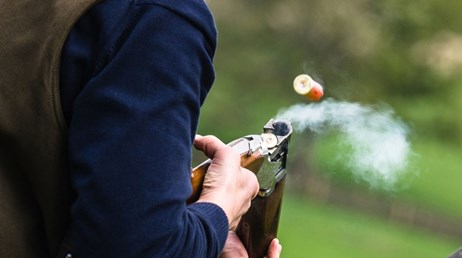
Break-action firearms are also referred to as hinge-action firearms. Whatever you call it, the break-action firearm is operated by moving a lever or tang to one side. When the tang reaches its furthest travel, the lock is disengaged, and the barrels rotate downward by a hinge at the front of the receiver. Breaking the firearm open resets the firing pin. The cartridges or shells are loaded by manually inserting them into the receiver. After firing the cartridges or shells, the shooter can break open the firearm; the spent casings or hulls are either thrown clear of the chamber or manually removed.
Pump Action
Pump-action firearms are also commonly associated with shotguns. Like break-action firearms, rifles can also be pump actions. Pump .22s were very common in our grandparents’ day. Today you can find pump-action rifles in nearly all the common hunting calibers.
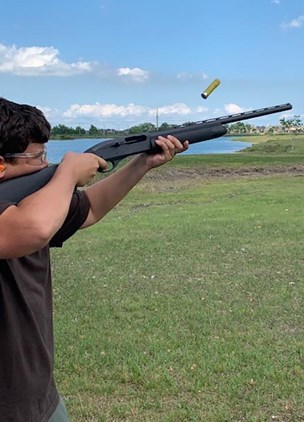
Pump-action firearms are operated by sliding or pumping the forend of the firearm’s two-piece stock to the rear. This forend is referred to as the slide. As the slide is moved rearward, it resets the firing pin while moving the bolt to the open position. When this movement is complete, the spent cartridge or shell is thrown clear of the breech. As the slide is pulled forward to the closed position, the bolt picks up a new cartridge or shell from the magazine. When the slide reaches its most forward position, the slide is locked in place.
The locking mechanism of the slide prevents the bolt from being thrown backwards when the cartridge or shell is discharged. The lock also prevents the expanding gasses from escaping out of the breech. This forces all the gasses to exit the firearm through the muzzle.
Semi-Automatic Action
Semi-automatic firearms can be found in rifles and shotguns. Modern sporting arms are very popular with today’s shooters. These include the modern AR platforms. Semi-automatic shotguns are also very popular with waterfowl hunters. These types of firearms are easy to learn and operate. They also allow for fast follow-up shots. The downside to semi-automatic firearms is that their operation can be adversely affected by the residue from previous shots. As a result, semi-automatic firearms need to be properly cleaned after each use.
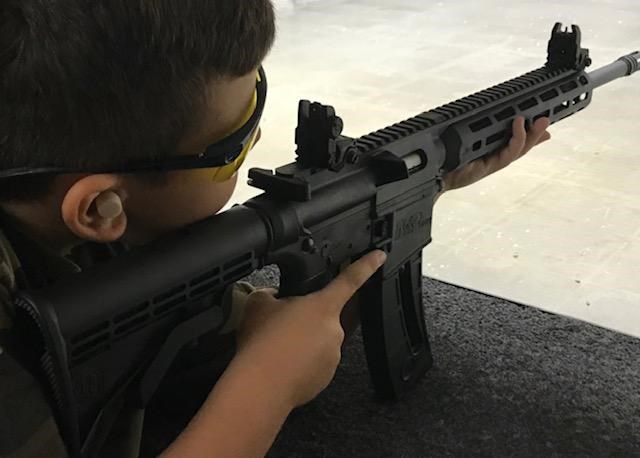
Semi-automatic firearms are operated by pulling the trigger. When the cartridge or shell is discharged, the recoil, gasses (or a combination of both) work the action. This means the bolt of the firearm is thrown rearward, and then slams forward to the closed position in one fluid motion. There are several things that happen in this fast operation. As the bolt travels rearwards, the firing pin is reset and the spent cartridge or shell is thrown clear of the breech. As the bolt travels forward, it picks up a new cartridge or shell from the magazine and feeds it into the chamber.
A semi-automatic firearm discharges one round for every pull of the trigger. As a result, a semi-automatic firearm can be fired as fast as the trigger can be pulled. This is not to be confused with a fully automatic firearm, which will continue firing until the shooter lets off the trigger, or the firearm runs out of ammunition. As responsible shooters we must use the correct terminology when referring to our firearms.
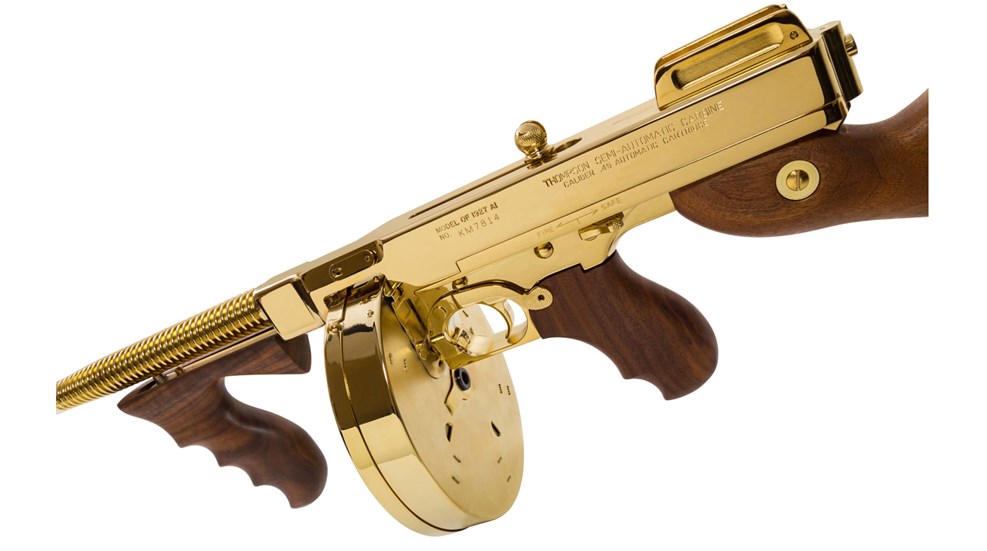
Simply stated, steel is better suited to the explosive nature of shooting than other metal or material. For this reason, rifles of every type are built using steel components including the barrels, receivers and internal parts. However, steel is comprised mostly of iron, and iron is susceptible to rust. That’s why the primary purpose of all rifle finish types, or surface treatments, is to inhibit or prevent environmental oxygen and water from causing gun metal corrosion.
Today there are literally dozens of rifle finish options to choose from ranging from 19th century technology to cutting edge composites. Some are more interesting to look at while others have added physical benefits such as improved scratch resistance or increased heat tolerance. Here is a quick look at five of the popular rifle finishes you’re likely to see on display at your local sporting goods store.
Black Oxide (Bluing)
Strangely enough, the popular black oxide rifle finish we all know and love, commonly called Bluing because if its blue-black color, is a close cousin of the red iron oxide we call rust. Giving gun metal a blued finish is a controlled electrochemical conversion process, or oxidizing chemical reaction, with the iron in the surface of the steel. The resulting thin layer of oxide on top of the steel increases the metal’s corrosion resistance. This type of finish can be applied in various ways for different cosmetic results. Methods include Hot Bluing, Cold Bluing, Rust Bluing, Fume bluing, Niter bluing and Browning which leaves the surface with a plumy brown finish.
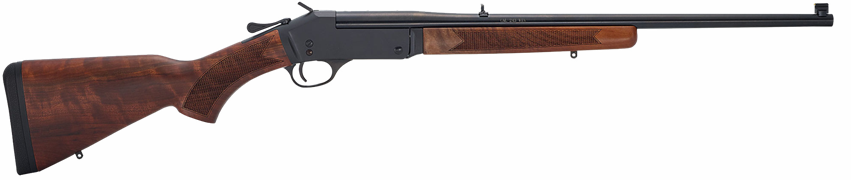
The much loved blued finish can have a non-reflective matte appearance or it can be polished to an eye catching shine.
Bluing is one of the oldest and most widely accepted rifle finishes in use today. For some folks, blued steel and hardwood stocks are the only way to go! A blued gun can have a non-reflective matte appearance or it can be polished to a fine shine. When properly cared for, a blued finish will easily last the lifetime of the rifle. But it’s not nearly as tough or corrosion resistant as other rife finishes. It’s relatively easy to scratch and offers minimal protection from rust unless it’s kept dry and coated with moisture displacing oil. If you have some blued guns in storage, make sure to look them over at least a couple of times a year, especially if you live in a part of the country with higher humidity.
Parkerizing (Phosphate Finish)
Parkerizing, also known as phosphating or bonderizing, is a gun metal treatment that provides a tougher finish than bluing with an increased resistance to corrosion, nicks and scratches. The development of the phosphating process began in the 19th century in England. It was further developed by the Parker family in the United States (which is where the term Parkerized comes from). The process was adopted for the mass production of firearms by the U.S. military during World War II and it has been in use ever since.
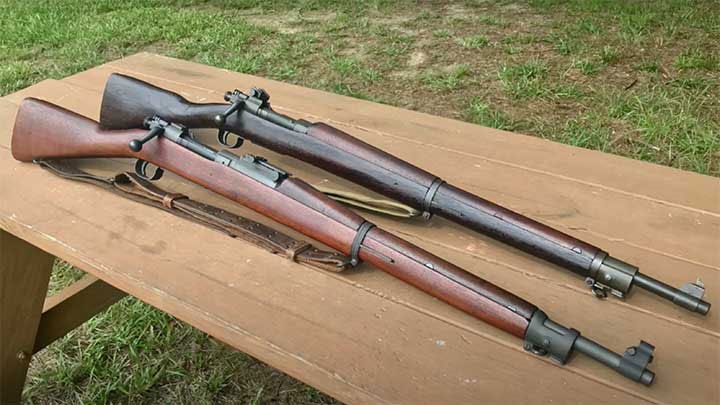
Vintage combat rifles like the Remington M1903 and M1903A3 often have distinctive matte black or gray Parkerized finishes.
This finish is applied by dunking steel gun parts into a heated bath of phosphoric acid solution. Simmer for between 5 to 45 minutes and the components are ready to serve. Key ingredients in the solution include zinc or manganese along with various nitrates, chlorates, and copper. The resulting matte finish can have a color range from a medium gray to dark black depending on the chemical solution used. It’s a durable finish which benefits from a good coating of oil for smooth operation.
Metal Plating
Plating is a centuries old process of depositing a thin layer of one kind of metal on top of another. It’s a process that’s widely used in the appliance, electronics and automotive industries as well as gun manufacturing. The goal is a best-of-both-worlds result with the thin top layer, or plate, providing cosmetically desirable or corrosion resistance properties to the steel underneath. Plating can be applied to gun parts in various ways including processes that call for an electrical charge (electroplating) along with chemical or auto-catalytic processes that don’t require electricity (electroless plating).
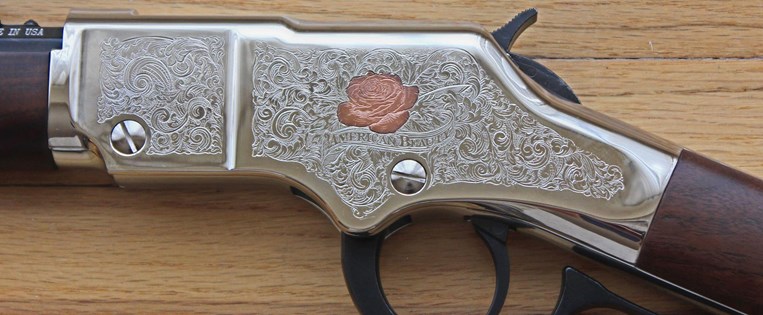
The receiver of this Henry American Beauty .22 rifle features a polished nickel finish applied over the fine line engraving.
The quality of the plating can vary depending on the preparation of the gun parts, the solutions used, and the skill of the smith applying it. The level of scratch resistance and appearance all comes down to the type of plating metal used. Nickel plated guns have been around for quite some time because nickel is corrosion resistant and it can be polished to a bright shine. Hard chrome is one of the toughest plate choices available and is commonly used to extend the working life of high velocity rifle bores.
For those who want to give their guns an artistic twist, silver and gold plating is the way to go. They offer high corrosion resistance but because they are soft metals they are best reserved for display pieces only. If you want a glittery gun you can also shoot, then take a look at a Titanium nitride finish. When polished, a Titanium-type finish provides the luster of polished gold, silver or bronze with a level of toughness similar to hard chrome.
Stainless Steel
Technically speaking, stainless steel is not a gun finish. Most finishes are comprised of a layer of material applied to the outer surfaces of carbon steel gun parts. Instead, this is a type of steel with corrosion resistance built right into it. Developed in the early 1900s, stainless steels are steel alloys which contain relativity high amounts of a mineral called chromium (at least 10.5 percent by mass) that is added for its anti-corrosive properties. Stainless steel can also be polished to a mirror shine.

The stainless steel alloys used in rifles like this Ruger 77/357 contain a high percentage of rust resistant chromium.
In most cases, a stainless-steel rifle is going to cost more than the same model with a blued finish. But it’s worth the investment for guns used regularly in harsh weather conditions. Although stainless steel is a low maintenance option, it’s not a no maintenance metal. It still needs to be kept dry, clean and properly oiled. It used to be that stainless steel had an easily recognized silver appearance. But today you need to check the label because various modern coatings can be applied to stainless steel to give it a matte black look that matches polymer stocks.
Cerakote (Ceramic Coatings)
Cerakote is the brand name for a popular coating that has taken the industry by storm over the last few years. It’s composed of a polymer-ceramic compound that can be air brushed onto gun parts that are then placed into an industrial kiln for a few hours to cure the coating. The result is a smooth, matte or gloss finish that is available in a wide variety of colors including black, gray, green, red, pink, blue and yellow, to name a few.
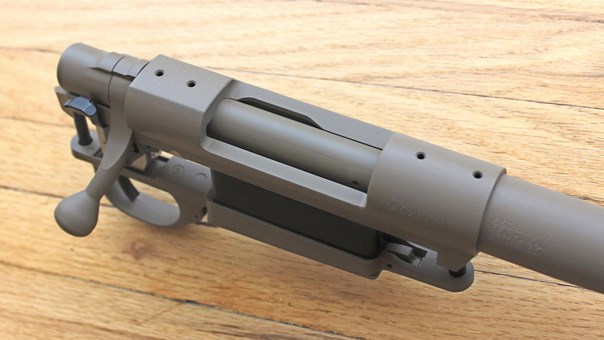
Cerakote, and other ceramic coatings, are available in a wide variety of bright or conservative colors like the Flat Dark Earth finish of this Brownells exclusive Howa 1500 barreled action.
Cerakote and similar ceramic coatings have several desirable physical qualities that make them ideal for firearms. The provide a hard, durable finish which is resistant to wear, corrosion, chemicals and impact damage. They improve lubricity, which means there’s less friction between moving parts. But what gives this finish a real edge in the market place is that its applications are not limited to steel. Cerakote can be applied to a variety of materials, including wood, polymer and aluminum. This allows an entire rifle to be treated which comes in handy for matching component colors or treating the gun to a uniform camouflage pattern.
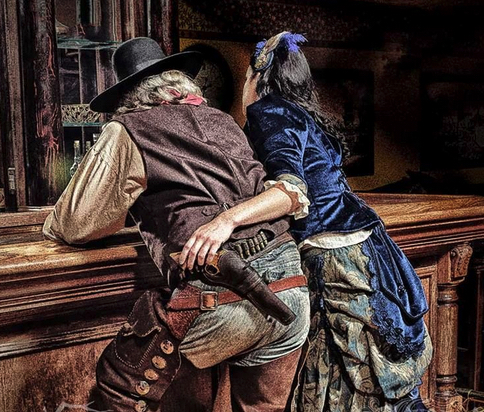
There is actually a real misconception of the Old West that truly needs correcting. That is the notion of an uncivilized Wild West, where antisocial and violent behavior was the norm, and where citizens were afraid to leave their homes, afraid of rampant crime and in fear for their lives.
This savage perspective turns out to be incorrect—false assumptions of the Old West based on sensationalist press, the Buffalo Bill Wild West Show of the 1880s and ‘90s, and subsequently cowboy shows and Hollywood movies. Bands of working cowboys and good citizens did not go about town in their leisure time challenging, outdrawing, and shooting each other in a systematized orgy of violence and gunfights as portrayed in the movies.
Bad men and violent outlaws did kill each other, but almost always left the good people of the towns alone. The famous gunfight at the O.K. Corral in 1881 in Tombstone, Arizona, in which Wyatt Earp, and his brothers, Virgil and Morgan, with Doc Holliday, killed three of the outlaw “Cowboys,” became a celebrated incident not only because of the unique circumstances but also because brother lawmen killed brother outlaws in a historic shootout. Even then it was newsworthy and certainly not a daily occurrence.
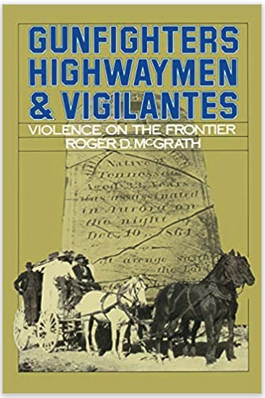
In his book, Gunfighters, Highwaymen and Vigilantes: Violence on the Frontier, historian Roger D. McGrath has corrected the historic record with substantive scholarship. After studying the Sierra Nevada frontier towns of Aurora and Bodie, McGrath found that those mining towns, where audacious young men and gunmen roamed freely packing either Colt Navy .36 six shot pistols in Aurora or Colt double action “lightning” or “peacekeeper” revolvers in Bodie, were peaceful towns, except for the quarrels in the carousing and gambling saloons. Otherwise, both towns carried on well, and everyone not interested in whoring, drinking, and gun fighting were left alone.
True, the homicide rate was high among those carousing and looking for fights in the saloons, but in the rest of the populace, the old, the ladies, and those not willing to pick fights, homicides were rare. Likewise, robbery, burglary, and rape were rare. Murder was confined to the “drunkards upholding their honor.” The homicide rate for Aurora and Bodie were 64 and 116 per 100,000, respectively, compared to Washington, D.C., at 72 per year in the 1990s. Likewise, the burglary and robbery rates were 6 and 84 per 100,000, respectively, for Bodie; compared to 2,661 and 1,140, respectively, for New York City in 1980.
The townspeople, although they might have carried guns, respected each other, and townspeople did not even bother to lock their doors at night. Similar observations have been made by other researchers studying the supposedly violent and crime-ridden Lincoln County, New Mexico; the Kansas towns of Dodge City and Wichita in the 1870s; and the Texas frontier towns from 1875 to 1890.
Returning to the issue of the possible confiscation of American firearms in the current era, consider the practical obstacles, not to mention the constitutional protection. Trying to blame, register, ban, and confiscate (one step usually follows the other) over 300 million firearms owned by Americans would bring about a tinder box situation, at least an order of magnitude worse than Prohibition, for Americans obey just and moral laws but not capricious or tyrannical laws, and a veritable police state would be required to enforce the draconian gun laws that would be necessary to carry that out.
Thus, politicians who sadly continue to use the latest tragedy (and the emotionalism and the passions elicited in its wake) to push for the usual round of gun control—while ignoring the accumulated objective research published in the social sciences and the criminologic literature—are not sincerely lamenting the deaths of the innocent or sympathizing with their families, but attempting to score political points, political points at the expense of the victims or good citizens.
They are also further polarizing America and tearing apart the fabric of this great nation by using emotionalism rather than common sense to bolster their unwise, political actions. Let’s stop demonizing guns and end the shootings by incarcerating the criminals and identifying and healing the mentally ill, for much work needs to be done in the psychiatric and mental health arenas and in the task of reducing violence. Sensationalization of violence day after day by the press, the electronic media and the internet—heaped upon impressionable individuals subject to our increasingly dumbed down, popular culture and public education—is having a malevolent effect that needs to stop.
Written by Dr. Miguel Faria
Miguel A. Faria, Jr, MD is a retired professor of Neurosurgery and Medical History at Mercer University School of Medicine. He founded Hacienda Publishing and is Associate Editor in Chief in Neuropsychiatry and World Affairs of Surgical Neurology International. He served on the CDC’s Injury Research Grant Review Committee. This article is excerpted, updated, and edited from his book, America, Guns, and Freedom: A Journey Into Politics and the Public Health & Gun Control Movements (2019).
This article may be cited as: Faria MA. Gun Violence and the Wild West. HaciendaPublishing.com, February 28, 2022. Available from: https://haciendapublishing.com/gun-violence-and-the-wild-west-by-miguel-a-faria-md/.
Copyright ©2022 Miguel A. Faria, Jr., M.D