Category: Gun Info for Rookies
 This is why the Army is fanatical about cleaning guns! Grumpy
November 18, 2021
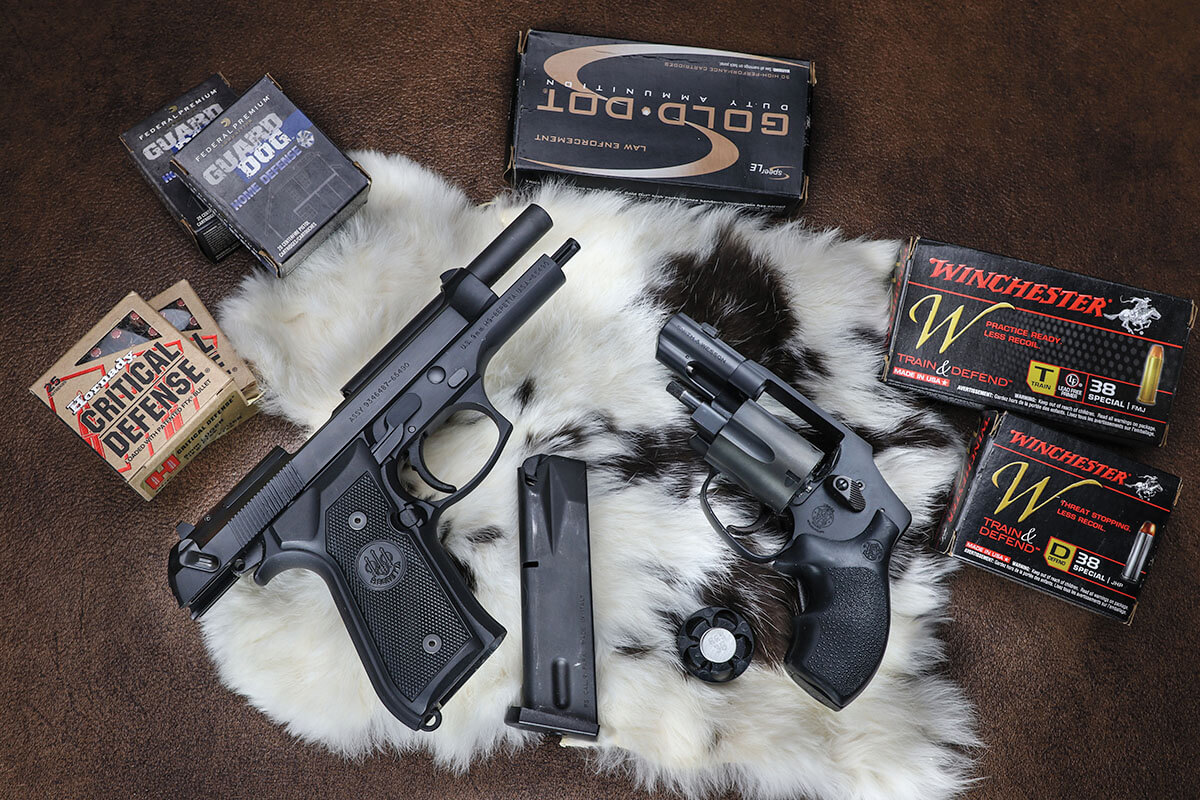
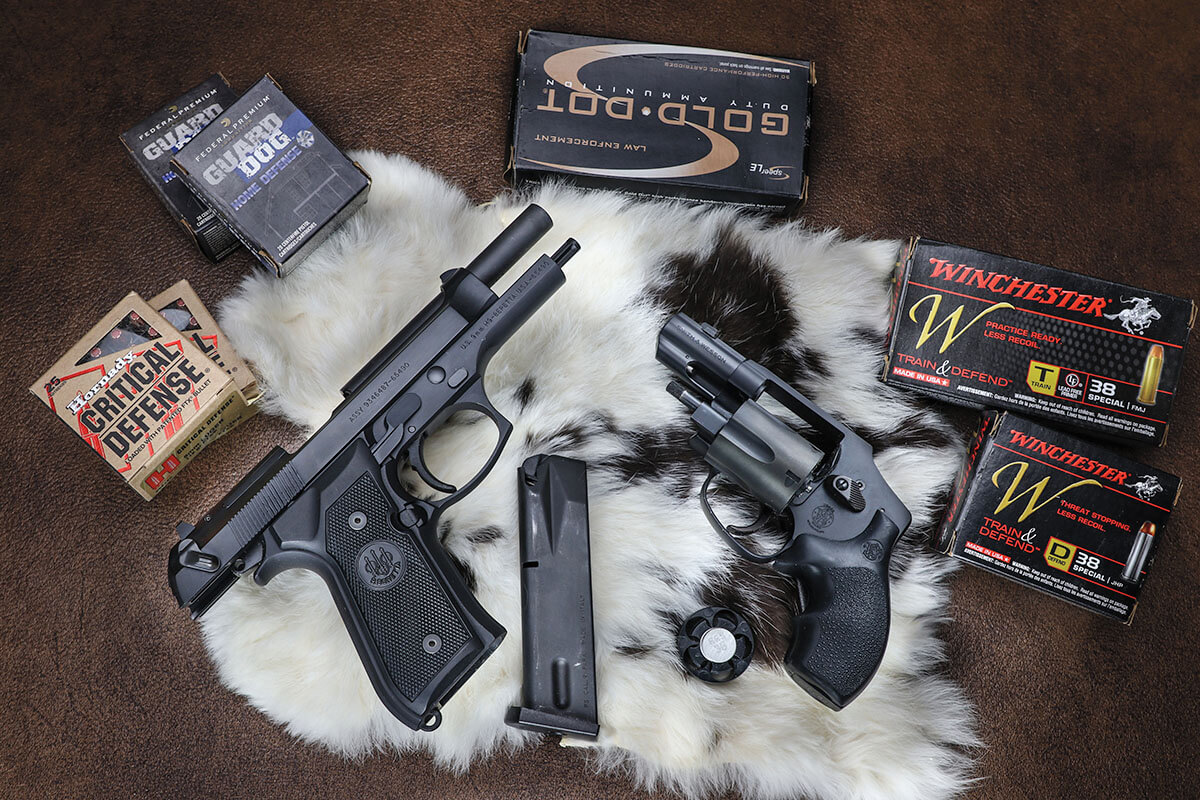
Most think “new” when buying a defensive handgun, but used can be just as good—and in some cases better. A semiauto’s break-in period is usually over, for example, and some former owners may have upgraded sights or added accessories like custom grips. Plus, the price is generally 20 to 25 percent less than new.
Here are some things to pay attention to when you’re looking at a used gun. If you’re not overly familiar with handguns, it can be helpful to bring along an experienced friend to help explain some of the finer points, and be sure to take your time and not be pushed into a decision.
It’s best to stay with newer semiautos built in the last 30 or 40 years and revolvers up to 50. Modern semiautos are engineered for reliability across a wide range of self-defense ammunition, whereas older ones are often reliable only with full metal jacket ammo. Revolvers have no such issues.
If the prospect is on the far end of two decades or older, ask if it is still in production and if there are new factory magazines and spare parts available. Pass on fully discontinued models. You don’t want to be scouring gun shows and the internet for used magazines or parts.
Current best buys include the many police trade-ins on the market that show carry wear but have been fired little. Many have been certified by the original maker and come with a good warranty.
If it’s not a former police firearm with that paperwork, ask if the gun has been test-fired and if it comes with a warranty. While you can download owner’s manuals for most modern guns—or have the manufacturer mail you one—it’s not a bad idea to find out if a manual comes with the handgun. Either way, you’re going to want one so you can learn how to disassemble and clean it.
Speaking of cleaning, is the gun clean inside and out? The shop or gun show purveyor should have done this, but if not, a dirty gun shows indifference by its previous owner and also makes it harder to assess the gun’s condition.
Take your time examining any prospective purchase. See if you like the way it feels and that it operates easily for you. If it’s a semiautomatic, the slide should run smoothly, and all the controls should function properly. Magazines should go in and out easily, and the slide should lock back on an empty magazine.
Magazines need a little special attention. Ideally, the mag will be marked with the pistol manufacturer’s name or logo, which usually (but not always) can be found on the base pad or body. Many companies subcontract out their magazine manufacturing, but they purchase quality magazines built to their specifications, and ideally, that’s what you want.
Inspect the magazine. Especially if the gun was used in shooting sports requiring magazine changes, they were likely dropped and possibly kicked or stepped on. Check the feed lips for damage or burrs, but expect the body to show light scuffing.
If the magazine has far more wear than the pistol, it may not be the one that came with the gun originally. Plan to replace it or its spring. Ask if the gun comes with more than one magazine or if there are any more to be had. It would be best to leave the transaction with more than one mag in hand.
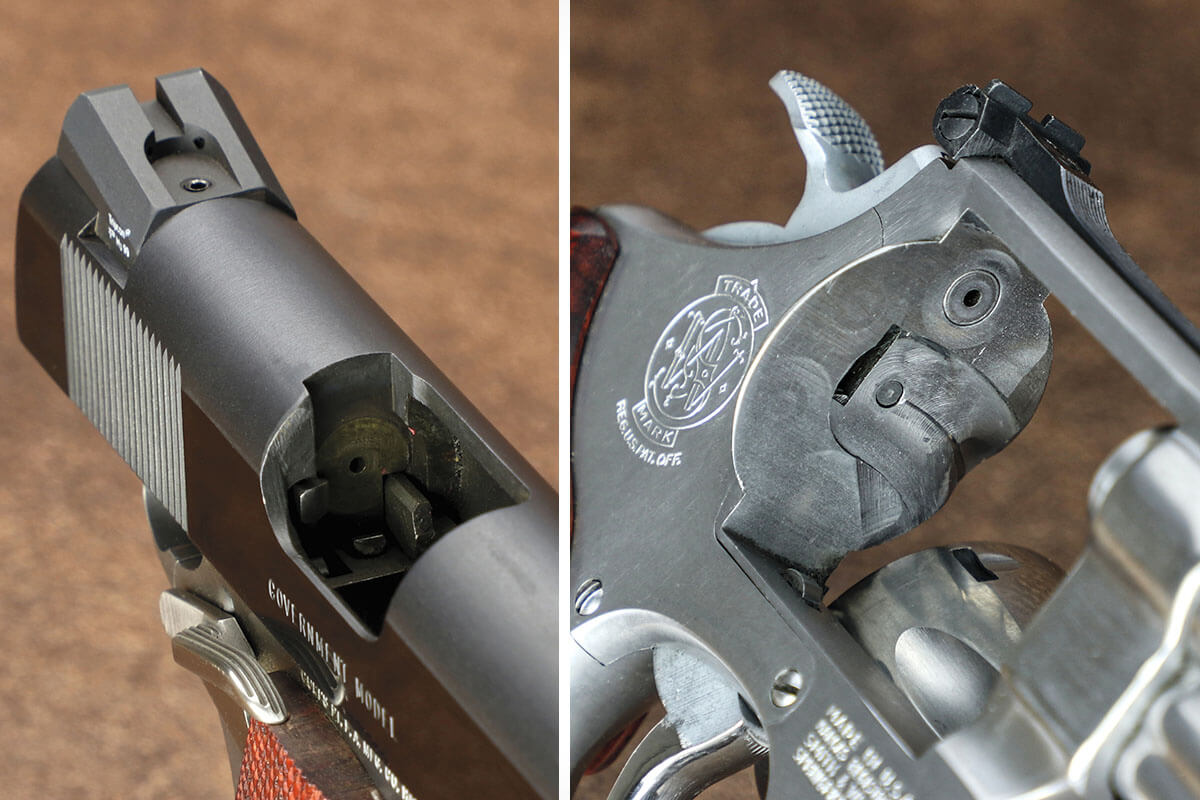
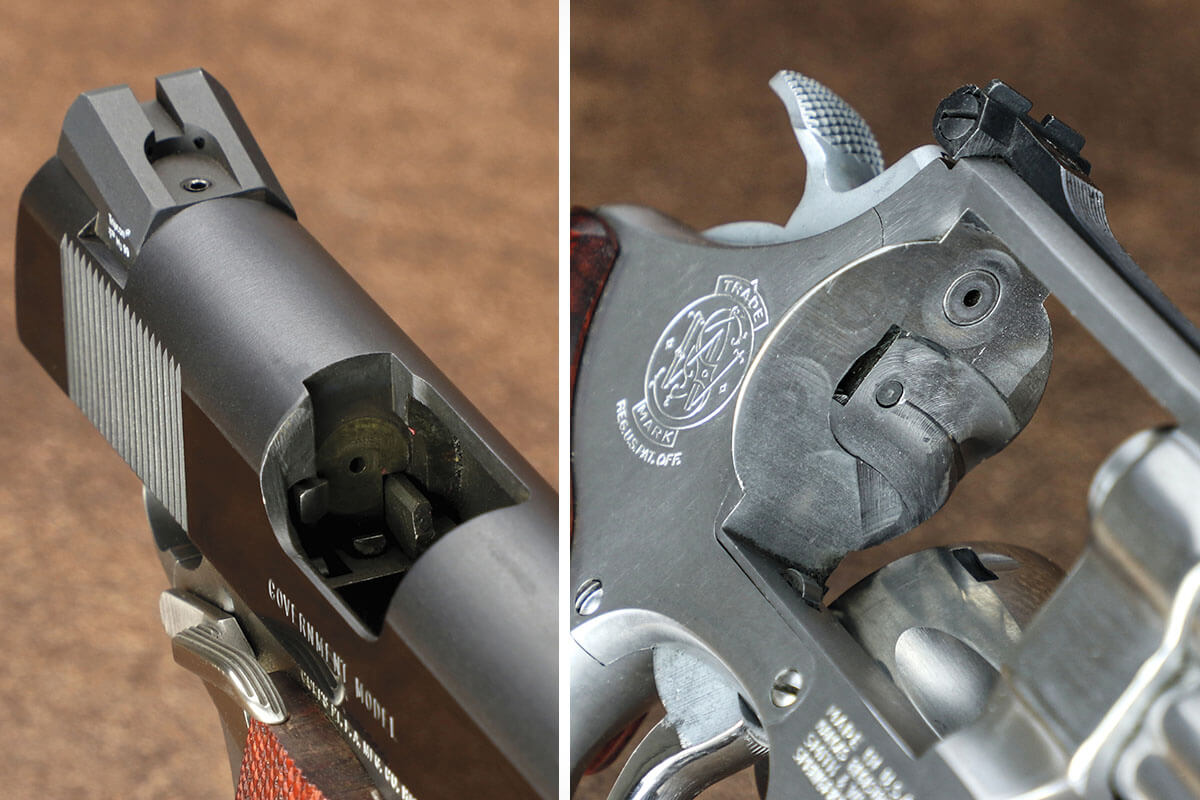
When a cartridge discharges, it leaves a mark on the breech face and will polish this area even if it’s stainless steel. The amount gives you a rough idea of how many rounds have been fired through the pistol.
A police trade-in may show little finish missing here, although the external finish may look very worn. A target pistol may show quite a bit of wear to the breech face but exhibit little wear externally. For business, I’d want the former, since the latter may require service sooner than later—but not always. This is where having an experienced friend along for a second opinion helps.
Final points on semiautomatics. Because they cycle faster, subcompacts may require more frequent recoil spring and magazine spring replacement for reliable performance than would a belt-sized pistol.
And if the pistol has tritium sights, check them in a dark room or at least cup your hand around the sights to see if the tritium lamps are functioning. Even if they are, keep in mind they work only about 10 to 12 years, so be prepared to replace them sooner rather than later on a used pistol.
Revolvers are simple things by comparison, since their working parts are always at rest. Because revolver springs aren’t compressed for long periods, they rarely need replacement.
Look at the breech face and see how much wear is present. Look at the topstrap where the barrel protrudes and see if any cutting is present. The amount and depth of cutting shows if the gun was fed a steady diet of magnum loads for those that are so chambered.
You want to check for any play in the crane, which is the arm that allows the cylinder to open and close. After ensuring the gun is unloaded (yes, even in a gun shop or at a show), close the cylinder, and with the muzzle skyward, look down on the front of the revolver and gently press on the closed cylinder to see if the crane moves.
No play is best, but minor play is okay. A lot of play is a sign of abuse. It can be fixed, but if you’re unwilling to wait for repairs or unsure, pass it by.
Lightly rest—don’t press—your thumb against the cylinder and slowly cock the hammer. The cylinder bolt should still lock into place over each chamber.
If it doesn’t, think of passing it up. It will probably lock properly in double-action firing, but this indicates a timing issue and will eventually require a gunsmith’s attention. Ask if any speedloaders are available for that particular model.
This is my rifle. There are many like it, but this one is mine.
My rifle is my best friend. It is my life. I must master it as I must master my life.
Without me, my rifle is useless. Without my rifle, I am useless. I must fire my rifle true. I must shoot straighter than my enemy who is trying to kill me. I must shoot him before he shoots me. I will …
My rifle and I know that what counts in war is not the rounds we fire, the noise of our burst, nor the smoke we make. We know that it is the hits that count. We will hit …
My rifle is human, even as I [am human], because it is my life. Thus, I will learn it as a brother. I will learn its weaknesses, its strength, its parts, its accessories, its sights and its barrel. I will keep my rifle clean and ready, even as I am clean and ready. We will become part of each other. We will …
Before God, I swear this creed. My rifle and I are the defenders of my country. We are the masters of our enemy. We are the saviors of my life.
So be it, until victory is America’s and there is no enemy, but peace!

Target Acquisition is the location, detection, and identification of a target in sufficient detail to permit the effective employment of lethal and non-lethal means.
It takes more than a good eye, it takes a combination of vision, resolve and strength. I know that when I first starting shooting rifles, I could do a pretty good grouping for those first few rounds, then it went south. That was simply a matter of muscle strength. I got a couple of five pound weights, holding one out where a support hand would be, one where my grip would be. At home each morning, I’d pull them up, like I was pulling the rifle up quickly to target and hold 30 seconds or so, drop, rest, hold, repeat, 80’s music sounding out a rhythm on the stereo.

“Hammer Time!”
But it’s seeing what you are doing that’s the most important element of target acquisition, not just maintaining it.
When I was a child, we’d take a vacation every year to the Oregon Coast, renting a small cottage with a view of the beach. Coming down a steep hillside into Cannon Beach, the station wagon dissolving into damp grey light, streams of fog pouring over the road to lie like barely congealed oil, we kids would have all eyes glued to the front windshield. It was always a contest to see who first could spot the water and call it out.

There it is! We’ll pull ourselves up in the seat seeing that ocean as if for the first time. You’ve never seen small children so focused, so concentrated. It was something our parents taught us early on. There is fun, and there is play, but there are times, that for your safety, you need to be able to sit still and truly look.
Eighteen years later, I’m in the left seat of a transport, shooting down the barrel of an instrument approach into a tight runway in the mountains. We have enough fuel to give it just one try and then go to our alternate airport. But thanks to a weather system that didn’t bother to read the accu-hunch forecast, there were some serious thunderstorms drifting in that moat between us and our only other option. We needed to get into this airport, now, this once. If we blew it, we’d not get a second shot.
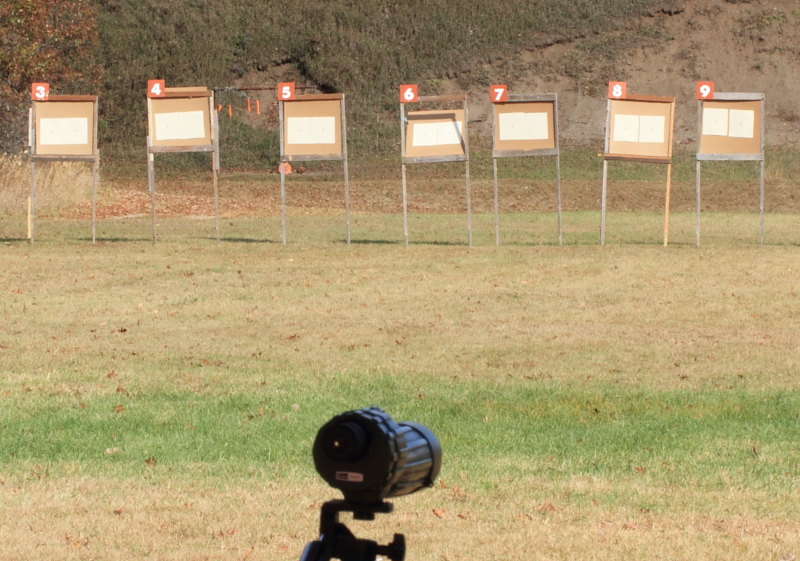
There is no range concentration that can match that of pilots that have just one shot at getting in to land or face a dire horizon. If you’re lucky, you can pick up the tease of the approach lights and stay in the clouds til you’re a hundred or so feet from the ground. But if you break out of that ragged overcast at that point, rain splatting on the windshield like a thousand guppies, doing 130 miles an hour, you’d better have your target in clear view or your day is not going to go well.
As the shotguns and Daisy’s of my youth gave way in my middle years to pistols and AR’s and a cranky Mauser or two, the ability to see and quickly lock on to a target became more of a priority. Things like humidity and breath suddenly become issues, safety glasses fogging up and things like foliage becoming more than shade when hunting from a blind. Even eyewear was an issue. I wear contacts, deciding to get rid of glasses that could be used for vision as well as setting ants on fire. There’s no fogging, and although my vision isn’t as “crisp” as glasses when I’m tired, I have the peripheral vision to see the target coming into view if it’s a moving one. As nearsighted as I am now, a Beluga whale could sneak up on me from the side if I wear glasses.

Be sure of your target and what is behind it. Wise words, especially with distance. How often do we hear of someone accidentally shot and killed while hunting because someone mistook them for a moose. Frankly if some someone mistook me for a moose, I’d be visiting Weight Watchers after I wrapped their firearm around their ears. But it happens , first a sound, a rustle of brush, and some muttonhead fires, not waiting to notice that his target is sporting a Cabelas hat, not a full rack.
It is so easy to just react without a true target (patience grasshopper). I’ve sat in more than one blind, feet freezing, stomach growling, just waiting for it. You can hear everything, the retreating darkness, the smell of first light, the delineation of leaves, the Morse code of squirrels chattering their warnings. But you can’t really see. Then the forest emerges into smooth, bright shapes, light and shadow and movement, and your eyes can only scan, looking with that tense, unmoving sobriety that is a blind man listening. If you are lucky you will see it, a flash of fur, a mass of bone that is more fight than surrender. You make sure it is all there, all four dimensions, solidity, mass, a shape that could be no other than an animal, and something else. Not hesitation, not fear, but pure and intent assurance as you draw up your weapon.

If you don’t CLEARLY know what your target is, keep your finger off the trigger. If you do, and ONLY when you do, use the front sight of the gun as a guide to aim. If you are after multiple bogies (i.e. kevlar vested doves) leave your front sight as soon as your next target approaches and as the gun approaches it, sight again and pull the trigger. Always know where your front sight is. It will tell you almost anything you could want to know about a shot. If you’re new to shooting, just practice watching the sight, no targets. When you get used to seeing the sight in recoil, move onto paper. If the shot needs to be dead center precise, the sight needs to be clear.
I know many people that can shoot faster than their sight picture and do so with the accuracy needed to stop a human target in most situations. But that involves the instinct of practice and an intimacy with their weapon that someone that takes that firearm out of the nightstand drawer a couple of times a year is not going to have.
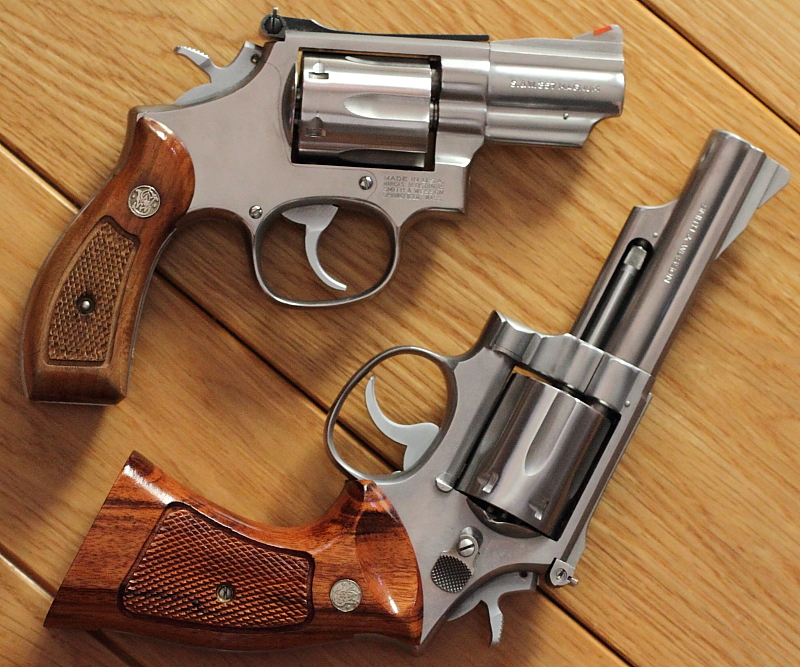
Unless you are being mugged by a 18 inch tall paper squirrel, your target is going to be moving. Remember, as far as triggers- mechanical things all happen at the same speed for each given piece of machinery. You need to learn to act upon what your eyes tell you. Like anything else with shooting, that requires practice and concentration.
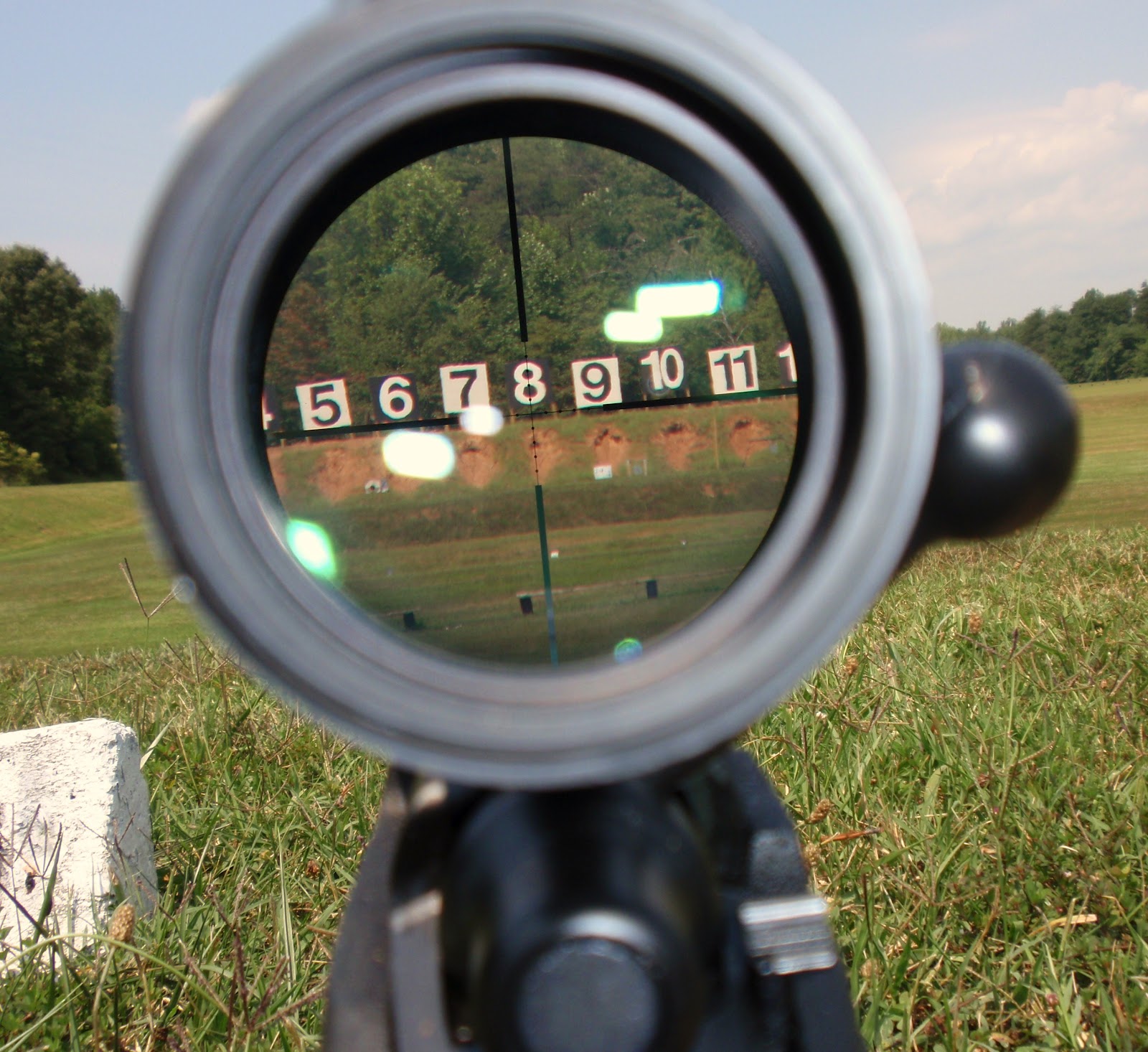
Practice close up. Practice at a distance. If you have never shot long range, you won’t ever forget it, a moment whispered and dreamt about, laid out flat in front of you. In that fleeting moment, you will hold your breath in the presence of power. You count that pulse between heartbeat and breath, compelled into an aesthetic deliberation you don’t quite understand but fully desire, faced for the first time in your living history with something proportionate with your capacity for awe.
Target acquisition is when what you have been waiting for comes from an enormous distance. It sometimes comes directly, sometimes coming as if by magic from no where when you least expect it, giving you a clear view after long dark, days of solitary combat.
My weapons are at rest and dinner is simmering on the stove. Coming up the long road, the sunlight streaming off of it like shining wind, is an SUV, its form and windows giving no hint of what it brings.

Inside, a rescue Lab gives a gentle “woof”, recognizing the sound and what it means before human ears can even hear its echo. We look up through the light, beyond the drive, beyond the wasted years in which we looked, but never really did see.
We stand in the drive as the vehicle comes into view, bringing up an arm in greeting, in that moment between heartbeat and breath.