Category: Gear & Stuff

Categories
How M18A1 CLAYMORE Works
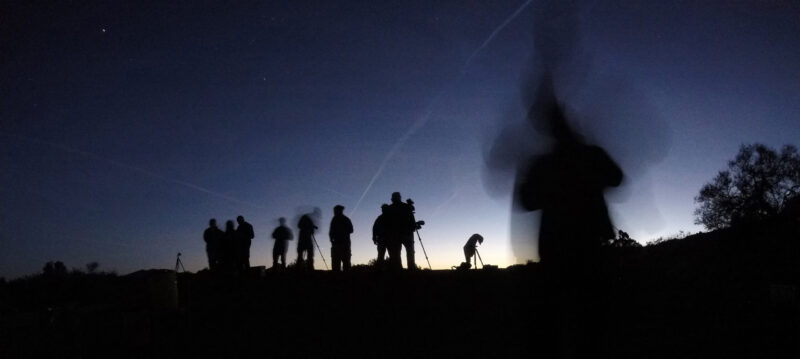
Own the night — knowing a few tricks can help your eyes work much better in the darkness.
Of the five senses, eyesight is arguably the most important, and during potential emergencies, it’s critical. While other senses play an important role, your eyes are absolutely necessary to locate and evaluate threats, maneuver within your environment, use cover to advantage and effectively target your weapon if necessary.
Sight is so critical, yet it has a serious shortfall — it doesn’t work well at night. Though human eyes aren’t as efficient during low light as a cat or raccoon, there are things you can do to maximize your abilities within the limitations of our species. First, let’s look at the physiological facts.
Anatomy 101
The light-sensitive layer of cells at the back of the eyeball is called the retina, the equivalent of the film in a camera. This layer is comprised of two types of cells: rods and cones. The cones require a large amount of light to operate, can distinguish all colors in the spectrum and primarily function during daylight or bright situations. Unfortunately, they are nearly useless at night.
The rod cells serve the opposite function. They incorporate a light-sensitive protein known as Rhodopsin, often called “visual purple,” which activates the rod cells and allows you to see at night. Cone cells can be thought of as a high-quality video camera, while rod cells are essentially low-resolution black-and-white webcam.

The greatest abundance of low-light rod cells are a few degrees off the central axis of the eyeball,
so looking a bit away from your center of attention will actually produce a better image.
Rod (night) vision is not as effective as cone (daylight) vision and only allows you to distinguish black, white, shades of grey and the general outline of objects. Our eyes contain mostly cone cells, concentrated at the rear of the eye where most light falls. The more specialized low-light rod cells are scattered throughout the retina.
Several factors affect night vision. Exposure to bright light quickly breaks down the visual purple and ‘blinds’ the rod cells until the protein regenerates. Rhodopsin is chemically related to vitamin A, so a deficit of this vitamin can decrease night vision. Illness, headaches, fatigue, drugs, alcohol and heavy smoking also reduce your ability to see at night.
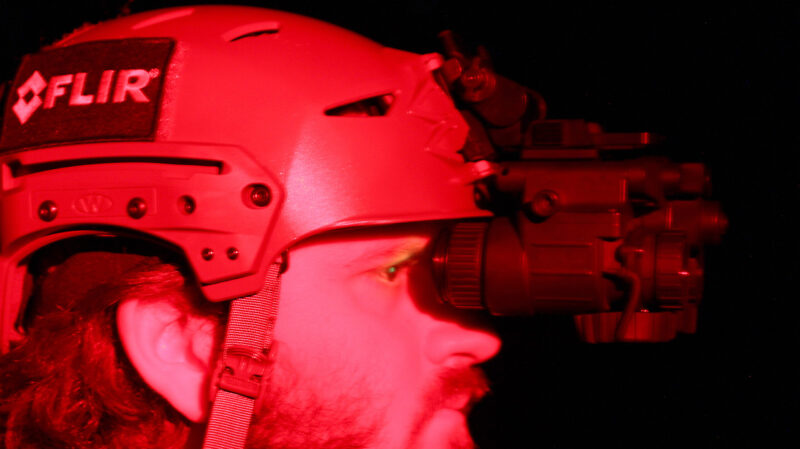
Thermal imaging devices literally highlight warm objects, but they are also bulky, delicate, depend on batteries
for power and are incredibly expensive!
In The Dark
Most folks already realize night vision does not start working immediately after the lights go out. It takes about thirty minutes for the rod cells to produce enough visual purple to reach maximum effectiveness. Thus, if you know you’re going to be operating in low light, it is important to spend at least a few moments in the dark before setting out. If you can spare 20 minutes, your night vision will be much improved.
One common night-vision-killer is your vehicle’s interior lights. Opening a door instantly leads to a flood of white light, which quickly ruins your night vision. Fortunately, there are workarounds.
You can purchase red or blue interior bulbs, use red lens-repair tape from an automotive store or remove them altogether. Fortunately, most relatively new vehicles have a switch to disable interior lights.
Leaving the interior lights off is standard procedure on police and military transportation and isn’t a bad idea if you feel like you might reasonably encounter 2-legged danger around your vehicle. Risky situations aside, this is also a smart idea for avid hunters, pre-dawn anglers, morning joggers or anyone else traipsing about during the darkness hours. If you need the interior lights to find your lost glove, you can always turn them on!
Putting a filter over the lens of a flashlight is great for protecting night vision when you don’t need a strong burst of light. Many flashlights of the ‘tactical’ and hunting variety do so, while most small Everyday Carry (EDC) lights do not. This problem falls into the category of “Do the best you can with what you have on hand.” I’ve found a fat finger or two makes a nice, adjustable, improvised low-light filter. But be careful, as some LED lights get quite hot!
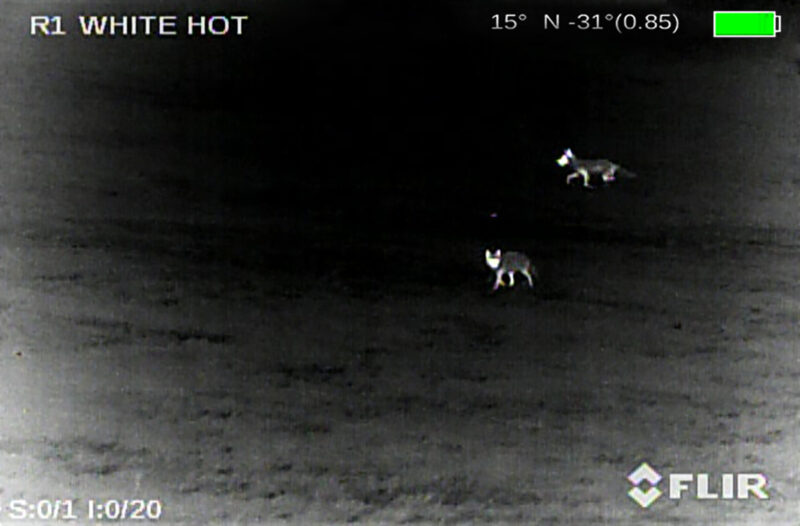
You’ll never have the night-vision of a coyote but by using some of the techniques mentioned, you can operate effectively
at night without thermal imaging or light-intensifying devices.
Sight Tricks
Even without artificial light, there is usually enough ambient illumination for your eyeballs to work to some degree or another. Rod cells are not located in the center of the retina — the most dark-sensitive region is located six to ten degrees off-axis. This is why the technique of “Off-center vision” works. For example, if you want to examine someone’s face in the dark, you will need to look at their ear. When evaluating a landmark or object, look several feet left or right of it. It takes some practice, but you will be amazed at how well this works.
You must also “scan” with your night vision. Even in dim light, the visual purple eventually bleaches out within 4 to 10 seconds, causing individual rod cells to cease functioning. To compensate, simply shift your glance every few seconds and avoid staring. You have probably noticed that the harder you stare at something in the dark, the more it will seem to float and jump and finally disappear. This is due to the degradation of visual purple.
While electronic night vision devices have evolved to the point where darkness doesn’t pose any substantial hindrance, the old Mark I eyeball is still less bulky, easier and much faster to deploy. Practice these techniques, and you’ll be surprised at how well you can “own the night.”