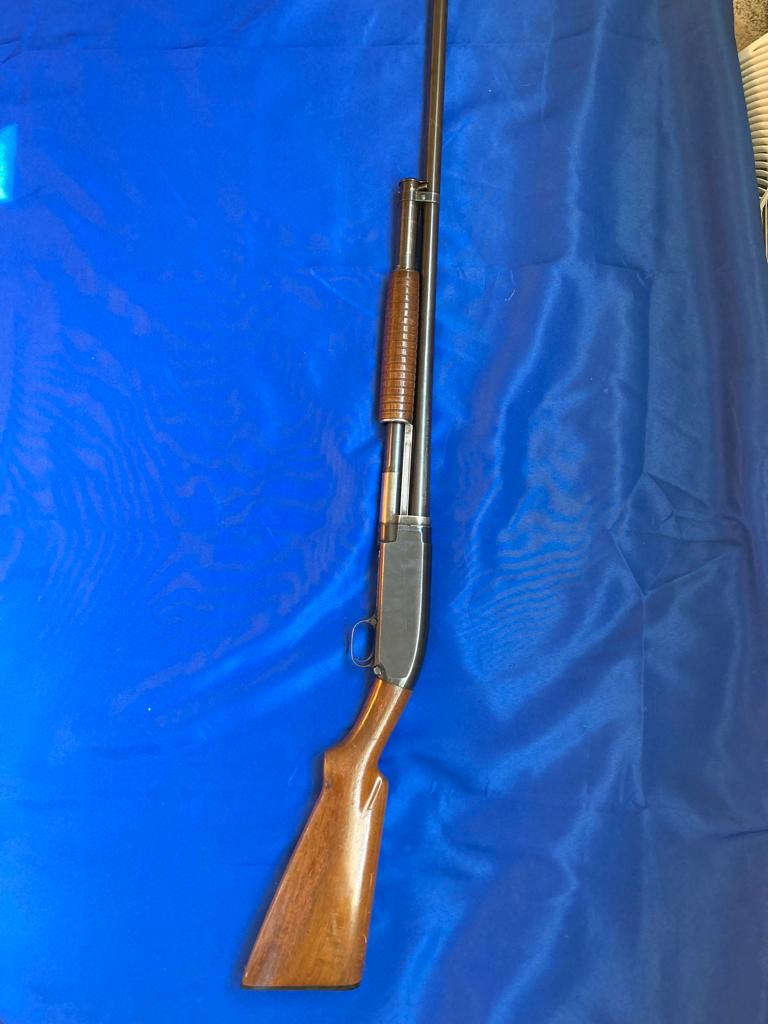
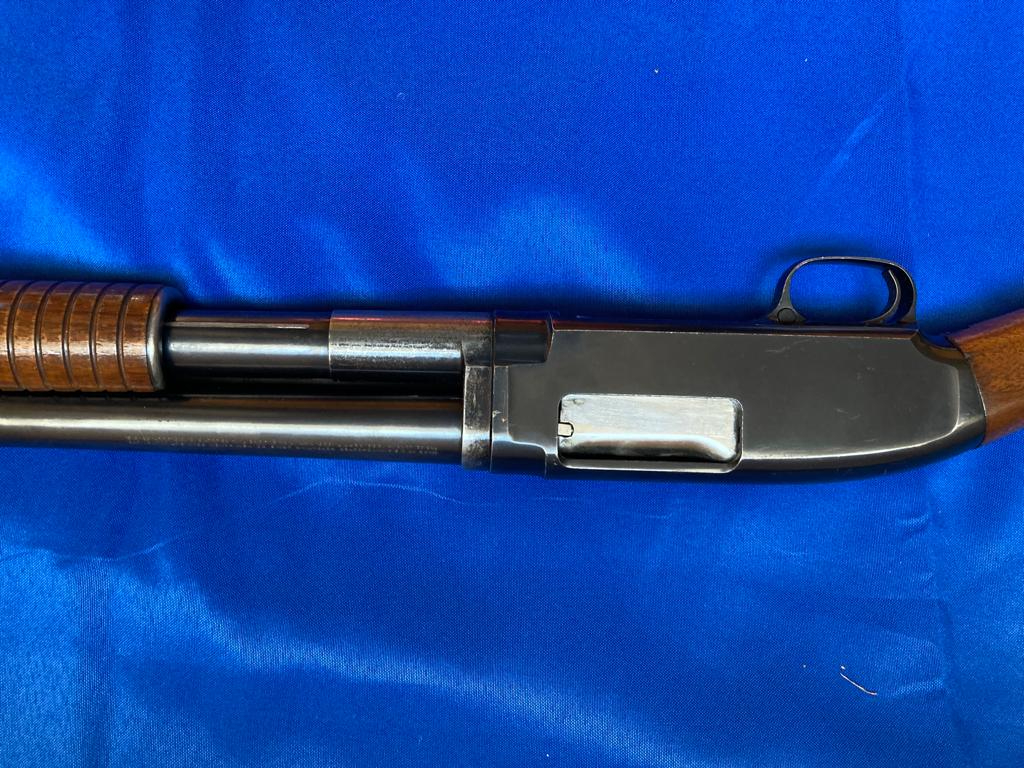
Its an upside down Winchester Model 12 30″ Full Choke Barrel in 12ga
Its an upside down Winchester Model 12 30″ Full Choke Barrel in 12ga
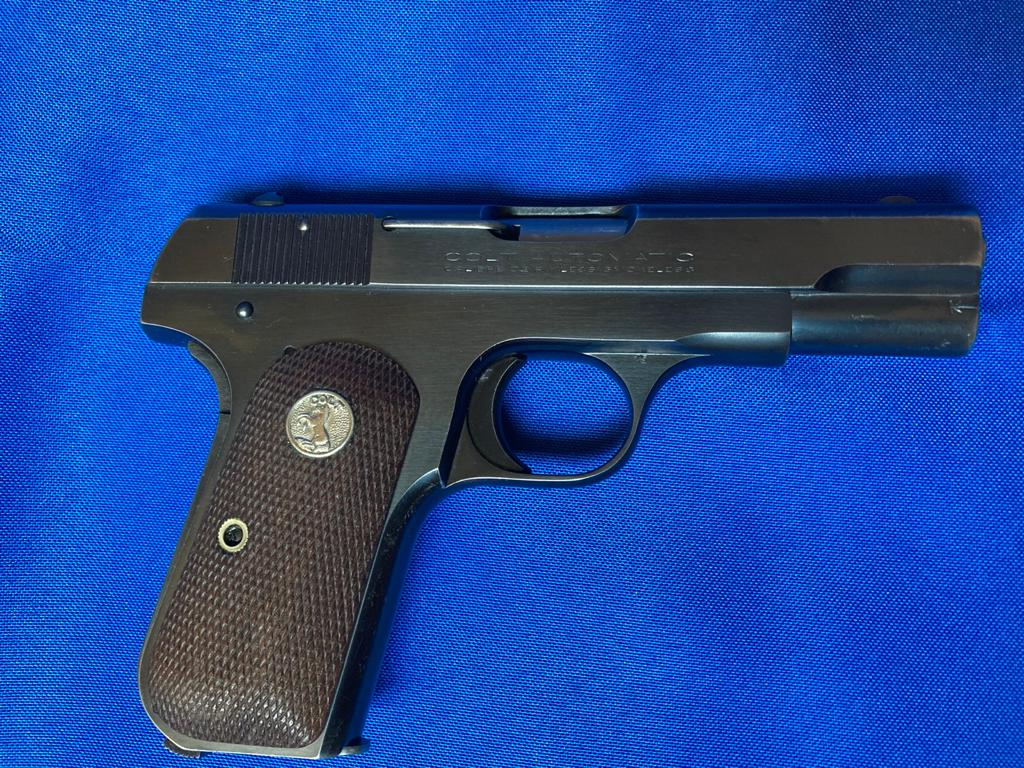
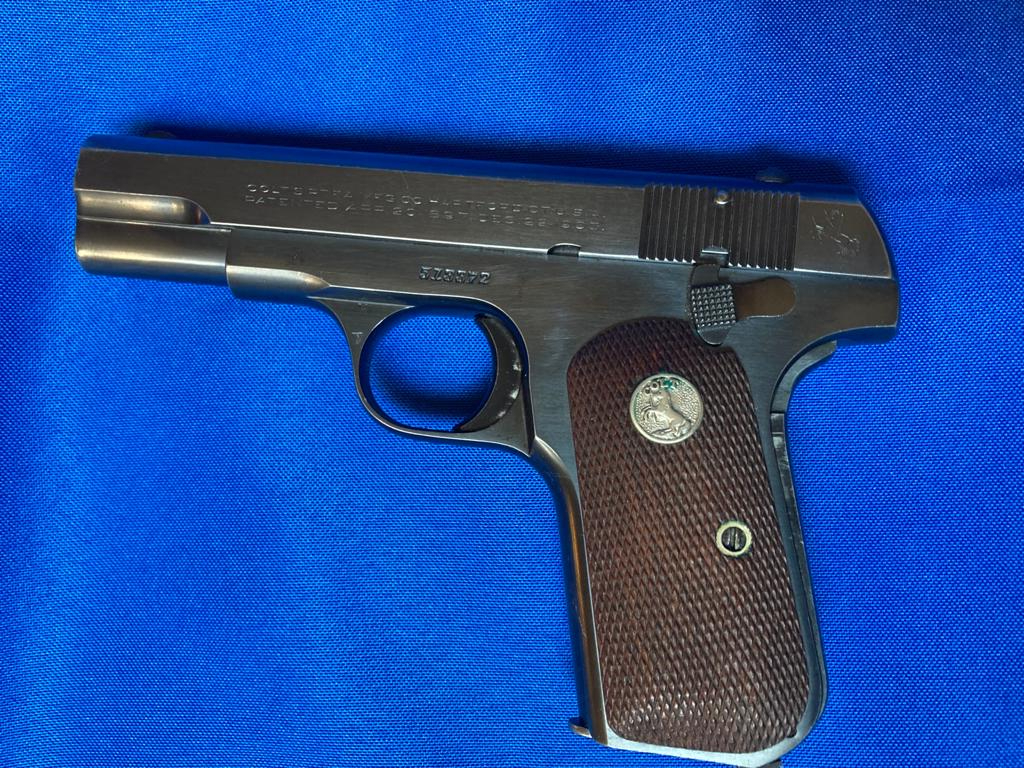
Its a Colt Model 1903 Pocket Hammerless in caliber 32 ACP Pistol / .32 Auto (7.65 Browning)

Carrying a single-action revolver for self-defense isn’t a choice to make without considering all the drawbacks
of this venerable — but certainly outdated — pistol. Photo: Clayton Walker
[Editor’s Note: Countless stories and articles have debated the practicality of carrying a single-action revolver in the modern world. This fictional piece aims to personalize the decision and spark thoughtful discussion.]
Eli Turner didn’t intend to be an anachronism. He just liked his tools made from steel and soul, things considered time-worn traditions and things that looked good tucked inside sweat-stained leather.
That’s why the gun on his belt was a Colt Single Action Army, .45 Colt, four-and-three-quarter-inch barrel, black factory grips and the faint silver holster gloss that only comes from years of quiet devotion.
People noticed. A few of them admired him, but most scoffed behind his back.
Eli didn’t care. When he pressed the hammer back with his thumb and heard the four distinct clicks — C-O-L-T — it felt like he was hearing history. For a man who’d spent most of his life secretly believing he had arrived 150 years too late, it meant something.
Still, he knew history had its limits, but did it really matter? He’d soon find out.

Eli told himself there were advantages to his choice.
The big-bore single-action is simple in a way modern guns forgot how to be. No safeties to manage, no decocking lever, and no magazine to secretly unseat and turn the gun into a “none-shooter.” The Peacemaker either worked or it didn’t.
His Colt was dead-on reliable, digesting blunt-nose .45 Colt loads like a farm mule: slow, steady, unstoppable.
Eli knew that if he drew the gun, cocked the hammer and aligned the fixed front blade, the next thing to happen was going to be loud and very persuasive. To him, there was something undeniably grounding and even a bit thrilling about carrying such a piece of history. For these reasons and more, he intentionally chose to be a relic.
However, late one Tuesday night outside a gas station, romance met reality.
Eli wasn’t looking for trouble but trouble came looking for him. He had stopped for gas while visiting Capital City when a man jumped from behind the dumpster in the parking lot. He had a cheap but large knife in hand and was shouting something about Eli’s wallet. Eli was momentarily stunned and shocked at the sudden appearance of real danger, but practiced instinct took over.
He reached for the Colt.
In the place where theory intersects practical application, he began to see the problems that come from relying on nostalgia.
His presentation was fumbly as he tried to get the big gun out of its shuck hidden under his jacket. He soon discovered thumb-cocking a single-action revolver while your heart is hammering harder than a boilermaker is anything but graceful.
His thumb actually missed the hammer on the first attempt—slicked by adrenaline, not sweat — and by the second attempt, the knifeman had closed the gap.
Time turned to cold molasses. The robber had seen the big Colt, but his meth-soaked brain hadn’t yet registered the danger.
When the attacker was only four steps away, the Colt barked with a familiar boom — though it seemed weirdly quiet, almost like a squib to Eli — and the mugger stumbled back, suddenly remembering urgent business elsewhere. He made it about 50 feet before wobbling unsteadily for a moment and then collapsing near the street.
Turns out he was fortunate the gas station happened to be less than a mile from a big city Level 1 trauma center.
The 285-grain Keith-style slug driven by 18.5 grains of IMR #4227 — just as specified by John Taffin in American Handgunner Magazine — had done awful things to the chest cavity with the slightly right-of-center hit and missed both the heart and spine.
Mr. Meth Man would survive, partly by luck of the draw and some very skilled doctoring, but he’d need to seriously reconsider his life choices after leaving the ICU a week later.

After all the resulting hullabaloo and a six-hour interrogation at the police station, Eli was released as his statement, the witnesses and the gas station video cameras all agree he was defending his life when he fired the one shot.
However, on the drive home, he had over an hour to think about how the confrontation had gone down. The slow presentation and missing the hammer on the first attempt really bothered him. He also wondered if he actually meant to only fire one shot.
He wondered if maybe the old-timers had steadier hands.
“Maybe they also died more often,” the other side of his brain responded.
Over breakfast the next morning, Eli pondered the Colt (still in police custody as evidence), but this time without the sepia nostalgia filter in place.
He kicked around:
• Considerable weight, length and bulk to carry and bring to bear.
• Six rounds — five, actually, if you’re doing it safely with non-transfer-bar models.
• Slow reloads under the best conditions and virtually impossible under fire.
• The sights, which were questionable at best when compared to virtually any modern design.
• One-handed cocking required practiced dexterity.
• A long hammer travel increased lock time and could increase the effects of shooter flinch.
He thought about the guys he knew who carried Ruger Vaqueros and Blackhawks on camping trips — big men with big hands who loved the guns — but he knew they generally carried another, more modern pistol for the daily “just in case” stuff.
The truth was unavoidable.
A single-action revolver worked beautifully … unless you needed to run it at the speed of survival. It then became a complex test of nimbleness rather than an optimized tool for defense.
He knew, and had experienced firsthand, that in a real fight you don’t want a test — you want a cheat code, full stop. A black polymer gun didn’t feel anywhere as “honest” to Eli, but it became clear why the “plastic fantastic” had become the modern standard for CCW.

Artificial Intelligence isn’t. Brent asked AI to produce a photo illustration of a single-action revolver in a concealable belt holster and this was the result. On the other hand, it shows that even the world’s most sophisticated computers had trouble finding a good example of a concealed SAA holster!
Eli knew why he loved the SAA in the first place: a single-action forces discipline. It rewards deliberate action and demands respect. And, there is the whole history and nostalgia thing.
He now realized carrying one isn’t stupid — but it is specialized. If you train with it, understand its limits and accept that you’re using a tool built for a time 150 years ago, it can still serve. Plenty of folks in the backcountry trust single-actions for protection against dangerous critters, and they have saved many lives.
But for everyday self-defense?
Eli finally admitted the hard truth to himself: He liked the Colt because it felt like a handshake with the past, not because it gave him the best odds in the present. Now, he knew in the hard, cold light of life and death, survival is the only result that actually counts, and his odds were better with a more modern choice of handgun.
The next day, before heading out, Eli went to his safe and took out a modern 9mm polymer magazine-fed pistol with a red-dot optic — lightweight, high-capacity, fast to reload, quick to sight and embarrassingly practical.
Are they dull? Yes, but sensible? Eminently.
After it was given back to him six months later, Eli didn’t retire his Colt out of shame. He kept it because it had earned and deserved respect, even if it didn’t now ride his belt every day.
Eli still shot his trusty six-shooter on weekends, feeling the weight of each deliberate shot. Every time, he smiled. The romance wasn’t gone, but it wasn’t going to be the first choice for social emergencies anymore.
 Nothing in life is perfect — and this is especially true with a sight picture with iron sights. For centuries, iron sights — also called open sights — have been the de facto device for aiming both rifles and handguns. If you take one thing away from this how-to on irons sights, it should be this: focus on the front sight. If done correctly, the rear sight and the target will both be fuzzy — and that’s okay. Like I said; nothing in life is perfect.
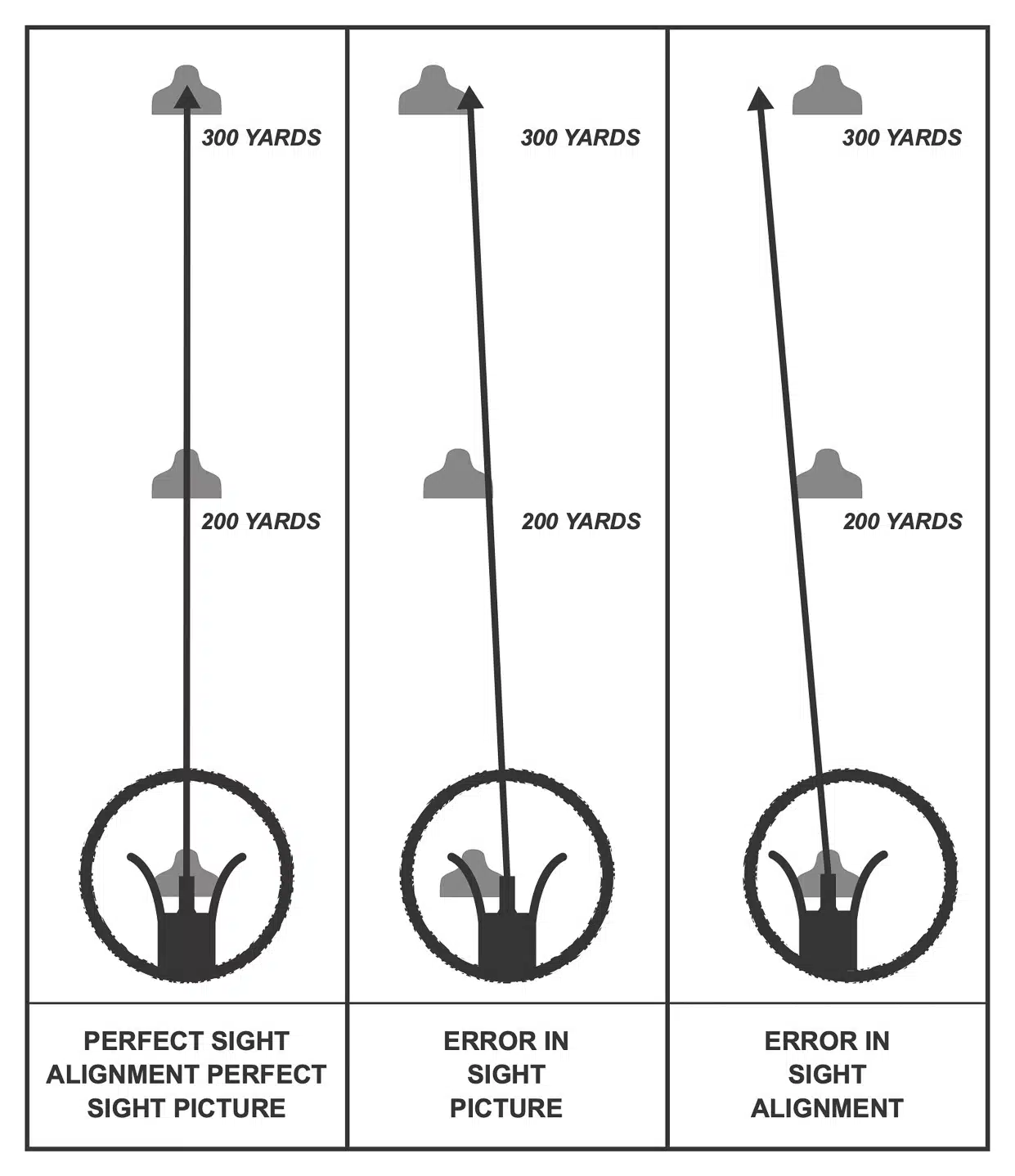
Let’s discuss handgun sights first. While there’s a wide variety of iron sights, all have the same primary features: a rear sight with a notch in it, and a front post that’s aligned in that notch to aim the pistol.
The rear notch can range from a square notch to a V- or U-shaped notch. On a handgun, in many cases there is a dot — either painted white or luminescent — on either side of this notch. The dots help the shooter more quickly locate the rear notch (and align the front sight).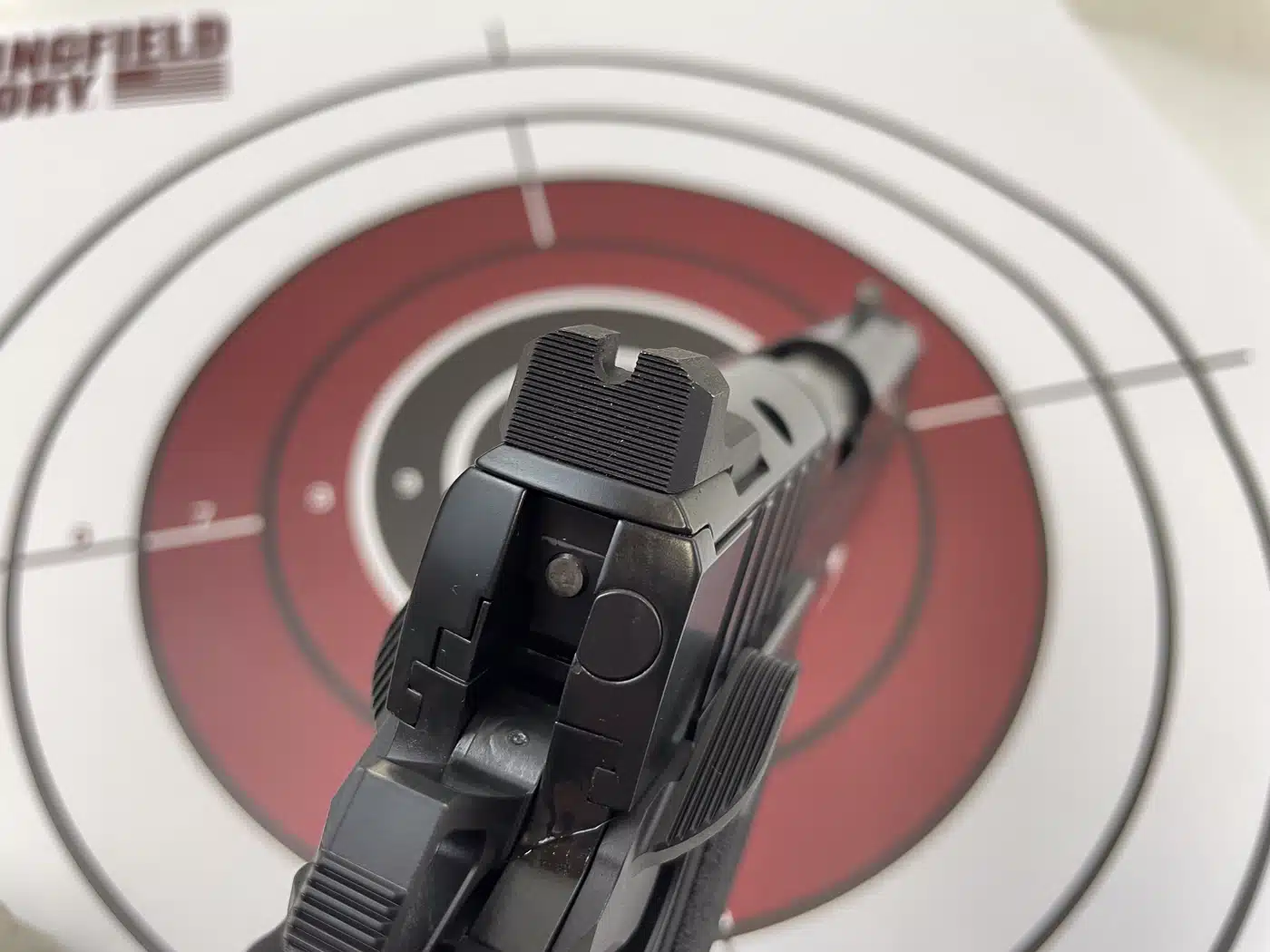
Rear sights on handguns can be fixed or adjustable. Adjustable sights are usually found on target handguns and allow the user to adjust windage (left or right) and elevation (up and down) via a turn of a screw.
Fixed sights are just that fixed. Most can be drifted left or right to adjust windage (unless it is machined directly into the slide of the pistol), but most come from the factory adjusted to hit anywhere from 10 to 25 yards depending on the size, caliber, and type of pistol. The front sight post can be plain, or have a dot or a bead.
Rifle sights are similar, but different. The rear sight on an AR-15 and M1A is typically an aperture sight, also called a peep sight. This is a disc with a hole in the center. Usually, the rear sight can be adjusted for both windage and elevation.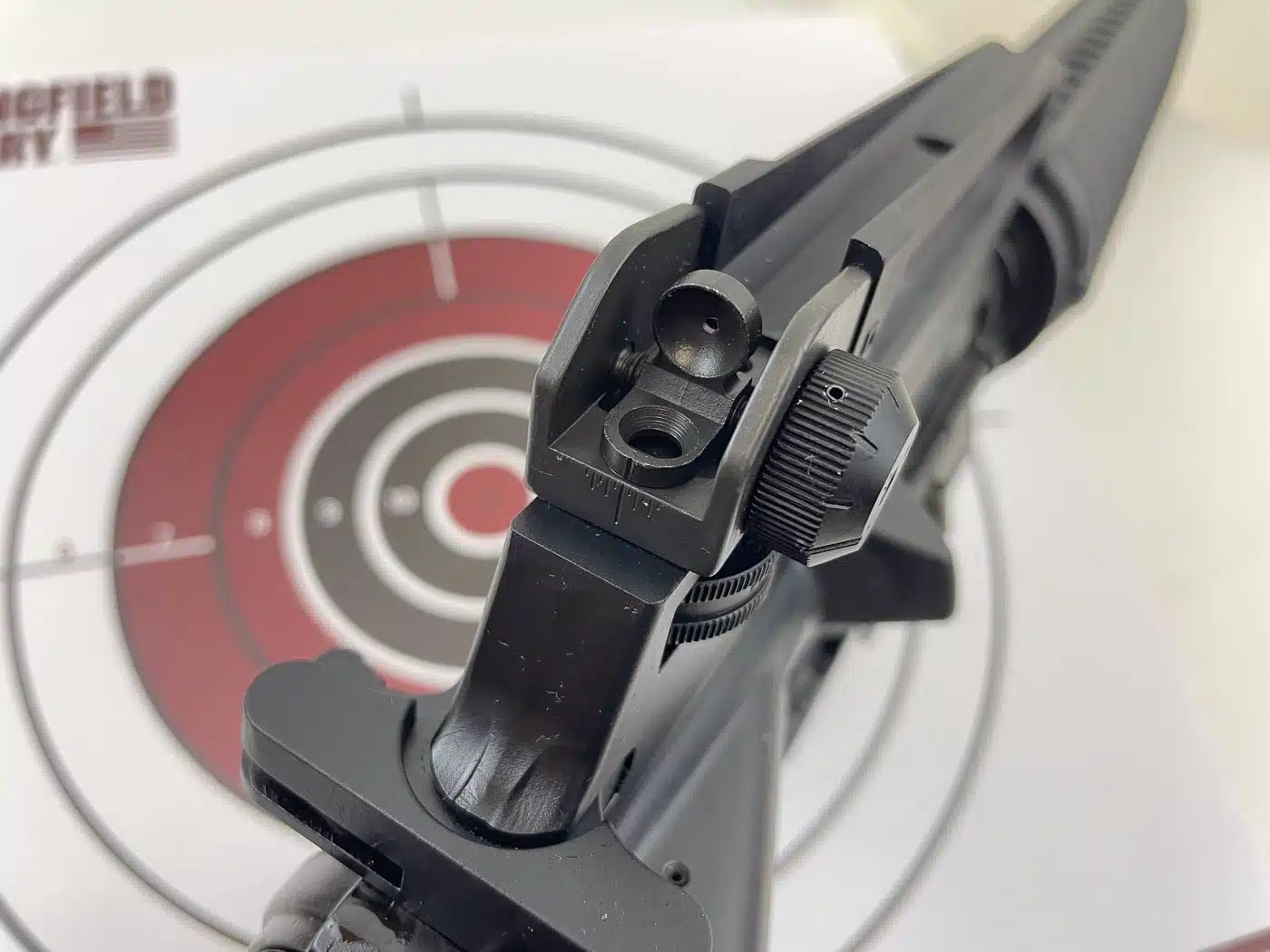
On some AR-15 rifles, there are two rear aperture sights; one with a small hole and one with a larger hole. The small hole rear aperture sight is used for normal shooting while the large aperture rear sight is used for close quarters when fast target acquisition and a larger field of view is needed. The front sight is typically a post.
On rifles like the M1A and AR-15, there are protective wings on either side of the front post to protect it in the event the rifle is dropped. The wings ensure the post is unscathed during an accidental drop. On an AR-15, the front sight can typically be adjusted for elevation.
Now that you know a front sight from a rear sight, let’s discuss the sight alignment process.
The key to aligning open sights on a handgun is to align the front post in the notch of the rear sight. The top of the front sight should be flush with the top of the rear sight. That’s where the “equal height” part comes in.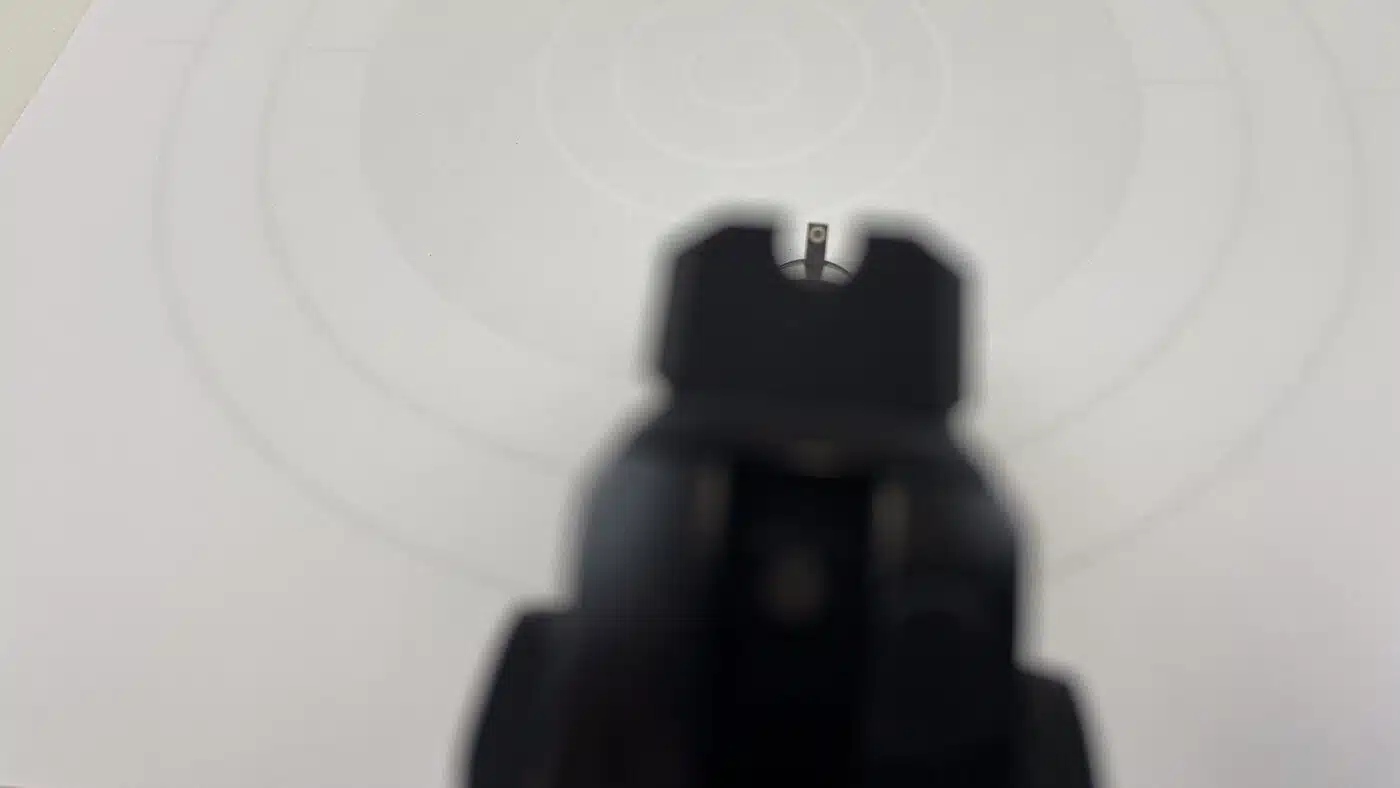
Next is to ensure the front sight post is positioned in the center of the notch. The “equal light” phrase means there should be the same amount of space or light on each side of the front sight post when it is aligned in the notch.
I know this may sound complicated, but once you understand the concept, sight alignment happens ultra-fast. In a rifle, the process is basically the same. The shooter looks through the rear sight aperture and centers the top of the front sight post in the center of the aperture.
Now that you know how to align handgun and rifle open sights, let’s talk sight picture.
What does “sight picture” mean? Sight picture is when the shooter aligns the sights while focusing on the front sight and placing the front sight on the target. This is the “imperfect” part I mentioned since, while the front sight is in clear focus, the rear sight and target are fuzzy or even blurry.
Don’t be bothered by the fuzzy rear sight and target. Our eye can only focus on one thing at a time when aiming a gun, and when aiming with open sights there are three planes our eye is using: one at the rear sight, the second at the front sight, and the third is the target. Remember to focus on the front sight.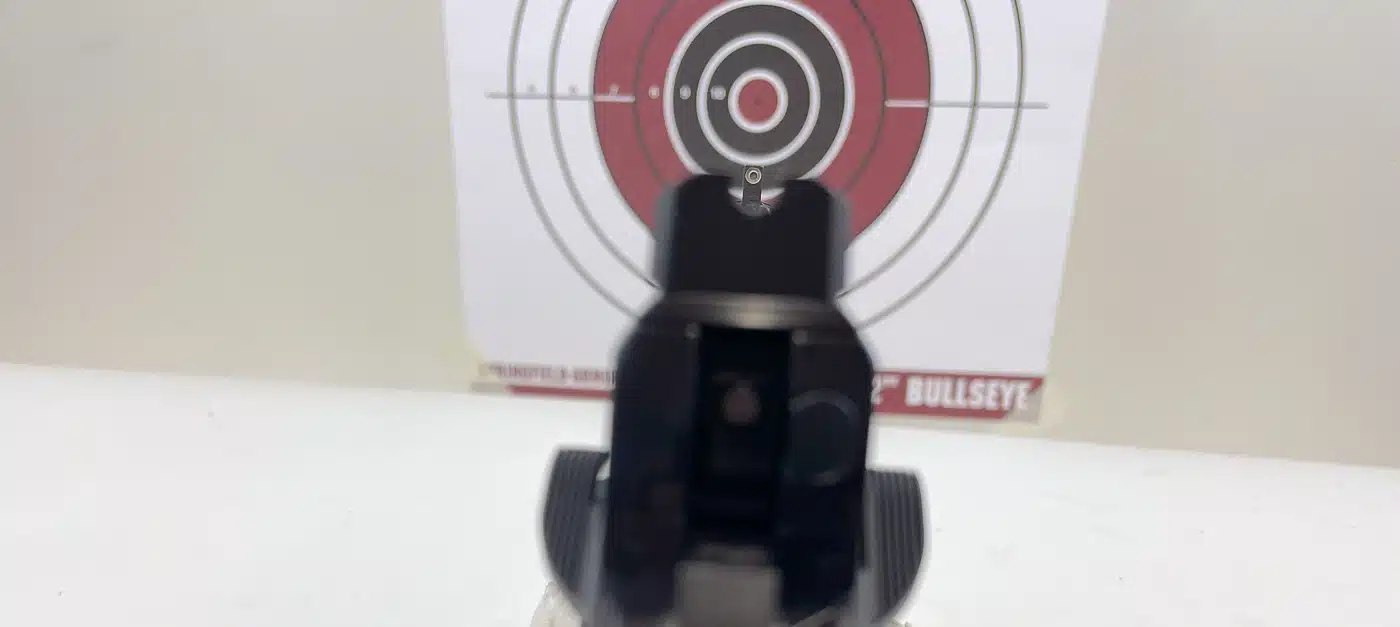
There are different types of sight picture depending on the spot where you place the front sight. For instance, a center-of-mass sight picture is when the front sight is placed on the target so the bullet strikes the exact point of aim.
Aim at the middle of the target, and (if you do your part) the bullet will hit the middle of the target. Center-of-mass sight pictures are typically used in defense and combat shooting, and generally speaking most fixed sight handguns will shoot center of mass.
A six o’clock hold is when the front sight is placed just below the desired point of impact, and the bullet’s point of impact is the center of the bullseye. A six o’clock sight picture is usually used by target shooters who have adjustable sights on their firearm and can adjust the point of impact to be slightly above the aiming point.
This approach allows you to see the desired targeting point more clearly (rather than obscuring it behind the sights). In my opinion, if you conceal carry for defense, the center of mass method should be used.
Now that the sights are aligned and you have a sight picture, you are ready to fire the shot. This is the tricky part. With a firm grip on the handgun, press the trigger back while keeping the sights aligned and holding the sight picture. Assuming there are no jerks or flinching, the shot should hit according to your sight picture.
Sight picture and point of impact are dependent on the ammunition used. Try shooting center of mass at a specific distance and see where the bullet impacts. You may need to adjust your sight picture depending on where the bullet hits when using fixed sights; with adjustable sights, you will be able to dial in the hits to your sight picture as needed.
Sight alignment is crucial. At close distances like 10 yards, sights that are not perfectly aligned will have minimal effect on point of impact. At longer distances, as with rifle shots at hundreds of yards, a small error in alignment will cause the shot to miss dramatically.
In today’s age of optics, a red dot on a handgun or a scope on a rifle are so common that you might ask if it’s even worth practicing with open sights. Here’s why — batteries die, lenses crack, and optics can come loose. When it comes to a defensive firearm, it’s simply sound reasoning to have a back-up in case your technology fails. In that case, open sights can save the day.
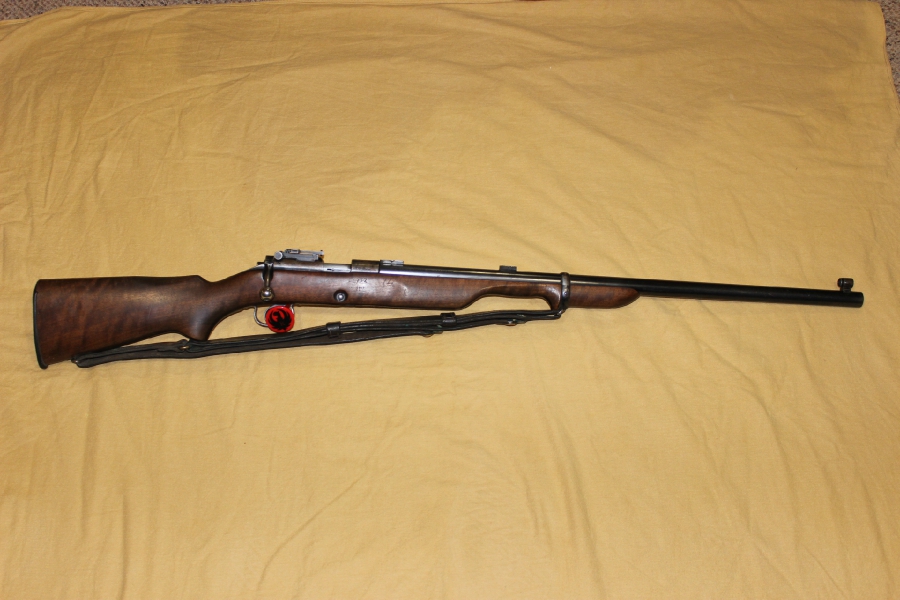
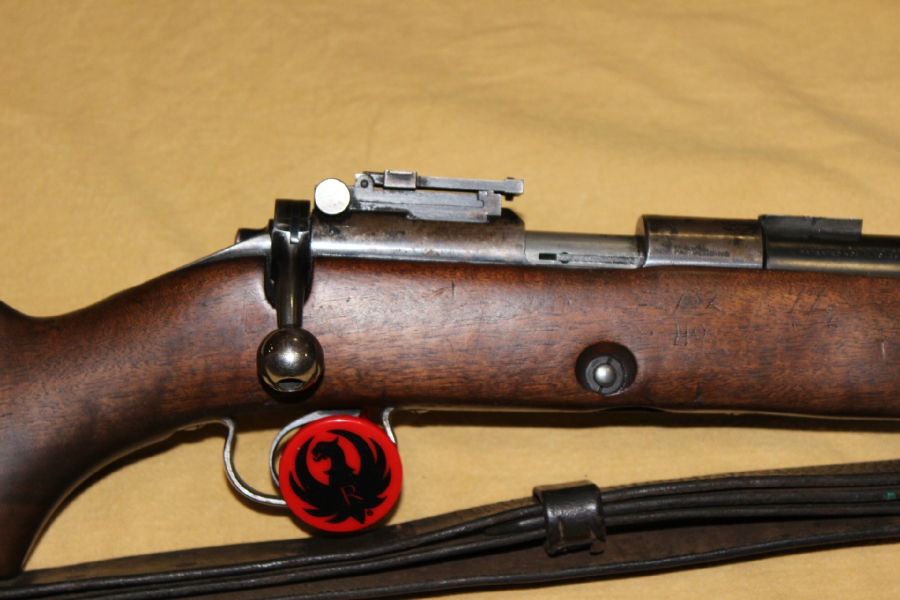
Its a Winchester Model 52 Heavy Barrel Target Rifle w/Win 82A Sight in .22 LR

