
Categories

WRITTEN BY JOHN CONNOR

It happened again, and I can’t stand it anymore — the muffled whispers and furtive pointing; the sidelong slitty-eyed glances and snide snickering. I have to confess; get it off my chest and out in the open: I don’t shoot by The Book!
I was at another GunWriter Group-Grope — one of those wingdings put on by arms and ammo makers where a buncha real gunwriters and a couple fellow hacks like me are invited to burn up a ton of somebody else’s ordnance and fondle their firearms.
Anyway, I was merrily makin’ mayhem on innocent cardboard targets when, once again, I became aware of weighty stares and rancid repugnance radiatin’ from an assembly of The Anointed. They were horrified at my heresy. See, I don’t worship at any particular Temple of Technique or follow any “School of Shootery” du jour. I have what I call “evolved practices,” born of experience, and they’re still evolving. But in the eyes of the Keepers of The Book, my sins are many and mortal, it seems.
In an attempt to avoid co-pay costs for sessions on a shrink’s sofa, maybe I’ll just spill my guts to you guys …
The Seven Deadly Sins
I don’t do “tactical speed reloads” with pistols or mag-fed rifles. I don’t hit the mag release and kick empty magazines out on the deck with my weapon hand while reaching for a fresh one with the other. I do “sure & certain combat reloads” as fast as I can without fumbling. That means keeping an unchanged granite grip on the weapon, hitting the mag release with my off-hand and assisting that empty mag out if necessary. Then I’ll fetch a fresh mag and shove it in.
Yeah, I know. This might cost you critical points in a match. But in my experience, doing otherwise could cost my life in a fight. Pristine mags should fall free from a clean mag well, but just add mud/blood/beer, sand/sludge/grit, twisted positions or damage to the equation, and “drop-free” mags often don’t. I could practice “tactical speed reloads” just for matches or to “fit in with the boys,” but I won’t, because I know me under fire, and I want just one absolutely reliable reloading drill in my head when somebody’s trying to blast my butt off.
My slide release ain’t a “slide release,” it’s a “slide STOP.” I don’t thumb that lever to feed first rounds on reloads. I crank the slide back briskly to its limit either overhand or “slingshot style” because I want that slide driven home under full spring-plus-paw power. Again, it’s all about keeping that granite grip, plus absolute certainty the round is fully chambered and the slide is in battery. It ain’t slick and stylish, but it’s survivable. If you can chew gum, whistle and play with your GameBoy whilst shooting for your life, good for you. I can’t.
I don’t “ride the safety” on a 1911, keepin’ it held down with the master thumb to prevent it from bein’ bumped up and engaging unintentionally. I confess I never heard much about it until recently, but I’ve read several experts’ opinions that this practice separates the pros from the poseurs.
I guess I’m a heavily-experienced poseur. Riding it just doesn’t work for me. If I use too high a thumb-over-thumb grip I lose rigidity, and I’m not installing shelf-sized safety levers. Maybe a tad wider than standard, OK. I like my slides slick and “service-issue” for all kinds of clumsy Neanderthal reasons.
Plunging Into Purgatory
I am a profligate expender of ordnance, operating under the premise if anything needs shootin’ once (besides game) could probably benefit from a barrage of bullets until its inherent threat potential is absolute zero. Kinda like the difference between water “kinda-sorta-maybe conditionally” freezing at 32 degrees Fahrenheit, versus complete cessation of quantum activity at minus 459.6 F or zero Kelvin. I’ve seen too many guys who were “technically dead,” but who apparently didn’t receive their termination telegram, so they kept fighting. That kinda thing scares me.
I respect my own Fear Factor. For me, the quicker that dude is deader, the sooner I’m less scareder.
I don’t like feather-light triggers that “break like a thin, glass rod.” Not on firearms for Serious Social Work anyway, so I avoid them entirely. I want to know when I’m “on” that trigger, and it will require deliberate pressure to go bang — not when Adrenaline Overdrive decides to drop the hammer for me. What I want is a clean break after a tad of take-up. So I’m not a connoisseur, so crucify me, OK?
I’m not a straight-up shooter. The Book says a handgun should be held at zero vertical and, as much as possible, zero horizontal. I think this sprang from the days when first, shooting positions were dictated by geometry-driven military martinets, second, when a lot of pistols wouldn’t feed and function when held off-axis, and third, when all training and practice shooting was done on black-ball bull’s-eye targets.
It made for a prettier sight picture — but I’ve never had to fight a bull’s-eye target. Two-handed or single, strong or weak hand, I shoot best when side-canted about 10 to 15 degrees. You might shoot better that way too, but watch out for angry mobs of The Anointed bearing pitchforks, tar and feathers.
I don’t “index” nice, or “UTM” per usual. When you’re not actually “tappin’ the trigger with intent to pop caps,” your index finger is s’posed to be rigidly extended straight along the frame. Mine doesn’t “rigid” very well, and “straight” went off the table with some fractured mitt-bones and nerve damage a while back. The tip of my crooked trigger finger parks on the side of the triggerguard in Condition Orange, and it’s on the trigger in Condition Red. Note: I go Red real easy (another reason for favoring sorta stout service triggers).
Dang, I feel so much better now! And I didn’t have to lay on a couch or pay a guy in Gucci loafers to listen to me!
Connor OUT
One of the best wild survival tactics. pic.twitter.com/aT8IlXrECO
— Learn Something (@cooltechtipz) October 3, 2023
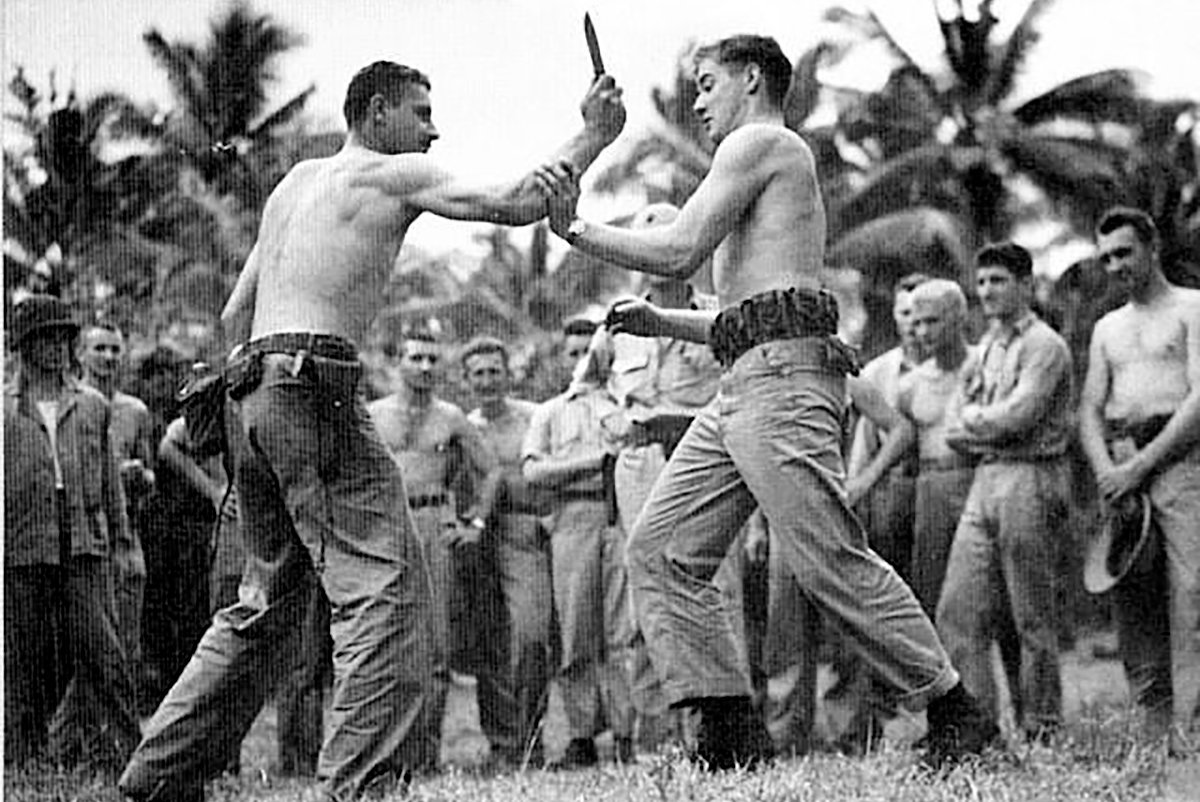
Marine Raiders practice knife-fighting techniques during World War II. US Department of Defense photo.
Whether armed with aircraft, rifles, or just their hands, Marines are renowned for being tough and capable fighters. The Corps’ lethal reputation stretches back to the days when Marines were tasked with boarding enemy ships, armed only with muskets, blades, and brawn.
The nature of their job as a naval force charged with seizing enemy vessels and conducting small amphibious landings often placed Marines in close-quarters combat. In the 246 years of the branch’s existence, the Marine Corps has worked hard to improve upon those early hand-to-hand fighting skills.
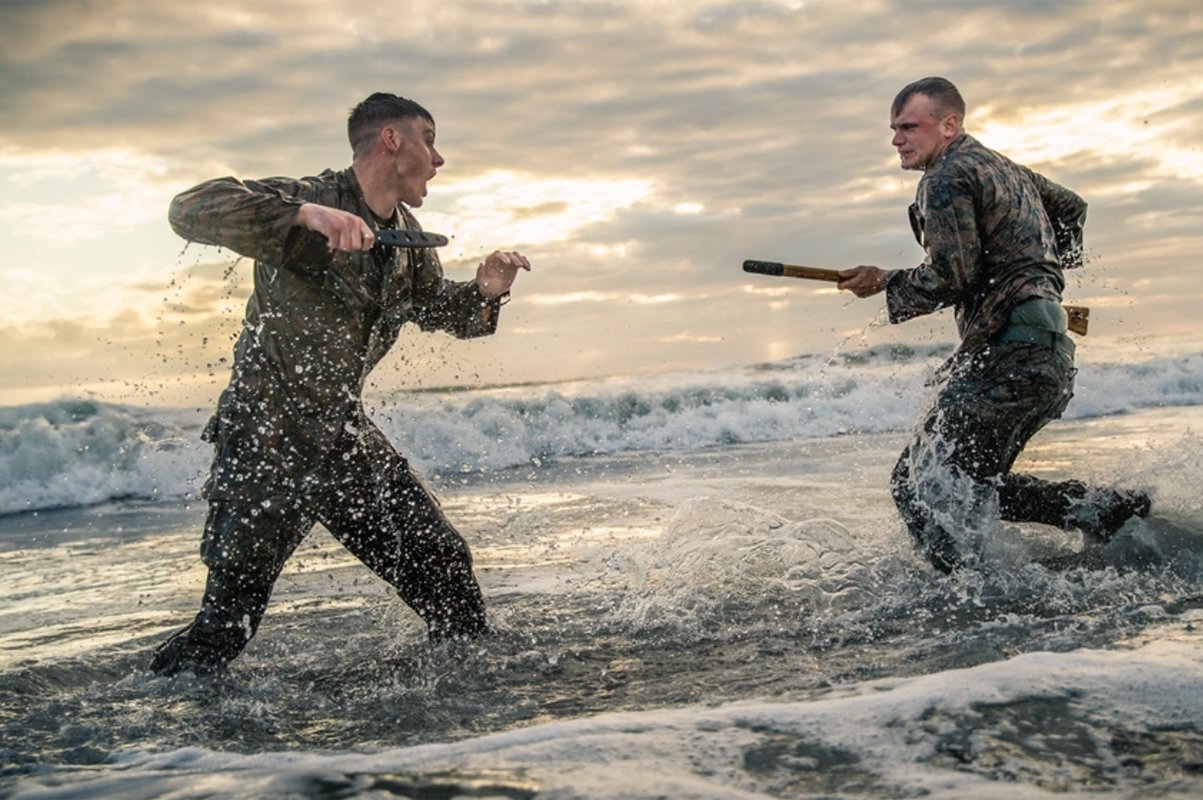
Of all the small wars and major conflicts the Marines have been involved in, few have required such a high level of proficiency in hand-to-hand fighting as the island-hopping campaigns of World War II. Marines regularly found themselves fighting for survival in the cramped quarters of their own foxholes. In order to prepare Marines for the nightmarish scenario, the Marine Corps produced instructional videos with close-quarters techniques for killing the enemy.
In one video titled “Combat Conditioning Series Part 3: Club and Knife Fighting,” Marines are taught things like how to use a fistful of dirt to win a knife fight and how to disarm an opponent using a stick. The video places a heavy emphasis on creativity and an “any means necessary” attitude for winning in hand-to-hand combat.
“To kill your enemy from as great a distance as possible is good sense — and basic to Marine Corps tactics,” text in the video’s intro states. “But a time may come when you will engage him at close quarters and you will have to destroy him hand-to-hand with a knife or a club.”
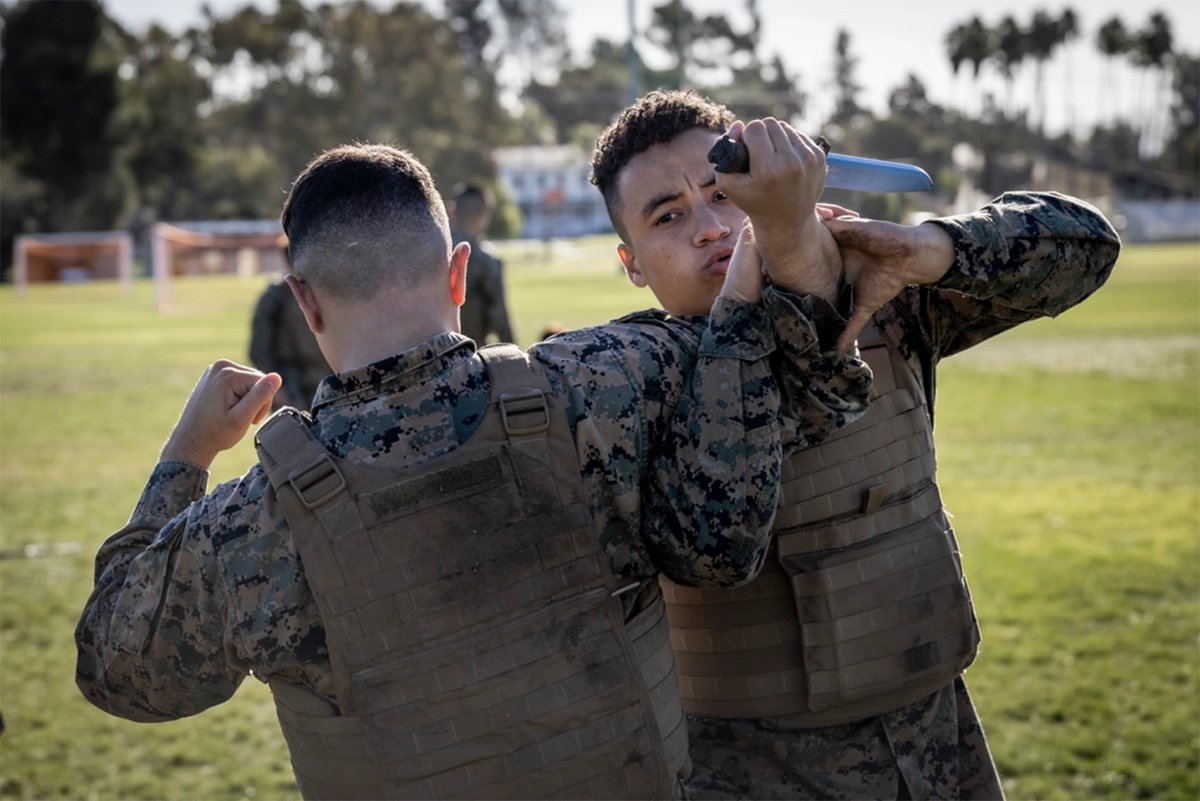
The Marines currently teach the Marine Corps Martial Arts Program, which includes both knife- and club-fighting techniques, but proficiency in these “dirty fighting” skills is not as much of a priority as it once was. Watch the full video of WWII club- and knife-fighting techniques above.
Read Next:
Mac Caltrider is a senior staff writer for Coffee or Die Magazine. He served in the US Marine Corps and is a former police officer. Caltrider earned his bachelor’s degree in history and now reads anything he can get his hands on. He is also the creator of Pipes & Pages, a site intended to increase readership among enlisted troops. Caltrider spends most of his time reading, writing, and waging a one-man war against premature hair loss.
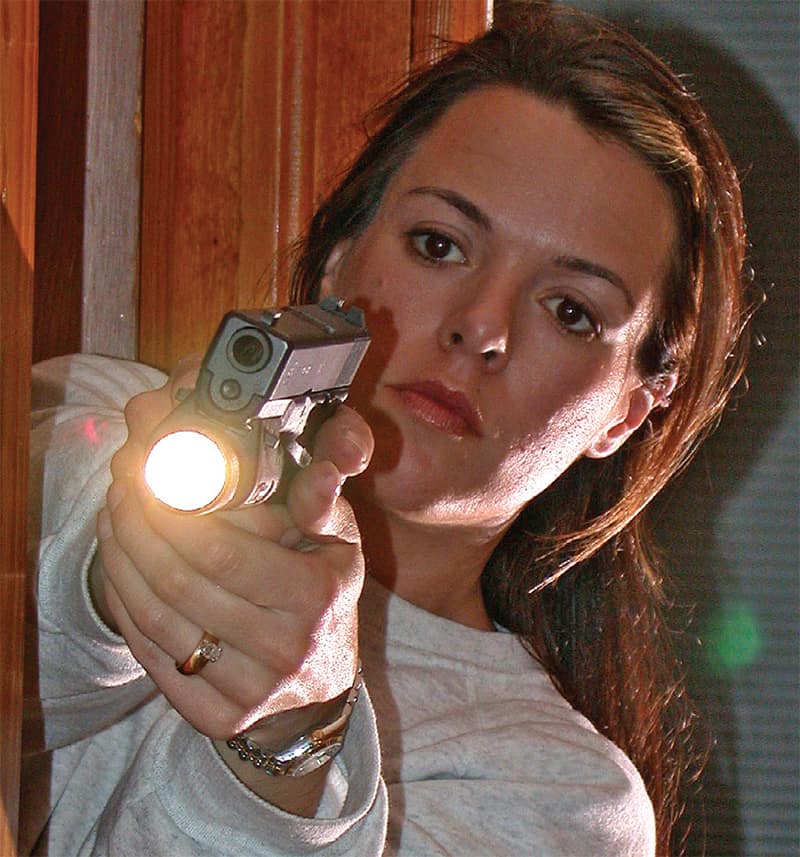
In the beginning there were those newly transferred in from the unwashed masses who for some reason — real or perceived — glimpsed the truth they might need to be responsible for their own well being. For some, this lesson was purchased at great price. They are the few lucky ones, lucky to have survived, but unlucky enough to have been roles players in a real life act of robbery, rape and even murder.
A student, a victim of an attempted kidnapping comes to mind, he recalled, “I shot him with my two-shot derringer and he just looked at me.” He now carries a 1911 with no prompting from me.
From another student: “He broke into my house and raped me in front of my children and it will never happen again… ever.” This female, a true warrior now, shoots a large-frame magnum revolver. And she shoots it very well.
Student three advised, “I came to school because two guys kidnapped my wife and murdered her.” Continuing, he said, “I need to be able to protect myself and my two kids now that I have to raise them by myself.”
For the novice all of this mayhem can seem somewhat overpowering. What gun should I have, what kind of ammunition should I carry? It can be truly mind-boggling.
Review the “who, what, where and when” so to speak of your life. Break your daily life down into where you work, play and move about. By doing so you may be able to develop a plan for your training agenda. If your life revolves around kids, then dismount drills from vehicles — making sure the munchkins do not sling the vehicle doors open into oncoming traffic — is a good thought.
Too complicated you say? I just talked to a woman who carried one child inside and one outside her person while living in Rhodesia. Her driving accessories were an FN-FAL rifle on the front seat of the car and a glove box full of hand grenades. She managed to raise two good kids and is even now a grandmother. And rather an elegant one I might add.
Who you are and what you do will help you to decide how you should train.
You can get formal training and it can be beneficial. Just make sure what you are getting is what you think you need. If you aren’t sure, ask questions from those you’re about to take training from. Just because somebody was in the Army or a cop for 20 years doesn’t necessarily mean you want to drop your personal protection anchor on his or her theoretical expertise.
I just had a guy sit in my house and tell me marksmanship wasn’t as important as tactics. Could be, but if you can’t hit anything when you shoot you won’t need tactical skills. If you buzz a 9mm through the head of your kid being held hostage at the end of your hallway it will probably ruin your day and Junior’s too.
Guns And Gear
If you don’t own a handgun, don’t know anything about them and are truly interested in personal defense, a solid, simple choice is a Glock. I prefer the mid-size Model 19 or 23 in 9mm or .40 caliber respectively. I would avoid vent holes in the barrel. All the latest models come with the built-in light rail so if you want to add a light to your pistol and training, the rail makes it easy.
Buy a good flashlight and consider whether or not a gun-mounted light serves any purpose for you. Buy only high quality lights and consider rechargeable types that may be kept readily available inside the home or vehicle. Streamlight, Inc. is a brand I have used successfully for both hand held and gun-mounted systems.
Blue Light Special
I had two different guns blow up on our ranges in March of 2004 because of people using reloaded and cheap, foreign made ammo. Economy is nice, but some things should not be scrimped on. Should I go on?
Buy good ammunition, Black Hills, Corbon, Federal, Remington or Winchester as examples. You can buy ball for practice and something exotic if you think you need it for personal defense. Buy, test, carry, shoot and use only good ammunition! And as always, while practicing, wear good eye and ear protection.
The Bottom Line
For those interested, a good handgun runs about $570 with night sights. The flashlights (hand-held and gun-mounted) run from $100 to $250 based on features such as recharge capability. A case of 1,000 rounds of 9mm ball is still affordable. So for around a minimal investment you can get good equipment and good ammunition to start your skills development.
Will you be one of the lucky ones? I don’t know, but I believe the harder you train the luckier you will get — and I would rather be good than lucky.
Let me see now. You go into hostile territory by yourself. You know nothing about the enemy. You then enter into a swamp with steel armor on & during a hot humid weather environment. Your fighting skills suck.
Bottom line I think that A. You are an idiot & B. Your chances of winning a Darwin Award are looking mighty good Rookie!
Grumpy
PS It still amazes me that we won the Indian Wars!!
