Categories
Dear Grumpy Advice on Teaching in Today's Classroom N.S.F.W. Other Stuff

A Different way to Look at the Education System

 
Here is something to think about here on National Teachers Day. Sadly it has a lot of truth in it.
 
Image result for national teachers day
 
The most erroneous assumption is to the effect that the aim of public education is to fill the young of the species with knowledge and awaken their intelligence, and so make them fit to discharge the duties of citizenship in an enlightened and independent manner.
Nothing could be further from the truth. The aim of public education is not to spread enlightenment at all; it is simply to reduce as many individuals as possible to the same safe level, to breed and train a standardized citizenry, to put down dissent and originality. That is its aim in the United States, whatever the pretensions of politicians, pedagogues and other such mountebanks, and that is its aim everywhere else. – H.L Mencken Journalist and Born again Cynic
Related image

H. L. Mencken

From Wikipedia, the free encyclopedia
H. L. Mencken
H-L-Mencken-1928.jpg

H. L. Mencken in 1928
Born Henry Louis Mencken
September 12, 1880
BaltimoreMaryland, U.S.
Died January 29, 1956 (aged 75)
Baltimore, Maryland, U.S.
Occupation Journalist, satirist, critic
Notable credit(s) The Baltimore Sun
Spouse(s) Sara Haardt
Relatives August Mencken, Jr.
Brother
Family August Mencken, Sr.
Father

Henry Louis Mencken (September 12, 1880 – January 29, 1956) was an American journalist, satirist, cultural critic and scholar of American English.[1]Known as the “Sage of Baltimore”, he is regarded as one of the most influential American writers and prose stylists of the first half of the twentieth century. He commented widely on the social scene, literature, music, prominent politicians and contemporary movements. His satirical reporting on the Scopes trial, which he dubbed the “Monkey Trial”, also gained him attention.
As a scholar, Mencken is known for The American Language, a multi-volume study of how the English language is spoken in the United States. As an admirer of the German philosopher Friedrich Nietzsche, he was a detractor of religion, populism and representative democracy, which he believed to be a system in which inferior men dominated their superiors.[2]Mencken was a supporter of scientific progress, skeptical of economic theories and critical of osteopathic and chiropractic medicine.
Mencken opposed American entry into World War I and World War II. His diary indicates that he was a racist and anti-semite, and privately used coarse language and slurs to describe various ethnic and racial groups (though he believed it was in poor taste to use such slurs publicly).[3]Mencken also at times seemed to show a genuine enthusiasm for militarism, though never in its American form. “War is a good thing,” he once wrote, “because it is honest, it admits the central fact of human nature… A nation too long at peace becomes a sort of gigantic old maid.”[4]
Mencken’s longtime home in the Union Square neighborhood of West Baltimore was turned into a city museum, the H. L. Mencken House. His papers were distributed among various city and university libraries, with the largest collection held in the Mencken Room at the central branch of Baltimore’s Enoch Pratt Free Library.[citation needed]

Early life[edit]

Mencken was born in BaltimoreMaryland, on September 12, 1880. He was the son of Anna Margaret (Abhau) and August Mencken, Sr., a cigar factory owner. He was of German ancestry and spoke German in his childhood.[5] When Henry was three, his family moved into a new home at 1524 Hollins Street facing Union Square park in the Union Squareneighborhood of old West Baltimore. Apart from five years of married life, Mencken was to live in that house for the rest of his life.[6]
In his best-selling memoir Happy Days, he described his childhood in Baltimore as “placid, secure, uneventful and happy.”[7]
When he was nine years old, he read Mark Twain‘s Huckleberry Finn, which he later described as “the most stupendous event in my life”.[8] He became determined to become a writer and read voraciously. In one winter while in high school he read Thackeray and then “proceeded backward to AddisonSteelePopeSwiftJohnson and the other magnificos of the Eighteenth century”. He read the entire canon of Shakespeare and became an ardent fan of Kipling and Thomas Huxley.[9] As a boy, Mencken also had practical interests, photography and chemistry in particular, and eventually had a home chemistry laboratory in which he performed experiments of his own devising, some of them inadvertently dangerous.[10]
He began his primary education in the mid-1880s at Professor Knapp’s School, located on the east side of Holliday Street between East Lexington and Fayette Streets, next to the Holliday Street Theatre and across from the newly constructed Baltimore City Hall. The site today is the War Memorial and City Hall Plaza laid out in 1926 in memory of World War I dead. At fifteen, in June 1896, he graduated as valedictorian from the Baltimore Polytechnic Institute. BPI was a mathematics, technical and science-oriented public high school, founded in 1883, which was then located on old Courtland Street just north of East Saratoga Street. This location is today the east side of St. Paul Street in St. Paul Place and east of Preston Gardens.
He worked for three years in his father’s cigar factory. He disliked the work, especially the sales aspect of it, and resolved to leave, with or without his father’s blessing. In early 1898 he took a class in writing at one of the country’s first correspondence schools, the Cosmopolitan University.[11] This was to be the entirety of Mencken’s formal education in journalism, or in any other subject. Upon his father’s death a few days after Christmas in the same year, the business reverted to his uncle, and Mencken was free to pursue his career in journalism. He had applied in February 1899 to the Morning Herald newspaper (which became the Baltimore Morning Herald in 1900) and had been hired as a part-timer there, but still kept his position at the factory for a few months. In June he was hired as a full-time reporter.

Career[edit]

Mencken served as a reporter at the Herald for six years. Less than two and a half years after the Great Baltimore Fire, the paper was purchased in June 1906 by Charles H. Grasty, the owner and editor of The News since 1892, and competing owner and publisher Gen. Felix Agnus, of the town’s oldest (since 1773) and largest daily, The Baltimore American. They proceeded to divide the staff, assets and resources of The Herald between them. Mencken then moved to The Baltimore Sun, where he worked for Charles H. Grasty. He continued to contribute to The Sun, The Evening Sun(founded 1910) and The Sunday Sun full-time until 1948, when he stopped writing after suffering a stroke.
Mencken began writing the editorials and opinion pieces that made his name at The Sun. On the side, he wrote short stories, a novel, and even poetry, which he later revealed. In 1908, he became a literary critic for The Smart Set magazine, and in 1924 he and George Jean Nathan founded and edited The American Mercury, published by Alfred A. Knopf. It soon developed a national circulation and became highly influential on college campuses across America. In 1933, Mencken resigned as editor.

Personal life[edit]

Marriage[edit]

In 1930, Mencken married Sara Haardt, a German American professor of English at Goucher College in Baltimore and an author eighteen years his junior. Haardt had led efforts in Alabama to ratify the 19th Amendment.[12] The two met in 1923, after Mencken delivered a lecture at Goucher; a seven-year courtship ensued. The marriage made national headlines, and many were surprised that Mencken, who once called marriage “the end of hope” and who was well known for mocking relations between the sexes, had gone to the altar. “The Holy Spirit informed and inspired me,” Mencken said. “Like all other infidels, I am superstitious and always follow hunches: this one seemed to be a superb one.”[13] Even more startling, he was marrying an Alabama native, despite his having written scathing essays about the American South. Haardt was in poor health from tuberculosis throughout their marriage and died in 1935 of meningitis, leaving Mencken grief-stricken.[14]He had always championed her writing and, after her death, had a collection of her short stories published under the title Southern Album.

Great Depression, war and after[edit]

Mencken photographed by Carl Van Vechten, 1932

During the Great Depression, Mencken did not support the New Deal. This cost him popularity, as did his strong reservations regarding US participation in World War II, and his overt contempt for President Franklin D. Roosevelt. He ceased writing for the Baltimore Sun for several years, focusing on his memoirs and other projects as editor, while serving as an adviser for the paper that had been his home for nearly his entire career. In 1948, he briefly returned to the political scene, covering the presidential election in which President Harry S. Trumanfaced Republican Thomas Dewey and Henry A. Wallace of the Progressive Party. His later work consisted of humorous, anecdotal, and nostalgic essays, first published in The New Yorker, then collected in the books Happy DaysNewspaper Days, and Heathen Days.

Last days[edit]

On November 23, 1948, Mencken suffered a stroke, which left him aware and fully conscious but nearly unable to read or write and able to speak only with difficulty. After his stroke, Mencken enjoyed listening to Classical music and, after some recovery of his ability to speak, talking with friends, but he sometimes referred to himself in the past tense, as if he were already dead. During the last year of his life, his friend and biographer William Manchester read to him daily.[15]

Legacy[edit]

Preoccupied as Mencken was with his legacy, he organized his papers, letters, newspaper clippings and columns, even grade school report cards. After his death, these materials were made available to scholars in stages in 1971, 1981, and 1991, and include hundreds of thousands of letters sent and received; the only omissions were strictly personal letters received from women.
The H.L. Mencken Club was founded in Elizabethtown, Pennsylvania in 2008.[16] The organization was founded by Paul Gottfried, the current president.[17]

Death[edit]

Mencken died in his sleep on January 29, 1956.[18] He was interred in Baltimore’s Loudon Park Cemetery.[19]
Though it does not appear on his tombstone, during his Smart Set days Mencken wrote a joking epitaph for himself:

If, after I depart this vale, you ever remember me and have thought to please my ghost, forgive some sinner and wink your eye at some homely girl.[20]

Man of ideas[edit]

In his capacity as editor and man of ideas, Mencken became close friends with the leading literary figures of his time, including Theodore DreiserF. Scott FitzgeraldJoseph HergesheimerAnita LoosBen HechtSinclair LewisJames Branch Cabell, and Alfred Knopf, as well as a mentor to several young reporters, including Alistair Cooke. He also championed artists whose works he considered worthy. For example, he asserted that books such as Caught Short! A Saga of Wailing Wall Street (1929), by Eddie Cantor (ghost-written by David Freedman) did more to pull America out of the Great Depression than all government measures combined. He also mentored John FanteThomas Hart Bentonillustrated an edition of Mencken’s book Europe After 8:15.
Mencken also published many works under various pseudonyms, including Owen Hatteras, John H Brownell, William Drayham, WLD Bell, and Charles Angoff.[21] As a ghostwriter for the physician Leonard K. Hirshberg, he wrote a series of articles and (in 1910) most of a book about the care of babies.
Mencken admired German philosopher Friedrich Nietzsche (he was the first writer to provide a scholarly analysis in English of Nietzsche’s views and writings) and Joseph Conrad. His humor and satire owe much to Ambrose Bierce and Mark Twain. He did much to defend Dreiser despite freely admitting his faults, including stating forthrightly that Dreiser often wrote badly and was a gullible man. Mencken also expressed his appreciation for William Graham Sumner in a 1941 collection of Sumner’s essays, and regretted never having known Sumner personally. In contrast, Mencken was scathing in his criticism of the German philosopher Hans Vaihinger, whom he described as “an extremely dull author” and whose famous book Philosophy of ‘As If’ he dismissed as an unimportant “foot-note to all existing systems.”[22]
Mencken recommended for publication libertarian philosopher and author Ayn Rand‘s first novel, We the Living, calling it “a really excellent piece of work.” Shortly afterward, Rand addressed him in correspondence as “the greatest representative of a philosophy” to which she wanted to dedicate her life, “individualism,” and later listed him as her favorite columnist.[23]

Mencken is fictionalized in the play Inherit the Wind (a fictionalized version of the Scopes Monkey Trial of 1925) as the cynical sarcastic atheist E. K. Hornbeck (right), seen here as played by Gene Kelly in the Hollywood film version. On the left is Henry Drummond, based on Clarence Darrowand portrayed by Spencer Tracy.

For Mencken, Adventures of Huckleberry Finn was the finest work of American literature. Much of that book relates how gullible and ignorant country “boobs” (as Mencken referred to them) are swindled by con men like the (deliberately) pathetic “Duke” and “Dauphin” roustabouts with whom Huck and Jim travel down the Mississippi River. These scam-artists swindle by posing as enlightened speakers on temperance (to obtain the funds to get roaring drunk), as pious “saved” men seeking funds for far off evangelistic missions (to pirates on the high seas, no less), and as learned doctors of phrenology (who can barely spell). Mencken read the novel as a story of America’s hilarious dark side, a place where democracy, as defined by Mencken, is “the worship of jackals by jackasses.”
Such turns of phrase evoked the erudite cynicism and rapier sharpness of language displayed by Bierce in his darkly satiric Devil’s Dictionary. A noted curmudgeon,[24] democratic in subjects attacked, Mencken savaged politics,[25]hypocrisy, and social convention. Master of English, he was given to bombast, once disdaining the lowly hot dog bun’s descent into “the soggy rolls prevailing today, of ground acorns, plaster of paris, flecks of bath sponge and atmospheric air all compact.”[26]
As a nationally syndicated columnist and book author, he commented widely on the social scene, literature, music, prominent politicians and contemporary movements, such as the temperance movement. Mencken was a keen cheerleader of scientific progress but very skeptical of economic theories and critical of osteopathic/chiropractic medicine.
As a frank admirer of Nietzsche, Mencken was a detractor of populism and representative democracy, which he believed was a system in which inferior men dominated their superiors.[2] As did Nietzsche, he also spoke out against religious belief (and as a fervent nonbeliever, against the very notion of a deity), particularly Christian fundamentalismChristian Science and creationism, and against the “Booboisie,” his word for the ignorant middle classes.[27][28][29] In the summer of 1925, he attended the famous Scopes “Monkey Trial” in Dayton, Tennessee, and wrote scathing columns for the Baltimore Sun (widely syndicated) and American Mercury mocking the anti-evolution Fundamentalists (especially William Jennings Bryan). The play Inherit the Wind is a fictionalized version of the trial, and, as noted above, the cynical reporter E.K. Hornbeck is based on Mencken. In 1926, he deliberately had himself arrested for selling an issue of The American Mercury that was banned in Boston under the Comstock laws.[30] Mencken heaped scorn not only on the public officials he disliked, but also on the contemporary state of American elective politics itself.
In the summer of 1926, Mencken followed with great interest the Los Angeles grand jury inquiry into the famous Canadian-American evangelist Aimee Semple McPherson. She was accused of faking her reported kidnapping and the case attracted national attention. There was every expectation Mencken would continue his previous pattern of anti-fundamentalist articles, this time with a searing critique of McPherson. Unexpectedly, he came to her defense, identifying various local religious and civic groups which were using the case as an opportunity to pursue their respective ideological agendas against the embattled Pentecostal minister.[31] He spent several weeks in HollywoodCalifornia, and wrote many scathing and satirical columns on the movie industry and the southern California culture. After all charges had been dropped against McPherson, Mencken revisited the case in 1930 with a sarcastically biting and observant article. He wrote that since many of that town’s residents acquired their ideas “of the true, the good and the beautiful” from the movies and newspapers, “Los Angeles will remember the testimony against her long after it forgets the testimony that cleared her.”[32]
In 1931 the Arkansas legislature passed a motion to pray for Mencken’s soul after he had called the state the “apex of moronia.”[33]
In the mid 1930s Mencken feared Franklin Roosevelt and his New Deal liberalism as a powerful force. Mencken, says Charles A. Fecher, was, “deeply conservative, resentful of change, looking back upon the ‘happy days’ of a bygone time, wanted no part of the world that the New Deal promised to bring in.”[34]

Views[edit]

The striking thing about Mencken’s mind is its ruthlessness and rigidity … Though one of the fairest of critics, he is the least pliant. … [I]n spite of his skepticism, and his frequent exhortations to hold his opinion lightly, he himself has been conspicuous for seizing upon simple dogmas and sticking to them with fierce tenacity … true skeptics … see both truth and weakness in every case.

— Literary critic Edmund Wilson (1921)[35]

Theology: An effort to explain the unknowable by putting it into terms of the not worth knowing

— H. L. Mencken[36]

Racism and elitism[edit]

In addition to his identification of races with castes, Mencken had views about the superior individual within communities. He believed that every community produced a few people of clear superiority. He considered groupings on a par with hierarchies, which led to a kind of natural elitism and natural aristocracy. “Superior” individuals, in Mencken’s view, were those wrongly oppressed and disdained by their own communities, but nevertheless distinguished by their will and personal achievement, not by race or birth.

External video
 Booknotes interview with Charles Fecher on The Diary of H.L. Mencken, January 28, 1990C-SPAN

In 1989, per his instructions, Alfred A. Knopf published Mencken’s “secret diary” as The Diary of H. L. Mencken. According to an Associated Press story, Mencken’s views shocked even the “sympathetic scholar who edited it,” Charles A. Fecher of Baltimore.[37] There is a club in Baltimore called the Maryland Club which had one Jewish member, and that member died. Mencken said, “There is no other Jew in Baltimore who seems suitable,” according to the article. The diary also quoted him as saying of blacks, in September 1943, that “it is impossible to talk anything resembling discretion or judgment to a colored woman. They are all essentially child-like, and even hard experience does not teach them anything.”
Mencken opposed lynching. For example, he had this to say about a Maryland incident:

Not a single bigwig came forward in the emergency, though the whole town knew what was afoot. Any one of a score of such bigwigs might have halted the crime, if only by threatening to denounce its perpetrators, but none spoke. So Williams was duly hanged, burned and mutilated.

Mencken also wrote: “I admit freely enough that, by careful breeding, supervision of environment and education, extending over many generations, it might be possible to make an appreciable improvement in the stock of the American Negro, for example, but I must maintain that this enterprise would be a ridiculous waste of energy, for there is a high-caste white stock ready at hand, and it is inconceivable that the Negro stock, however carefully it might be nurtured, could ever even remotely approach it. The educated Negro of today is a failure, not because he meets insuperable difficulties in life, but because he is a Negro. He is, in brief, a low-caste man, to the manner born, and he will remain inert and inefficient until fifty generations of him have lived in civilization. And even then, the superior white race will be fifty generations ahead of him.”[38]

Democracy[edit]

Rather than dismissing democratic governance as a popular fallacy or treating it with open contempt, Mencken’s response to it was a publicized sense of amusement. His feelings on this subject (like his casual feelings on many other such subjects) are sprinkled throughout his writings over the years, very occasionally taking center-stage with the full force of Mencken’s prose:

Democracy gives [the beatification of mediocrity] a certain appearance of objective and demonstrable truth. The mob man, functioning as citizen, gets a feeling that he is really important to the world—that he is genuinely running things. Out of his maudlin herding after rogues and mountebanks there comes to him a sense of vast and mysterious power—which is what makes archbishops, police sergeants, the grand goblinsof the Ku Klux and other such magnificoes happy. And out of it there comes, too, a conviction that he is somehow wise, that his views are taken seriously by his betters—which is what makes United States Senators, fortune tellers and Young Intellectuals happy. Finally, there comes out of it a glowing consciousness of a high duty triumphantly done which is what makes hangmen and husbands happy.

This sentiment is fairly consistent with Mencken’s distaste for common notions and the philosophical outlook he unabashedly set down throughout his life as a writer (drawing on Friedrich Nietzsche and Herbert Spencer, among others).[39]
Mencken wrote as follows about the difficulties of good men reaching national office when such campaigns must necessarily be conducted remotely:

The larger the mob, the harder the test. In small areas, before small electorates, a first-rate man occasionally fights his way through, carrying even the mob with him by force of his personality. But when the field is nationwide, and the fight must be waged chiefly at second and third hand, and the force of personality cannot so readily make itself felt, then all the odds are on the man who is, intrinsically, the most devious and mediocre—the man who can most easily adeptly disperse the notion that his mind is a virtual vacuum.
The Presidency tends, year by year, to go to such men. As democracy is perfected, the office represents, more and more closely, the inner soul of the people. We move toward a lofty ideal. On some great and glorious day the plain folks of the land will reach their heart’s desire at last, and the White House will be adorned by a downright moron.[40]

Science[edit]

Mencken supported biology and the theory of evolution by Charles Darwin but spoke unfavorably of physics and mathematics. In Charles Angoff’s record, Mencken said:

[Isaac Newton] was a mathematician, which is mostly hogwash, too. Imagine measuring infinity! That’s a laugh.[41]

In response, Angoff said: “Well, without mathematics there wouldn’t be any engineering, no chemistry, no physics.” Mencken responded: “That’s true, but it’s reasonable mathematics. Addition, subtraction, multiplication, fractions, division, that’s what real mathematics is. The rest is baloney. Astrology. Religion. All of our sciences still suffer from their former attachment to religion, and that is why there is so much metaphysics and astrology, the two are the same, in science.”[41]
Elsewhere, he spoke of the nonsense of higher mathematics and “probability” theory, after he read Angoff’s article for Charles S. Peirce in the American Mercury. “So you believe in that garbage, too—theories of knowledge, infinity, laws of probability. I can make no sense of it, and I don’t believe you can either, and I don’t think your god Peirce knew what he was talking about.”[42]
Mencken also repeated these opinions multiple times in articles for the American Mercury. He said mathematics is simply a fiction, compared with individual facts that make up science. In a review for Vaihinger’s The Philosophy of “As If”, he said:

The human mind, at its present stage of development, cannot function without the aid of fictions, but neither can it function without the aid of facts—save, perhaps, when it is housed in the skull of a university professor of philosophy. Of the two, the facts are enormously the more important. In certain metaphysical fields, e.g. those of mathematics, law, theology, osteopathy and ethics—the fiction will probably hold out for many years, but elsewhere the fact slowly ousts it, and that ousting is what is called intellectual progress. Very few fictions remain in use in anatomy, or in plumbing and gas-fitting; they have even begun to disappear from economics.[43]

Mencken repeatedly identified mathematics with metaphysics and theology. According to Mencken, mathematics is necessarily infected with metaphysics because of the tendency of many mathematical people to engage in metaphysical speculation. In a review for A. N. Whitehead’s The Aims of Education, Mencken remarked that despite his agreement with Whitehead’s thesis and approval of his writing style, “now and then he falls into mathematical jargon and pollutes his discourse with equations”, and “[t]here are moments when he seems to be following some of his mathematical colleagues into the gaudy metaphysics which now entertains them”.[44] For Mencken, theology is characterized by the fact that it uses correct reasoning from false premises. Mencken also uses the term “theology” more generally, to refer to the use of logic in science or any other field of knowledge. In a review for both A. S. Eddington’s The Nature of the Physical World and Joseph Needham’s Man a Machine, Mencken forcefully ridiculed the use of reasoning to establish any fact in science, because theologians happen to be masters of “logic” and yet are mental defectives:

Is there anything in the general thinking of theologians which makes their opinion on the point of any interest or value? What have they ever done in other fields to match the fact-finding of the biologists? I can find nothing in the record. Their processes of thought, taking one day with another, are so defective as to be preposterous. True enough, they are masters of logic, but they always start out from palpably false premises.[45]

Mencken also wrote a review for Sir James Jeans’s book, The Mysterious Universe, in which he said that mathematics is not necessary for physics. Instead of mathematical “speculation” (such as quantum theory), Mencken believed physicists should just directly look at individual facts in the laboratory like chemists:

If chemists were similarly given to fanciful and mystical guessing, they would have hatched a quantum theory forty years ago to account for the variations that they observed in atomic weights. But they kept on plugging away in their laboratories without calling in either mathematicians or theologians to aid them, and eventually they discovered the isotopes, and what had been chaos was reduced to the most exact sort of order.[46]

In the same article which he later re-printed in the Mencken Chrestomathy, Mencken primarily contrasts what real scientists do, which is to simply directly look at the existence of “shapes and forces” confronting them instead of (such as in statistics) attempting to speculate and use mathematical models. Physicists and especially astronomers are consequently not real scientists, because when looking at shapes or forces, they do not simply “patiently wait for further light”, but resort to mathematical theory. There is no need for statistics in scientific physics, since one should simply look at the facts while statistics attempts to construct mathematical models. On the other hand, the really competent physicists do not bother with the “theology” or reasoning of mathematical theories (such as in quantum mechanics):

[Physicists] have, in late years, made a great deal of progress, though it has been accompanied by a considerable quackery. Some of the notions which they now try to foist upon the world, especially in the astronomical realm and about the atom, are obviously nonsensical, and will soon go the way of all unsupported speculations. But there is nothing intrinsically insoluble about the problems they mainly struggle with, and soon or late really competent physicists will arise to solve them. These really competent physicists, I predict, will be too busy in their laboratories to give any time to either metaphysics or theology. Both are eternal enemies of every variety of sound thinking, and no man can traffic with them without losing something of his good judgment.[46]

Mencken also ridiculed Einstein’s theory of general relativity, saying “in the long run his curved space may be classed with the psychosomatic bumps of Gall and Spurzheim”.[47] In his private letters, he said:

It is a well known fact that physicists are greatly given to the supernatural. Why this should be I don’t know, but the fact is plain. One of the most absurd of all spiritualists is Sir Oliver Lodge. I have the suspicion that the cause may be that physics itself, as currently practised, is largely moonshine. Certainly there is a great deal of highly dubious stuff in the work of such men as Eddington.[48]

Anglo-Saxons[edit]

Mencken countered the arguments for Anglo-Saxon superiority prevalent in his time in a 1923 essay entitled “The Anglo-Saxon”, which argued that if there was such a thing as a pure “Anglo-Saxon” race, it was defined by its inferiority and cowardice. “The normal American of the ‘pure-blooded’ majority goes to rest every night with an uneasy feeling that there is a burglar under the bed and he gets up every morning with a sickening fear that his underwear has been stolen.”[49]

Jews[edit]

In the 1930 edition of Treatise on the Gods, Mencken wrote:

The Jews could be put down very plausibly as the most unpleasant race ever heard of. As commonly encountered, they lack many of the qualities that mark the civilized man: courage, dignity, incorruptibility, ease, confidence. They have vanity without pride, voluptuousness without taste, and learning without wisdom. Their fortitude, such as it is, is wasted upon puerile objects, and their charity is mainly a form of display.[50]

That passage was removed from subsequent editions at his express direction.[51]
Author Gore Vidal later deflected claims of anti-Semitism against Mencken:

Far from being an anti-Semite, Mencken was one of the first journalists to denounce the persecution of the Jews in Germany at a time when The New York Times, say, was notoriously reticent. On November 27, 1938, Mencken writes (Baltimore Sun), “It is to be hoped that the poor Jews now being robbed and mauled in Germany will not take too seriously the plans of various politicians to rescue them.” He then reviews the various schemes to “rescue” the Jews from the Nazis, who had not yet announced their own final solution.[52]

As Germany gradually conquered Europe, Mencken attacked President Roosevelt for refusing to admit Jewish refugees into the United States and called for their wholesale admission:

There is only one way to help the fugitives, and that is to find places for them in a country in which they can really live. Why shouldn’t the United States take in a couple hundred thousand of them, or even all of them?[53]

However, Jewish historian Michael Kazin accused Mencken of being “a lifelong anti-Semite with a reverence for German culture so strong it blinded him to the menace of Nazism.”[54]

Memorials[edit]

Home[edit]

Mencken’s home at 1524 Hollins Street in Baltimore’s Union Square neighborhood, where he lived for sixty-seven years before his death in 1956, was bequeathed to the University of Maryland, Baltimore on the death of his younger brother, August, in 1967. The City of Baltimore acquired the property in 1983, and the H. L. Mencken House became part of the City Life Museums. It has been closed to general admission since 1997, but is opened for special events and group visits by arrangement.

Papers[edit]

Shortly after World War II, Mencken expressed his intention of bequeathing his books and papers to Baltimore‘s Enoch Pratt Free Library. At his death, it was in possession of most of the present large collection. As a result, his papers as well as much of his personal library, which includes many books inscribed by major authors, are held in the Library’s Central Branch on Cathedral Street in Baltimore. The original third floor H. L. Mencken Room and Collection housing this collection was dedicated on April 17, 1956. The new Mencken Room, on the first floor of the Library’s Annex, was opened in November 2003.
The collection contains Mencken’s typescripts, newspaper and magazine contributions, published books, family documents and memorabilia, clipping books, large collection of presentation volumes, file of correspondence with prominent Marylanders, and the extensive material he collected while he was preparing The American Language.
Other Mencken related collections of note are at Dartmouth CollegeHarvard UniversityPrinceton UniversityJohns Hopkins University, and Yale University. In 2007, Johns Hopkins acquired “nearly 6,000 books, photographs and letters by and about Mencken” from “the estate of an Ohio accountant.”[55]
The Sara Haardt Mencken collection at Goucher College includes letters exchanged between Haardt and Mencken and condolences written after her death. Some of Mencken’s vast literary correspondence is held at the New York Public Library. “Gift of HL Mencken 1929” is stamped on the Marriage of Heaven and Hell, Luce 1906 edition of William Blake, which shows up from the Library of Congress online version for reading.

Works[edit]

Books[edit]

  • George Bernard Shaw: His Plays (1905)
  • The Philosophy of Friedrich Nietzsche (1907)
  • The Gist of Nietzsche (1910)
  • What You Ought to Know about your Baby (Ghostwriter for Leonard K. Hirshberg) (1910)
  • Men versus the Man: a Correspondence between Robert Rives La Monte, Socialist and H. L. Mencken, Individualist(1910)
  • Europe After 8:15 (1914)
  • A Book of Burlesques (1916)
  • A Little Book in C Major (1916)
  • A Book of Prefaces (1917)
  • In Defense of Women (1918)
  • Damn! A Book of Calumny (1918)
  • The American Language (1919)
  • Prejudices (1919–27)
    • First Series (1919)
    • Second Series (1920)
    • Third Series (1922)
    • Fourth Series (1924)
    • Fifth Series (1926)
    • Sixth Series (1927)
    • Selected Prejudices (1927)
  • Heliogabalus (A Buffoonery in Three Acts) (1920)
  • The American Credo (1920)
  • Notes on Democracy (1926)
  • Menckeneana: A Schimpflexikon (1928) – Editor
  • Treatise on the Gods (1930)
  • Making a President (1932)
  • Treatise on Right and Wrong (1934)
  • Happy Days, 1880–1892 (1940)
  • Newspaper Days, 1899–1906 (1941)[56]
  • A New Dictionary of Quotations on Historical Principles from Ancient and Modern Sources (1942)
  • Heathen Days, 1890–1936 (1943)
  • Christmas Story (1944)
  • The American Language, Supplement I (1945)
  • The American Language, Supplement II (1948)
  • A Mencken Chrestomathy (1949)

Posthumous collections

  • Minority Report (1956)
  • On Politics: A Carnival of Buncombe (1956)
  • Cairns, Huntington, ed. (1965), The American Scene.
  • The Bathtub Hoax and Blasts & Bravos from the Chicago Tribune (1958)
  • Lippman, Theo jr, ed. (1975), A Gang of Pecksniffs: And Other Comments on Newspaper Publishers, Editors and Reporters.
  • Rodgers, Marion Elizabeth, ed. (1991), The Impossible HL Mencken: A Selection of His Best Newspaper Stories.
  • Yardley, Jonathan, ed. (1992), My Life As Author and Editor.
  • A Second Mencken Chrestomathy (1994)
  • Thirty-five Years of Newspaper Work (1996)
  • A Religious Orgy in Tennessee: A Reporter’s Account of the Scopes Monkey TrialMelville House Publishing, 2006.

Chapbooks, pamphlets, and notable essays[edit]

  • Ventures into Verse (1903)
  • The Artist: A Drama Without Words (1912)
  • The Creed of a Novelist (1916)
  • Pistols for Two (1917)
  • The Sahara of the Bozart (1920)
  • Gamalielese (1921)
  • “The Hills of Zion” (1925)
  • The Libido for the Ugly (1927)
Categories
Dear Grumpy Advice on Teaching in Today's Classroom Fieldcraft

The Ultimate Army Field Guide to Wild Edible Plants

Brett & Kate McKay | June 30, 2017

Manly SkillsOutdoorsSurvivalvintage man climbing coconut tree


Editor’s note: Whether for survival purposes or the desire simply to be able to forage and live off the land, knowing how to find and identify wild edible plants is an incredibly valuable skill. One of the very best guidebooks for studying up on this skill is the 1969 edition of FM 21-76, the Army’s field manual on 
Survival Evasion and Escape. The manual contains easy-to-understand descriptions and colorful, instructive illustrations for how to identify dozens of edible plants found in the wilds around the world, and even tips on how to cook them not only for safety, but tastiness. We’ve recreated this rich resource below; take a look through from time to time and try to commit some of these to memory. 

WILD PLANT FOOD

Experts estimate that about 300,000 classified plants grow on the earth’s surface, including many which grow on mountain tops and ocean floors. Of these, 120,000 varieties are edible. Obviously, it is not possible to learn about all of these plants from reading this manual. If you are stranded, can identify the plant, and know how to prepare it properly, you should derive enough food substance to keep you alive.

For study purposes and future use, this manual gives descriptions and pictures of certain edible plants that can be eaten. Become familiar with these “pilot plants”; they will enable you to evaluate the food possibilities of other plants of the same variety.

Do not limit your study to the illustrations and descriptions of plant food in this manual. Take every opportunity to see these plants in their natural habitat: then, if forced into a survival situation in any area of the world, you will know where the best plant food of a region is.

Plant food will sustain you, although it may not provide a balanced diet, even in the arctic where the heat producing qualities of meat are normally essential. Many plant foods like nuts and seeds will give enough protein for normal efficiency. Suitable plants provide calorie-giving carbohydrates.

It is generally safe to try wild plant food you see being eaten by birds and animals; however, you will find few plants of which every part is edible. Many have one or more identifiable parts that have considerable food or thirst-quenching value

B–1. Roots and Other Underground Parts

These starch-storing foods include tubers, root stalks, and bulbs.
a. Tubers. All tubers are found below the ground and must be dug. Cook them by boiling or roasting.
wild potato illustration edible plants
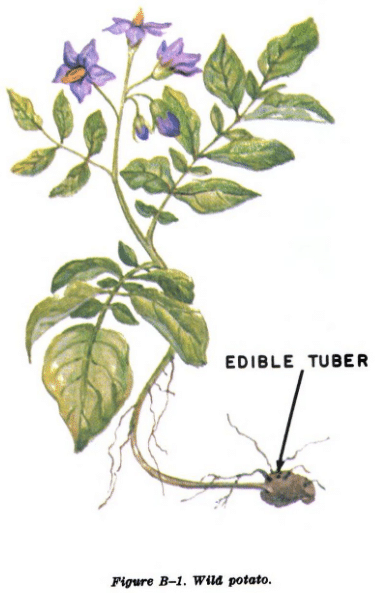
(1) Wild potato. This is an example of an edible tuber. The plant is small and found throughout the world, especially in the tropics (fig. B–1). This type of potato is poisonous when eaten uncooked.
soloman's seal illustration edible plants
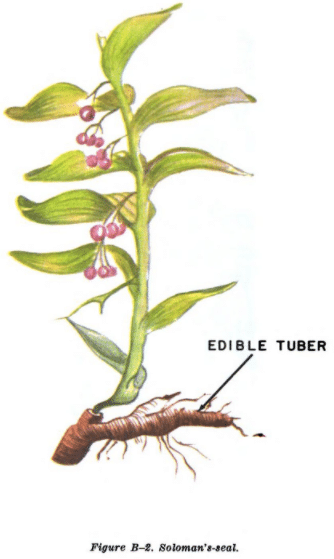
(2) Soloman’s-seal. Tubers of Soloman’s-seal grow on small plants and are found in North America, Europe, Northern Asia, and Jamaica. Boiled or roasted, they taste much like parsnips (fig. B–2).
water chestnut illustration edible plants
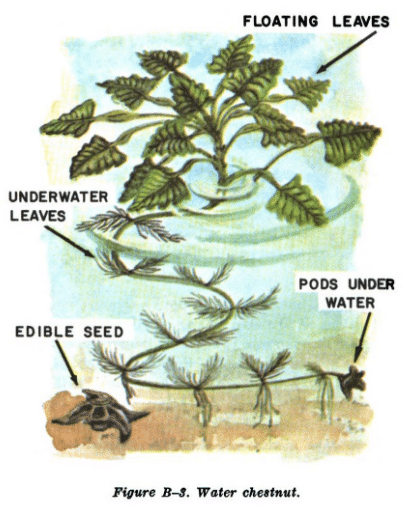
(3) Water chestnut. The water chestnut is a native of Asia, but it has spread to both tropical and temperate areas of the world, including North America, Africa, and Australia. It is found as a free-floating plant on rivers, lakes, and ponds. The plant covers large areas wherever it grows and has two kinds of leaves—the submerged leaf, which is long, root-like, and feathery; and the floating leaves, which form a rosette on the surface of the water. The nuts borne beneath the water are an inch or two broad with strong spines that give them the appearance of a horned steer. The seed within the horny structure may be roasted or boiled (fig. B–3).
nut grassl illustration edible plants
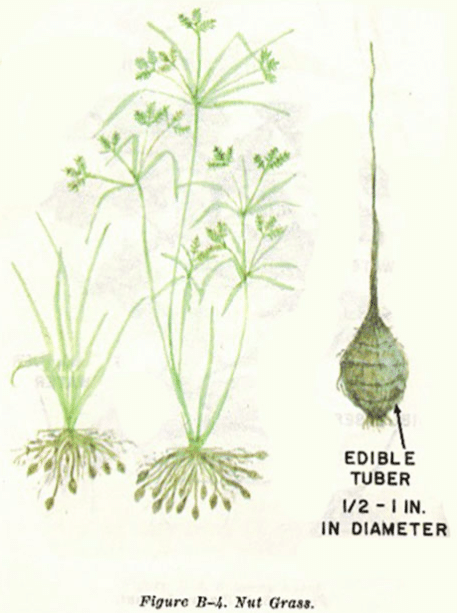
(4) Nut grass. Nut grass is widespread in many parts of the world. Look for it in moist sandy places along the margins of streams, ponds, and ditches. It grows in both tropical and temperate climates. Nut grass differs from true grass in that it has a three-angle stem and thick underground tubers that grow one-half to one inch in diameter. These tubers are sweet and nutty. Boil, peel, and grind them into flour. This flour can be used as a coffee substitute (fig. B–4).
taro root tuber illustration edible plants

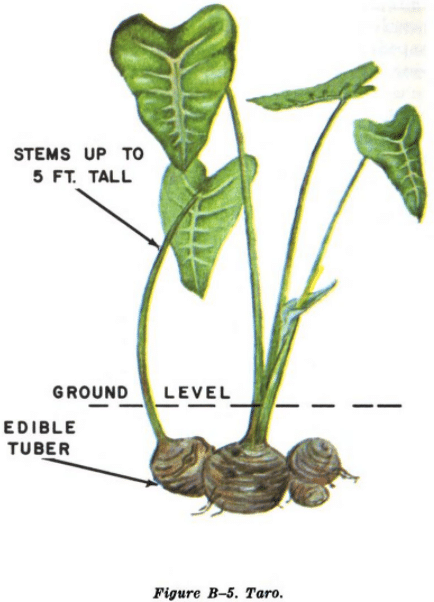
(5) Taro. The taro grows in moist, forested regions of nearly all tropical countries. This large, smooth skinned ground plant has long, wide (heart shaped), single pointed, light green leaves which grow singly from the main trunk. The flower is 4 inches in diameter, tulip shaped, and yellow-orange in color. It has an edible tuber growing slightly below ground level. This tuber must be boiled to destroy irritating crystals. After boiling, eat the tuber like a potato (fig. B–5).

b. Roots and Rootstalks. These plant parts are storage devices rich in starch. Edible roots are often several feet long and are not swollen like tubers. Rootstalks are underground stems, and some are several inches thick and relatively short and pointed. Following are illustrations showing both edible roots and rootstalks:
bulrush illustration edible plants
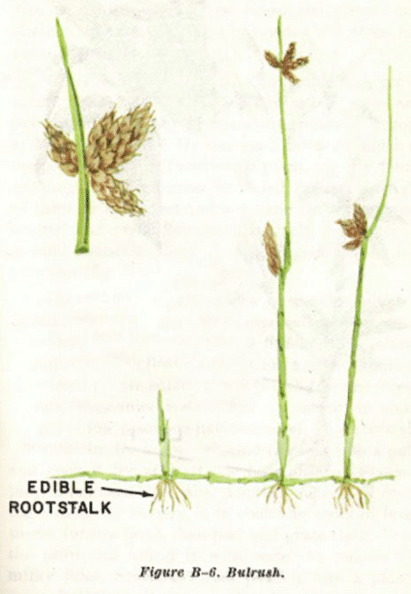
(1) Bulrush. This familiar tall plant is found in North America, Africa, Australia, East Indies, and Malaya. It is usually present in wet swamp areas. The roots and white stem base may be eaten cooked or raw (fig. B–6).
ti plant illustration edible plants
(2) Ti plant. This plant is found in tropical climates, especially in the islands of the South Pacific. It is cultivated over wide areas of tropical Asia. In both the wild and cultivated state, it ranges from 6 to 15 feet in height. It has large, coarse, shiny, leathery leaves arranged in a crowded fashion at the tips of the thick stems. The leaves are green and sometimes reddish. This plant grows a large plumelike cluster of flowers that usually droops. It bears berries that are red when ripe. The fleshy rootstalk is edible and full of starch, and should be baked for best results (fig. B–7).
water plantain illustration edible plants
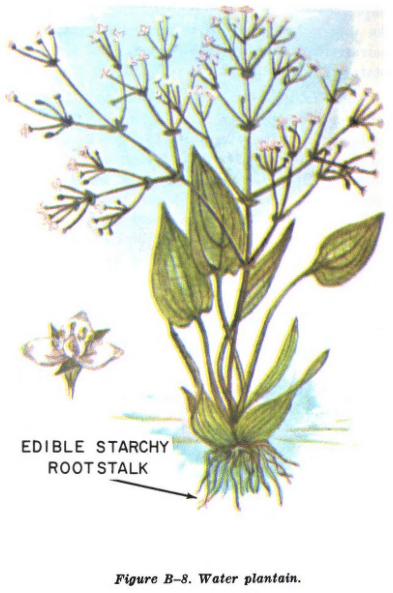
(3) Water plantain. This white flowered plant is found most frequently around fresh water lakes, ponds, and streams where it is often partly submerged in a few inches of water. It is usually abundant in marshy areas throughout the north temperate zone and has long-stalked, smooth, heart-shaped leaves with 3 to 9 parallel ribs. Thick, bulblike rootstalks which grow below the ground lose their acrid taste after being dried. Cook them like potatoes (fig. B–8).
flowering rush illustration edible plants
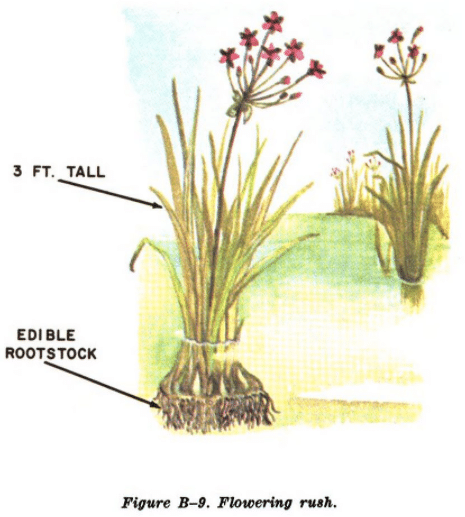
(4) Flowering rush. The flowering rush grows along river banks, on the margins of lakes and ponds, and in marshy meadows over much of Europe and temperate Asia. It grows in Russia and much of temperate Siberia. The mature plant, usually found growing in a few inches of water, reaches a height of three or more feet and has loose clusters of rose-colored and green flowers. The thick, fleshy underground rootstalk should be peeled and boiled like potatoes (fig. B–9).tapioca tree illustration edible plants
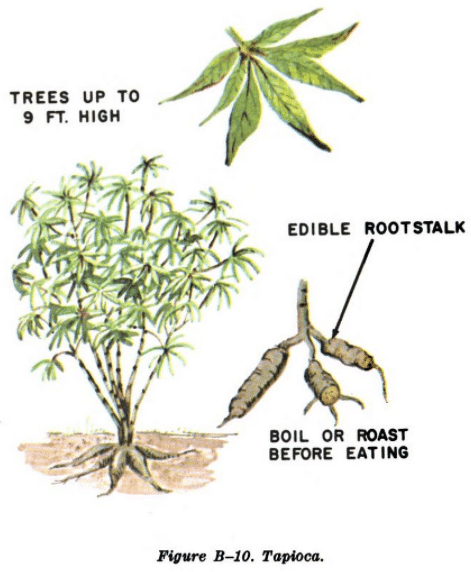
(5) Tapioca. The tapioca or manioc plant is found in all tropical climates, especially in wet areas. It grows to a height of 3 to 9 feet and has jointed stems and finger-like leaves. There are two kinds of manioc that have edible rootstalks—bitter and sweet. The bitter manioc is the common variety in many areas and is poisonous unless cooked. If a rootstalk of bitter manioc is found, grind the root into a pulp and cook it for at least one hour. Flatten the wet pulp into cakes and bake. Another method of cooking this bitter variety is to cook the roots in large pieces for one hour, then peel and grate them. Press the pulp and knead it with water to remove the milky juice. Steam it; then pour it into a plastic mass. Roll the paste into small balls and flatten them into thin cakes. Dry these cakes in the sun, and eat them baked or roasted. Sweet manioc rootstalks are not bitter and can be eaten raw, roasted as a vegetable, or made into flour. You can use this flour to make dumplings or the cakes described above (fig. B–10).
cattail illustration edible plants
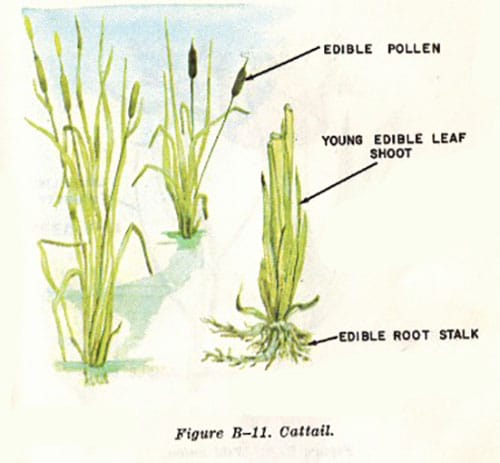
(6) Cattail. The cattail is found along lakes, ponds, and rivers throughout the world, except in the tundra and forested regions of the far north. It grows to a height of 6 to 15 feet with erect, tape-like, pale-green leaves one-quarter to one inch broad. Its edible rootstalk grows up to one inch thick. To prepare these rootstalks, peel off the outer covering and grate the white inner portion. Eat them boiled or raw. The yellow pollen from the flowers can be mixed with water and steamed as bread. In addition, the young growing shoots are excellent when boiled like asparagus (fig. B–11).
c. Bulbs. All bulbs are high in starch content and, with the exception of the wild onion ((1) below), are more palatable if they are cooked.
wild onion illustration edible plants
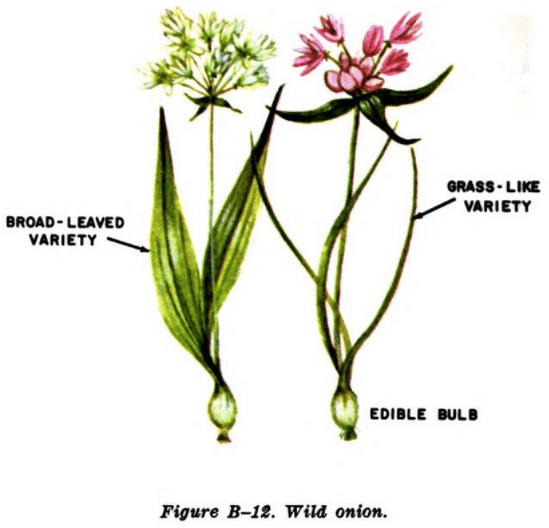
(1) Wild onion. This is the most common edible bulb and is a close relative of the cultivated onion. It is found throughout the north temperate zones of North America, Europe, and Asia. The plant grows from a bulb buried 3 to 10 inches below the ground. The leaves vary from narrow to several inches wide. The plant grows a flower that may be white, blue, or a shade of red. No matter what variety of onion is found, it can be detected by its characteristic “onion” odor. All bulbs are edible (fig. B– 12).
wild tulip illustration edible plants
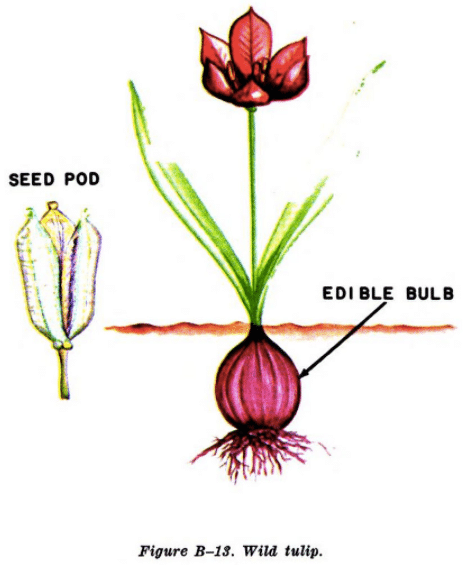
(2) Wild tulip. The wild tulip is found in Asia Minor and Central Asia. The bulb of the plant can be cooked and eaten as a substitute for potatoes. The plant bears flowers for a short time in the spring and these resemble the common garden tulip except they are smaller. When red, yellow, or orange flowers are absent, a seed pod can be found as an identifying characteristic (fig. B–13).

B–2. Shoots and Stems

Edible shoots grow very similarly to asparagus. The young shoots of ferns and bamboo, for example, make excellent food. Although some can be eaten uncooked, most shoots are better if they are panboiled for 10 minutes, the water drained off, and reboiled until they are sufficiently tender for eating. Following are a few of the plants that may be found with edible shoots and stems:
mescal illustration edible plants
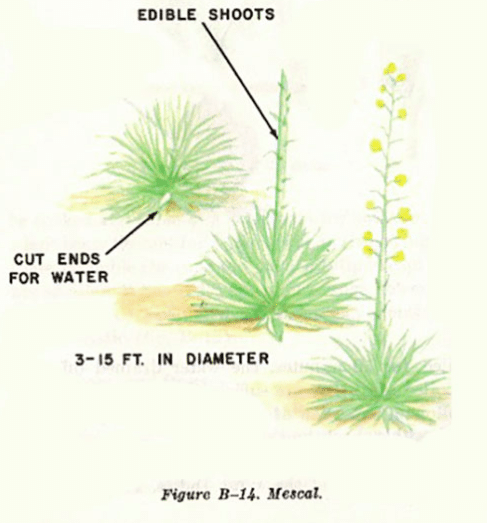
a. Mescal. This plant exists in Europe, Africa, Asia, Mexico, and the West Indies. It is a typical desert plant, but also grows in moist tropical areas. The mescal, when fully grown, has thick, tough leaves with stout, sharp tips borne in a rosette. In the center is a stalk that rises like a candle to produce a flowering head. This stalk or shoot is the edible part. Select plants having flowers not fully developed; roast the shoot. It contains fibrous, molasses-colored layers that taste sweet (fig. B–14).
wild groud illustration edible plants
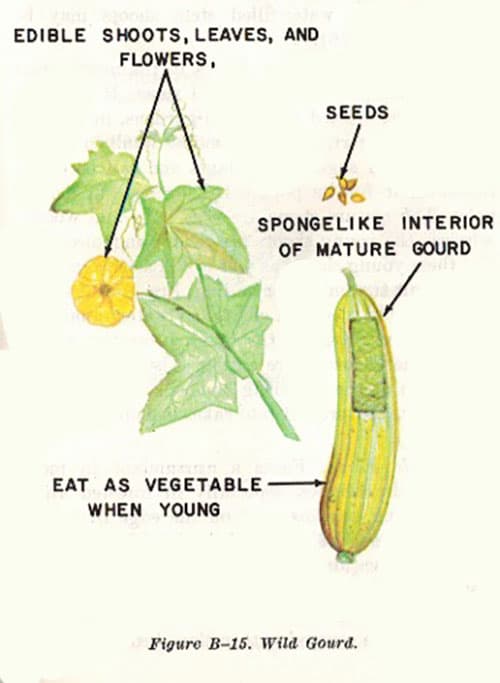
b. Wild Gourd or Luffa Sponge. This plant is a member of the squash family and grows similarly to watermelon, cantaloupe, and cucumber. It is widely cultivated in tropical areas, and it might be found in a wild state in old gardens or clearings. The vine has leaves 3 to 8 inches across and the fruit is cylindrical, smooth, and seedy. Boil and eat the fruit when it is half ripe; eat the tender shoots, flowers, and young leaves after cooking them. The seeds can be roasted and eaten like peanuts (fig. B–15).
wild desert gourd illustration edible plants
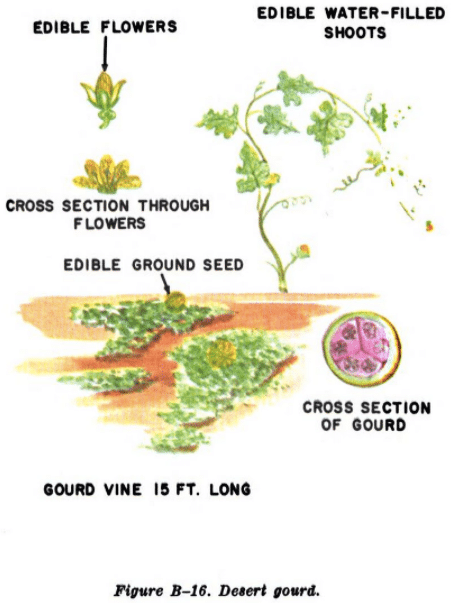
c. Wild Desert Gourd. Also a member of the squash family, this creeping plant grows abundantly in the Sahara Desert, Arabia, and on the southeastern coast of India. It produces a vine 8 to 10 feet long that runs over the ground and a gourd that grows to about the size of an orange. The seeds are edible roasted or boiled. The flowers also can be eaten, and the water-filled stem shoots may be chewed (fig. B–16).
bamboo illustration edible plants

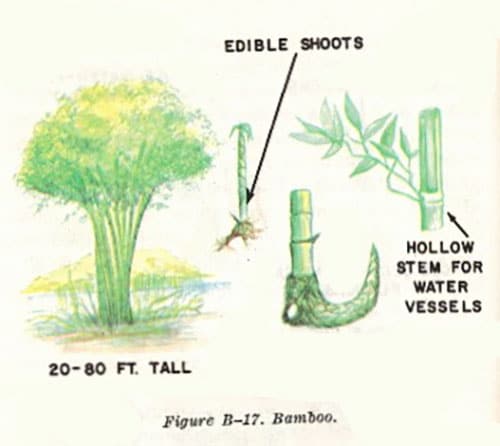
d. Bamboo. This plant grows in the moist areas of warm temperate and tropical zones. It is found in clearings, around abandoned gardens, in the forest, and along rivers and streams. Bamboo resembles corn and sugar cane plants and can be easily remembered for its popularity for making fishing poles. The mature stems are very hard and woody, whereas the young shoots are tender and succulent. Cut these young shoots as you would asparagus, and eat the soft tip ends after boiling. Freshly cut shoots are bitter, but a second change of water eliminates the bitterness. Remove the tough protective sheath around the shoot before eating. Also edible is the seed grain of the flowering bamboo. Pulverize this, add water, and press it into cakes or boil it like rice (fig. B–17).

e. Edible Ferns. Ferns are abundant in moist areas of all climates, especially in forested areas, gullies, along streams, and on the edge of woods. They may be mistaken for flowering plants, but by careful observation, you should be able to distinguish them from all other green plants. The under surface of the leaves is usually covered with masses of brown dots which are covered with yellow, brown, or black dust. These dots are filled with spores and their presence makes them easily distinguishable from plants with flowers.

bracken illustration edible plants

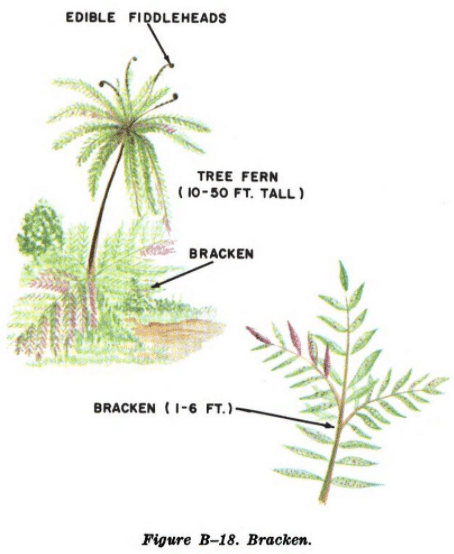
(1) Bracken is one of the most widely distributed ferns. It grows through the world, except the Arctic, in open, dry woods, recently burned clearings, and pastures. It is a coarse fern with solitary or scattered young stalks, often one-half inch thick at the base, nearly cylindrical, and covered with rusty felt; the uncoiling frond is distinctly three-forked with a purplish spot at each angle. This spot secretes a sweet juice. Old fronds are conspicuously three-forked, and the rootstalk is about one-quarter inch thick, creeping, branching, and woody (fig. B–18).

fern illustration edible plants

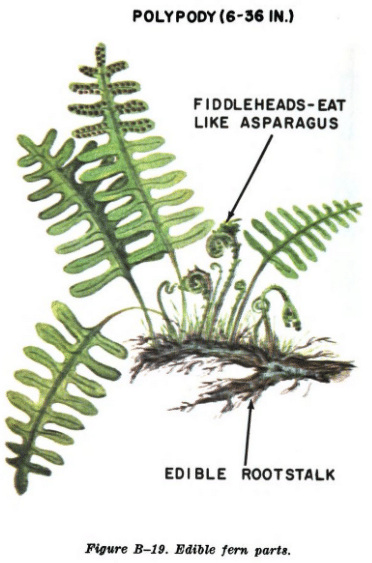
(2) On all ferns, select young stalks (fiddleheads) not more than 6 to 8 inches high. Break them off as low as they remain tender; then close your hand over the stalk and draw it through to remove the wool. Wash and boil in salted water or steam until tender (fig. B–19).

B-3. Leaves

Plants which produce edible leaves are probably the most numerous of all plant foods. They can be eaten raw or cooked; however, overcooking destroys many of the valuable vitamins. Following are some plants with edible leaves:
baobab tree illustration edible plants
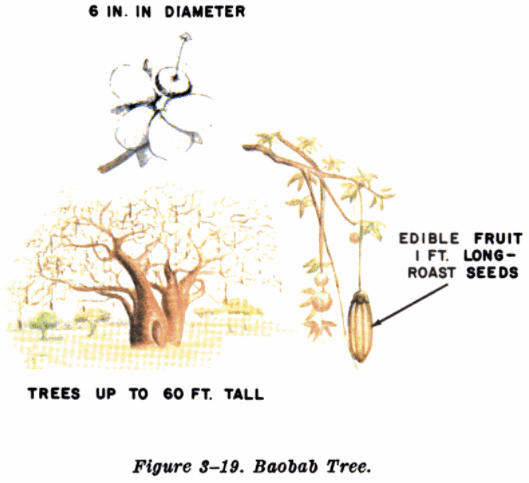
a. Baobab. This tree is found in open bush country throughout tropical Africa. It can be spotted by its enormous girth and swollen trunk, and the relatively low stature of the tree. A mature tree 60 feet high may have a trunk 30 feet in diameter. It produces large white flowers about three inches across that hang loosely from the tree. The tree also bears a mealy pulpy fruit with numerous seeds. These are edible and the leaves can be used as a soup vegetable (fig. 3–19).
b. Ti Plant. See paragraph B–1b (2).
water lettuce illustration edible plants
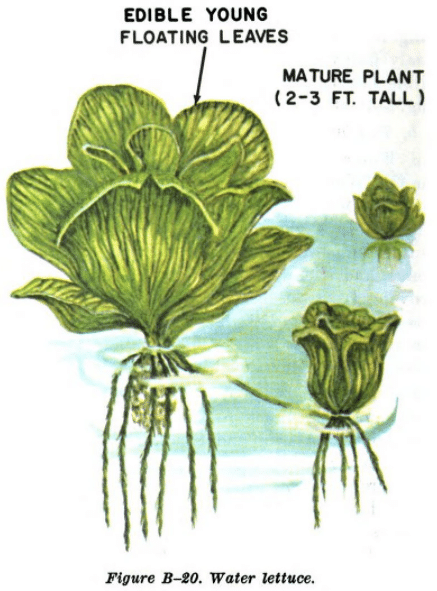
c. Water Lettuce. This plant grows throughout the Old World tropics in both Africa and Asia and in the New World tropics from Florida to South America. It is found only in very wet places, usually as a floating water plant. Look for it in still lakes, ponds, and backwaters, and for the little plantlets growing from the margins of the leaves. These are rosette-shaped, and they often cover large areas in the regions in which they are found. The plant’s leaves look much like lettuce and are very tender. Boil the leaves before eating (fig. B–20).
spreading wood fern illustration edible plants
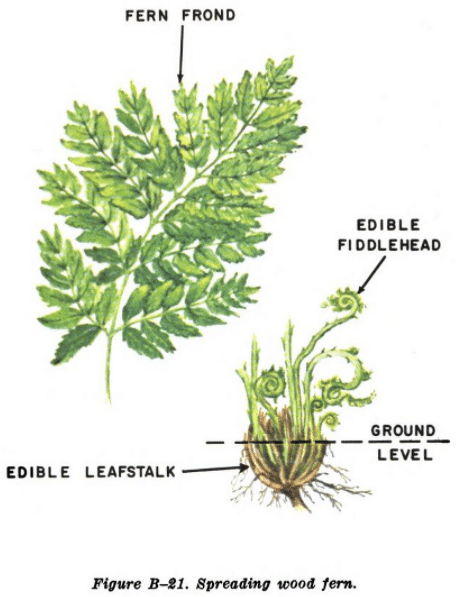
d. Spreading Wood Fern. This plant, especially abundant in Alaska and Siberia, is found in the mountains and woodlands. It sprouts from stout underground stems which are covered with old leafstalks that resemble a bunch of small bananas. Roast these leafstalks and remove the shiny brown covering. Eat the inner portion of the fern. In the early spring, collect the young fronds or fiddleheads, boil or steam them, and eat them like asparagus (fig. B–21).
horseradish tree illustration edible plants
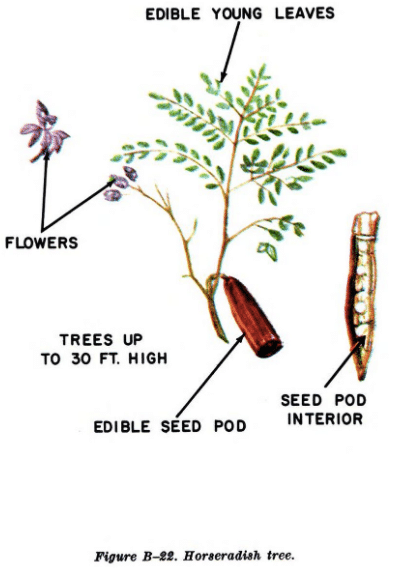
e. Horseradish Tree. This tropical plant is native to India but is widespread in other tropical countries throughout Southern Asia, Africa, and America. Look in abandoned fields and gardens and on the edges of forests for a rather low tree from 15 to 45 feet high. The leaves have a fern-like appearance and can be eaten old or young, fresh or cooked, depending on their state of hardness. At the ends of the branches are flowers and long pendulous fruit that resemble a giant bean. Cut the long, young seed pod into short lengths and cook them like string beans. Young seed pods can be chewed when they are fresh. The roots of this plant are pungent and can be ground for seasoning much as you do true horseradish (fig. B–22).
wild dock and sorrel illustration edible plants
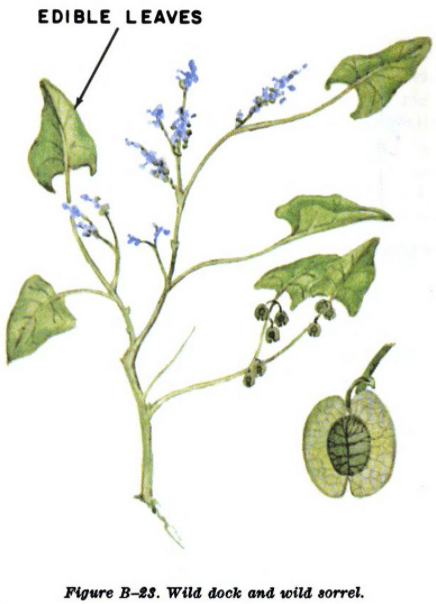
f. Wild Dock and Wild Sorrel. Although these plants are native to the Middle East, they are often abundant in both temperate and tropical countries and in areas having high and low rate of rainfall. Look for them in fields, along roadsides, and in waste places. Wild dock is a stout plant with most of its leaves at the base of its 6 to 12-inch stem. It produces a very small, green to purplish, plume-like cluster of flowers. Wild sorrel is smaller than dock, but similar in appearance. Many of its basal leaves are arrow-shaped and contain a sour juice. The leaves of both plants are tender and can be eaten fresh or slightly cooked. To eliminate the strong taste, change the water once or twice while cooking (fig. B–23).
wild chicory illustration edible plants
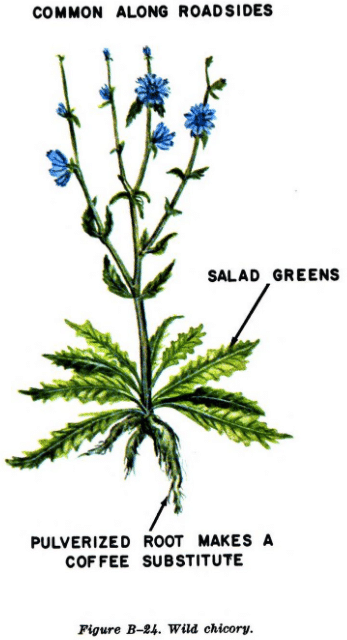
g. Wild Chicory. Originally a native of Europe and Asia, chicory is now generally distributed throughout the United States and the world as a weed along roadsides and in fields. Its leaves are clustered at ground level at the top of a strong, underground, carrot-like root. The leaves look much like dandelion leaves, but are thicker and rougher. The stems rise 2 to 4 feet and are covered in summer with numerous bright blue heads of flowers, also resembling a dandelion, except for color. The tender young leaves can be eaten as a salad without cooking. Grind the roots as a coffee substitute (fig. B–24).
arctic willow illustration edible plants
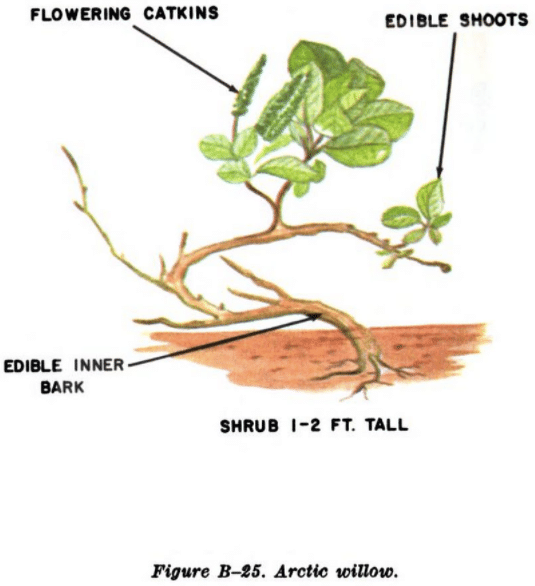
h. Arctic Willow. This shrub never exceeds 1 or 2 feet in height and is common on all tundra areas in North America, Europe, and Asia. It grows in clumps which form dense mats on the tundra. Collect young shoots in the early spring and eat the inner portion raw after stripping off the outer bark. The young leaves are a rich source of vitamin C, containing 7 to 10 times more than oranges (fig. B–25).lotus lily illustration edible plants
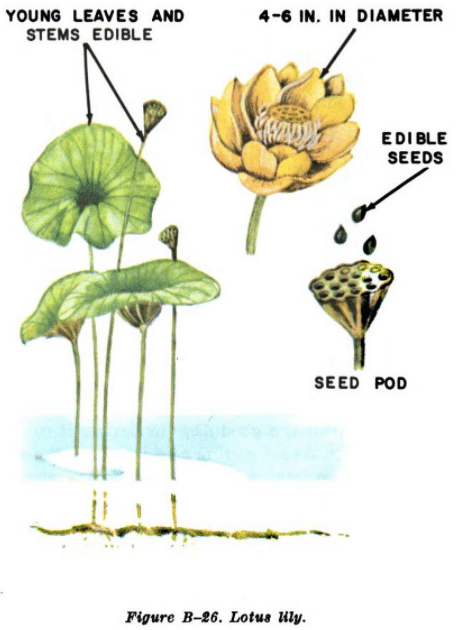
i. Lotus Lily. This plant grows in fresh water lakes, ponds, and slow streams from the Nile basin through Asia to China and Japan, and southward to India. It also grows in the Philippines, Indonesia, northern Australia, and eastern United States. The leaves of the lotus lily are shield-shaped, 1 to 3 feet across. They stand 5 to 6 feet above the surface of the water and grow either pink, white, or yellow flowers 4 to 6 inches in diameter. Eat the young stems and leaves after cooking, but remove the rough, outer layer of the young stems before cooking or eating. The seeds are also edible when ripe. Remove the bitter embryo from the seeds, then boil or roast them. Also edible are the rootstalks, which become 50 feet long with tuberous enlargements. Boil these and eat them like potatoes (fig. B–26).
papaya tree illustration edible plants
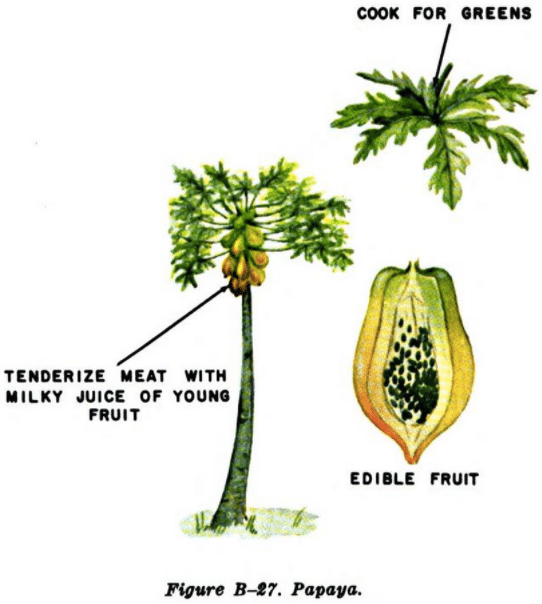
j. Papaya. This tree grows in all tropical countries, especially in moist areas. It is found around clearings and former habitations, and also in open sunny places in uninhabited jungle areas. The papaya tree is 6 to 20 feet tall with a soft hollow trunk that will break under your weight if you try to climb it. This trunk is rough and the leaves are crowded at the top. The yellow or greenish fruit grows among and below the leaves directly from the trunk and is squash-shaped. It is high in vitamin C and can be eaten cooked or raw. The milky sap of the unripe fruit is a good meat tenderizer if rubbed into the meat. Avoid getting this juice into the eyes—it will cause intense pain and temporary or even permanent blindness. The young papaya leaves, flowers, and stems are also edible. Cook them carefully and change the water at least twice (fig. B–27).
wild rhubarb illustration edible plants
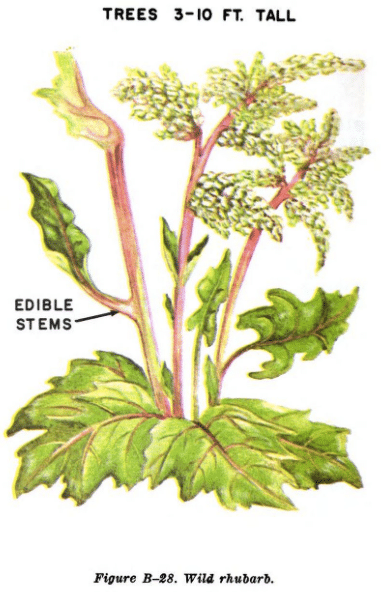
k. Wild Rhubarb. This plant grows from southeastern Europe to Asia Minor through the mountainous regions of Central Asia to China, and can be found in open places, along the borders of woods and streams, and on mountain slopes. The large leaves grow from the base of long stout stalks. These stalks flower and rise above the large leaves, and may be boiled and eaten as a vegetable (fig. B–28).
prickly pear illustration edible plants

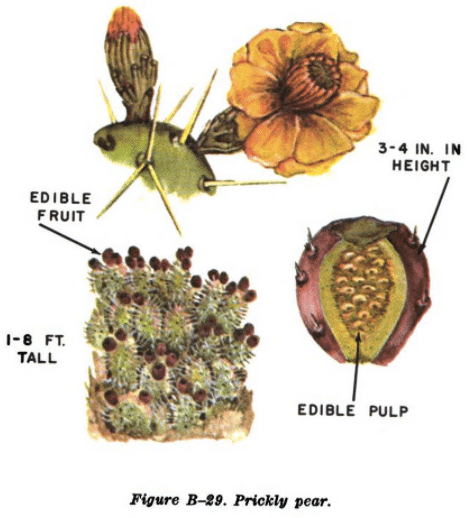
 l. Prickly Pear. This plant is native to America, but grows in many desert and seacoast areas of the world except in the Arctic. It is found in the southwestern United States, Mexico, South America, and along the shores of the Mediterranean. It has a thickened stem about an inch in diameter which is full of water. The outside is covered with clusters of very sharp spines spaced at intervals, and the plant grows yellow or red flowers. This plant can be mistaken for other kinds of thick, fleshy cactus-like plants, especially those in Africa. The spurges of Africa look like cacti, but contain a milky poisonous juice. The prickly pear never produces a milky juice. The egg-shaped fruit growing at the top of the cactus is edible. Slice off the top of the fruit, peel back the outer layer, and eat the entire contents. Also edible are the prickly pear pads. Cut away the spines and slice the pad lengthwise into strips like string beans. Eat them raw or boiled (fig. B–29).

B-4. Nuts

Nuts are among the most nutritious of all plant foods and contain valuable protein. Plants bearing edible nuts grow in all climatic zones and continents of the world except the Arctic. Some nuts of the temperate zones are walnuts, filberts or hazelnuts, almonds, hickory nuts, acorns, beechnuts, and pine nuts. Tropical zone nuts include coconuts, Brazil nuts, cashew nuts, and macadamia nuts. Following are some edible nuts:
english walnut illustration edible plants
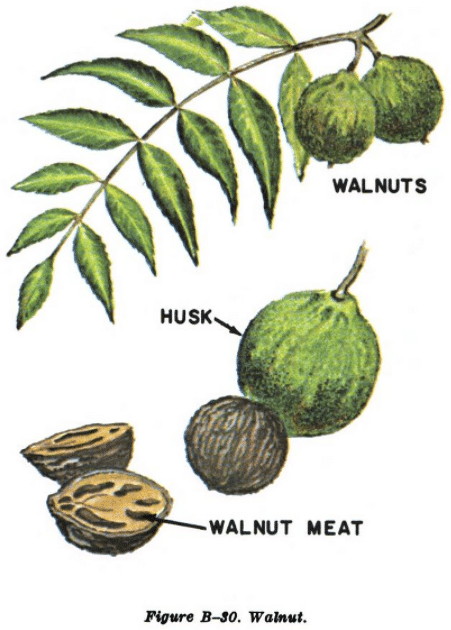
a. English Walnut. In the wild state, this nut is found from southeastern Europe cross Asia to China. It is abundant in the Himalayas and grows on a tree that sometimes reaches 60 feet tall. The leaves of the tree are divided, which is a characteristic of all walnut species. The walnut itself is enclosed by a thick outer husk which must be removed to reach the hard inner shell of the nut. The nut kernel ripens in autumn (fig. B–30).
hazelnut tree illustration edible plants
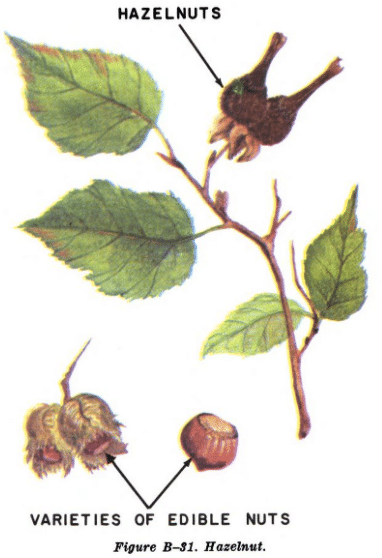
b. Hazelnut (Filbert). Hazelnuts are found over wide areas of the United States, especially in the eastern half of the country. They also grow in Europe and eastern Asia from the Himalayas to China and Japan. Growing mostly on bushes 6 to 12 feet tall, hazelnuts exist in dense thickets along stream banks and open places. The nut is enveloped by a bristly long-necked husk; it ripens in the fall. It can be eaten either in the dried or fresh unripe stage, and great food value can be derived from its oil content (fig. B–31).
chestnut tree illustration edible plants
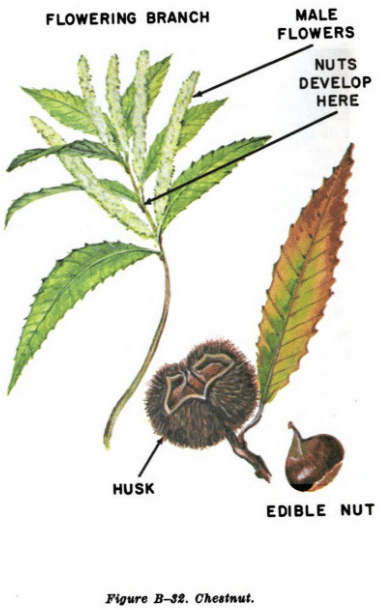
c. Chestnut. Wild chestnuts are highly useful as a survival food. They grow in central and southern Europe, from central Asia to China and Japan. The European chestnut is the most common variety; it grows along the edge of meadows and is a forest tree some 60 feet in height. The ripe or unripe nut can be prepared either by roasting it in embers or by boiling the kernel that lies within the shell. If the nut is boiled, mash it like potatoes before eating it (fig. B–32).
almond illustration edible plants
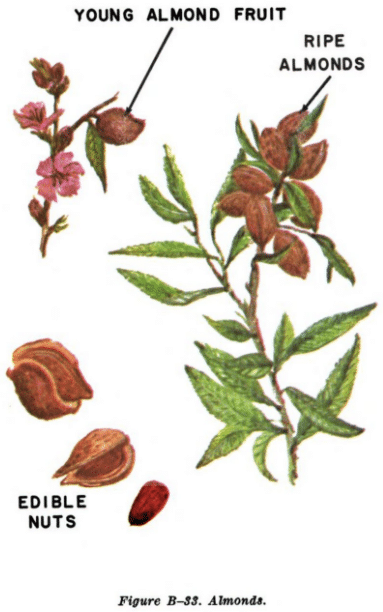
d. Almond. Wild almonds grows in the semidesert areas of southern Europe, the eastern Mediterranean area, Iran, Arabia, China, Madeira, the Azores and the Canary Islands. The almond tree resembles a peach tree and sometimes grows 40 feet tall. The fruit, found in clusters all over the tree, looks somewhat like a gnarled, unripened peach with its stone (the almond) covered with a thick, dry wooly skin. To extract the almond nut, split the fruit down the side, and crush open the hard stone. Gather and shell them in large quantities as a food reserve (fig. B–33).
acorn english oak illustration edible plants
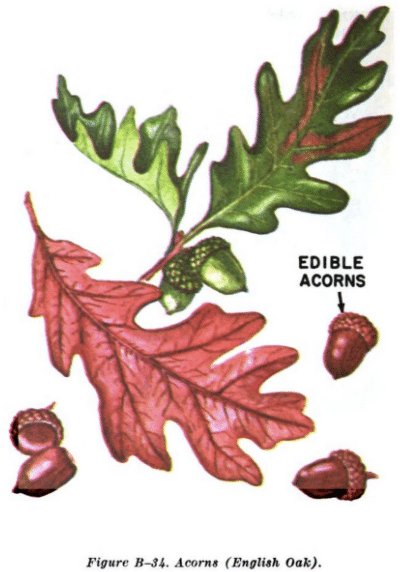
e. Acorns (English Oak). There are many varieties of oak, but the English oak is typical of those found in the north temperate zone. It often grows 60 feet tall and the leaves are deeply lobed. The acorns grow out of a cut and are not edible raw because of the bitter tannin properties of the kernel. Boil the acorns for two hours, pour out the water, and soak the nut in cold water. Change the water occasionally, and after 3 to 4 days, grind the acorns into paste. Make the paste into mush by mixing it with water and cooking it. You can make flour out of this paste by spreading and drying it (fig. B–34).
beechnut illustration edible plants
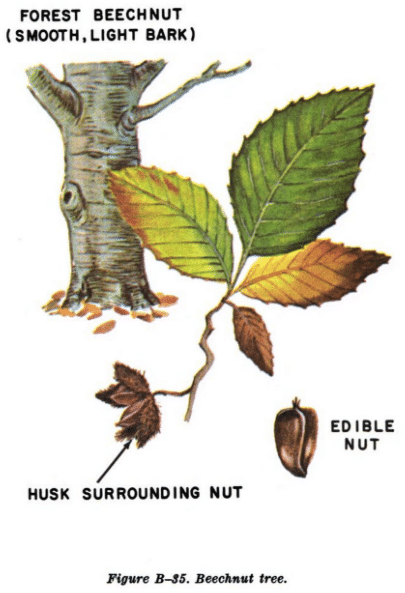
f. Beechnut. Beechnut trees grow wild in moist areas of the eastern United States, Europe, Asia, and North Africa. They are common throughout southeastern Europe and across temperate Asia but do not grow in tropical or subarctic areas. The beechnut is a large tree, sometimes reaching 80 feet in height, with smooth, light-gray bark and dark green foliage. Mature beechnuts fall out of their husk-like seed pods, and the nut can be broken with your fingernail. Roast and pulverize the kernel; then boil the powder for a satisfactory coffee substitute (fig. B–35).

pine nut illustration edible plants

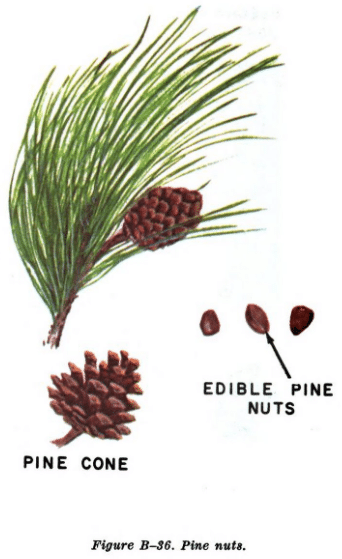
g. Swiss Stone Pine. Swiss stone pine is distributed widely in Europe and northern Siberia. The needles are typically in bunches, and the edible seeds or nuts (fig. B–36) grow in woody cones which hang either separately or in clusters near the tips of the branches. The nuts grow at the base of the cone scales and, when mature, will fall out of the ripe cone. Eat these raw or roasted.

h. Water Chestnut. See paragraph B–1a(3).

tropical almond illustration edible plants

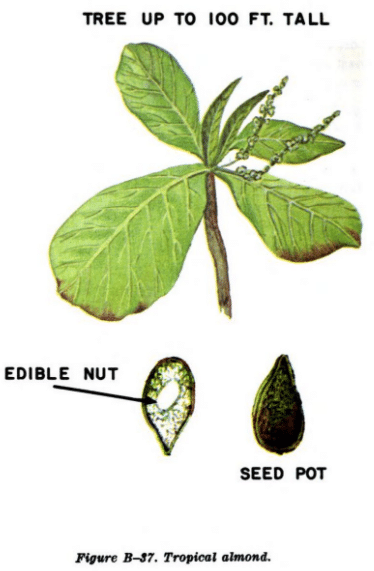
i. Tropical Almond. The Indian or tropical almond tree is widely dispersed in all tropical countries and is found in abandoned fields, gardens, along roadsides, and upon sandy Seacoasts. The edible seeds or kernels growing at the tips of the branches are surrounded by a spongy, husklike covering from 1 to 3 inches long. These kernels have an almond-like flavor and consistency (fig. B–37).

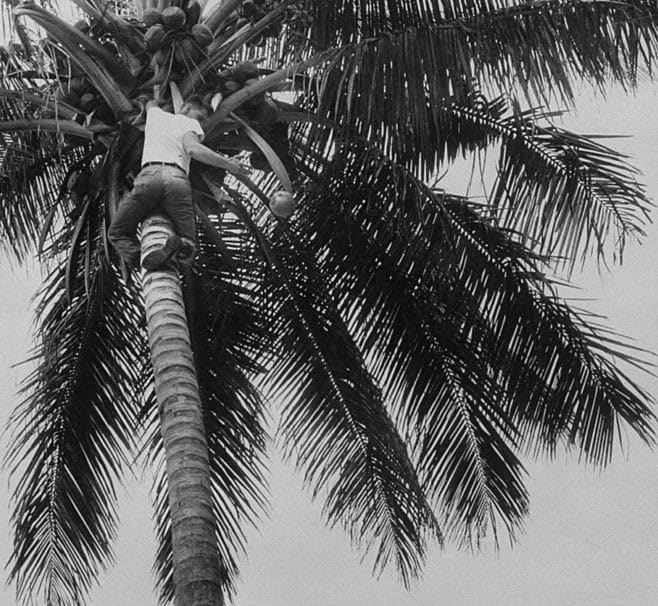
j. Coconut.

coconut tree illustration edible plants

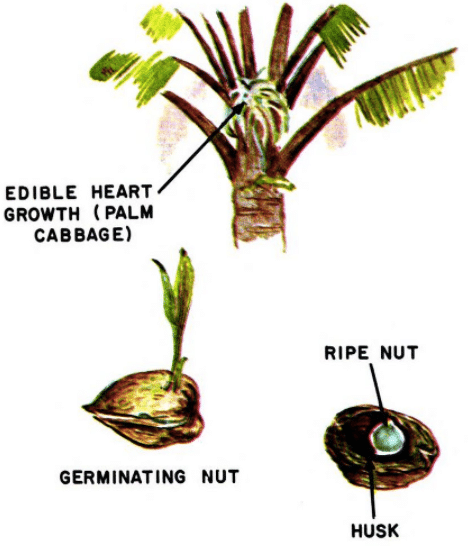
(1) The coconut palm is widely cultivated but grows wild throughout much of the moist tropics. It exists mainly near the seashore, but it sometimes grows some distance inland. This tall, unbranched tree sometimes reaches 90 feet. The nuts grow in large clusters and hang downward among the leaves.

(2) The two most valuable parts of the coconut palm are the cabbage and the nut. The cabbage is the snow-white heart at the top of the tree. Eat it cooked, raw, or mixed with vegetables. The nut is most useful in the drinking and mature stage. In the drinking stage, split the nut and scoop out the the meat with a spoon fashioned from the outside husk. In the mature stage, crack the nut, loosen the meat, and eat it fresh, grated, or dried to copra. Let the milk stand for a short time so that the oil will separate from it, making it useful for food and drink.

(3) Sprouting coconuts can also be eaten. Husk and split them open or simply crack them in half. Eat the white spongy material inside. To remove the purgative or physic qualities of this meat, cook it before eating (fig. B–38).

wild pistachio illustration edible plants

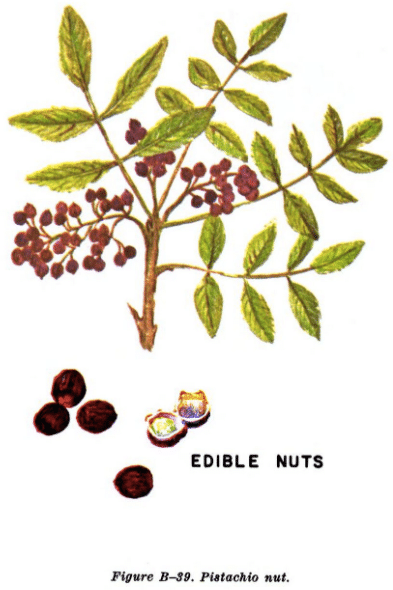
k. Wild Pistachio Nut. About seven types of wild pistachio nuts grow in desert or semi-desert areas surrounding the Mediterranean, in Asia Minor, and in Afghanistan. Some plants are evergreen while others lose their leaves during the dry season. The leaves alternate on the stem and have either three large leaves or a number of leaflets. The nuts are hard and dry when mature. Eat them after parching over coals (fig. B–39).

cashew nut illustration edible plants

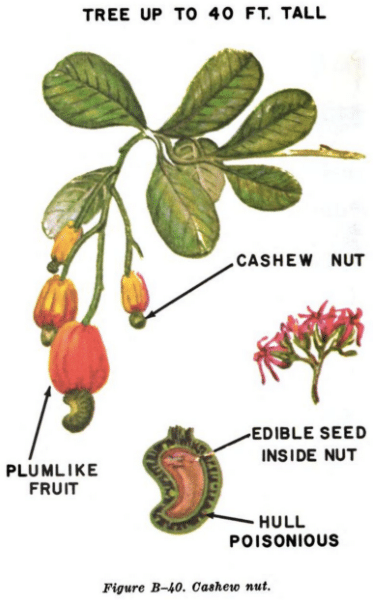
l. Cashew Nut. This nut grows in all tropical climates, on a spreading evergreen tree that reaches a height of 40 feet. The leaves are normally 8 inches long and 4 inches wide; the flowers are yellowish pink. The fruit is thick, pear-shaped, pulpy, and red or yellow when ripe, with a kidney-shaped nut growing at the tip. This nut encloses one seed and is edible roasted. The green hull surrounding the nut contains an irritant poison that will blister your eyes and tongue like poison ivy. This poison is destroyed when the nuts are roasted. Caution, however, must be taken when roasting or boiling the cashew nut because the steam or smoke can cause temporary or permanent blindness (fig. B–40).

B-5. Seeds and Grains

The seeds of many plants such as buckwheat, ragweed, amaranth, goosefoot, and the beans and peas from beanlike plants contain oils rich in protein. The grains of all cereals and many other grasses are also rich in plant protein. They may be ground between stones, mixed with water and cooked to make porridge, or parched. Grains like corn can also be preserved for future use when parched. Following are some plants with edible seeds and grains:

a. Baobab. See paragraph B–3a.

b. Sorrel. See paragraph B–3f.

sea orach illustration edible plants

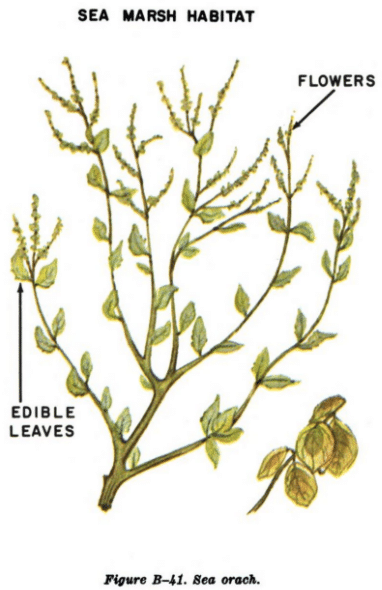
c. Sea Orach. This plant is found along seashores from the Mediterranean countries to inland areas in North Africa and eastward to Asia Minor and central Siberia. It is thinly branched with small, edible, gray-colored leaves about an inch long. The flowers grow in narrow, densely compacted spikes at the tips of the branches

Categories
Dear Grumpy Advice on Teaching in Today's Classroom Hard Nosed Folks Both Good & Bad

The last surviving Code Talker has gone home

World War II Navajo Code Talker reports for final musterRoy Hawthorne Sr.

Roy Hawthorne dead at 92:

Navajo Code Talker Roy Hawthorne, who used his native language as an uncrackable code during World War II, died Saturday.
At 92, he was one of the last surviving Code Talkers.
Hawthorne was 17 when he enlisted in the U.S. Marine Corps and became part of a famed group of Native Americans who encoded hundreds of messages in the Navajo language to keep them safe from the Japanese. Hawthorne served in the 1st Marine Division in the Pacific Theatre and was promoted to corporal.

Semper fi, Corporal.

Categories
Dear Grumpy Advice on Teaching in Today's Classroom Fieldcraft

How to Treat Frostbite

how to treat frostbite illustration diagram

In a frigid environment, your skin and the tissue just below can start to freeze and crystallize in as little as a few minutes.
This condition is called frostbite, and it’s no minor matter, but rather a serious injury which can permanently affect your appendages.
Knowing how to properly treat it can mean the difference between a sore hand and an amputated one.
Your first course of action should always be to call 911 or to get yourself to a hospital.
The damage may run deeper than you can visually assess. In the meantime, follow the steps above to do your best to ensure that no lasting tissue damage occurs.

Categories
All About Guns Anti Civil Rights ideas & "Friends" Dear Grumpy Advice on Teaching in Today's Classroom

Want to help some Good Kids in NY? Then take a Gander at this please

Dear League Parent/Student Athlete
The League has been made aware of pending legislation that will have significant impact on the thousands of student athletes, parents, coaches, and volunteers that participate in the New York State High School Clay Target League.
Bill A10428 has been introduced to the New York Assembly. The intention of the bill is to prohibit all New York schools from offering any type of shooting program. The relevant text from the bill is quoted below.
“S 809-B. PROHIBITION OF MARKSMANSHIP AND/OR SHOOTING PROGRAMS.

1. NO PUBLIC SCHOOL SHALL OFFER MARKSMANSHIP AND/OR SHOOTING PROGRAMS.
2. FOR PURPOSES OF THIS SECTION, MARKSMANSHIP AND/OR SHOOTING PROGRAMS SHALL INCLUDE ANY COMPETITIVE AND RECREATIONAL SPORTING ACTIVITIES INVOLVING PROFICIENCY TESTS OF ACCURACY, PRECISION AND SPEED IN USING VARIOUS TYPES OF RANGED WEAPONS, SUCH AS FIREARMS AND AIR GUNS, IN FORMS SUCH AS HANDGUNS, RIFLES AND SHOTGUNS AND/OR BOWS OR CROSSBOWS.”
What Can You Do?
The League encourages everyone who may be impacted to express their opinions on NY State Assembly Bill A10428 at  THIS LINK.
You can also express your opinions on A10428 by contacting your respective State Senators and Members of Assembly.

  • You can learn who your Member of Assembly is HERE.
  • You can learn who your State Senator is HERE.

Key points for your conversations:

  1. The League has never had a reported injury or accident.
  2. No cost to the schools or taxpayers.
  3. Thousands of student athletes, parents, coaches, and volunteers are participating in the League this spring.
  4. The League is fully Title IX compliant and gender neutral.
  5. All teams are 100% School-Approved.
  6. League participation supports local economies along with generating state tax funding for conservation and habitat management.
  7. Shooting sports are Olympic sports.
  8. Participation can lead to scholarships and other educational opportunities.
Safety, Fun, & Marksmanship.
Keep New York’s safest sport safe!
The New York State High School Clay Target League has never had a reported injury. Please make sure coaches, student athletes, shooting facilities and spectators clearly understand all team, facility and League safety policies and procedures. Thank you!

Informative Videos!
Start A Team!
Help The League!
More About The League!
Copyright © 2018 USA High School Clay Target League, All rights reserved.
Categories
Dear Grumpy Advice on Teaching in Today's Classroom

Math over the years

Categories
Dear Grumpy Advice on Teaching in Today's Classroom Hard Nosed Folks Both Good & Bad Uncategorized

Ain't it the Truth!


Image result for general patton

Categories
Dear Grumpy Advice on Teaching in Today's Classroom The Green Machine

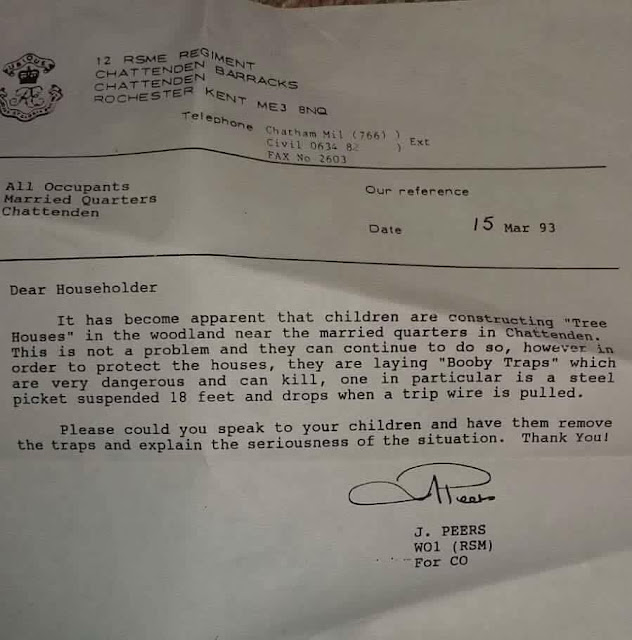
Daily life at the Royal School of Military Engineering (UK)

Categories
Born again Cynic! Dear Grumpy Advice on Teaching in Today's Classroom

Here is a contest for Earth day that i am glad the US did not win!

A Shocking study

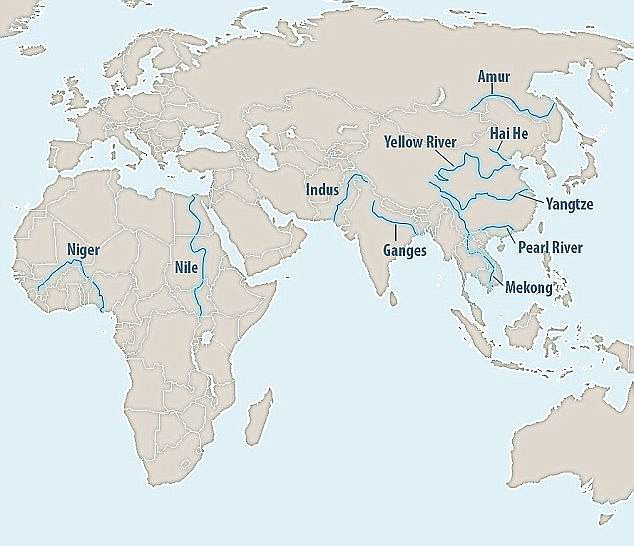
Y reveals 90% of global plastic waste comes from just TEN rivers in Asia and Africa

  • Study reveals 90 per cent of plastic waste comes from rivers in Asia and Africa
  • Researchers suggest the best way of reducing plastic is by targeting these
  • Bag ban skeptics meanwhile claim that shopping bags mostly end up in landfill
  • University of Sydney professor calls the bag ban a ‘low-hanging fruit’ issue 

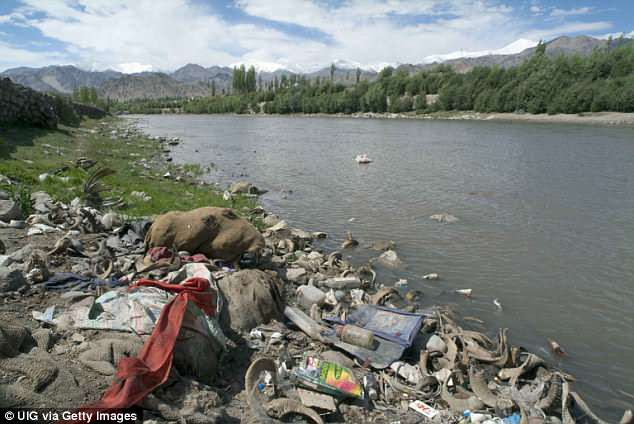
A shocking study has revealed 90 per cent of the world’s plastic waste comes from just 10 rivers in Asia and Africa.

As governments around the world rush to address the global problem of plastic pollution in the oceans, researchers have now pinpointed the river systems that carry the majority of it out to sea.

About five trillion pounds is floating in the sea, and targeting the major sources – such as the Yangtze and the Ganges – could almost halve it, scientists claim.

Scroll down for video

China's Yangtze River was the worst polluter, and ferries some 1.5 million tonnes of plastic into the Yellow Sea every year, the study found. Pictured, workers clear rubbish in Taicang reach of Yangtze River on December 23, 2016 in Taicang, Jiangsu Province of China.

China’s Yangtze River was the worst polluter, and ferries some 1.5 million tonnes of plastic into the Yellow Sea every year, the study found. Pictured, workers clear rubbish in Taicang reach of Yangtze River on December 23, 2016 in Taicang, Jiangsu Province of China.

THE 10 MOST POLLUTING RIVERS

Yangtze East China Sea Asia

Indus Arabian Sea Asia

Yellow River Yellow Sea Asia

Hai He Yellow Sea Asia

Nile Mediterranean Africa

Ganges Bay of Bengal Asia

Pearl River South China Sea Asia

Amur Sea of Okhotsk Asia

Niger Gulf of Guinea Africa

Mekong South China Sea Asia

ADVERTISING

Carried out by Germany‘s Helmholtz Centre for Environmental Research, it suggests that the most effective way of reducing the amount of plastic in the world’s oceans is by addressing the sources of pollution along such waterways as these.

The researchers, who first released their paper in 2017, issued a chilling warning for the future.

‘One thing is certain: this situation cannot continue,’ Dr. Christian Schmidt, a hydrogeologist at the Germany‘s Helmholtz Centre for Environmental Researchsaid when the study was first published.

‘But as it is impossible to clean up the plastic debris that is already in the oceans, we must take precautions and reduce the input of plastic quickly and efficiently.’

His team analysed data on debris from 79 sampling sites along 57 rivers – both microplastic particles measuring less than 5 mm and macroplastic above this size.

China’s Yangtze River was the worst polluter, and ferries some 1.5 million tonnes of plastic into the Yellow Sea every year, the study found.

They said microplastics in particular can damage the health of marine life but cleaning it all up would be impossible.

Categories
Dear Grumpy Advice on Teaching in Today's Classroom Well I thought it was funny!

Not my idea of Mother of the Year!