Categories
Anti Civil Rights ideas & "Friends" Darwin would of approved of this! Dear Grumpy Advice on Teaching in Today's Classroom Grumpy's hall of Shame

Obviously the man did not do his home work!

Trump Derangement Syndrome is REAL! Professor Shoots Himself in Protest of Trump

Evidence strongly suggests the loon professor intended on killing himself, taping a $100 bill on the school’s bathroom mirror which read, “for the janitor.” Apparently the aftermath of the shooting was to be so gory that he felt bad for the clean-up person. Alas, his firearm ability only managed a shot to his arm.
Before we get to the story I want to say that, sadly, Trump Derangement Syndrome is real, and the afflicted are a real danger. This guy brought an illegal gun into the school. There’s really no telling what he was capable of doing. It is time to take this disease seriously, and the first step is awareness.

At iOTW report we want to do our part and recognize an organization that is spreading the word about this mental disorder.

I believe it is a national security issue.
Be a good citizen and display the ribbon. Put it on your car. Put it on your mailbox. Wear it on your shirt. Send the ribbon to the people in your life that may be afflicted, signaling to them that you support them and are hoping they get the help they need.
Tell them that you don’t want them to be desperate, in a bathroom with a gun, because they might accidentally shoot a Trump supporter, and that wouldn’t be good.
Go HERE to get your stickers. Keep them in your wallet and hand them to people when they go into their spittle-flecked rants, inanely disparaging the best president this country has seen in decades.
(Full disclosure: This project has been initiated by an iOTWreport reader who wants to remain anonymous. We are happy to publicize this project for them and if you are a blogger, tweeter, facebooker, etc., we encourage you to do the same.)
Review Journal-
Mark J. Bird was charged last month with discharging a gun within a prohibited structure, carrying a concealed weapon without a permit and possessing a dangerous weapon on school property, court records show.
He was found bleeding from a self-inflicted gunshot wound to his arm about 8:15 a.m. on Aug. 28 outside a bathroom in the Charleston campus K building.
The sociology professor was hired Aug. 26, 1993, and was an emeritus faculty member at the time of the shooting, college spokesman Richard Lake said. Bird was not scheduled to teach any courses during the fall 2018 semester.
Bird was employed with the college as of Tuesday, although Lake said it was not clear what disciplinary actions, if any, would be taken against him.
A 911 call was made after several CSN employees and at least one student saw Bird stumble out of the bathroom, bleeding, before he collapsed, the report said.
None of the witnesses — who later told police they only recalled hearing “a loud noise” — initially knew that Bird was armed and had shot himself, according to the report.
One college employee told police that he held Bird’s hand to calm him down as others tried to stop the bleeding. While waiting for authorities to arrive, Bird said he had shot himself in protest of President Donald Trump, police noted in their report. The report did not elaborate.
ht/ js
________________________________     Having seen a few suicides in my life.
Here is a little bit of advice. Mind you I am not condoning this or saying that you should do this!
But the only really effective way to do this follow these simple rules
A. Be Sober as booze really effects your aim a lot!
B. Do it outside as it is a lot easier to clean up afterward. But I have to give Bonus points for leaving a Tip. That did show some class!
C. Use the right gun that you have some experience with!
D. I suggest using any caliber above size of the 44 caliber.
E. That and if possible use either hollow points or semi wad cutters. Since they seem to ricochet less and lessen the chances of taking out somebody else. As the bullet might otherwise hit somebody else by accident.
F. Place the gun under the jaw, then press up & toward the back of your throat.
G. Squeeze the trigger don’t jerk it or you might miss!
H. When you get to Hell as a Suicide. (Hey, it is a Mortal Sin in most religions!)  Don’t be a pussy because you belong here now for all eternity. So be a man and act like one!You idiot!
By the way, most of your friends and family are going to be really pissed off at you. Even if you do write the Suicide Note of all time.
Since most Folks hate Cowards & because most suicides are a cowardly acts of a very selfish & self centered jerk.
Grumpy – By the way this part is only a attempt at humor and in no way codons or encourages other to try & snuff them selves!
 

Categories
All About Guns Allies Anti Civil Rights ideas & "Friends" Dear Grumpy Advice on Teaching in Today's Classroom

Firearms: The Great Equalizer

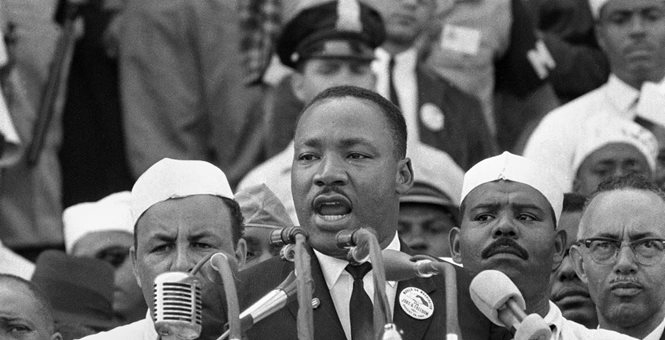
Fifty-five years ago today, Dr. Martin Luther King, Jr., delivered his famous “I Have a Dream” speech in front of the Lincoln Memorial in our nation’s capital.
While Dr. King’s speech is well-known, what is not so widely recognized are his views on firearms.
People who visited Dr. King’s home described it as an arsenal. One journalist came to his house and later reported that while sitting down in an armchair, he almost landed right on a handgun.

Not only that, after Dr. King’s home was bombed, he applied for a concealed carry permit in Alabama in 1956. But he was denied.
All of this just underscores the dangers of gun control. It turns our rights into privileges, allowing prejudiced officials to revoke the rights of decent people at will.
We see this in the Black Codes which either prevented or discouraged the ability of African-Americans to protect themselves with firearms.
This, of course, made them easy prey for the lynch mobs.
One African-American journalist, Ida Wells, documented many of the lynchings that took place in the 19th Century.
But she also noted that the only time blacks actually escaped the lynch mobs was when they “had a gun and used it in self-defense.”
Click here to see more GOA News articles like this one.
This is why the Second Amendment is so important. It not only safeguards our right to defend ourselves against thugs, it protects that right when the thugs are wearing badges.
The best-known example of this in American history is the colonists’ spirited defense against the British attempt to confiscate weapons and powder at Concord, Massachusetts, on April 19, 1775.
But this was not the last time that armed civilians would use their weapons to protect themselves against corrupt officials.
In 1906, a white mob worked itself up into a frenzy and started a race riot in Georgia. Over a thousand men walked through the streets of Atlanta, indiscriminately beating black men and women, black teenagers, and black businessmen.
The scene was gruesome. The best estimates record that dozens of blacks were murdered. Hundreds were wounded.
The rioters spilled from one area of Atlanta into another, until they reached one neighborhood, known as “Darktown,” where African-Americans were armed and shot back. That’s where the riot was stopped in its tracks.
Armed blacks forced the mob to retreat and they prevented a second bloodbath.
All this happened on a Saturday night. The riots were paused because of the armed response, but then they resumed again on Monday.
Only this time, to make matters worse, state law enforcement officers went into south Atlanta and tried to disarm the blacks.
One of the preeminent historians who has covered the 1906 riots, John Dittmer, had this to say about what happened next:
[The lead officer] James Heard, was shot out of his saddle and died instantly. Three other officers … were wounded in the initial exchange before the outgunned troops fled, leaving Heard’s body behind. (John Dittmer, Black Georgia in the Progressive Era (1900-1920), p. 128).
Once again, the riot was abruptly stopped.
In his 1963 speech, Dr. King spoke of the Declaration of Independence as the great promissory note which guaranteed the unalienable rights of ALL people.
This right of self-protection is the freedom which protects all our other rights against official abuse. We’ve seen this in practice time and again.
Former Secretary of State to George Bush, Condoleezza Rice, tells the story of how her dad would take his shotgun — and with other armed African Americans in the neighborhood — would form nightly patrols to protect the town’s people from the KKK.
This was common during the difficult days of the civil rights movement. African Americans would use their firearms to protect themselves against the KKK when the Southern Democrat police departments were looking the other way.
So therein lies the rub — government agents don’t always act in the best interests of its citizens.
And that’s why there is a Second Amendment — a guarantee which protects the right of the people to keep and bear arms without infringement.
Categories
Born again Cynic! Dear Grumpy Advice on Teaching in Today's Classroom

All I want to know is who is the idiot that hired these folks in the 1st place!?!

‘In God We Trust’ sign offended teachers, so the school district came up with a fix

South Florida Sun Sentinel

Palm Beach County teachers who were offended by an “In God We Trust” sign displayed in front offices prompted the school district on Wednesday to come up with a new way to comply with a recently approved state law.
The School Board agreed to use the state seal, which also says “In God We Trust,” in place of Palm Beach County’s homemade design, which posted the words in bold capital letters. The seal is more subtle and can’t be criticized, board members said.

 
“Who can be offended by the state seal?” asked board member Karen Brill, who came up with the idea. “It’s one of those stories where employees see something that rubs them the wrong way.”
In March, Gov. Rick Scott signed a lawthat says schools must post the motto in a “conspicuous place.” The measure, passed by the state Legislature, was sponsored by Rep. Kimberly Daniels, D-Jacksonville, who runs a Christian ministry.

The law requires “each district school board” to display the motto inside “all of the schools of the district and in each building used by the district school board.”
“In God We Trust” has been the state’s motto since 2006, although it’s been on the state seal since 1868 and on the state flag since 1900, according to the Florida Department of State.
Palm Beach County schools’ Deputy Superintendent Keith Oswald said schools have been given flexibility on where and how to post the motto. It’s typically been placed at the counter of the front office or near the front desk, he said.
Brill said she heard from several teachers who took umbrage at the district’s prominent placement of the motto. She said they felt it violated church-state separation, but didn’t realize it was now a state requirement.
“A few of them were very offended,” she said.
Several Florida school districts are making use of the state emblem to comply, including Lake, Osceola, Seminole and Orange counties.
Palm Beach County School Board member Erica Whitfield said the district should develop a consistent display method.
“We should work toward having it look nice,” she said. “We’ll make it look more professional.”
__________________________________
This sounds like some Folks have way too much time on their hands.
If I was in charge, I would put them in charge of a In Service that they would have to develop about this “ISSUE”.
Then make them redo it a few dozen times. All the while having to do their regular assignments also at the same time.
Followed up by an official evaluation about their time management skills as an Employee at the District.
Grumpy

Categories
Dear Grumpy Advice on Teaching in Today's Classroom

A Hogan's Heroes Promo Commercial

https://youtu.be/6ZPA4BY1OR8
Back in the days when they had some great Programs on Regular TV!

Categories
Dear Grumpy Advice on Teaching in Today's Classroom Well I thought it was funny!

And let the Games Begin!


All I can say is that I am so Happy to be a Retired Teacher!
That & God Bless those who are still in it and doing the Good fight! Grumpy

Categories
Anti Civil Rights ideas & "Friends" Dear Grumpy Advice on Teaching in Today's Classroom

A not so bright move in Utah!

University of Utah Instructor Ostracizes Concealed Carriers & LosesUniversity of Utah Instructor Ostracizes Concealed Carriers & Loses
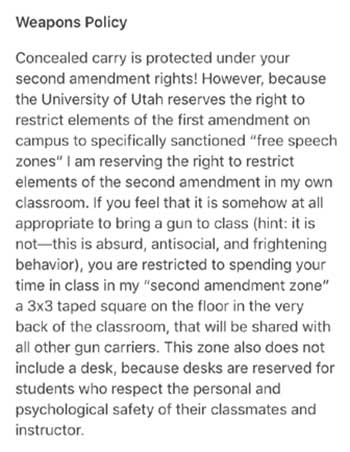
Fairfax, VA – -(Ammoland.com)- In an outrageous attempt to punish anyone exercising their Second Amendment rights, a University of Utah instructor tried to isolate concealed carry holders by forcing them into a tiny corner in the back of the classroom.
The unnamed graduate teaching assistant told her students on the first day of class this week that anyone carrying a firearm would be forced to stand in a “3 x 3 taped square on the floor in the very back of the classroom.”

University of Utah Anti Gun Syllabus

Despite the fact that Utah is one of ten states that allows for campus carry, the instructor claimed she had the right to “restrict elements of the Second Amendment” in the class, adding that bringing a gun to class is “absurd, anti-social, and frightening behavior.”

The professor created a bizarre “Second Amendment Zone… that does not include a desk, because desks are reserved for students who respect the personal and psychological safety of their classmates and instructor.”

This absurdity did not sit well with at least one student. The 23-year old concealed carry permit holder, who asked to remain anonymous for fear of retaliation, alerted a friend who then contacted Utah State Representative Karianne Lisonbee. Rep. Lisonbee was on the phone immediately with officials at the University of Utah who took swift action against the instructor.
In a statement provided to the NRA, a University of Utah spokesman said the instructor was forced to redact the syllabus and apologize to students. Officials also removed the instructor from any teaching this semester.
The university said the class syllabus “violated both state law and university policy.

“I am very pleased with how it turned out,” said Lisonbee. “I am very pleased the university handled it so quickly.”

Before the instructor could remove her syllabus from her class website, the anonymous tipster grabbed a screenshot of it as evidence of her outrageous anti-gun bias.

AmmoLand Editors Note: If any of our readers know the name of this teacher please let us know in the comments below.
*******************************

Well that was not handled well by this “Instructor”. It seems to me that she could of thought this one out a little better before hand.
As a Retired Teacher, I like to think that I would handled this issue this way.
“Hey guys with a Permit. I would like to talk to you later about this during my office hours. Okay?” Then I am sure that a fair & equitable deal would of been reached.
As is it now, I am willing to be that this instructor career just took a major hit. As like any Boss out there, you do not want any problems during your shift.
If my Wonderful Readers have a better idea feel free to hit the comments button. Or better yet hit the Paypal Button. As I am looking to get a new toy soon in 22-250.  More on that later!
Grumpy

Categories
Dear Grumpy Advice on Teaching in Today's Classroom Well I thought it was funny!

Playgrounds in Florida

Now that’s what I call motivational PE!

Categories
All About Guns Dear Grumpy Advice on Teaching in Today's Classroom

Flashback

Categories
Dear Grumpy Advice on Teaching in Today's Classroom Gear & Stuff This great Nation & Its People Uncategorized

How did Coca-Cola become so popular in WWII (Stolen from My Daily Kona)

I live in the Atlanta Area, and there are 2 iconic images from Atlanta, one is Delta Airlines, the other is “Coke”,   They say that babies are nursed on this stuff and if you don’t drink Coke, then you must be a carpetbagger or some Yankee sympathizer.  The locals take their “Coke” seriously, so seriously that every carbonated drink here in the south is called “Coke”.

The Coca-Cola trademark remains one of the most iconic brands in history, and the company behind it remains one of the wealthiest corporations in the world. The secret formula for the original flavor that makes this beverage so distinct is guarded with maximum security, as enthusiasts all over the world try to copy it.
It first started as an alcoholic drink, similar to vermouth, but switched to its non-alcohol taste which we know today in 1886, when John Pemberton, the inventor of the patent, had to step down from alcohol production due to legislative circumstances in Atlanta, where the company was seated.
But how did the brand become so influential?
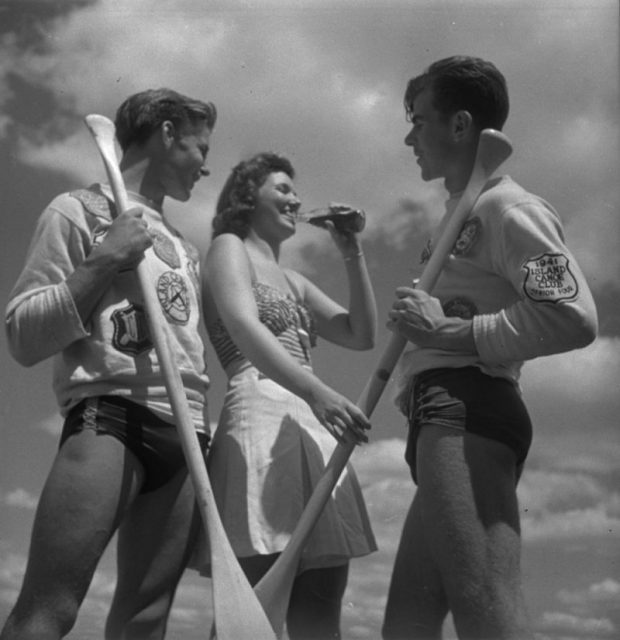
Well, part of the success of the Coca-Cola company lies in its cunning use of marketing and its even more cunning use of investments. When the U.S. entered the World War II, Coca-Cola made sure to be the official drink of every GI Joe on the field. In 1941, a subsidy for servicemen was introduced, making the price of a coke bottle 5 cents, which was more than affordable at the time.

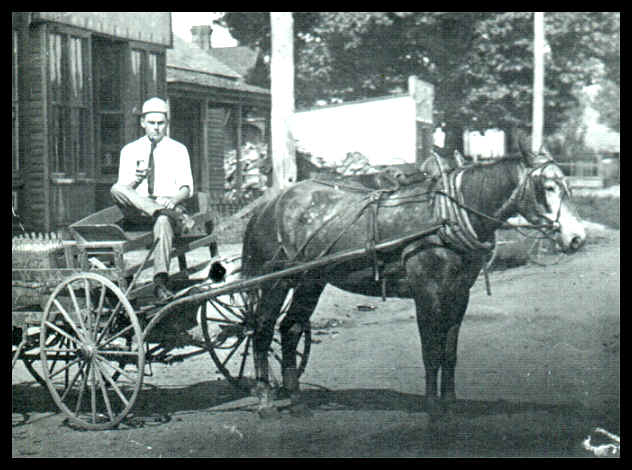
Coca-Cola horse drawn delivery wagon on the Boulevard in Leaksville, North Carolina, 1909.

Also, Coca-Cola briefly turned its investments into weapons manufacture, operating a propellant ammunition loading plant in Talladega, Alabama.
An average of 30 railroad cars of ammunition per day was reportedly produced from their Coosa River Ordnance Plant until closure in August 1945.
The subsidy and the munition production made the company immune to war-time sugar rationing, therefore leaving the production level at its normal rate and even blossom, while their reputation skyrocketed.
The conscripted Coca-Cola employees were also used to operate the 64 newly-formed bottling factories which supplied the military with the beverage. As a result, many of the employees were granted Technical Observer status and were called the Coca-Cola Colonels, never stepping on the battlefield, due to their expertise.

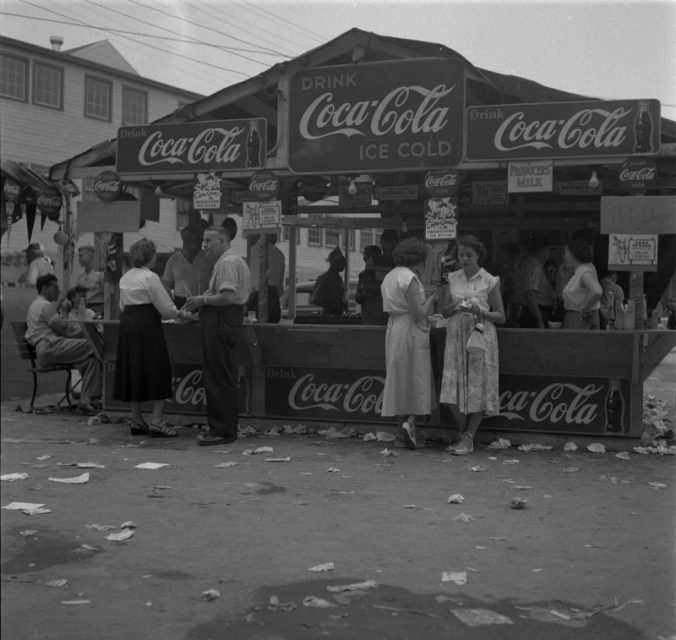
People Gathered By Coca-Cola Stand. Photo: Credit: Rosemary Gilliat Eaton / Library and Archives Canada..

They would go on to produce and distribute 10 billion Coke bottles to Allied military bases and fleets in Europe, Africa, and the Pacific.

Speaking of Africa, while fighting on the North African front, Germans would come across the typical American soft drink. Even though it was forbidden for German soldiers to consume the treat of their enemies, Coca-Cola soon earned its popularity among the members of Wehrmacht, and especially the Luftwaffe.
Allegedly, pilots would wrap Coke bottles in towels while on their sorties and attach them to the underwings of their BF109 fighter planes. This was truly an ingenious cooling method, as the altitude cooled the drink to almost freezing, which was a true refreshment in the desert sun.
A similar method was used by the American pilots in the Pacific Theater of War. They would freeze an ice-cream mixture in mid-air, and upon their return, voila―an excellent icy treat!
As for the Germans, they relied on captured Coca-Cola bottles, which reached an incredible price as contraband goods in the soldier’s black market. The flavor was truly adored by German soldiers, but this was in part due to the fact that Coca-Cola had a factory in Germany prior to the war, and the Germans weren’t all that unfamiliar with the tasty beverage.

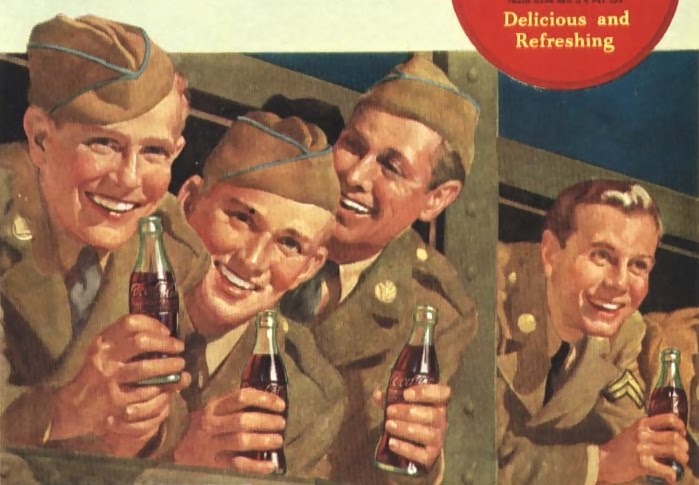
Coca Cola advertising. Photo: Karsh, Malak/Library and Archives Canada

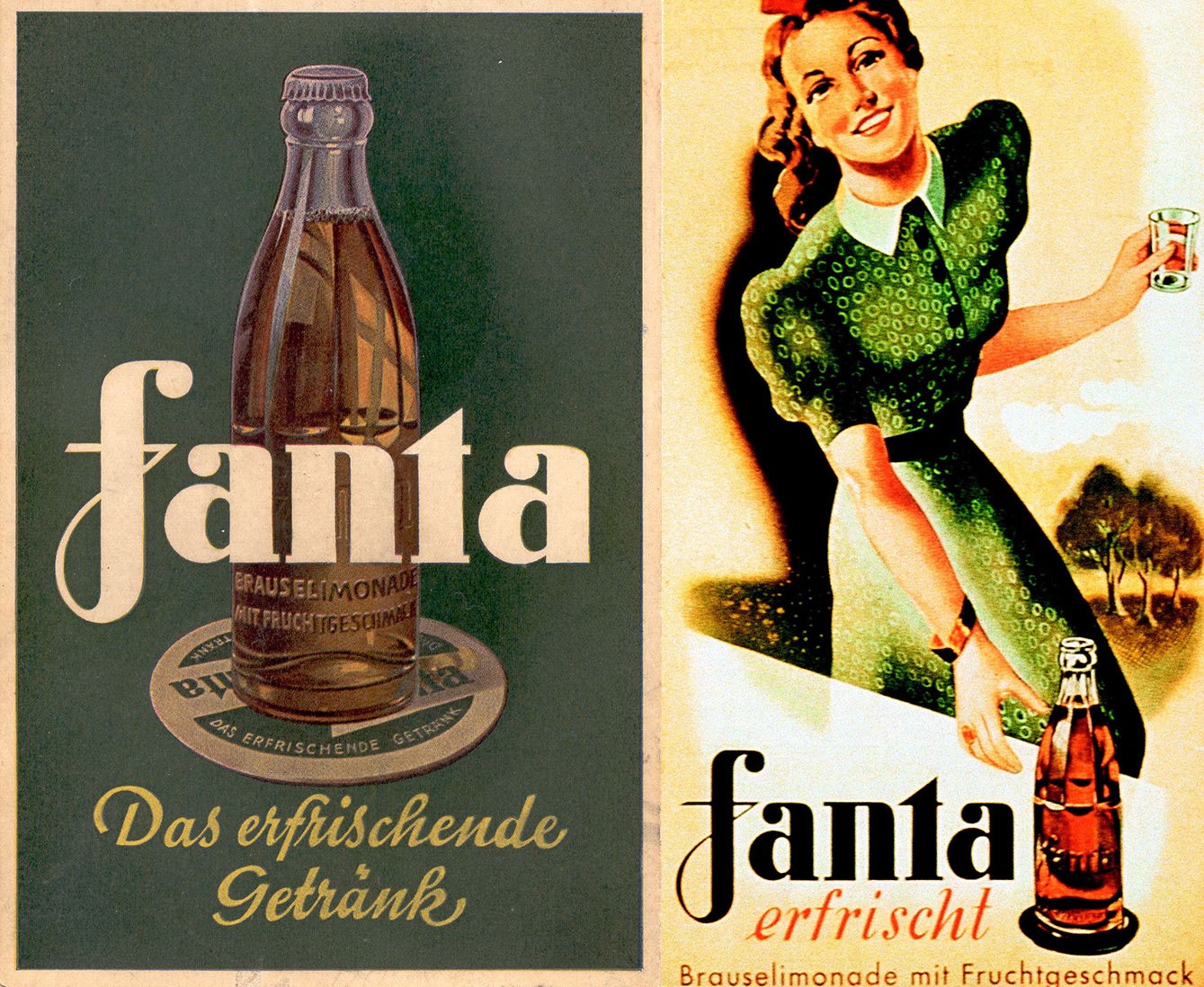
For a decade before the war broke out in 1939, the Coca-Cola Company in Germany operated uninterrupted. Once the two countries declared war on each other, the import of the syrup necessary for production was prevented by the embargo. Germany’s new Coca-Cola factory director, Max Keith, then decided to use the potential of the factory and produce a local soft drink that would serve as an equivalent to Coca-Cola.
He gathered the experts to make a combination of fruit pomace and whey―which were ingredients classified as “leftovers”―and thus Fanta was born. The name came from the German word for “fantasy,” as it really took an imaginative effort to make anything tasty from the given ingredients.
The drink was distributed to soldiers, but due to war rationing, its flavor was often used by military and civilians alike to sweeten their food instead of sugar, which was a wartime luxurious commodity.
After the war, Coca-Cola regained its factory in Germany and continued to produce Fanta under its trademark.

During WWII, a trade embargo was established against Nazi Germany – making the import of Coca-Cola syrup difficult. To circumvent this, Max Keith, the head of Coca-Cola Deutschland (Coca-Cola GmbH) decided to create a new product for the German market, using only ingredients available in Germany at the time, including whey and apple pomace—the “leftovers of leftovers”, as Keith later recalled. The name was the result of a brief brainstorming session, which started with Keith’s exhorting his team to “use their imagination” (Fantasie in German), to which one of his salesmen, Joe Knipp, immediately retorted “Fanta!”
The plant was effectively cut off from Coca-Cola headquarters during the war. After the war, The Coca-Cola Company regained control of the plant, formula, and the trademarks to the new Fanta product—as well as the plant profits made during the war.
During the war the Dutch Coca-Cola plant in Amsterdam (N.V. Nederlandsche Coca-Cola Maatschappij) suffered the same difficulties as the German Coca-Cola plant. Max Keith therefore also put the Fanta brand at the disposal of the Dutch Coca-Cola plant, of which he had been appointed the official Verwalter (caretaker). Dutch Fanta had a completely different recipe from German Fanta, elderberries being one of the main ingredients.
Fanta production was discontinued when the German and Dutch Coca-Cola branches were reunited with their parent company. Following the launch of several drinks by the Pepsi corporation in the 1950s, Coca-Cola competed by relaunching Fanta in 1955. The drink was heavily marketed in Europe, Asia, Africa and South America.

Categories
Dear Grumpy Advice on Teaching in Today's Classroom Hard Nosed Folks Both Good & Bad

Medieval Chivalry Wasn’t Just Knights and Valor

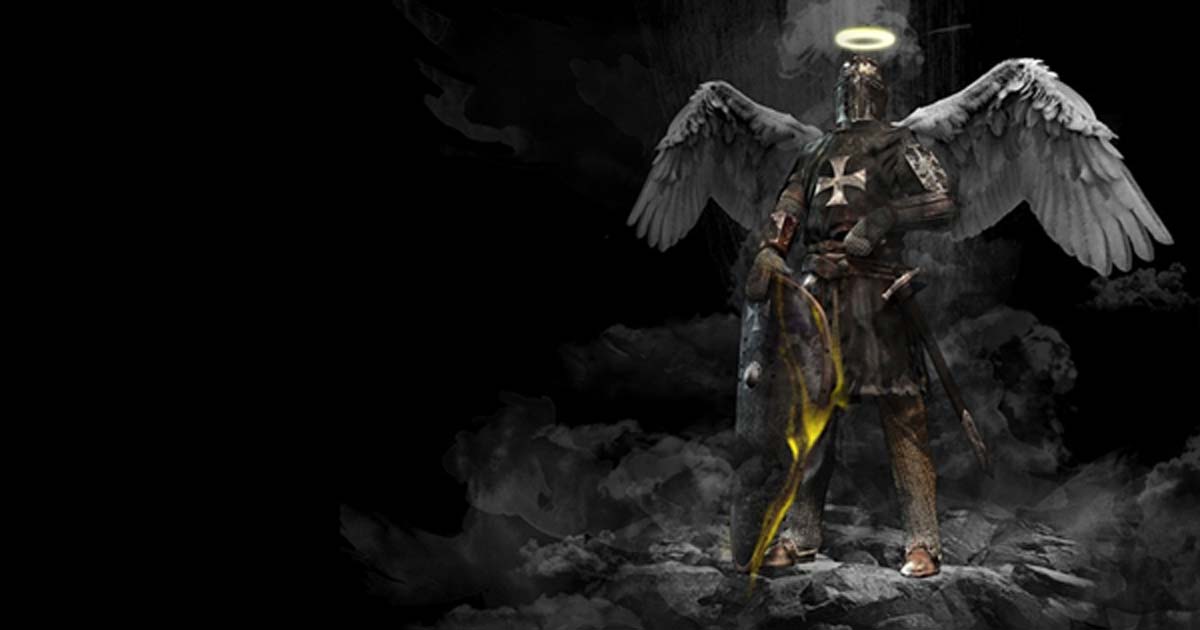
Medieval Knights are viewed as moral do-gooders.

Medieval Chivalry Wasn’t Just Knights and Valor

By Kathleen McGarvey University of Rochester
Our popular ideas of the chivalric world are off base, according to historian Richard Kaeuper. The gallant knights on horseback and banners unfurling before exciting tournaments largely come from people in the 19th century who saw the Middle Ages through a romantic haze.

The term “chivalry”—unlike “feudalism”—is a medieval one, and an essential concept for the age. It denotes “deeds of great valor performed by knights,” he says.
But it also refers to the collective body of knights present in an action and—most important—a set of ideas and practices. He writes that “virtually every medieval voice we can hear accepts a chivalric mentalité and seems anxious to advance it (and often to reform it toward some desired goal) as a key buttress to society, even to civilization.”
Chivalry is “pretty much a French creation,” and then it moves through Western Europe . The English, the Italians, the Spanish, and the Germans not only adopt it but also make it their own.

He identifies three phases of chivalry. The first, he calls “knighthood before chivalry”—the beginnings of the military profession in the period before kings and other noblemen would have called themselves knights.
In the second period, such high-born men begin to cultivate
And in the third phase, which he calls “chivalry beyond formal knighthood,” the influence of chivalry pervades society. By then, it’s a “set of ideas that organizes thought and behavior.”

Dressage by e_monk encapsulates the image of a chivalrous knight on horseback. (CC BY-NC-SA 2.0)

Dressage by e_monk encapsulates the image of a chivalrous knight on horseback. ( CC BY-NC-SA 2.0 )

Kaeuper uses five “model” knights to guide readers through the concepts of his book: cross-Channel, 13th-century hero William Marshal ; 14th-century king of Scotland Robert Bruce ; 14th-century French knight and author Geoffroi de Charny; late 14th-century Castilian warrior Don Pero Niño; and 15th-century English knight and author Thomas Malory, still famous for his Le Morte d’Arthur.
All the figures—whose lives illustrate changes over time in chivalry and its geographical range—are the authors or subjects of a major textual work. “They’re active participants” in the chivalric world, he says.
As a historian, Kaeuper finds enormous value in literary texts. “I use a lot of miracle stories, as well as standard imaginative literature,” he says. “They’re important—because they are imaginative, because they show what people are worried about, what they’re hoping for.”

Young Knight in a Landscape by Vittore Carpaccio. (Public Domain)

Young Knight in a Landscape by Vittore Carpaccio. ( Public Domain )

Lessons for today?

The title of his book is deliberate because Kaeuper wants to emphasize that what he is examining is medieval chivalry, not post-medieval chivalry or neo-Romantic chivalry.
Describing his task as “cutting a path through the thickets of Romanticism,” Kaeuper says that people in the 1800s in England and continental Europe, and to a lesser extent, the United States, looked back to the Middle Ages in a search for national identity and in an effort to escape problems of modernity.
“Far from dark,” he writes, “the medieval past was not only colorful and fascinating, but too important and too useful to be ignored. The romantic revivers did not and perhaps could not recognize that they were altering the original drastically and investing it with meanings that would have surprised its first practitioners.”
According to Kaeuper, the chivalric world resonates still—and he feels its power as it touches on issues of violence, religion, governance, and more.
“It’s a scary subject, because it’s so serious,” he says. “The editor of one of my books wrote to me and said, ‘This isn’t just about the Middle Ages. This is a modern book.’ That’s not the goal. My goal is to understand the Middle Ages. But you can see how it applies.
“If you start thinking modern as you go into the past, you distort the past. If you start with the past and see if it informs the present, I think you’re on the right path.”
Top image: Medieval Knights are viewed as moral do-gooders. Source: Public Domain
The article ‘ Medieval chivalry wasn’t just knights and valor’ by  Kathleen McGarvey-University of Rochester  was originally posted on Futurity and has been republished under a Creative Commons license.
Source: University of Rochester