Categories
A Victory! Dear Grumpy Advice on Teaching in Today's Classroom This great Nation & Its People Well I thought it was neat!

Uber Cool!

NASA’s Mars Perseverance Rover is about to drop a drone on Mars – Ingenuity helicopter will be the first flying machine on another planet and carries a piece of the Wright Flyer from 1903.

 

Categories
Dear Grumpy Advice on Teaching in Today's Classroom Interesting stuff Useful Shit Well I thought it was neat!

The First Aerial Bombing of the Continetial US

Bombing of Naco

From Wikipedia, the free encyclopedia
Bombing of Naco
Bombing Of Naco Arizona 1929.jpeg

A Dodge touring car destroyed by Patrick Murphy in the bombing of Naco.
Date April 2, 1929–April 6, 1929
Location NacoCochise County, Arizona, United States
Also known as The Naco incident
Type Aerial bombardment
Participants Patrick Murphy

The Bombing of Naco[1][2] was an international incident which occurred in the border town of Naco, Arizona, during the 1929 Escobar Rebellion. While rebel forces were battling Mexican ‘Federales‘ for control of the neighboring town of Naco, Sonora, the Irish mercenary and pilot Patrick Murphy was hired to bombard the government forces with improvised explosives dropped from his biplane. During the ensuing fighting, Murphy mistakenly dropped bombs on the American side of the international border on three occasions, causing significant damage to both private and government-owned property, as well as slight injuries to several American spectators watching the battle from across the border. The bombing, although unintentional, is noted for being the first aerial bombardment of the continental United States by a foreign power in history.[3]

Background[edit]

Late in 1928, as the Cristero War was raging in western Mexico, a new revolutionary faction led by General José Gonzalo Escobar drafted the “Plan of Hermosillo” and occupied the copper mining town of Cananea, Sonora, not far from the international border with the United States. Encouraged by their successes early on, they next decided to take control of Agua Prieta and Naco, both situated on the border with Arizona, knowing many of the locals were sympathetic to their cause and thinking the revenue generated by these two towns would be a good source of income for the revolution. From there, General Escobar intended to carry the war south and ultimately oust Emilio Portes Gil and take his place as president.[3]
The battle for Naco began early the next year, on the night of March 31, 1929. The rebels later claimed that they waited until 8:00 PM to attack, so as not to harm any American citizens shopping on the Mexican side of the border. To start the attack, the rebels loaded a train car full of explosives and sent it down the tracks toward the center of town. Unfortunately for the rebels, their plan failed when the train car derailed and exploded before reaching its intended target. After their failure with the train car, the rebels sought outside help from the United States and found it in an Irish cropduster named Patrick Murphy. Other pilots were hired as well, and the Federales found a pilot of their own named Jon Gorre. According to a witness, Murphy and Gorre were friends and although hired by opposing sides, would take turns making bombing runs on the opposing forces in Naco, Sonora, and would spend the night drinking together and enjoying themselves.[1][3][4]
An Arizona citizen named Charlie Elledge saw much of the fighting in Naco, Sonora, while working to repair the roof of the immigration building along the border. Elledge says that Murphy and Gorre bought their homemade “suitcase bombs” from the same man and that about 200 people gathered on the American side of the border each day to watch the fighting, like they had during the Mexican Revolution a decade before. Some brought their children and picnic baskets with lunch and others climbed on top of train cars sitting idle along the border for a better view of the action. The men gambled with each other on where the bombs would fall.[3]

Suitcase bomb[edit]

Diagram of the type of “suitcase bomb” dropped by Patrick Murphy and other pilots during the battle.

The so-called “suitcase bombs” used by Murphy and the other pilots in Naco were improvised aerial bombs made by packing dynamite, scrap iron, nails, nuts and bolts and other small pieces of material to use as fragmentation into a steel cylinder with fins and an improvised warhead made of dynamite caps and a nail for a firing pin. The bombs were then stuffed in suitcases that could be attached to the side of the plane and opened during flight to deliver the payload. Other improvised bombs were made the same way using five-gallon gasoline cans.[2][3]

Bombing[edit]

Murphy dropped one suitcase bomb each on his first two bombing runs, both of which turned out to be duds, and it was his third pass before managed to hit anything: the Mexican custom house near where the crowd of American spectators had formed. The resulting explosion sent small bits of shrapnel and other fragments into the crowd of spectators and caused the American patrons of the bars and clubs on the Mexican side of the border to rush back to their side of the line. Among the casualties were a reporter and a photographer, along with many others, but nobody was killed and all of the injuries were considered minor. After realizing the danger of watching the battle from such a short distance away, the crowd dispersed and went home, some to Fry and Buena.[3]
Neither Murphy or any of the other pilots were very successful in hitting their targets, but the high winds which regularly blow in the region in late spring and early summer most likely contributed to their inaccuracy. The first bomb to actually hit Arizona soil landed at 7:45 AM on April 2[4] and it was followed by others over the next few days. Murphy’s bombing runs smashed windows and otherwise damaged several buildings on the American side of the border, including a garage, the Phelps-Dodge Mercantile and the Haas Pharmacy. One bomb also struck the post office building, making it a federal offense, and another landed next to one of the idle train cars used by the crowd of spectators. Other bombs left large craters in the dirt streets and other unpaved surfaces. Yet another bomb landed on and devastated a regal Dodge touring car owned by a Mexican Army officer, which had been left on the American side of the border for safekeeping during the expected hostilities.[2][3]
Murphy’s bombs were responsible for at least a few deaths on the Mexican side of the border, but nobody was killed on the American side. The Americans suffered more casualties over the following days as bombs landed on their side, but none of the injuries were life-threatening. The final bombardment took place on April 6, when the rebels launched their final attack to take control of the city. Murphy was shot down by Mexican soldiers the following day, but he managed to escape and get across the border, where he was quickly arrested by American authorities. He was released for unspecified reasons after only a couple nights in jail. After being repulsed in their final attack, the rebels retreated to Cananea by way of Agua Prieta, marking the beginning of the end of the revolution in the north.[1][3]

Aftermath[edit]

The United States Army was slow in responding to the situation, having closed all military posts in Arizona the same year, with the exception of Fort Huachuca. Fort Huachuca, which is relatively close to Naco, sent two companies of Buffalo Soldiers to occupy Naco, Arizona, and prevent the fighting from spreading into American territory. The commander of the detachment positioned his men along the border and had them prepare to attack at a moment’s notice while he crossed the border and demanded that the rebel commanders stop dropping bombs on the Arizona side. By this time, however, the rebels were already defeated, and so the Buffalo Soldiers never had to engage. A squadron of eighteen warplanes was also dispatched from somewhere in Texas to shoot down any plane violating American airspace, but it never went into action either, and was withdrawn sometime later without incident.[1][3][4]
Murphy never faced charges for his bombing of Naco, Arizona, which became the first aerial bombardment of the continental United States by a foreign power in American history. According to local rumor, the rebel commander, General Escobar, kept a plane loaded with gold near the border so he could escape if the revolution collapsed. When it did, Escobar abandoned his troops and flew into Arizona, where he asked for and received asylum from the local authorities. The rebellion officially came to an end not long after the incident in Naco.[1][3]
Popular culture[edit]

The Bombing of Naco

Categories
Anti Civil Rights ideas & "Friends" Dear Grumpy Advice on Teaching in Today's Classroom Grumpy's hall of Shame Some Sick Puppies!

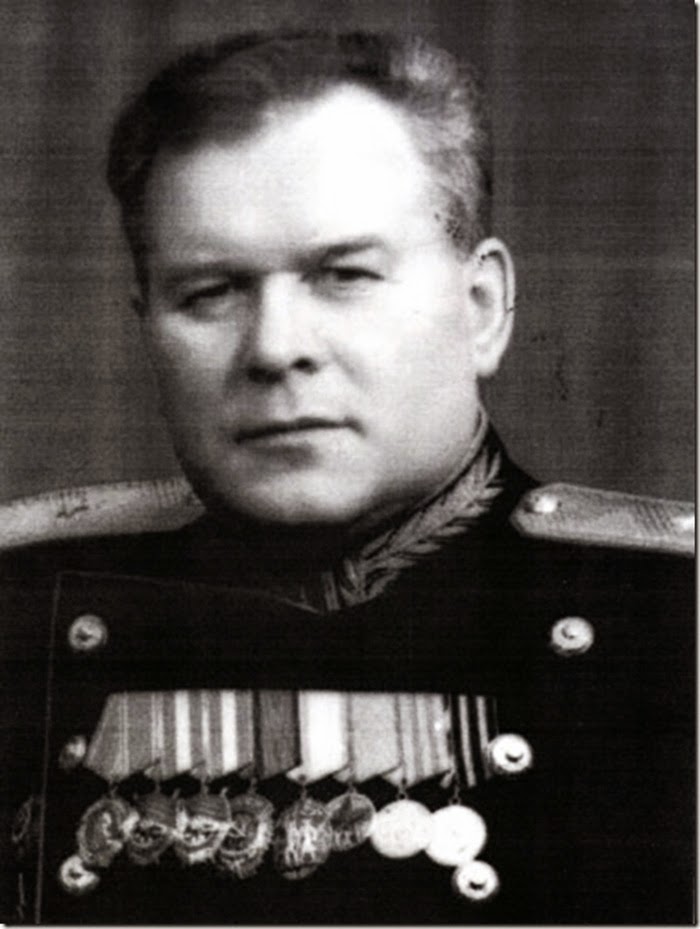
May he rot in Hell – Vasily Blokhin, history’s most prolific executioner

Vasili Mikhailovich Blokhin

Vasily Mikhailovich Blokhin.

Vasily Blokhin is recorded as having executed tens of thousands of prisoners by his own hand, including his killing of about 7,000 Polish prisoners of war during the Katyn massacre in spring 1940, making him the most prolific official executioner in recorded world history. He was the NKVD major in charge of executing the Polish officers from the Ostashkov camp, and he believed in personally doing the killing that his superiors had ordered him to supervise.

Born in 1885, he was known as the NKVD’s chief executioner, having been hand-picked for this position by Joseph Stalin himself. Blokhin personally killed tens of thousand of men and women during Stalin’s Great Purges of the 1930s, so it was only natural that the NKVD would turn to him when it came time to dispatch the officers held in the Soviet prison camps. Along with a team of about thirty NKVD men from Moscow, mainly drivers and prison guards, Blokhin arrived at the NKVD prison in Kalinin (Tver) and set himself up in a sound-proofed cellar room that had a sloping floor for drainage. He then put on his special uniform, consisting of a leather cap, long leather apron, and elbow-length gloves. On a table next to him was a briefcase filled with his own personal Walther PPK pistols, for Blokhin, a true artist at his trade, would use no one else’s tools but his own.

Vasili Blokhin's official photo

Vasily Blokhin’s official photo.

After the prisoner’s identity was verified, he was brought handcuffed into the cellar room where Blokhin awaited in his long apron, like some horrible butcher. One guard later testified: “The men held [the prisoner’s] arms and [Blokhin] shot him in the base of the skull…that’s all”. Blokhin worked fast and efficiently, killing an average of one men every three minutes during the course of ten-hour nights – the killings were always done at night, so that the bodies could be disposed of in darkness.

Although this has never been completely proven, historians suspect that Blokhin shot 7,000 men over a period of twenty-eight days, which would make him one of the most prolific murderers of all time. However many people he killed, Blokhin was consistently promoted by his superiors for performing “special tasks”. He lost his job after Stalin died. The cause of Blokhin’s death, in 1955, was listed as suicide.
Katyn massacre
The Katyn massacre, also known as the Katyn Forest massacre was a mass execution of Polish nationals carried out by the People’s Commissariat for Internal Affairs (NKVD), the Soviet secret police, in April and May 1940. The massacre was prompted by NKVD chief Lavrentiy Beria’s proposal to execute all captive members of the Polish Officer Corps, dated 5 March 1940. This official document was approved and signed by the Soviet Politburo, including its leader, Joseph Stalin. The number of victims is estimated at about 22,000.

Interesting facts:

  • Blokhin initially decided on an ambitious quota of 300 executions per night; and engineered an efficient system in which the prisoners were individually led to a small antechamber—which had been painted red and was known as the “Leninist room”—for a brief and cursory positive identification, before being handcuffed and led into the execution room next door. The room was specially designed with padded walls for soundproofing, a sloping concrete floor with a drain and hose, and a log wall for the prisoners to stand against.
  • He had brought a briefcase full of his own Walther pistols, since he did not trust the reliability of the standard-issue Soviet TT-30 for the frequent, heavy use he intended. The use of a German pocket pistol, which was commonly carried by German police and intelligence agents, also provided plausible deniability of the executions if the bodies were discovered later. Another reason he used the Walther rather than his standard issue Tokarev was the blow back. The Walther’s lower recoil made it easier for him (as well as other executioners for the NKVD) to kill large numbers of people in one night. Walthers were readily available due to the cooperation between the Soviets and Nazi’s in which the Germans ended up giving a fair amount of arms to their Soviet Allies.
  • Each night, 24–25 trenches, measuring eight to ten meters (24.3 to 32.8 feet) total, were dug by a bulldozer to hold the night’s corpses, and each trench was covered up before dawn.
  • Blokhin and his team worked without pause for ten hours each night, with Blokhin executing an average of one prisoner every three minutes. At the end of the night, Blokhin provided vodka to all his men.
  • On April 27, 1940, Blokhin secretly received the Order of the Red Banner and a modest monthly pay premium as a reward from Joseph Stalin for his “skill and organization in the effective carrying out of special tasks”.
  • His count of 7,000 shot in 28 days remains the most organized and protracted mass murder by a single individual on record; and saw him being named the Guinness World Record holder for ‘Most Prolific Executioner’ in 2010.
  • Blokhin’s rank was stripped from him in the de-Stalinization campaigns of Nikita Khrushchev. He reportedly sank into alcoholism, went insane, and died February 3, 1955, with the official cause of death listed as “suicide”.
  • The Soviet government admitted that the Soviet Secret Police were responsible for the Katyn massacre in 1990. Before that they claimed that the Germans did it. The Germans actually invited an international delegation to investigate the mass grave in 1943, which also concluded that the Soviets had done it. In order to try to ‘get away’ with it, the Soviets staged show trials against German POWs to blame them for Katyn, and tried to hold German defendants accountable for Katyn at Nuremberg (which the Allies refused).

Vasily Blokhin was buried in 1955 at the Novodevichy Cemetery. In the late 1960’s, after Khrushchev era ended, the titles and medals were returned to him, and he himself was rehabilitated by the state. The history’s most prolific executioner found a tomb to rest, unlike ten thousands of people killed by him.
Vasili Blokhin tomb

Vasily Blokhin tomb.

Categories
Dear Grumpy Advice on Teaching in Today's Classroom Some Red Hot Gospel there! Well I thought it was funny!

Yep

Categories
Dear Grumpy Advice on Teaching in Today's Classroom Well I thought it was neat!

Something for the Science Teachers – A Tour of Asteroid Bennu

Categories
Anti Civil Rights ideas & "Friends" Born again Cynic! Dear Grumpy Advice on Teaching in Today's Classroom Grumpy's hall of Shame

Something that is really sad to read – Confessions of a Public Defender

Michael Smith, American Renaissance, May 9, 2014

Still liberal after all these years.
[Editor’s Note: This is just one of thirteen essays in our newly-released collection of first-hand reports about the reality of race, Face to Face with Race.]
I am a public defender in a large southern metropolitan area. Fewer than ten percent of the people in the area I serve are black but over 90 percent of my clients are black. The remaining ten percent are mainly Hispanics but there are a few whites.
I have no explanation for why this is, but crime has racial patterns. Hispanics usually commit two kinds of crime: sexual assault on children and driving under the influence. Blacks commit many violent crimes but very few sex crimes. The handful of whites I see commit all kinds of crimes. In my many years as a public defender I have represented only three Asians, and one was half black.
As a young lawyer, I believed the official story that blacks are law abiding, intelligent, family-oriented people, but are so poor they must turn to crime to survive. Actual black behavior was a shock to me.
The media invariably sugarcoat black behavior. Even the news reports of the very crimes I dealt with in court were slanted. Television news intentionally leaves out unflattering facts about the accused, and sometimes omits names that are obviously black. All this rocked my liberal, tolerant beliefs, but it took me years to set aside my illusions and accept the reality of what I see every day. I have now served thousands of blacks and their families, protecting their rights and defending them in court. What follow are my observations.
Although blacks are only a small percentage of our community, the courthouse is filled with them: the halls and gallery benches are overflowing with black defendants, families, and crime victims. Most whites with business in court arrive quietly, dress appropriately, and keep their heads down. They get in and get out–if they can–as fast as they can. For blacks, the courthouse is like a carnival. They all seem to know each other: hundreds and hundreds each day, gossiping, laughing loudly, waving, and crowding the halls.
When I am appointed to represent a client I introduce myself and explain that I am his lawyer. I explain the court process and my role in it, and I ask the client some basic questions about himself. At this stage, I can tell with great accuracy how people will react. Hispanics are extremely polite and deferential. An Hispanic will never call me by my first name and will answer my questions directly and with appropriate respect for my position. Whites are similarly respectful.
A black man will never call me Mr. Smith; I am always “Mike.” It is not unusual for a 19-year-old black to refer to me as “dog.” A black may mumble complaints about everything I say, and roll his eyes when I politely interrupt so I can continue with my explanation. Also, everything I say to blacks must be at about the third-grade level. If I slip and use adult language, they get angry because they think I am flaunting my superiority.
At the early stages of a case, I explain the process to my clients. I often do not yet have the information in the police reports. Blacks are unable to understand that I do not yet have answers to all of their questions, but that I will by a certain date. They live in the here and the now and are unable to wait for anything. Usually, by the second meeting with the client I have most of the police reports and understand their case.
Unlike people of other races, blacks never see their lawyer as someone who is there to help them. I am a part of the system against which they are waging war. They often explode with anger at me and are quick to blame me for anything that goes wrong in their case.
Black men often try to trip me up and challenge my knowledge of the law or the facts of the case. I appreciate sincere questions about the elements of the offense or the sentencing guidelines, but blacks ask questions to test me. Unfortunately, they are almost always wrong in their reading, or understanding, of the law, and this can cause friction. I may repeatedly explain the law, and provide copies of the statute showing, for example, why my client must serve six years if convicted, but he continues to believe that a hand-written note from his “cellie” is controlling law.
The risks of trial
The Constitution allows a defendant to make three crucial decisions in his case. He decides whether to plea guilty or not guilty. He decides whether to have a bench trial or a jury trial. He decides whether he will testify or whether he will remain silent. A client who insists on testifying is almost always making a terrible mistake, but I cannot stop him.
Most blacks are unable to speak English well. They cannot conjugate verbs. They have a poor grasp of verb tenses. They have a limited vocabulary. They cannot speak without swearing. They often become hostile on the stand. Many, when they testify, show a complete lack of empathy and are unable to conceal a morality based on the satisfaction of immediate, base needs. This is a disaster, especially in a jury trial. Most jurors are white, and are appalled by the demeanor of uneducated, criminal blacks.
Prosecutors are delighted when a black defendant takes the stand. It is like shooting fish in a barrel. However, the defense usually gets to cross-examine the black victim, who is likely to make just as bad an impression on the stand as the defendant. This is an invaluable gift to the defense, because jurors may not convict a defendant—even if they think he is guilty—if they dislike the victim even more than they dislike the defendant.
Most criminal cases do not go to trial. Often the evidence against the accused is overwhelming, and the chances of conviction are high. The defendant is better off with a plea bargain: pleading guilty to a lesser charge and getting a lighter sentence.
The decision to plea to a lesser charge turns on the strength of the evidence. When blacks ask the ultimate question—”Will we win at trial?”—I tell them I cannot know, but I then describe the strengths and weaknesses of our case. The weaknesses are usually obvious: There are five eyewitnesses against you. Or, you made a confession to both the detective and your grandmother. They found you in possession of a pink cell phone with a case that has rhinestones spelling the name of the victim of the robbery. There is a video of the murderer wearing the same shirt you were wearing when you were arrested, which has the words “In Da Houz” on the back, not to mention you have the same “RIP Pookie 7/4/12” tattoo on your neck as the man in the video. Etc.
If you tell a black man that the evidence is very harmful to his case, he will blame you. “You ain’t workin’ fo’ me.” “It like you workin’ with da State.” Every public defender hears this. The more you try to explain the evidence to a black man, the angrier he gets. It is my firm belief many blacks are unable to discuss the evidence against them rationally because they cannot view things from the perspective of others. They simply cannot understand how the facts in the case will appear to a jury.
This inability to see things from someone else’s perspective helps explain why there are so many black criminals. They do not understand the pain they are inflicting on others. One of my robbery clients is a good example. He and two co-defendants walked into a small store run by two young women. All three men were wearing masks. They drew handguns and ordered the women into a back room. One man beat a girl with his gun. The second man stood over the second girl while the third man emptied the cash register. All of this was on video.
My client was the one who beat the girl. When he asked me, “What are our chances at trial?” I said, “Not so good.” He immediately got angry, raised his voice, and accused me of working with the prosecution. I asked him how he thought a jury would react to the video. “They don’t care,” he said. I told him the jury would probably feel deeply sympathetic towards these two women and would be angry at him because of how he treated them. I asked him whether he felt bad for the women he had beaten and terrorized. He told me what I suspected—what too many blacks say about the suffering of others: “What do I care? She ain’t me. She ain’t kin. Don’t even know her.”
No fathers
As a public defender, I have learned many things about people. One is that defendants do not have fathers. If a black even knows the name of his father, he knows of him only as a shadowy person with whom he has absolutely no ties. When a client is sentenced, I often beg for mercy on the grounds that the defendant did not have a father and never had a chance in life. I have often tracked down the man’s father–in jail–and have brought him to the sentencing hearing to testify that he never knew his son and never lifted a finger to help him. Often, this is the first time my client has ever met his father. These meetings are utterly unemotional.
Many black defendants don’t even have mothers who care about them. Many are raised by grandmothers after the state removes the children from an incompetent teenaged mother. Many of these mothers and grandmothers are mentally unstable, and are completely disconnected from the realities they face in court and in life. A 47-year-old grandmother will deny that her grandson has gang ties even though his forehead is tattooed with a gang sign or slogan. When I point this out in as kind and understanding way as I can, she screams at me. When black women start screaming, they invoke the name of Jesus and shout swear words in the same breath.
Black women have great faith in God, but they have a twisted understanding of His role. They do not pray for strength or courage. They pray for results: the satisfaction of immediate needs. One of my clients was a black woman who prayed in a circle with her accomplices for God’s protection from the police before they would set out to commit a robbery.
The mothers and grandmothers pray in the hallways–not for justice, but for acquittal. When I explain that the evidence that their beloved child murdered the shop keeper is overwhelming, and that he should accept the very fair plea bargain I have negotiated, they will tell me that he is going to trial and will “ride with the Lord.” They tell me they speak to God every day and He assures them that the young man will be acquitted.
The mothers and grandmothers do not seem to be able to imagine and understand the consequences of going to trial and losing. Some–and this is a shocking reality it took me a long time to grasp–don’t really care what happens to the client, but want to make it look as though they care. This means pounding their chests in righteous indignation, and insisting on going to trial despite terrible evidence. They refuse to listen to the one person–me–who has the knowledge to make the best recommendation. These people soon lose interest in the case, and stop showing up after about the third or fourth court date. It is then easier for me to convince the client to act in his own best interests and accept a plea agreement.
Part of the problem is that underclass black women begin having babies at age 15. They continue to have babies, with different black men, until they have had five or six. These women do not go to school. They do not work. They are not ashamed to live on public money. They plan their entire lives around the expectation that they will always get free money and never have to work. I do not see this among whites, Hispanics, or any other people.
The black men who become my clients also do not work. They get social security disability payments for a mental defect or for a vague and invisible physical ailment. They do not pay for anything: not for housing (Grandma lives on welfare and he lives with her), not for food (Grandma and the baby-momma share with him), and not for child support. When I learn that my 19-year-old defendant does not work or go to school, I ask, “What do you do all day?” He smiles. “You know, just chill.” These men live in a culture with no expectations, no demands, and no shame.
If you tell a black to dress properly for trial, and don’t give specific instructions, he will arrive in wildly inappropriate clothes. I represented a woman who was on trial for drugs; she wore a baseball cap with a marijuana leaf embroidered on it. I represented a man who wore a shirt that read “rules are for suckers” to his probation hearing. Our office provides suits, shirts, ties, and dresses for clients to wear for jury trials. Often, it takes a whole team of lawyers to persuade a black to wear a shirt and tie instead of gang colors.
From time to time the media report that although blacks are 12 percent of the population they are 40 percent of the prison population. This is supposed to be an outrage that results from unfair treatment by the criminal justice system. What the media only hint at is another staggering reality: recidivism. Black men are arrested and convicted over and over. It is typical for a black man to have five felony convictions before the age of 30. This kind of record is rare among whites and Hispanics, and probably even rarer among Asians.

StatsSource: Bureau of Justice Statistics.

At one time our office was looking for a motto that defined our philosophy. Someone joked that it should be: “Doesn’t everyone deserve an eleventh chance?”
I am a liberal. I believe that those of us who are able to produce abundance have a moral duty to provide basic food, shelter, and medical care for those who cannot care for themselves. I believe we have this duty even to those who can care for themselves but don’t. This world view requires compassion and a willingness to act on it.
My experience has taught me that we live in a nation in which a jury is more likely to convict a black defendant who has committed a crime against a white. Even the dullest of blacks know this. There would be a lot more black-on-white crime if this were not the case.
However, my experience has also taught me that blacks are different by almost any measure to all other people. They cannot reason as well. They cannot communicate as well. They cannot control their impulses as well. They are a threat to all who cross their paths, black and non-black alike.
I do not know the solution to this problem. I do know that it is wrong to deceive the public. Whatever solutions we seek should be based on the truth rather than what we would prefer was the truth. As for myself, I will continue do my duty to protect the rights of all who need me.

Categories
Dear Grumpy Advice on Teaching in Today's Classroom

It seems that the Romans are always amazing me! (It also helps to have an unlimited budget and unending line of Slaves too!)

Theatre of Termessos, Pisidia (Turkey)

Roman theatre built in the 2nd century CE. Annia Aurelia Faustina, a grandniece of Marcus Aurelius and a short-term empress (221 CE)  had a large estate in Pisidia.
image.png

Ancient Epidaurus, Greece

image.png
Arco Felice Cumae Italy They never did think small did they? Grumpy
Categories
A Victory! All About Guns Dear Grumpy Advice on Teaching in Today's Classroom War Well I thought it was neat!

The Brief Moment when the Confederacy Ruled the Sea

A New age of Warfare and advent of the Ships of Iron.

Iron Ships of War
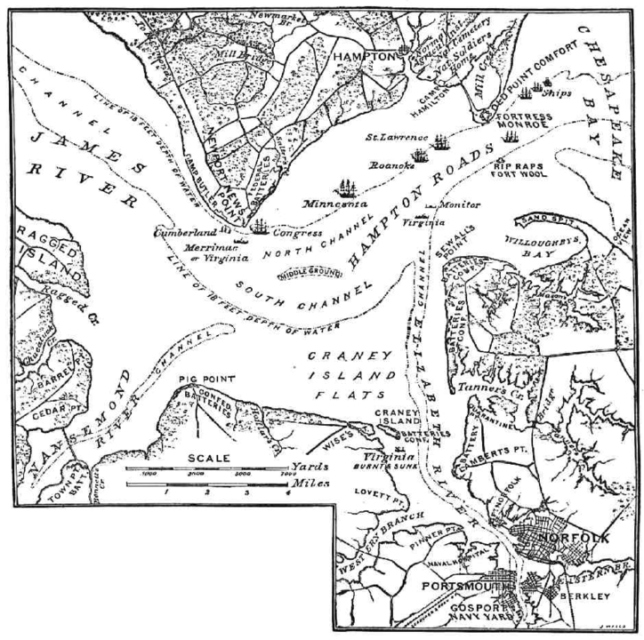
It was March 8, 1862, a Saturday. On the waters of Hampton Roads off Newport News, Virginia – where the Chesapeake Bay empties into the Atlantic Ocean – the Federal warships Cumberland and Congress bobbed easily on a light chop.
The sky was blue, the day warming, the morning uneventful. Drying wash flapped on a light breeze, harmonicas offered-up pleasant tunes, as sailors went about their usual duties. Then, abruptly, around 12:30 in the afternoon, all that changed.
Across the Bay, far to the south, emerging from the Elizabeth River at Norfolk, something odd, something never seen before, had just been spotted. Heads turned, fingers pointed, as binoculars and telescopic glasses were quickly yanked from their cases. A trail of black smoke could be seen rising from a smokestack, below that what appeared to be an enormous hull moving very slowly, bearing WNW.
“I wish you would take the glass and have a look over there, sir,” said the quartermaster of the watch. “I believe that thing is a-comin’ down at last.”
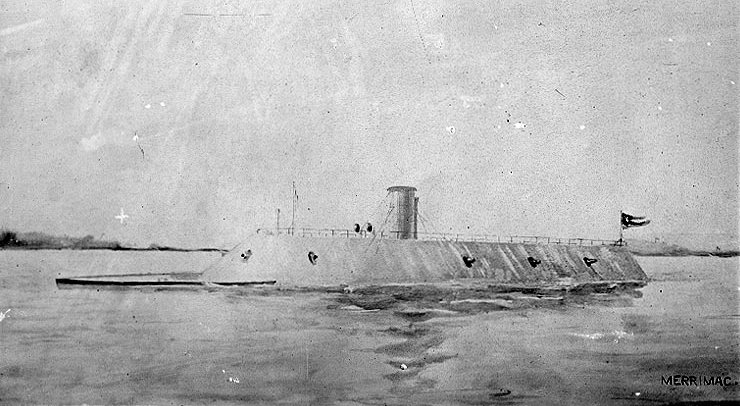
CSS Virginia (ex-USS Merrimack)
General Quarters was sounded. Drums beat the rhythm as men scurried cross decks, pulling down laundry, racing to the guns, preparing for battle. Truthfully, there was no rush. It would take almost an hour before the hulking mass would be near enough to spot the gun tubes that lined its casemate, or the iron that covered its hull.
At that point there was no doubt, however, it was the rechristened USS Merrimack, clearly identifiable now by the Confederate, seven-star, blue naval jack flying from her stern. The Confederates had renamed her Virginia, but everyone – friend and foe alike – still called her Merrimack.
She had been joined by several vessels of the Confederacy’s James River Squadron – Raleigh, Beaufort, Jamestown, Patrick Henry, along with the tug, Teaser – all of them smaller, and far less formidable than the Merrimack.
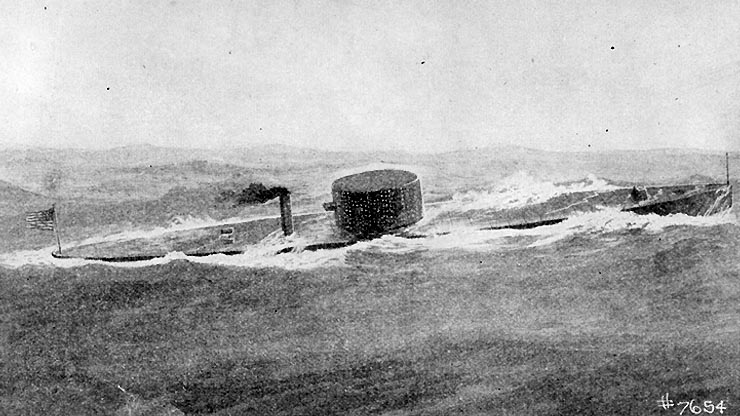
USS Monitor
USS Monitor
The Merrimack had been a frigate under construction at the Federal Navy’s yard in Norfolk at the beginning of the war. That yard was then put to the torch when the Navy decided to abandon Norfolk to the Confederacy, but much of the Merrimack survived the flames. Salvaged and retooled as an ironclad, the vessel, now a lumbering, iron monster with sloping sides, and a formidable collection of guns, looked far more like some leviathan risen from the deep, than any recognizable vessel of the day.
As Cumberland and Congress cleared decks for action, the other wooden ships of the North Atlantic Blockading Squadron – St. Lawrence, Roanoke, and Minnesota attempted to get underway and escape as quickly as possible. Cumberland, a powerful sloop-of-war, was the flagship of the Home Fleet, a wood-and-sail vessel of the Raritan-class. She had been recently streamlined and refitted with twenty-two 9” Dahlgren smoothbore cannon, one 10” Dahlgren, and a 70 lb. naval rifle – a daunting array of weaponry.
But the Virginia – now armed with three 9” Dahlgren guns on each broadside, a Brooke rifle fore and aft, and an additional Brooke rifle on each broadside – appeared unimpressed. The ironclad churned-on slowly but steadily, straight at Congress, a wood and sail frigate bearing 48 32 pounder guns, and four 8” smoothbore cannon.
Map of events of the Battle of Hampton Roads
The crews of both Federal warships looked-on in amazement as the Virginia closed to within two hundred yards. “The Congress then fired a full broadside point-blank. Nine hundred pounds of hurtling metal smashed fully home. In horror the gunners saw the balls ricochet into the air likes pebbles off a roof.”
The Virginia was not only unscathed by the broadside, but unfazed. Hardly a metal plate had been rattled loose. The ironclad then came about and unleashed a four-gun broadside, tearing Congress to pieces. Below decks, smoke billowed, men screamed, and blood pooled like water. The era of the wooden warship – an era that had reigned for at least five thousand years – had just been brought to an abrupt and frightful end. The age of the iron warship had dawned.
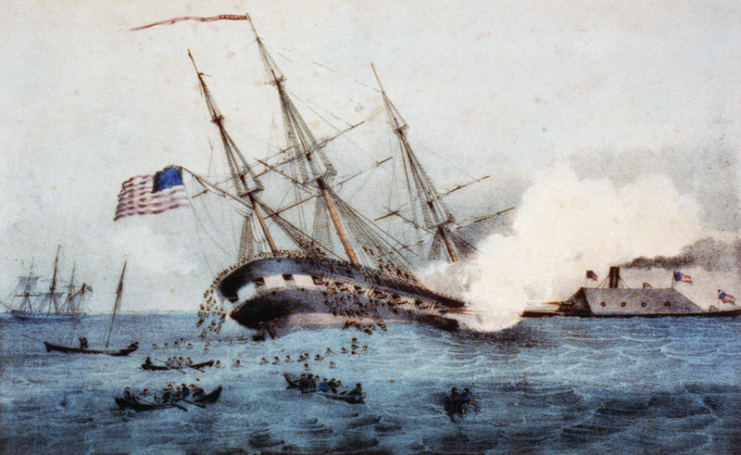
As Congress took on water, Virginia came about, then headed straight for the Cumberland. Attached to her prow was an iron ram – a weapon not used widely since the days of Greece and Rome – with which she intended to dispatch the Federal sloop-of-war. The ironclad fired one shot with its forward gun which exploded below decks, then rammed Cumberland dead on the bow.
Sinking of Cumberland by the ironclad Virginia
Mayhem reigned onboard the Federal sloop as the ironclad backed away full astern, turned slightly, and found a comfortable position just off Cumberland’s shattered bow where she raked the Federal warship with impunity. The Cumberland soon went-up in smoke and flames. That accomplished, the ironclad returned to the wounded Congress, which was trying to limp away to safety.
But Virginia caught her easily and turned broadside. Raking the frigate from stem-to-stern, the ironclad simply tore her to shreds, and the Congress eventually blew to pieces when her magazines took fire
By day’s end the Federal squadron had been virtually annihilated. Both Congress and Cumberland were on the bottom, while the other three Federal vessels had run aground in their haste to escape. For those looking on, it appeared the Confederacy had developed a superweapon.
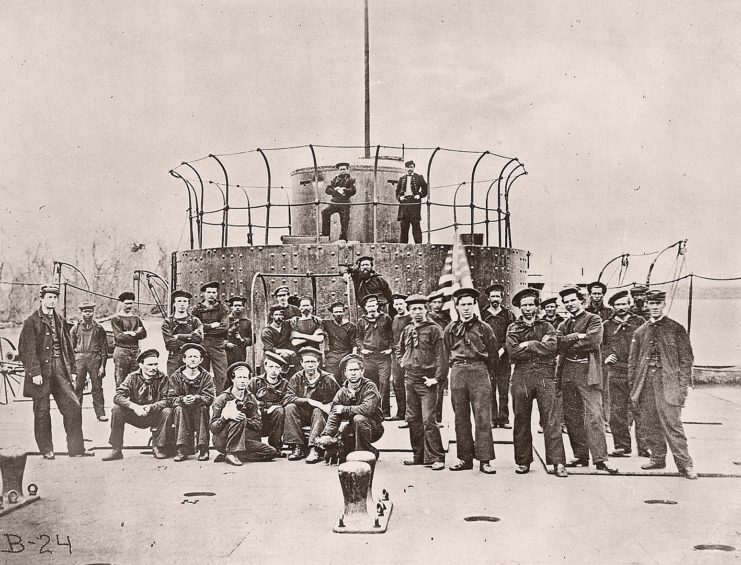
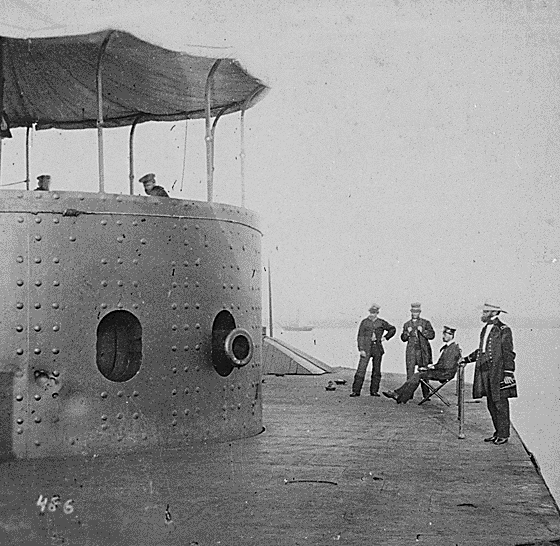
Photo of crew members aboard the USS Monitor
Thus, as the Virginia returned to its berth that evening –intent on returning the following morning to finish-off the stranded Federal squadron – it appeared the Confederacy had engineered a new weapon that would, not only break the Federal naval blockade, but revolutionize naval warfare entirely.
As the Virginia slipped away on the evening tide, however – and unknown to everyone present – another ironclad was then steaming-up Bay. As if Neptune, with an eye for high drama, had written the script himself, this ironclad finally cut its engines, dropped anchor, and took-up a position in defense of the stranded Minnesota. It was, of course, the USS Monitor.
The brainchild of Swedish engineer John Ericsson, his design was so radical that initially the navy board hardly knew what to make of it. The Monitor was only 172’ in length, 41’ abeam. On the deck sat a small pilot house, a revolving turret sporting 2 11” Dahlgren naval rifles, and nothing more. Constructed on New York’s East River in just over 100 days, having received reports of the Virginia’s imminent completion, Monitor had shoved-off for Virginia in early March.
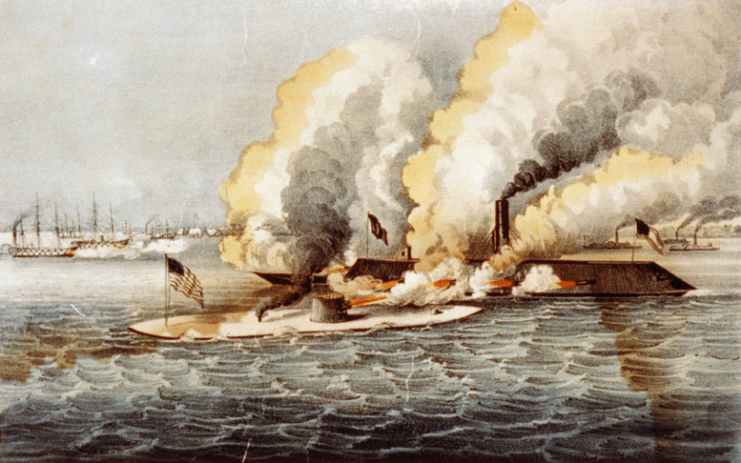
Ironclads engaged in terrific combat by Currier and Ives
Meanwhile, in Washington, President Lincoln, along with his cabinet, having received telegraphed reports of the prior day’s calamity, sat in benumbed silence. No one had the slightest idea what to do. Lincoln was reportedly so overwrought he could barely speak.
Secretary of War Edwin Stanton finally broke the silence, railing: “The Merrimack would sink every vessel in the navy, capture Fort Monroe, cut off Burnside in the Carolina sounds, retake Port Royal, and lay New York and Boston under ‘contribution.’” Then he threw-open a window, half-expecting to see the Merrimac steaming-up the Potomac River, presumably to open fire on the White House. According to Gideon Welles, then Secretary of the Navy, it was “the worst day of the war.”
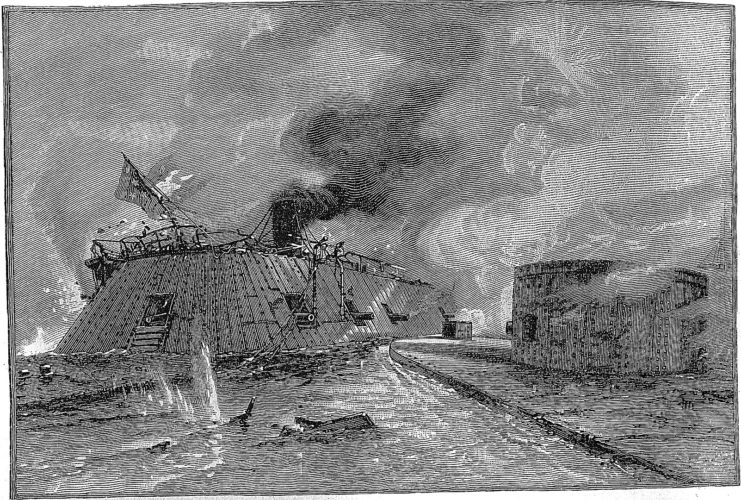
The heart of battle, from an 1871 wood engraving published by A.S. Barnes & Co.
The morning following the Virginia’s frightening debut, March 9, the Confederate ram again journeyed across the Bay with the intention of destroying the stranded Minnesota, only to discover the tiny Monitor bobbing in the water like “a cheese on a raft,” gamely prepared to give battle. Much like a heavyweight fight, crowds jammed and jostled along the shoreline to watch as the spectacle unfolded.
The Virginia opened the engagement with a broadside that flew high, and the Monitor returned fire, striking Virginia, but doing little damage. Then, for hours-on-end, the combatants circled at close quarters, repeatedly scoring hits, but neither able to strike a decisive blow. Virginia attempted to ram, but the more maneuverable Monitor dodged away, unharmed.
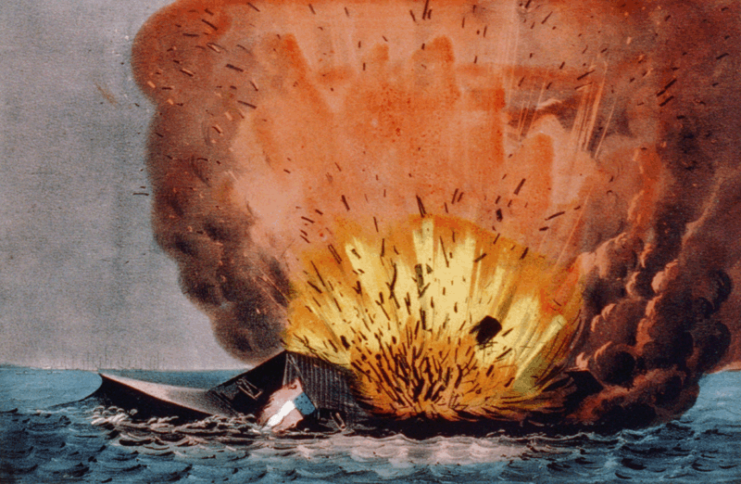
Destruction of the rebel monster Merrimac off Craney Island, May 11, 1862, by Currier and Ives
Damage was done to both vessels, but nothing disabling. In fact, at one point during the confrontation, the Virginia’s guns fell oddly silent. Catesby Jones, the ironclad’s commander, inquired as to the pause. From the gundeck Lieutenant Eggleston responded wryly, “I find that I can do her as much damage by snapping my thumb at her every two minutes and a half.”
A shot finally struck the Monitor’s pilot house, momentary blinding the captain, and the vessel withdrew momentarily to make a change in command. It soon returned to combat, however, only to discover the Virginia’s – thinking its foe had given-up the fight – departed. Both sides subsequently claimed victory, but there is little question the first clash of iron warships had ended in a draw.
Stereograph of Monitor after the battle, July 1862
Regardless of wins and losses, however, every wooden warship then in existence had been instantly rendered obsolete, naval blueprints altered forever. And while Virginia’s had made a fine showing, it would be the gritty little Monitor with its low silhouette and revolving gun turret, that would inspire naval concepts of the future.
Indeed, it would not be overstatement to suggest that every battleship of the 20th Century – from Dreadnaught to Bismarck to Missouri – had direct bloodlines back to John Ericsson’s innovative design, and that on March 9, 1862 a page in the book of naval warfare had been emphatically turned.
Categories
Born again Cynic! Dear Grumpy Advice on Teaching in Today's Classroom

Why do we still have this?

Image result for is daylight saving time still a thing

Categories
Dear Grumpy Advice on Teaching in Today's Classroom Useful Shit Well I thought it was neat!

The Secret Plan for the US to Invade Canada Before WW2 – War Plan Red