Category: Dear Grumpy Advice on Teaching in Today’s Classroom
A really interesting historical site in Saint Malo (Saint Servan), France dating from the Roman period, although the most obvious relics of its past are the extensive WW2 German fortifications making it one of the most significant elements in Festung St Malo.
Having a couple of hours to spare in St Malo before catching the ferry or the train, the Fort de la Cité d’Alet, St Malo is well worth a visit. For those who have an interest in the international boundary and front line which existed in the area around the Channel Islands between warring England / Britain and France over the seven and a half centuries, it’s a reminder of the defences the French put up to repel frequent English raids.
For those with an interest in twentieth century history, it’s a massive German fortified position to defend St Malo, the Germans’ main gateway from occupied France to the occupied Channel Islands, from Allied attack.
The area of la Cité d’Alet dates back to the Roman period when the promontory was topped by a fortified town, of which little remains except a few small sections of “Roman” walls. By the end of the seventeenth century, it was known as “la Cité d’Alet” and was fortified by a gun battery to protect the entrance to the Rance river.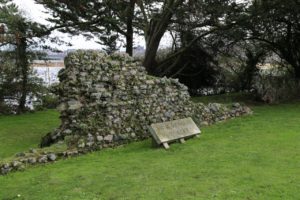
For those with an interest in twentieth century history, it’s a massive German fortified position to defend St Malo, the Germans’ main gateway from occupied France to the occupied Channel Islands, from Allied attack.
The area of la Cité d’Alet dates back to the Roman period when the promontory was topped by a fortified town, of which little remains except a few small sections of “Roman” walls. By the end of the seventeenth century, it was known as “la Cité d’Alet” and was fortified by a gun battery to protect the entrance to the Rance river.
Cité d’Alet, Roman walls
Vaubin, the well-known French Inspecteur Général of Fortifications from 1678, was, however, not satisfied by the defences of la Cité d’Alet, and he advised that additional mortars to be mounted. Apparently, this advice was not followed.
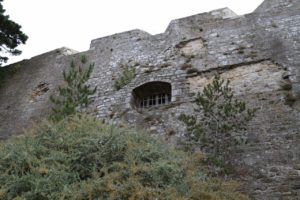
It was not until the next century when in 1759, during the Seven Years War, after numerous English incursions into the bay of St Malo, the decision was taken to build a very large artillery fort at the Cité d’Alet, capable of defending not only the bay, but also the town, the port, the Rance estuary as well as the area to the rear. That fort built by Mazin, the Chief Engineer of St Malo is still very much in evidence today, albeit that it now has some significant twentieth century additions.
Cité d’Alet, 18th century fort
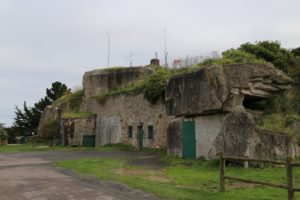
Those additions, built by the Germans after June 1940 and the fall of France, dwarf the original fort in scale. St Malo, quickly appropriated by the Kriegsmarine as the primary port for the supply of the occupied British Channel Islands, saw extensive fortification from 1941 onwards as part of Hitler’s Atlantic Wall to become “Forteresse St Malo” or “Festung St Malo”.
Cité d’Alet with WW2 German additions
By that time, the German occupied Channel Islands had become an obsession of Hitler, with him vowing that they were never to be returned to Britain when final German victory came, and destined to become part of the German Thousand Year Reich forever. As a result of that obsession, a staggering one twelfth of all the cost and materials expended in building the whole of the Atlantic Wall (i.e. from the Artic in Norway all the way down to the French/Spanish border) was ploughed in the Islands! It is therefore hardly surprising that the French port which served those islands was also destined to have more than its fair share of fortifications.
Around St Malo, La Varde, Saint-Ideuc, la Montagne Saint-Joseph, la Garde Guérin were all fortified, as were the islands of Grand-Bé and Cézembre (more of the latter later). But probably the most important element of the fortress was the Cité d’Alet.
From 1942 to 1944, the promontory became a huge building site into which tonnes of reinforced concrete were poured. Incorporated into la Cité was an artillery battery with a range-finding position, a fortress PC, extensive defensive positions, 1350 metres of underground tunnels and shelters for about 200 men.
All in all, there were a total of 32 bunkers built and 8 heavy machine gun turrets (Sechsschartentürms) installed. The latter 50-ton 6 port armoured steel cupolas, mounted with MG 34s, were reserved for those places deemed by the Germans to be at most risk from Allied group attack.
The Cité d’Alet saw severe bombardment in August 1944 at the hands of the American forces who had entered Brittany from Normandy on 31 July. By the 4th August, the Americans headed by the 83rd Infantry Division had reached St Malo and by the 9th August, the city and the Germans in it, were encircled. It took two murderous infantry assaults by the Americans, as well as blanket bombing which left the fabulous old walled city of St Malo in ruins, before the German defenders surrendered on 17th August. The last remaining Germans of the Fortresse St Malo, held out on the island of Cézembre until early September, partially supplied from Jersey, until ground and aerial bombardment, including the first use of Napalm, forced their surrender.
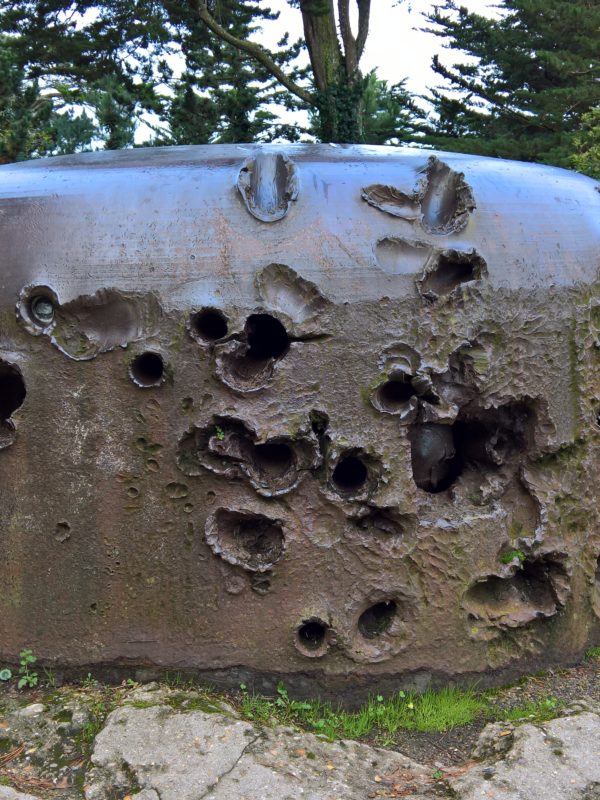
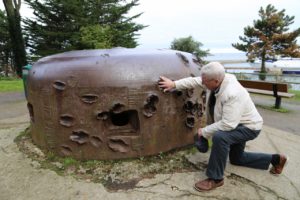
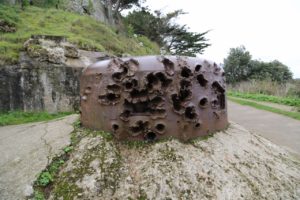
Cité d’Alet, St Malo. The heavy machine gun turrets are peppered with shell hits.
The most striking things that you will see at the Cité d’Alet are the armoured steel turrets along what is a very picturesque walk around the promontory. They are literally peppered by shell fire. But the vast majority of the shell fire is not as a result of the battle which raged around St Malo for nearly two weeks.
Cité d’Alet- German heavy machine gun turret after US attempt (post battle) to destroy them
No it’s a demonstration of the strength of these turrets, as after the battle, the Americans brought up various tanks and other anti-tank weapons into range and fired at them to see how much punishment they would take. It is incredible to see that virtually all the hits show shells bouncing off or merely embedding themselves into the armoured steel without penetrating it. I found only one shell hole which had penetrated the cupola straight through, whilst one other shell appears to have found a way in at the point where the moveable gun port shield slots into the turret.
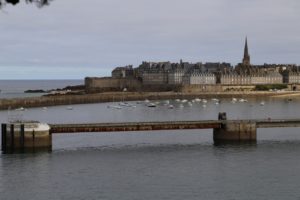
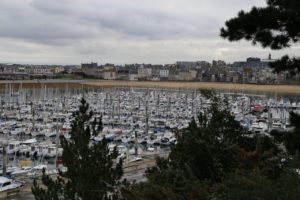
An interesting thing also seems apparent when you compare the direction from which the US shots have been fired at the first two turrets as you come to along the path at la Cité d’Alet . Whoever was firing at each of these two turrets was doing so from different positions – my guess is one was below the old city walls and the other, several hundred metres away, was on the beach at St Servan, the adjacent area next to St Malo. Were the two different sets of gunners having a competition perhaps? I don’t know but perhaps somebody else does know?
One of the likely firing positions of US forces below old city walls of St Malo
Second of the likely firing positions of US forces on the beach at St Servan
Memorial 39-45 Museum, la Cité d’Alet, St Malo
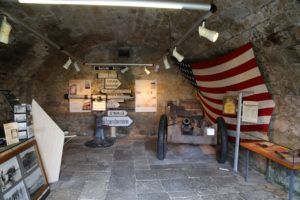
Finally, in the interior of the old fort of la Cité d’Alet, you can clamber around different battle-scarred bunkers and gun positions, as well as visiting the “Memorial 39-45” housed in the bunkers which have been built into the ancient walls. Unfortunately, on the day of my “spare time” visit, the museum was only open in the afternoon. Open regularly everyday only in July and August, it’s generally afternoons only in the shoulder months of April, May and October (closed Mondays) and the same afternoons and Sunday mornings in June and September. November to March, it is closed.
For further information, contact Jersey Military Tours
www.jerseymilitarytours.je


A photograph of Reed which appeared on the title page of his 1936 autobiography The Life of Texas Jack.
Nathaniel “Texas Jack” Reed (March 23, 1862 – January 7, 1950)[1] was a 19th-century American outlaw responsible for many stagecoach, bank, and train robberies throughout the American Southwest during the 1880s and ’90s. He acted on his own and also led a bandit gang, operating particularly in the Rocky Mountains and Indian Territory.
Reed is claimed to have been the last survivor of the “47 most notorious outlaws” of Indian Territory.[2] He became an evangelist in his later years, and could often be seen on the streets of Tulsa preaching against the dangers of following a “life of crime”.[2][1] His memoirs were published in the 1930s, and are considered valuable collectors’ items (one copy was reportedly sold on the internet for $1,500 in 2007).[3] He claimed to have ridden with the Dalton gang, Bill Doolin, Henry Starr and other outlaws and bandits of the old west. He may have also helped Cherokee Bill, a fellow outlaw from the Indian Territory, in his escape from Fort Smith during the 1880s.[3]
As with many others of the era, Reed’s colorful stories of his almost 10-year career as an outlaw were probably exaggerated by later writers.[3] He claimed to have ridden briefly with the Daltons, and participated in their dual bank robberies in Coffeyville in 1892, as well as in the infamous 1893 gunfight at Ingalls. However, there is no corroborating evidence that he was involved in either of those events.[3]
Biography[edit]
Early life[edit]
Reed was born in Madison County, Arkansas. His father, Mason Henry Reed, was killed in action fighting for the Union Army during the American Civil War, probably at the Battle of Campbell’s Station on November 16, 1863.[2] His mother was Sarah Elizabeth Prater. Reed lived with a number of relatives, including his maternal grandparents, until 1883 when, at the age of 21, he moved to the American frontier.[4] He worked at various jobs in Idaho, Wyoming, Colorado, Texas until he reached Oklahoma, where he became a ranch hand for the Tarry outfit.[4]
During the summer of 1885, his foreman recruited him to rob a train at La Junta, Colorado.[2] In the course of the robbery, Reed entered the passenger car firing his pistol to keep the passengers under control.[4] He later received $6,000 for his part in the hold up.[2][4] Encouraged by this success, Reed gave up working as a cowboy and became an outlaw. During the next nine years he and his gang robbed trains, stagecoaches, banks and, on one occasion, captured a large shipment of bullion in California.[5]
Robbery at Blackstone Switch[edit]
During the early 1890s, when he was living near Muskogee, Oklahoma,[4] Reed learned that a gold shipment was leaving Dallas, Texas on November 13, 1894. He recruited Buz Luckey, William “Will” Smith and Tom Root, and selected Blackstone Switch at Wybark as the site for the robbery. The plan was for Reed to throw the switch as the train approached then, as it entered onto a sidetrack, the gang would use dynamite to enter the express car. Root, a full-blooded Cherokee known for his size and strength, would enter the express car, break open the strong boxes, and bring out the gold. Smith would hold a gun on the engineer and fireman while Luckey stayed with the horses.[4]
Despite their practice staged-robbery the previous day,[4] as the Katy No. 2 approached, Reed threw the switch too early. Engineer Joseph Hotchkiss stopped the train when he saw the signal light change,[4] far short of the siding. Reed and the others were forced to run towards the train yelling and shooting. Hotchkiss and the fireman alerted the messengers using the bell cord connected to the car and jumped off the train to hide in a small ravine nearby.[4]
The railroad company had anticipated the possibility of a robbery, and had moved the gold to another train, putting in its place several armed messengers to guard the express car including Bud Ledbetter, Paden Tolbert, Sid Johnson, Frank Jones.[4] When Reed and the others approached the express car, he called for the messengers to leave the car. When they refused, Reed and Root took cover behind some trees and began shooting into the car. The messengers returned fire, resulting in a gunfight that lasted for nearly an hour. Eventually one of Reed’s men was killed; Reed jumped onto the train and went through the passenger cars forcing passengers to put their valuables into a sack before he and his gang fled.[4]
As they rode away, Reed was shot by Bud Ledbetter; the pain from his wound grew so severe that his partners were forced to leave him behind for the night. He gave them some of his loot, and kept the rest of it in a sack to use as a pillow.[4] He lay on a blanket hiding under a rock ledge until he was found by an Indian woman, who nursed him back to health.[4][5]
The American Express Company offered a reward of $250 for the arrest and conviction of each member of the gang.[4] An extensive manhunt was conducted by U.S. Marshals George Crump and S. Morton Rutherford, and large groups of deputies were sent into the Indian Territory and Creek Nation. While burning the canebrakes in the Verdigris bottoms, one deputy found the burnt remains of Reed’s saddle and threatened to destroy the crops of local residents if they did not turn over Reed and his men.[4] This was considered a legal act, authorized by “The Hanging Judge” Isaac Parker himself, but no one came forward with information.[4] Reed was warned of the search and decided to leave the territory as soon as he was able. He arrived in Seneca, Missouri on December 9, where Bill Lawrence took care of him.[4]
Once fully recovered from his wounds Reed returned to Arkansas in February 1895, where he stayed with his brother in Madison County.[4] Having decided to retire from a life of crime, he wrote to Judge Isaac Parker, agreeing to testify against the man who planned the robbery in exchange for probation, although he did not participate in the proceedings.[5] Smith managed to disappear, but U.S. Marshal Newton LaForce was successful in tracking down Luckey and Root to the latter’s home in Broken Arrow, 15 miles south of Tulsa, Oklahoma. The two fugitives were subsequently killed in a gunfight with LaForce and his men on December 4, 1894.[4]
Later years[edit]
Despite Parker’s promise of immunity, Reed was convicted and sentenced to serve five years in prison.[5] However, he served less than one, as shortly before his own death Parker granted Reed his parole, in November 1896.[5] Reed subsequently carried his signed parole from Judge Parker around with him, along with a letter signed by Ledbetter acknowledging that Ledbetter had shot him.[5]
After his release Reed became an evangelist, preaching the rewards of living a respectable, law-abiding life.[2] He also toured the country with a series of Wild West shows.[5] His memoirs, The Life of Texas Jack, were published in 1936, and 35,000 copies of several published pamphlets and dime novels describing his life as an outlaw were sold before his death at home in Tulsa, Oklahoma, at the age of 87.[citation needed] He was buried in St. Paul, Arkansas.[3]
References[edit]
- ^ Jump up to:a b “Texas Jack, 87, Once Southwest Outlaw”, The New York Times, January 9, 1950. “The penitent badman then became an evangelist and toured the country with a wagon and team of horses”
- ^ Jump up to:a b c d e f Haile, Bartee. “This Week in Texas: Old West relic dies in his sleep”, Diboll Free Press, January 2, 2008. Accessed June 3, 2008. Archived July 10, 2011, at the Wayback Machine “Texas Jack started the new century by turning over a new leaf. Trading his sixguns for a Bible, he preached the gospel as an itinerant evangelist.”
- ^ Jump up to:a b c d e Curtis, Gene (June 1, 2007). “Only in Oklahoma: Outlaw left life of crime for lecture circuit”. Tulsa World. Archived from the original on March 6, 2012.
- ^ Jump up to:a b c d e f g h i j k l m n o p q r s Wilson, R. Michael. Great Train Robberies of the Old West. Guilford, Connecticut: Globe Pequot, 2007. (pp. 94–101) ISBN 0-7627-4150-3
- ^ Jump up to:a b c d e f g Drago, Harry Sinclair. The Organized Bands of Bank and Train Robbers Who Terrorized the Prairie Towns of Missouri, Kansas, Indian Territory and Oklahoma for Half a Century. Lincoln: University of Nebraska Press, 1998. (pg. 195–199) ISBN 0-8032-6612-X
Further reading[edit]
Books[edit]
- Croy, Homer. He Hanged Them High: An Authentic Account of the Fanatical Judge who Hanged Eighty-Eight Men. New York: Duel, Sloan & Pierce, 1952.
- Drago, Harry Sinclair. The Organized Bands of Bank and Train Robbers Who Terrorized the Middle West for Half a Century. New York: Bramhall House, 1964.
Magazine articles[edit]
- Cain, Lianne. “‘Texas Jack’ and the Blackstone Train Robbery”. True West. (January 1996): 14.
- Reed, Nathaniel. “Train Holdup at Blackstone Switch”. The West. (May 1964): 16.
- Shirley, Glenn. “The Bungled Job at Blackstone Switch”. True West. (June 1966): 40.
By Colonel James E. Moschgat, Commander of the 12th Operations Group, 12th Flying Training Wing, Randolph Air Force Base, Texas
William “Bill” Crawford certainly was an unimpressive figure, one you could easily overlook during a hectic day at the U.S. Air Force Academy. Mr. Crawford, as most of us referred to him back in the late 1970s, was our squadron janitor.
While we cadets busied ourselves preparing for academic exams, athletic events, Saturday morning parades and room inspections, or never-ending leadership classes, Bill quietly moved about the squadron mopping and buffing floors, emptying trash cans, cleaning toilets, or just tidying up the mess 100 college-age kids can leave in a dormitory. Sadly, and for many years, few of us gave him much notice, rendering little more than a passing nod or throwing a curt, “G’morning!” in his direction as we hurried off to our daily duties.
Why? Perhaps it was because of the way he did his job-he always kept the squadron area spotlessly clean, even the toilets and showers gleamed. Frankly, he did his job so well, none of us had to notice or get involved. After all, cleaning toilets was his job, not ours. Maybe it was is physical appearance that made him disappear into the background. Bill didn’t move very quickly and, in fact, you could say he even shuffled a bit, as if he suffered from some sort of injury. His gray hair and wrinkled face made him appear ancient to a group of young cadets. And his crooked smile, well, it looked a little funny. Face it, Bill was an old man working in a young person’s world. What did he have to offer us on a personal level?
Finally, maybe it was Mr. Crawford’s personality that rendered him almost invisible to the young people around him. Bill was shy, almost painfully so. He seldom spoke to a cadet unless they addressed him first, and that didn’t happen very often. Our janitor always buried himself in his work, moving about with stooped shoulders, a quiet gait, and an averted gaze. If he noticed the hustle and bustle of cadet life around him, it was hard to tell. So, for whatever reason, Bill blended into the woodwork and became just another fixture around the squadron. The Academy, one of our nation’s premier leadership laboratories, kept us busy from dawn till dusk. And Mr. Crawford…well, he was just a janitor.
That changed one fall Saturday afternoon in 1976. I was reading a book about World War II and the tough Allied ground campaign in Italy, when I stumbled across an incredible story. On September 13, 1943, a Private William Crawford from Colorado, assigned to the 36th Infantry Division, had been involved in some bloody fighting on Hill 424 near Altavilla, Italy. The words on the page leapt out at me: “in the face of intense and overwhelming hostile fire … with no regard for personal safety … on his own initiative, Private Crawford single-handedly attacked fortified enemy positions.” It continued, “for conspicuous gallantry and intrepidity at risk of life above and beyond the call of duty, the President of the United States …”
“Holy cow,” I said to my roommate, “you’re not going to believe this, but I think our janitor is a Medal of Honor winner.” We all knew Mr. Crawford was a WWII Army vet, but that didn’t keep my friend from looking at me as if I was some sort of alien being. Nonetheless, we couldn’t wait to ask Bill about the story on Monday. We met Mr. Crawford bright and early Monday and showed him the page in question from the book, anticipation and doubt in our faces. He starred at it for a few silent moments and then quietly uttered something like, “Yep, that’s me.”
Mouths agape, my roommate and I looked at one another, then at the book, and quickly back at our janitor. Almost at once we both stuttered, “Why didn’t you ever tell us about it?” He slowly replied after some thought, “That was one day in my life and it happened a long time ago.”
I guess we were all at a loss for words after that. We had to hurry off to class and Bill, well, he had chores to attend to. However, after that brief exchange, things were never again the same around our squadron. Word spread like wildfire among the cadets that we had a hero in our midst-Mr. Crawford, our janitor, had won the Medal! Cadets who had once passed by Bill with hardly a glance, now greeted him with a smile and a respectful, “Good morning, Mr. Crawford.”
Those who had before left a mess for the “janitor” to clean up started taking it upon themselves to put things in order. Most cadets routinely stopped to talk to Bill throughout the day and we even began inviting him to our formal squadron functions. He’d show up dressed in a conservative dark suit and quietly talk to those who approached him, the only sign of his heroics being a simple blue, star-spangled lapel pin.
Almost overnight, Bill went from being a simple fixture in our squadron to one of our teammates. Mr. Crawford changed too, but you had to look closely to notice the difference. After that fall day in 1976, he seemed to move with more purpose, his shoulders didn’t seem to be as stooped, he met our greetings with a direct gaze and a stronger “good morning” in return, and he flashed his crooked smile more often. The squadron gleamed as always, but everyone now seemed to notice it more. Bill even got to know most of us by our first names, something that didn’t happen often at the Academy. While no one ever formally acknowledged the change, I think we became Bill’s cadets and his squadron.
As often happens in life, events sweep us away from those in our past. The last time I saw Bill was on graduation day in June 1977. As I walked out of the squadron for the last time, he shook my hand and simply said, “Good luck, young man.” With that, I embarked on a career that has been truly lucky and blessed. Mr. Crawford continued to work at the Academy and eventually retired in his native Colorado where he resides today, one of four Medal of Honor winners living in a small town.
A wise person once said, “It’s not life that’s important, but those you meet along the way that make the difference.” Bill was one who made a difference for me. While I haven’t seen Mr. Crawford in over twenty years, he’d probably be surprised to know I think of him often. Bill Crawford, our janitor, taught me many valuable, unforgettable leadership lessons. Here are ten I’d like to share with you.
- Be Cautious of Labels. Labels you place on people may define your relationship to them and bound their potential. Sadly, and for a long time, we labeled Bill as just a janitor, but he was so much more. Therefore, be cautious of a leader who callously says, “Hey, he’s just an Airman.” Likewise, don’t tolerate the O-1, who says, “I can’t do that, I’m just a lieutenant.”
- Everyone Deserves Respect. Because we hung the “janitor” label on Mr. Crawford, we often wrongly treated him with less respect than others around us. He deserved much more, and not just because he was a Medal of Honor winner. Bill deserved respect because he was a janitor, walked among us, and was a part of our team.
- Courtesy Makes a Difference. Be courteous to all around you, regardless of rank or position. Military customs, as well as common courtesies, help bond a team. When our daily words to Mr. Crawford turned from perfunctory “hellos” to heartfelt greetings, his demeanor and personality outwardly changed. It made a difference for all of us.
- Take Time to Know Your People. Life in the military is hectic, but that’s no excuse for not knowing the people you work for and with. For years a hero walked among us at the Academy and we never knew it. Who are the heroes that walk in your midst?
- Anyone Can Be a Hero. Mr. Crawford certainly didn’t fit anyone’s standard definition of a hero. Moreover, he was just a private on the day he won his Medal. Don’t sell your people short, for any one of them may be the hero who rises to the occasion when duty calls. On the other hand, it’s easy to turn to your proven performers when the chips are down, but don’t ignore the rest of the team. Today’s rookie could and should be tomorrow’s superstar.
- Leaders Should Be Humble. Most modern day heroes and some leaders are anything but humble, especially if you calibrate your “hero meter” on today’s athletic fields. End zone celebrations and self-aggrandizement are what we’ve come to expect from sports greats. Not Mr. Crawford-he was too busy working to celebrate his past heroics. Leaders would be well-served to do the same.
- Life Won’t Always Hand You What You Think You Deserve. We in the military work hard and, dang it, we deserve recognition, right? However, sometimes you just have to persevere, even when accolades don’t come your way. Perhaps you weren’t nominated for junior officer or airman of the quarter as you thought you should – don’t let that stop you.
- Don’t pursue glory; pursue excellence. Private Bill Crawford didn’t pursue glory; he did his duty and then swept floors for a living. No job is beneath a Leader. If Bill Crawford, a Medal of Honor winner, could clean latrines and smile, is there a job beneath your dignity? Think about it.
- Pursue Excellence. No matter what task life hands you, do it well. Dr. Martin Luther King said, “If life makes you a street sweeper, be the best street sweeper you can be.” Mr. Crawford modeled that philosophy and helped make our dormitory area a home.
- Life is a Leadership Laboratory. All too often we look to some school or PME class to teach us about leadership when, in fact, life is a leadership laboratory. Those you meet everyday will teach you enduring lessons if you just take time to stop, look and listen. I spent four years at the Air Force Academy, took dozens of classes, read hundreds of books, and met thousands of great people. I gleaned leadership skills from all of them, but one of the people I remember most is Mr. Bill Crawford and the lessons he unknowingly taught. Don’t miss your opportunity to learn.
Bill Crawford was a janitor. However, he was also a teacher, friend, role model and one great American hero. Thanks, Mr. Crawford, for some valuable leadership lessons.
Dale Pyeatt, Executive Director of the National Guard Association of Texas, comments: And now, for the “rest of the story”: Pvt William John Crawford was a platoon scout for 3rd Platoon of Company L 1 42nd Regiment 36th Division (Texas National Guard) and won the Medal Of Honor for his actions on Hill 424, just 4 days after the invasion at Salerno.
On Hill 424, Pvt Crawford took out 3 enemy machine guns before darkness fell, halting the platoon’s advance. Pvt Crawford could not be found and was assumed dead. The request for his MOH was quickly approved. Major General Terry Allen presented the posthumous MOH to Bill Crawford’s father, George, on 11 May 1944 in Camp (now Fort) Carson, near Pueblo. Nearly two months after that, it was learned that Pvt Crawford was alive in a POW camp in Germany. During his captivity, a German guard clubbed him with his rifle. Bill overpowered him, took the rifle away, and beat the guard unconscious. A German doctor’s testimony saved him from severe punishment, perhaps death. To stay ahead of the advancing Russian army, the prisoners were marched 500 miles in 52 days in the middle of the German winter, subsisting on one potato a day. An allied tank column liberated the camp in the spring of 1945, and Pvt Crawford took his first hot shower in 18 months on VE Day. Pvt Crawford stayed in the army before retiring as a MSG and becoming a janitor. In 1984, President Ronald Reagan officially presented the MOH to Bill Crawford.
William Crawford passed away in 2000. He is the only U.S. Army veteran and sole Medal of Honor winner to be buried in the cemetery of the U.S. Air Force Academy.