Federal law enforcement officials have launched a new initiative to inform the public of what they say is a growing problem that involves the illegal modification of semi-automatic firearms into fully automatic weapons.
Officials from the United States Attorney’s Office for the Central District of California and the Bureau of Alcohol, Tobacco, Firearms and Explosives launched a series of public service announcements designed to raise awareness on the dangers of these machine gun conversion devices, which are often referred to as “switches,” “chips” or “auto sears.”
A simple aftermarket device added to the internals of a firearm can convert a semi-automatic gun into a fully automatic weapon, ATF officials said in a new public service announcement.
The devices can be 3D-printed at home, but are often sold online, sometimes under misleading names to avoid detection by law enforcement, and billed as being legal to possess.
But despite their seeming harmlessness on their own, simply owning one of the conversion devices carries the same legal penalty as carrying an illegal machine gun, even if you don’t even have a weapon to modify.
The public service announcements feature U.S. Attorney Martin Estrada and leadership from the ATF Los Angeles, highlighting the dangers of the illegal conversion devices and the stiff legal penalties for those found in possession of them.
“These devices are not gun accessories. They are illegal and considered machine guns under federal law,” says ATF LA Field Division Special Agent in Charge Christopher Bombardiere.
He adds that the ATF has recovered more than 31,000 of the devices in the last five years and compared the problem to the rise of ghost guns — untraceable firearms that are assembled using spare or 3D-printed parts and which have no serial number.
Law enforcement officials say the devices can switch a semi-automatic pistol or rifle into fully automatic in as little as 60 seconds. “One pull of the trigger can release all the ammunition in the magazine,” they said.
In a new PSA, a law enforcement officer demonstrates how a semi-automatic pistol can be converted into fully automatic using an aftermarket device known as a “switch.” (ATF)
Estrada said simply possessing one of these “switches” can carry a sentence of up to 10 years in prison and federal law enforcement officials are being extra diligent to keep the devices off the streets.
If you know of anyone who may be purchasing, making or stockpiling these devices, you are urged to contact your local ATF office. They can also be safely turned over at a local office.
A machine gun is described under the National Firearms Act as follows:
Any weapon which shoots, is designed to shoot, or can be readily restored to shoot, automatically more than one shot, without manual reloading, by a single function of the trigger.
The combination of parts designed and intended for use in converting a weapon into a machine gun.
To view one of the public service announcements published by the ATF, click here.
Late Saturday night, the United States Court of Appeals for the Ninth Circuit issued an order dissolving a prior order and reinstating a preliminary injunction that prevented the state of California from enforcing the expanded so-called sensitive places designated under SB 2, which were set to go into effect January 1.
This means the injunction that was granted in late December preventing the state from enforcing the expanded sensitive places under SB 2 is back in effect, pending further court orders. This is a huge win for gun owners as this litigation proceeds.
The only thing they’re aware of is the personal information of gun owners who aren’t part of the problem. (Attorney General Rob Bonta/Facebook)
“A California appeals court [Fourth Appellate District, Division One Court of Appeal of California] ruled Friday that the state may continue sharing the personal information of gun owners with ‘gun violence’ researchers,” The Western Journal reports. “California’s Department of Justice had been permitted to share ‘identifying information of more than 4 million gun owners’ collected by the state during the background check process for firearms purchases with ‘qualified research institutions,’ ostensibly to aid in the study of gun-related accidents, suicides and violence.”
The “personal information” includes “names, addresses, phone numbers, and any criminal records, among other things.” What “other things”?
Per the bill that “authorized” this massive privacy intrusion against citizens for claiming their rights (Assembly Bill No. 173), those include “a database of gun violence restraining orders, and a database of firearm precursor parts purchases.” In other words, that will include people who have never been charged with or tried for a crime, let alone convicted, and will identify people who bought parts that may later be declared verboten.
“The DROS [Dealer Record of Sale] system and the associated AFS [Automated Firearms System] and APRF [Ammunition Purchase Records File] databases create a unique data set regarding gun and ammunition ownership not available anywhere else. Researchers in California have used this data to conduct empirical research regarding firearm-related violence for some time.”
“The court’s decision is a victory in our ongoing efforts to prevent gun violence,” Attorney General Rob Bonta Bonta crowed in a media release. “AB 173’s information-sharing serves the important goal of enabling research that supports informed policymaking aimed at reducing and preventing firearm violence. Research and data are vital in our efforts to prevent gun violence in California and provide a clear path to help us save lives.”
Left unsaid is how Bonta’s DOJ incompetently keeping databases on gun owners has already demonstrably exposed and endangered them.
“California’s Department of Justice mistakenly posted the names, addresses and birthdays of nearly 200,000 gun owners on the internet because officials didn’t follow policies or understand how to operate their website,” the Associated Press reported last December. California Rifle and Pistol Association President Chuck Michel “noted the leaked data likely included information from people in sensitive positions — including judges, law enforcement personnel and domestic violence victims — who had sought gun permits.”
As for who the “researcher” is privy to the data, per AB 173:
“This bill would name the center for research into firearm-related violence the California Firearm Violence Research Center at UC Davis. The bill would generally require that the information above be made available to the center and researchers affiliated with the center, and, at the department’s discretion, to any other nonprofit bona fide research institution accredited by the United States Department of Education or the Council for Higher Education Accreditation, as specified, for the study of the prevention of violence.”
That pretty much guarantees whose yard they’ll be playing in, and that suits someone who is no stranger to this correspondent just fine.
ADVERTISEMENT
SCROLL DOWN TO CONTINUE READING
“The court’s decision is an important victory for science,” University of California’s Davis California Firearm Violence Research Center Chair Garen Wintemute declared. It’s more like an “important victory” for “agenda science”…
Back in 2007, I warned gun show attendees that Wintemute was surreptitiously eavesdropping on and recording gun show transactions to report them to authorities and justify banning private sales. I saw this as a violation of gun show rules and recommended notifying security if anyone saw it happen. He told Slate it was a “Wanted poster” and tied that in with threats against his life and that “federal law enforcement agents recommended that I wear a ballistic vest.” There was also the false accusation that I had “outed” him. The end result was the science journal Nature felt compelled to publish a (incomplete) retraction.
Call the guy a “researcher” and a scientist” if you like. I prefer “prohibitionist” and “apparatchik.” And drama queen.
While acknowledging that “the law also insists that ‘Material identifying individuals shall only be provided for research or statistical activities and shall not be transferred, revealed, or used for purposes other than research or statistical activities, and reports or publications derived therefrom shall not identify specific individuals,’” they made another important observation:
“[A] gun owner might understandably not be thrilled that people in the business of coming up with reasons why no one should be allowed to own guns (largely true of people in the ‘gun violence research’ field) can easily know their name, address, and all the weapons, parts, and ammo they bought legally. What’s more, nothing in the law as written applies any stern level of oversight or punishment over misuse of the information.”
That “misuse” can be deliberate by activists gone wild or due to lax/incompetent security protocols. And it’s not like sensitive and supposedly secure government systems at the highest levels can’t be breached and hacked by anyone, from cyber criminals to foreign enemies. It’s not like names, addresses, and lists don’t have real-world street value, and it would be just like the prohibitionists to have their efforts actually increase violence and its incentives.
It also looks like it might be a good way for someone with list access and an agenda to call in an anonymous tip and give police “probable cause” for sending out militarized confiscation teams. It’s not like law enforcement won’t do so with information targeting owners of previously registered but now prohibited items.
A truism about “gun control” laws is that criminals don’t obey them, and they end up infringing on those who have. A case in point is 1968’s Haynes v. U.S., in which the Supreme Court (correctly, if you think about it) decided that forcing a convicted felon to register an NFA weapons he was prohibited by law from possessing violated his Fifth Amendment-recognized right against self-incrimination. So, oath-breaker Bonta’s vaunted database, relied on by the Davis gun show mole and his gaggle of anti-gun eggheads, by design, does not include the very reprobates initiating the lion’s share of the “gun violence” they’re purporting to “study”—California’s armed-to-the-teeth criminals who get their guns the old-fashioned way, by breaking the law.
It’s all Kabuki theater designed to divvy up the tax plunder and subject a population they hold in contempt (and, truth be known, fear) – gun owners – to more demoralizing in-your-face harassment.
There’s another break afforded exclusively to criminal suspects, the reading of their “Miranda rights.” Noting another well-documented prohibitionist tactic, declaring what was once legal to now be banned, gun owners buying what could be prohibited later should be advised that whatever they admit to on a required registration form can and will be used against them in a court of law if the Democrats get their way.
A federal judge blocked California’s ban on gun shows at county fairs on Monday, ruling that the state is violating the rights of sellers and would-be buyers by prohibiting transactions for firearms that can be bought at any gun shop.
The decision by U.S. District Judge Mark Holcomb halts enforcement of two state laws, both written by Democratic state Sen. Dave Min, the San Francisco Chronicle reported. The first, effective Jan. 2022, barred gun shows at the Orange County Fair, and the other, which took effect this year, extended the ban to county fairgrounds on state-owned land.
“California’s interest in stopping crimes committed with illegal weapons, as important as it is, cannot justify prohibiting the complete sale of lawful firearms at gun shows,” Holcomb wrote.
Min called Holcomb’s injunction “shocking,” and predicted it would be overturned on appeal.
“California’s vital ban on gun shows at state properties, encompassing even our iconic fairgrounds sites, serves as a critical line of defense against the unchecked proliferation of firearms, including ‘ghost guns’ that circumvent essential background checks and traceability,” Min said in a statement Monday.
Gun shows attract thousands of prospective buyers to local fairgrounds. Under a separate state law, not affected by the ruling, actual purchase of the firearm is completed at a licensed gun store after a 10-day waiting period and a background check, the Chronicle said.
But gun-control groups insist the shows pose dangers, making the weapons attractive to children and enabling “straw purchases” for people ineligible to possess firearms.
Another state law, also unaffected by Monday’s decision, has prohibited gun shows since 2020 at the Del Mar Fairgrounds in San Diego County. The Cow Palace in Daly City, which formerly held five gun shows per year, ended them in 2020 after multiple legislative measures to ban those shows were vetoed by Govs. Arnold Schwarzenegger and Jerry Brown.
Challengers to the statewide ban on gun shows at county fairs included the California Rifle & Pistol Association, an affiliate of the National Rifle Association.
“Anti-gun-owner politicians are trying to eliminate the ‘gun culture’ for future generations by, among other things, banning folks from getting together at a gun show to learn about guns, gun safety and gun-control politics,” Chuck Michel, the Rifle & Pistol Association’s president, said Monday
Since the Orange County Fair had previously hosted gun shows for three decades, Holcomb said, there was “no historical basis” for the state’s ban in 2022.
Attorney General Rob Bonta, who defended the laws in court, could appeal Holcomb’s ruling to the 9th U.S. Circuit Court of Appeals. Bonta’s office asked Holcomb for a stay that would leave the law in effect for at least 10 days, according to the Chronicle. But the judge refused, saying state officials had not shown a likelihood of either a successful appeal or any interim danger to the public from gun shows that would take many months to schedule.
Supervisor Janice Hahn proposed the new ordinance. (Photo: Hahn.LaCounty.gov)
The Los Angeles County Board of Supervisors advanced an ordinance today to enhance regulations for gun and ammunition dealers in unincorporated areas of the county.
LA County Board Supervisor Janice Hahn pushed for the new policy.
“We need to prevent guns from falling into the wrong hands and part of that effort is ensuring gun and ammunition dealers are acting responsibly,” said Hahn.
“These are commonsense regulations that will make sure gun dealers have basic security measures in place, maintain inventory, and keep records of who they sell guns and ammunition to,” she added.
The new ordinance will impact 18 gun dealers and two exclusive ammunition dealers in unincorporated LA County.
The Los Angeles County Treasurer and Tax Collector will enforce these rules.
Key provisions Include
Ammunition dealers must obtain a business license and meet requirements similar to gun dealers. Previously, exclusive ammunition dealers didn’t need a specific license.
Stores selling guns and ammunition can’t allow minors unless an adult accompanies them. Mixed-use stores must offer sight separation.
Dealers should maintain annual sales reports, keep purchaser fingerprints, update a weekly inventory, install security cameras, and display signs about gun access risks.
The Treasurer and Tax Collector will publicly post names of suspended and revoked licensees.
The annual license fee for initial applications and renewals will increase.
The ordinance awaits a second hearing on November 7th. If approved again, it will become effective 30 days afterward.
Prior Regulations
This regulation is the third in a series of four proposed by Supervisor Hahn. Previous ordinances banned .50 caliber firearms sales and prohibited firearms on county property.
Another in development will introduce a 1,000-foot buffer between gun shops and “child safety zones.”
Furthermore, LA County is advocating for greater awareness and utilization of gun violence restraining orders (GVROs) aka “red flag” laws.
GVROs are gun confiscation orders that target those accused — not convicted — of being a threat to public safety.
SAF Responds
“Politicians like Janice Hahn is the reason the Second Amendment is so important. She has done everything in her power to shred our Bill of Rights,” said Alan Gottlieb, the founder of the Second Amendment Foundation (SAF), in an email to GunsAmerica.
“Our founding fathers warned us about those in government who abuse their power and made sure that we had courts to protect our freedom,” he continued. “The Second Amendment Foundation will make sure that she will be a defendant in the court room!”
Federal Judge Roger T. Benitez last month, and for the
second time, declared California’s ban on so-called
“high-capacity magazines” is unconstitutional.
When U.S. District Court Judge Roger T. Benitez last month handed down his crushing 71-page ruling in a case known as Duncan v. Bonta — declaring California’s ban on so-called “high-capacity magazines” to be unconstitutional for a second time — one could tell by reading the opinion he had really done his homework.
In his ruling, Judge Benitez observed, “There is no American tradition of limiting ammunition capacity and the 10-round limit has no historical pedigree and it is arbitrary and capricious. It is extreme. Our federal government and most states impose no limits and in the states where limits are imposed, there is no consensus. Delaware landed on a 17-round magazine limit. Illinois and Vermont picked limits of 15 rounds for handguns and 10 rounds for a rifle. Colorado went with a 15-round limit for handguns and rifles, and a 28-inch tube limit for shotguns. New York tried its luck at a 7-round limit; that did not work out. New Jersey started with a 15-round limit and then reduced the limit to 10-rounds. The fact that there are so many different numerical limits demonstrates the arbitrary nature of magazine capacity limits.”
All this tells us is that people who craft gun control laws limiting magazine capacities don’t know zip about firearms. Nobody has ever explained to me — and I have asked — why the 10-round limit seems to be popular among gun prohibitionists. I wasn’t really surprised; after all, no explanation would make sense, anyway.
Were someone to claim a 10-rounder would help prevent mass shootings, I’d just remind them about Elliot Rodger, the Isla Vista killer who murdered six people in 2014. After killing three people with a knife, he drove to the area near the University of California, Santa Barbara and killed three more people using two different handguns and California-compliant 10-round magazines.
For the best perspective on what this ruling meant to anti-gunners, one need only look to the message on “X” (formerly known as Twitter) posted by Gov. Gavin Newsom on Sept. 22. Here’s what he said: “California’s high-capacity magazine ban was just STRUCK DOWN by Judge Benitez, an extremist, right-wing zealot with no regard to human life. Wake up, America. Our gun safety laws will continue to be thrown out by NRA-owned federal judges until we pass a Constitutional Amendment to protect our kids and end the gun violence epidemic in America.”
Newsom earlier this year announced his proposed 28th Amendment to the U.S. Constitution, which would essentially nullify the Second Amendment and replace it with gun control fanaticism designed to turn the right to keep and bear arms into a government-regulated privilege.
Far Left
Newsom isn’t the only far-left Democrat governor (recall last week’s Insider, which discussed New Mexico Gov. Michelle Lujan Grisham’s arbitrary and quickly-enjoined order essentially suspending the Second Amendment in Albuquerque and surrounding Bernalillo County), but he is certainly a standout.
He probably went into convulsions when reading through the Benitez decision. The judge observed, “Why are larger magazines chosen for self-defense? Crime happens a lot. One recent estimate holds that guns are needed defensively approximately 1,670,000 times a year.”
And then there was this: “California relies entirely on the opinion of its statistician for the hypothesis that defenders fire an average of only 2.2 shots in cases of confrontation. Where does the 2.2 shot average originate? There is no national or state government data report on shots fired in self-defense events. There is no public government database.”
Translation: Somebody may have simply made it up.
Judge Benitez’s recent ruling looked back on his previous decision regarding the California mag ban, which was remanded back to his court following the Supreme Court’s 2022 Bruen ruling. In a footnote on Page 5 of his new decision, the judge added this footnote: “As this Court explained in its prior decision, ‘[a]rtificial limits will eventually lead to disarmament. It is an insidious plan to disarm the populace and it depends on for its success a subjective standard of ‘necessary’ lethality. It does not take the imagination of Jules Verne to predict that if all magazines over 10 rounds are somehow eliminated from California, the next mass shooting will be accomplished with guns holding only 10 rounds.
To reduce gun violence, the state will close the newly christened 10-round ‘loophole’ and use it as a justification to outlaw magazines holding more than 7 rounds. The legislature will determine that no more than 7 rounds are ‘necessary.’ Then the next mass shooting will be accomplished with guns holding 7 rounds. To reduce the new gun violence, the state will close the 7-round ‘loophole’ and outlaw magazines holding more than 5 rounds determining that no more than 5 rounds are ‘suitable.’ And so it goes, until the only lawful firearm law-abiding responsible citizens will be permitted to possess is a single-shot handgun.’”
Mass Shooting Misinformation
California’s magazine ban was initiated ostensibly to reduce potential carnage in a mass shooting incident, which are rare but high-profile. The media loves a bloodbath.
Author and researcher John Lott, founder and president of
the Crime Prevention Research Center, was at the Gun Rights
Policy Conference last month with some interesting information
about armed citizen intervention in mass shootings.
What the media apparently doesn’t like, however, is a case where an armed private citizen intervenes and stops a shooting. The FBI claims it happens rarely, but during last month’s 38th annual Gun Rights Policy Conference (GRPC) in Phoenix, author/economist John Lott referred to his recent report on the “massive errors” in the FBI’s active shooting reports from 2014 to 2022.
According to Lott, “Sources the media relied on undercounted the number of instances in which armed citizens have thwarted such attacks by an order of more than ten, saving untold numbers of lives.”
“Of course,” Lott wrote, “law-abiding citizens stopping these attacks are not rare. What is rare is national news coverage of those incidents. Although those many news stories about the Greenwood shooting also suggested that the defensive use of guns might endanger others, there is no evidence that these acts have harmed innocent victims.”
Lott also notes, “The FBI reports that armed citizens only stopped 14 of the 302 active shooter incidents it identified for the period 2014-2022 … An analysis by the CPRC identified a total of 440 active shooter incidents during that period and found that an armed citizen stopped 157.”
Even if Lott’s numbers were off by 50% (which I doubt), his figure would still far exceed the number of armed citizen interventions acknowledged by the FBI.
Look for an upcoming report from Lott’s Crime Prevention Research Center updating the number of active concealed carry permits and licenses in the United States, which will not include the estimated number of armed citizens in the 27 states which have adopted permitless (constitutional) carry.
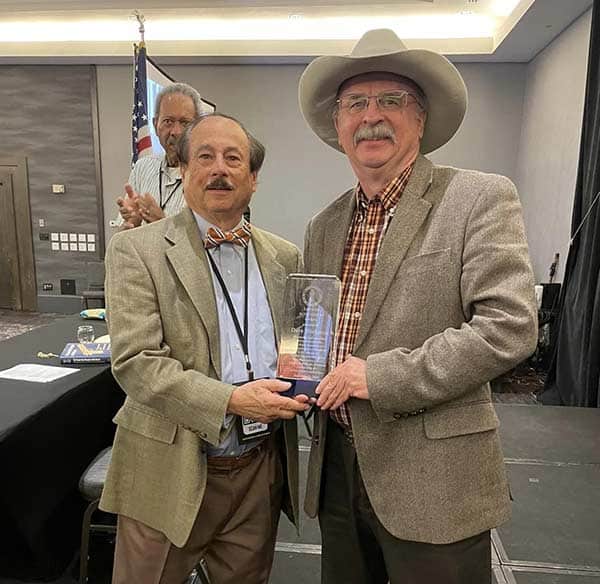
Alan Gottlieb (left) honored Dave Workman with the Lifetime
Achievement award from the Citizens Committee for the Right
to Keep and Bear Arms at last month’s Gun Rights Policy Conference.
Personal Honors
At the recent GRPC, this correspondent was honored to receive a Lifetime Achievement Award from the Citizens Committee for the Right to Keep and Bear Arms and to be named to the Joseph P. Tartaro II “Hall of Fame.”
Tartaro was the longtime president of the Second Amendment Foundation and executive editor of Gun Week and then TheGunMag.com, where I am now editor-in-chief. He was what Central Casting would have offered as the quintessential “crusty” old newspaper editor, a sharp-eyed reader with an excellent grasp of the English language, and a veritable walking encyclopedia of the history of the gun rights movement. And he was my friend.
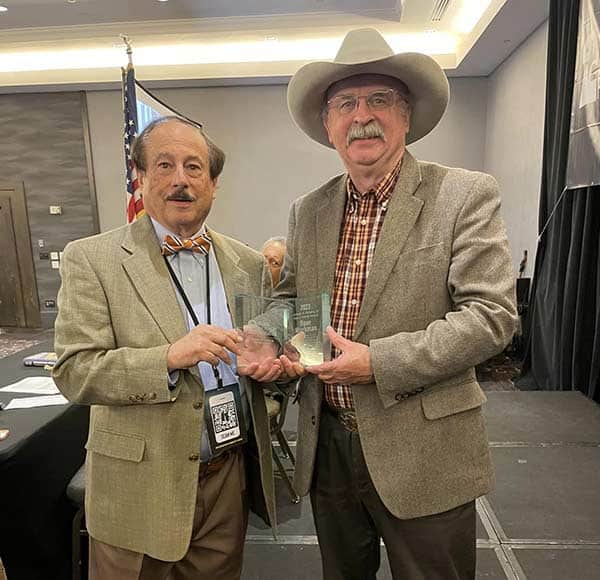
Dave was also named to the Joseph P. Tartaro Hall of Fame,
making him the only double award recipient in the 38-year history
of the conference, which was held in Phoenix.
I recently announced my pending retirement from that position — don’t worry, I’m not departing from Insider Online or GUNS Magazine — because at my age, it’s time to slow down a little. I’ve been working for SAF and CCRKBA for more than 23 years, which came after spending 21 years at the old Fishing & Hunting News, which came after nearly seven years at a little weekly newspaper in Washington State.
There is a lot of brass in my workshop which needs reloading, and a fair amount of firewood still in need of cutting, splitting and stacking in the woodshed. Who knows, I may even find time to press a trigger!