As the Taliban celebrates the withdrawal of U.S. forces by parading their American-sourced tactical vehicles, aircraft, guns and other weapons, reports have emerged that the Biden Administration has ordered federal agencies to delete online information respecting the cost of this military equipment and related spending in Afghanistan, while proclaiming its support for more gun control.
A Forbes article states that by August 23, at least “two key reports on the U.S. war chest of military gear in Afghanistan … had disappeared from federal websites,” including a Government Accountability Office (GAO) audit of U.S.- funded equipment for Afghan National Defense and Security Forces (GAO-17-667R, Aug. 2017).
A week later, Forbes reported that the U.S. State Department admitted the documents had been removed and had instructed other federal agencies to “review their web properties” for similar content and “remove [it] from public view.” The reason given was the need to ensure the “safety of our Afghan contacts” by deleting information that poses “a security risk.” A GAO spokesperson contacted by Forbes confirmed that “the State Department requested we temporarily remove and review reports on Afghanistan to protect recipients of US assistance that may be identified through our reports and thus subject to retribution.”
In the circumstances, this is a less than convincing justification. The deleted GAO Report, for one, lacks any personally identifiable information about members of the Afghan defense and security forces or other partners. Moreover (as pointed out in the Forbes article), the Biden Administration itself would have directly jeopardized such individuals already, when government officials allegedly provided the Taliban with the names of Afghan allies during the evacuation of Kabul.
A group of U.S. Senators is now demanding that the administration provide a full accounting regarding the U.S. military equipment left behind “as a result of our poorly executed withdrawal from the country,” questioning why such assets weren’t adequately secured prior to announcing the withdrawal from Afghanistan.
A cynic may be excused for believing that the Biden Administration is acting out of concern about the political blowback once the details of the unprecedented extent of state-of-the-art weaponry, paid for by American taxpayers and currently in the hands of the brutal Taliban, become more widely known.
One early casualty of Biden’s fast and furious exit from Afghanistan is the complete loss of credibility on gun control the President and his administration have as a result.
For decades, Joe Biden has pushed for strict gun control, hectoring Americans about the evils of guns in general and “assault weapons” in particular, yet a conservative estimate indicates that the weaponry left behind includes well over half a million rifles, handguns, shotguns and machine guns, together with an undisclosed amount of ammunition (the GAO report did not account for small arms ammunition and other ammunition was included with the billions spent in general “sustainment” expenditures). As NRA-ILA noted earlier, Biden’s “bungling of [the withdrawal] ensured that not just firearms but some of America’s more sophisticated military technology is now available to terrorists and other enemies who are and will continue to use them against Americans, American interests, and American allies.”
Even more jarringly, NRA witnessed – just a day after the August 30 pullout – a State Department official speak at the Seventh Conference of States Parties to the Arms Trade Treaty (“Promoting responsibility in international transfers of conventional arms”) to “underscore the continuing commitment” of the administration “to responsible international trade in conventional arms” and affirm its steadfast support for “strong and effective national controls on the international transfer of conventional arms.”
By now, Americans don’t believe in Biden’s policies or buy into his gun control agenda. A poll released at the beginning of this month shows that only 15% of U.S. voters polled “strongly approve” of President Biden’s handling of “gun policy,” compared to 35% who “strongly disapprove,” and over 60% thought the country had “gotten off on the wrong track.”
The U.S. Government Lied For Two Decades About Afghanistan
Using the same deceitful tactics they pioneered in Vietnam, U.S. political and military officials repeatedly misled the country about the prospects for success in Afghanistan.
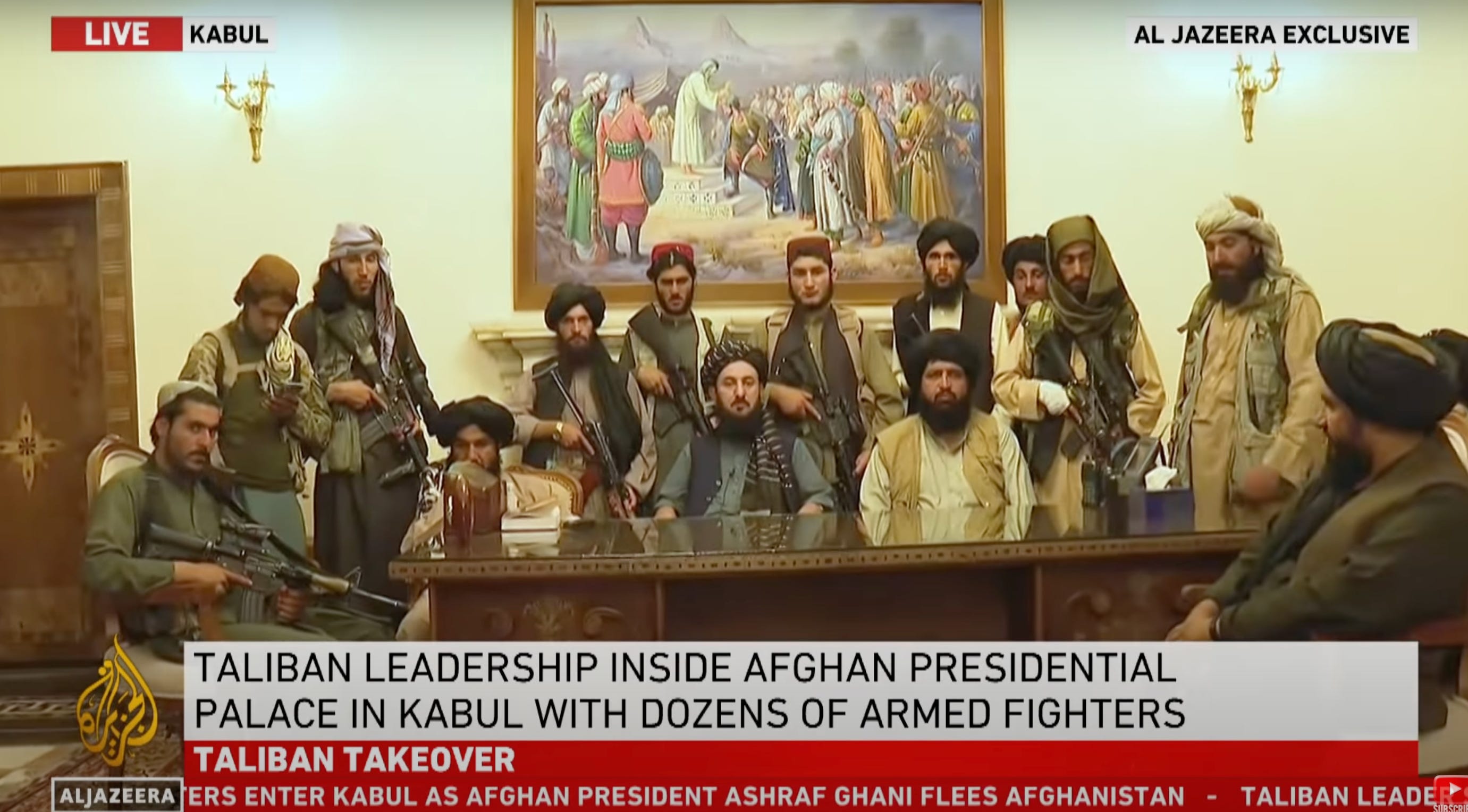
The Taliban give an exclusive interview to Al Jazeera after taking control of the presidential palace in Kabul, Afghanistan, Aug. 15, 2021 (Al Jazeera/YouTube)
“The Taliban regime is coming to an end,” announced President George W. Bush at the National Museum of Women in the Arts on December 12, 2001 — almost twenty years ago today. Five months later, Bush vowed: “In the United States of America, the terrorists have chosen a foe unlike they have faced before. . . . We will stay until the mission is done.” Four years after that, in August of 2006, Bush announced: “Al Qaeda and the Taliban lost a coveted base in Afghanistan and they know they will never reclaim it when democracy succeeds. . . . The days of the Taliban are over. The future of Afghanistan belongs to the people of Afghanistan.”
For two decades, the message Americans heard from their political and military leaders about the country’s longest war was the same. America is winning. The Taliban is on the verge of permanent obliteration. The U.S. is fortifying the Afghan security forces, which are close to being able to stand on their own and defend the government and the country.
Just five weeks ago, on July 8, President Biden stood in the East Room of the White House and insisted that a Taliban takeover of Afghanistan was not inevitable because, while their willingness to do so might be in doubt, “the Afghan government and leadership . . . clearly have the capacity to sustain the government in place.” Biden then vehemently denied the accuracy of a reporter’s assertion that “your own intelligence community has assessed that the Afghan government will likely collapse.” Biden snapped: “That is not true. They did not — they didn’t — did not reach that conclusion.”
Biden continued his assurances by insisting that “the likelihood there’s going to be one unified government in Afghanistan controlling the whole country is highly unlikely.” He went further: “the likelihood that there’s going to be the Taliban overrunning everything and owning the whole country is highly unlikely.” And then, in an exchange that will likely assume historic importance in terms of its sheer falsity from a presidential podium, Biden issued this decree:
Q. Mr. President, some Vietnamese veterans see echoes of their experience in this withdrawal in Afghanistan. Do you see any parallels between this withdrawal and what happened in Vietnam, with some people feeling —
THE PRESIDENT: None whatsoever. Zero. What you had is — you had entire brigades breaking through the gates of our embassy — six, if I’m not mistaken.
The Taliban is not the south — the North Vietnamese army. They’re not — they’re not remotely comparable in terms of capability. There’s going to be no circumstance where you see people being lifted off the roof of an embassy in the — of the United States from Afghanistan. It is not at all comparable.
When asked about the Taliban being stronger than ever after twenty years of U.S. warfare there, Biden claimed: “Relative to the training and capacity of the [Afghan National Security Forces} and the training of the federal police, they’re not even close in terms of their capacity.” On July 21 — just three weeks ago — Gen. Mark Milley, Biden’s Chairman of the Joint Chiefs of Staff, conceded that “there’s a possibility of a complete Taliban takeover, or the possibility of any number of other scenario,” yet insisted: “the Afghan Security Forces have the capacity to sufficiently fight and defend their country.”
Similar assurances have been given by the U.S. Government and military leadership to the American people since the start of the war. “Are we losing this war?,” Army Maj. Gen. Jeffrey Schloesser, commander of the 101st Airborne Division, asked rhetorically in a news briefing from Afghanistan in 2008, answering it this way: “Absolutely no way. Can the enemy win it? Absolutely no way.” On September 4, 2013, then-Lt. Gen. Milley — now Biden’s Chairman of the Joint Chiefs of Staff — complained that the media was not giving enough credit to the progress they had made in building up the Afghan national security forces: “This army and this police force have been very, very effective in combat against the insurgents every single day,” Gen. Milley insisted.
None of this was true. It was always a lie, designed first to justify the U.S’s endless occupation of that country and, then, once the U.S. was poised to withdraw, to concoct a pleasing fairy tale about why the prior twenty years were not, at best, an utter waste. That these claims were false cannot be reasonably disputed as the world watches the Taliban take over all of Afghanistan as if the vaunted “Afghan national security forces” were china dolls using paper weapons. But how do we know that these statements made over the course of two decades were actual lies rather than just wildly wrong claims delivered with sincerity?
To begin with, we have seen these tactics from U.S. officials — lying to the American public about wars to justify both their initiation and continuation — over and over. The Vietnam War, like the Iraq War, was begun with a complete fabrication disseminated by the intelligence community and endorsed by corporate media outlets: that the North Vietnamese had launched an unprovoked attack on U.S. ships in the Gulf of Tonkin. In 2011, President Obama, who ultimately ignored a Congressional voteagainst authorization of his involvement in the war in Libya to topple Muammar Qaddafi, justified the NATO war by denying that regime change was the goal: “our military mission is narrowly focused on saving lives . . . broadening our military mission to include regime change would be a mistake.” Even as Obama issued those false assurances, The New York Times reported that “the American military has been carrying out an expansive and increasingly potent air campaign to compel the Libyan Army to turn against Col. Muammar el-Qaddafi.”
Just as they did for the war in Afghanistan, U.S. political and military leaders lied for years to the American public about the prospects for winning in Vietnam. On June 13, 1971, The New York Timespublished reports about thousands of pages of top secret documents from military planners that came to be known as “The Pentagon Papers.” Provided by former RAND official Daniel Ellsberg, who said he could not in good conscience allow official lies about the Vietnam War to continue, the documents revealed that U.S. officials in secret were far more pessimistic about the prospects for defeating the North Vietnamese than their boastful public statements suggested. In 2021, The New York Times recalled some of the lies that were demonstrated by that archive on the 50th Anniversary of its publication:
Brandishing a captured Chinese machine gun, Secretary of Defense Robert S. McNamara appeared at a televised news conference in the spring of 1965. The United States had just sent its first combat troops to South Vietnam, and the new push, he boasted, was further wearing down the beleaguered Vietcong.
“In the past four and one-half years, the Vietcong, the Communists, have lost 89,000 men,” he said. “You can see the heavy drain.”
That was a lie. From confidential reports, McNamara knew the situation was “bad and deteriorating” in the South. “The VC have the initiative,” the information said. “Defeatism is gaining among the rural population, somewhat in the cities, and even among the soldiers.”
Lies like McNamara’s were the rule, not the exception, throughout America’s involvement in Vietnam. The lies were repeated to the public, to Congress, in closed-door hearings, in speeches and to the press.
The real story might have remained unknown if, in 1967, McNamara had not commissioned a secret history based on classified documents — which came to be known as the Pentagon Papers. By then, he knew that even with nearly 500,000 U.S. troops in theater, the war was at a stalemate.
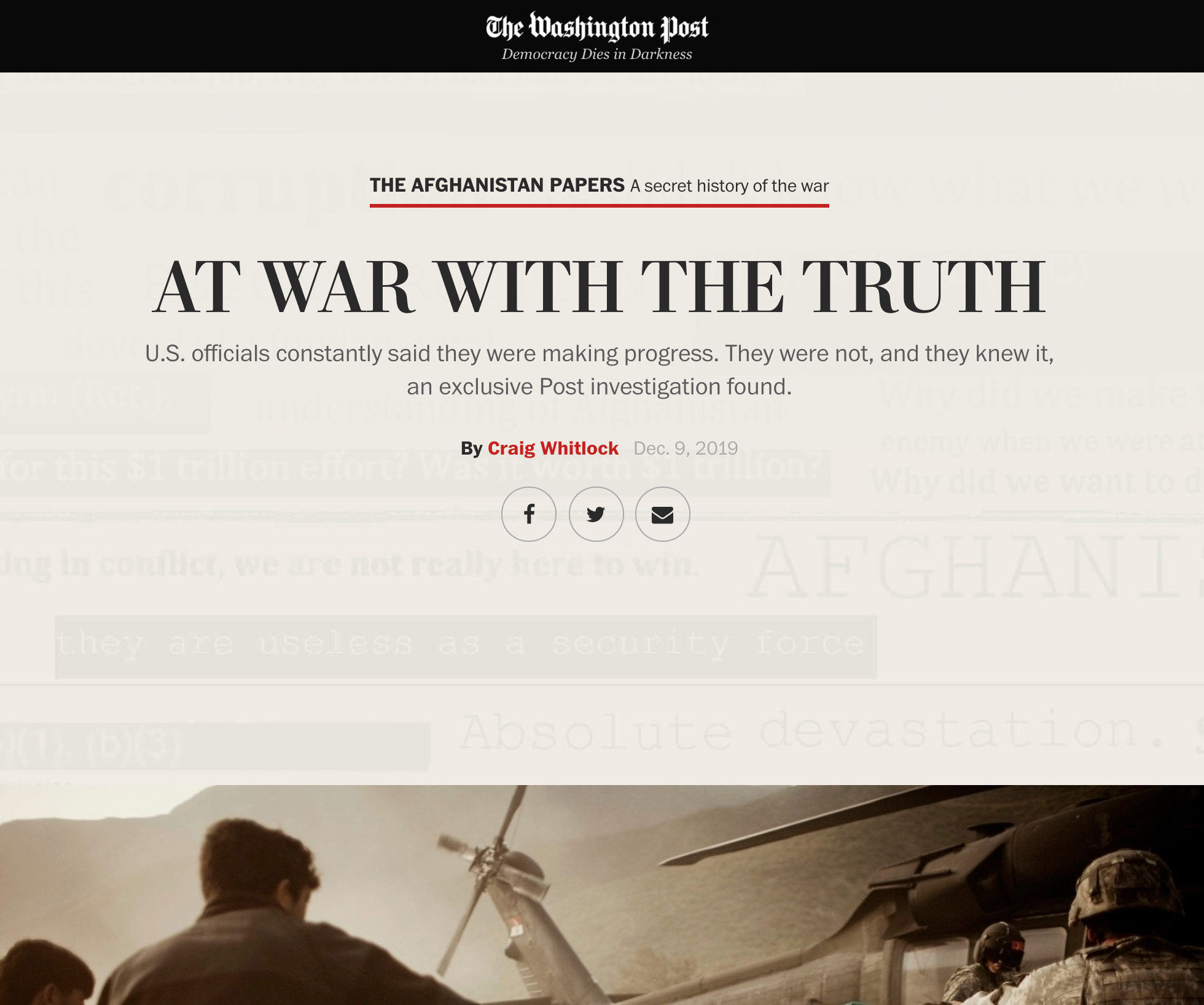
The pattern of lying was virtually identical throughout several administrations when it came to Afghanistan. In 2019, The Washington Post — obviously with a nod to the Pentagon Papers — published a report about secret documents it dubbed “The Afghanistan Papers: A secret history of the war.” Under the headline “AT WAR WITH THE TRUTH,” The Post summarized its findings: “U.S. officials constantly said they were making progress. They were not, and they knew it, an exclusive Post investigation found.” They explained:
Year after year, U.S. generals have said in public they are making steady progress on the central plank of their strategy: to train a robust Afghan army and national police force that can defend the country without foreign help.
In the Lessons Learned interviews, however, U.S. military trainers described the Afghan security forces as incompetent, unmotivated and rife with deserters. They also accused Afghan commanders of pocketing salaries — paid by U.S. taxpayers — for tens of thousands of “ghost soldiers.”
None expressed confidence that the Afghan army and police could ever fend off, much less defeat, the Taliban on their own. More than 60,000 members of Afghan security forces have been killed, a casualty rate that U.S. commanders have called unsustainable.
As the Post explained, “the documents contradict a long chorus of public statements from U.S. presidents, military commanders and diplomats who assured Americans year after year that they were making progress in Afghanistan and the war was worth fighting.” Those documents dispel any doubt about whether these falsehoods were intentional:
Several of those interviewed described explicit and sustained efforts by the U.S. government to deliberately mislead the public. They said it was common at military headquarters in Kabul — and at the White House — to distort statistics to make it appear the United States was winning the war when that was not the case.
John Sopko, the head of the federal agency that conducted the interviews, acknowledged to The Post that the documents show “the American people have constantly been lied to.”
Last month, the independent journalist Michael Tracey, writing at Substack, interviewed a U.S. veteran of the war in Afghanistan. The former soldier, whose job was to work in training programs for the Afghan police and also participated in training briefings for the Afghan military, described in detail why the program to train Afghan security forces was such an obvious failure and even a farce. “I don’t think I could overstate that this was a system just basically designed for funneling money and wasting or losing equipment,” he said. In sum, “as far as the US military presence there — I just viewed it as a big money funneling operation”: an endless money pit for U.S. security contractors and Afghan warlords, all of whom knew that no real progress was being made, just sucking up as much U.S. taxpayer money as they could before the inevitable withdraw and takeover by the Taliban.
In light of all this, it is simply inconceivable that Biden’s false statements last month about the readiness of the Afghan military and police force were anything but intentional. That is particularly true given how heavily the U.S. had Afghanistan under every conceivable kind of electronic surveillance for more than a decade. A significant portion of the archive provided to me by Edward Snowden detailed the extensive surveillance the NSA had imposed on all of Afghanistan. In accordance with the guidelines he required, we never published most of those documents about U.S. surveillance in Afghanistan on the ground that it could endanger people without adding to the public interest, but some of the reporting gave a glimpse into just how comprehensively monitored the country was by U.S. security services.
In 2014, I reported along with Laura Poitras and another journalist that the NSA had developed the capacity, under the codenamed SOMALGET, that empowered them to be “secretly intercepting, recording, and archiving the audio of virtually every cell phone conversation” in at least five countries. At any time, they could listen to the stored conversations of any calls conducted by cell phone throughout the entire country. Though we published the names of four countries in which the program had been implemented, we withheld, after extensive internal debate at The Intercept, the identity of the fifth — Afghanistan — because the NSA had convinced some editors that publishing it would enable the Taliban to know where the program was located and it could endanger the lives of the military and private-sector employees working on it (in general, at Snowden’s request, we withheld publication of documents about NSA activities in active war zones unless they revealed illegality or other deceit). But WikiLeaks subsequently revealed, accurately, that the one country whose identity we withheld where this program was implemented was Afghanistan.
There was virtually nothing that could happen in Afghanistan without the U.S. intelligence community’s knowledge. There is simply no way that they got everything so completely wrong while innocently and sincerely trying to tell Americans the truth about what was happening there.
In sum, U.S. political and military leaders have been lying to the American public for two decades about the prospects for success in Afghanistan generally, and the strength and capacity of the Afghan security forces in particular — up through five weeks ago when Biden angrily dismissed the notion that U.S. withdrawal would result in a quick and complete Taliban takeover. Numerous documents, largely ignored by the public, proved that U.S. officials knew what they were saying was false — just as happened so many times in prior wars — and even deliberately doctored information to enable their lies.
Any residual doubt about the falsity of those two decades of optimistic claims has been obliterated by the easy and lightning-fast blitzkrieg whereby the Taliban took back control of Afghanistan as if the vaunted Afghan military did not even exist, as if it were August, 2001 all over again. It is vital not just to take note of how easily and frequently U.S. leaders lie to the public about its wars once those lies are revealed at the end of those wars, but also to remember this vital lesson the next time U.S. leaders propose a new war using the same tactics of manipulation, lies, and deceit.
Newsom hasn’t been able to turn the 20-year failure around. (Photo: Wikimedia Commons)
In 2001, California passed a first-of-its-kind law to create a database of residents who had become prohibited from owning firearms. Whether through criminal conduct or mental health issues, these individuals would be included on a list dubbed the “Armed and Prohibited Persons System” (APPS).
The database is made possible by the state’s firearm registration and universal background check systems, and the California Department of Justice hoped local law enforcement and state agents would be able to use APPS to confiscate firearms from those deemed unfit.
Unfortunately for Golden State gun grabbers, the program has been an abject failure—and its problems are only getting worse.
The news outlet CalMatters published this week a lengthy article highlighting the program’s worst failings, and they sum it up like this: “…what seemed at the time like a straight-forward approach to the enforcement of existing gun laws has instead become mired in chronic shortcomings, failing for years to make good on its potential.”
The full piece is worth a read, but CalMatters revealed (sometimes unintentionally, it seems) how the APPS system is used to harass gun owners and violate their privacy rights.
Since government agencies maintain the APPS list, CalMatters was able to obtain personal information of some of the current and former gun owners included in the database. But as CalMatters admits, not everyone on the list is supposed to be there.
Some people who appear in the APPS database have already surrendered their firearms. Others are only there due to administrative errors.
“Even when the information is correct, some people might be on the list because of an apparent misunderstanding or paperwork issue, not because they’re trying to illegally keep their guns,” the outlet reports.
Law enforcement agents sometimes devote time and resources to confiscating firearms only to find that the database has given them faulty information.
“The work-intensive process and outmoded technology has led some in law enforcement to question the database’s reliability. They say they’ve discovered errors during field operations and that investigations based on the list are a waste of resources,” according to CalMatters.
And then there’s simple bureaucratic incompetence. Some officials estimate that there are 24,000 people in the APPS database who have not surrendered their firearms. But CalMatters reports (towards the bottom of the article) that even this number is mostly guesswork.
“As it stands now, the department can’t even determine the precise breadth of the backlog, including how many cases have remained unresolved for more than six months,” they say.
There are multiple causes for the backlog. CalMatters discovered that many local police departments do not even know about the database. They also note that judges often do not ensure that their gun confiscation orders are carried out, and agents at the California DOJ can’t keep up with the constant stream of new prohibited persons.
What many gun owners may not know is that just being on the list doesn’t give law enforcement the right to confiscate firearms. According to CalMatters, agents must acquire probable cause that a person still possesses a gun in order to obtain a search warrant. If an individual simply denies owning a firearm, the investigation may end right there.
One agency told CalMatters that they gave up on confiscating firearms after one night of work, calling it “a waste of resources that could be directed toward more pressing violent crime problems.” Some people provided proof that their guns had been sold long ago, while others claimed they had gotten rid of them but could provide no evidence.
“There was just no way to verify,” one agent said, adding that the state “has no idea who has guns and who’s turned them in.”
The program’s sorry track record has made it difficult for anti-gun advocates to justify its continued existence. According to CalMatters, “Gun control advocates struggled to identify shootings that might have been prevented had authorities successfully retrieved firearms,” and the outlet did not report on any specific instances.
One spokesperson for the anti-gun group Giffords may have unintentionally summed up how most law-abiding gun owners feel about gun control efforts.
“It’s very frustrating to see that we have such a hard time implementing firearms removals in situations where we have all the information in front of us,” she said. “It doesn’t give the public a lot of confidence in our ability to tackle a lot of these more complex firearm issues.”