Categories
All About Guns Art

This just goes to show that America can make some really great Art

Winchester Model 1886 Takedown Rifle (serial no. 125176)

Manufacturer Winchester Repeating Arms Company American

This factory engraved and gold- and platinum-inlaid Model 1886 rifle fitted with a complement of special-order features exemplifies the upper tier of Winchester’s embellished and customized firearms at the turn of the century. Though the Model 1886 remained in production until 1935 few deluxe Model 1886 rifles were made after 1900. This rifle, made in 1901, years after Winchester released the more advanced Model 1894 and almost two decades after the Model 1886 was introduced, nevertheless testifies to the enduring popularity of Winchester’s products, and to wealthy customers’ willingness to spare little expense on their decoration.

As the production of firearms became increasingly industrialized in the United States in the 1850s, customers seeking to personalize their machine-made guns could hire an independent gunsmith to add original embellishments, or, alternatively, choose from a variety of customization options executed by skilled decorators employed by the firearm’s manufacturer.

This rifle was decorated at the Winchester factory, and its factory record specifies its upgrades from the standard model. It is an extra light takedown with a shotgun butt and rubber butt plate and a special hand-made stock with a pistol grip made of fancy walnut with high grain contrast and an oil finish, inset with a gold nameplate on the underside (Originally “GH”, later replaced with “OAW” by a subsequent owner).

The stock has Style D carving. It has a half magazine, sling swivels, and is fitted with Lyman Gun Sight Company rear and jack sights. It has Style No. 2 engraving with a fancy dull finish.

The engraving and carving Style types refer to patterns illustrated in the Winchester Arms Company’s catalogue Highly Finished Arms. First published in 1897, Highly Finished Arms codified for the first time Winchester’s factory decoration options for its line of rifles, offering Winchester customers ten design options for receiver decoration and eight for the stock at varying price points.

They include game scenes surrounded by scrollwork, and foliage motifs combined with scrollwork, with the option to customize for an added cost. The designs were conceived primarily by Winchester factory engravers Herman Leslie Ulrich (1846–1937) and William E. Stokes. The Museum’s rifle’s Style No. 1 engraving is the second most expensive available, and its Style D stock carving which combines checkering and oak leaves was a popular option on Model 1886s and later models.

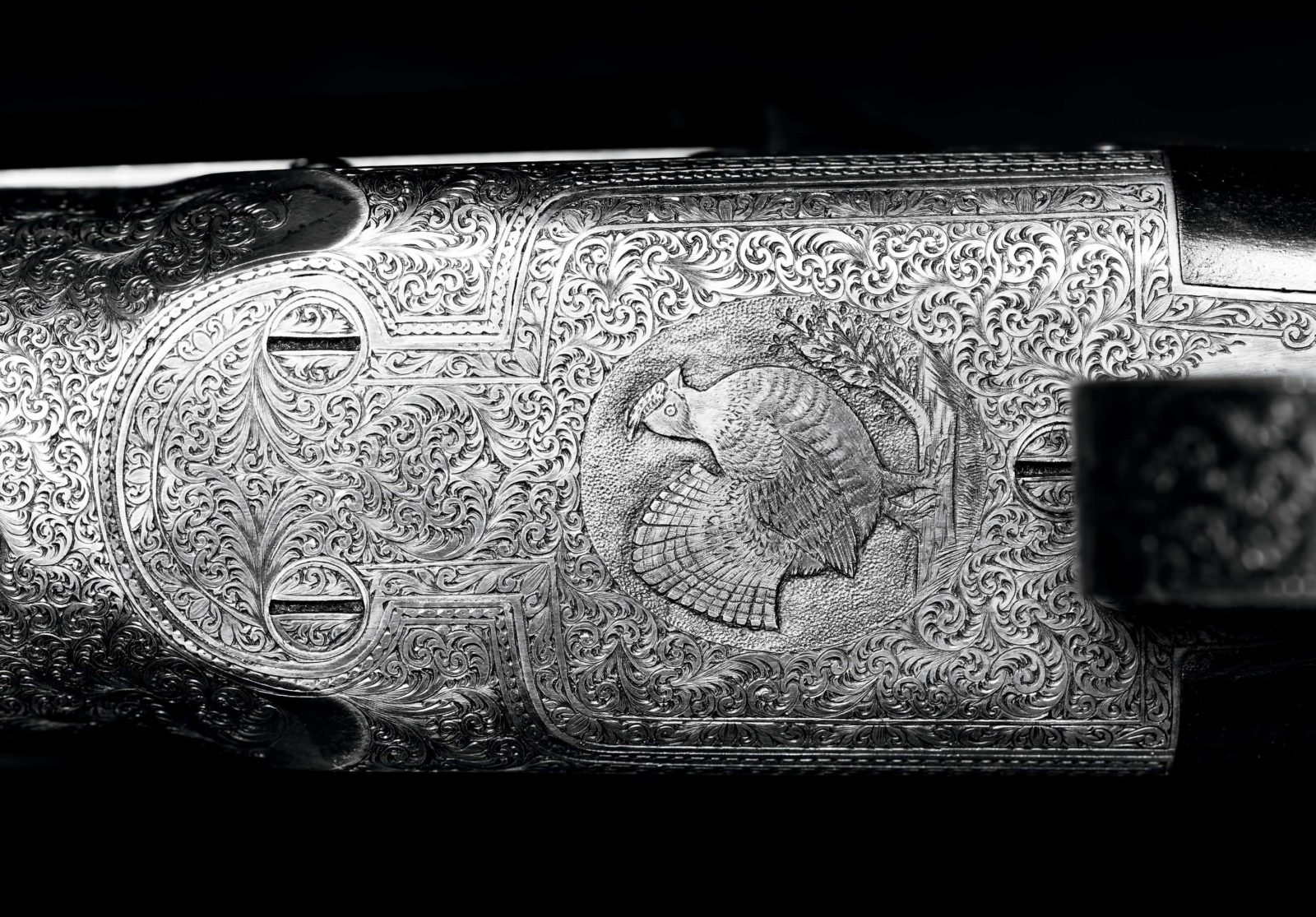
The rifle’s blued and casehardened receiver, finger lever, and barrel are engraved with scrollwork and inlaid with gold wire framing two gold-inlaid game scenes of a moose and two deer.

Though traditionally regarded as “American” in style, such decorations found on Winchester rifles and many other American machine-made firearms of the mid-nineteenth and early twentieth century are in fact international in nature, reflecting the training and taste of the German-born engravers who emigrated to the United States around the middle of the century and headed the decorative operations at America’s largest firearms manufacturers, including the Ulrich family and Gustave Young.

This rifle’s game and hunting scenes, and indeed many of the standard hunting and game scenes offered by Winchester, draw direct inspiration from specific northern European iconographic sources, including the 1856 pattern book by the Belgian artist Charles Claesen, Recueil d’ornements et de sujets pour etre appliques a l’ornamentation des armes d’apres les dessins pircipaux artistes.

The inspiration for the profusion of scrollwork found on embellished Winchester rifles, Colt pistols, and guns by other major American manufacturers, too, traces to northern Europe, chiefly the work of Gustav Ernst of Zella, who produced six influential pattern books between 1839–53 widely used by gun engravers in America. A copy of Ernst’s pattern book Musterblätter enthaltend die anwendbarsten Jagdstücke u. Arabesken für Büchsenschäfter, Graveure etc. of 1850 owned by the famous firearms engraver Louis Daniel Nimschke (1832–1904) is part of The Met’s collection (acc. no. 2002.233.1a–j).

The Model 1886 represents a milestone in Winchester’s history as it was the first rifle designed for the company by John Moses Browning (1855–1926). Browning’s designs led to the development of nine Winchester rifle models in total over the course of fifteen years, including the company’s most popular rifle, the Model 1894. Browning’s Model 1886 introduced significant improvements to the company’s previous lever action rifle, the Model 1876.

These included an improved, stronger locking system with two vertical lug nuts interfacing with the bolt and receiver, an improved elevator system, new safety mechanisms, and better insulation from dust and debris.

Categories
Art Dear Grumpy Advice on Teaching in Today's Classroom Hard Nosed Folks Both Good & Bad

Very spooky realistic bronze of Thracian king Seuthes III, who ruled around 300 BC

To these tired old eyes of mine, he looks like a tough & very dangerous man to boot.

Categories
Ammo Art

Remember these?

Categories
Art

Some Art that I really like for some reason

Categories
Art

Bringing home dinner the old school way

Categories
Art The Green Machine This great Nation & Its People War

The Battle of Caloocan


The Battle of Caloocan was one of the opening engagements of the Philippine–American War, and was fought between an American force under the command of Arthur MacArthur Jr. and Filipino defenders led by Antonio Luna in February 1899.

American troops launched a successful attack on the Filipino-held settlement of Caloocan on February 10, which was part of an offensive planned by MacArthur Jr. Occurring a few days after an American victory near Manila on February 4–5, the engagement once again demonstrated the military superiority that American forces held over the Philippine Revolutionary Army.

However, it was not the decisive strike that MacArthur had hoped for, and the war continued for another three years.

Categories
Art Well I thought it was neat!

Some Deadwood anybody?

Categories
Art Soldiering

A Roman Soldier near the End of the Empire!

Legionary of the HERCULIANI SENIORES from the 4th century. Painted by Johnny Shumate.
Categories
Art Soldiering War

Marshal Ney Supporting the Rear Guard (Russia 1812)

Ney, The Bravest of Napoleons Marshals

Categories
Art War

1917 – The Real Story