Category: Anti Civil Rights ideas & “Friends”
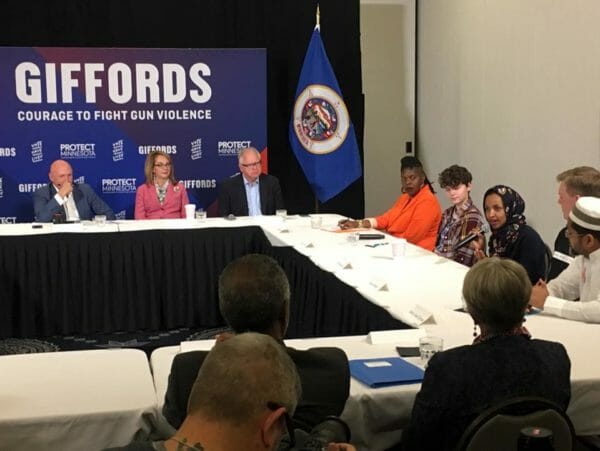 Mark Kelly and GabbyGiffords look on approvingly as Ilhan Omar explains how Americans can be made just as helpless and dependent on others as the people she left behind when her family fled murderous factions in Somalia. (Ilhan Omar for Congress Facebook photo)
U.S.A. – -(Ammoland.com)- “Ilhan Omar will be sworn into the U.S. House of Representatives at a time when liberal-leaning newcomers like her are pushing for more influence in shaping the party’s agenda,” the Star Tribune reports. The Congressional Progressive Caucus, “the largest voting bloc among House Democrats,” is turning up the pressure to wield more power and advance its agenda via committee assignments.
That should surprise no one. For all its phony egalitarian posturing, the overtly socialist wing of the Democrat party rejects the ultimate political power-sharing that can only be possible with an armed citizenry. As such, they embrace gun bans and due process-denying prior restraints. And that’s just what they admit to.
They have close ties to the Democratic Socialists of America, the domestic arm of Socialist International, which doesn’t reveal all of its cards, either. Case in point, they’d just as soon you not see their songs of solidarity (now only available via the Internet Archive) that include such inclusive lyrics as:
And when the revolution comes,
We’ll kill you all with knives and guns
So it’s also no surprise that “gun control legislation” is a priority for Omar. The Founders considered a citizen militia to be the one thing “necessary to the security of a free State.” She wants to render those citizens disarmed and thus incapable.
Some might find that curious considering Omar and her family were admitted to this country as refugees from Somalia. Rather than embracing the freedom that made America a place to run to, she’s intent on reshaping the Republic into something alien where all one can do against murderous factions is flee from them or die.
And she’s allegedly not above playing fast and loose with the rules to make the changes happen. Still unresolved are accusations of “using state resources and state staff time to conduct her private business activities” and reports of bigamy (with her brother) and immigration fraud, which she refuses to discuss and tries to dismiss by accusing those calling for answers of being racists and anti-Islamic.
Omar has been able to exploit manipulated demographic changes to obtain political power and thus puts a face on the ideological and cultural transformation that will ultimately prove to be the greatest threat against gun owner rights. Most in the “gun community leadership” ignore that and some even deny that observation, but none will present verifiable facts to refute it.
It’s not bigotry or xenophobia to observe that importing dependent populations with foreign political beliefs and making them “voting citizens” benefits disarmament-demanding political factions. It’s also self-evident that the Founders intended the Constitution “to secure the Blessings of Liberty to ourselves and our Posterity,” with all that implies about who gets admitted and what the expectations for them should be.
About David Codrea:
David Codrea is the winner of multiple journalist awards for investigating / defending the RKBA and a long-time gun owner rights advocate who defiantly challenges the folly of citizen disarmament.
He blogs at “The War on Guns: Notes from the Resistance,” is a regular featured contributor to Firearms News, and posts on Twitter: @dcodrea and Facebook.
In the wake of the 2018 mid-term elections, so-called “gun control” is back in the news. Even though the murder rate in the United States is declining and at a 33-year low, the mass media’s much-heralded “threat of gun violence” has politicians in a frenzy much like those seen in 1968 and 1994. Gun control laws and decrees should be called out for what they really are: Systematic Civilian Disarmament.
In Western nations, most such legislation usually starts small, progressing from registration to wholesale confiscation. First one category of weapons is banned, and then another. Gradually, these draconian laws can ramp up to the point where most citizens can’t even possess air rifles and crossbows. To understand the origins of these laws, we need to examine both some psychology and some history.
INHERENT COMPULSIONS
There is a distinct psychology of humans who gain positions of power. They almost immediately develop a “we/they” outlook on life that can eventually develop into narcissism and paranoia. This is most pronounced in dictators, but even petty bureaucrats display the same sinful tendencies:
- The desire to consolidate and accumulate more power. (In its extreme, totalitarianism and megalomania.)
- Fear and dislike of competitors to their power.
- A tendency toward corruption and nepotism. (Typically, as a means to consolidate power in an inner circle.)
- Belief that laws only apply to “little people.”
- A compulsion toward a monopoly of force, that necessitates arming the “we” whilst disarming the “they.”
With that sadly almost universal psychological makeup in mind, let’s move on to some historical examples of governors and governments that have felt compelled to disarm those they rule.
They leave arms only in the hands of those that they trust. (These trusted folks are usually called “comrades” (cronies), “bodyguards”, “trained police”, “military professionals”, and “loyal cadres.”)
Many people mistakenly believe that systematic civilian disarmament was an invention of the 20th Century. Here in America, gun restrictions actually got a very early start. The first General Assembly of Virginia met in Jamestown in 1619. There, the settlers enacted more than 30 laws to govern the fledgling colony.
One of these laws was a monopoly of force provision that included this wording : “…[t]hat no man do sell or give any Indians any piece, shot, or powder, or any other arms offensive or defensive, upon pain of being held a traitor to the colony and of being hanged as soon as the fact is proved…” Yes, they had the death penalty for selling a firearm or ammunition to an Indian!
Gun laws were not systematic, widespread, and applicable to the general citizenry until after the Civil War.
It was in the late 1860s that such laws got their start at the state level. In this Reconstruction period in the former Confederate States, state governments sought to keep freed slaves from asserting their rights.
These were the first states to systematically ban carrying concealed knives or handguns. Not surprisingly, those inherently racist laws were only selectively enforced, based on skin tone.
THREE MILLENNIA OF DISARMAMENT
But to back up even more… If we dig in to historical texts, we can see that organized efforts to disarms civilians have been going on for at least three millennia.
In the Bible we read an early account of civilian disarmament in the book of 1st Samuel, where it describes a successful effort by Philistine governors to disarm the Israelites. This was at about the same time that Saul was anointed as Israel’s first king (in 1026 BC):
“Now there was no smith found throughout all the land of Israel: for the Philistines said, Lest the Hebrews make them swords or spears:
But all the Israelites went down to the Philistines, to sharpen every man his [plow]share, and his coulter, and his axe, and his mattock.
Yet they had a file for the mattocks, and for the coulters, and for the forks, and for the axes, and to sharpen the goads.
So it came to pass in the day of battle, that there was neither sword nor spear found in the hand of any of the people that were with Saul and Jonathan: but with Saul and with Jonathan his son was there found.” – 1Sam. 13:19-22 (KJV)
Later, the Israelites were systematically disarmed by successive waves of invaders, most notably:
- The Babylonians–following the Battle of Carchemish in 605 BC.
- The Macedonian Greeks led by Alexander The Great in 332 B.C.E.. After Alexander’s death in 323 BC, Greek occupational rule of the Levant was continued by the Seleucid Greeks. The Jewish revolt against Seleucid rule was described in detail in the apocryphal books 1st and 2nd Maccabees. Aside from the Greeks defiling the Temple in Jerusalem, one of the main reasons for the Maccabean Revolt was that the Greeks had disarmed the Jews to the extent that they could not even carry a knife to defend themselves against robbers.
- The Romans–from 6 AD to 135 AD. This occupation was detailed by Flavius Josephus, in his histories titled Antiquities of the Jews and Wars of the Jews. (After the burning of Jerusalem in AD 70, the great Diaspora began. The nation of Israel would not be reconstituted until 1948.)
- Under the British Mandate, by the British Army from 1945 to 1947. Jews had to create more than 1,500 hidden weapons caches, while waiting out the British Army’s departure.
- Finally, starting in 1948, by their own newly established government. Since most of the leaders of the new government had a European background, they foolishly imitated their former masters and set up small arms registration schemes for Israel. And, like the Europeans, they fairly quickly banned private ownership of heavier weapons. Getting a permit to own a firearm in modern day Israel is a minor nightmare. It now requires a background check, a physician’s statement, and paying a regular fee. Further, most permit holders are only allowed to own one firearm (usually a pistol), and to possess no more than 50 rounds of ammunition at a time. Roughly 40 percent of requests for gun permits are rejected.
THE JAPANESE SWORD HUNTS
In the Wiki world, we read about systematic civilian disarmament in Feudal Japan:
“Several times in Japanese history, the new ruler sought to ensure his position by calling a sword hunt (katanagari). Armies would scour the entire country, confiscating the weapons of the enemies of the new regime. In this manner, the new ruler sought to ensure that no one could take the country by force as he had just done. The most famous sword hunt was ordered by Toyotomi Hideyoshi in 1588.
Prior to the sword hunt called by Oda Nobunaga towards the end of the 16th century, civilians were free to carry swords for defense or simply for decoration. Nobunaga sought an end to this, and ordered the seizure of swords and a variety of other weapons from civilians, in particular the Ikkō-ikki peasant-monk leagues which sought to overthrow samurai rule.”
You can read the entire article at Infogalactic.
It is interesting to note that both the Israelites and the Japanese peasantry resorted to using farming implements as weapons, after they had been disarmed. Most famously, the martial arts weapon known as Nunchaku (aka “Nunchucks’ in modern parlance) got their start as a two-piece grain harvesting flail.
Here is another wiki quote: “Okinawans, under the rule of foreign powers, were prohibited from carrying weapons or practicing with them in public. But the weapons-based fighting that they secretly practiced (and the types of weapons they practiced with) had strong Chinese roots.” Many of these weapons were repurposed or simple adaptations of existing farming tools.”
EARLY EUROPEAN DISARMAMENT PROGRAMS
Perhaps the earliest systematic civilian disarmament scheme in Europe was created by Holy Roman Emperor Frederick Barbarossa The First. He issued the Peace Ordinance of 1152. That law forbade peasants from carrying swords and lances. Only nobles were allowed to be armed, in peacetime.
The French nobility also got an early start at disarming those Deplorable Peasants. In the 1440s King Louis XI signed an order called The Noble Privileges, which mentions the right of Nobles to carry swords. All others had no such privileges.
In 1533, the crown of England issued this edict:
“An Act for shooting in Cross Bows and Hand Guns Whosoever shall shoot in any Hand Gun or Cross Bow or keep any in his House except he has Land Annuities or Offices to the yearly Value of an Hundred Pounds shall forfeit Ten Pounds for every Offence and a Justice of the Peace may commit the Offender to Gaol until he hath paid the same Forfeiture All former Placards made to shoot in either of them shall be void.”
It is interesting that the 1533 English law exempted wealthy people–that is, anyone with a net worth of One Hundred Pounds. In today’s currency, that is the equivalent of near $800,000 USD. Once again, it was the Deplorable Peasants that powers the Powers That Be of that era meant to disarm.
Weapons prohibition gradually increased in western Europe in the 17th, 18, and 19th centuries. Along with mass production of arms in the 1800s came the standard practice of stamping serial numbers. And that opened up the opportunity for governments to register not just owners but particular guns to particular owners.
THE 20TH CENTURY: THE CENTURY OF GENOCIDE
What is now called “common sense gun control” was adopted by many nations around the world in the 20th Century, with disastrous results for human life and liberty. Although nearly all of Europe now has gun registration, there have been a number of notable campaigns to outright disarm the European citizenry:
The Ottoman Turkish government began systematic civilian disarmament in the 1890s. These laws were not equally enforced.
It was non-Muslims that were singled out for prosecution. In 1901, H. F. B. Lynch–a British travelogue writer–described the Armenians of Turkey as “rigorously prohibited from possessing firearms.” The Armenian Genocide (1915 to 1922) saw some 1.5 million disarmed Armenians killed.
They died at the hands of Turkish Army troops, police, and civil administrators. Most of the Armenian genocide victims were Christians.
As early as 1918, the Soviet Union established systematic civilian disarmament. In December of 1918, the Council of People’s Commissars issued decree on the surrender of weapons.
As documented at the Infogalactic wiki: The citizenry was ordered to surrender “…any firearms, swords, bayonets and bombs, regardless of the degree of serviceability. The penalty for not doing so was ten years imprisonment.
Members of the Communist Party were allowed to have a single weapon (a pistol or a rifle) and possession of the weapon was recorded in the party membership book. On December 12, 1924 the Central Executive Committee of the USSR promulgated its degree “On the procedure of production, trade, storage, use, keeping and carrying firearms, firearm ammunition, explosive projectiles and explosives”, all weapons were classified and divided into categories.
Now the weapons permitted for personal possession by ordinary citizens could only be smoothbore hunting shotguns. The other category of weapons were only possessed by those who were put on duty by the Soviet state; for all others, access to these weapons was restricted to within state regulated shooting ranges.
Illegal gun possession was severely punished. Since March 1933 the manufacture, possession, purchase, sale of firearms (except for smoothbore) hunting weapons without proper authorization was punishable by up to five years in prison. In 1935, the same penalty was imposed for possession of knives.”
From 1929 to 1953, about 20 million disarmed dissidents in the Soviet Union were either systematically starved, exiled to Siberian gulags, or exterminated. Some of these pogroms were on a grand scale.
Most notably, there was the forced starvation in the Ukraine, called The Holodomor. (“To kill by starvation”). This man-made famine of 1932-1933 was also also known as the Terror-Famine or the Famine-Genocide.
Nazi Germany established systematic civilian disarmament in 1938. Under the Law on the Reunification of Austria with Germany of 13 March 1938, most guns in Germany became subject to registration.
But even earlier, in Section 5 of the First Regulations of the German Citizenship Law of 14 November 1935 (Reichsgesetzblatt 1, p. 1332) Jews were named in particular as prohibited from “acquiring, possessing, and carrying firearms and ammunition”, as well as “truncheons or stabbing weapons”.
From 1939 to 1945, no less than 6 million Jews and 4 million others were segregated, rounded up, and systematically worked and/or starved to death or outright exterminated by gassing or gunfire. Their bodies were then either cremated or buried in mass graves.
During World War II, Nazi Germany invaded and occupied parts or all of 18 countries. (This included some of the Channel Islands that were part of the United Kingdom.)
In the majority of those countries, the Nazis immediately seized gun registration records held by local police. Using those records, they confiscated nearly all guns in private hands.
This systematic civilian disarmament made occupying these nations much easier, and any organized resistance quite difficult.
In Hungary, systematic civilian disarmament began soon after the end of World War II. The Soviets were successful in quashing the attempted counter-revolution of 1956 because they mainly faced unarmed (or grossly under-armed) civilians. More than 2,500 Hungarians died in the failed counter-revolution.
Yugoslavia began systematic civilian disarmament immediately after the end of World War II. In the Kosovo War that erupted with the inevitable breakup of Yugoslavia, there were widespread kidnappings, summary executions, and civilian massacres.
Programs of “ethnic cleansing”–primarily through forced property dispossession and relocation–caused untold misery in the late 1990s.
In the Kosovo War it was primarily ethnic Albanians who were systematically killed. The worst of these were in the Dubrava Prison massacre, the Meja massacre, and the Orahovac massacre.
These massacres underscored the sad truth: Disarmed people can be victimized en masse. And in this case, it was a nominally Christian government that was oppressing Muslims.
SYSTEMATIC CIVILIAN DISARMAMENT IN EAST ASIA
In 1948, Indonesia established systematic civilian disarmament with enactment of Law No. 8/1948 On Firearms, followed by Emergency Law No. 12/1951 On the Illegal Possession of Firearms , and Law No. 62/1960 On Gun Licenses.
Beginning in December 1975 and up until October 1999, Indonesia conducted a brutal occupation and mass killings in East Timor (Timor-Leste). In each village that the Indonesians successively occupied, Indonesian troops knew exactly where to go to round up Timorese-owned guns.
Most of them had been dutifully registered. The civilian death toll for East Timor in the period of 1974 to 1999 was estimated at roughly 103,000 people.
Communist China established systematic civilian disarmament throughout all their territories in 1935. From 1948 to 1952, 20 million disarmed political dissidents were rounded up and exterminated.
Then, again in from 1966 until 1976, Chairman Mao initiated the Cultural Revolution. This was intended to purge “remnants of capitalist and traditional elements” from The People’s Republic. According to Wikipedia: “…millions of people were persecuted and suffered a wide range of abuses including public humiliation, arbitrary imprisonment, torture, hard labor, sustained harassment, seizure of property and sometimes execution.
A large segment of the population was forcibly displaced, most notably the transfer of urban youth to rural regions during the Down to the Countryside Movement. Historical relics and artifacts were destroyed and cultural and religious sites were ransacked.”
Simultaneously, The Great Famine, created by communist Central Planning resulted in the deaths of approximately 45 million Chinese citizens.
Any attempts at rebellion by anti-communists were put down with extreme force by the People’s Liberation Army (PLA). The PLA was successful because they had a monopoly on force. Only loyal communist cadres were armed. All others had long since been systematically disarmed.
Communist China invaded Tibet in 1950. There, they quickly embarked on systematic civilian disarmament. The PLA had a devious three-part plan to subjugate Tibet: Gun restrictions, imprisoning or deporting those who resisted, and bringing in thousands of ethnic Chinese settlers, to shift demographics. Those all worked, and Tibet is still under Chinese control, nearly 80 years later.
Cambodia (aka Kampuchea) established systematic civilian disarmament in 1956. From 1975 to 1977, mostly during the second term of Pol Pot, as General Secretary of the Central Committee of the Communist Party of Kampuchea, one million intellectuals, unable to defend themselves, were rounded up and exterminated.
IN AFRICA
Uganda established systematic civilian disarmament under the Firearms Act of 1970. During the rule of Muslim dictator Idi Amin (from January 1971 to April, 1979), 300,000 people mostly Christians, unable to defend themselves, were rounded up and exterminated.
Here is an insightful quote from the Infogalactic wiki: “Amin recruited his followers from his own ethnic group, the Kakwas, along with South Sudanese. By 1977, these three groups formed 60 percent of the 22 top generals and 75 percent of the cabinet.
Similarly, Muslims formed 80 percent and 87.5 percent of these groups even though they were only 5 percent of the population. This helps explain why Amin survived eight attempted coups.”
Zimbabwe’s dictatorship led by Robert Mugabe and his ZANU-PF party began systematic civilian disarmament in 1981. They focused on disarming the minority Ndebele tribe of western Zimbabwe.
Then, starting in 1983, there was a series of hushed-up massacres in Matabeleland by the Fifth Brigade of the Zimbabwean Army. Those took the lives of 20,000 Ndebele tribe men, women, and children. In 2015 it was revealed that Mugabe had personally ordered the main massacre series, commonly known as The Gukurahundi killings.
The nation of Sudan (which later partitioned into Sudan and South Sudan), ruled by an Islamist government, implemented the “Arms, Ammunition and Explosives Act of 1986.” This law requires the registration of most firearms, and entirely bans civilian possession of most military weapons.
According to Pierre-Richard Prosper, Ambassador-at-Large for War Crimes Issues of the U.S. State Department, in the Second Sudanese civil war (1983 to 2005), “…the Government of Sudan engaged in a policy to destroy the predominately Christian and animist south.
Death and destruction reached staggering proportions. Credible estimates from human rights organizations suggest that two million people have perished, four million have been internally displaced, and nearly 400,000 have been forced to live in neighboring countries as refugees.”
SYSTEMATIC CIVILIAN DISARMAMENT IN THE AMERICAS
Cuba established systematic civilian disarmament soon after Fidel Castro took power on July 26th, 1959. By restricting firearms almost all gun ownership to the military, police, and a few loyal communist paramilitary cadres, any organized resistance to to the Castro regime was almost impossible.
Guatemala established systematic civilian disarmament in 1964, by the Directorate General for Control of Arms and Ammunition (DIGECAM). From 1964 to 1981, roughly 100,000 disarmed Mayan Indians were rounded up and killed.
The Mexican Constitution of 1857 promised that: “…every man has the right to keep and to carry arms for his security and legitimate defense.” However, in 1917, in response to a revolution led by Pancho Villa, their constitution was amended.
Under one amendment citizens were precluded from being able to buy weapons “reserved for use by the military”. Another amendment forbade carrying “…arms within inhabited places… …without complying with police regulations.”
Mexico was successful in stopping several revolutions. Gun laws were a key part of their strategy. But now, in the 21st Century, there has been an unintendend consequence: Mexico’s drug cartels now run rampant.
They just ignore the country’s gun registration, caliber restriction, and firearm category restriction laws. The gangs import or even manufacture weapons, with impunity. The police are outnumbered.
And because of civilian disarmament laws the general citizenry is vastly out-gunned by the drug gangs. They are at their mercy.
In the United States, there were no Federal gun laws until 1934. Then, in the midst of the Great Depression, with a Democrat-dominated 73rd Congress and with Democrat Franklin Delano Roosevelt in the White House, the National Firearms Act of 1934 (NFA-34) was enacted.
This law put a $200 tax on machineguns, silencers, short-barreled rifles, and short-barreled shotguns. The machinegun law was expanded in 1986, when an outright freeze on the production or importation of any new machineguns transferable to civilians was enacted.
After the NFA-34 tax morphed into a quasi-ban, the prices of transferable machineguns have risen astronomically. Just a two ounce AR-15 registered drop-in autosear now sells for as much as $34,000!
As you can see, over the centuries the gun-grabby compulsions of governments keep coming back, like a bad rash.
Sooner or later, centralized governments almost always gravitate toward a monopoly of force. And even in nominally “democratic” countries, gun prohibition laws have led to suffering and death on a monumental scale.
WE, THE DEPLORABLES
The gun politics of the 21st Century have become intensely divisive. The increasingly populous and liberal coastal states are at odds with the conservative lightly-populated interior.
The published talking points and “messaging’ of the gun grabbers reveal that they are willing to twist statistics, mischaracterize events, and vilify their enemies, in order to get their way.
We are now viewed as “deplorables” by the media, academia, the Democrat party, and even by the euphemistically-labeled “moderate” wing of the Republican party. To the urban elite, we are seen as disloyal, deplorable, and despicable country bumpkins.
This viewpoint was revealed in 2008 by then-candidate Barack Hussein Obama, when he went off-script at a campaign town hall meeting. In those remarks, he described working-class people in traditional industrial towns thusly: “They get bitter, they cling to guns or religion or antipathy to people who aren’t like them or anti-immigrant sentiment or anti-trade sentiment as a way to explain their frustrations.”
I’m proud to call myself a Bitter Clinger. I will defy their unconstitutional gun laws, even if means going to prison or dying in combat. The alternative–complying and simply watching the history of genocide repeated–is not acceptable to me.
Whether its now spoken or not, Obama’s view of the We/They Paradigm is clearly shared by leftists and statists at all levels of government. They see us clinging to our guns as a threat to their power.
And in one sense, they are right. We will continue to cling to our guns as long as governments continue to pursue a monopoly of force and creep toward total government. This is what the Second Amendment is all about: It provides a final check on the ambitions of those with unlimited ambition.
Learn from the mistakes of history. Do not allow them to be repeated! – JWR
Note: Permission is granted for re-posting of this article, but only if done so in full, with proper attribution to James Wesley, Rawles and SurvivalBlog.com, and only if the included links are preserved.)
(Why do I act surprised by the fact that all the Pols would sell their nearest & dearest for an advantage? Right?)
Bipartisan Support for New Federal Gun Controls Is a Red Flag

By
Is more gun control legislation coming to Congress?
The 2018 midterm elections produced a split Congress with Democrats gaining control of the House and Republicans gaining seats in the Senate.
The change in House leadership will signal changes in gun control legislation in the near future. The Guardian has detailed House Democrats’ desire to pass gun control legislation in the upcoming Congress:
The 2018 midterm elections produced a split Congress with Democrats gaining control of the House and Republicans gaining seats in the Senate.
The change in House leadership will signal changes in gun control legislation in the near future. The Guardian has detailed House Democrats’ desire to pass gun control legislation in the upcoming Congress:
“Ted Deutch, a Democratic congressman from Florida who represents Parkland, where a February school shooting left 17 dead, said this week that he expected House Democrats to focus on bills with more bipartisan support. Those measures included bump stock bans and “extreme risk protection orders”, also known as red flag laws, which give law enforcement and family members a way to petition a court to temporarily bar an unstable person from buying or owning guns.”
Red flag laws might just be the “come together” moment establishment politicians have been looking for.
What Are Red Flag Laws?
Red flag laws or Extreme Risk Protection Orders (ERPOs) are the euphemistic label for new gun-control measures. Under red flag laws, law enforcement has the ability to confiscate an individual’s firearms who is deemed a threat to themselves or others. A simple accusation from a family member, friend, or associate will suffice to seize someone’s firearms.
These laws, mind you, operate in the absence of due process. The accused can have their weapons confiscated without even so much as a hearing a before a judge. It could take months before a gun owner would have to appear in court to win back his gun rights.
Thirteen states currently have red flag laws on the books, with dozens more filing their own versions. What started out as a state-level movement may have some legs at the federal level. Although it’s true that Congressional Democrats are making gun control a major theme of their legislative agenda, it’s naïve to think red flag laws are only relevant because of “gun-grabbing” Democrats have taken power.
As we’ll see below, red flag laws have a history of bipartisan support. And when any piece of legislation has Democrats and Republicans locking arms in agreement, you know trouble lies ahead.
The Gun Control Bipartisan Status Quo
Despite the passionate campaign rhetoric, a significant portion of Republican politicians will change colors on gun rights once in DC. Several GOP members in the upcoming Congress are notable when it comes to their gun control advocacy:
Lindsay Graham: The South Carolina Senator already introduced a red flag bill earlier this year. With the 116thCongress right around the corner, Graham will likely reach across the aisle with Democrat colleagues to move red flag legislation forward. Graham has opined that red flag legislation is the “place where we begin a long-overdue discussion about firearms and mental health. But we must start.”
Marco Rubio: Following the Parkland shootings, Rubio joined the gun control chorus by sponsoring a red flagbill along with Democrat Senators Joe Manchin, Bill Nelson, & Jack Reed. Rubio has even flirted with the idea of regulations on magazine clips, raising the minimum age to buy certain firearms like AR-15s, and tweaking the current background check system.
Rick Scott: the Former Governor of Florida (and now a U.S. Senator from Florida), Rick Scott poses an interesting threat to gun rights. Despite his ostensibly pro-gun rhetoric, Scott signed SB 7026 Florida’s most expansive gun control measure in recent history. Scott’s SB 7026 contains red flag provisions, raises the age to buy a firearm to 21, and imposes a three-day waiting period for all firearms purchases.
Trump Administration: Even the Executive branch is joining in on the red-flag craze. The Trump Administration’s Commission on School Safety recently released a report recommending red flag laws as a means to “address school safety and violence.” It’s likely only a matter of time before legislation is introduced in either chamber of Congress now that the Trump administration has endorsed red flag laws.
Larry Hogan, the Republican Governor of Maryland, recently signed a series of gun bills, one which included a red flag law. In October, the first month Maryland’s red flag law went into effect, there were 114 requests to confiscate individuals’ firearms.
Maryland’s red flag law has not been without its fair share of controversy. At 5 a.m on Monday, November 5, two police officers came knocking on 61-year-old Gary Willis’ door to serve him a court order mandating that he turn over his guns. What seemed like a typical court order, quickly turned deadly as one of the cops shot and killed Willis in a struggle that ensued. Quick to defend one of his own, Anne Arundel County Police Chief Timothy Altomare defended the cops’ action by callously claiming that they “did the best they could with the situation they had.”
The tragic incident in Maryland is an ominous sign of what may be to come should red flag laws gain more traction.

Man Sells Junk Guns To Buy-Back Program, Buys New Gun With Cash