Categories
All About Guns Anti Civil Rights ideas & "Friends"

Biden, DOJ Announce ‘National Ghost Gun Enforcement Initiative’ to Crack Down on Homemade Guns by Jordan Michaels

Biden, DOJ Announce &8216;National Ghost Gun Enforcement Initiative&8217; to Crack Down on Homemade Guns

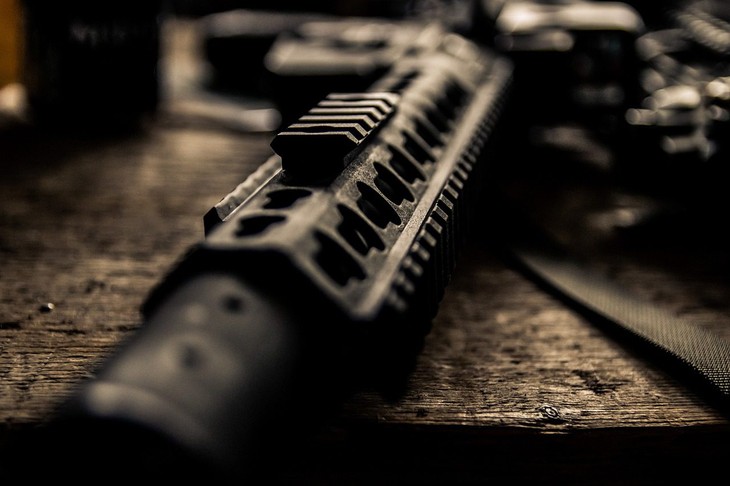
President Joe Biden and Attorney General Merrick Garland announced today the creation of a “National Ghost Gun Enforcement Initiative” designed to crack down on homemade guns, sometimes referred to as “ghost guns.”

The announcement comes as Biden travels to New York City to meet with Mayor Eric Adams, who recently announced his own “Blueprint to End Gun Violence.”

“Today, the Department is announcing the launch of a national ghost gun enforcement initiative designed to prevent these unserialized firearms from being used to commit crimes, including by prioritizing bringing federal charges against criminal use of these weapons,” the DOJ explained in a statement.

As part of this new initiative, the DOJ will “train a national cadre of prosecutors on enforcement issues specific to the use of ghost guns in crimes.” These prosecutors will be available to “every district across the country.”

The DOJ will also send out a “set of materials” to assist investigators and prosecutors in bringing cases against those who use homemade firearms in crimes, and designate a “ghost gun coordinator” in each ATF field division.

The statement’s focus on crimes and criminals is doubtless intended to reassure law-abiding gun owners that the DOJ won’t come after them. But “ghost gun” owners may not be considered “law-abiding” for long.

At the behest of the Biden administration, the Bureau of Alcohol, Tobacco, Firearms, and Explosives (ATF) proposed a new rule that would redefine what constitutes a “firearm frame or receiver.”

As part of this new rule, the ATF will ban “weapons parts kits” by redefining the term “firearm” to include “a weapon parts kit that is designed to or may readily be assembled, completed, converted, or restored to expel a projectile by the action of an explosive.”

This new definition requires companies that manufacture weapons parts kits to serialize unfinished receivers and conduct a background check on all customers prior to purchase.

The ATF assures gun owners that “nothing in this rule would restrict persons not otherwise prohibited from possessing firearms from making their own firearms at home without markings solely for personal use.”

However, the DOJ’s laser focus on “ghost gun” prosecution casts doubt on how gun owners who currently own non-serialized weapons parts kits will be treated. As GunsAmerica has covered previously, the ATF has banned a product, secured customer lists from gun companies, and used those lists to prosecute search warrants.

In the case of one firefighter from California, state agents discovered illegal firearms while assisting the ATF on its raid, and the state tried to prosecute him.

Considering this history, the DOJ’s assurance that its new task force will only target criminal ghost gun owners is small comfort.

Categories
Anti Civil Rights ideas & "Friends" California Cops

California: Mandatory Gun Ownership Disclosure Bill Filed

Yesterday, the California State Legislature saw the introduction of two more anti-gun bills that continue the assault on lawful gun ownership in the Golden State. On the heels of passing legislation to violate gun owner privacy during the 2021 legislative session, for which the NRA has already filed a lawsuit, legislators have now introduced Senate Bill 906, to require disclosure of firearm ownership and storage methods for parents of school-age children. This is one more attack on the privacy of lawful gun owners in this state. NRA will fight this legislation during the session and will be prepared to pursue litigation in the event it receives the Governor’s signature. Additionally, Assembly Bill 1769 was introduced prohibiting the sale of firearms, ammunition, and firearm parts at gun shows in the 31st Agricultural District. Both SB 906 and AB 1769 are still awaiting committee assignments and policy hearings. Your NRA will continue to keep you updated as these bills are scheduled.

Senate Bill 906, introduced by Senator Anthony Portantino (D-25), makes it mandatory that parents of students disclose firearm ownership status to the schools their children attend, including how they are stored. It requires that these questions be placed on the forms used to register or enroll students, and these forms may be made available to law-enforcement under certain conditions.

Assembly Bill 1769, introduced by Assembly Member Steve Bennett (D-37), prohibits officers, employees, operators, lessees, or licensees of the 31st District Agricultural Association from entering into any agreement to allow for the sale of any firearm, firearm parts, or ammunition on property or buildings that comprise the Ventura County Fair and Event Center or properties in Ventura County and the City of Ventura that are owned, leased, operated, or occupied by the District. This imposes a one-size-fits-all restriction to prevent officials from deciding how to use venues.

Categories
Anti Civil Rights ideas & "Friends" Cops

Biden Admin Has Records on Nearly One Billion Gun Sales ATF database on firearm sales sparks fears Biden admin tracking millions of gun owners

 • January 31, 2022 1:10 pm

The Biden administration is in possession of nearly one billion records detailing American citizens’ firearm purchases, far more than Congress and the public has been aware of, according to new information from the Bureau of Alcohol, Tobacco, Firearms, and Explosives obtained by the Washington Free Beacon.

The ATF disclosed to lawmakers that it manages a database of 920,664,765 firearm purchase records, including both digital and hard copy versions of these transactions. When a licensed gun store goes out of business, its private records detailing gun transactions become ATF property and are stored at a federal site in West Virginia. The practice has contributed to the fears of gun advocacy groups and Second Amendment champions in Congress that the federal government is creating a national database of gun owners, which violates longstanding federal statutes.

Rep. Michael Cloud (R., Texas), who led an investigation into the ATF database following a November Free Beacon report that the Biden administration had stockpiled records of more than 54 million gun transactions in 2021, expressed shock at the number of gun records being kept by the federal government. Cloud maintains that the ATF’s database could be exploited by the Biden administration to surveil American gun owners as it pursues new restrictions on firearms.

“A federal firearm registry is explicitly banned by law. Yet, the Biden administration is again circumventing Congress and enabling the notably corrupt ATF to manage a database of nearly a billion gun transfer records,” Cloud told the Free Beacon. “Under the president’s watch, the ATF has increased surveillance on American gun owners at an abhorrent level. The Biden administration continues to empower criminals and foreign nationals while threatening the rights of law-abiding Americans. It’s shameful and this administration should reconsider its continued attacks on American gun owners.”

While the ATF denies that these records are used to track gun owners, it transfers hard copies of the information into a searchable digital database that it says is used to trace firearms tied to crimes. The ATF reported that 865,787,086 of the records are already in a digital format.

As the ATF stockpiles gun records, the Biden administration is seeking to alter a federal law that allows gun stores to destroy their records after 20 years, preventing the federal government from getting them. The Biden administration wants gun stores to maintain their records in perpetuity, meaning that when a store closes, the ATF receives all of its records. The ATF’s gun records database has long been a flashpoint between Second Amendment advocates and the federal government, with the latter claiming the ATF is exploiting legal loopholes to expand the database. The Biden administration’s push to ensure that all out-of-business records ultimately make their way to the ATF has sparked fierce pushback from 52 Republicans in Congress.

The proposed change, Cloud and his colleagues wrote to the ATF in a November letter, “means that 100 percent of all lawful commercial firearm transfers would eventually end up in an ATF computer system, thereby creating a permanent database”—in violation of the law.

The ATF maintained in its response to the 2021 investigation that the “sole purpose” of its database and ongoing efforts to digitize out-of-business records “is to trace firearms used in crimes.”

More than half-a-million traces were performed in 2021, according to the ATF, and just under half a million in 2020. The ATF, however, says it does not have the ability to determine if the database actually helps solve crimes. The ATF’s National Tracing Center “has no ability to determine the successful prosecution of hundreds of thousands of crime gun traces it completes annually, nor does it have any way to link a trace for a specific prosecution for a particular year,” the agency informed Congress.

Aidan Johnston, director of federal affairs for Gun Owners of America, an advocacy group that has closely tracked the ATF’s database, told the Free Beacon that it is becoming clear the Biden administration is on its way to creating a national gun registry.

“Make no mistake—this is clear evidence that a partial national gun registry exists,” Johnston said. “If the American people don’t stand up for their rights now, Biden’s anti-gun ATF will be able to track gun owners, infringe on our rights, and potentially even confiscate our firearms.”

Categories
All About Guns Anti Civil Rights ideas & "Friends" Cops

They cannot control their feral residents, so you, 800 miles away, must be made to account for their failures.

APSU student indicted for selling firearms to NYPD undercover officer

  • Guns

    CLARKSVILLE, TN (WSMV) – New York City Police indicted a Clarksville college student for selling 73 firearms to an undercover officer.

    On Wednesday, Bronx District Attorney Darcel D. Clark announced the indictment of 23-year-old Shakor Rodriguez, originally from the Bronx, NY. Rodriguez, attending Austin Peay State University, has been indicted on hundreds of counts of criminal sale of a firearm, criminal possession of a firearm, and related charges for trafficking 73 weapons and high-capacity magazines to the Bronx and Manhattan.

    The investigation dubbed “Operation Overnight Express” took place between July 2020 and Dec. 2021 in New York. According to the investigation, Rodriguez sold an undercover officer 73 firearms, of which 59 were loaded and more than 40 high-capacity magazines, including multiple “drum” magazines.

    Authorities said the undercover typically paid between $1,000 and $1,500 per gun.

    “The defendant allegedly brought these semi-automatic weapons and high-capacity magazines up from the south, sometimes transporting them in a duffle bag by bus,” D.A.Clark explained. “Dozens of the firearms were loaded, and four are considered assault weapons. The NYPD worked diligently to intercept these deadly weapons before they hit our streets.”

    Rodriguez was arraigned on January 24 on 79 counts, including the criminal sale of a firearm, criminal possession of a weapon, criminal possession of a firearm, and possession of ammunition.

    “We have to make sure that we’re working together, and this is not a New York phenomenon. This is a national phenomenon,” New York Governor Kathy Hochul explained. “And we now have to pull together all the tools in a concerted way, not just deploying what we have available to us here in the state of New York, which is exceptional, but also saying, where are these guns coming from? They’re not originating here in the state of New York.”

    Investigators are still looking into how Rodriguez obtained the guns and where they were purchased.

Categories
Anti Civil Rights ideas & "Friends"

Gee I wonder why that is !

image.png

Categories
All About Guns Anti Civil Rights ideas & "Friends" Born again Cynic!

San Jose approves 1st U.S. liability insurance law for gun owners

San Jose Mayor Sam Liccardo stops to view a makeshift memorial for the rail yard shooting victims in front of City Hall in San Jose on May 27, 2021. (Haven Daley/Associated Press)

San Jose Mayor Sam Liccardo stops to view a makeshift memorial for the rail yard shooting victims in front of City Hall in San Jose on May 27, 2021. (Haven Daley/Associated Press)

 A California city voted Tuesday night to require gun owners to carry liability insurance in what’s believed to be the first measure of its kind in the United States.

The San Jose City Council overwhelmingly approved the measure despite opposition from gun owners who said it would violate their Second Amendment rights and promised to sue.

The Silicon Valley city of about 1 million followed a trend of other Democratic-led cities that have sought to rein in violence through stricter rules. But while similar laws have been proposed, San Jose is the first city to pass one, according to Brady United, a national nonprofit that advocates against gun violence.

Council members, including several who had lost friends to gun violence, said it was a step toward dealing with gun violence that Councilman Sergio Jimenez called “a scourge on our society.”

Having liability insurance would encourage people in the 55,000 households in San Jose who legally own at least one registered gun to have gun safes, install trigger locks and take gun safety classes, Mayor Sam Liccardo said.

The liability insurance would cover losses or damages resulting from any accidental use of the firearm, including death, injury, or property damage, according to the ordinance. If a gun is stolen or lost, the owner of the firearm would be considered liable until the theft or loss is reported to authorities.

However, gun owners who don’t have insurance won’t lose their guns or face any criminal charges, the mayor said.

The council also voted to require gun owners to pay an estimated $25 fee, which would be collected by a yet-to-be-named nonprofit and doled out to community groups to be used for firearm safety education and training, suicide prevention, domestic violence, and mental health services.

The proposed ordinance is part of a broad gun control plan that Liccardo announced following the May 26 mass shooting at the Santa Clara Valley Transportation Authority rail yard that left nine people dead, including the employee who opened fire on his colleagues then killed himself.

At an hours-long meeting, critics argued that the fee and liability requirements violated their right to bear arms and would do nothing to stop gun crimes, including the use of untraceable, build-it-yourself “ghost guns.”

“You cannot tax a constitutional right. This does nothing to reduce crime,” one speaker said.

The measure didn’t address the massive problem of illegally obtained weapons that are stolen or purchased without background checks.

Liccardo acknowledged those concerns.

“This won’t stop mass shootings and keep bad people from committing violent crime,” the mayor said, but added most gun deaths nationally are from suicide, accidental shootings or other causes and even many homicides stem from domestic violence.

Liccardo also said gun violence costs San Jose taxpayers $40 million a year in emergency response services.

Some speakers argued that the law would face costly and lengthy court challenges.

Before the vote, Sam Paredes, executive director of Gun Owners of California, said his group would sue if the proposal takes effect, calling it “totally unconstitutional in any configuration.”

However, Liccardo said some attorneys had already offered to defend the city pro bono.

Categories
Anti Civil Rights ideas & "Friends" Cops

Own a Fast Reset Trigger for your AR? You better watch this

Categories
All About Guns Allies Anti Civil Rights ideas & "Friends"

NRA-ILA Asks Court for Temporary Restraining Order to Protect California Gun Owners’ Privacy

Last week, NRA-ILA filed a lawsuit challenging AB-173, a newly enacted California law that directs the California Department of Justice  (“Cal DoJ”) to turn over the personal information that it has on gun owners, including their name, address, place of birth, phone number, occupation, driver’s license or ID number, race, sex, height, weight, hair color, eye color, and even their social security number and types of firearms that they own, to the California Firearm Violence Research Center at UC Davis. AB-173 further allows the Cal DoJ and UC Davis to turn that information over to any other “bona fide research institute.” Now NRA-ILA has asked the court to issue a Temporary Restraining Order, enjoining the Cal DoJ from releasing any of that personal information until the case can be heard.

This is “an unprecedented invasion of privacy of millions of Californians who purchased firearms and ammunition, or who are licensed to carry a concealed weapon,” the motion argues. “The public release of Plaintiffs’ Personal Information threatens Plaintiffs’ personal privacy and physical security. Indeed, firearm owners often encounter concerted harassment, sometimes including violence, and they are frequent targets of criminal efforts to steal firearms from their homes and businesses.”

It is bad enough that AB-173 infringes on law-abiding gun owners’ constitutional rights in multiple ways. But the harm that it creates is even worse; once that personal information is released, it cannot be undone. That is why NRA-ILA is asking the court to prohibit the Cal DoJ from releasing the information before gun owners have had their day in court.

The court has scheduled a hearing on the motion for Wednesday, January 19th. The case is captioned as Doe v. Bonta.

Categories
All About Guns Anti Civil Rights ideas & "Friends" California

NRA Files Suit to Defend Gun Owners’ Privacy in California

The National Rifle Association Institute for Legislative Action (NRA-ILA) filed a lawsuit against California on Wednesday challenging a law that allows the state to disclose sensitive personal information about law-abiding gun owners to universities and any “bona fide research institute.”

“California must be held accountable for its near-constant, unconstitutional assaults on law-abiding gun owners and the Second Amendment,” said Jason Ouimet, executive director, NRA-ILA. “This law strips privacy rights from anyone who has ever purchased a firearm, transferred a firearm, purchased ammunition, or obtained a concealed-carry license. This is an outright violation of our rights and must be reversed.”

The bill, Assembly Bill 173, allows for the disclosure of highly sensitive information, including a gun owner’s name, address, place of birth, phone number, occupation, driver’s license or ID number, race, sex, height, weight, hair color, eye color, and even their social security number and types of firearms that they own. This information was gathered from law-abiding gun owners with the understanding that it would only be used for legitimate law enforcement purposes.

“This information is a person’s identity. And it’s being handed over to organizations that have no duty to safeguard it. This will do nothing to prevent crime — it will only serve to put law-abiding gun owners at risk,” Ouimet said. “Gun owners are entitled to the same privacy rights as all law-abiding citizens. They should not be ‘doxxed’ for exercising their rights.”

This is only one of the cases that NRA-ILA has filed in recent years to curtail California’s efforts to burden the Second Amendment. NRA-ILA is also challenging California’s draconian restrictions on ammunition purchases and transfersmagazine bans, and the closure of gun shops and ranges. NRA-ILA will continue opposing California as long as it continues to infringe upon the Second Amendment.

This case is captioned Doe v. Bonta.

Please stay tuned to www.nraila.org for future updates on NRA-ILA’s ongoing efforts to defend your constitutional rights.

Categories
Anti Civil Rights ideas & "Friends" Cops

Illinois Gun Turn-in / “Buyback” Includes 8 Air Guns, Antiques

Guns turned in at the Evanston “buyback”

U.S.A. –-(AmmoLand.com)- Gun turn-in events, labeled with the Orwellian term “buyback” are making a small comeback in the United States.  Most of them are occurring in states where private sales are not allowed by law. They are not occurring in states which require the valuable property to be sold for the public’s benefit.

Illinois has a version of the law that requires private sales to go through the state website, identify the purchaser of the firearms with a Firearms Owner Identification (FOID), and be assigned an approval number.  This eliminates privacy from private sales. It becomes unworkable for private purchasers to buy guns legally at gun turn-in events.

At the Evanston, Illinois event, 53 guns were turned in on December 4, 2021. From wgntv.com:

EVANSTON, Ill. — Evanston police held a gun buyback event on Saturday, just days after a shooting left four people wounded and one dead.

“It gets the guns off the street. Whether it’s one gun or five, today we had 53. It gets the guns off the street,” interim police chief Aretha Barnes said.

Today, citizens were given $100 for each gun and $25 for ammunition. The gun buyback began nine years ago.

“I’m a lifetime 5th Ward Evanston resident and I was concerned about the gun violence I was experiencing in the neighborhood, so I was planning to do a gun buyback,” organizer Carolyn Murray said.

The best academic study of these events shows they do not reduce homicide, gun crimes, or suicide. There is a small but statistically significant increase in crimes committed with guns in the two months after the event.

These events are propaganda, street theater, virtue signaling; they are symbolic, not pragmatic.

They are meant to send the message: Guns are bad. Turn them into the Police.

Eight of the 53 guns shown as turned in at the Evanston event were BB guns, CO2 guns, or spring-powered air guns. Presumably, the people who turned them in received $100 for each of them.

Private purchasers at gun turn-in events eliminate the propaganda value of these events. They show the opposite message:

Guns are good. We pay cash.

Private purchasers buy guns that are worth more than what the organizers of the event are willing to pay. It is a way for ignorant owners of guns, who want them out of their house, to get a closer approximation of what the gun is worth.

An original military-stocked 1903 Springfield rifle may have been turned in at the event (upper right corner). It could be worth several hundred dollars to a collector.  Several other firearms worth hundreds of dollars each were turned in. They include what appear to be Glock handguns, a Remington model 11 shotgun, a pair of antique 7-shot .22 revolvers, a near-new .22 lever action rifle, and others.

If the motive of the organizers were to “get guns off the street”, they would welcome private purchasers. Private purchasers would stretch their money, moving guns from unwanted hands into the hands of responsible owners.

There was no indication of private buyers at the Evanston event. It appears the Illinois law worked to prevent private sales.

Ideally, the organizers of these events would sell the guns they obtain in ordinary commercial channels, then use the money to  buy more guns from people who do not want them.

Moving guns from unwanted hands into responsible hands is not the intent.  Destruction of the valuable property appears to meet an emotional need. Organizers want to shift responsibility for bad events from people to inanimate objects.

When faced with the option of selling the guns or not having a turn-in “buyback” event, organizers choose not to have the event.


About Dean Weingarten:

Dean Weingarten has been a peace officer, a military officer, was on the University of Wisconsin Pistol Team for four years, and was first certified to teach firearms safety in 1973. He taught the Arizona concealed carry course for fifteen years until the goal of Constitutional Carry was attained. He has degrees in meteorology and mining engineering, and retired from the Department of Defense after a 30 year career in Army Research, Development, Testing, and Evaluation.

Dean Weingarten