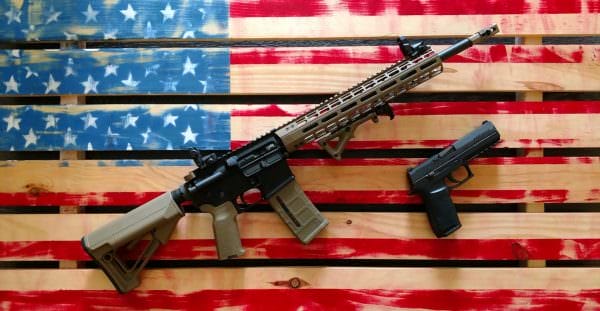
SPRINGFIELD, Ill. – A federal appeals court on Friday upheld Illinois‘ prohibition on high-power semiautomatic weapons, refusing to put a hold on the law adopted in response to the mass killing of seven people at a 2022 parade in the Chicago suburb of Highland Park.
A three-judge panel of the 7th District U.S. Court of Appeals voted 2-1 on the issue.
The majority recognized a difference between firearms for personal use and those the state law reserves for “trained professionals,” semiautomatic weapons, including the popular AR-15.
“There is a long tradition, unchanged from the time when the Second Amendment was added to the Constitution, supporting a distinction between weapons and accessories designed for military or law-enforcement use and weapons designed for personal use,” Judge Diane Wood said in the opinion. “The legislation now before us respects and relies on that distinction.”
Ed Sullivan, a lobbyist for the Illinois State Rifle Association, said gun-rights advocates were not surprised by the decision, given the court’s political makeup, though only one of the three judges was appointed by a Democratic president. Sullivan said it’s likely that plaintiffs in one or more of the multiple cases consolidated in Friday’s opinion would seek a U.S. Supreme Court review, where he predicted victory.
At least eight other states and the District of Columbia have some sort of prohibition on semiautomatic weapons.
The law, adopted by a lame-duck session of the Legislature in January, prohibits the possession, manufacture or sale of semiautomatic rifles and high-capacity magazines. It takes effect Jan. 1, 2024.
Known as the Protect Illinois Communities Act, it bans dozens of specific brands or types of rifles and handguns, .50-caliber guns, attachments and rapid-firing devices. No rifle will be allowed to accommodate more than 10 rounds, with a 15-round limit for handguns.
Those who own such guns and accessories when the law was enacted have to register them, including serial numbers, with the Illinois State Police. That process began Oct. 1.
The Illinois Supreme Court upheld the law on a 4-3 decision in August.
“The Protect Illinois Communities Act is a commonsense law that will keep Illinoisans safe,” Gov. J.B. Pritzker said in a statement. “Despite constant attacks by the gun lobby that puts ideology over people’s lives, here in Illinois we have stood up and said ‘no more’ to weapons of war on our streets.”
Gun rights advocates have argued that it’s illogical to define semiautomatic guns as only suitable for the military. They say there are myriad reasons a homeowner would choose to protect family and property with an AR-15 as opposed to a handgun. And such semiautomatic weapons are the choice of many gun owners for sport shooting and hunting, they say.
Further, they note protections the U.S. Supreme Court issued in its June 2022 decision in a case known as Bruen for guns in “common use.” The AR-15 is one, they say, given the millions in U.S. households today. But the court noted that the gun’s popularity rocketed when the 10-year federal assault-weapon ban expired in 2004.
“Most of the AR-15s now in use were manufactured in the past two decades,” Wood wrote. “Thus, if we looked to numbers alone, the federal ban would have been constitutional before 2004 but unconstitutional thereafter.”
The House sponsor of the legislation, Rep. Bob Morgan, a Democrat from the Chicago suburb of Deerfield who attended the Highland Park 4th of July parade where the deadly shooting occurred, praised the decision and joined Pritzker in calling for congressional action.
“This law has already prevented the sales of thousands of assault weapons and high capacity magazines in Illinois, making our state safer,” Morgan said. “We must renew our calls for a nationwide ban on assault weapons and high capacity magazines in order to make mass shootings a thing of the past.”
THE VIEWS EXPRESSED BY CONTRIBUTORS ARE THEIR OWN AND NOT THE VIEW OF THE HILL
BY ALEXANDER TALEL, OPINION CONTRIBUTOR
The Supreme Court will hold oral argument in U.S. v. Rahimi on Tuesday. The case involves the constitutionality of a federal law that criminalizes firearm possession by an individual subject to a domestic violence restraining order.
Rahimi is one of a slew of federal court decisions applying the Supreme Court’s recent Second Amendment precedent of New York State Rifle & Pistol Association v. Bruen (2022), which requires that any statutory firearm restriction be consistent “with this nation’s historical tradition of firearm regulation.”
Bruen didn’t change the Supreme Court’s preexisting position that the Second Amendment fully covers only “ordinary” or “responsible,” “law-abiding citizens,” as set out in District of Columbia v. Heller (2008). It’s time for the court to tell us what those words mean.
Zackey Rahimi was subjected to a restraining order after being found in a civil proceeding to be “a credible threat to the physical safety of [an] intimate partner.” He was then indicted solely because he possessed a firearm while subject to the restraining order.
The statute under which Rahimi was indicted thus eliminates an individual’s right to bear arms based on a finding in a civil proceeding, as opposed to some criminal process. This is constitutionally problematic, particularly because the due process protections that attach to a criminal proceeding are far higher than those attached to a civil proceeding.
A thornier question is whether Rahimi even qualifies as an “ordinary, law-abiding citizen,” entitled to full Second Amendment protection. The Supreme Court has previously suggested that “ordinary” and “law-abiding” simply refer to the government’s historical authority to strip felons of their Second Amendment rights. It’s not clear whether this interpretation holds up in light of Bruen, however.
Before Bruen, federal courts evaluating the constitutionality of a sidearm regulation could engage in a “means-end” analysis, through which the social policy goals of the regulation could be weighed against the burden it imposed on an individual’s Second Amendment rights. Under Bruen, however, in order to establish a firearm regulation’s constitutionality, the government must point to “historical precedent from before, during, and even after the founding [that] evinces a comparable tradition of regulation” — a “well-established and representative historical analogue.”
Applying Bruen, the Fifth U.S. Circuit Court of Appeals threw out Rahimi’s conviction, striking down the domestic violence law as unconstitutional. Under Bruen, that outcome seems correct, at least at first blush. The U.S. just doesn’t have a historical tradition of regulating firearm possession in a way that absolutely denies Second Amendment rights to individuals based on civil proceedings.
But the Fifth Circuit also recognized that the U.S. does have such a tradition when it comes to merely curtailing Second Amendment rights, especially in the case of provably dangerous individuals. At common law, an individual could demand a “surety of the peace” against any person that the individual could show was a threat to him. Many early U.S. jurisdictions codified that tradition in statutory law, often by requiring reckless individuals to post bonds in order to secure full entitlement to rights under the Second Amendment.
Rahimi seems to fit that bill. At the time of his indictment, he had multiple state charges for violent crimes pending against him related to no fewer than five shootings between December 2020 and January 2021. One shooting came in reaction to a minor car accident; another after his friend’s credit card was declined at a restaurant.
But Rahimi wasn’t a felon at that point, as he hadn’t been convicted yet for any of those shootings. And the Fifth Circuit interpreted the qualifiers “ordinary” and “law-abiding” to exclude from full Second Amendment coverage only felons or classes of individuals “whose disarmament the Founders ‘presumptively’ tolerated or would have tolerated” in order to preserve public order (insurrectionists, for example). That reasoning — entitling Rahimi to full Second Amendment protection because he is not a felon — is problematic under Bruen.
The first federal law allowing for disarmament of felons dates to 1938. In other words, there doesn’t appear to be a strong Founding-era historical tradition that supports the notion that a felony conviction should be the line at which an individual becomes excluded from the “ordinary, law-abiding citizens” fully covered by the Second Amendment. That line thus seems inconsistent with the “historical analogue” command of Bruen, and the justices must now consider whether that line makes sense insofar as it seems to entitle individuals like Rahimi to the full protection of the Second Amendment.
A suspected domestic abuser with a demonstrated history of recklessly discharging firearms is a threat to public order. He probably shouldn’t be entitled to the full protection of the Second Amendment. The justices can now refine Bruen to tolerate that outcome by clarifying the meaning of “ordinary, law-abiding citizen,” irrespective of how they rule on the domestic violence law’s constitutionality.
Their finding could guide legislatures in crafting sensible firearm regulations, akin to historical surety laws, which comply with Bruen but curtail Second Amendment protections for demonstrably dangerous individuals, even if they haven’t yet been convicted of felonies.
Alex Talel is an attorney who served as law clerk to Judge Jon O. Newman of the U.S. Court of Appeals for the Second Circuit and to Judge Sidney H. Stein of the U.S. District Court for the Southern District of New York.
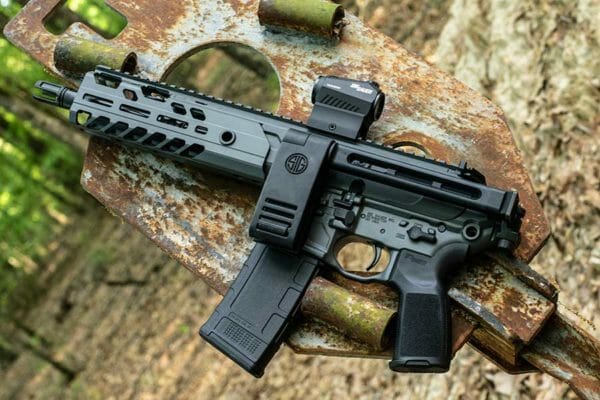
The MCX pistol with folding brace is super compact and easy to carry. IMG Jim Grant
Gun Owners of America’s (GOA) preliminary injunction against the Bureau of Alcohol, Tobacco, Firearms and Explosives (ATF) rule on pistol stabilizing devices (Final Rule 2021R-08F) has been extended until the conclusion of the case.
The case, State of Texas v. ATF, was bought by GOA, Gun Owners Foundation (GOF), and the state of Texas to challenge the ATF rule that reversed years of determinations surrounding pistols equipped with stabilizing devices. The ATF’s new rule reclassified most pistols with stabilizing braces to short-barreled rifles (SBRs), meaning the firearms would be regulated under the National Firearms Act of 1934 (NFA). It required owners of these guns to register the firearms with the ATF, submit to additional background checks, hand over passport pictures, and provide fingerprints.
If the gun owners don’t want to register the pistol, the ATF gives them four choices. The first choice is to turn over the pistol to law enforcement. The second is to install a barrel greater than 16 inches. The third is to remove the brace and make it so it can never be installed again. The final choice is to destroy the firearm.
The rule set off a flurry of lawsuits asking for a nationwide injunction before the June 1, 2023, effective date. Second Amendment Foundation (SAF) would get an injunction in a Texas District Court. Firearms Policy Coalition (FPC) would get their injunction from the Fifth Circuit Court of Appeals. GOA’s injunction would also come from a Texas District Court—none of the injunctions applied to all gun owners. Only the members of the organizations were covered. The injunctions were issued before the cut-off date.
The injunctions would be used as stop gaps until later to give the courts time to rule on the cases. Judge Drew B. Tipton has now decided to extend the preliminary injunction until the case is settled.
A preliminary injunction is an “extraordinary remedy” to maintain the status quo. Several factors have to be considered for an injunction to be issued.
The first and most important factor is the likelihood of the plaintiffs to succeed on the merits of the case. Judge Tipton cited the ruling in Mock v. Garland, where the Fifth Circuit Court of Appeals found that the ATF violated the Administrative Procedures Act (APA) by pulling a bait and switch with the Proposed Rule and the Final Rule.
The ATF presented a rule with a form (ATF Form 4999) with a point system to determine if a brace would turn a pistol into an SBR. When the Final Rule was unveiled, the point system was gone. All braces currently on the market would turn any pistol into an SBR if equipped. The rule bore no resemblance to the Proposed Rule.
“The first inquiry is whether a Plaintiff that has standing has established a substantial likelihood of prevailing on the merits. Id. The Fifth Circuit has already decided “that the Final Rule fails the logical-outgrowth test and violates the APA.” Mock, 75 F.4th at 578. Because that holding pertained to the ATF’s rulemaking process, any plaintiff challenging the Final Rule on APA grounds in the Fifth Circuit has the same likelihood of success. Therefore, Plaintiffs have a substantial likelihood to succeed on the merits of their logical-outgrowth claim,” Judge Tipton wrote in his 29-page decision.
The judge also believes the plaintiffs will suffer irreparable harm if the Court doesn’t issue an injunction. Judge Tipton pointed out that the plaintiffs would be forced to comply with ATF’s rule if no injunction is issued, meaning they would have to get rid of or modify their firearms.
“The ATF gave affected gun owners until May 31, 2023, to register their stabilizing braces. 88 Fed. Reg. at 6570. Because that deadline has now passed, complying with the Final Rule would require the private Plaintiffs to do one of four things: (1) permanently modify their weapon to remove it from the scope of the NFA, (2) dispose of or ‘alter’ their stabilizing brace so that it can never be reattached, (3) turn over their weapon to the ATF, or (4) destroy their weapon completely,” the order reads.
The final factor in a preliminary injunction is the balance of equities and public interest. In this stage, the judge explores the harm to the plaintiff if an injunction is not issued. The judge also looks to the harm caused to the defendant if an injunction is issued. The judge will then look at the public interest.
The judge ruled that the plaintiff would experience harm immediately without an injunction. He said the ATF’s harm is more administrative and speculative. Judge Tipton also ruled that “there is no public interest in the perpetuation of unlawful agency action.”
“The Court finds that the balance of equities tips in Plaintiffs favor because the Final Rule’s effect on Plaintiffs is immediate and imminent while the effect on Defendants, especially the ATF, is more administrative and speculative. Defendants’ arguments of harm to the public are unavailing,” the judge wrote.
The judge kept the scope of the ruling just to GOA members. This decision means that all GOA members will be protected from ATF enforcement actions over braced pistols for the foreseeable future. Even though there is no all-encompassing order enjoining the ATF from taking enforcement action against anyone who owns a pistol equipped with a stabilizing brace, the scale of the current injunctions means millions of Americans are protected from ATF action. Since none of the groups are required to share their membership rolls with the ATF, many believe the rule is currently unenforceable.
The ATF Final Rule on the classification of pistols equipped with stabilizing braces is not dead yet, but it is on life support.
Federal Judge Roger T. Benitez last month, and for the
second time, declared California’s ban on so-called
“high-capacity magazines” is unconstitutional.
When U.S. District Court Judge Roger T. Benitez last month handed down his crushing 71-page ruling in a case known as Duncan v. Bonta — declaring California’s ban on so-called “high-capacity magazines” to be unconstitutional for a second time — one could tell by reading the opinion he had really done his homework.
In his ruling, Judge Benitez observed, “There is no American tradition of limiting ammunition capacity and the 10-round limit has no historical pedigree and it is arbitrary and capricious. It is extreme. Our federal government and most states impose no limits and in the states where limits are imposed, there is no consensus. Delaware landed on a 17-round magazine limit. Illinois and Vermont picked limits of 15 rounds for handguns and 10 rounds for a rifle. Colorado went with a 15-round limit for handguns and rifles, and a 28-inch tube limit for shotguns. New York tried its luck at a 7-round limit; that did not work out. New Jersey started with a 15-round limit and then reduced the limit to 10-rounds. The fact that there are so many different numerical limits demonstrates the arbitrary nature of magazine capacity limits.”
All this tells us is that people who craft gun control laws limiting magazine capacities don’t know zip about firearms. Nobody has ever explained to me — and I have asked — why the 10-round limit seems to be popular among gun prohibitionists. I wasn’t really surprised; after all, no explanation would make sense, anyway.
Were someone to claim a 10-rounder would help prevent mass shootings, I’d just remind them about Elliot Rodger, the Isla Vista killer who murdered six people in 2014. After killing three people with a knife, he drove to the area near the University of California, Santa Barbara and killed three more people using two different handguns and California-compliant 10-round magazines.
For the best perspective on what this ruling meant to anti-gunners, one need only look to the message on “X” (formerly known as Twitter) posted by Gov. Gavin Newsom on Sept. 22. Here’s what he said: “California’s high-capacity magazine ban was just STRUCK DOWN by Judge Benitez, an extremist, right-wing zealot with no regard to human life. Wake up, America. Our gun safety laws will continue to be thrown out by NRA-owned federal judges until we pass a Constitutional Amendment to protect our kids and end the gun violence epidemic in America.”
Newsom earlier this year announced his proposed 28th Amendment to the U.S. Constitution, which would essentially nullify the Second Amendment and replace it with gun control fanaticism designed to turn the right to keep and bear arms into a government-regulated privilege.
Far Left
Newsom isn’t the only far-left Democrat governor (recall last week’s Insider, which discussed New Mexico Gov. Michelle Lujan Grisham’s arbitrary and quickly-enjoined order essentially suspending the Second Amendment in Albuquerque and surrounding Bernalillo County), but he is certainly a standout.
He probably went into convulsions when reading through the Benitez decision. The judge observed, “Why are larger magazines chosen for self-defense? Crime happens a lot. One recent estimate holds that guns are needed defensively approximately 1,670,000 times a year.”
And then there was this: “California relies entirely on the opinion of its statistician for the hypothesis that defenders fire an average of only 2.2 shots in cases of confrontation. Where does the 2.2 shot average originate? There is no national or state government data report on shots fired in self-defense events. There is no public government database.”
Translation: Somebody may have simply made it up.
Judge Benitez’s recent ruling looked back on his previous decision regarding the California mag ban, which was remanded back to his court following the Supreme Court’s 2022 Bruen ruling. In a footnote on Page 5 of his new decision, the judge added this footnote: “As this Court explained in its prior decision, ‘[a]rtificial limits will eventually lead to disarmament. It is an insidious plan to disarm the populace and it depends on for its success a subjective standard of ‘necessary’ lethality. It does not take the imagination of Jules Verne to predict that if all magazines over 10 rounds are somehow eliminated from California, the next mass shooting will be accomplished with guns holding only 10 rounds.
To reduce gun violence, the state will close the newly christened 10-round ‘loophole’ and use it as a justification to outlaw magazines holding more than 7 rounds. The legislature will determine that no more than 7 rounds are ‘necessary.’ Then the next mass shooting will be accomplished with guns holding 7 rounds. To reduce the new gun violence, the state will close the 7-round ‘loophole’ and outlaw magazines holding more than 5 rounds determining that no more than 5 rounds are ‘suitable.’ And so it goes, until the only lawful firearm law-abiding responsible citizens will be permitted to possess is a single-shot handgun.’”
Mass Shooting Misinformation
California’s magazine ban was initiated ostensibly to reduce potential carnage in a mass shooting incident, which are rare but high-profile. The media loves a bloodbath.
Author and researcher John Lott, founder and president of
the Crime Prevention Research Center, was at the Gun Rights
Policy Conference last month with some interesting information
about armed citizen intervention in mass shootings.
What the media apparently doesn’t like, however, is a case where an armed private citizen intervenes and stops a shooting. The FBI claims it happens rarely, but during last month’s 38th annual Gun Rights Policy Conference (GRPC) in Phoenix, author/economist John Lott referred to his recent report on the “massive errors” in the FBI’s active shooting reports from 2014 to 2022.
According to Lott, “Sources the media relied on undercounted the number of instances in which armed citizens have thwarted such attacks by an order of more than ten, saving untold numbers of lives.”
“Of course,” Lott wrote, “law-abiding citizens stopping these attacks are not rare. What is rare is national news coverage of those incidents. Although those many news stories about the Greenwood shooting also suggested that the defensive use of guns might endanger others, there is no evidence that these acts have harmed innocent victims.”
Lott also notes, “The FBI reports that armed citizens only stopped 14 of the 302 active shooter incidents it identified for the period 2014-2022 … An analysis by the CPRC identified a total of 440 active shooter incidents during that period and found that an armed citizen stopped 157.”
Even if Lott’s numbers were off by 50% (which I doubt), his figure would still far exceed the number of armed citizen interventions acknowledged by the FBI.
Look for an upcoming report from Lott’s Crime Prevention Research Center updating the number of active concealed carry permits and licenses in the United States, which will not include the estimated number of armed citizens in the 27 states which have adopted permitless (constitutional) carry.
Alan Gottlieb (left) honored Dave Workman with the Lifetime
Achievement award from the Citizens Committee for the Right
to Keep and Bear Arms at last month’s Gun Rights Policy Conference.
Personal Honors
At the recent GRPC, this correspondent was honored to receive a Lifetime Achievement Award from the Citizens Committee for the Right to Keep and Bear Arms and to be named to the Joseph P. Tartaro II “Hall of Fame.”
Tartaro was the longtime president of the Second Amendment Foundation and executive editor of Gun Week and then TheGunMag.com, where I am now editor-in-chief. He was what Central Casting would have offered as the quintessential “crusty” old newspaper editor, a sharp-eyed reader with an excellent grasp of the English language, and a veritable walking encyclopedia of the history of the gun rights movement. And he was my friend.
Dave was also named to the Joseph P. Tartaro Hall of Fame,
making him the only double award recipient in the 38-year history
of the conference, which was held in Phoenix.
I recently announced my pending retirement from that position — don’t worry, I’m not departing from Insider Online or GUNS Magazine — because at my age, it’s time to slow down a little. I’ve been working for SAF and CCRKBA for more than 23 years, which came after spending 21 years at the old Fishing & Hunting News, which came after nearly seven years at a little weekly newspaper in Washington State.
There is a lot of brass in my workshop which needs reloading, and a fair amount of firewood still in need of cutting, splitting and stacking in the woodshed. Who knows, I may even find time to press a trigger!
New York’s Gun Law Amendments: The Hochul Government’s changes are viewed as worsening the issues and not aligning with recent Supreme Court rulings.
Opposition to the Second Amendment: New York’s leadership, especially under Hochul and Cuomo, is criticized for curbing Second Amendment rights.
Ammunition Background Check Issues: Hochul’s attempt at implementing background checks for ammunition mirrors Cuomo’s failed 2013 attempt, causing processing delays.
Unclear Leadership: The recent resignation of the New York Superintendent of State Police, Steven Nigrelli, adds to the uncertainty and complexity of gun law enforcement.
Controversial Gun Policies: Policies around firearm storage, proof, and fees for background checks are being challenged as infringements on citizen rights.
iStock
New York’s licensed firearms dealers and gun ranges are getting swamped with questions over confusing new laws concerning concealed handgun carry licenses, ammunition, and firearms “transfers” (that is to say, purchases, trade-ins, and giveaways).
In this article, we address these important and timely issues and provide our take, attempting clarification on what the law is.
On enactment and enforcement of York’s Concealed “Carried Improvement Act” (“CCIA”), including recent amendments to the CCIA, licensed firearms dealers and those also operating gun ranges have unfairly suffered the brunt of attacks by frustrated New Yorkers who have seen constant and infuriating delays in their taking possession of firearms and ammunition.
These delays did not occur prior to the amendments to New York’s Gun Law which points to a disturbing fact: the Hochul Government’s changes to the Gun Law, purporting to comply with the June 2022 U.S. Supreme Court rulings in Bruen, did no such thing. In many ways, the Government’s amendments to the Gun Law made matters worse.
Hochul and the Democrat-Party-controlled Legislature in Albany simply gave lip service to the Bruen rulings. As a matter of fact, the Hochul Government merely continues the policy established by her predecessor Andrew Cuomo. The aim of this State Government in the Twenty-First Century is to continue the process of further constraining and constricting the exercise of the right of the people to keep and bear arms in New York, and to do so with increasing rapidity.
It is therefore business as usual for a New York Government that is virulently opposed to the Second Amendment of the Nation’s Bill of Rights.
And it isn’t only New York civilians who are facing frustrations and confusion. The new amendment is also impacting active-duty New York Police Officers. And both citizen civilians and police officers are all taking out their frustration on the wrong people: the Gun Dealer and Gun Range Owner.
This impossible situation is all by design and then enhanced and perpetuated by the Hochul Government.
Is there any way out of this morass?
Yes. But it is important to understand that Hochul’s recent “ammunition” amendment to the Handgun Law isn’t alone the cause of the problem. It is simply a reflection of the New York Government’s long-standing and deep-seated abhorrence of the fundamental right of the people to keep and bear arms and the Government’s contempt for those citizens residing in New York who are intent on exercising their right, regardless of the many obstacles placed in their path by the Government.
It is also important to understand that this new amendment isn’t a standalone provision. It is simply the most recent addition to the Hochul Government’s “Concealed Carry Improvement Act” (“CCIA”).
Moreover, the ammunition background check requirement is not something new that Governor Kathy Hochul and the Democrat Party-controlled Legislature in Albany dreamed up. It has been done before.
Hochul’s predecessor, Andrew Cuomo, tried to impose an ammunition background check system on New York firearms owners in 2013—ten years before the passage of Hochul’s CCIA. Cuomo’s ammunition background check provision was written into the New York Safe Act of 2013. It didn’t pan out, then, just as it isn’t panning out now. The Superintendent of the New York State Police could not get the damn thing to work even in 2014, one year after the Safe Act was implemented. And it was costing the taxpayer millions of dollars.
So, Cuomo scrapped it, and the Superintendent of State Police and those working to get the thing operational breathed a sigh of relief.
Hochul never pointed this little matter out to the public when she resurrected Cuomo’s little scheme.
She, too, is having problems implementing this ammunition background check system—hence the delays in processing transfers of ammunition and firearms. Nothing has changed, ten years after Cuomo originally promulgated an ammunition background check provision and placed it in the Safe Act.
The difference between Hochul and Cuomo is that Hochul doesn’t mind the constant problems and obviously doesn’t care about the many people—citizen civilians, licensed gun dealers and owners of gun ranges, and even active-duty New York Police officers—voicing vociferous and incessant complaints and doing so with justification.
If Hochul is going to create a mechanism of enforcement, then at least make the damn thing work. Otherwise, do away with it. But she won’t do that.
She won’t do that because it is obvious that Hochul relishes the delays. Otherwise, she, like Cuomo, would have either scrapped the thing or would have urged the State Legislature in Albany to formally repeal the amendment or she would have placed continual pressure on the Superintendent of State Police who is tasked with getting this thing to work efficiently and effectively.
But, as far as we can tell, Hochul has done none of these things and has no plans to do so. She simply doesn’t care. She doesn’t care because she is doing exactly what her wealthy benefactors, and what the Biden Administration, and what those citizens residing in New York, who voted her into Office, want her to do. Hochul knows she is on safe ground politically on this, and that is all that matters to her—at least at this moment. Hopefully, this will change as increasing violent crime and the frustration of the public ramps up.
But, what about the New York Superintendent of State Police?
Does he care about the problems he is faced with in getting a notoriously difficult database up and running? This thing does, after all, sit on his lap.
Well, he doesn’t care either because, at this moment, there is no New York Superintendent of State Police.
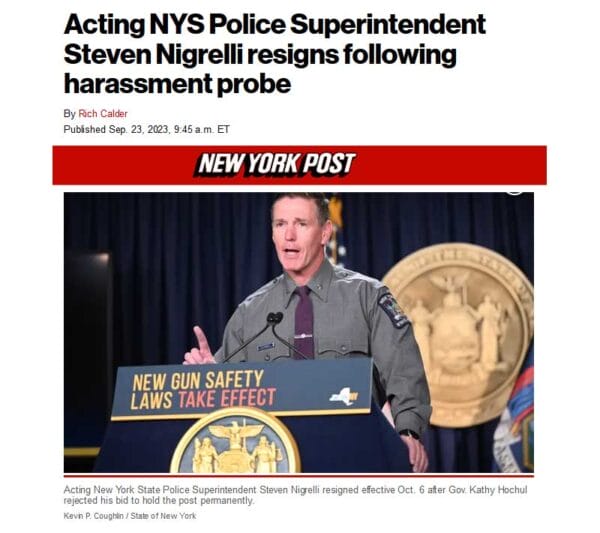
Acting NYS Police Superintendent Steven Nigrelli resigns Screengrab NYPost 10-21-2023
Steven Nigrelli, the Acting Superintendent and the most recent Superintendent resigned his post on September 23, 2023, after Governor Hochul refused to make his position permanent, ostensibly because he faced employment harassment charges.
So, who is the new acting Superintendent of State Police? Who can say? We don’t know. No news account to date we are aware of has reported an appointment of a new acting Superintendent of State Police. So, if Hochul did appoint someone, anyone, she failed to mention that person’s name. And, if she is considering an appointment, she hasn’t made that fact known either.
This only complicates matters, not only for the State Police that cannot get the NICS database working but for every New Yorker who suffers a delay in obtaining either a firearm or ammunition.
New York law now requires a Licensed Gun Dealer and Gun Range Owner to run NICS background checks only through the Superintendent of State Police and not directly through the Federal Government for firearms and ammunition transfers. And keep in mind that, even if Hochul authorized Licensed New York Gun Dealers and owners of Gun Ranges to utilize the Federal NICS system for undertaking background checks, the FBI only does background checks involving transfers of firearms. They are not legally authorized, even if they were willing to do checks on those individuals who simply wish to purchase ammunition.
And this delay is affecting active-duty police officers as well because they are not exempted from the NICS background check requirement either for the purchase of ammunition or for the purchase of firearms beyond Departmental-issued firearms.
If there is a delay in running a check, everyone is, then, in the same boat.
But none of this negatively impacts your run-of-the-mill criminal element or murderous international cartel member that, thanks to Biden’s Open Border misadventure, has enabled millions of illegal aliens to take up residence in our Nation, and like a horrific viral infection, these illegals have coursed through the entire body politic.
The criminal element doesn’t bother with Hochul Gun Regime compliance matters, anyway.
If criminals get hit with a gun charge among other things, these noxious elements can expect a lenient judicial system to give them a slap on the wrist and send them on their merry way to create more mayhem for both police and the average citizen. And this is exactly what is happening in New York.
*For those readers interested in the specific operative State Statutes and Municipal Codes, Rules, and Regulations, feel free to contact the Arbalest Quarrel directly or through Ammoland Shooting Sports News, and we will be happy to provide you with the citations.
To Lawfully Carry A Handgun In New York, the City Government Still Requires A Person To Acquire A Valid Concealed Handgun Carry License That IS Issued By The NYPD License Division
One burning question concerns whether, under the CCIA, a valid concealed handgun carry license issued in a New York county or municipality other than the City of New York enables a license holder to carry his or her handgun for self-defense IN the City of New York.
The answer is an emphatic “no.” Handgun Preemption Laws that most States follow have no application in an Anti-Second Amendment State like New York.
This means that, as long as New York City, or any other county or city in New York, establishes rules and codes that appear legally consistent with the State’s Handgun Law—found in Penal Code Section 400.00 et. seq.—then those jurisdictions are free to create and implement new rules, codes, and regulations that are more detailed and potentially tougher than the State’s own Handgun Law requirements. This has always been true of New York City.
Even with the passage of the CCIA in July 2022, State law does not preempt the Rules of the City of New York on the matter of the City’s continuing refusal to honor the validity of concealed carry licenses issued by another New York jurisdiction.
Anyone who applies for a New York City Handgun Concealed Carry License must comply with the City’s stringent Handgun Rules, the NYPD License Division enforces those Rules rigidly. This means that if a person wishes to carry his or her concealed handgun in New York City, that person MUST first acquire a valid New York City-issued handgun carry license.
But, wouldn’t that mean, from a logical standpoint, that a rule, code, or regulation that’s more stringent than the State law, is, by logical implication, illegal by the very reason that such rule, code, or regulation is more restrictive than the State Law?
Of course. But when was a New York Gun Law ever internally consistent, let alone consistent with the Second Amendment of the Bill of the Rights of the U.S. Constitution?
The U.S. Supreme Court struck down New York’s “Proper Cause” requirement in Bruen, sure. But this doesn’t legally prevent any jurisdiction in New York, be it municipal or county, from establishing its own Gun rules, codes, or regulations, applicable to that jurisdiction that a prospective handgun carry applicant must follow.
New York City requires anyone who wishes to carry a handgun lawfully in the City to obtain a handgun carry license issued by the NYPD License Division, regardless of the fact that a person may already possess a valid handgun carry license issued by another New York City or County.
Doesn’t The Curtailment Of The Proper Cause Requirement Negate The Need To Acquire Multiple New York Concealed Carry Licenses
The fact that no jurisdiction in New York is allowed any longer to require a person to show extraordinary (“Proper Cause”) need as a condition for obtaining a handgun carry license doesn’t legally prevent any city or county from requiring compliance with its own peculiar rules, codes, and regulations involving concealed handgun carry licenses.
In that case, a city or county can mandate that a person obtain a concealed handgun carry license for that jurisdiction, regardless of any other valid New York concealed handgun carry license he or she might happen to hold, applicable for the specific county or city.
At the moment, New York City is the only jurisdiction, now as before, that requires a person to acquire a license to lawfully carry in the City. Nothing in the CCIA changes that old mandate.
Remaining New York Gun-Related Questions Not Presently Before The Courts
One Thorny Question Concerns Whether A Person Domiciled in a Jurisdiction Outside of New York Can Obtain a New York Concealed Handgun Carry License
A New York Gun Dealer asked the Arbalest Quarrel the other day whether a person residing in another State can obtain a New York State handgun license.
The New York State Gun Law doesn’t assert categorically that a person must be domiciled in New York to obtain a handgun carry license. New York case law bears that out. So, the consensus of opinion in the Courts to date is that a person need not be domiciled in New York to obtain a New York Concealed Handgun Carry License.
However, an out-of-state applicant must still comply with both the training and “Good Moral Character” requirements of the CCIA and other applicable State and Federal Statutes.
A Second Thorny Question Concerns The Legality Of Charging A Person Fees For The Purchase Of A Firearm And Ammunition.
The fees are assessed by the State Police, ostensibly to cover the cost of undertaking a background check on a person to verify the person is not under Statutory disability that would preclude the transfer of a firearm and ammunition to that person.
The fee for the transfer of a firearm has increased. But New York never before charged a fee for the purchase of ammunition. It does so now. A fee of $2.50 is now assessed for the background check that the State Police now undertakes on the purchase of ammunition.
Note: The fee of $2.50 applies only to the background check itself, not to the number of boxes of ammunition a person purchases.
But each time a person purchases a new box or boxes of ammunition, there is a new $2.50 fee imposed because the State Police is required to undertake a new background check on that person. It therefore, behooves a person to purchase as much ammunition as he can afford at any one time to keep the fee at a straight $2.50.
A Couple More Points Concerning Fee Assessment On Firearm And Ammunition Transfers
First, the background check is charged to the seller of firearms and ammunition, not the buyer. A seller must provide the State Police with a valid Credit Card. The State Police applies a charge to the seller’s credit card immediately. The seller doesn’t eat the charge but passes the fee onto the purchaser. This is perfectly legal. This creates consternation, and that is understandable. A gun dealer and gun range owner have substantial expenses. They have to make a living, too.
If there is a delay—the usual occurrence—in completing the NICS background check, the transferee must still reimburse the seller of the firearm or ammunition immediately even though the transferee doesn’t take immediate possession of the firearm or ammunition. That is one reason why a person—a civilian citizen or active-duty police officer—gets upset with the Gun Dealer or the owner of the Gun Range. The transferee pays out of pocket immediately and gets nothing for his troubles as he must await the State Police processing of the transfer. That can take hours or even days.
Second, are both the fees and the dollar amounts of those fees lawful? They are. New York law specifies the State Police can assess fees for conducting NICS background checks and also provides a mechanism for determining what dollar amount is lawful.
A Third Thorny Question Pertains To The Legality Of Agency Policy
AdobeStock_Rawpixel
A third question is whether the Superintendent of the New York State Police can require a person who owns and possesses several firearms to show proof of having acquired a firearm safe to store those firearms.
A licensed New York Gun Dealer and the owner of a Gun Range has posed this question to us.
The New York State Police has required a person who holds several firearms on a restricted handgun premise license to present the State Police with a photograph of that safe.
This suggests that the person does not presently have a firearm safe, which is an expensive purchase, and would probably wish to defer the purchase of a safe if that were possible. It isn’t.
We believe that the State Police can require proof of purchase of a firearm safe once a New York premise license details possession of a certain (arbitrary) number of firearms on a premise license.
Is this true? If so, why?
According to New York Courts, the question is considered more a matter of policy than of law.
But Gun Policy, apart from State Statutes or County or Municipal code, rule, or regulation, still operates with the force of law.
New York Courts have dealt with this issue and have so stated.
When a complainant contests a “Gun Policy, New York Courts have said that the complainant must prove that a given New York Gun Policy is “arbitrary and capricious” before a Court will strike that Policy down.
This follows from the “Primary Jurisdiction of Agency Rule” that Courts have followed since U.S. Supreme Court rulings in the Chevron case that was decided decades ago, and a long line of cases following Chevron, since.
This Term, the U.S. Supreme Court has taken a renewed look at Chevron and is considering either constraining the Court’s rulings in that case or overturning the rulings of Chevron outright.
The Biden Administration is apoplectic with rage over this.
But, at the moment, Courts generally acquiesce to agency decisions because of Chevron. Agencies have tremendous discretion. And, so, failure to prove to the satisfaction of a Court that a gun “policy” is “arbitrary and capricious”—a difficult standard to meet and the burden of which falls on the complainant—the policy will stand.
New York Police Departments are, therefore, given substantial freedom of action to create and implement policy directed at firearms licensing requirements.
This also follows from the fact—as New York Courts routinely make as asserted in their rulings, and that remains “Black Letter Law”—that, while the keeping and bearing of arms remains a basic and indisputable Right, the licensing of one to keep and bear arms remains a privilege.
The Arbalest Quarrel has pointed out that possessing a license (a Government bestowed privilege) as a condition precedent to the enjoyment of a fundamental, unalienable Right is not only logically fallacious and legally unsupportable but also nonsensical.
So, unless, or until, the U.S. Supreme Court has the courage to abolish the nonsense of allowing a State or Federal Government to license exercise of a God-Given Right, the citizen will continue to suffer the consequences of the rudeness of State actors who refuse to countenance the sanctity of natural law, eternal rights.
And the worst consequence by far is the insinuation of Tyranny upon us and our inability to effectively contend with that Tyranny if the citizenry is unable to bear arms to defeat it.
That, of course, is what a Treacherous Government’s concern is really all about—the power of the armed citizenry to thwart the will of the Tyrant who would dare subjugate the common man.
This has nothing whatsoever to do with ensuring “Public Safety” and preventing “Gun Violence.” Those things are nothing more than makeweights, mere cliché, that only a fool would believe. And there are, unfortunately, plenty of them that reside amongst us.
About The Arbalest Quarrel:
Arbalest Group created `The Arbalest Quarrel’ website for a special purpose. That purpose is to educate the American public about recent Federal and State firearms control legislation. No other website, to our knowledge, provides as deep an analysis or as thorough an analysis. Arbalest Group offers this information free.
SUDDENLY, HUNTER BIDEN’S GUN CASE DEFENSE GOES CONSTITUTIONAL
Dave was sitting in camp listening to the news one evening last month
when a report about Hunter Biden’s defense strategy against a gun
law violation almost ruined the sunset.
If the past three years have taught us anything, it’s that the guy in the White House has some pretty radical views on the Second Amendment. So when his son’s attorney declared (with a straight face!) that his client will probably beat the gun charges against him because they are “likely unconstitutional,” it might be time to check if you’ve arrived in the alternate universe of hypocrisy.
I was sitting in a makeshift, solitary camp on the evening before the fall grouse opener (more about that in a minute), enjoying the sunset and listening to a news report when the announcer revealed how attorney Abbe Lowell had offered this defense for Hunter’s felony gun charges: He expects the charges to be dropped before trial because the statute may not pass the constitutional smell test, based on an appeals court ruling this past summer relating to guns and drug use. Sure, his client asserted on the federal Form 4473 that he was not a habitual drug user when he bought a Colt revolver in .38 Special. That’s a fib, and it’s a felony.
Therein lies a dilemma for gun rights activists. They dislike the law, but it’s evident they dislike the Biden family and how Hunter has been getting extraordinary treatment during his legal dramatics even more. Apparently, some folks don’t think gun ownership should be restricted based on drug use, but the Citizens Committee for the Right to Keep and Bear Arms took an interesting perspective on the whole affair, and it makes sense.
In a news release, CCRKBA Chairman Alan Gottlieb observed, “This is really the only thing that counts; whether Hunter Biden was heavily using drugs at the time of the gun purchase is not the issue, and we can’t lose perspective on this. The president’s son may have other demons with which to deal, but this case is about providing false information on a gun purchase form, which is a federal crime, and which is made explicitly clear on the Form 4473.”
However, there is no small irony — actually, it’s bizarre — in the fact that the son of Joe “I wanna ban assault weapons and 9mm pistols” Biden will apparently fight his federal charge on constitutional grounds; you know, the same Second Amendment his dad has been trying to erode since arriving on Capitol Hill about 50 years ago.
A long-gone Seattle radio announcer had a term for this some 40 years ago: “Weirder than skaditch!” I’m not sure what “skaditch” was, but it had to be something way out in the weeds.
Pants On Fire!
Having made a career out of reporting on gun politics, the Biden case would make a great script for a movie spoof. Joe got poked pretty hard recently by Gottlieb and the CCRKBA when his son’s indictment on the gun charge was revealed.
“Joe Biden has been lying about guns for years,” Gottlieb said. “We can’t list all of Joe Biden’s canards about guns, but the few real whoppers include his claim that the Second Amendment prohibited people from owning cannons, for which even the Washington Post Fact Checker called him out.”
Then there was that prevarication about the effect of a 9mm bullet on the human body, reported by Newsweek in May 2022. The story explained Biden’s claim he had chatted with a trauma surgeon about gunshot wounds, asserting this unidentified doctor told him, ‘A .22-caliber bullet will lodge in the lung, and we can probably get it out, may be able to get it, and save the life. A 9mm bullet blows the lung out of the body.’”
“Let’s face it,” Gottlieb said at the time, “Joe Biden has lied about guns for his entire adult life, and now, according to the federal indictment, his son allegedly has the same problem. This time, it has led to a criminal charge, and we’ll just have to see how this shakes out in court.”
Something Remarkable
In the middle of this sitcom, New Mexico Gov. Michelle Lujan Grisham announced her ban on open and concealed carry — essentially suspending the Second Amendment in the process — in Albuquerque and surrounding Bernalillo County.
Federal lawsuits sprang up like weeds, and within days, she backed away from the order, limiting her restrictions to public parks and places where children might gather. It was still unconstitutional, according to critics.
Angry gun owners gathered to protest in Albuquerque, and something remarkable happened. Actually, something didn’t happen. CCRKBA’s Gottlieb noted these armed protesters didn’t burn anything, there were no vandalism reports, nobody’s traffic was blocked, and nobody was arrested.
“What a stark contrast to the violent ANTIFA demonstrations and urban rioting we have seen in recent years,” he said. “Instead of setting fires, these gun owners set an example … The country has now witnessed an example of just how far anti-gun extremists are willing to go in an effort to push their agenda. This should alarm every American citizen, and not just the law-abiding gun owners in Albuquerque who peacefully exercised their First Amendment right to defend their Second Amendment right to keep and bear arms, showing the nation in the process they’re the good guys.”
Thirty minutes into this year’s Washington grouse season, Dave
followed through on a self-imposed challenge to start the hunt
with a handgun. That’s a fat fool hen and a deadly accurate Ruger MKIV pistol.
Meanwhile, In the Woods
All of this did not distract me from fulfilling a mission reported in this column some weeks ago regarding hunting grouse on the opener with a .22-caliber pistol.
For this exercise, I grabbed my Ruger MKIV as I headed out the door to drive the 70 miles to my “secret spot,” camp overnight and attack those rogue fool hens as soon as the sun was up. But, I had an edge, thanks in part to my colleague Jeff “Tank” Hoover and his former editorship Roy Huntington. Call it the “magic bullet.”
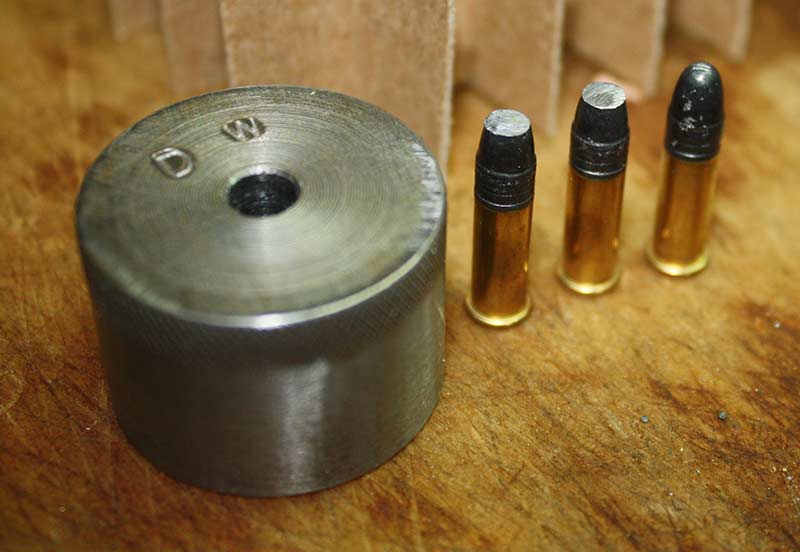
A couple of months ago, Tank wrote about a little gadget Roy cooked up, which enables guys like me to file off the front end of a .22 Long Rifle RNL bullet so it is flat. Tank and Roy both said such projectiles hit harder and knock ‘em down for the count. Naturally, I had to see this for myself, and Roy obligingly made one of these little units for me, even inscribing my initials.
Roy Huntington’s .22-caliber bullet die did the trick for Dave’s opening morning fowl buster.)
One inserts the cartridge, the bullet nose extends out the other side of this die, and you give it a few strokes with a file.
Recall how I reported I had “talked myself into” this, and 30 minutes into the 2023 grouse season, after pressing the trigger once with decisive results, I talked myself right back out of the idea, mission accomplished. That hooter hit the ground deader than the bacon I’d eaten for breakfast. I texted Roy a message with an image of the pistol and my bird, telling him, “It works!”
This happened when I came across about eight birds just off an old logging road. A few of them flushed in several directions, but I heard one hooting at me from a tree, about 15 feet up and maybe 25-30 feet away. Turning my head slightly, I saw the bird staring at me — they don’t call them “fool hens” for nothing — and in one slow, smooth motion, I raised my pistol, flipping off the safety and cut loose, taking him just under the neck.
For the rest of the season, I’m sticking with the shotgun. Maybe. Well, probably not.
We’ve Got Mail
Responding to my column on carrying a sidearm in predator country came this note from a reader from Idaho:
Re: some of your recent stuff online…
“Cougar attacks are rare.” But not nonexistent.
A good reminder, as spouse and I just took a two-lane drive through backcountry Washington from Boise to Pacific Beach. I’m a small-stature guy who has had a CCW since 1976 (Maine, then Idaho), was a reserve patrol officer for 9 years, and whose full-time career locale was a non-permissive environment with NO security provided. I carry a 1 5/8” North American 5-shot .22 Mag, but in the woods, I bring bigger and did so on our trip. Although I now reload, I carried HSM .357mag 180-grain Bear Load in my Blackhawk on this trip.
I’ve never seen a mountain lion, though 7 years ago, my wife saw one in the field opposite the patio of our condo. And then yesterday we had this visitor, who I saw at 7pm when I went out to call our two house cats home. I’d guess she was twice the size of our 14 lb. male cat. We watched her stalk and catch a mouse, then leave.
Ok now, grouse hunting with a .22. I think the complainers are of the “I’m not skilled enough to do that so it shouldn’t be allowed” type of person.
Sadly, they may make the rules …
You and Dr. (Will) Dabbs are my two must-reads in GUNS. Keep up the good work.
Steve Palley RN Emeritus
Boise, ID
Dave replies: Great to hear from you, Steve, and I admire your ammunition choice for that Ruger Blackhawk. I’ve got a North American 5-shooter in .22 Magnum as well. I’ll be writing about it shortly, so keep your eyes peeled. Thanks for the interesting photo, and for reading Insider Online!
Every Communist must grasp the truth: Political power grows out of the barrel of a gun.
What Mao meant was only the Communist Party should be allowed to have guns. For a Marxist revolution to succeed, the people must be disarmed. The left in the United States has long pushed for the disarmament of the population.
Recently, the left has primarily pushed for the banning of those arms that are commonly available and most suitable for militia use. These are modern semi-automatic rifles with standard capacity magazines of 30 rounds. These types of rifles are admirably suited to the defense of homes and neighborhoods, in part because they are understood to be extremely effective and, as such, have great deterrent value.
The American founding fathers understood the political power of firearms as well. They had just won a war with the superpower of the age, England. The English king had repeatedly attempted to disarm first the colonists and then the revolutionaries. The founders wished to make sure no future American government would be able to disarm the American people. Thus, they included the guarantee of the right to keep and bear arms in the Bill of Rights. The founders understood the right to keep and bear arms included defense against all threats from animals, criminals, other nations, and domestic tyrants.
Many infringements on the right to keep and bear arms have been tolerated by the people of the United States as long as the infringements were applied to disfavored minorities.
During the existence of the United States, the vast majority of people could easily purchase a rifle, shotgun, or pistol, with little difficulty in all states. Disfavored minorities, particularly black people, had a difficult time purchasing handguns in many places. Disfavored minorities were seldom prohibited from buying rifles and shotguns. Most of those infringements were in states dominated by the Democratic party.
Even in states that were most hostile to the Second Amendment, rifles and shotguns were easy to get. The greatest push was to ban handguns because handguns were commonly used in crime. Rifles and shotguns are rarely used in crime. Many political commentators made the claim restricting handguns did not affect the Second Amendment because there was easy access to rifles and shotguns.
As Americans perceived the growth of the political bureaucracy and the disfavor with which the Constitution was held by the political class, resistance to disarmament grew. The push to ban handguns failed. As a way to revive the failing fortunes of those pushing for population disarmament, Josh Sugermann advocated for a ban on “Assault Weapons” in 1988. From Reason.com:
Josh Sugarmann, founder and executive director of the Violence Policy Center, laid out this strategy of misdirection and obfuscation in a
1988 report on “Assault Weapons and Accessories in America.” Sugarmann observed that “the weapons’ menacing looks, coupled with the public’s confusion over fully automatic machine guns versus semi-automatic assault weapons—anything that looks like a machine gun is assumed to be a machine gun—can only increase the chance of public support for restrictions on these weapons.”
He added that because “few people can envision a practical use for these guns,” the public should be more inclined to support a ban on “assault weapons” than a ban on handguns. While handguns are by far the most common kind of firearm used to commit crimes, they are also the most popular choice for self-defense. Proscribing “assault weapons” therefore sounds more reasonable.
Sugarmann’s predictions fell flat. The market for semi-automatic rifles grew and grew. The more the left attempted to ban them, the more popular they became. Much of the popularity came from a growing resistance to the “Deep State” as the people became dissatisfied with the disconnect between what politicians did and what they said.
The Second Amendment gained vocal and organized supporters. A ten-year failed federal “Assault Weapon” ban was not renewed. A super majority of states reformed their gun laws, removing more and more infringements. The Supreme Court affirmed the Second Amendment meant what it said. At present, over half of the United States do not require a permit to carry a loaded handgun, openly or concealed.
A minority of historically repressive states with hard-left governments are resisting this trend. They include California, Connecticut, Delaware, Hawaii, Illinois, Maryland, Massachusetts, New Jersey, New York, and Rhode Island. Vermont, Colorado, and Washington State are recent additions.
They are working to ban the most effective militia weapons commonly available in the United States. Weapons which are seldom used in crime. Their laughable “reason” is semi-automatic rifles with standard capacity magazines are used in the rare mass murder when, in fact, pistols are used more commonly in mass murder. Judge Benitez, in his classic opinion on the California ban on “Assault Weapons,” says it very well:
Like the Swiss Army Knife, the popular AR-15 rifle is a perfect combination of home defense weapon and homeland defense equipment. Good for both home and battle, the AR-15 is the kind of versatile gun that lies at the intersection of the kinds of firearms protected under District of Columbia v. Heller, 554 U.S. 570 (2008) and United States v Miller, 307 U.S. 174 (1939).
Leftist politicians in a few states insist on banning the most effective militia weapons. Activists openly state they do not trust the people with “military” weapons. The shade of Chairman Mao would approve.
About Dean Weingarten:
Dean Weingarten has been a peace officer, a military officer, was on the University of Wisconsin Pistol Team for four years, and was first certified to teach firearms safety in 1973. He taught the Arizona concealed carry course for fifteen years until the goal of Constitutional Carry was attained. He has degrees in meteorology and mining engineering, and retired from the Department of Defense after a 30 year career in Army Research, Development, Testing, and Evaluation.