In a 6-3 decision on Friday, the U.S. Supreme Court ruled that semiautomatic rifles with bump stocks aren’t machine guns.
The court said the Bureau of Alcohol, Tobacco, Firearms, and Explosives (ATF) overstepped by classifying them as such. The case, Garland v. Cargill, represents a huge win for the 2A community.
Alan M. Gottlieb, the founder and Executive Vice President of the Second Amendment Foundation (SAF), praised the decision.
“This is a significant victory for gun owners because it reminds the ATF it simply cannot rewrite federal law,” said Gottlieb. “The agency has just been reminded that it can only enforce the law, not usurp the authority of Congress.”
Justice Clarence Thomas, writing for the majority, clarified:
We hold that a semiautomatic rifle equipped with a bump stock is not a ‘machinegun’ because it cannot fire more than one shot ‘by a single function of the trigger.’ And, even if it could, it would not do so ‘automatically.’ ATF therefore exceeded its statutory authority by issuing a Rule that classifies bump stocks as machineguns.
The ruling highlighted that for many years, the ATF didn’t consider bump stocks to make rifles machine guns.
This stance changed after the 2017 Las Vegas shooting, leading the ATF to demand bump stock owners surrender or destroy their devices within 90 days.
SAF Executive Director Adam Kraut, who challenged the ATF’s rule in 2018, said, “ATF exceeded its statutory authority by issuing a rule that was logically inconsistent with the plain text of the statute and cut into the prerogative of Congress.”
“As the executive branch has continued to use ATF to implement its will and circumvent congressional authority, we are optimistic that today’s decision will send a message that such actions will not be tolerated and that the courts will strike down more regulations inconsistent with the law as Congress wrote,” he continued.
Meanwhile, Everytown for Gun Safety, the gun-control organization funded by Michael Bloomberg, was irate with the ruling.
“Guns outfitted with bump stocks fire like machine guns, they kill like machine guns, and they should be banned like machine guns — but the Supreme Court just decided to put these deadly devices back on the market,” said John Feinblatt, president of Everytown.
“We urge Congress to right this wrong and pass bipartisan legislation banning bump stocks, which are accessories of war that have no place in our communities,” he added.
Well, there’s no doubt that anti-gun Democrats will move to ban bump stocks following SCOTUS’ decision. The question is whether they’ll have enough support across the aisle to make it law.
Further bolstering the case against the state of California for restricting gun purchases to one a month, the National Rifle Association has filed a brief with the 9th Circuit Court of Appeal in the lawsuit challenging that law.
In the case Nguyen v. Bonta, plaintiffs argue that the law restricting firearm purchases to no more than one every 30 days is a violation of the Second Amendment right to keep and bear arms. In March, a U.S. District Court ruled the law to be unconstitutional, but the state—never opposed to wasting citizens’ tax dollars—appealed the decision to the 9th Circuit Court.
In the brief, the NRA argues that the law violates the Second Amendment because the right to “keep and bear” arms includes the right to “acquire” firearms.
“This Court has twice held that the Second Amendment protects the right to acquire arms,” the brief stated. “This Court’s prior holdings are supported by Supreme Court precedent. First, the Supreme Court has determined that ‘keep Arms’ in the Amendment’s text means to ‘have weapons,’ and the plain meaning of ‘have’ encompasses the act of acquisition. Second, the Supreme Court has acknowledged that certain rights are implicit in enumerated guarantees. In the Second Amendment context, four Justices have recognized—and none have disagreed—that firearms training is ‘a necessary concomitant’ of the right to keep and bear arms. As this Court, the Third Circuit, and many district courts have recognized, acquiring a firearm must be a necessary concomitant as well.”
The brief further argues that multiple gun purchases per month were common in early America, and there were no historical limitations on the number of firearms that law-abiding citizens could purchase—a fact the government must prove under the new Bruen standard.
“The State argues that a more nuanced analogical approach is required because historically firearms were too laborious to manufacture and too expensive to purchase for firearms to be available for bulk purchase,” the brief stated. “In fact, firearms were ubiquitous in early America, and affordable enough for every militiaman and many women to be required to purchase one or several firearms. Indeed, newspaper advertisements regularly offered large quantities of firearms for sale.”
Further bolstering that point, the brief continued: “In any event, California does not merely prohibit “bulk” purchases; it prohibits the purchase of even two firearms in one month. Americans commonly purchased multiple firearms in a single transaction in the colonial and founding eras—and no law ever forbade it.” The brief also pointed out that the state “failed to provide a single historical law limiting how many firearms someone could purchase in a month. Nor did the State provide any founding era regulation.”
In the end, the brief calls for the circuit court to affirm the earlier district court ruling that the law is unconstitutional.
Without providing any evidence, the paper says “loosened restrictions on firearms” contributed to gun violence in Columbus.
Like many other cities across the country, Columbus, Ohio, saw a spike in homicides during the COVID-19 pandemic. Even though that was a nationwide phenomenon, The New York Times, in a story that purports to explain “How Gun Violence Spread Across One American City,” blames “loosened restrictions on firearms” in Ohio.
The implausibility of that explanation is immediately apparent because the story opens and closes with the June 2021 death of 43-year-old Jason Keys, who was killed during a bizarre dispute in Walnut Hill Park, “a leafy neighborhood” of Columbus. Although Times reporters Shaila Dewan and Robert Gebeloff present that incident as emblematic of how weak gun control has helped make formerly safe Columbus neighborhoods newly dangerous, the details of this homicide plainly do not fit that theory.
Keys and his wife had just visited her grandparents’ house when they were confronted by 72-year-old Robert Thomas, who was carrying a rifle. Prosecutors later said Thomas “believed that the couple had let the air out of his tires and poured herbicide on his lawn.” But it was not Thomas who killed Keys. Another neighbor, a 24-year-old ex-Marine named Elias Smith, responded to the altercation by firing seven shots at Keys from his front doorstep.
At his murder trial in July 2023, Smith testified that he thought he was defending his neighbors from Keys, who had a pistol in his waistband. The jury did not buy it. Smith was convicted and received a sentence of 15 years to life.
It is hard to see how “loosened restrictions on firearms” contributed to Keys’ death. Dewan and Gebeloff note that Smith was armed with “a so-called ghost gun, an AR-style rifle that Mr. Smith had assembled from parts ordered online,” which is doubly irrelevant. First, Keys would be just as dead even if Smith had bought a ready-made rifle. Second, the “loosened restrictions on firearms” highlighted by the Times did not affect the availability of homemade rifles. More generally, those changes clearly had nothing to do with this crime.
In 2020, Dewan and Gebeloff note, Ohio “enacted a ‘stand your ground’ law supported by gun rights organizations, expanding established limits on when a shooting can be deemed self-defense.” Under Senate Bill 175, which took effect in April 2021, “a trier of fact shall not consider the possibility of retreat as a factor in determining whether or not a person who used force in self-defense, defense of another, or defense of that person’s residence reasonably believed that the force was necessary to prevent injury, loss, or risk to life or safety.”
That rule already applied to people in their homes or vehicles. The new law extended it to other locations where “the person lawfully has a right to be.” Whatever the merits of that change, it did not affect Smith’s criminal liability, since he was standing at the entrance of his own home when he fired his rifle. His defense failed because he was unable to show that he “reasonably believed” the use of deadly force was “necessary to prevent injury, loss, or risk to life or safety.”
Dewan and Gebeloff also mention changes that Ohio legislators made in 2022, when they “allowed school boards to arm teachers who completed 24 hours of training, eliminated permit and training requirements for concealed weapons, and barred cities from prohibiting gun sales during riots.” These provisions are not relevant to Smith’s crime, and in any event they were approved the year after he killed Keys.
Finally, Dewan and Gebeloff note that “lawmakers pre-empted cities from passing their own gun statutes” in 2006 and “rescinded a ban on high-capacity magazines” in 2014. Litigation based on the former law, they add, blocked enforcement of Columbus ordinances “requiring guns to be safely stored around children and banning high-capacity magazines.” Those ordinances were enacted in 2022, so it is logically impossible that preventing them from taking effect played a role in Keys’ death even if their requirements were relevant, which they are not.
At the time of the shooting, Smith was a 24-year-old man, not a child. And since he fired seven rounds, the city’s subsequent 30-round limit on magazine capacity could not even theoretically have made a difference either. Likewise with the magazine restriction that state legislators repealed in 2014, which imposed a similar limit.
In addition to Keys’ murder, the Times notes homicides committed by gun-wielding Columbus teenagers as a result of trivial disputes. One reason those teenagers have access to guns, it says, is “the attitude that the ‘man’ of the family should be armed, even if he is still a child.” A safe storage law might or might not correct that attitude, but at least it is arguably relevant to the problem the Times is describing, unlike the “stand your ground” law, permitless concealed carry, and limits on magazine capacity.
Dewan and Gebeloff also note that gun sales rose during the pandemic. “According to law enforcement officials,” they say, “stolen guns in Columbus might be had for as little as $50.” They quote a local activist who avers that buying guns is as easy as buying marijuana nowadays.
It is not clear what any of that has to do with “loosened restrictions on firearms.” Stealing guns is still illegal in Ohio, and so is selling them to minors. The minimum purchase age is 18 for long guns and 21 for handguns.
Although homicides generally fell in 2023, the Times notes, they rose in Columbus. But Dewan and Gebeloff add that “there is optimism that 2024 is going to be better in Columbus, which has seen homicide numbers fall dramatically so far this year, with 36 as of last week, compared with 70 in the same period the year before.”
Despite that good news, Dewan and Gebeloff cannot let go of the notion that insufficiently strict gun laws are retarding progress in this area. “Some criminologists,” they write, “say there is no reason to think that homicides cannot fall back to the relatively low levels seen in the 20 years before the pandemic—except perhaps that there are far more guns and far fewer limits on them.” Dewan and Gebeloff also worry that “the Supreme Court has made [guns] harder to regulate.” The subhead likewise wonders if Columbus can “find its way back to the old normal” despite “more guns and looser laws.”
The Times, in short, assumes that more guns mean more murder, even though that effect was not apparent in the decades prior to the pandemic, when a long decline in homicides established “the old normal” despite rising gun ownership. It also assumes that “loosened restrictions on firearms” resulted in more homicides during the pandemic without explaining exactly how that worked in Columbus or anywhere else. And it assumes that reducing crime requires stricter gun control, even though homicides are falling precipitously in Columbus and other cities despite “looser laws.” When you take those propositions for granted, there is no need for evidence, which explains why the Times does not bother to offer any.
Maine gun owners aren’t out of the woods yet concerning the proposed “assault weapons” ban pushed by anti-gun Democrat lawmakers this session.
While Gov. Janet Mills vetoed LD 2086 back on April 29, some in the legislature are attempting to override the governor’s veto. And tomorrow, both the state Senate and House will be holding a vote that will either uphold or override that veto.
In her veto message concerning the measure, Mills said the bill might unintentionally ban weapons that responsible gun owners use for hunting or target shooting.
While Mills said she agreed that semi-automatic firearms converted into the functional equivalent of a machine gun should be restricted, she said she was concerned that certain language in the bill could have a “risk for unintended consequences.”
“Such legislation should only be developed in a deliberate, inclusive and clear manner for both gun safety advocates and those concerned with protecting lawful access to firearms,” Mills said in the veto message.
In fact, the governor’s fears were well founded. The legislation would actually create a backdoor ban on commonly owned firearms and firearm parts by redefining a “machine gun” to include any semi-automatic firearm that includes parts that could “increase the rate of fire.”
As Gun Owners of Maine said in a recent update to members: “Destruction of firearms and alterations in the definition of Machine Gun to include commonly owned semi-automatic firearms modifications is not only a waste of perfectly good firearms, it is a stepping stone to a ban on ‘assault’ weapons.
This amendment brought to light the fact that Maine’s current statute surrounding the definition of a Machine Gun (as assessed by attorneys specializing in firearms) could be construed to include shotguns/buckshot/snake shot. Yes, this law has been on the books for decades, but it is out of step with federal law and frankly, ‘intentions’ of politicians who seek to remove firearms from the hands of law-abiding citizens is not something we trust. This definition needs to be amended and we will be seeking to do so next session.”
Maine gun owners found themselves under heavy fire by gun-hating Democrats this legislative session following last fall’s mass murder in Lewiston. The governor allowed a measure requiring a three-day waiting period before gun purchasers who have already passed the federal background check can have a new gun transferred to them. She also signed bills making it easier to confiscate firearms without due process, requiring background checks for private sales through online means and strengthening a law that forbids the “reckless” sale of a gun to a prohibited person.
Interested Maine gun owners should contact their Senator or Representative immediately and ask them to vote to uphold the governor’s veto on the “assault weapons ban.”
South Carolinian faced 115 years in prison until ATF admitted they got the wrong man
ATF refused to say how the false arrest could have happened. by LEE WILLIAMS
Firearms seized by ATF and South Carolina law enforcement last year during a “major drug and guns crackdown,” which resulted in 20 arrests, including Bryan Montiea Wilson. (Photo courtesy U.S. Attorney’s Office, District of South Carolina.)
Wednesday, December 13, 2023, began just like any other workday for Bryan Montiea Wilson, a 33-year-old resident of West Columbia, South Carolina, who had never been in trouble with the law. At 6 a.m., Wilson began his shift at Harsco Rails on West Technology Drive, where he worked as a material processor for the railroad equipment manufacturer. A couple hours later, Wilson’s supervisor found him on the facility floor and told him to report to the main office. Inside were two men and a woman, all wearing civilian clothes. They told Wilson they were ATF agents and that they had a warrant for his arrest. They never showed him a badge.
Wilson was handcuffed and searched. He did not resist and complied fully with their demands. He told the agents he was diabetic, so they allowed his supervisor to retrieve a Pop-Tart, fruit juice and blood-sugar monitor from his locker. Wilson was walked out of Harsco in handcuffs. All of his coworkers witnessed his arrest. In the parking lot, Wilson saw two more agents searching his car.
On the way to the federal courthouse, the agents allowed Wilson to call his brother, who notified his parents of his arrest. At the courthouse, Wilson was booked, fingerprinted and photographed. He was searched a second time; all of his personal property was seized, and he was locked in a holding cell by himself.
Eventually, a Federal Public Defender was allowed in and showed Wilson a copy of an indictment, which charged him with five counts of possession with intent to distribute a controlled substance and three counts of possession of a firearm in furtherance of a drug trafficking offense.
Wilson faced up to 115 years in a federal penitentiary and more than $17 million in fines. The indictment also sought to forfeit unspecified personal property and money. Wilson had never been arrested in his life. He repeatedly told his lawyer he was innocent and that there had to be some sort of mistake.
Wilson was ushered into a courtroom and arraigned before a U.S. Magistrate Judge, who read the charges off of the indictment. An agent falsely testified that the ATF had Wilson under surveillance for the past 13 months. The agent listed several dates when Wilson allegedly sold drugs to undercover ATF agents. He claimed they had Wilson on tape committing the crimes, and that other codefendants had been arrested as well.
Wilson pleaded not guilty. The judge was willing to schedule a bond, but prosecutors wanted Wilson held for several days instead. After the hearing, Wilson continued to tell his lawyer that there had been a mistake. His family, who were present during the arraignment, said the same thing.
False reports
According to court documents, from November 2022 to March 2023 West Columbia Police Officers Calvin Brown and David Thompson — who were assigned to an ATF task force and supposedly working under ATF supervision — “conducted a series of gun and drug purchases from (among others) someone they identified as Mr. Wilson.”
According to the officers’ reports, the person that the officers bought guns and drugs from and surveilled was listed as “WILSON, BRYAN MONTIEA” or “BRYAN WILSON.” Their reports even listed Wilson’s actual home address. They described him as a black male, 33 years old, five feet, 10-inches tall, with black hair and brown eyes — a description that matches Wilson and a host of other West Columbia residents.
Their reports document numerous undercover purchases of crack cocaine, methamphetamine and numerous firearms from someone they falsely believed was Wilson.
On March 15, 2023, the officers wrote “A CONTROLLED PURCHASE FOR 2 FIREARMS FOR THE PRICE OF $1,900 AND 29 GRAMS OF METHAMPHETAMINE FOR THE PRICE OF $280 FROM THE SUSPECT IDENTIFIED AS BRYAN WILSON WAS CONDUCTED THROUGH THE USE OF CONFIDENTILA (sic) INFORMANTS AND UNDERCOVER OFFICERS.”
On December 5, 2023 — eight days before Wilson’s arrest — a federal grand jury issued an eight-count indictment, alleging Wilson committed the following federal crimes:
Count One: Possessing and distributing crack cocaine on November 10, 2022, in violation of 21 U.S.C. § 841(a)(1) and (b)(1)(C).
Count Two: Possessing and distributing five grams or more of methamphetamine (i.e., “meth”) and crack cocaine on November 18, 2022, in violation of 21 U.S.C. § 841(a)(1), (b)(1)(B) and (b)(1)(C).
Count Three: Possessing and distributing crack cocaine on December 8, 2022, in violation of 21 U.S.C. § 841(a)(1) and (b)(1)(C).
Count Four: Using and carrying a firearm during a drug trafficking crime on December 8, 2022, in violation of 18 U.S.C. § 924(c)(1)(A)(i).
Count Five: Possessing and distributing five grams or more of meth and crack cocaine on January 17, 2023, in violation of 21 U.S.C. § 841(a)(1), (b)(1)(B) and (b)(1)(C).
Count Six: Using and carrying a firearm during a drug trafficking crime on January 17, 2023, in violation of 18 U.S.C. § 924(c)(1)(A)(i).
Count Seven: Possessing and distributing five grams or more of meth on March 13, 2023, in violation of 21 U.S.C. § 841(a)(1) and (b)(1)(B).
Count Eight: Using and carrying a firearm during a drug trafficking crime on March 13, 2023, in violation of 18 U.S.C. § 924(c)(1)(A)(i).
There was just one problem: Bryan Montiea Wilson never sold guns or drugs to ATF agents, their informants or anyone else.
ATF got the wrong man.
Release
Wilson’s Federal Public Defender is the real hero in this case. After the arraignment, he persuaded prosecutors to keep Wilson at the courthouse long enough for him to investigate Wilson’s claims of innocence.
No documentation exists about the process or how this happened, but eventually the ATF somehow realized they got the wrong man. Prosecutors quickly moved to dismiss the case, but they offered no written explanation as to why they wanted the charges dropped.
“Further review of the case reveals that the interests of justice would best be served by a dismissal of the pending charges as opposed to further prosecution. Based on the foregoing, the Government respectfully requests that the Court dismiss the pending charges against defendant Bryan Montiea Wilson,” the prosecution’s motion to dismiss states.
Assistant U.S. Attorney E. Elizabeth Major, the prosecutor who signed the motion to dismiss, did not return calls seeking comment for this story.
Wilson was released from federal custody around 4:20 p.m., and he walked out of the courthouse a free but damaged man. All of the charges were dismissed with prejudice at the prosecutors’ request.
No one told him how the ATF had made such a horrible mistake.
Civil suit(s)
Earlier this month, Wilson filed a federal civil-rights lawsuit against the two West Columbia Police Officer who falsely alleged he sold them guns and drugs while they were working as task force officers for the ATF.
His lawsuit, which seeks an unspecified amount of actual, consequential and punitive damages, alleges the officers committed a false arrest, in violation of his Fourth Amendment rights, and that their misconduct led to wrongful indictment/malicious prosecution, which violated his Fifth and Fourteenth Amendment rights.
“Defendants initiated a criminal proceeding against Plaintiff without probable cause — i.e., without a reasonable belief that Plaintiff, in fact, committed federal drug trafficking and gun crimes,” the lawsuit claims. “As a direct and proximate result of Defendants’ conduct, Plaintiff was indicted, arrested, searched, detained, and humiliated and is entitled to recover damages, present and prospective, including for lost wages, mental anguish, distress, shock, loss of reputation, the violation of his Fifth Amendment rights, and other expenses.”
Wilson’s suit details the harm his false arrest has caused.
He needed to take several days off work. Nowadays, he rarely leaves his house. He suffers migraines and his coworkers spread rumors about his arrest and his release. One falsely claims he flipped on a codefendant, which is the kind of rumor that can get him killed. Others claim he was arrested for rape and even murder.
According to his lawsuit, Wilson worries his teenage daughter may learn what the ATF did to him. His mother, this suit claims, “now calls her son while he is at work to check on his wellbeing.”
“Mr. Wilson is a father, brother, and son, and a law-abiding citizen who works for an honest living,” the lawsuit states. “He has never trafficked drugs. He is a lawful gun owner. He has no criminal record.”
A second civil rights lawsuit against the ATF is extremely likely.
Veronica Hill, spokeswoman for the U.S. Attorney’s Office for the District of South Carolina said she cannot comment about the case because Wilson has filed an administrative claim against the government — a prelude to a civil suit.
“When you want to file a (civil) complaint against a federal agency, you have to file an administrative claim first,” she said. “If it is not resolved within six months, or not resolved to the satisfaction of the claimant, a lawsuit can then be filed.”
Corey Ray, spokesperson for ATF’s Charlotte Field Division, which oversaw the investigation, did not return calls seeking comment for this story.
Guns on the table
Neither prosecutors nor the ATF allowed Wilson’s false arrest to dampen their enthusiasm for what they described in a press release as an “advanced, intelligence-based, multi-faceted law enforcement operation.”
“In June of 2022, in response to rising violent crime in the West Columbia area, the Bureau of Alcohol, Tobacco, Firearms and Explosives (ATF) in Columbia launched an advanced, intelligence-based, multi-faceted law enforcement operation. The purpose of the operation was to target criminal entities and groups in the area, specifically those engaged in the illegal use, sale, and possession of firearms and narcotics. ATF established a controlled buy location, and ATF undercover agents and confidential informants began conducting controlled purchases of firearms and narcotics from criminal targets in the area, while local agencies conducted crime suppression operations,” the release states.
According to the press release, 210 firearms were seized and 20 people were arrested, including “members of the Bloods, Crips, and Gangster Disciple street gangs.”
Neither Wilson nor his false arrest were mentioned in the press release.
Takeaways
Were it not for the heads-up play of a Federal Public Defender, Wilson would likely still be in jail alongside 20 alleged gang members. It is not known if ATF agents were ever able to track down the suspect whom they mistook for Wilson, who actually sold them drugs and guns.
We will never know all of the allegations that the ATF made against Wilson or the details. Their federal complaint was quickly sealed and is no longer available to the public. However, the allegations Wilson’s attorney included in his civil suit are eerily similar to the allegations ATF made about Bryan Malinowski, the 53-year-old Arkansas airport executive whom ATF agents shot and killed in his home March 19.
The ATF also claimed they had made several undercover firearm purchases from Malinowski. They said they surveilled Malinowski for months, too. Malinowski will never be able to refute these allegations or file a civil suit.
Civil rights violations by the ATF have skyrocketed since the Biden-Harris administration weaponized the agency as part of its war on law-abiding gun owners. One can only wonder whether federal judges will take judicial notice of these injustices and start asking a few more questions before they sign off on any future request from the ATF, to ensure the agents don’t shoot another innocent homeowner or make another false arrest.
While several states have passed laws this legislative session protecting gun owner privacy by prohibiting the use of firearm-specific merchant category codes by payment processors, Colorado has done just the opposite.
On Wednesday, Democrat Gov. Jared Polis signed SB24-066 into law, basically creating backdoor gun registration in the state by requiring use of such codes.
At issue is a new Merchant Category Code (MCC) for gun purchases adopted by the International Organization for Standardization a little over a year ago. MCCs are used by payment processors (like Visa and Mastercard) and other financial services companies to categorize transactions.
Prior to the creation of the specific code for guns, firearms retailers fell under the MCC for sporting goods stores or miscellaneous retail. If the new code is used, credit card companies and other payment processors can tell the purchases were firearms.
This session, legislators in Utah, Kentucky, Iowa, Tennessee, Georgia, Wisconsin and Indiana passed laws prohibiting use of the code. A similar bill is still under consideration by lawmakers in New Hampshire.
State Sen. Tom Sullivan, sponsor of the measure in the Colorado Senate, said the bill is a life-saving measure.
“Credit cards have been repeatedly used to finance mass shootings, and merchant codes would have allowed the credit card companies to recognize his alarming pattern of behavior and refer it to law enforcement,” Sullivan said. “This bill will give us more tools to protect people, and make it easier to stop illegal firearms-related activity like straw purchases before disaster strikes.”
Interestingly, efforts are underway in Congress to outlaw the use of firearm-specific merchant category codes. Republican Reps. Elise Stefanik of New York, Andy Barr of Kentucky and Richard Hudson of North Carolina have filed a bill that would prohibit use of the four-digit code that’s been created to identify merchants selling firearms.
“The tracking of gun purchases is a violation and infringement on the Constitutional rights of law-abiding Americans which is why I am proud to introduce the Protecting Privacy in Purchases Act to prohibit radical gun grabbing politicians from tracking lawful gun purchases,” Rep. Stefanik said in a press release announcing the measure. “I share the concern of law-abiding gun owners across our nation that have voiced their fear that such tactics will work to serve the radical Left’s anti-gun agenda. I will always stand up for our Second Amendment rights as Americans and provide a critical check to any entity attempting to encroach on our liberties.”
The Colorado law will take effect 90 days after the adjournment of this session of the Colorado legislature.






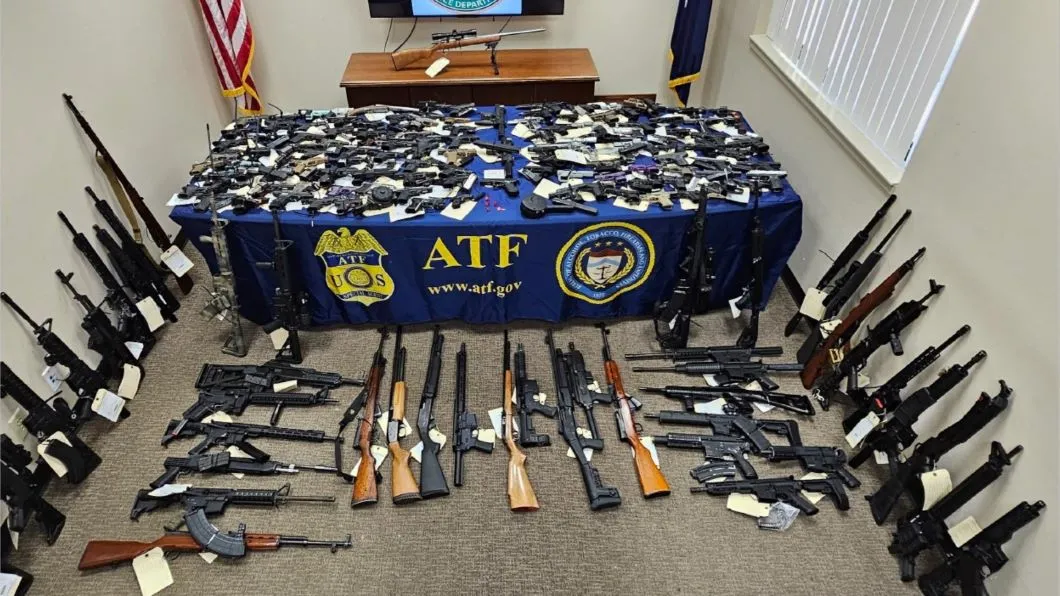 Firearms seized by ATF and South Carolina law enforcement last year during a “major drug and guns crackdown,” which resulted in 20 arrests, including Bryan Montiea Wilson. (Photo courtesy U.S. Attorney’s Office, District of South Carolina.)
 At 6 a.m., Wilson began his shift at Harsco Rails on West Technology Drive, where he worked as a material processor for the railroad equipment manufacturer. A couple hours later, Wilson’s supervisor found him on the facility floor and told him to report to the main office. Inside were two men and a woman, all wearing civilian clothes. They told Wilson they were ATF agents and that they had a warrant for his arrest. They never showed him a badge.