Categories
Ammo

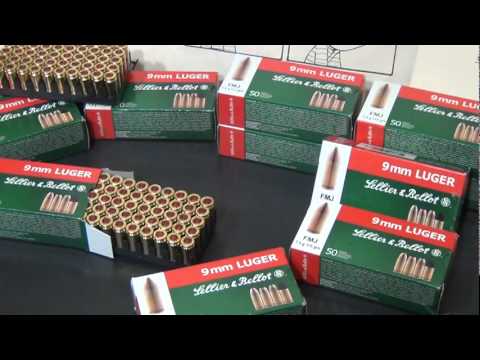
A Sellier & Bellot ammo review

Image result for Sellier & Bellot ammunition

https://youtu.be/osPhOsnKJwE

In the spirit of Transparency

(What ever the F**K that is!)

I want to let you know that I have have used this brand for a very long time. As usually it is very cheap and for the price that is sold at very good.
In plain English that means that it is fairly accurate and does not leave a huge mess in your gun after using it. Unlike some other major league Brands that I could mention. But do not want to get sued by!
And no I am not getting a kick back from them. But I do have a Paypal Button by the way. If somebody wants to help with my financial affairs!
Grumpy
PS Most of the time today. When I stock up on ammo. I usually go to a Gunshow.
As you will usually get a better deal than at your local Gun Emporium. Who has a much higher overhead than the guys at the show!

Categories
All About Guns Ammo

The 6.5 Creedmoor VS 300 Win. Mag at 1000 yard Ballistics compared

Categories
Ammo

Classic Ammo – The 6.5mm Creedmoor

6.5mm Creedmoor
6.5 lineup.jpg

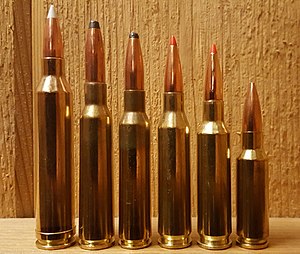
Size comparison of some 6.5mm cartridges, left to right: .264 Winchester Magnum6.5×55mm Swedish6.5×52mm Carcano.260 Remington6.5mm Creedmoor6.5mm Grendel
Type Centerfire rifle
Place of origin United States
Production history
Designed 2007
Manufacturer Hornady
Produced 2008
Specifications
Parent case .30 TC
Case type Rimless, bottleneck
Bullet diameter .2644 in (6.72 mm)
Neck diameter .2950 in (7.49 mm)
Shoulder diameter .4620 in (11.73 mm)
Base diameter .4703 in (11.95 mm)
Rim diameter .4730 in (12.01 mm)
Rim thickness .054 in (1.4 mm)
Case length 1.920 in (48.8 mm)
Overall length 2.825 in (71.8 mm)
Case capacity 52.5 gr H2O (3.40 cm3)
Rifling twist 1-8″ (203 mm)
Primer type Large rifle,
Small rifle (Lapua and Starline brass)
Maximum pressure (C.I.P.) 63,100 psi (435 MPa)
Maximum pressure (SAAMI) 62,000 psi (430 MPa)
Ballistic performance
Bullet mass/type Velocity Energy
120 gr (8 g) AMAX 3,020 ft/s (920 m/s) 2,430 ft⋅lbf (3,290 J)
143 gr (9 g) Hornady ELD-X 2,710 ft/s (830 m/s) 2,283 ft⋅lbf (3,095 J)
Test barrel length: 28 inch[not in citation given]
Source(s): Hornady,[1] SAAMI,[2][3] C.I.P.
[4][5]

The 6.5mm Creedmoor, designated 6.5 Creedmoor by SAAMI6,5 Creedmoor by the C.I.P. or 6.5 CM or 6.5 CRDMR for short, is a centerfire rifle cartridge introduced by Hornady in 2007[6] as a modification of the .30 TC,[7] which was based on the .308 Winchester[8]. It was designed specifically for long-range target shooting,[6] although it is also achieving success in game hunting.[7] Bullet for bullet, the 6.5mm Creedmoor achieves a slower muzzle velocity than longer cartridges such as the 6.5-284 Normaor magnum cartridges such as the 6.5mm Remington Magnum. However, due to its 2.825 inches (71.8 mm) overall length, it is capable of being chambered in short-action bolt-action rifles and AR-10 semi-automatic rifles.

Design considerations[edit]

6.5 mm (.264″) bullets, in general, are known for their relatively high sectional density[7] and ballistic coefficients, and have seen success in rifle competition. For some loads the 6.5mm Creedmoor is capable of duplicating the muzzle velocity[2] or trajectory[9] of the .300 Winchester Magnum while generating significantly lower recoil, based on lighter projectile weight. As this cartridge is designed for a bolt face diameter of .473 inches (roughly 12 mm), conversion of a short action rifle to another caliber (such as the .22-250 Remington.243 Winchester or .300 Savage) with similar bolt face diameter generally requires little more than a simple barrel change.

Performance[edit]

This is a medium power cartridge often compared to the .260 Remington and 6.5×47mm Lapua.[10] Three hundred yard energy using 129 grain Hornady SST bullets is listed by an independent reviewer as 1641 ft. lbs.[11] For the 140 grain bullet at 2700 feet per second initial velocity another reviewer reports an MPBR[12] for a six inch high target of 265 yards and reports a manufacturer claim of “almost 1600 ft. lbs.” of retained energy at 300 yards using a 24-inch barrel.[13] SAAMI test data confirms 6.5 mm Creedmoor (fifteen feet from muzzle) velocity of 2,940 fps for the 129 grain bullet and 2,690 for the 140 grain bullet (which compares to .300 Winchester magnum data of 2,930 fps for a 200 grain bullet and 2,665 fps for a 210 grain bullet).[2] Long-range shooter Ray “RayDog” Sanchez summarized the bolt-action Tubb 2000 rifle in 6.5mm Creedmoor as “boringly accurate” at 1000 yards (914.4 metres). He asserted the rifle and ammunition combination he used was able to maintain sub-MOA groups at 1000 yards (914.4 metres).[14]

Handloading[edit]
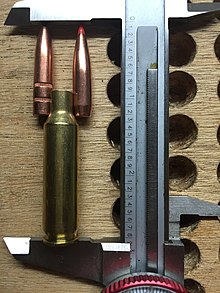
Only the very longest 140gr bullets will even reach the neck shoulder junction. Right to left: is a 123gr A-Max and Remington 140gr. Calipers are set to magazine length.

Handloading cost for the 6.5 Creedmoor is roughly equivalent to other 6.5mm cartridges, such as the 6.5×47mm Lapua, due to the availability of Lapua small primer brass for both cartridges.[15][16] Norma now makes brass for the cartridge and as of 2017 Norma brass is available through several major retailers at approximately the same cost as Lapua brass. Lapua brass for 6.5×47 lasts about 12 to 20 reloads.[17] Starline sells brass cases with either large or small primer pockets, with small pocket brass costing slightly more.[18] When the 6.5 CM was first introduced it was advertised as a 60,000 psi capable case.[6]However, when it was placed into production Hornady listed it as 62,000 psi and had it SAAMI registered as such. For this reason many hand loaders have had poor experiences reloading for it. Blown primers on the first shot at 62,000 psi is not uncommon. Early shooting articles listed the ammo as loaded to 58,000 psi[19] but later ones list it as 57,000 psi.[20] This is because Hornady reduced the loads in its factory ammo because of complaints that it was often blowing primers.[21]Lapua delivered Creedmoor brass at Shot show 2017,[22] and production quantities became available via major retailers in second quarter 2017. The Lapua version has a small primer pocket.[15][23] Thus, loads from a Lapua Creedmoor should not be used in another manufacturer’s Creedmoor brass that features a large primer pocket without applying proper hand loading test for pressure first. Also the use of a smaller diameter decapping rod is required to size and decap.

Further developments[edit]
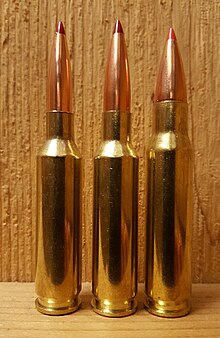
From left: 6mm Creedmoor, 6.5mm Creedmoor, .308 Winchester

The 6mm Creedmoor is a necked-down version of the 6.5mm Creedmoor using 6mm (.243 inch) bullets, which are lighter than 6.5mm bullets with similarly reduced recoil. John Snow at Outdoor Life designed it in 2009. As of May 2018, Savage Arms offers 3 bolt action rifles and 1 semiautomatic rifle chambered in 6mm Creedmoor.[24] As of May 2018, Hornady offers 87 gr Varmint Express, 103 gr Precision Hunter and 108 gr Match ammunition in 6mm Creedmoor.[25]

Military use[edit]

In October 2017, U.S. Special Operations Command tested the performance of 7.62 NATO, .260 Remington, and 6.5 Creedmoor cartridges out of SR-25M110A1, and Mk 20 sniper rifles. SOCOM determined that 6.5 Creedmoor performed the best, doubling hit probability at 1,000 meters, increasing effective range by nearly half, reducing wind drift by a third and having less recoil than 7.62 NATO rounds. Because the two rounds have similar dimensions, the same magazines can be used and a rifle can be converted with a barrel change. This led to its adoption and fielding by special operations snipers to replace the 7.62 NATO cartridge in their semi-automatic sniper rifles, planned in early 2019. In response to SOCOM’s adoption, the Department of Homeland Securityalso decided to adopt the round.[26][27]
Categories
Ammo

Ammo on Budget: 6.5 Creedmoor Sellier & Bellot

Categories
Ammo

Classic Ammo – The 6.5mm Grendel

6.5mm Grendel
65G 144 123 129 120 90.jpg

6.5mm Grendel showing variety of bullets—144 gr (9.3 g) to 90 gr (5.8 g)
Type Rifle
Place of origin  United States
Production history
Designer Bill Alexander and Janne Pohjoispää
Designed 2003[1]
Specifications
Parent case .220 Russian[2]
Case type Rimless, bottleneck
Bullet diameter 6.71 mm (0.264 in)
Neck diameter 7.44 mm (0.293 in)
Shoulder diameter 10.87 mm (0.428 in)
Base diameter 11.15 mm (0.439 in)
Rim diameter 11.2 mm (0.44 in)
Rim thickness 1.5 mm (0.059 in)
Case length 38.7 mm (1.52 in)
Overall length 57.5 mm (2.26 in)
Case capacity 2.3 cm3 (35 gr H2O)
Rifling twist 1 in 8″ or 1 in 9″
Primer type Small rifle
Maximum pressure 52,000 psi (AR-15 bolt), 58,000 psi (case strength)
Ballistic performance
Bullet mass/type Velocity Energy
90 gr (6 g) Speer TNT 2,880 ft/s (880 m/s) 1,658 ft⋅lbf (2,248 J)
108[3] Scenar (moly) 2,790 ft/s (850 m/s) 1,866 ft⋅lbf (2,530 J)
120 gr (8 g) Norma FMJBT 2,700 ft/s (820 m/s) 1,942 ft⋅lbf (2,633 J)
123 gr (8 g) Sierra Matchking 2,650 ft/s (810 m/s) 1,917 ft⋅lbf (2,599 J)
130 gr (8 g) Norma 2,510 ft/s (770 m/s) 1,818 ft⋅lbf (2,465 J)
Test barrel length: 24 inches
Source(s): Alexander Arms Pressure-safe Load Data

The 6.5mm Grendel (6.5×39mm) is an intermediate cartridge designed by Arne Brennan, Bill Alexander, and Janne Pohjoispää as a low recoil, high accuracy, 200–800 yard cartridge specifically for the AR-15. It is an improved variation of the 6.5mm PPC.[4] Since its introduction, it has proven to be a versatile design and is now expanding out into other firearms including bolt-action rifles and the Kalashnikov system.[5]
The name “6.5mm Grendel” was a trademark owned by Alexander Arms until it was legally released to allow the cartridge to become SAAMI standardized.[6][7]

Development and history[edit]

The 6.5mm Grendel design goal was to create an effective 200–800 yard AR-15 magazine-length cartridge for the AR-15 that surpassed the performance of the native 5.56mm NATO/.223 Remington cartridge. Constrained by the length of the 5.56×45mm NATO round, the Grendel designers decided to use a shorter, larger diameter case for higher powder volume while allowing space for long, streamlined, high ballistic coefficient (BC) bullets. Firing factory loaded ammunition loaded with bullets ranging from 90 to 129 grains (5.8–8.4 g), its muzzle velocity ranges from 2,500 ft/s (760 m/s) with 129- and 130-grain (8.4 g) bullets to 2,900 ft/s (880 m/s) with 90 gr (5.8 g) bullets (similar in velocity to a 5.56 mm 77-grain (5.0 g) round). 6.5 Grendel cartridges depending on their case material and bullet weigh 14.7 to 17.8 grams (227 to 275 gr).
The case head diameter of the Grendel is the same as that of the .220 Russian, the 7.62×39mm, and 6.5mm PPC cases. This diameter is larger than the 5.56×45mm NATO, thereby necessitating the use of a non-standard AR-15 bolt. The increased case diameter results in a small reduction in the capacity of standard size M16/AR-15 magazines. A Grendel magazine with the same dimensions as a STANAG 30-round 5.56 magazine will hold 26 rounds of 6.5mm ammunition.

Timeline[edit]

  • 1943: The Soviets develop and adopt the 7.62×39mm M43 cartridge and begin to field it.
  • Late 1950s: The .220 Russian hunting cartridge is developed, based on the military 7.62×39mm M43 design.
  • 1984: Louis Palmisano and William B. Davis, PhD, develop the 6.5mm PPC from the .220 Russian for the US Shooting Team for use in bolt-action rifles in the 1986 world championships. While performance was exceptional, the US Shooting Team stays with 6mm. The 6.5mm PPC is shelved and never seen again, although Dr. Louis Palmisano believes the 6.5mm PPC could be a formidable competition cartridge with new sub-100 grain bullets.
  • 1998: Arne Brennan, a competition shooter and founder of competitionshooting.com, designs and orders a 6.5 PPC reamer from JGS Tool optimized for AR-15 magazine length after conducting extensive theoretical study of multiple calibers and cartridge cases.
  • 2000: Arne Brennan, after thousands of rounds of testing 6.5 PPC, compares notes with Dr Louis Palmisano (creator of the 22 and 6mm PPC cartridges).
  • Early 2002: Bill Alexander, an engineer who worked for the British Ministry of Defense and designer of the .224 BOZ, .499 L-W and .50 Beowulf cartridges, begins research on developing a 6.5mm Intermediate cartridge specifically for the AR-15. Eventually the 6.5mm PPC caught his attention as it would fit his existing high strength .50 Beowulf bolt. So he machined a solid brass 6.5mm PPC dummy round. It was a cartridge that was small enough to double-stack in an AR-15 size magazine.
  • July 2002: American firearms journalist David M. Fortier and Bill Alexander share ideas for a 6.5mm Intermediate cartridge. Fortier shares his idea for a 7.62×39mm based cartridge for use in the Kalashnikov system. He shelves his idea, though, when Alexander shares what he is working on for the AR-15.
  • August 2002: Arne Brennan and Bill Alexander are introduced by a mutual acquaintance at Lothar Walther USA.
  • January 2003: Janne Pohjoispää, an engineer working for Lapua, and Bill Alexander begin working together on designing and finalizing what would become the 6.5mm Grendel cartridge. Pohjoispää decides against basing it on the PPC as Lapua is already producing .220 Russian brass. He redesigns it using Lapua’s .220 Russian case as the starting point. The two bounce ideas off each other and finalize the cartridge. The end result is noticeably different than Brennan and Alexander’s original 6.5mm-PPC-based design. The new design features a relocated shoulder, increased case capacity, and a thicker neck for increased case life in auto-loading rifles.
  • November 2003: Alexander Arms pays for the cartridge tooling and places an initial order for 50,000 brass cases.
  • November 2003: JGS produces the first reamer for the new cartridge.
  • January 2004: Alexander Arms officially introduces their new cartridge, dubbed the 6.5mm Grendel, at the SHOT Show. They introduce both a line of rifles and ammunition.
  • May 2006: Independent ballistic gelatin testing completed for 90 gr (5.8 g) TNT, 120 grains (7.8 g) Norma, 120 gr (7.8 g) SMK, and 123 grains (8.0 g) SMK prototype.
  • Aug 2006: Pressure safe loading data is published for AR firearms with 14.5- to 28.0-inch (370–710 mm) barrels.
  • Feb 2007: Production Wolf brand ammunition becomes available. Wolf Performance Ammunition becomes a supporter of the cartridge and introduces both a 123 grain Soft Point and 120 grain Multi Purpose Tactical HPBT in their brass-cased Gold line.
  • Nov 2009: Hornady teams with Alexander Arms to produce 6.5mm Grendel ammunition, cartridge cases, and dedicated projectiles. They introduce a 123 grain AMAX load, which quickly gains a reputation for excellent accuracy.
  • Early 2011: Barnaul of Russia begins development of a 110 grain FMJ-BT load using steel cartridge cases. Preproduction cases are delivered for testing in the fall of 2011.
  • June 2014: Production 100gr FMJ Wolf Steel Case ammunition becomes available in large quantities in the US, offering an economical factory load for the 6.5 Grendel.[8]

Performance[edit]

C-Products 26-round Grendel Magazine

Proponents assert that the Grendel is a middle ground between the 5.56×45mm NATO and the 7.62×51mm NATO. It retains greater terminal energy at extended ranges than either of these cartridges due to its higher ballistic coefficient.[2] For example, the 123 gr (8.0 g) 6.5 Grendel has more energy and better armor penetration at 1,000 meters than the larger and heavier 147 gr (9.5 g) M80 7.62 NATO round.[9][10][11][12]
In order to obtain ballistics that are superior to the 7.62×51mm cartridge, a weapon with a longer barrel and firing a heavier bullet is necessary. To achieve the same results from shorter length barrels, even heavier bullets are needed.[13]

External ballistics[edit]

Muzzle Velocity Change with Bullet Weight

Bullet velocity: 24 inch (609.6 mm) barrel
Bullet mass Muzzle velocity 1,000 meter velocity
gr g ft/s m/s ft/s m/s
Lapua Scenar 108 7.0 2,700 820 1,166 355
Lapua Scenar 123 8.0 2,620 800 1,222 372
Lapua FMJBT 144 9.3 2,450 750 1,213 370

As noted above, the Grendel case is very closely related to the .220 Russian case. In general, each additional grain of bullet weight will reduce muzzle velocity by 10 ft/s (4.7 m/s for each gram) and each additional inch of barrel length will increase muzzle velocity by 20 ft/s (2.4 m/s for each centimeter).[citation needed] Therefore, a handy rule of thumb is “one inch of barrel length equals two grains of bullet weight (1 mm → 5 mg)”. Specific details are available as graphs derived from Alexander Arms’ public domain load table linked below.

Sporting uses[edit]

The 6.5mm Grendel is effective in the humane harvest of medium-sized game.

The cartridge developer, Bill Alexander, has been quoted as saying he was looking for a cartridge with “more legs” (i.e. longer effective range) than the .50 Beowulf so that it could be used for white tail deer hunting.[2] The round’s original marketing for military and police usage created skepticism about its suitability for hunting. Despite this, there has been critical acknowledgement that it is sufficient for CXP2 class game such as deer.[14] Its manufacturer is more enthusiastic, saying that it has “flat trajectories and bullets well-suited to deer and varmints”.[15] It is similar to deer cartridges such as the .30-30 Winchester.257 Roberts and .243 Winchester but is not in the same class as the .270 Winchester or the .30-06. Now that bolt action rifles are being offered in 6.5 Grendel it is appearing at target matches and metallic silhouette competitions.

Army and police uses[edit]

Serbia is in process of adopting a rifle made by Zastava Arms [16] in 6.5 mm Grendel caliber as main armament for its armed forces. USA manufactured rifle in 6.5mm Grendel caliber will also be adopted in armament for special forces units after it passes testing in Technical Testing Center. Three types of 6.5mm Grendel ammunition produced by Prvi Partizan Uzice Serbia will be tested for use with these rifles. [17][18][19][20][21]