Categories

An interesting question was raised just the other day as to what have been the greatest law enforcement revolvers. I suppose you could look at it from several different perspectives. You might consider those guns that were the trend setters or you might tally up the guns that have had the highest production numbers. Or, you might just go with your favorites. And I suppose that there is nothing wrong with any of that.
When I first put on the badge of a Texas peace officer, the revolver was king. So I have a bit more than just academic interest in the subject. For my list, I have combined durability, longevity, and trend setting to come up with what I consider the seven greats.
Colt Single Action Army

Having been introduced in 1873, the Colt SAA enjoys 148 years of popularity although it is no longer considered a premier fighting gun. But, for about 75 years, it was the gun that most savvy lawmen chose and with good reason. Chambered in over 30 calibers (can you name them all?), the Colt was accurate enough to get the job done. And, just as important, it was a robust handgun that could often, in the old days, be a substitute for a billy-club. After all this time, it is still considered one of the iconic American handguns.
Smith & Wesson Model 10

The revolver that we call the Model 10 started life as the .38 Hand Ejector Model of 1899. Then, along came some military contracts and Smith & Wesson decided to call it the Military & Police model before finally settling on the Model 10. In its lifetime, some 6 million of the guns have been produced.
I would also venture to guess that more law enforcement officers have carried some version of the Model 10 (or its stainless versions…or its magnum versions) than any other handgun. There are several reasons for this popularity. The Model 10 is a medium-frame gun that is comfortable to carry during long hours of shift duty.
Its most popular caliber, .38 Spl., was relatively easy for most shooters to control. And the action was surprisingly smooth, and could be made even smoother by a good pistolsmith. Not as flamboyant as the magnums and other big-bore guns, the Model 10 was just a quality workhorse that could get the job done when an officer paid attention to the business at hand.
Smith & Wesson Triple Lock

The .44 Hand Ejector New Century was only manufactured from 1908 to 1915, with only about 15,000 guns made during that time. However, it showed the shooting world what Smith & Wesson was capable of building in a large-frame sixgun. And it created a line of descendants that are still with us today.
The Triple Lock became the foundation for the development of the .357 Magnum, .41 Magnum, and the .44 Magnum. If an officer had hands big enough to manage the large frame, he was well armed with just about any of the big frame Smith & Wessons. As an aside, though, I wonder just how many lawmen would have ever chosen the gun in .44 Magnum if Dirty Harry had not led the way.
Smith & Wesson Model 19

Border Patrol fast-draw expert Bill Jordan was one of the main ones to prevail upon Smith & Wesson to build a medium-frame revolver chambered for the .357 Magnum cartridge. Jordan suggested the adjustable sights, heavy barrel, and shrouded ejector rod as well and the results became known at the Combat Magnum. I carried one for many years…heck, I’ve still go four of them and use them often. Comfortable to carry, smooth action, extremely accurate, it was truly a lawman’s dream.
Back in those days, we practiced with .38 target loads and reserved our magnum ammo for serious use. However, when departments began to mandate an officer practicing with the same ammo that he used on the street, we found that a steady diet of magnum loads could cause some serious trouble for these revolvers. Thus, the Model 19 & 66 (the stainless version) revolvers gave way to the fine L-frame series and the tradition continued.
Colt Detective Special

Since its introduction in 1927, the Colt Detective Special has been a popular choice for plain-clothes detectives and off-duty carry. It is also the oldest of the modern snubnosed revolvers, predating the good S&W Model 36 by almost 25 years.
Colt employee J.H. FitzGerald started the trend when he would cut down the 4-inch Colt Police Positive to make custom belly guns for savvy lawmen and special friends. The popularity of the Detective Special paved the way for all of the snubnose guns that we’ve seen, and continue to see, today. It was definitely a trend setter.
Colt Python

Introduced in 1955, I suspect that the Python was designed by Colt for use in bullseye pistol matches which, in those days, the revolver ruled. However, most of us considered it the true Cadillac of cop guns, with its smooth action and great accuracy.
The Python also used a slightly larger frame than the S&W Model 19 which allowed us to handle the .357 Magnum cartridge a bit more efficiently. While you could buy a Model 19 for about $80, the Python sold for $125, but when you saw a lawman packing one, you could pretty well bet that he knew a thing or two about shooting handguns and was probably not a rookie.
Ruger Security-Six

Not to be outdone, Ruger introduced the Security-Six in 1972. It utilized investment casting and other manufacturing innovations to build a good revolver and keep the cost to a minimum at the same time—a fact that working cops really appreciated.
From 1972 to 1988, the Ruger DA family expanded to include stainless guns, as well as the original blue, and spin-off models of the Service-Six and Speed-Six. Typical of Ruger, the Security-Six was a lot of gun for the money. But it was just a bit too lightweight for steady use of magnum ammo, so the company beefed it up here and there and called it the GP100.
So there you have my picks for the seven great law enforcement revolvers. What’s that? I left out your favorite? Well, let us hear from you and tell us why your favorite is…well…your favorite.

Remembrance of Things Past, or as currently translated, In Search of Lost Time, is not for the faint-hearted. I began reading it as a young man and greedily sucked in the first 500 pages, began to lose traction in the next 500, and spun out completely in the second 1,000. I still return to it occasionally, knowing in the same way that I know I’ll never see all of the Rocky Mountains that I’ll never finish Proust’s 1.3-million-word masterpiece. What I gained in my time with Proust was a conviction that my own nocturnal adventures were gifts that revived past pleasures and sometimes illuminated future ones. Case in point: Lying awake one night in softly filtered moonlight beneath the ceiling fan’s gentle whir, I glanced at the bedside clock to see how much of the night remained to be enjoyed. Glowing numerals said 2:43, and off I went.
ONCE UPON A TIME, in the closing years of the 1960s, the decade one writer defined as when our country suffered a nervous breakdown, there was a kid undistracted by flower children, assassinations, moon walks, and unpopular wars. That kid, obsessed by forest and field, lake and stream, couldn’t concentrate on anything else for longer than two seconds. Today he’d be labeled ADD and introduced to the local pharmacist. But luckily he had a sympathetic father and an indulgent mother who allowed him to self-medicate with heavy doses of open air and wild places. While his peers were obsessing on cars, rock-and-roll, and girls, our protagonist, indifferent to the first two and unready for the last, extended his obsession for woods and fields to include rifles—a tough act in the Deep South, which in those days was a shotguns-only world. There was no Internet, no TV hunting channels, no virtual anything to feed his rifle obsession, so the kid absorbed hunting magazines like a sponge, coming to know the writers better than the adults in his own neighborhood. Firearms catalogs littered his room, and he rushed through homework to pore over ballistics tables and study the comparative anatomy of the Model 70 vis-à-vis the Model 700.
The years passed, and one autumn day in the early 1970s the kid wedged himself into the fork of a solitary oak in a South Alabama bean field. The Ruger Model 77 on his shoulder was only a couple of years out of the womb, but like most kids, he wanted to try new things. Winchester and Remington had been around almost since the days of stone axes, and founders Oliver and Eliphalet looked like Dickens characters. Bill Ruger, on the other hand, was dapper and hip and no older than the kid’s parents, and he built things like inexpensive .22 autoloading pistols (one of which the kid had already worn free of bluing), cowboy-style revolvers long after Colt had dumped the design, and an unlikely single-shot rifle, all of which the shooting public took to like free ice cream.
Later, Ruger would be written up in Forbes, design his own car and yacht, acquire a world-class art collection, and be compared to John Browning as a firearms designing genius. Before those things, though, Ruger announced his Model 77 bolt-action rifle about the time the kid’s obsession was peaking. For the kid, it was the right thing at the right time. His gun writer gurus called it an instant classic, though the kid struggled to see the similarity between the Model 77 and the ancient civilizations his teachers used the same word to describe. Beyond its innovative design features and uncluttered lines, reviewers were amazed that Ruger offered the 77 only in what the ad-men called “short stroke” calibers—language that would have killed it instantly in the sexually obsessed decades that followed.
The kid liked everything about the new rifle, from its clean lines down to its flattened, oddly angled bolt handle, and he meant to have one. That you couldn’t get it in the all-American .30/06 or O’Connor’s pet .270 merely added a dash of spice to its appeal. The .243 Winchester was the wunderkind cartridge of the day, claimed by some writers to drop deer like Thor’s hammer, inexplicably quicker than more powerful rounds and without their backlash. The concept being hammered out in the kid’s mind was that a Ruger 77 in .243 topped with one of the new generation of variable scopes (it would be a Weaver V7 from the old El Paso firm) was about as cutting edge as you could get. And the kid made it happen.
AS DARKNESS SETTLED OVER THE BEAN FIELD, a buck stepped out of the shadows. The kid gulped, steadied the crosshairs, and got a shot off before the shakes could introduce him to the darker side of gravitational acceleration. The buck dropped without a quiver, just as advertised. The kid never forgot the way he felt when his dad’s ridiculously finned ’59 Chevy hove into view, and he knew his dad could see him standing over his buck in the headlights.
Other deer fell to his magic .243 before the kid had a run of bad luck; accepting poor judgment and bad shooting as the real culprits lay miles of maturity into his future. In the meantime, companies were turning out new wonder cartridges, and the kid was relieved to read that his failures may have been equipment related. He dropped the .243 as quickly as it had downed that first bean-field deer, and a new obsession took flight.
If there was an “it” cartridge in the early 1980s, it was the .280 Remington. Introduced in throttled-back form to accommodate its namesake company’s semiautos and pumps, then jacked up to .270 speeds and renamed 7mm Express in an effort to bolster lagging sales, then back to the .280 when consumers found the dual names confusing, it seemed a cartridge in search of an identity. But the rifle cognoscenti took to it like ants after honey, and the articles poured forth like free wine. Mystical ballistic qualities were once again hinted at, and our kid, still clay to the printed word and hungry for the cutting edge, jumped in with both feet. He still liked 77s and scoured the land until he found one in .280.

Women, and especially black women, are increasingly buying firearms for self-defense. This reality did not sit well with the hosts of a somehow still-running daytime talk show.
Readers are likely aware of, if not familiar with “The View.” Sherri Shepherd is an actress and former co-host of “The View” who recently returned for a guest spot. Self-professed “big gun control person” Joy Behar set up a segment on the rise in gun ownership among black women, queuing up Shepherd to reveal that she is among the large number of black female new gun owners.
Shepherd shared with the audience that she, like millions of other Americans, recently became a first-time gun buyer. Shepherd said:
“During the quarantine, I felt really helpless, Joy, and we’re talking about depression, I felt [my son] Jeffrey would look at me like he was so scared. I get these little alerts in my neighborhood app about there’s going to be a march through the neighborhood and I started feeling like, ‘how am I supposed to protect my son if something happens?’”
Shepherd took steps to lawfully acquire, be trained, and familiarize herself with her firearm. She practices regularly. She did – and presumably does – everything as prescribed.
That wasn’t enough for former federal prosecutor Sunny Hostin.
Hostin admitted that she knew many black women who had acquired firearms recently but quickly pivoted to the supposed inherent risks of firearm ownership. She claimed having a firearm in the home increases the risk of homicide and suicide but offered no references. The research that supports such claims is based on a flawed methodology to support a predetermined outcome. We’ve covered some examples here and here.
Hostin claimed she knows “the statistics” and referenced going to crime scenes as a federal prosecutor. Vaguely referencing advocacy masked as research does not afford anyone special insight into firearm ownership, nor does witnessing the aftermath of criminal actions.
After all, we know with certainty that criminals do not lawfully acquire the firearms they use in crimes. Hostin was a former federal prosecutor who won an award for prosecution of child sexual predators and child sex abuse. Her experience at crime scenes is very unlikely to be relevant to the lawful gun ownership exemplified by Sherri Shepherd – or a hundred million other law-abiding American gun owners.
Hostin concluded her soap box sermon with “”I still believe that in this country our readiness to sort of allow arms to be purchased at will and fired at will has led to violence and hatred becoming a really popular pastime.”
A former federal prosecutor should really know the difference between criminal and lawful actions. A former federal prosecutor should also know that federal law requires retailers to conduct a background check before all firearms purchases, and that the background check requirement as well as the prohibiting factors were codified in the 1968 Gun Control Act.
But that’s the game, right? Try to drum up some in-group credibility by claiming you or your friends own guns, and then blur the lines between lawful gun ownership and criminal behavior. Just like the drivel presented as “statistics,” this is a worn-out trope.
Shepherd tried to explain to her fellow panelists on “The View” and the audience that she found arming herself to be empowering. It seems that all Shepherd wants is a chance to keep her son and herself safe. “If something happens, I can protect my child.”
That’s what the 2nd Amendment provides: a chance.
Sherri Shepherd is just one of hundreds of thousands of black women who became first-time gun owners. The year 2020 may be over, but interest in firearms has not passed. The National Shooting Sports Foundation estimates that 3.2 million people purchased a firearm for the first time in the first half of 2021. More than 90% of licensed firearms retailers reported an increase in black female customers in this time frame – along with sizeable increases in every other demographic group.
That’s in addition to the estimated 8.4 million new gun owners that joined our community last year. Approximately 11.6 million new gun owners in 18 months.
That’s a lot of people who, just like Sherri Shepherd, just want a chance to protect their loved ones.
There is nothing irresponsible or unlawful about that.


Twice a year for the past half-century or so, the rolling hills around the small Kentucky town of West Point have echoed with the sounds of full-auto rifles, booming explosions, and the roar of the crowds at the Knob Creek Gun Range’s Machine Gun Shoot. But while the gun range will continue its operations, this weekend will be the last hurrah for the venerable festival of firepower.
That’s right. The Knob Creek Machine Gun Shoot is coming to an end.
The April shoot was canceled because the COVID-19 pandemic, so crowds are expected to be big. WDRB started getting calls about traffic backups on Dixie Highway and Highway 44 before 8 a.m. on Friday, when people started making their way to the site.
Anyone who has ever attended the events over the past 50 years can describe feeling the vibration of the barrage of bullets during the open shoots. Those participating in the shoot take aim at a variety of targets including used appliances, abandoned vehicles, and barrels of fuel with pyrotechnic charges attached. When one of the bullets hits the barrels, there is a huge explosion and flames that last for several minutes.
One of the highlights of the twice-a-year event has been the nighttime shoots, which will thankfully live on in videos that have received hundreds of thousands of views online.
As you can see in the videos above, the Knob Creek Machine Gun Shoot is a big deal, drawing in thousands of attendees for a shooting celebration that’s become a treasured tradition for many gun owners. So why is it going away?
According to a comment on the gun range’s Facebook page, it’s not government intrusion or the rising cost of ammunition that’s to blame. The owners of the range say that they’re just ready to slow down a little.
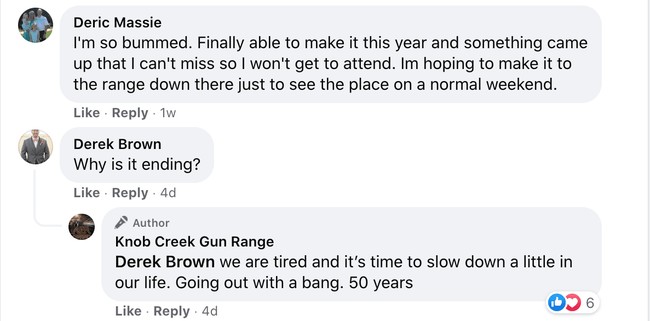
Putting on these events twice a year has to be a major undertaking for the Sumner family, who’ve owned the range for decades. In another message on Facebook, the individual running the range’s account said that “we all agreed the work load is more than we want anymore,” while adding that “most won’t understand until they are in our shoes.”
I believe that most gun owners do understand, just as I imagine the Sumners are well aware of the sadness that many longtime attendees are feeling this weekend. The Knob Creek Machine Gun Shoot has become a legendary experience in the 2A community, and while it’s not the only machine gun shoot around, it’s perhaps the biggest and certainly the longest-running event of its kind.
So when last tracer round is fired on Saturday night, the 50-year history of the Knob Creek Machine Gun Shoot will come to an end. I know I’m not alone in hoping that after a little break the Sumners decide to bring the event back, but for the moment it sounds like they’re not planning on revisiting their decision. Thankfully the range itself will remain open for business, and I’m still keeping my fingers crossed that we haven’t heard the last enormous boom echo across the hills of Bullitt County.