Categories
Category: All About Guns
Categories
Crime in the Countryside

Arsenals and Library of Congress

Retired Army engineer officer Lt. Col. Charles “Sherm” Mills with his M1903 Springfield rifle purchased from the NRA for $14.50. During his assignment to Springfield Arsenal, the “CAL .30” rifle was professionally restored by fellow “Artificers.” Photo: Chip Lohman
First, some history: From the 50-plus weapon and ammunition arsenals created since the birth of our nation, you’ll recognize a few of the names that have been proudly adopted by firearm-related companies, such as Frankford Arsenal (reloading supplies) and gun manufacturers like Springfield Armory, Rock River and Redstone, not to mention the ubiquitous Picatinny Rail.1
Our nation’s firearm manufacturing industry began in 1777 when patriot colonists established “The Arsenal at Springfield.” By the War of 1812, additional federal arsenals had been approved by the Continental Congress, including: Springfield and Harpers Ferry Arsenals that manufactured small arms; Watervliet Arsenal in New York for the production of artillery equipment and ammunition; Watertown Arsenal in Massachusetts for artillery gun carriages and small arms and the Frankford, Pa., arsenal that fabricated ammunition. Later, Rock Island Arsenal in Illinois produced artillery recoil mechanisms, followed by the Picatinny Arsenal in New Jersey for artillery ammunition.
“Arsenals were typically staffed by a small cadre of military personnel and a large number of skilled civilian “artificers.” Although the Ordnance Department was officially tasked with [the]responsibility to design weaponry after 1834, new models of all types were normally brought to the Department by entrepreneurs or commercial companies for testing and evaluation.” From The Arsenal Act: Context and Legislative History by Daniel H. Else.

Springfield Arsenal’s original main building now houses a museum of the largest American gun collection in the world.
Springfield Arsenal: The Nation’s first Ordnance Arsenal is located in the city of Springfield, Mass., and was the main source for the manufacture of United States military firearms from 1777 until its closing in 1968. It was the first federal armory and one of the first factories in the United States dedicated to the manufacture of weapons. Today, the site is preserved as the Springfield Armory National Historic Site, and features the world’s largest collection of historic American firearms.
So how did retired Army Lt. Col. and decorated Vietnam veteran “Sherm” Mills find himself in receipt of orders to close the doors on this iconic institution? During an interview with this modest Dumfries, Va., veteran, his story was told for the first time.
As a Distinguished ROTC graduate of Dartmouth College in 1957, Mills entered the Army with a regular commission, thus bypassing the typical two-year probationary period as a reservist. His first duty assignment was platoon leader and later commanding officer of Delta Company, 91st Combat Engineer Battalion, Camp Dumfries (which would later become Fort Belvoir, Va.). After studying at the Army Engineering Center, Mills’ career included a return to the Center as an instructor in 1969. Mills later put himself through night school at George Washington University to earn a master’s degree in engineering administration.
During two tours in Vietnam, Mills was awarded three Bronze Star medals—one with the V device for heroism; the Air Medal; the Meritorious Unit Commendation and the Vietnam Gallantry Cross with Palm, among several other awards earned during his 22-year career. It was after his first tour in Vietnam that then-Capt. Mills received orders to Springfield with the assignment to de-commission the storied arsenal.
Q: So what was your first impression of those orders, Lt. Col. Mills?
A: I thought it sounded interesting, even though I did not yet know the magnitude of the assignment. I was sent to a two-week Post Engineer School en route to Springfield to learn the technical aspects of the job.
Q: Once you reported-in to Springfield Arsenal, who did your team consist of and what was their morale, having learned that the arsenal would be closing?
A: While the entire group exceeded 200 civilian craftsmen, I worked primarily with each of the section heads of various union-organized plumbers, electricians, millwrights (move machinery) and carpenters who worked in 65 buildings spread out over four campuses. (Laughing) I did a lot of walking in those days to supervise the line and keep an eye on the details.

Then Maj. Mills, after his assignment to Springfield Arsenal and return from a second tour in Vietnam.
Springfield Arsenal had been the principle employer for generations of families in the area, so naturally there was some disappointment. However, the Army went to great lengths to retrain and place those employees who chose not to retire. I don’t recall the numbers, but many of the 200 personnel under my watch transferred to other arsenals.
They were a very talented group of tradesmen, and I remember one particularly challenging job for the millwrights was to move a very large piece of machinery and drop it precisely into a narrow area of the shop. Another interesting aspect of the job was that, having been built in the early 1900s, the electricity to power the machinery was a unique 380 volts, rather than the standard 220/440 volts you see today. So that presented some unique maintenance challenges for our electricians.
Q: What was a typical day for you at the arsenal?
A: Every single piece of machinery or tool had a serial number, so that was a large part of the two-year project—accounting for everything; annotating where it was shipped; or whether it was disposed of or sold. We hired a contractor to help move all the equipment, which required detailed coordination. Because most of my crew were union members, there were restrictions on workload, scheduling and so-on. So organizing the equipment moves to make efficient use of people’s time was a large part of our planning effort. I submitted weekly reports to my boss and worked closely with the transportation officer once we had the machines inventoried and ready for shipment.

Aerial view of one of the four Springfield Arsenal campuses that then-Capt. Mills was tasked with transitioning.
Each day began with a campus-wide bugle call for reveille and ended with evening taps. So, despite the large number of civilian employees, the arsenal retained certain military traditions. Once reveille and the morning flag raising were completed, my day began with a one-minute walk from my quarters to my office—not a very long commute! Amidst the daily planning and inventory tasks, we continued to manufacture items such as M14 stocks and barrels. And of course we had to keep everything running, so I organized a system of work orders to keep up with breakages and repairs while everything else was going on. I also had the collateral duty of safety officer with two full-time inspectors overseeing the operation. The bottom line for my job was: keep track of everything, and keep it running until it was shipped, sold or scrapped.
———————————————————————————————————————–
Following his assignment, Mills was promoted to major. This extract from his efficiency report while assigned to the arsenal helps explain the promotion.
He has personally supervised and coordinated this effort which required that much detailed information be furnished as to stock numbers, nomenclature, condition code, availability dates, age of equipment, etc. … Captain Mills presents a trim, sharp military appearance and sets a fine example for the employees who work under his supervision by his fine personal appearance, his aggressive direction of the Post Engineer activities and his firm but amiable approach to getting a job done in a timely manner … .
As Mills reminisced about the two years spent at Springfield Arsenal, he recalled occasional, brief meetings with a distinguished staff member whose name you may recognize. Mills spoke respectfully about this consultant—a Mr. John Garand2—of whom Mills said, “He was a very nice gentleman who lived in the Springfield area and was helping with the design of the M14 rifle at the time.”

How else would a retired engineer organize his personal wine collection? Photo: Chip Lohman
Following his retirement in 1979, Mills and his wife, Caroline, settled in Springfield, Va., followed by a move in 2005 to Dumfries, Va., just 20 minutes south of Fort Belvoir—their first duty station of nearly three decades prior.
As we were looking through his gun collection, we passed by a climate-controlled room in Mills’ basement. Given his organizational skills at Springfield Arsenal, it was no surprise to see how Lt. Col. Mills inventoried his retirement hobby of wine collecting.
Postscript
What follows are a few of the hallmarks of our nations’ military might, spread over the Revolutionary War, the War of 1812, two World Wars, the Korean War, Vietnam and our continued presence in the Middle East.
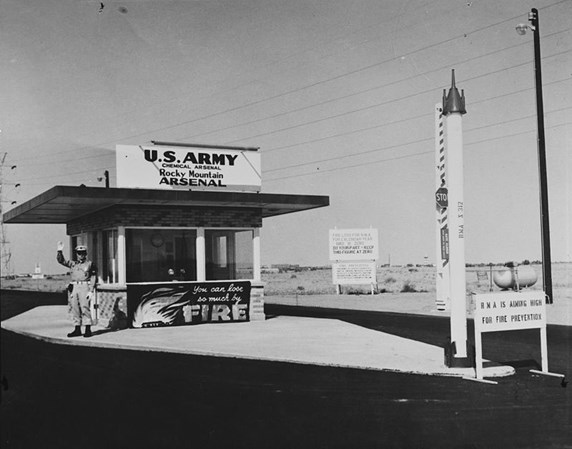
Rocky Mountain Arsenal: The Rocky Mountain Arsenal was a United States chemical weapons manufacturing center located near Denver, Colo. The site was completed in 1942, operated by the U.S. Army throughout the later 20th century, and was controversial among local residents until its closure in 1992. Much of the site is now protected as the Rocky Mountain Arsenal National Wildlife Refuge.

Detroit Arsenal: Detroit Arsenal was the first manufacturing plant ever built for the mass production of tanks in the United States. Established in 1940 under Chrysler, this plant was owned and managed by the U.S. government until 1952, when management of the facility was turned over to the Chrysler Corp. Chrysler’s construction effort was one of the fastest on record.The first tanks rumbled out of the plant, even before its construction was completed.

Watertown Arsenal: Established in 1816-1968, the Watertown Arsenal was a major American arsenal located on the northern shore of the Charles River in Watertown, Mass. During the Civil War, a new commander’s quarters was commissioned by then-Capt. Thomas J. Rodman, inventor of the Rodman gun3.

Watervliet Arsenal:“The Big Gun Shop.” Built in 1813 in Watervliet, N.Y., on the west bank of the Hudson River, it is the oldest continuously active arsenal in the United States. The arsenal was founded to support the War of 1812, and was designated as the Watervliet Arsenal in 1817. Today, Watervliet produces much of the artillery for the U.S. Army, as well as gun tubes for cannons, mortars and tanks. It has been a National Historic Landmark since 1966.
Footnotes:
1The rail is named after the Picatinny Arsenal in New Jersey, which was tasked in 1992 to develop a standardized mounting system after the U.S. Army was dissatisfied with available products on the market.
2John C. Garand created the semi-automatic M1 Garand rifle that was widely used by the U.S. Army and U.S. Marine Corps during World War II and the Korean War.
3 The Rodman gun was a class of Civil War–era coastal fortification artillery pieces designed to shoot shell and shot munitions.

U.S. Reps. John Rutherford (R-Fla.) and Henry Cuellar (D-Texas.) introduced the Federal Firearms Licensee (FFL) Protection Act of 2023 (H.R. 2620) — a bipartisan bill aimed at strengthening and enhancing criminal penalties for thefts of firearms from federally licensed firearm retailers. Penalties would include minimum sentences of three years in prison for burglary and five years in prison for robbery.
According to the Bureau of Alcohol, Tobacco, Firearms and Explosives (ATF), between 2017 and 2021, there were over 2,254 burglaries and robberies of FFL dealers. Over 28,000 firearms were stolen during this period, many showing up at crime scenes.
The legislation is designed to send a strong message to the violent criminals engaging in these illicit activities, as well as provide for safer communities, assist law enforcement and protect the livelihoods of firearm retailers.
“During my career in law enforcement, I saw firsthand how FFL dealers were targeted by criminals. This legislation will ensure that those who rob and burglarize federally licensed gun dealers receive adequate punishment for their crimes,” said Congressman Rutherford.
The Federal Firearms Licensee Protection Act of 2023 has received support from the National Shooting Sports Foundation.
“This bipartisan legislation is what true gun safety looks like. Congress is sending a clear message that the safety of our communities is nonnegotiable and targeting firearm retailers to steal guns in order to commit further crimes is intolerable,” said Lawrence G. Keane, Senior Vice President and General Counsel for NSSF. “The firearm industry is grateful to Congressmen Rutherford and Cuellar for reaching across the aisle to provide those firearm retailers who follow the law the protection they deserve. This legislation assigns the responsibility for crime where it belongs — with the criminal. These are real solutions that make our communities safer.”
The Federal Firearms Licensee (FFL) Protection Act has been referred to the House Judiciary Committee.
From NE Austin (TX) — not to be confused with the City of Austin — comes this cheery news:
According to the Austin Police Department, at around 5:31 a.m., officers responded to a call in the 7600 block of Bethune Avenue, where a female resident reported a man attempting to break into her home through the door and a window. The caller then stated that the male suspect had entered the home, followed by the sound of gunshots.
Upon arrival at the scene, the APD officers and EMS medics found the male suspect dead. APD says the preliminary investigation indicates that the suspect was shot by one of the residents in self-defense.

The interesting part of the story to me is that the dead goblin is not, as one might think, a teenage choirboy, but a sixty-something asshole. Whatever. Asshole is asshole, regardless of age, and dead is dead. (Thankee, Reader Brad for the alert.)
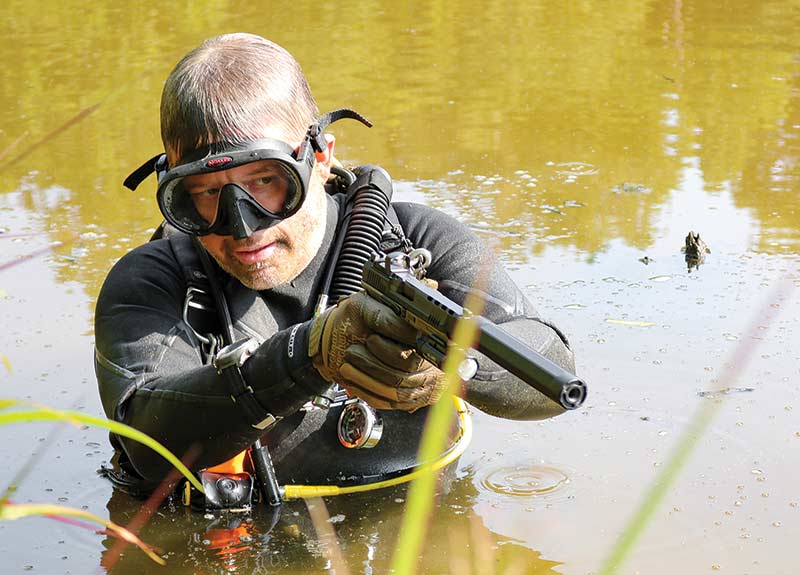
The Canik TP9 SFx METE holds its own with the finest combat
handguns in the world at a very sweet price — definitely secret agent stuff.
I am an unrepentant fan of the Canik TP9 family of pistols. I bought my first copy back in 2012. There was a cavorting dolphin on the side. The thing looked like a Walther P99 had a baby with a brick. I still enjoy shooting it.
Today’s most recent offerings are both uber-svelte and sexy-cool. They include a feature set that eclipses the big-name guns. The new TP9 METE takes combat pistols to a previously unexplored space.

The Canik TP9 METE pistols are thoroughly awesome unadorned right out of the box.
However, they readily lend themselves to some proper accessorizing.

The Canik TP9 METE pistols came in a truly epic box. Will tricked
his out with all the cool-guy stuff he could find.
The Operator
The crew of the International Space Station was shocked when the hatch to the supposedly unmanned SpaceX Dragon resupply capsule opened, and Duke Sterling floated in behind his signature disarming grin. The ISS crew consisted of three experienced cosmonauts and Mission Specialist Dag Nilsen from Norway.
“Forgive my unexpected visit,” Sterling said in unaccented Russian. “Unfortunate international circumstances dictate I impose upon you briefly.” Mission Specialist Nilsen heard the words in Norwegian.
One of the cosmonauts was the preternaturally gorgeous Svetlana Fedorov, formerly principal dancer at the Bolshoi. She subsequently earned a PhD in astrophysics while simultaneously raising her twin nephews orphaned in a tragic catfish noodling accident. Her two male comrades were hardened Spetsnaz veterans.
Sterling quickly settled into the routine of ISS life. He dominated the Russian card game of P’yanitsa despite never before having played. Forty-eight hours later, the four scientists counted Sterling among their dearest friends.
On day three, Sterling glanced at his watch and said, “I must be going. Thank you for your hospitality.” Before anyone could react, he was in his EVA suit, a sleek armored case connected to his waist via an aluminum carabiner.
Svetlana leaned toward him and whispered, “Am I pregnant?”
Sterling could always tell. Though he had not physically touched her, Svetlana Fedorov would not be the first woman to find herself with child simply from being in the same room with Duke Sterling. Smiling sweetly, Sterling said, “Nyet.”
In one practiced movement, Sterling was in the airlock. He glanced at his watch a final time, waved at his new friends and exited the ISS. When the moment was right, he pushed off vigorously toward earth.
Two hours and 27 minutes later, Sterling deployed his parachute. A quarter-hour after that, he touched down noiselessly in total darkness on the horse track of the Ryongson Residence north of Pyongyang, North Korea. Sterling removed his space helmet and soaked up the silence. Despite having just HALO’d into North Korea from the International Space Station, his heart rate loitered in the high 50s.
Sterling’s dark camouflage fatigues rendered him invisible in the darkness. He popped open the case and ran his fingers over its contents in the darkness. In 30 seconds, he had his Canik TP9 SFx METE fully assembled. He slipped the sinister weapon into its custom fit-and-lock retention holster before stowing his spacesuit, parachute and dunnage behind the stable. He then activated his NVGs and pressed toward the foreboding enormity of the main edifice. It was showtime.
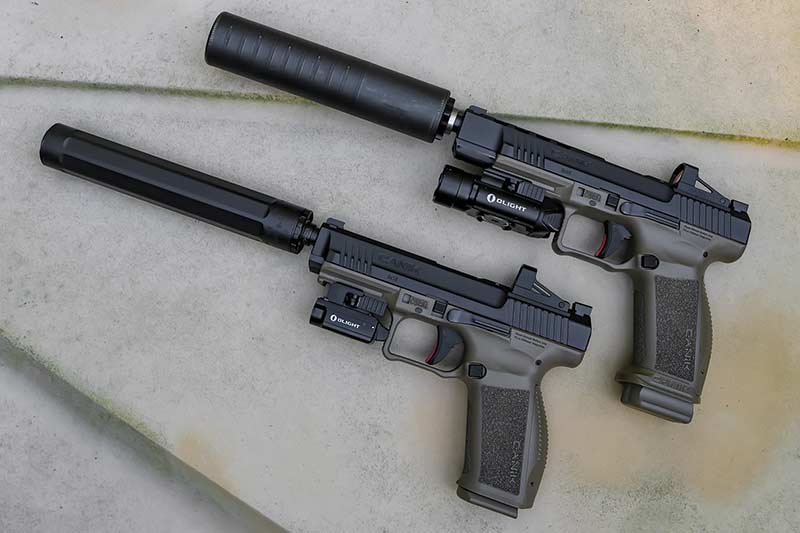
The new Canik TP9 METE pistols are as refined as human craftsmanship and engineering can make them. They are simply magnificent combat handguns.

The Canik TP9 SFT METE is the standard service pistol. Though beautifully
tricked out, this gun occupies the same space as a GLOCK 17 or HK VP9.
Avoiding the North Korean guards was not a challenge. Sterling had both an otherworldly proximity sense and an uncanny ability to blend in with foliage, furniture and household decor. In moments, he stood poised outside the Supreme Leader’s master bedroom. With grim determination, Sterling readied his Canik, flipped up his goggles and pressed through the door.
The rotund North Korean despot sat at a massive ornate table. In one hand, he held an adorable squirming beagle puppy. In the other, he grasped a dental tool. Shock and surprise registered on his moon-like face. Without a moment’s hesitation, the highly trained CIA Special Activities Division operative raised his customized Canik handgun and shot the short fat man three times in the chest.
He was answered by a shower of sparks and the acrid smell of burned electrical components. Kim fell heavily out of his chair, his gaze disconjugate and his limbs writhing wormlike. So, Kim Jong-un actually was a robot. Sterling had long suspected.
Sterling dropped the abused puppy into his cargo pocket and made his way next door to the suite of Kim Yo-jong, Kim Jong-un’s psychotic nutjob sister. He used his simply breathtaking romantic powers to convince the 33-year-old under-tyrant to fetch him a helicopter. Ninety minutes later, he landed the North Korean Mi-24 Hind gunship at Camp Humphries in South Korea to great fanfare. At the same instant, Kim Yo-jong was also pondering her pregnancy status. Sterling had not touched her, either.
Sterling retired to the BOQ’s at Humphries with his new dog. He cleared and stowed his Canik before curling up with the grateful little beagle. Another day, another despot.
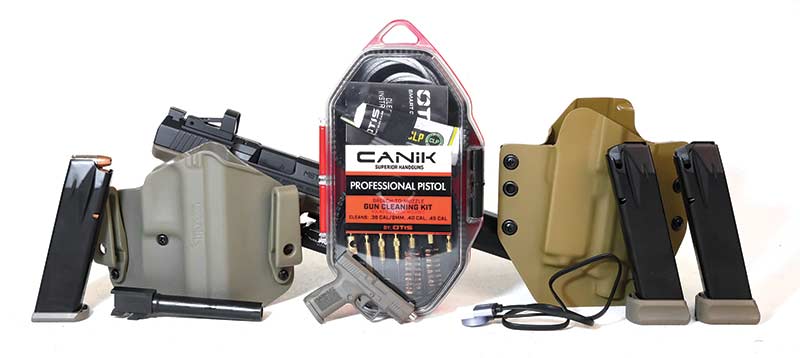
The pistols come with everything you could possible need — all in the box.
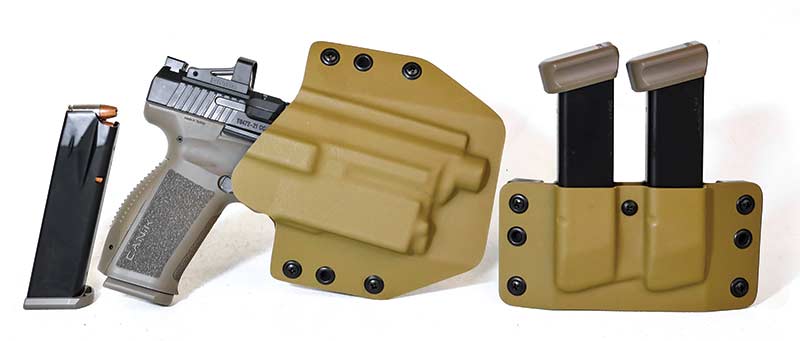
Unlike many “combo” kits, the holsters and magazine carriers are
solid pieces of gear and ready for daily use.
The Gun
METE is a Turkish given name. It means, “brave,” “valiant” or “hero.” The word is pronounced “Met-ay.” METE is actually a deformed variation of Mo-du, which is a version of the classic Mongol honorific Baghatur. The literal translation of METE into English would be “freaking awesome.”
Using the basic yet superlative TP9 chassis as a foundation, the skunk works at Canik accumulated literally everything anyone might possibly need to optimize a combat handgun. The case mine came in is adequate to survive atmospheric re-entry. We reviewed both the TP9 SFT and the TP9 SFx. Amazingly the MSRP for each kit is $519.99 and $574.99, respectively.
All TP9 pistols include a fiber-reinforced polymer frame with interchangeable backstraps and a Picatinny rail on the dust cover. The slide release is replicated perfectly on both sides. The magazine catch is readily reversible and sports various-sized buttons for a custom fit. There is a loaded chamber indicator and a striker status button, both of which are accessible by feel in hard dark.
The fire controls are nickel plated for a beautiful trigger experience. The base finish is Tenifer. The slides are further Cerakoted as well. The ample trigger guard is oversized to accommodate gloves. This all comes standard.
The TP9 METE guns include an optics-ready slide with several mounting plates for common red dots. The superb steel 3-dot sights are designed to co-witness with a red dot. The rear sight is angled for one-handed charging should life truly go sideways. The integral magwell is flared for fast mag changes
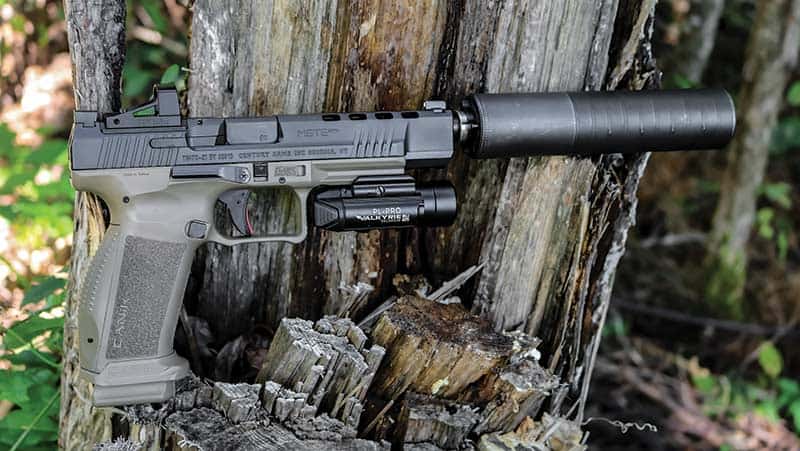
The Canik TP9 SFx METE is part race gun, part rugged combat tool.
Will’s shoots like a tuned target pistol.
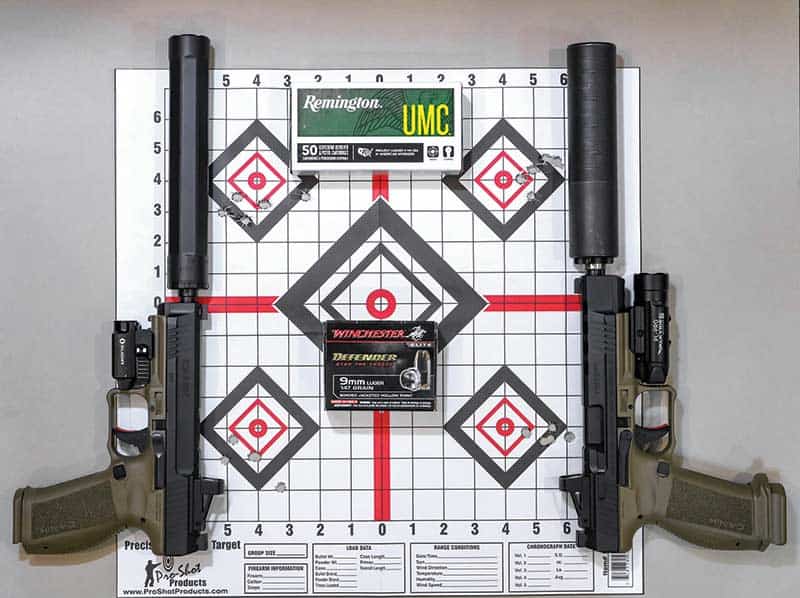
At 15 meters from a simple rest both of these guns shoot great.
The TP9 SFx METE (right) and Will got along particularly well on the range.
METE-mazing
The full meal deal is fairly incredible. The gun includes a superlative fit-and-lock Kydex holster. This rig is reversible for either IWB or OWB carry. There are two magazines. One packs 18 rounds, while the other carries 20. There is an applique flared magwell adaptor that secures with an Allen screw.
These guys really did think of everything. The pushpins are all dimpled for easy disassembly. Each pistol comes with the most adorable little tool kit that looks like a miniaturized version of the pistol. This rig includes the fasteners for your red dot as well as a bit driver and accessories. There is also a premium OTIS cleaning kit. The package includes a rugged punch and sundry support kit as well.
I tricked my guns out with factory extended threaded barrels that are a drop-in fit. Shield RMSc red dots and custom rechargeable OLIGHT tactical lights round out the package. Century offers holsters for the gun/light combination as well.
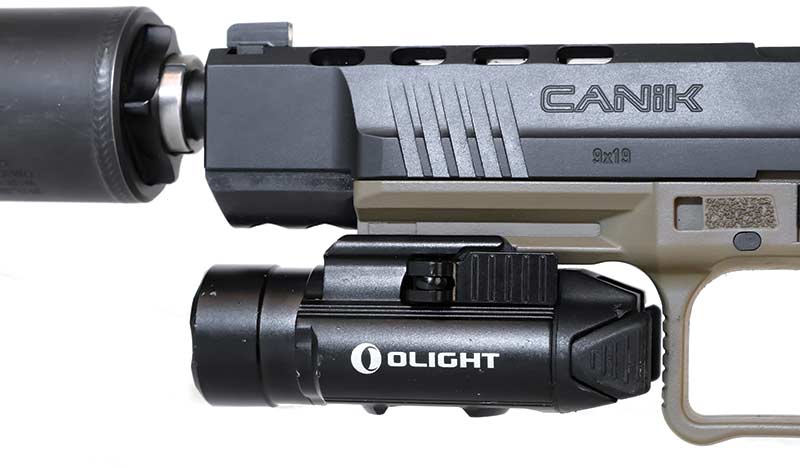
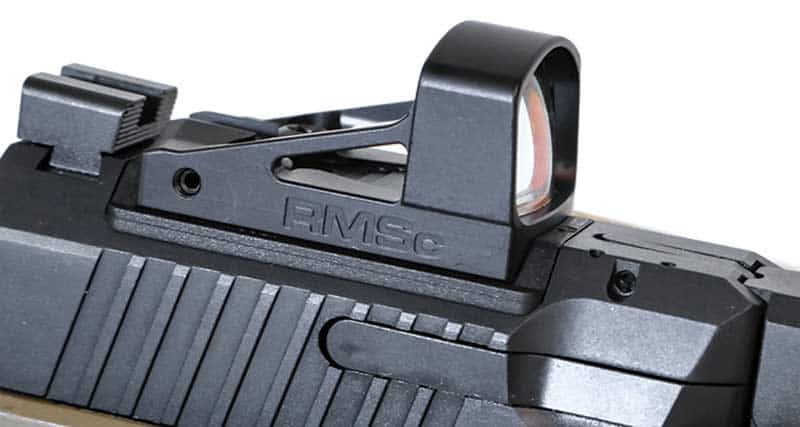
The Shield RMSc red dot is automatically on every time you grab the gun.
It will ruin you to conventional iron sights.
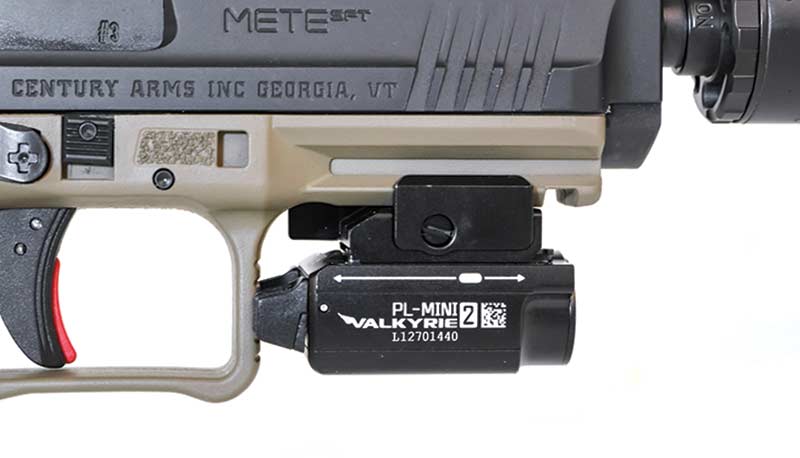
OLIGHT makes the most extraordinary rechargeable weapon lights.
The units can be recharged via a magnetized charging cable without
removing them from the gun.
Decisions, Decisions …
The TP9 SFT sports an unthreaded 4.46″ barrel. The SFx version comes with a longer 5.2″ tube and a slide extended to match. The slides on both guns are serrated both front and rear. That of the SFx is also skeletonized up front for lighter weight, faster lock times and general cool points.
The polymer frames are interchangeable. The trigger guards are as aggressively undercut as physics and geometry might allow. This equals superb recoil control, minimal muzzle flip and faster follow-up shots.
The SFT is the standard bedside concealed carry service pistol. It packs like any other high-end duty pistol, only better. The plethora of included accessories just mean there’s substantially less to buy when it comes time to trick the gun out for service.
The SFx is a holy melding between a defensive pistol and a race gun. The extended snout helps tame the chaos, while the added mass keeps the sights on target. Both guns run like a toddler after a Twinkie.
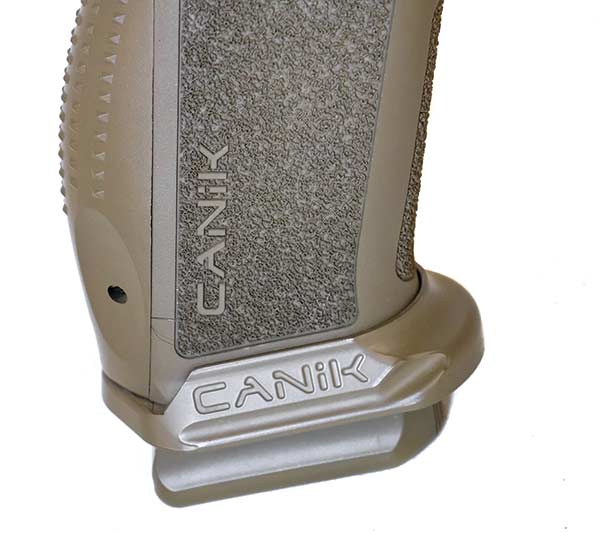
The applique magwell extension fits in place using the included tools.
Ruminations
My SFx METE performs like a tuned target gun. However, a defensive pistol isn’t much good if you can’t keep it handy. I tricked out my TP9 SFx METE longslide with its Shield RMRcc sight and got it arranged in the included IWB holster underneath my surgical scrubs.
The resulting package is undeniably bulky. However, I gutted through 12 hours at the clinic and 43 sick people, with none of them realizing I was armed. I also got home without any undue back strain.
Should life go sideways at home, at work, in North Korea or aboard the International Space Station, you really won’t find a better
defensive tool.