Categories
Category: All About Guns
Categories
P53 Enfield Turkey Shoot
Categories
“AT HOME WITH GUNS”
Categories
MATURE MAN’S RIFLE
Arthur L. “Gat” Howard earned his reputation and nickname from behind a Gatling gun.
As slang for a gun, “gat” took hold in the early 20th century, but is clearly a play on Gatling gun, designed in 1862 and named after its inventor Richard J. Gatling.
Born in 1846, Howard served with the U.S. Cavalry for five years and fought in the Indian Wars on the western plains before going to work for Winchester Arms. Eventually he left Winchester and started his own cartridge manufacturing company and enjoyed some success before the factory burned down. Howard served in the Connecticut National Guard where he led the Gatling gun platoon, but it was in service of the Canadian government where Howard earned his nickname.
A Smith & Wesson New Model No. 3 single action revolver with pearl grips attributed to Howard is on offer in Rock Island Auction’s Feb. 14-17 Sporting & Collector Auction along with an unmarked black powder reproduction Model 1862 Gatling gun.

Gatling Gun
Gatling, a doctor, invented his namesake weapon hoping to make a gun that would reduce the number of men in battle and lower the devastating losses seen early in the American Civil War. A precursor to the machine gun, Gatling’s multi-barrel, crank-operated weapon was patented in 1862 but not officially adopted by the U.S. military until 1866, after the end of the Civil War.

Colt produced all Gatling guns for the U.S. market from 1866 to 1903. The grandfather of the machine gun, the first Gatling gun could fire about 200 rounds per minute. Later models achieved the fire rate of as high as 1,500 rounds per minute. The 1883 Colt Gatling gun had a full brass housing and a fire rate of 800 rounds per minute.
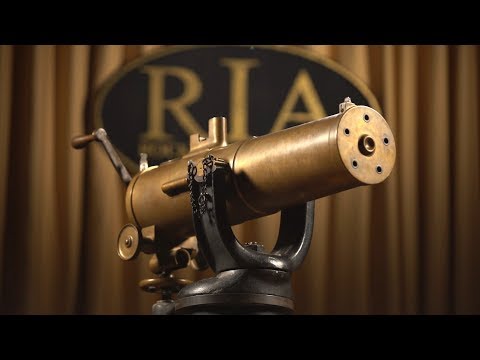
The Gatling gun available in the February Sporting & Collector Auction is an unmarked black powder reproduction of the Model 1862 which did not use self-contained cartridges as we know them today. It utilized steel cartridge chambers which were individually loaded with paper cartridges in the front and primed with percussion caps at the rear.

Rebellion in Canada
In 1885, rebellion was fomenting north of the border as indigenous people and mixed race settlers were unhappy about European settlers coming west, the Canadian government’s neglecting to recognize land titles in Saskatchewan and Alberta, and being under-represented in the Canadian parliament.
The Canadian government at the time had a small professional army and so enlisted militias to assist in quelling the uprising, amassing a military force of about 5,000 soldiers. Colt executives seeing a marketing opportunity, offered to loan a Gatling gun to the Canadian government.
The question was who would operate the Gatling gun? Colt and Gatling turned to Howard. He was not to be a representative of Colt, nor the Connecticut National Guard. Even Gatling stated that Howard didn’t represent him but was on the mission as “a friend of the gun.”
Gatling saw Howard, two of his guns, likely 10-barrel 1874 models, and 5,000 rounds of ammunition get on a train bound for Winnipeg. There was little time to train Canadian gunners.
In an early battle during the uprising, the Battle of Cut Knife Hill, the resistance gained the upper hand so it was up to a Gatling gun operated by a Canadian gunner to cover a retreat by government forces, preventing a possible massacre. Howard, as always wearing his blue army uniform, played a key part in stopping a charge in the decisive Battle of Batoche in May 1885 that ended the five month-long rebellion. Ultimately, it was the superior firepower of the government forces that led to the end of the resistance.

Canada after the Rebellion
Howard earned $5,000 and received a medal for his role in quashing the rebellion. He never returned to Connecticut, instead taking up residence in Montreal where he became an investor in the Dominion Cartridge Factory. Along with the stipend and medal, Howard also got assistance from the Canadian government that allowed him to import materials for the cartridge factory duty free. The business made him a wealthy man.
His actions gained Howard enough fame that his purported death and survival in a storm off Nova Scotia was reported by The New York Times. He grew weary of the tedium of Montreal and as the Boer War began in South Africa, he offered to commission a battery of four machine guns at his expense but was refused. Instead, he was offered and accepted a position as machine gun officer in the 1st Canadian Mounted Rifles.

Second Boer War
Conflict between the descendants of South African Dutch settlers, called Boers or Afrikaners, and British colonists exploded into open warfare in 1899. The British took control of most of the territory as the Boers began fighting with guerilla tactics.
In South Africa, Howard commanded a Maxim and Colt machine gun. An aggressive and fearless leader willing to fight at close quarters, he didn’t return to Canada with his unit in December, 1900, choosing to stay in South Africa where he organized the Canadian Scouts, equipped with air-cooled Colt Model 1895 machine guns.

Two months later, in February, 1901, Howard was killed at the age of 57. Reports of Howard’s death varied, with some saying he and his aide were killed in an ambush by Boers, or that they were captured and murdered. In a short article in The New York Times, he was described as “an intrepid and absolutely fearless fellow.”
The article also stated “He knew a machine gun perfectly and it was his skill in handling the gun of the Gatling make that earned for him his title during the Riel rebellion when he was in the Canadian Service.”

Machine Gun Hero
Arthur L. “Gat” Howard was a man of action who joined in the Canadian government’s effort to put down a western uprising, earned his reputation and nickname as a Gatling gunner. An American who remained in Canada, Howard fought in the Boer War where he met his death. A Smith & Wesson New Model No. 3 with pearl grips and attributed to Howard is on offer in the Feb. 14-17 Sporting & Collector Auction, as is a Gatling gun Model 1862 black powder reproduction of the weapon that ushered in the machine gun.

Sources:
“A Connecticut Yankee (and his Gatling) in Queen Victoria’s Canada,” by Terry Edwards,Small Arms Re
Benjamin Berkeley Hotchkiss was born in 1826 to a family of inventors in Connecticut, the hotbed of gun creation in the 19th century. The family had a business that manufactured many of their inventions, including an early variation of a monkey wrench.
Early in his career Hotchkiss worked as a gun maker for Colt and Winchester. He patented a cannon shell for rifled cannons. More of his shells were used for rifled cannons during the American Civil War than from any other munitions maker.
The main heavy machine gun used by the French Army in World War I bore his name, but before the machine gun was the Hotchkiss Revolving Cannon. A 37 mm gun with five barrels, a Hotchkiss Revolving Cannon will be available in Rock Island Auction Company’s Feb. 14-17 Sporting & Collector Auction.

Machine Guns Predecessors
A rapid-fire gun was long a dream of military leaders.
The Puckle gun, designed and patented in 1718 by London attorney James Puckle, is considered one of the earliest predecessors of the machine gun. Designed for naval defense against smaller, faster ships, the Puckle gun was a single barrel flintlock with a revolving cylinder that could fire off a whopping nine shots per minute before swapping out the cylinder for a freshly loaded one. In military tests it was found to be unreliable.
Other guns, like the Chambers Flintlock, came and went until the Gatling gun of 1862 arrived, firing from 200 rounds per minute to as many as 1,200 rounds per minute as improvements were made.

Hotchkiss Revolving Cannon
After the Civil War, the U.S. Government wasn’t interested in new munitions, so Hotchkiss went to Europe where it seemed in a perpetual state of war. He established a factory in France on the eve of the Franco-Prussian War in 1870 where he made metallic cartridges for small arms. It was here that the Hotchkiss Revolving Cannon was born.
Hotchkiss saw shortcomings in the Reffye Mitrailleuse, the French volley gun that fired ammunition from a 25-cartridge magazine in separate barrels within a cannon sleeve. He saw the French weapon had a fragile firing mechanism and a narrow cone of fire.
Since it also has a crank handle, the Hotchkiss Revolving Cannon is often compared to the Gatling gun but has a number of differences. The most starkly obvious difference was the size of the rounds. The Gatling gun fired small firearm rounds but the Hotchkiss fired a 37 mm round. The St. Petersburg agreement of 1868 forbid exploding ammunition that weighed less than 14 oz., but the Hotchkiss projectile weighed 16 oz.

The Gatling gun had a bolt for each barrel, but the Hotchkiss Revolving Cannon had an immovable breech block with a bolt. One rotation of the crank handle was a firing cycle for the revolving cannon that stops the barrel in place for firing accuracy.
The Hotchkiss Revolving Cannon used what one 1879 publication called 10-round “feed cases” to load cartridges into the gun. With an assistant gunner to load ammunition, it could fire about 60-80 rounds per minute out to a range of about 4,000 meters. The gun offered no recoil so one gunner could fire it with accuracy if it was suitably mounted.
Hotchkiss Revolving Cannon Trials
The gun was produced too late for use in the Franco-Prussian War but faced trials by the French Ministry of Marine as a maritime weapon. As a naval gun, the Hotchkiss Revolving Cannon could fire about 15 shots a minute aimed at a fast-moving target, like a torpedo boat.
During testing, 1,136 rounds were fired with only five malfunctions. The gun destroyed a boat during trials, hitting the ship 70 times out of 119 shots aimed at it.
As a field gun, the Hotchkiss Revolving Cannon was considered as an anti-personnel weapon because the shells weren’t very powerful. Firing canister shot could spray 7,000 balls per minute with an effective range of 2,000 yards. It was also considered for use arming railway cars guarded by steel shields to protect from small arms fire.

Naval Use for Hotchkiss Revolving Cannon
The naval model revolving cannon was adopted by the French Navy in 1877. By 1880, the Hotchkiss Revolving Cannon was adopted for naval use by Brazil, China, France, Holland, Greece, the United States, Chile, Argentina, Russia, and Denmark.
However, its time was short as a naval weapon as torpedo boats grew larger and were better protected. The Hotchkiss Revolving Cannon was also made in 47 mm and 53 mm sizes, but the multi-barrel guns increased in weight and could no longer be mounted aboard ships where they were most effective. The revolving cannon was out of vogue by the early 1890s with the advent of the machine gun.

Hotchkiss Machine Gun
Benjamin B. Hotchkiss began working on an automatic machine gun to compete with the Maxim that came out in 1884. Designed in England by Hiram Maxim, his machine gun was used by every major power. Hotchkiss never got to see a working machine gun from his company. He died in 1885 before a design could be developed.
Before the turn of the century, Hotchkiss’s company eventually developed the Model 1897 that went through three variations before becoming the Model 1914. The era of automatic weapons had begun. In World War 1, the Germans fought with the MG 8 that was a version of the Maxim machine gun, while the British used the Vickers machine gun, also based on Maxim’s weapon.
The French Army used the Hotchkiss Model 1914 machine gun starting in the second half of World War 1 and continued to use it through World War 2. The Model 1914 was a sturdy, air-cooled weapon that was one of a number of modifications made to the Hotchkiss Model 1897. When the United States joined in World War 1, it was underprepared so relied on France for automatic weapons so the American Expeditionary Force used the Hotchkiss Model 1914 and Savage-made Vickers.
Legendary gun maker John Moses Browning would soon provide a machine gun for the U.S. military but production couldn’t ramp up fast enough to get his M1917 in the war until late 1918. His Browning Automatic Rifle, or BAR, was also adopted by the United States as a light machine gun and was in the hands of doughboys by the end of the war.

Hotchkiss Revolving Rifle Available
This particular Hotchkiss Revolving Cannon looks more like a Gatling gun, with its nine smaller caliber barrels as opposed to the five 37 mm barrels on the U.S. Navy Hotchkiss shown earlier. However, a peek inside the receiver shows a single bolt, rather than the multiple bolts inside the Gatling. This unmarked prototype is chambered to fire .6335 caliber ammunition (approximately 16 mm), and is likely from the turn of the 20th century. A Bureau of Alcohol Tobacco and Firearms letter that accompanies the gun concludes that the receiver is similar to to the original design of the Hotchkiss Revolving Cannon and the the barrels are chambered for a one-of-a-kind black powder cartridge that is no longer manufactured in the United States. In scouring our library, we were unable to find any similarly chambered Hotchkiss cannons, leaving an air of mystery around this model.
While Benjamin B. Hotchkiss may not land among the great gun inventors like Browning, Samuel Colt, or Daniel Wesson, his vision of the revolving cannon helped bridge early attempts at automatic weapons to the machine guns used in World War 1. This piece of history is part of the evolution of full auto guns born out of 19th century European land wars.
Sources:
The Strange Early History of American Machine Guns: Hotchkiss Browning, by Gene Fax The Artilleryman Magazine
“The Hotchkiss Revolving Cannon” by Alfred Koerner, published in 1879
A video posted to Twitter this week by Mr.GunsNGear shows government agents making the rounds to confiscate forced reset triggers.
One of the individuals who was targeted recorded his interaction with the agents. It wasn’t immediately clear when the video was taken.
“So, the reason why we’re here is, as I’m sure you’re aware, the ATF recently classified FRTs — the forced reset triggers — as machineguns,” says the female agent.
“We are aware that you may have purchased some of these FRTs,” she continues. “So now basically the whole agency is reaching out to these purchasers and we have to pick ’em up. You know they’re evil.”
The citizen responds by saying he won’t be answering any questions regarding their inquiry nor will he be turning anything over.
“Are you refusing to give us the triggers,” asks the male agent.
“I’m not refusing anything and I won’t be answering any questions,” the citizen says.
“Again, we are aware that you did purchase FRTs,” says the female agent. “You wouldn’t be in trouble if you gave those up to us. Or, if you sold them, you can tell me you sold them.”
The citizen holds firm in his stance. He tells them that if he’s not being detained or if he’s not being placed under arrest he is going to leave.
“Just to be clear, so that now you know, that if you were to be in possession of these FRTs then you would be basically breaking the law,” she says.
In the United States, the possession of an unregistered machine gun is a federal offense under the National Firearms Act (NFA) of 1934 and the Gun Control Act of 1968. Penalties for violating these laws are no joke.
For possession of an unregistered machine gun, the potential penalties include:
- Imprisonment: Convicted individuals can face up to 10 years in federal prison.
- Fines: Fines for possessing an unregistered machine gun can be substantial, with amounts up to $250,000 for individuals and $500,000 for organizations.
- Forfeiture: Any machine guns and other firearms involved in the offense, as well as any property used to commit the crime or traceable to the crime, may be subject to seizure and forfeiture.
- Loss of gun rights: Convicted individuals may lose their right to own or possess firearms in the future.
Remember, not only are FRTs considered “machineguns,” but bump stocks fall under that classification as well.
It appears that Biden’s ATF is playing hardball. Sending agents door-to-door to confiscate forced reset triggers from law-abiding citizens is tantamount to declaring war on 2A advocates, not to mention a terrible use of limited government resources.
Seriously, there are hardened criminals terrorizing communities all across the country. Yet, the president believes the best use of ATF’s personnel is to send them out to seize aftermarket triggers from responsible gun owners and enthusiasts.
It’s insanity. Or, maybe, Mr.GunsNGear is right. It’s tyranny.
Update 5/10/22 — ATF Responds
GunsAmerica reached out to ATF to ask the following questions:
Is the ATF still actively doing this? How did it obtain the list of purchasers of FRTs? Also, does it plan to take a similar approach with respect to bump stocks, pistol braces, and/or unserialized frames and receivers?
Erik Longnecker, ATF’s Deputy Chief of the Public Affairs Division responded in the following manner:
We would direct you to this Open Letter in reference to certain unregistered machineguns: https://www.atf.gov/firearms/docs/open-letter/all-ffls-mar-2022-open-letter-forced-reset-triggers-frts/download.
Additional information about bump stocks, short barreled rifles and firearm frames and receivers can be found on our website at: https://www.atf.gov/rules-and-regulations/rulings.