.JPG)
Categories
One thing that has made the AR-15 platform so popular
is its modularity. You can mix, match and accessorize your rifle
to your heart’s content. It’s like Barbie for men.
Now let’s examine the more recent and commonly known .300 AAC Blackout (.300 BLK). The caliber’s name partly comes from the company that “invented” it which is Advanced Armament Corporation (AAC). So what is the difference between .300 AAC Blackout and the synonymous .300 Whisper? Without boring the reader with things like the measurement of the barrel throat etc. the answer is not much really.
The largest difference is that the .300 Whisper started as a wildcat round and AAC went to the trouble of getting the cartridge recognized by the Sporting Arms and Ammunition Manufacturers’ Institute (SAAMI) as a standard round.
As a sad side note, J.D. Jones never received any royalties and little recognition for his efforts. Partly in homage to J.D., Black Hills Ammunition lists the cartridge as. the .300 Blackout/Whisper.
So much for the history lesson.
One thing that has made the AR-15 platform so popular is its modularity. You can mix, match and accessorize your rifle to your heart’s content. It’s like Barbie for men.
I have exactly one AR that has not been “customized” in some way—an original Colt SP-1. For awhile I replaced the Delta rings with round ones and so I could add a quad rail to it but nothing else was changed. Out of nostalgia more than anything else, I went back to the original triangular handguards.
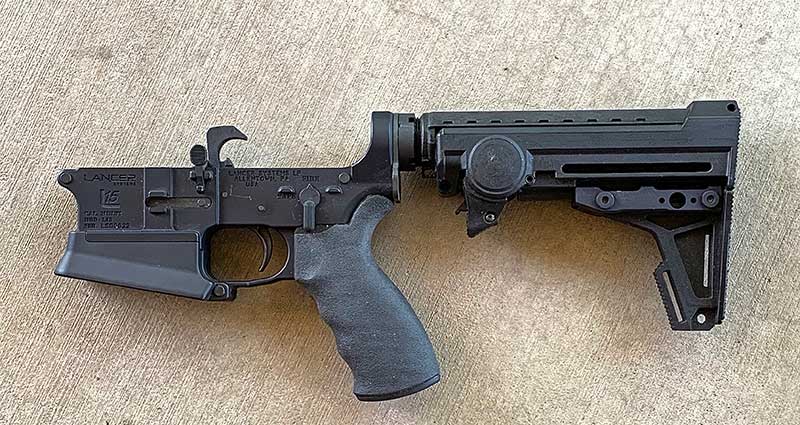
Lancer Systems lower receiver was used as the foundation.
I decided to use Lancer Systems lower for the “build.” The unique thing about this receiver is that there is a takedown pin at the bottom of the trigger guard that allows for attaching different sizes of funnel-type magazine wells. I used the medium size, as it offers a quick reload without becoming too bulky.
I contacted WMD Guns about receiving one of their excellent uppers for the project. Wynn Atterbury of WMD was enthused about the project and agreed to send one to me. I received the upper receiver within two weeks.
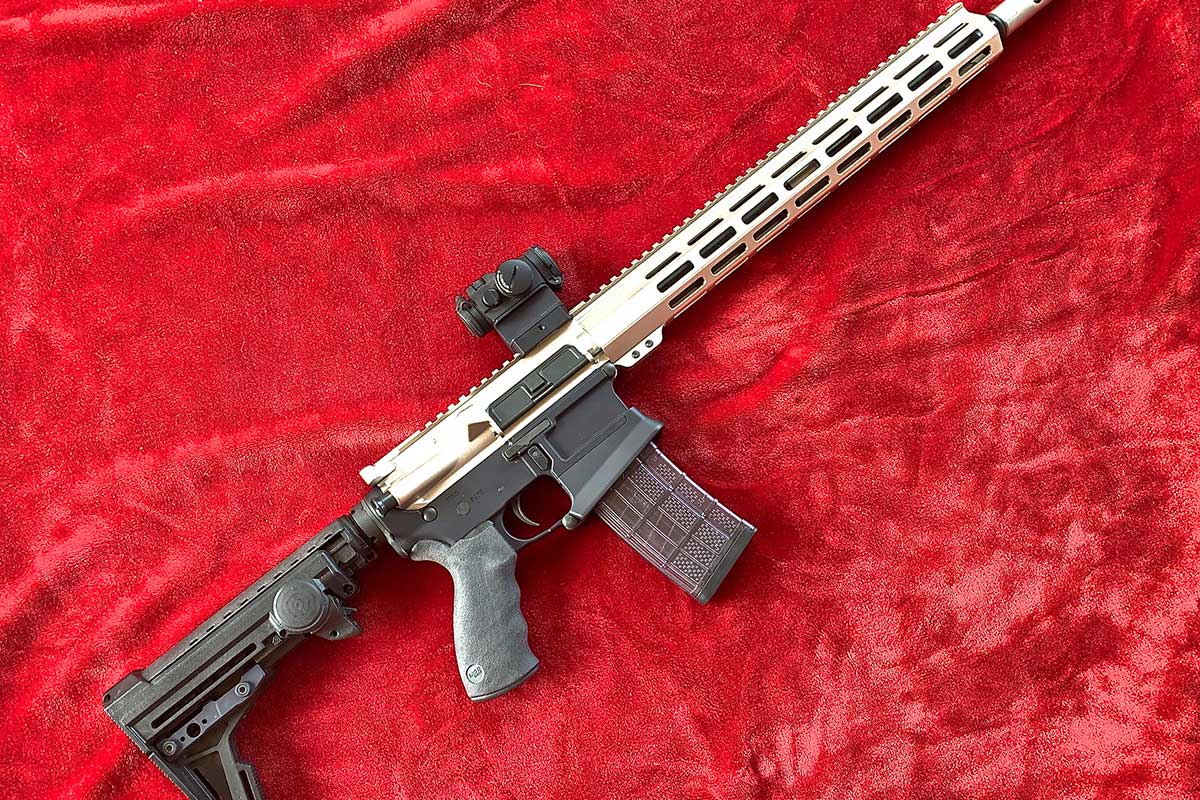
The forged upper receiver has a 16” barrel, is fitted with a 15” M-LOK handguard. The rifle has a mid-length gas system. The top rail run from the rear of the receiver to within an inch of the muzzle, with a total of 56 M-LOK slots so there’s plenty of real estate for a wide variety of accessories. A brake is attached to the muzzle that has three large slots on each side and three holes at 12 o’clock.

WMD Guns upper receiver has their proprietary NiB-X finish with a matte silver/gray appearance.

Top rail runs from the rear of the receiver to within an inch of the muzzle.

WMD Guns muzzle brake was very effective.
The upper features WMD’s proprietary NiB-X (Nickel Boron eXtreme) finish. This coating is tougher than hard chrome with a coefficient of friction near Teflon with excellent lubricity. This coating requires little wet lubrication and so it cleans easily after shooting, while protecting against the elements.
NiB-X is offered in a matte silver/gray appearance, distressed, or polished to a near chrome look. I opted for the matte silver/gray finish. It gives the rifle a classic two-tone look and is fairly unique for an AR-15-type rifle. I personally find it aesthetically pleasing.
The .300 BLK cartridge will chamber in a 5.56 rifle, but in no way, shape or form should you ever try to fire it. The .22-caliber bore simply isn’t big enough to handle the .30-caliber projectile of the .300 BLK round, and all that pressure from the round needs to go somewhere once the primer is struck and the results can be devastating.
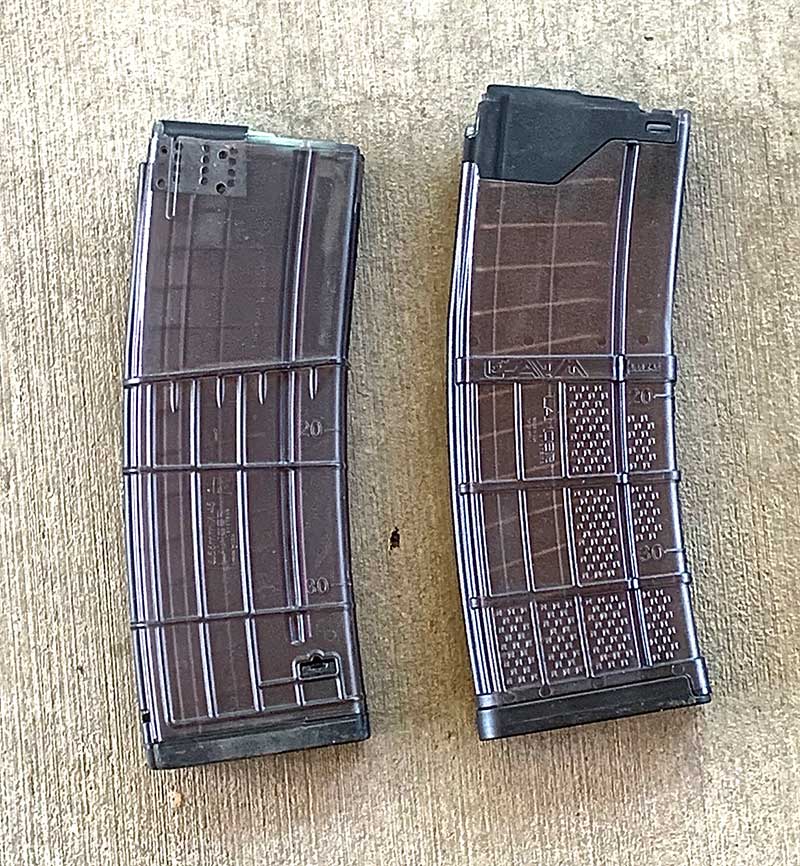
To avoid a possible kaboom, only Lancer Systems magazines are used in the .300 BLK.
When I had my first .300 BLK rifle I avoided this by using only Lancer magazines—both the original and Advanced War Fighter—in the rifle. I have never placed a .5.56 round in them or a .300 BLK round in any other AR mag.
I can almost hear someone saying, “Just pay attention to what ammo you’re putting in the gun.” I agree with this in a perfect world but I often shoot with family members, including grandchildren, where there is probably three or four ARs on the range and by using a noticeably different magazine it minimizes the chance of a kaboom.
I attached an Aimpoint Micro T-2 to the top rail. The T-2 has a 2 MOA dot so it covers two inches at 100 yards, four inches at 200 yards and six inches at 300 yards. That suits me fine as I rarely, if ever, shoot beyond that distance with anything but a precision rifle.
The “trick” to shooting smaller groups with a red dot sight (RDS) is to lower the intensity. While this doesn’t actually change the size of the dot, it gives the illusion of a smaller dot for greater accuracy.
I went with the ammo I had on hand for the .300 Blackout which was the Black Hills Ammunition 125-gr. TMK (Tipped Match King). This load develops 2,100 feet-per-second and 1,224 foot-pounds of energy at the muzzle.
I obtained a rough zero at fifty yards and then fine-tuned the T-2 at 100 yards.
Shooting from the bench, I shot four three-round strings. My best group measured 1.5 inches while the average group size was 1.8 inches. Not too shabby at all with my first time out and using a RDS instead of conventional rifle scope.
I found the muzzle brake to be quite effective though, like all brakes, very loud.
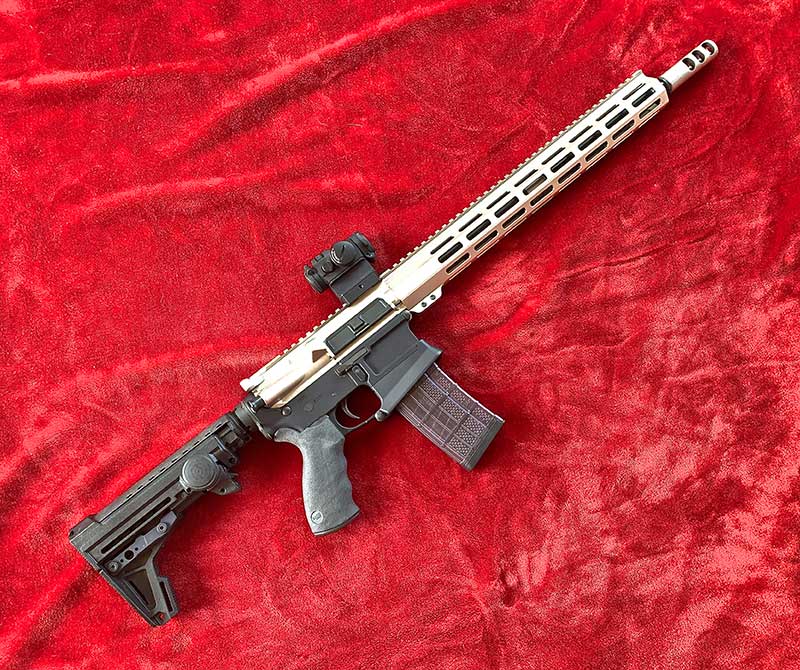
Completed rifle equipped as evaluated. Author likes the classic two-tone look.
I don’t have a .30 caliber suppressor at the moment, but I plan to resolve that problem in the near future to fully utilize the potential of the .300 BLK.
WMD not only offers parts and assemblies, but entire guns and NiB-X coatings.
Whether you are looking to assemble your own or purchase an entire gun, check out WMD Guns. You won’t be disappointed.
WMD GUNS
https://wmdguns.com
AIMPOINT INC.
www.aimpoint.com
BLACK HILLS AMMUNITION
www.black-hills.com
LANCER-SYSTEMS
https://lancer-systems.com
Almost immediately, three media narratives emerged.
One, semiautomatic weapons, not the killer Audrey Hale, were mostly responsible for the massacre.
Two, the shooter’s transgender identity profile played no role in the killing whatsoever.
Three, the public had no need to know of the contents of the shooter’s “manifesto.”
Why?
The media and authorities apparently assumed Hale’s written rantings tried to justify the murders because of Christianity’s supposed disapproval of transgenderism.
That censored reaction to the Tennessee shooting was quite different from another mass murder committed nearly six weeks later in Allen, Texas by a former security guard Mauricio Garcia.
Within minutes of the identification of the shooter, the media blared that Garcia wore pro-Nazi insignia and was thus a “white supremacist.”
Apparently that narrative was deemed useful to promote the idea of white supremacist terrorists using their semiautomatic “assault” weapons to kill for right-wing agendas.
Yet second-generation Hispanic immigrants, whose parents do not speak English, are not likely “white supremacists.”
The strained effort to make violent “people of color” into white right-wing killers is reminiscent of Trayvon Martin’s death in 2012.
Then the media reinvented the shooter, half-Peruvian George Zimmerman, into a “white Hispanic.” He was transformed into a right-wing vigilante and racist who supposedly hunted down an innocent black teenager.
The media did not wish to portray Martin’s death as a fight between an Hispanic and black teen. Instead, it tried to refashion the shooting as “systemic racism”—to the point of doctoring the 911 tape and photoshopping Zimmerman’s police photo to fit its false narratives.
Recently, an African American man named Deion Patterson lethally shot one and wounded four others in an Atlanta medical waiting room. His own politics, race, and type of weapon were apparently of little interest. So he was simply described as suffering from mental illness.
The media also did not wish to sensationalize either the profile or circumstances of another contemporaneous mass shooter Francisco Oropeza. He executed five of his neighbors, including a young boy and two women.
Only later did we learn that Oropeza was in fact an illegal alien who had been deported four times previously and returned each time through an open border.
Most recently, outrage grew over the homicide of Jordan Neely, a homeless man who frequented the subway and often threatened and occasionally attacked bystanders.
When a would-be good Samaritan and ex-Marine determined Neely’s latest threats to passengers were serious, he subdued him with a choke hold. Tragically Neely died while being restrained.
A media circus followed. Neely was black. The former Marine who held him down was white. So activists and the media immediately cited the death as yet more proof of systemic racism.
The public was lectured that Neely was a talented impersonator, who did professional street imitations of Michael Jackson.
The violent death of his mother, we were told, had traumatized him.
Released subway videos showed him on the floor of the subway, thrashing about while the white Marine held him in a headlock.
Protests and demands for a murder indictment followed.
Then later the inevitable skipped details trickled out, despite, not because of, media coverage.
Neely had been arrested 42 times, including for lewd conduct, with three convictions for violent assaults.
His forte was brutally punching random victims in the face, including a 67-year old woman, and a 68-year-old Hispanic male.
The news stories also neglected to mention that a black passenger helped subdue Neely.
The public learned there might be other, as yet unreleased, videos of Neely earlier threatening commuters.
Death is traumatic enough, without searching for ways to gain political traction from it.
It is eerie how each tragedy prompts a desperate effort to spin narratives of a racist America, where only right-wing killers and vigilantes prey on marginalized people of color and the transgendered.
Once these fables become “facts,” then the media runs with their fables.
– – –
Victor Davis Hanson is a distinguished fellow of the Center for American Greatness and the Martin and Illie Anderson Senior Fellow at Stanford University’s Hoover Institution. He is an American military historian, columnist, a former classics professor, and scholar of ancient warfare. He has been a visiting professor at Hillsdale College since 2004. Hanson was awarded the National Humanities Medal in 2007 by President George W. Bush. Hanson is also a farmer (growing raisin grapes on a family farm in Selma, California) and a critic of social trends related to farming and agrarianism. He is the author most recently of The Second World Wars: How the First Global Conflict Was Fought and Won, The Case for Trump and the recently released The Dying Citizen.