Categories
All About Guns

On The Front Lines With The BAR & M1 Garand: One Veteran’s Account by FRANK FULFORD

Deitz
“First Victory” by James Dietz courtesy of jamesdietz.com.

This article, “”I Felt It Had Saved My Life” … The BAR,” appeared originally in the July 2006 issue of American Rifleman. To subscribe to the magazine, visit the NRA membership page and select American Rifleman as your member magazine.


Editor’s Note: NRA member Frank Fulford joined the Army in September 1949. He had trained to be a transportation specialist and was passing through Fort Lewis, Wash., on his way to Japan when the Korean War broke out. He was quickly reclassified as an infantryman and assigned to the 2nd Division. He became a BAR man in C Co., 1st Bn., 38th Infantry Regiment. The division was shipped to Korea and took its place in the line around the Pusan Perimeter. He spent about 13 months in combat with the 2nd Division, enduring the withering Chinese attacks and the costly retreat through the “gauntlet” near Kunu-ri during the harsh winter of 1951. Fulford later joined the National Guard and served in an artillery unit. He retired as a major after 32 years of military service.


During basic training, the only firearm I trained with was the M1 Garand. I didn’t train with any others until I joined the 2nd Division. I was a small guy in my unit, and I trained with the Browning Automatic Rifle for a few months while we were at Fort Lewis before we shipped out for Korea. I also fired a “grease gun,” but I didn’t think too much of it. I qualified with the pistol, too. Since I was a BAR man, I was issued a pistol.

When we arrived in Korea, we went right up on the line in the Pusan Perimeter. On our first night on the line, we had a couple of heavy attacks, and I probably fired about 1,000 rounds through my BAR. We were lucky that we brought plenty of ammunition up to our hole. I fired all night, and my assistant kept loading magazines for me. The ammo we had for the BAR came in cardboard boxes with 20 rounds in each box. We didn’t have those loaders they have now with the M16 rifle, where you can strip the rounds right into the magazine. We had to load them into the magazines one round at a time. The next morning, the barrel of my BAR was all discolored, so I went down to an ordnance unit and had them change the barrel for me. It was pretty simple, and it didn’t take too long.

I really loved that BAR; I felt it had saved my life a few times. It was quite accurate, too. Most of the engagements were at 100 to 200 yds., and from those ranges, it was deadly. You just couldn’t miss. It had two cyclic rates of fire, 650 or 450 rounds per minute. Usually 450 was sufficient; it would help hold down shooting the rounds too fast. I was good enough with it that I could fire single shots by controlling the trigger pull.
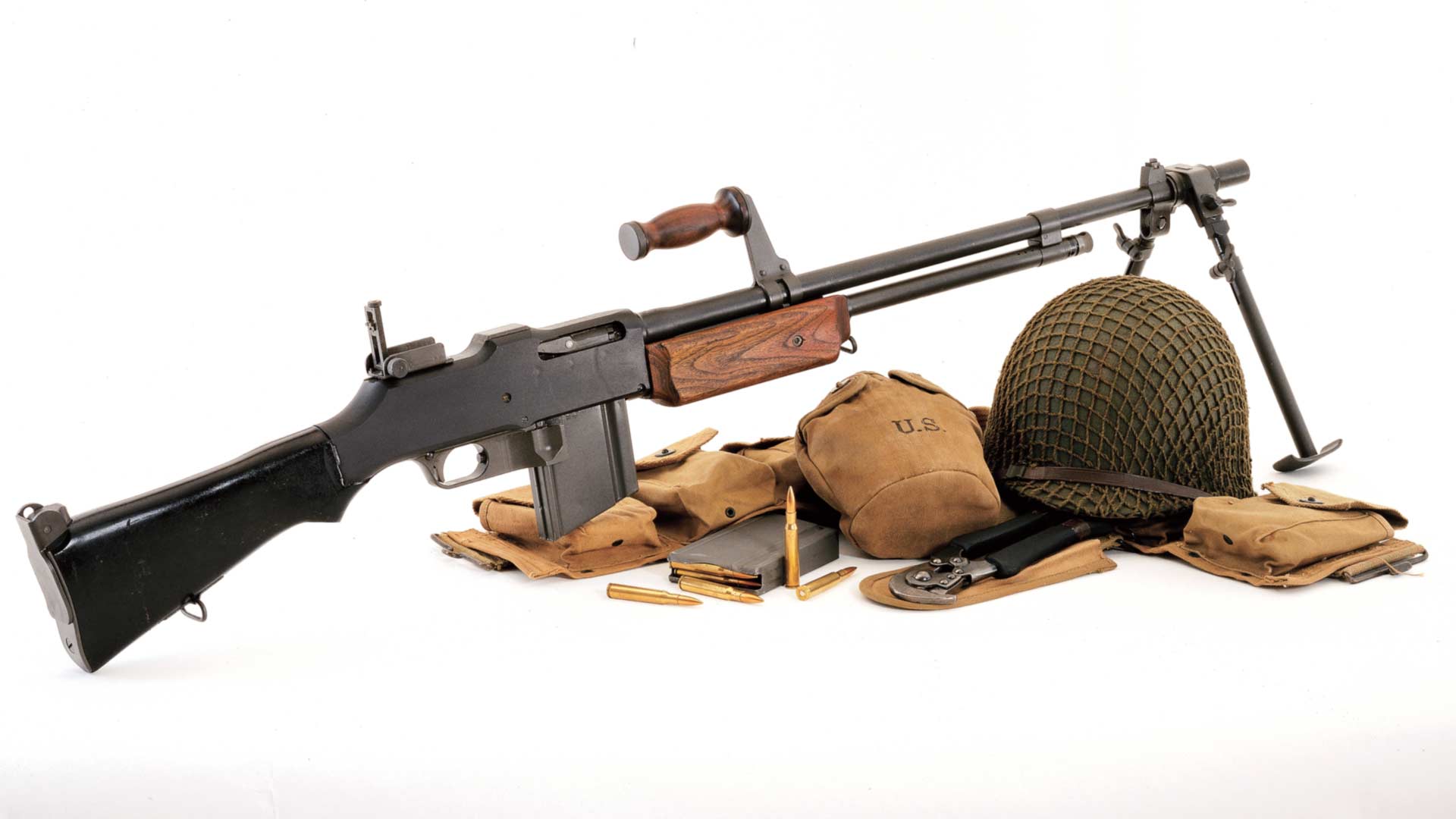
Browning BAR with gear

The North Koreans would zero in on our automatic weapons. They’d make probing attacks to locate them. We learned not to fire the automatics during those probing attacks. You could tell when the main attack came, and then we’d cut loose. On the attack, the BAR was a great weapon. You could really keep some heads down with it. When we attacked, the BAR would be in the center of our line. It was a good reliable weapon; I fired thousands of rounds through mine, and only once did I have to take immediate action to clear a jam. It was heavy, and the ammunition was heavy, but it gave you a lot of firepower.

During the breakout from the Pusan Perimeter, the 1st Cavalry Division was in the lead, and we were cleaning up behind them. I was on our flank one time, and I saw a few North Koreans running through some trees and fired at them. I dropped a few of them, and then 14 of those rascals came out of the bushes and surrendered. It surprised the heck out of me. They had heard that BAR talking, and they came out and threw their weapons down. I had my assistant take the prisoners back to the road and went in to check to see if there were any more of them hiding. One other North Korean came out and tried to run. I called for him to stop but he wouldn’t, and he met his maker.

After a few months, I was promoted to assistant squad leader and they gave me a scoped M1 sniper rifle. It was a nice, brand-new rifle, covered with cosmoline. It came with a scope and a cheekpad. Just like that, I was a sniper. No training, just here’s your rifle, go zero it. That rifle was a honey; I could reach out and touch someone with it. I had quite a few takedowns with that rifle. One time, I saw a North Korean that was about 500 yds. away across a valley. I took him down with one shot. I held a little bit over his head, fired and watched him fall. I used that rifle for several months, but then I had a problem with it. During the fighting at Kunu-ri, it would only fire one round at a time, and I had to slam the bolt back after every shot.

I just didn’t have time to clean it. I think we had fired so much that there was a problem with carbon build-up in the gas system. It just wasn’t blowing back enough gas to cycle the bolt. I threw that rifle away and picked up another one. That one did the same thing, so I found another rifle that worked right. Normally, every time we’d stop for a while, we would clean our rifles, but we couldn’t do that during Kunu-ri. There was just too much going on. We fired thousands of rounds through those rifles during that fight. It was the only time I ever had a problem with an M1. It was a tough rifle under tough conditions, and I don’t fault it for the problem I had with it. The M1 paid its way.

Before I completed my tour, I was made a platoon sergeant and acting platoon leader. I started carrying an M1 Carbine because I could move around with it better. The carbine couldn’t hold a candle to the M1 as far as effectiveness goes. I never had to use it too much, but I didn’t like it. You just couldn’t reach out with it. Most of the time, I was directing the platoon’s fire, and I wasn’t shooting.


U.S. Infantry Weapons In Combat
The accompanying article is excerpted from U.S. Infantry Weapons In Combat, which includes interviews with 65 U.S. combat veterans from World War II and the Korean War. What’s different about this book is that it is a “gun book,” and the stories presented are based upon the guns these men used—including M1 Garands, Thompsons, M1 Carbines. U.S. Infantry Weapons In Combat is a 6″x9″, 237-pp. softbound book available from Scott Duff Publications. The price is $23.50.
Categories
All About Guns

From the Vault: Winchester Model 64

Categories
All About Guns

A Harrington & Richardson Model 158 Topper, single shot in caliber .30-30 Winchester

Harrington & Richardson Model 158 Topper, 30-30 caliber single shot .30-30 Winchester - Picture 2

Categories
All About Guns Ammo

A Tale of Two 350 Rem Mags

Categories
All About Guns

Marlin 1895 (45-70). Observations & Modifications.

Categories
All About Guns

Mortimer Flintlock Rifle

Categories
All About Guns Hard Nosed Folks Both Good & Bad I am so grateful!! Real men This great Nation & Its People

Inside Springfield Armory featuring John Garand

Categories
All About Guns Anti Civil Rights ideas & "Friends" Paint me surprised by this

ATF Violates Agreed Upon Timeline By Filing For An Appeal In Pistol Brace Case by John Crump

MCX-Virtus004
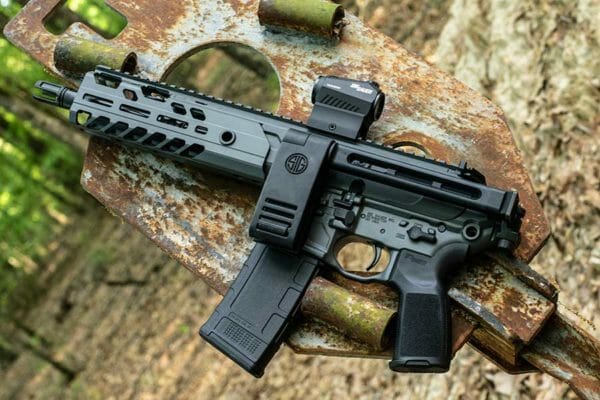
The MCX pistol with folding brace is super compact and easy to carry. IMG Jim Grant

The Bureau of Alcohol, Tobacco, Firearms and Explosives (ATF) has filed a notice of appeal in a case challenging its rule against pistol braces (FINAL RULE 2021R-08F). Gun Owners of America (GOA) filed a motion for summary judgment a day later.

The case, Texas v. ATF, is a joint effort between GOA, Gun Owners Foundation (GOF), and the state of Texas to take down the ATF’s pistol brace rule.

Just a day before the ATF rule was due to go into effect, Federal District Court Judge Drew Tipton for the Southern District of Texas issued a preliminary injunction (PI) for all GOA members, barring the ATF from taking enforcement actions against them. This ruling came on the heels of the Mock v. Garland Fifth Circuit Court of Appeals decision that blocked enforcement of the rule on Firearms Policy Coalition (FPC) members. Second Amendment Foundation (SAF) also got a preliminary injunction against the rule before the rule’s effective date.

“For these reasons, the Court GRANTS IN PART Plaintiffs’ Motion for Preliminary Injunction, (Dkt. No. 16). Defendants are ENJOINED from enforcing the Final Rule against the private Plaintiffs in this case, including its current members and their resident family members, and individuals employed directly by the State of Texas or its agencies. The preliminary injunction will remain in effect pending resolution of the expedited appeal in Mock v. Garland,” the order reads.

Since then, the Fifth Circuit Court of Appeals has expanded the injunction to cover everyone in the nation, effectively killing the ATF’s rule. Before that happened, according to GOA, all parties agreed to the timeline in the Texas v. ATF case.

Merely one day prior to Texas and GOA submitting a motion for summary judgment, the ATF proceeded to lodge a notice of appeal with the Fifth Circuit Court of Appeals. Many think the ATF violated the agreed-upon timeline and is trying to stall for time since the Fifth Circuit appears to be a dead end for a Bureau legal victory.

It is unlikely that the Fifth Circuit of Appeals would overturn Judge Tipton’s decision. The Fifth Circuit is openly hostile to the ATF’s use of the rule-making process.

It has ruled against the ATF’s alleged abuse of its rule-making powers in three different cases. Two of these cases deal with bump stocks (Cargill v. Garland) and frames and receivers (VanDerStok v. Garland). The third case, Mock v. Garland, is almost identical to Texas v. ATF.

GOA, GOF, and Texas were unhappy with the ATF’s actions. They called out the ATF for what they see as an obvious delay tactic. Many agree the ATF’s chances of winning in District Court are non-existent. With the expected defeat at the Fifth Circuit, the only other conceivable reason that the ATF would have to file a notice of appeal is to try to head off another nationwide injunction against its pistol brace rule that GOA and Texas requested in their motion for summary judgment.

“GOF, GOA, & Texas were DAYS away from seeking summary judgment in our lawsuit against the Biden Pistol Ban. ATF had even agreed to the timeline,” GOF posted to X (formerly Twitter). “But, at the 11th hour, appealed to the 5th Circuit (where they have already lost TWICE)—a shameless delay tactic.”

GOA’s motion for summary judgment covers the same topics as their successful PI but with even more substance and evidence. If GOA won easily on the PI and the judge continues to rely on taking cues from the Fifth Circuit, the ATF is looking down the barrel of another defeat. The Fifth Circuit has been critical of the ATF for violating the Administrative Procedures Act (APA).

The ATF has experienced multiple defeats on a cornucopia of issues, including pistol braces, force reset triggers, bump stocks, disarming Americans without due process, and frames and receivers. The only hope to save any of these cases is the Supreme Court, but that doesn’t look like a winning path in most of these legal challenges.

ATF Violates Agreed Upon Timeline By Filing For An Appeal In Pistol Brace Case by AmmoLand Shooting Sports News on Scribd


About John Crump

John is a NRA instructor and a constitutional activist; he has written about firearms and interviewed people of all walks of life. Mr. Crump lives in Northern Virginia with his wife and sons and can be followed on X at @crumpyss, or at www.crumpy.com.

John Crump

Categories
All About Guns Our Great Kids The Green Machine War

M67 FLAMETHROWER TANK: VIETNAM’S ZIPPO

The M67 flamethrower tank is one of the iconic American weapon systems from the Vietnam War. Nicknamed the “Zippo,” these flame tanks gave soldiers and Marines a tactical advantage against fortified enemy units.

m67 flamethrower tank in vietnam
A U.S. Marine Corps flame thrower tank in action during January 1966. Image: NARA

Since March 7, 1994, the United States Department of Defense has prohibited smoking worldwide in all workplaces and vehicles owned by the Pentagon. Moreover, smoking is even prohibited during basic training. Yet, there was a time when smoking and the U.S. military went hand in hand. During the Second World War, Zippo ceased production of lighters for the consumer market and dedicated all production to the U.S. military. Even today, Zippo produces a line of military-themed commemorative lighters.

However, the lighters aren’t the only connection between Zippo and the U.S. military.

usmc m67 flame tanks
A pair of U.S.M.C. M67 flamethrower tanks engage targets in a Department of Defense training film. Image: NARA

One of the most effective flamethrower tanks in the U.S. military’s arsenal was the “Flame Thrower Tank M67” — more commonly known as the M67 “Zippo.” It saw service with the United States Army, and later by the United States Marine Corps during the war in Vietnam. Though it was the last flamethrower tank used by the U.S. military, it wasn’t actually the first.

A Brief Service History of Flamethrower Tanks

Modern flamethrowers saw their horrific entrance on the battlefield during World War I. German flammenwerfer units experienced moderate successes, prompting the other powers to explore the use of the weapons also. World War I also introduced the tank to the battlefield.

german flamethrower team in wwi
A German assault team trains how to attack enemy trenches with flamethrowers and grenades.

It isn’t any significant surprise to find that the world’s armed forces might want to combine the two. The Soviet Union experimented with flamethrower tanks in the interwar era and adopted several models, including the KhT-27 and the KhT-26 among others.

During the Second World War, the Axis nations of Germany, Italy, and Japan also produced a number of tanks that could shoot flames to varying degrees of success.

The first U.S. flamethrower tank was actually the ominously-named “Satan,” a modified conversion of the M3 Stuart light tank. In place of its main gun, it was fitted with a “Ronson” flamethrower. The M3 Satan was used alongside M4 Sherman tanks that were also fitted with bow-mounted E4-5 flamethrowers to great effect against the heavily entrenched Japanese forces in the Pacific.

m3 flametank
A Marine M3 Satan flamethrowing tank turns on the heat to wipe out a Japanese pillbox on Saipan. Image: Cpl. Clifford G. Jolly/U.S.M.C.

United States Marines experienced firsthand the capabilities of flame tanks in the Pacific, as it primarily used tanks in a close infantry support role due to the fact that the type of island hopping campaigns meant there were no significant tank battles — at least not on the scale of those in the European Theater.

m4 sherman flame tank
A Marine flamethrower tank based on the M4 Sherman lays down a stream in heavy fighting near Naha, Okinawa. Image: Cpl. Robert Cusack/U.S.M.C.

During the Korean War, the U.S.M.C. sought a more effective platform to replace the aging M4 Sherman. That led to a request to the development of a M67, which was based on the M48 Patton with its 90mm gun.

Enter the M67

Production of the M67 began in 1952 and continued until 1954. The tank was, however, too late for the war in Korea. Nevertheless, the Marine Corps leadership apparently liked what they saw in the newly designed flame tank. A total of 109 were produced, and while the Army also adopted it briefly, only the Marines actually headed into combat with the flame thrower tank.

m67 tank burns out a vietcong position
A U.S. Marine M67 flame tank of the 1st Marine Division burns out a Viet Cong position on July 7, 1967. Image: U.S.M.C.

What is also notable is that there were actually three versions produced including an M67 on the M48A1 chassis, the M67A1 on the M48A2 chassis, and the M67A2 on the M48A3 chassis. The only difference was in said chassis, as the flamethrower was identical on all models. Each tank weighed around 48 metric tons, a bit heavier than the M48 Patton — due to the flamethrower system and internal fuel tank.

Externally there were a few differences from the basic M48 Patton medium tank.

m67 zippo tank with 90mm lookalike gun
The M67 “Zippo” tank was fitted with a lookalike 90mm main gun. The iconic muzzle brake was not needed to launch a stream of fire.

The M67 was fitted with a flame tube that was actually disguised to resemble a 90mm main gun, albeit the shroud was noticeably wider in diameter and a bit shorter. In hindsight, it was actually somewhat ironic that efforts were made to conceal the flamethrower as it proved to be a terrifying weapon, and one genuinely feared. However, the mock-up gun was fitted to the M67 to disguise it while on the move.

m67 clearing out vc tunnels
A Marine tank fires flame into some brush north of Camp Carroll where Viet Cong occupied tunnels. Image: J.L. Blick/U.S.M.C.

The flame tube was also heavier than the 90mm T54 gun, and though it shared many of the elevation and traverse components that were employed on the M48, the M6 Flame Gun required a complicated shroud, which made the muzzle heavy. This required that a hydraulic equilibrator device be introduced so as to balance the weapon.

Instead of a crew of four that was employed on the M48 Patton, the M67 actually had a crew of three — as it required no loader. Instead, a huge fuel tank was placed in the loader’s position within the turret. This meant that the gunner was charged with operating both the flame gun as well as the coaxial .30 caliber Browning M1919 air-cooled machine gun. It wasn’t an ideal setup, but there weren’t really any other options available.

All tanks can be described as cramped, and the M67 even more so.

m67 flame tank south of da nang
A M67 flame tank from C Co. 1st Tank Bn. fires its deadly flame into an enemy position 10 mines south of DaNang in May 1967. Image: Cpl. R. P. Curry/U.S.M.C.

Within the turret was a large 398-gallon central “tank,” which held “thickened gasoline,” more commonly known as napalm, which was put under pressure, and ignited by a 24,000-volt electric spark. The total burn time in operation was around a minute, depending on the size of the nozzle employed. Nozzles of 19 mm (.75-inches) and 22 mm (.88-inches) were the most common. The flame tube had an approximate range of 280 yards (256 meters).

Due to the fact that the M67 didn’t need to carry standard ordnance, the ammunition racks for the 90mm ammunition to the left and right of the driver were removed and replaced by stowage bays. This allowed for tools, spare parts for the equipment, and ammunition for the machine gun to be stored.

Baby, Won’t You Light My Fire

In what can only be described as perhaps one of the most bizarre coincidences in modern military history, in January 1967 the American rock band The Doors released their hit single “Light My Fire.” The song would go on to spend three weeks at number one on the Billboard Hot 100 Chart later that same year, and while not as potent of an anti-war song as the group’s “The Unknown Soldier,” it has come to be associated with the Vietnam War.

us marines m67 flamthrower tank in vietnam
Flame tanks of the 1st Tank Battalion engage Viet Cong combatants during Operation Doser near Binh Son in the Quang Ngai Province. Image: NARA

It was, of course, in that conflict where the M67 Zippo saw its only actions.

Details are sparse on how many of the flamethrower tanks were actually sent to Southeast Asia, but it was first employed in combat in August 1965 during Operation Starlite, the Battle of Van Tuong. It was the U.S. military’s first major action in the war, and during the battle, a number of M67s were ambushed and destroyed.

It wasn’t an ominous baptism of fire, yet the M67 did prove to be well-suited to the guerilla nature of the Vietnam War, and it was often employed to incinerate patches of jungle that may have concealed an enemy position. Such attacks took on the name “Rods of Flame,” and the Zippo was widely feared by the Viet Cong forces.

Urban Combat with the Zippo

It wasn’t just in the jungles where the M67 saw success.

During Operation Dozer, and the Battle of Hue, a pair of M67 Zippos accompanied by a number of M48 Patton tanks led the armored strike into the ancient Vietnamese city. The M67 proved even better suited to the urban combat in Hue than it did in the jungles. However, throughout its service, the M67 needed to be accompanied by a pair of 2 1/2 ton trucks that carried the equipment and supplies for the flamethrower. In most cases, one truck would carry the Napalm supply, while another would be employed to recharge the compressed air system. The need for such support restricted the type of operations where the tank could be used, while it also meant that efforts needed to be made to protect those trucks.

us navy demo of m67 flame tank
These Marines demonstrate the power of the M67 in a 1970 U.S. Navy training video. Image: NARA

Another issue that limited the success of the M67 was that the flamethrower was noisy — even by tank standards. When the flamethrower was in use, the level of the internal noise within the vehicle was so loud that the commander and gunner would barely hear each other over the intercom. There are reports of tank commanders putting their heads out of the turret so as to direct the gunner. In a firefight that was also far from ideal.

Legacy of the M67

The M67 wasn’t actually the only armored flamethrower to see service in the war. The other was the Self-Propelled Flame Thrower M132, a modified M113 armored personnel carrier (APC), which was fitted with much of the same equipment. It was employed in a limited role by the United States Army. However, the Army never had the same faith or success with the M132 as the Marines did with the M67.

zippo boat
Based on the success of the M67, the American armed forces looked to incorporate flamethrowers in other contexts. Here a U.S. Navy patrol boat tests a Zippo in January 1969. Image: NARA

Soon after the U.S. withdrew its forces from Southeast Asia, the Zippo was essentially snuffed out. The M67 was officially retired from service in 1974 without a replacement. It was the last flamethrower tank to be employed by the U.S. military.

Of the 109 that were produced, it is an actual mystery as to how many actually survive. According to Tanks-Encyclopedia.com, one was on display at the now-closed U.S. Army Ordnance Museum at the Aberdeen Proving Grounds in Maryland. All of the vehicles have been relocated to Fort Benning, Georgia — but as of press time, the M67 Zippo isn’t believed to be on display. Another can now be found outside the Engineering School at Fort Leonard Wood, Missouri.

These serve as the final reminders of the M67 Zippo.

Categories
All About Guns

Model 14 Smith & Wesson .38 Special 1973

https://youtu.be/krzZqYQR9DY