Senate Majority Leader Chuck Schumer (D-NY) is leading the pack of rabid Democrats prepping to take another stab at passing gun control legislation with the help of suburban women and, believe it or not, Republicans.
Citing mass shootings with no context as to why they are happening, Schumer and the Left continue screaming that something has to be done and that gun rights must be taken away from Americans in the name of safety.
The Hill seems to be in step with the Left on pushing for more gun control, reporting, “At least 10 people were killed in separate shootings in Baltimore, Fort Worth, and Philadelphia over the weekend and July 4, while shootings in Lansing, Mich., and Wichita, Kan., left dozens more injured. The Gun Violence Archive has counted 20 mass shootings across the nation since July 1, leaving 19 people dead and more than 100 injured.”
In the wake of passing gun control measures a year ago, it was, of course, not enough. Now the Left wants further steps taken, Constitution be damned.
“Leader Schumer was proud to have passed a significant bipartisan gun safety bill through the Senate last summer but more must be done. Schumer continues to work with his caucus to find a path forward that can garner enough Republican support and combat the scourge of gun violence, save lives, and bring meaningful change,” Schumer spokesperson Allison Biasotti declared.
Despite the incessant screeching, tearing of hair, and rending of clothes, the prospects for yet mreo gun control are dim, thankfully. However, in an ominous sign, things may be shifting.
Former Senate Majority Leader Bill Frist (R-Tenn.) claims the political dynamic concerning gun control is beginning to shift among GOP voters.
“It’s clear from today’s data — especially the growing incidence of mass shooting events involving high-capacity magazines and assault weapons — that it’s time to consider policy changes,” Frist, sounding more Democrat than Republican, wrote in an op-ed for Forbes where he called for a federal assault weapons ban and expanding background checks for all firearms purchases.
Frist has been beating the gun control drum for a while now.
Then Frist went to The Hill to do an interview claiming that Republican voters’ views of gun control are changing.
“Something is changing over the last three years compared to 20 years ago when I was here. There is a willingness to have civil discussions on what have been highly contentious issues that I didn’t see 15 years ago,” he asserted. “More needs to be done on gun safety today. Something more needs to be done because the overall governance of gun safety is outdated and it’s incomplete.”
The Hill dug up a poll in early May by “All In Together,” a nonprofit women’s civic education group, and “Echelon Insights,” a GOP polling firm, to cite that suburban voters support tougher gun laws. The polling venues appear to be leftist in nature despite the hyping of “Echelon Insights” being a GOP polling firm.
To many, the results do not sound conservative in the least and stretch credibility.
“Forty-two percent of independent women voters said a candidate needed to share their view on guns to get their vote, rating the issue as important as a candidate’s view on abortion and the cost of living,” The Hill reported.
“The poll of 1,227 likely voters also showed that 61 percent of Republican women support restricting the ability to purchase certain types of guns — a far higher percentage than the 41 percent of Republican men who feel that way,” the media outlet continued.
The saving grace here is that so far, discharge petitions to push gun control bills through the House are going nowhere fast. Instead, Democrats are likely to start in the Senate with the push. But it will most likely be dead on arrival in the House.
“Leader Schumer called a special caucus meeting last month solely dedicated to combatting gun violence which produced many good ideas. Now, we’re determining the best path forward that could garner enough Republican support,” a Senate Democratic aide said, according to The Hill.
Minority Senate Leader Mitch McConnell (R-Ky.) is a weak link in the chain. Fifteen Republicans last year supported the Bipartisan Safer Communities Act, including McConnell.
“That is one of the absolute critical reasons for why we have seen this issue change,” Christian Heyne, vice president of policy at Brady Campaign, said. “Suburban women are not only wildly supportive of gun violence prevention policies but we’ve seen numbers that it’s a huge motivator to bring people to the polls. It’s why the Bipartisan Safer Communities Act had such overwhelming majority support.”
Sen. John Cornyn (R-Texas), who played a leading role in negotiating last year’s gun violence legislation, bluntly contends that an assault weapons ban has no chance of passing Congress.
“I don’t think that’s going to happen. And, truthfully, the so-called assault weapons ban — what are they going to do about the millions of semi-automatic rifles that are already out there? I don’t think a prospective ban will have any of the intended effect of the proponents,” he remarked. “Basically what they’re advocating for is confiscation from law-abiding citizens. I’m willing to look at whatever the proposal is but I’m not willing to erode the rights of law-abiding citizens.”
Unbelievably, Frist told The Hill that “a majority of Republicans” support improved “gun safety.”
“It really is having people own guns if they want them and be able to do it in a way that is safe and secure,” he declared.
“The visibility with the increase in shootings, the lethality of the incidents that happen, the numbers of people [killed or injured] make it a real teaching point,” Frist claimed.

On April 19, 1963, military aide Gen. Chester V. Clifton brought two firearms into the Oval Office to show them to President John F. Kennedy. One was a crossbow intended for use in counterinsurgency operations, and the other was an AR-15, the Colt Model 601. President Kennedy had seen the AR-15 demonstrated the year before and had been directly involved in the gun’s military procurement, so he was well aware of the various innovative aspects of its design.
The example JFK held that afternoon in the White House was the product of a lengthy design development evolution that began six years earlier and would eventually produce the most prolific military rifle in the nation’s history.
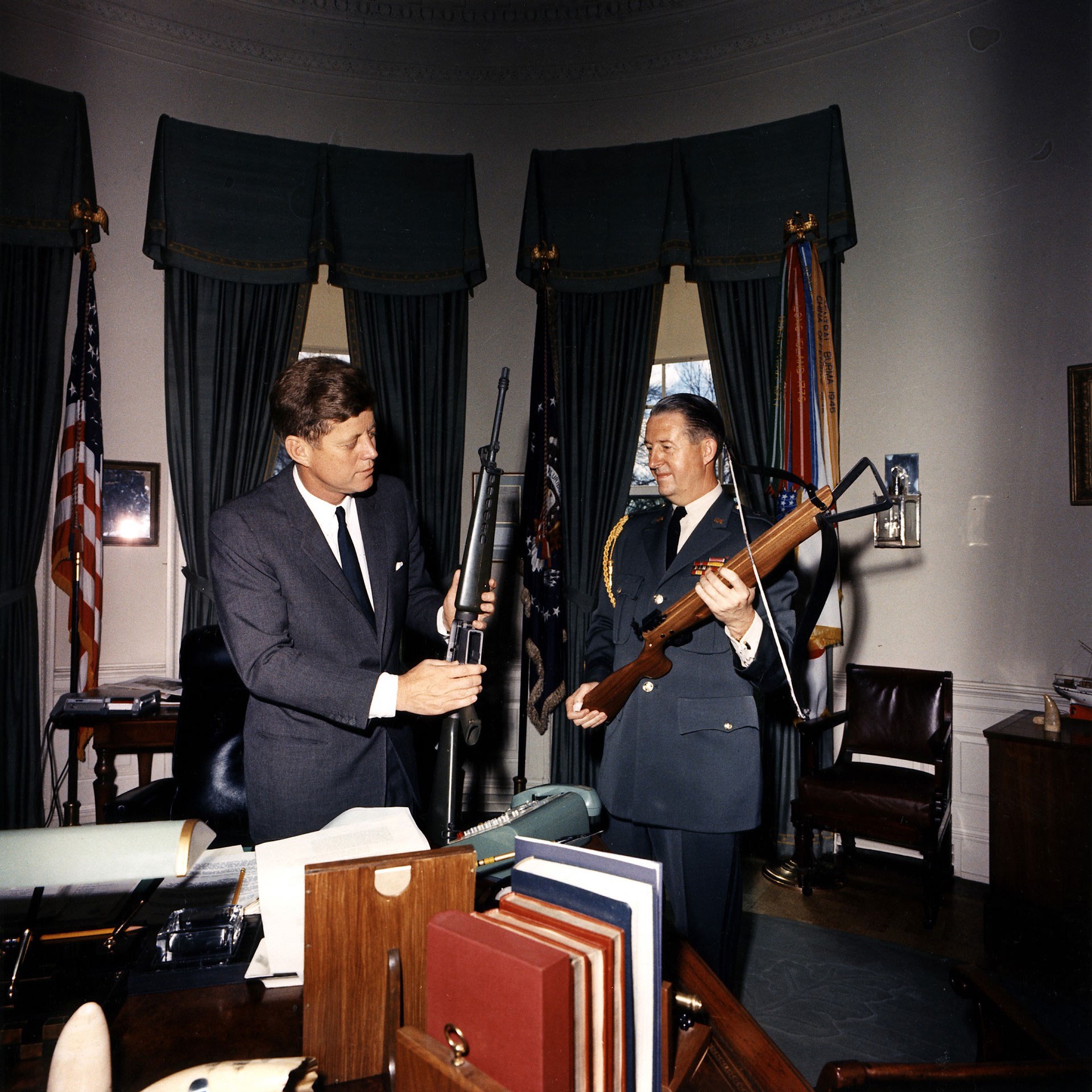 President John F. Kennedy and Military Aide Gen. Chester V. Clifton examine a Colt Model 601 rifle and crossbow in the White House’s Oval Office in April 1963. (ST-C85-1-63)
When a White House photographer snapped a now-famous image of the meeting, John Kennedy had only 217 days left to live, but the Model 601 on the other hand was just beginning its military service. During the next six decades, the rifle would fight in Vietnam, Grenada, Panama, Iraq and Afghanistan, among other geopolitical hotspots. Its basic design would evolve during those 60 years to ultimately become the M4 carbines and M16A4 rifles that arm our troops today. But it all began with the Model 601, the rifle that President Kennedy personally examined in the Oval Office.
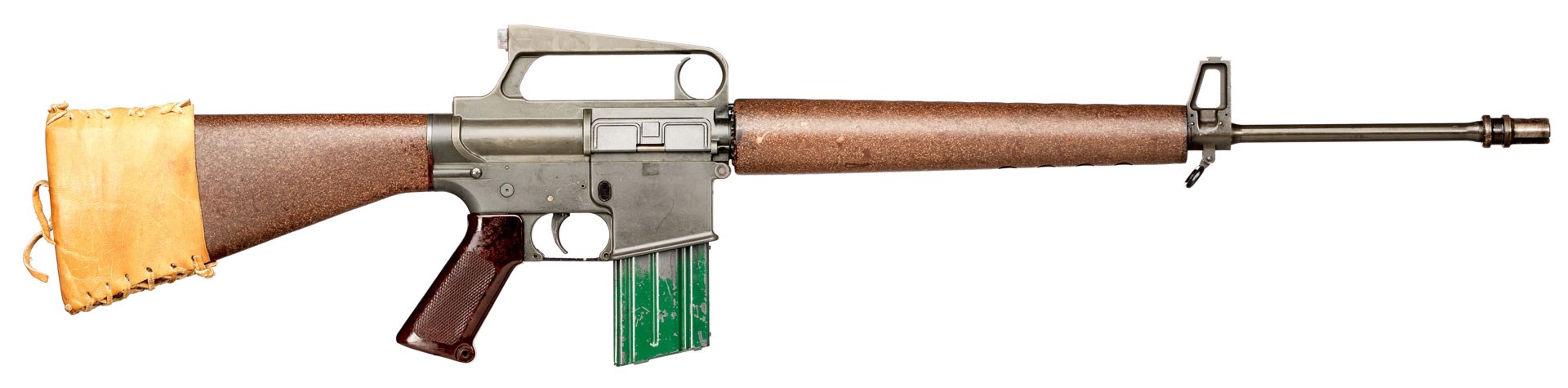 Right side view of the ArmaLite XAR1501 prototype. Photo courtesy of the Institute for Military Technology
Serial production of the Model 601 began in December 1959, and continued through to the summer of 1963. During that time, more than 14,000 of them came off the assembly line. Although the Model 601 was the first AR-15 to be mass-produced, it was not the first AR-15.
The design development and evolution that ultimately led to it began in the spring of 1957, when the Continental Army Command (CONARC) expressed an interest in evaluating a rifle chambered for a Small Caliber, High Velocity (SCHV) cartridge.
By then, the ArmaLite Division of Fairchild Aircraft Corporation was attempting to find a buyer for a 7.62×51 mm NATO-chambered, select-fire rifle that had been designed by Eugene Stoner and developed under the model designation AR-10.
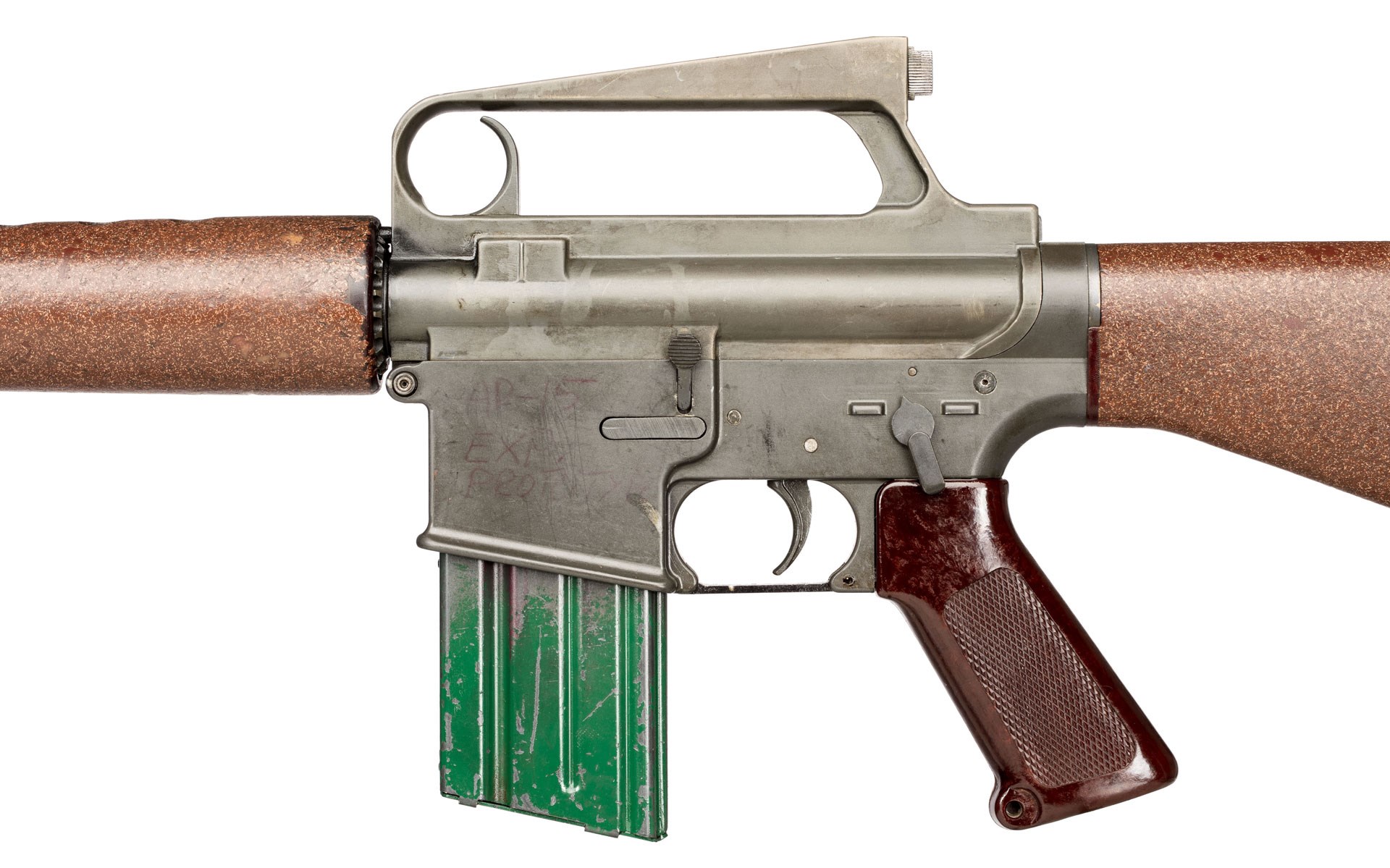 Left side closeup of the receiver of the ArmaLite XAR1501 prototype. Photo courtesy of the Institute for Military Technology
Although it was lightweight, because of the use of plastic and aluminum in its construction, and it offered a number of significant advantages as an infantry rifle, the U.S. Army had just rejected the AR-10 in favor of the M14.
Despite this setback, ArmaLite was not ready to throw in the towel, so it continued to look for a customer for the AR-10 while it simultaneously began a process of adapting its design to the type of SCHV cartridge the Army now wanted to test. Two engineers at ArmaLite, Robert Fremont and L. James Sullivan, were therefore assigned the task of scaling-down Stoner’s 7.62 NATO rifle to chamber an existing wildcat cartridge known as .222 Remington.
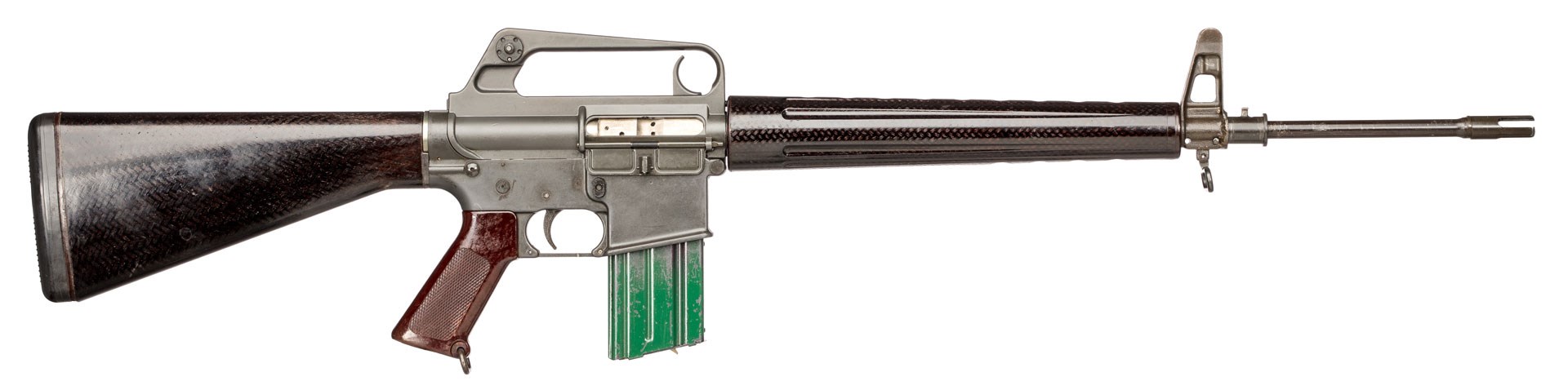 Right side view of ArmaLite prototype AR-15 Serial No. 000001. Note the buttstock and one-piece forward handguard made from woven fiberglass. Photo courtesy of the Institute for Military Technology
The prototype that Fremont and Sullivan created generally resembled the AR-10, insofar as it combined a buttstock and forward handguard made from woven fiberglass with an upper and lower receiver made of anodized aluminum. Like the AR-10, a distinctive carry handle was incorporated in the upper-receiver forging that provided protection for an equally distinctive non-reciprocating, trigger-type cocking handle.
The rifle used Stoner’s patented direct gas-impingement operating system and multi-lug rotating bolt, a 20″ fluted pencil barrel with 1:14″ twist rifling, and a detachable box magazine with 25-round capacity. Designated XAR-1501, it was demonstrated for CONARC by Stoner himself in May 1957, with the result that an order for 10 additional test rifles for further evaluation was placed.
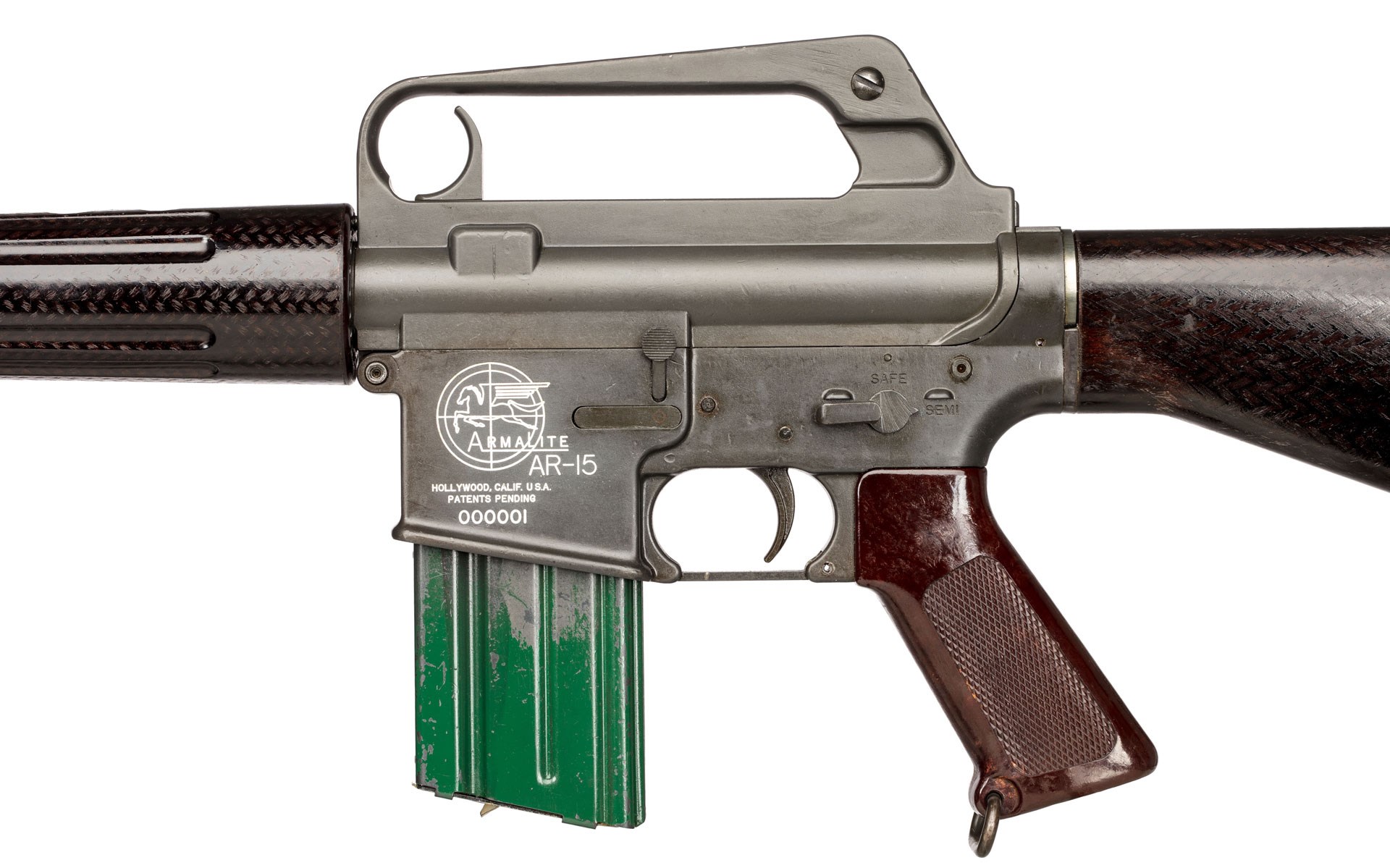 Left side closeup of ArmaLite prototype AR-15 Serial No. 000001. Note the AR-10 trigger type charging handle. Photo courtesy of the Institute for Military Technology
The only problem was that CONARC wanted the new SCHV cartridge’s bullet to penetrate a helmet at 500 yards. Since the .222 Rem. cartridge was not capable of meeting that requirement, Remington modified it by lengthening the case to provide the additional powder capacity needed to generate additional muzzle velocity and achieve the required penetration.
A 55-grain bullet and DuPont’s IMR-4475 nitrocellulose smokeless powder brought the package together, and the new cartridge initially received the designation .222 Special. To avoid confusion, though, that designation was ultimately changed to .223 Rem. More changes would soon follow.
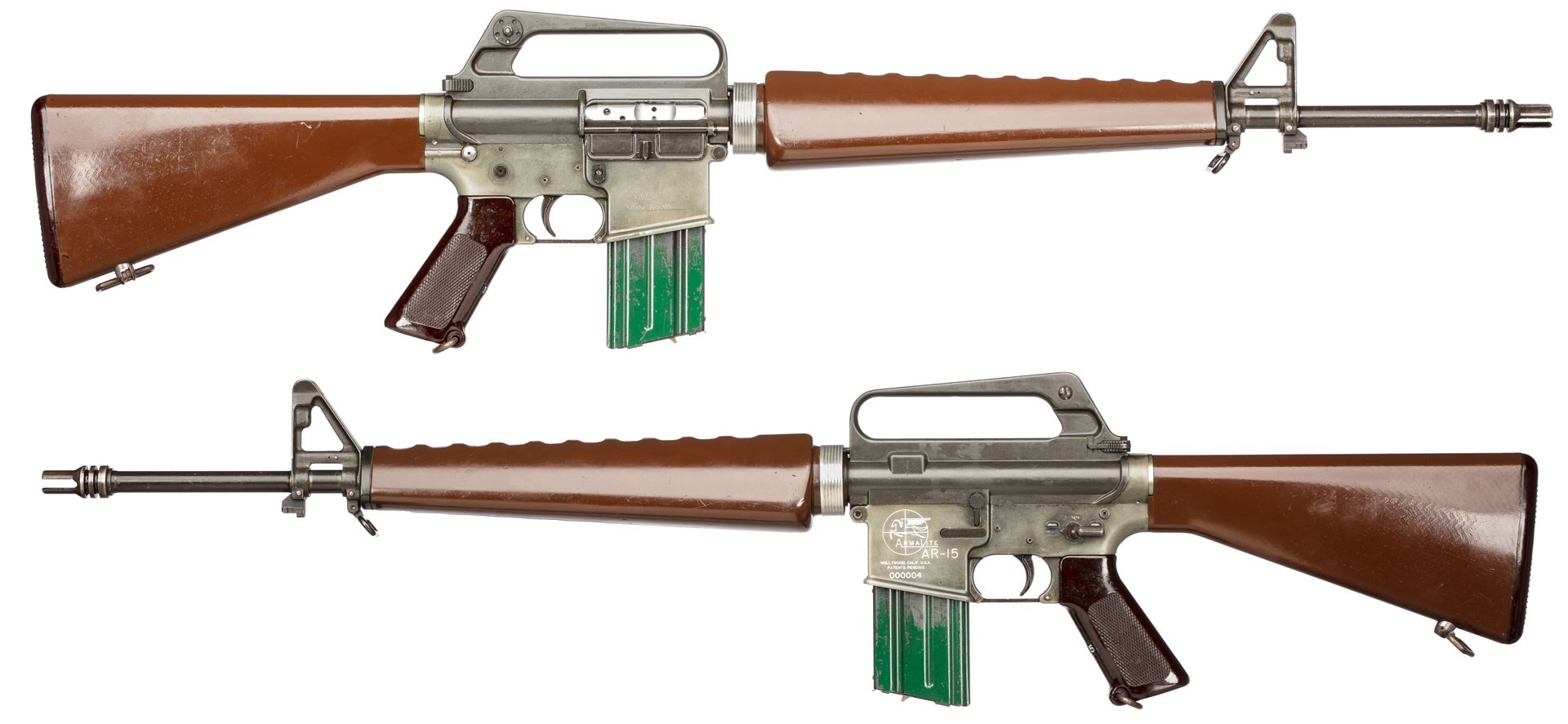 Left- and right-side view of ArmaLite prototype AR-15 Serial No. 000004. A 601-type upper receiver group from a later phase of the development of the AR-15 has been paired with the Serial No. 000004 lower despite the fact that it was first built during an earlier phase. Photo courtesy of the Institute for Military Technology
In March 1958, ArmaLite delivered the 10 AR-15s in .223 Rem. to Fort Benning, Ga., for test and evaluation. Except for a noticeable change to the rear sight assembly, the addition of a sling swivel to the Bakelite pistol grip and the addition of a bipod mounting bushing affixed to the front sight base, these rifles were anatomically similar to the XAR-1501.
Similarities notwithstanding, though, the new cartridge gave them the additional muzzle velocity needed to pass the 500-yard helmet penetration test. In addition to that, these AR-15s exhibited the low malfunction rate of just 6.1 for every 1,000 rounds fired in an early demonstration of the legendary reliability for which the system would ultimately be known.
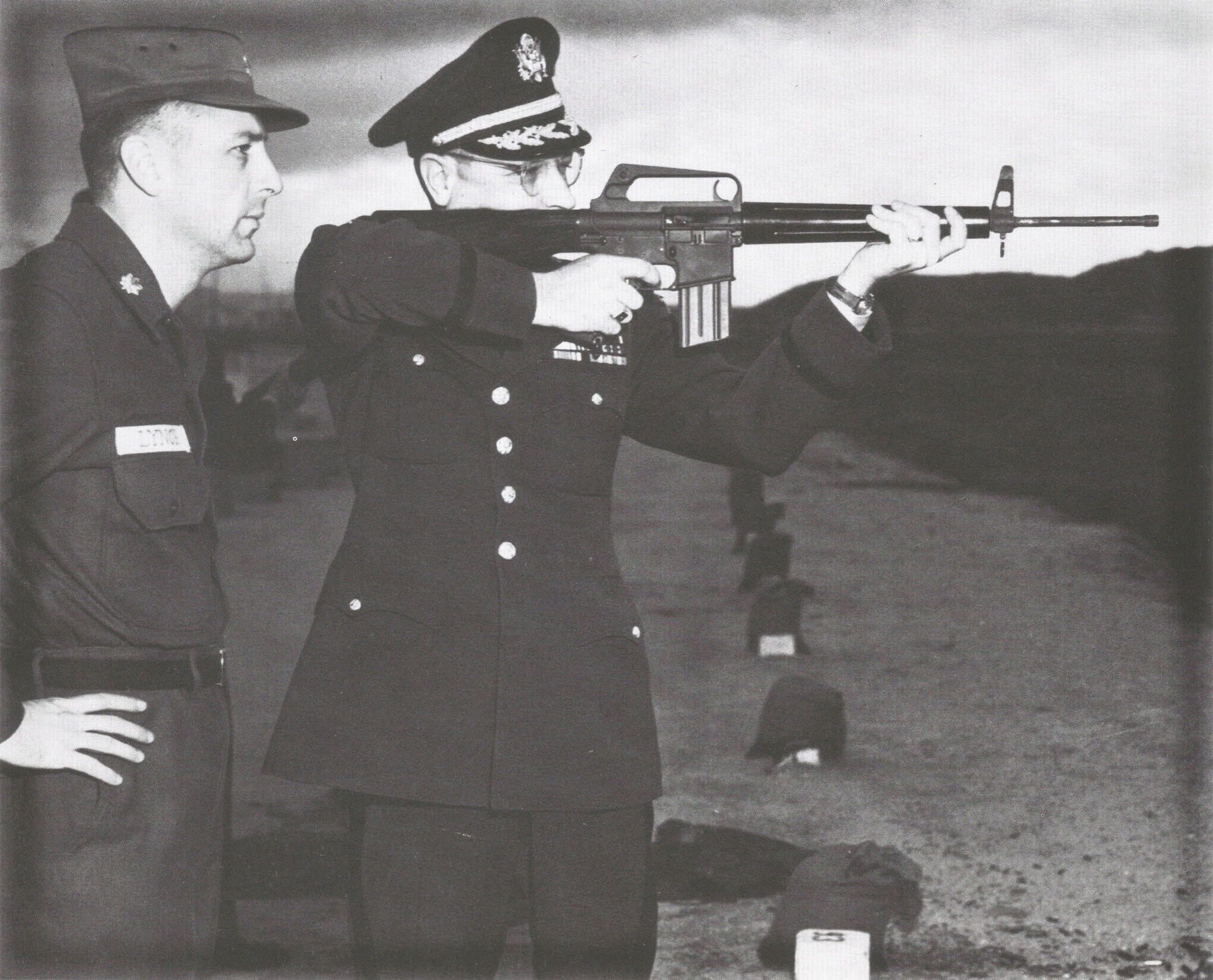 Major Eugene M. Lynch observes Lt. Col. Robert Vallendorf as he shoulders an ArmaLite prototype AR-15 (possibly Serial No. 000013) at Fort Benning on March 31, 1958. The rifle has no flash suppressor, but it is equipped with the AR-10 trigger type charging handle, one-piece cylindrical fiberglass handguard, and 25-round capacity magazine. U.S. Army photo
Two months after the tests at Fort Benning, the Infantry Board published a report titled “Evaluation of Small Caliber High Velocity Rifles – ArmaLite (AR-15)” that identified the rifle as a potential replacement for the M14.
Everything was not perfect, though, because it was found that the AR-15’s barrel could burst if water intruded into it, and because of that, the board decided that research should continue. Accordingly, the report recommended ordering another eight prototype AR-15s with “minor” modifications for further test and evaluation, and those modifications produced some elements of the AR-15’s anatomy that remain with the firearm to this day.
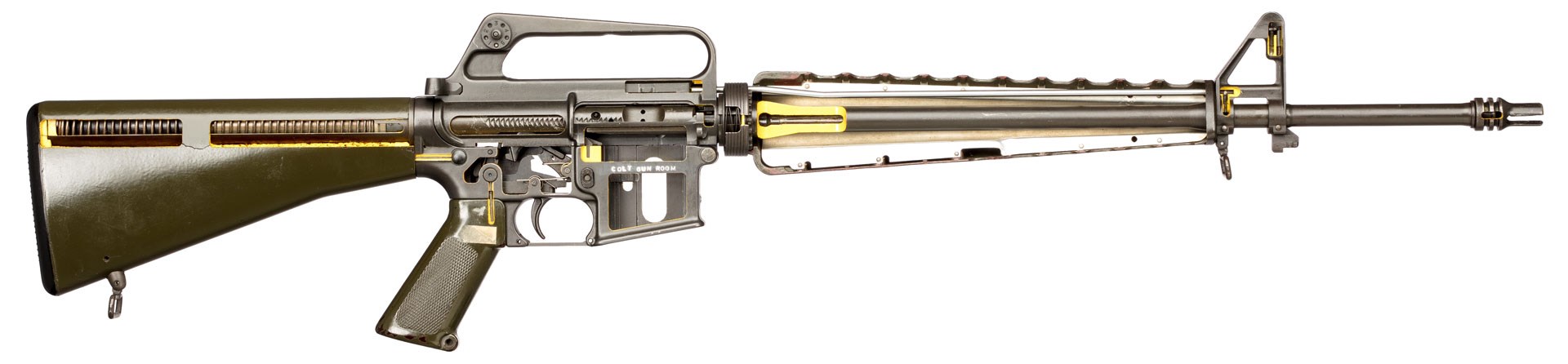 Right side view of a Colt/ArmaLite AR-15 Model 601 cutaway that reveals details of the rifle’s gas tube, the left handguard’s single heat shield and the early Edgewater buffer. Photo courtesy of the Institute for Military Technology
First of all, the Army wanted the one-piece conical fiberglass handguard changed to a triangular two-piece design. It also requested a magazine capacity change from 25-rounds to 20-rounds as well as a redesign of the AR-10 trigger type charging handle. In response, ArmaLite introduced a non-reciprocating triangular charging handle positioned at the rear end of the carry handle.
To reduce the water sensitivity that had been previously observed, the barrel fluting that had been a part of the first run of prototype rifles was eliminated. This was a change that made the barrel slightly heavier and, therefore, less likely to burst when water intruded into the bore. The selector positions were also changed.
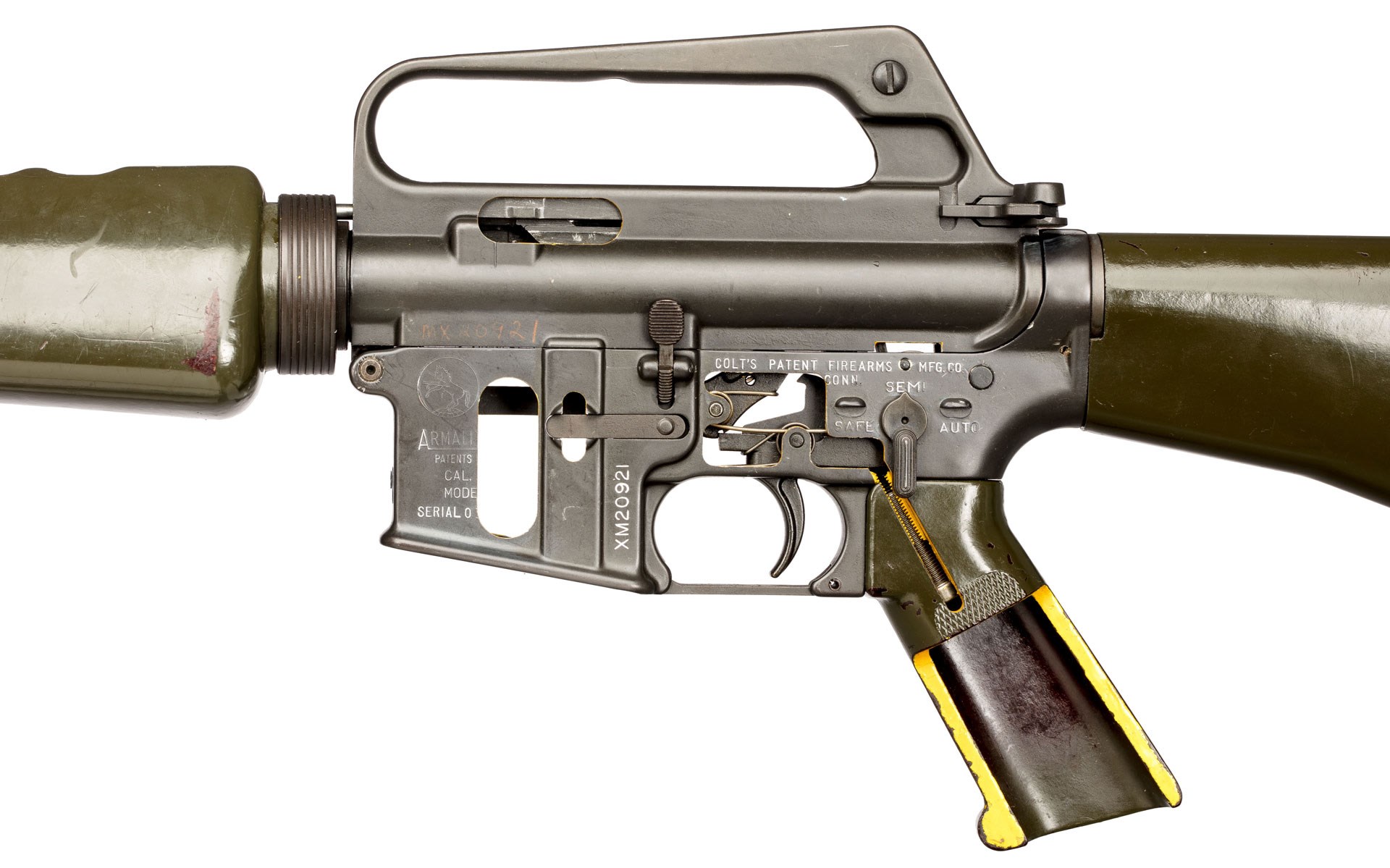 Left side closeup of a Colt/ArmaLite Model 601 cutaway. The original 601-type triangular charging handle has been replaced by a later 602-type charging handle. Photo courtesy of the Institute for Military Technology
Earlier prototype AR-15s featured selector settings with “AUTO” in the nine o’clock position, “SAFE” at twelve o’clock and “SEMI” at three o’clock. The Army worried that, in this configuration, troops crawling through brush could unintentionally advance the selector from the “SAFE” position to the “AUTO” position. ArmaLite solved the problem with a simple redesign that moved “SAFE” to nine o’clock, “SEMI” to twelve o’clock and “AUTO” to three o’clock.
This is also when ArmaLite introduced the aluminum slip ring for retention of the two-piece handguards, as well as a new version of the flash suppressor that could also function as a grenade launcher and a new version of the front-sight base, incorporating a .875″ gap between its front and back legs for securing the bipod. Little by little, the sleek austerity of the AR-15 prototypes was beginning to give way to an appearance more like the rifle President Kennedy would be photographed with five years later.
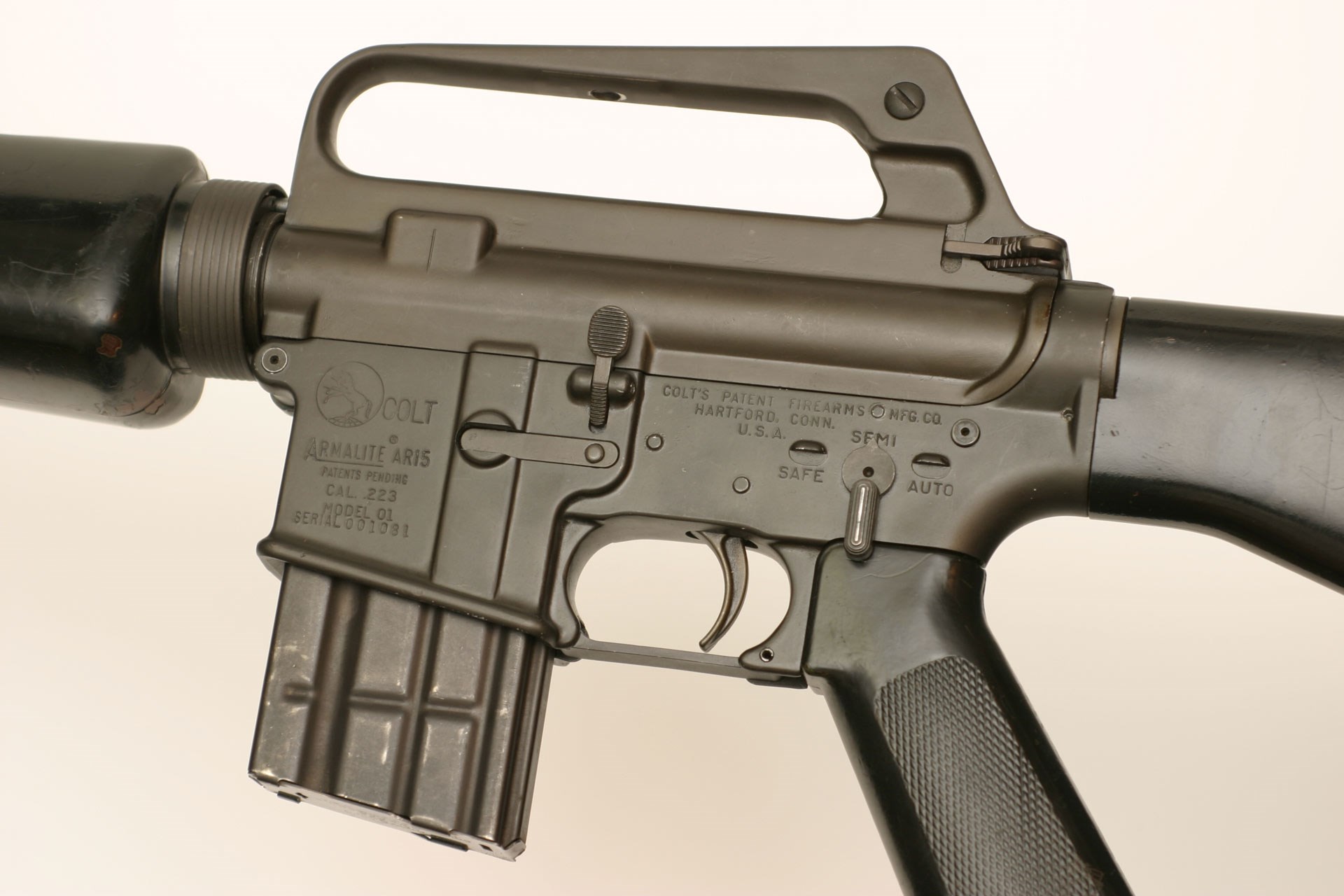 Left side closeup of Colt/ArmaLite Model 601 Serial No. 001081. The rifle’s original green painted furniture has been replaced by black painted furniture. Photo by the author
As the latest batch of modified prototype AR-15s was being built back in Hollywood, Calif., later that year, ArmaLite was in trouble. The company was losing money and was therefore in no position to continue the costly design development of the AR-15, even though it was beginning to look like the Army just might adopt the rifle.
While a multi-million-dollar government contract could save the day, there was another even bigger problem that had to be addressed. ArmaLite was a small shop that was not capable of the kind of mass production that would be required if the Army placed a big order, and Fairchild’s Board of Directors was not willing to allow it to establish an in-house production line.
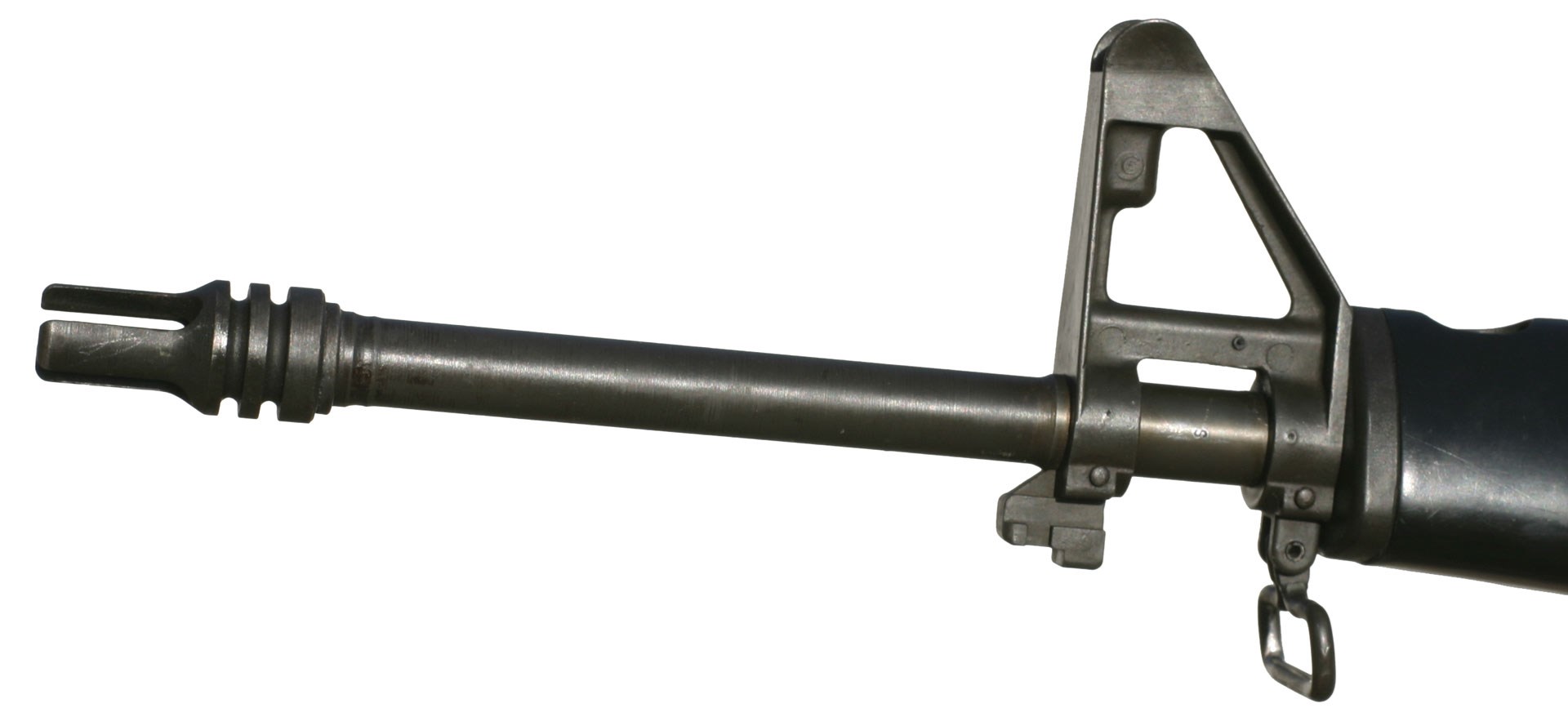 Closeup of the cast front sight base and duckbill flash suppressor of Colt/ArmaLite Model 601 Serial No. 001081. Photo by the author
ArmaLite was going to need a well-resourced partner capable of financing the AR-15’s continuing design development and eventually the large-scale production of the rifle. Colt’s Patent Firearms turned out to be that partner. Although it was not much better off than Fairchild or ArmaLite financially, Colt nevertheless had the kind of industrial capacity to get large scale production of the AR-15 rolling.
To that end, the company bought the rights to the AR-15 from ArmaLite in 1959 for a lump sum of $75,000, plus a 4.5-percent royalty against future sales for the use of Eugene Stoner’s patented gas system.
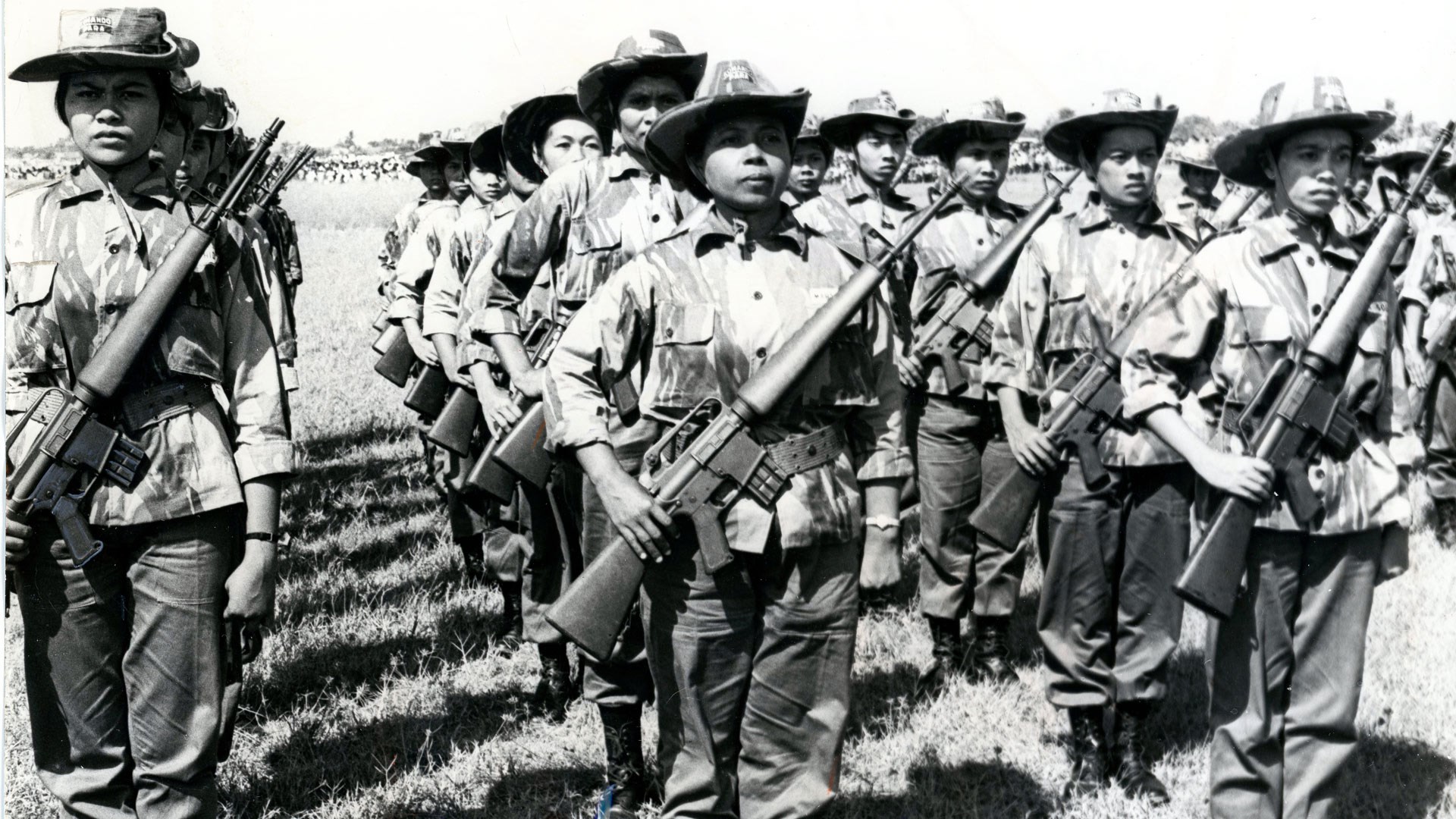 Indonesian female volunteer paratroopers armed with Colt/ArmaLite AR-15 Model 601 rifles – June 1965. Author’s collection
Just when it looked like the future of the AR-15 was in good shape, the Army backed away from it. The rifle had failed rain tests, and it did not help matters at all that Arctic testing in Alaska left a false indication that there were more problems yet to be solved. At that point the gun had progressed through enough of a design evolution that it was ready for mass production, and when that began at Colt in December 1959, it was assigned the model number “01,” the first of many in Colt’s “600 series” of AR-15 type rifles.
But even as serial production of the Model 601 began in Connecticut, the gun’s evolution continued. After assembling the first 300 rifles with unpainted Bakelite handguards, pistol grips and buttstocks, Colt began applying a light green epoxy paint to the furniture. Toward the end of Model 601 production though, black paint replaced green.
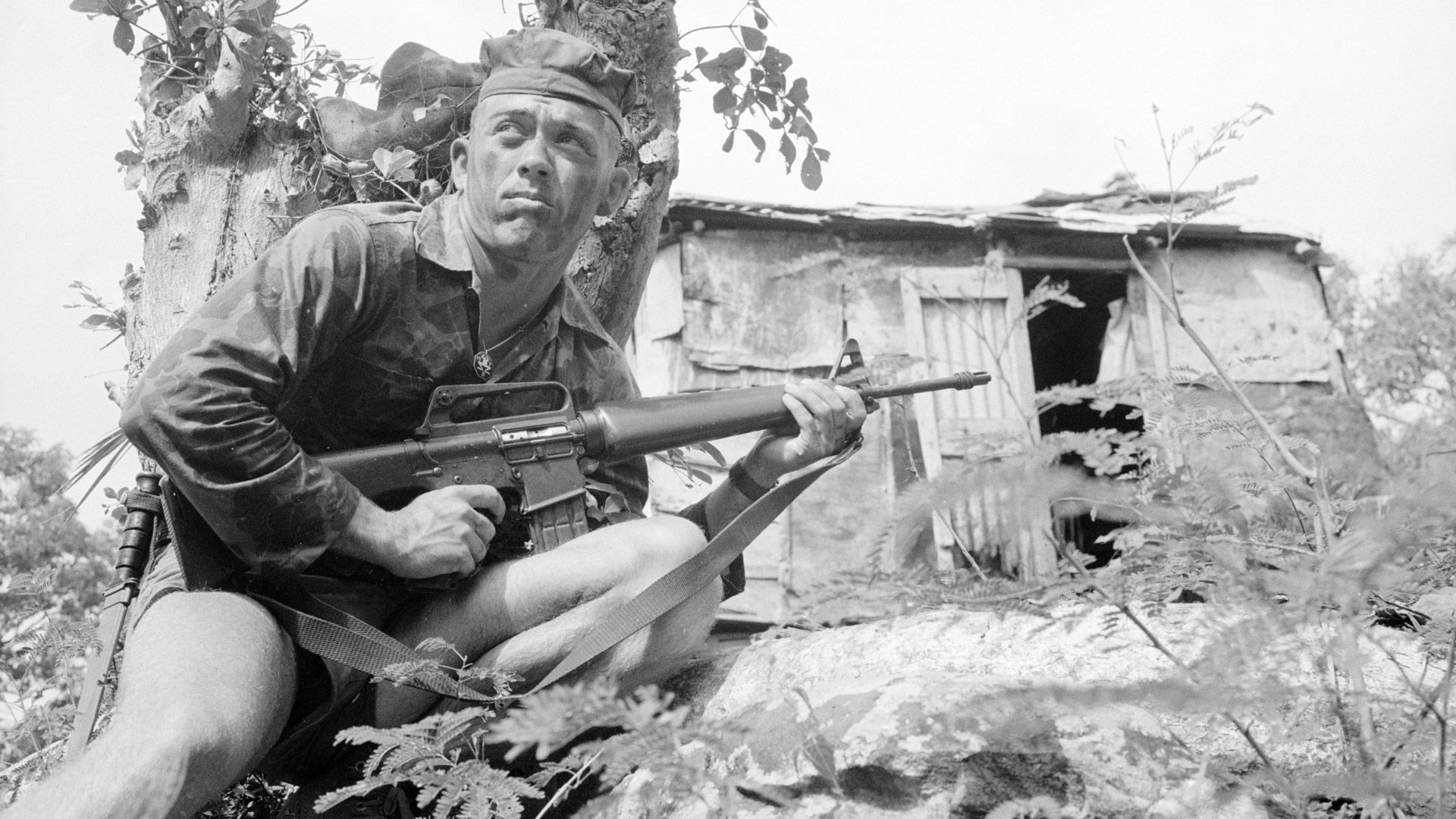 A U.S. Navy SEAL armed with a Colt/ArmaLite Model 601 is seen here during a training exercise on St. Thomas, U.S. Virgin Islands on February 21, 1963. Photo by Marion S. Trikosko/US News and World Report Collection/PhotoQuest/Getty Images
Eventually, changes were also made to the profile of the buttstock, the configuration of the receiver roll markings and the type of aluminum alloy used to make the uppers and lowers. By the 1960s though, the Model 601 had reached its final form right at about the time that things really began to happen for it. On July 4, 1960, the U.S. Air Force Vice Chief of Staff, Gen. Curtis LeMay, test fired Model 601 Serial No. 000106 during a barbeque in Maryland, and the emphatically positive impression he took away from the experience would ultimately lead to the rifle’s adoption by the American military.
Although the U.S. Army had initiated the development evolution that eventually led to the creation of the Model 601, it was the U.S. Air Force that made the first purchase, and that set in motion the sequence of events that brought a Model 601 to the White House on April 19, 1963.
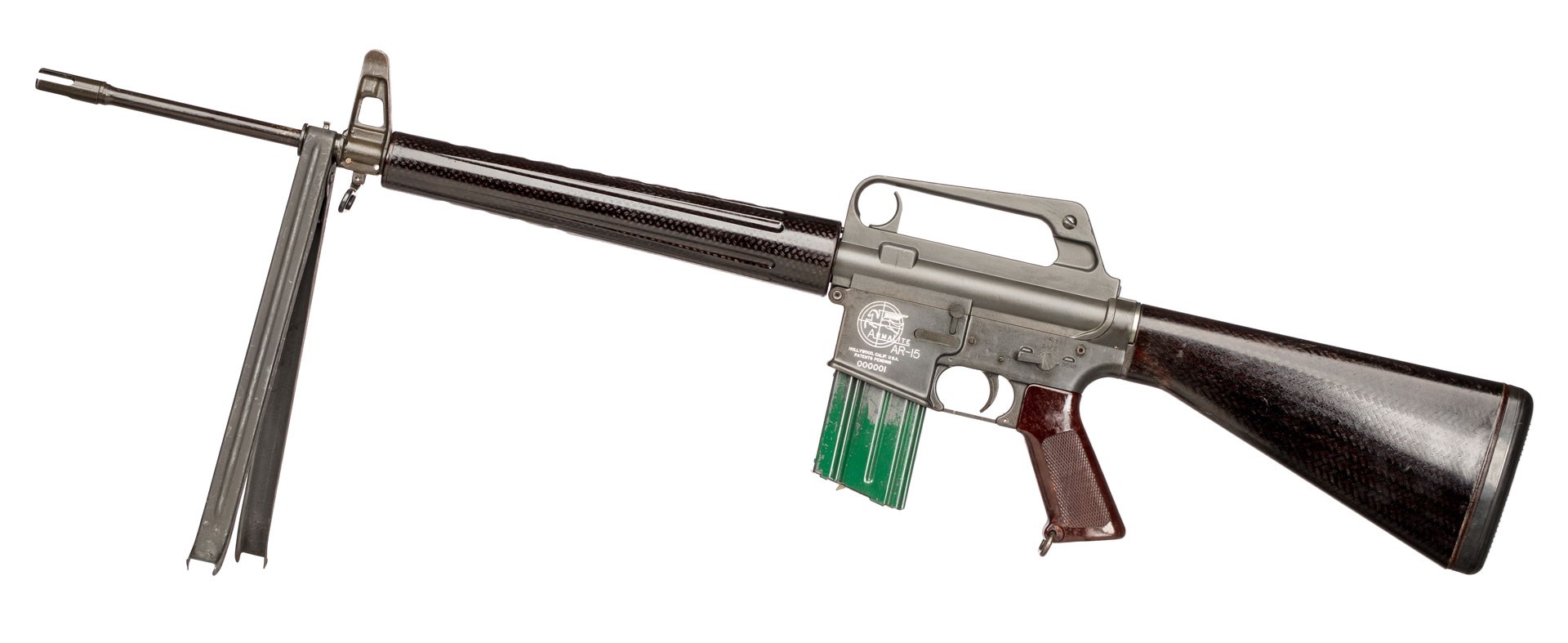 Left side view of ArmaLite prototype AR-15 Serial No. 000001 with bipod attached. Photo courtesy of the Institute for Military Technology
The AR-15 that JFK handled that day had come a long way from the XAR-1501 that had started it all way back in 1957, and many big changes were yet to come. But, in those days before forward assist devices, birdcage flash suppressors, chrome-lining, flat top upper receivers and three-round burst, the rifle was lighter, simpler and more lethal. In the end, the AR-15 would be asked to do much more than anyone could have imagined in 1963, and it would serve all the way across the threshold of the 21st century.
President Kennedy would not live to see any of this though because the example he inspected in the Oval Office that Friday afternoon in April 1963 was the only AR-15 he would ever know.
A short time ago, SIG SAUER introduced a pair of 9mms that could hardly be farther apart in size and application. It’s particularly interesting to examine the P320 X5 Legion heavy duty shooter and the P365 XL concealed carry pistol side by side.
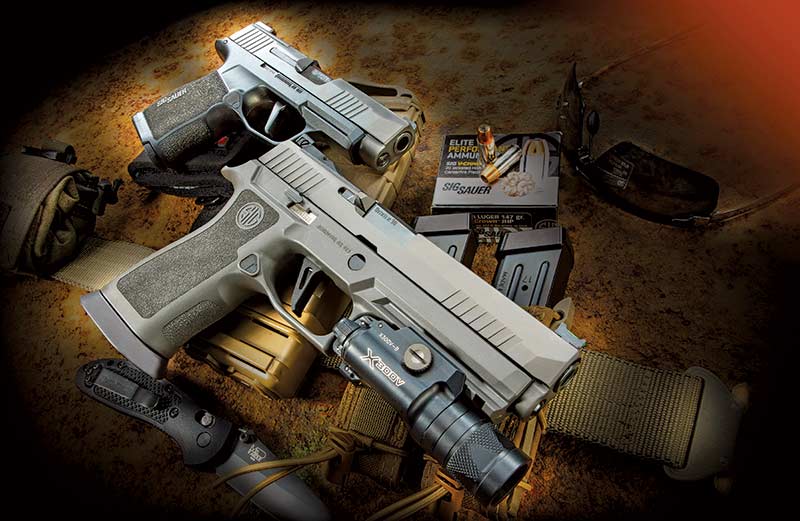
The P320 pistol has come a long way since the New Hampshire-based SIG team led by Ethan Lessard finalized the design circa 2013. A striker-fired modular pistol based on the P250, which was a DAO hammer-fired gun, it has evolved past some issues and been adopted by agencies such as the Oklahoma state troopers, the Texas Department of Public Safety, and most famously, by the U.S. military as the M17 service pistol.
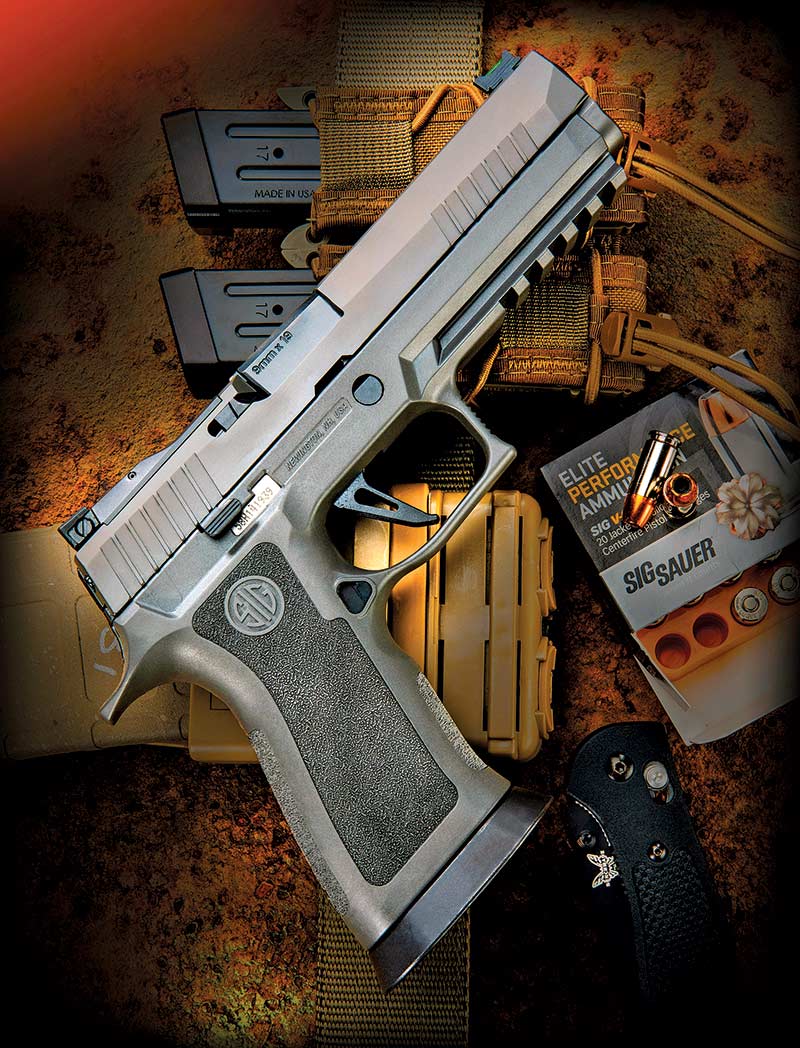
Its latest variation is the Legion. The “target” version of the P320, the X5, morphs into the Legion by more than its “SIGnature” Legion chevrons. The key differences are its heavy tungsten-infused polymer frame and its 30 percent lighter trigger pull.
The rationale of this model SIG is to combine the recoil-dampening weight we associate with all-steel frames with the kick-absorbing flexion of polymer. Hence, the new frame element. Phil Strader, pistol product manager for SIG, is a top-tier competitive shooter himself. He explained to American Handgunner, SIG learned “the company that actually makes some of our polymer material could add tungsten powder to the original mixture of polymer, glass, etc.
After a few iterations of (this) TXG material, we found the perfect balance of extreme weight and durability. The process has never been used in the firearms industry and SIG has a patent pending for its use.”
We found the recoil was indeed mild. It’s a hackneyed phrase to say, “This centerfire pistol kicks like a .22,” but with the P320 Legion, that’s actually pretty much the case. The Legion model is geared for competition. In Steel Challenge matches, where it’s generally one shot per target, the lighter polymer framed X5 would be my choice from the P320 line for its faster handling. Recoil recovery takes place as you’re tracking between the multiple targets. In games like USPSA or IDPA, however, it’s generally multiple shots per target and here, recoil recovery between shots is more critical.
Phil Strader told me, “The P320 XFIVE Legion is approved for USPSA Open, Limited, Production/Carry Optics (with the magwell removed), NRA Action Pistol Metallic and Production divisions, and IDPA Carry Optics, SSP (with the magwell removed) and ESP (with either the magwell or the internal grip weight removed). Removing the magwell or grip weight brings the weight of the XFIVE Legion to 41.7 oz. or 42 oz. respectively, well below the 43-oz. weight limit for SSP and ESP.”
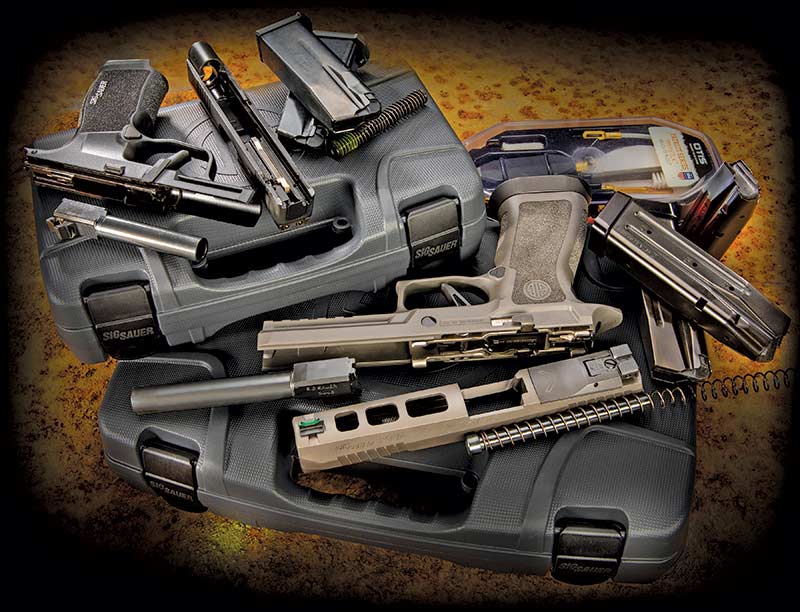
The P320 X5 Legion’s trigger is flat-faced, skeletonized and does not have a GLOCK-ish trigger tab or similar device. I think all serious shooters should have a trigger pull gauge, like the Lyman digital unit I got from Brownells. On mine, the test sample (serial number 58H116216) averaged 3.84 lbs. when measured from the toe of the trigger. While it’s a common measuring point, most human fingers generally pull from the center of the trigger, offering less leverage, and from there our P320 X5 Legion averaged 4.67 lbs.
The test Legion’s trigger had significant backlash to it, i.e., rearward movement after the striker released. This can cause gun movement between the trigger release and the instant of the shot. I haven’t experienced this with previous P320 X5s I’ve shot so am not sure why this was the case.
From a Matrix rest on the 25-yard bench, I tested it for accuracy with FMJ loads in the three most popular bullet weights. Five-shot groups weren’t up to what I got with my first P320 X5, and tended toward “4+1” clusters running in the 3″ to 4″ range. The best group was with SIG’s own 115-gr. FMJ, measuring 3.05″ for all five shots, with four of them in 1.5″ and the best three in 1.3″, measured center to center to the nearest 0.05″. The “best three” measurement factors out enough human error to reasonably predict what the same gun and load could be expected to do with all five from a machine rest.
With no holster to suitably fit the big, square beast, testing the P320 X5 Legion for ergonomics under pressure at a match was off the table. I went with the old Bianchi Cup falling plates test instead. Eight runs at six 8″ plates, twice each at a pace of six seconds at 10 yards, seven at 15, eight at 20, and nine seconds at 25 yards. I tightened each run by a second to allow for a low-ready instead of holstered-gun start. The pressure was applied by the unforgiving CED electronic timer. I wound up with 46 out of 48 possible plates down, missing one each at 20 and 25, and finished convinced the P320 X5 Legion could have shot a perfect score, even though I couldn’t that day!
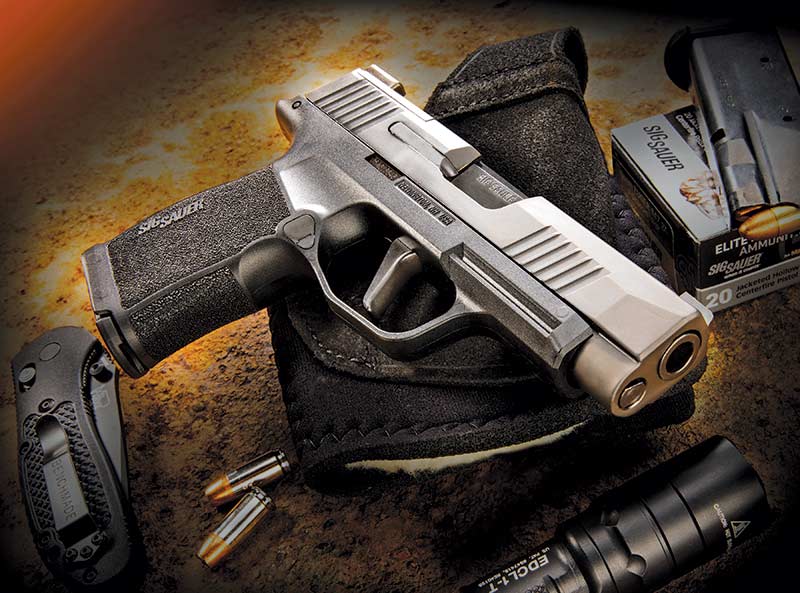
The P365, a “slim-nine” amazingly packing 10 rounds into a magazine scaled for a tiny grip-frame, was a game-changer and an instant hit when it was introduced at the beginning of 2018. I liked mine enough to buy it. The P365 XL is simply that slim, small-grip pistol extended at muzzle and butt. Magazine capacity is now 12+1, two rounds up from the standard P365. At 6.6″ long with 3.7″ barrel, 4.8″ high and 20.7 oz., it’s 0.8″ longer overall, 0.5″ greater in height (read: butt protuberance), and 2.9 oz. heavier than its smaller predecessor — not counting the two extra cartridges when fully loaded.
SIG categorizes the original P365 (still in the catalog, of course!) as a “micro-compact” and this new XL variation as “The perfect balance of micro-compact concealability with full-size shootability.” SIG also offers a 15-round P365 magazine, and while I haven’t tested it, I trust gun expert Chuck McDonald who tells me the 15-rounders run fine in his extensive P365 experience.
On our test sample, serial number 66A494274, the trigger pull ran an average 5.59 lbs. from the toe, and 7.64 lbs. from the center of the trigger on the Lyman gauge.
From the Matrix rest on a concrete bench, I ran it with SIG’s own load actually designed for the original short P365. The “365” cartridge comprises a 115-gr. V-Crown JHP spec’d for 1,050 fps velocity, running the gun fine, with very mild recoil. Five shots went into 3.35″, with the best three into 1.60″. The 147-gr. subsonic shot better, with the flat-nose Winchester FMJ grouping all five into 2.80″, four of those into 1.25″ and the best three in the tightest measurement of the test at 0.8″. The best five-shot group came with the Speer Gold Dot 124-gr. +P bonded hollow point at 1.95″ — with the best three into 1.05″. Yes, the little P365 XL grouped tighter than the big, heavy P320 X5 Legion. At least with these two particular pistols, in my hands.
in the P365 XL, even with +P ammo, and slightly less than with the original smaller model. The topmost round may be a little tight to squeeze into the magazine, and with the slide forward, the 12-rounders coming with it wanted to be seated firmly because of limited flex in the stack of cartridges when filled all the way up. The gun came with a flat trigger which, on this model, I liked better than the traditionally curved one on my original P365. There was a little creep in the pull, but it seemed to disappear in rapid fire.
I tested it for ergonomics, among other things running it over an off-duty police course encompassing 60 rounds, five-speed reloads, multiple draws, one hand only with each hand, and use of cover positions, from four to 15 yards. The pistol came with only two 12-round magazines, but the course of fire was “revolver neutral” with six round strings and mandatory reloads, so I got by mixing tactical reloads with speed reloads and filling one mag with six and the other with 12 for 18-round strings of fire.
The P365 XL gave me a full 300 out of 300 possible points, with some three-fourths of those in one ragged hole. The overall group measured about 5″. For a “micro-compact” pistol it would have been hard to ask for more than this. My reloads weren’t terribly fast. To make those many rounds fit into that compact a pistol, the P365’s mag release had to be mounted forward on the grip-frame requiring a push more to 5 o’clock than 3 o’clock to dump the empty mag. My old arthritic thumbs don’t handle that well. Some P365 shooters have addressed this by swapping the release button to the starboard side (instructions are in the owner’s manual) and ejecting the spent mag with the trigger finger.
I carried the XL for a while in a Bullseye Kydex OWB. No surprises: this 1.1″ thick pistol concealed very well and very comfortably, just as it was designed to do.

Everyone wants to shoot new guns, allowing me to get lots of hands on test firearms. Hundreds of rounds went through each of these SIGs, in the hands of five-foot-tall females and six-foot-plus testosterone monsters alike. There were no malfunctions except for failures of the slide to lock open when people left their thumbs on top of the slide stop levers — a shooter malfunction, not a gun issue.
What particularly impressed me was the P365 XL performed so reliably when it came out of the box bone dry. I know we should field strip and lube new guns before we shoot them. I also know most gun buyers don’t, so I test them as they come out of the box. Thus, for this little P365 XL, the test was somewhat abusive, but it still ran fine. Big thumbs up for that. Be smarter than me and lube yours, though!
Through the broad range of P320 options, this model has proven reliable enough for U.S. military adoption. The P365 has been approved by many law enforcement agencies for plainclothes, off-duty and backup carry. One such entity is the Orlando, Florida Police Department. Many of their 800-plus sworn officers have opted for the P365, including Rangemaster Kevin Williams, who happened to be wearing his own when I interviewed him. He says the P365s have done fine in training and qualification with department issue Winchester 124-gr. +P Ranger Bonded ammunition.


