Categories
All About Guns

M1909 Benet Mercie – American’s First LMG

M1909 Benet Mercie – American’s First LMG


This Benet-Mercie is being sold by Morphys on October 30, 2018.
The first light machine gun adopted by the United States was the M1909 Benet-Mercie, made by the Hotchkiss company in France. The gun was adopted when the US military realized that machine gun doctrine reuqired different guns for the light and heavy roles, and the M1904 Maxim gun was only suitable for use in the heavy role.
Less than 2,000 of the M1909 guns were acquired, virtually all of them being made under license by Springfield Arsenal and the Colt company. They were used as training guns by US forces mobilizing for World War One, but did not see combat in that war.
Indeed, the only action of note the Benet-Mercie saw was in Pancho Villa’s 1916 raid on the town of Columbus, New Mexico.
Categories
All About Guns Ammo Cops

THE MYSTERY OF THE EXPLODING HEAD WRITTEN BY WILL DABBS, MD

There’s quite a lot of science that goes into modern expanding bullets.
In the end they do exactly what they are supposed to do.

It still amazes me after all these years that I can speak so dispassionately about this stuff. Ours was a fairly large, extremely violent city, and I didn’t know many people. The possibility that a patient might be an acquaintance was small. This made it easier to depersonalize. An inability to depersonalize would disqualify you from service. Nobody could do this long-term otherwise.

The cops rolled in with the ambulance. Witnesses said this guy’s car veered off the crowded Interstate and onto the shoulder. The vehicle gradually lost speed until it came to an unceremonious but not unduly violent stop against an overpass abutment. The first bystander opened the door to find that the driver’s head had exploded.

That’s not hyperbole. The front bit looked quite normal. However, there was a defect to the right rear occiput, the back part of the skull, that would admit an adolescent tangerine. The skull was peeled outward, and a substantial volume of the poor guy’s personality was still back in the car someplace. Amazingly, when we met he was still breathing.

Of the literally countless things I found shocking about medical training, principal among them was just how tough it can be to kill a man. I’ve seen folks shot straight through the brain who kept on kicking and twitching for a quarter hour or more before their bodies finally got the memo. So it was here. There was clearly no happy ending to be had, but we still needed to go through the motions.

The physics behind guns and gunshot wounds can at times seem otherworldly.


When it was all done we put the guy in the Trendelenburg position. Modern medicine is so freaking stupid. Trendelenburg simply means you orient a person head down and feet up. Why we couldn’t just say “lower his head” or something similarly sensible escapes me. To make it worse, to orient a patient head up and feet down is called “Reverse Trendelenburg.” Please…as though the study of modern medicine were not sufficiently complicated already. We arranged a big garbage can underneath his nugget and let him be for a while.

I was just a medical student, but I spoke guns more fluently than anyone in the hospital. The cops literally had no idea what happened to the guy. There was no visible damage to the vehicle—no bullet holes or blown-out windows—and they could find no weapons in the car. He had apparently just been cruising down the Interstate when his head detonated. To exercise a tired cliché, the authorities were baffled.

I went back into the trauma room alone to study the guy for a while. Aside from being motionless and a little colder nothing was different. I donated a pen to the cause and started poking around the exit wound. A substantial piece of skull had been lifted loose and rolled back but was still attached to a flap of scalp. As I explored amidst the gore I saw it.

There was a circular scrap of gold-colored metal trapped between the skull fragment and scalp. I tugged it free, ran it under the sink, and studied it in good light. To the experienced eye it was clearly the base of a bullet jacket.


I moved around to the front and studied the dead man’s face. There just wasn’t anything out of the ordinary there. I then pried his mouth open and oriented the bright trauma room light so it would angle down his gullet. There back in the deepest recesses of his oropharynx I could see the beginnings of some powder burns. This was a suicide. The guy had shoved the muzzle back past the back of his tongue before he stroked the trigger.

I miked the bullet jacket on a piece of EKG paper at eleven millimeters. I then put it in a little bag and tracked down the cop who had come in with the guy. Our dude had killed himself with a .45ACP handgun. The pistol was still in the car someplace. They just hadn’t found it yet. The cop made a radio call.

They found the .45-caliber Glock deep underneath the passenger seat. Nobody had any idea the physics that could have put it there. The bullet core was lodged in the headliner and impossible to see if you weren’t specifically looking for it. I was just a lowly med student at a Level 1 trauma center, but that night everybody thought I was a rock star.

Categories
All About Guns War

Sherman Firefly – What were those wavy lines for?

Categories
All About Guns The Green Machine War

An Army Artillery Forward Observer in South Vietnam, 1970-1971

https://youtu.be/W3_g7FOi1jY

Categories
All About Guns

Colt 1909 Army Revolver

Categories
All About Guns War

From the American Revolution: Short Land Pattern Brown Bess

Categories
All About Guns

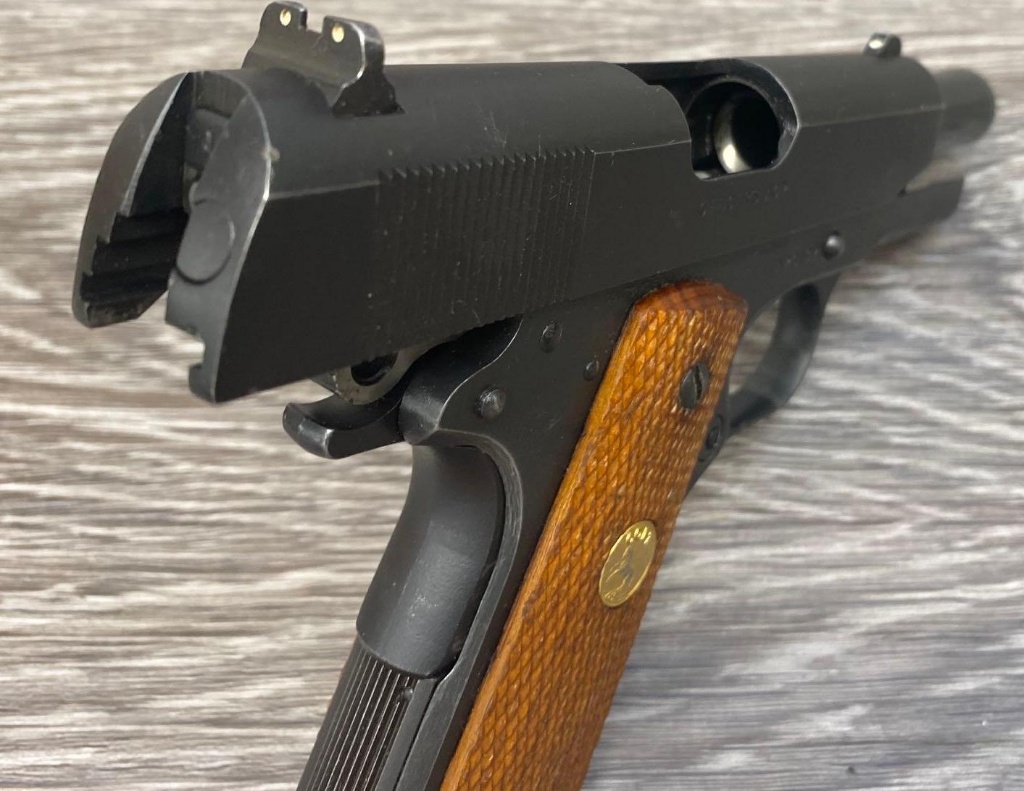
Colt 1911 Combat Commander In 38 Super

Categories
All About Guns Allies Soldiering War

Battle Ready: British Kit & Unexpected Weapons of the Zulu War

Categories
All About Guns You have to be kidding, right!?!

Webley revolver with a bayonet

Categories
All About Guns

The Most ACCURATE Beretta Just Released at SHOT Show 2023 | Gun Enthusiasts Must See!