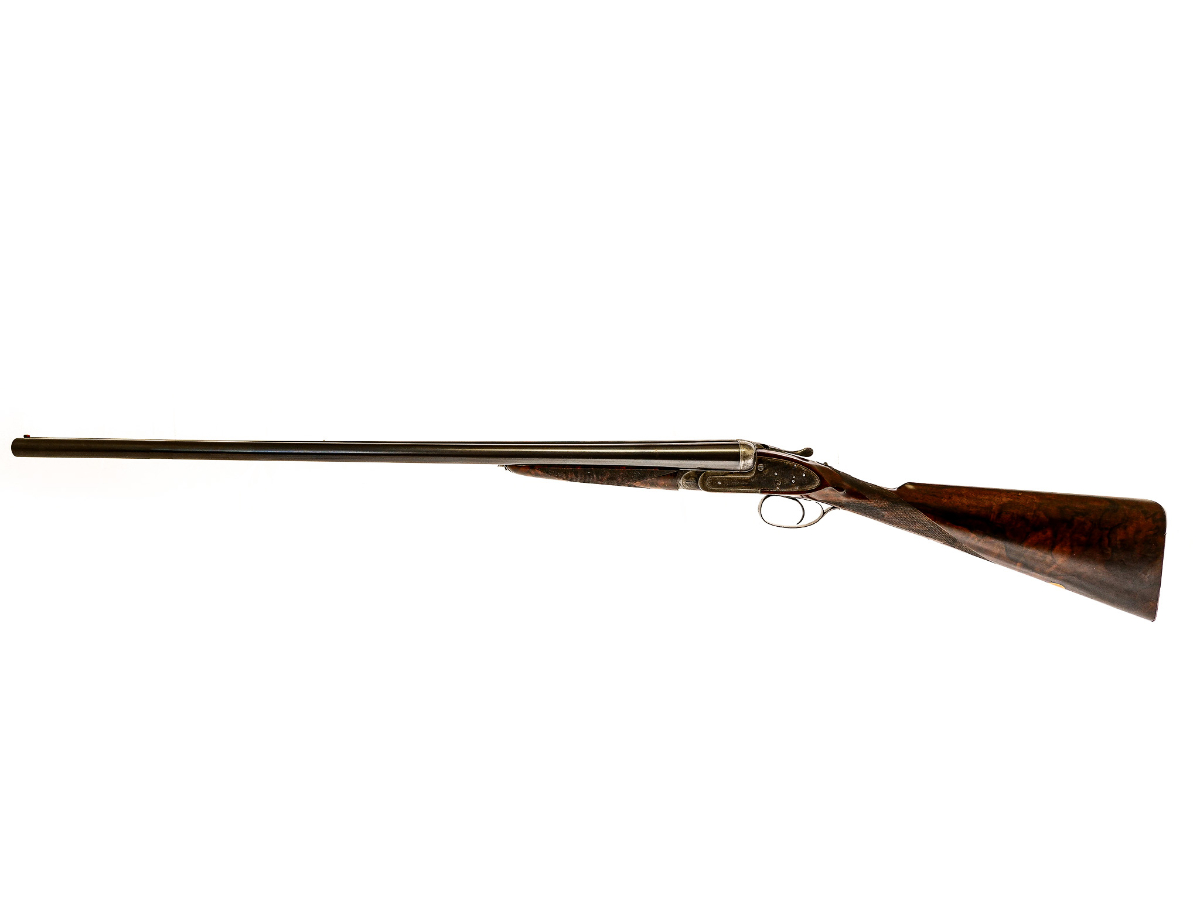


Sometimes I wonder whether folks working at a gun manufacturer know the impact of their decisions beforehand. I spent a little time at a couple of gun manufacturers many years ago. A couple of guys clearly dreampt of being the next John Moses Browning but most just liked the idea of working where guns were being made.
So as the 20th century was about to debut, the brass at Smith & Wesson decided on a new double-action revolver design called the Hand Ejector Model. More powerful cartridges were in high demand so the company developed a solid frame with a swing-out cylinder to replace its top-break double actions. The first of these were the I- and K-frame Hand Ejectors in .32 and .38 cal. These revolvers were an instant success as the 19th century drew to a close, so a .44-cal. frame given the factory name of the N-frame was developed in 1905. The .44 Russian cartridge was designed for and during the Top-Break era. This new N-frame allowed for a more powerful cartridge so the engineers lengthened the .44 Russian case by .19″, added 3 grains of black powder for a total of 26 grains to push a 246-gr. bullet to 750 f.p.s. The new cartridge was christened the .44 Smith & Wesson Special, tagging along with the already popular .38 Smith & Wesson Special.
These new .44 Hand Ejectors were made to very tight tolerances. Cylinder alignment was critical and these cylinders locked up in three places; the front of the extractor rod, the rear where an extension of the extractor rod fit into the face of the recoil shield and a third place on the yoke where it meets with the barrel. This provided for a very sturdy and repeatable lockup, thus allowing both cartridge and revolver to extract the most accuracy. Up on the barrel, a shroud was provided to protect the extractor rod and add some recoil-dampening weight. The first .44 Hand Ejectors became known as Triple Locks because of the three locking points. It was introduced in 1908 and available in 5″ and 6 1/2″ barrel lengths, chambered in .44 Russian and .44 S&W Spl. However, very few were made with 4″ barrels chambered in .38-40, .44-40 and .45 Colt.
Sales of the new .44s were disappointing to say the least, probably due to three factors. First, these revolvers recoiled more than the .38-cal. guns. Though considered paltry by today’s standards, the Modern Technique of the Pistol was still about half a century in the future. Most people still shot a handgun with one hand in what we now call a “duelist stance.” Too, because of the extensive handwork necessary to manufacture a revolver with three lockup points and the time required to evenly polish a barrel with an integral underlug, the retail cost was greater enough to spur many budget-conscious shooters to opt for the smaller caliber. Finally, the semi-automatic pistol was getting a lot of attention at the same time. A lot of “cutting edge” shooters of the day chose something newer than a rehash of existing technology. More than a century ago, as today, much of the gun-buying public clung to the arcane and false notion that “Where there is lead in the air, there’s danger!”
Smith & Wesson had a problem. Arguably its finest revolver wasn’t making it in the sales department, and it was costly to manufacture to boot. A Hand Ejector Second Model was introduced in 1915. The Second Model eliminated the third locking point in the yoke, along with the integral underlug. It was in production for just two years before Smith & Wesson had to make the switch to wartime production. The Hand Ejector Third Model came about in 1926 because of a heightened demand for the integral underlug on the barrel.
Wartime demands of World War II halted the manufacture of the 1926 Model in 1940. Once the world was once again made safe for a few years, the company brought out the Hand Ejector Fourth Model of 1950. Like its great, great grandpappy, the Model 1950 was not a stellar seller. Target shooters more often than not chose a lighter, easier recoiling .38 Spl. or a .45 ACP for their paper-punching chores. Buyers of the 1950 Model were largely restricted to savvy law enforcement guys, often in rural areas, and a group of revolver aficionados known as The 44 Associates, publicly led by a sawed-off Montana cowboy by the name of Elmer Keith.
This latter group made a name for themselves handloading the .44 Spl. to velocities never dreamed of by the cartridge’s inventors. Keith served as the blow horn for these efforts. In 1956, what appeared to be the final blow to the .44 Spl. was turned loose on the public—the .44 Remington Magnum. This cartridge did everything the .44 Spl. could do and then some, but at a cost. Those costs included an unacceptable amount of recoil for a fighting gun and an even heavier revolver to pack around.
A lot of law enforcement guys and backcountry wanderers clung to the Model 1950 but not enough to continue production. The Model 1950—by this time known as the Model 24—was discontinued in 1967, and according to the factory, no plans were in the works to reintroduce it. The supply of .44-Spl. S&Ws dried up faster than a spring rain in the desert.
***
Now let’s go back about 40 years. Some of you were not here yet; others, like me, still had all of our hair and it was dark. I was a gun-struck, wannabe pistolero with a whole lot of desire and energy and not much money. Working two jobs, virtually every spare nickel I made went into guns, ammunition and reloading components. I had bought my first handgun, a Colt New Frontier .22/.22 WMR just four years prior. During that first year I also bought my first two center-fires, a Smith & Wesson Model 27 and a used Series 70 Colt Government Model. Although fascinated by firearms back to my earliest memories, I had not really grown up around guns. My family was not into guns and hunting, so my interests sat famishing until I was old enough to buy my own.
Like a lot of guys back then, my mentors were writers in gun and outdoor magazines. Part of my gun money went to subscriptions and books to help me along in my self-education. One guy who struck a chord with me was Charles A. “Skeeter” Skelton, a law enforcement and cowboy type out of New Mexico. Skeeter was a Depression-era kid who found adventure as a Marine in World War II, and later as a Border Patrolman, Sheriff and U.S. Customs agent. He had a deep appreciation and knowledge of handguns and was a gifted storyteller. Skeeter wrote a handgun column for Shooting Times back when it was a part of PJS publications. The reason I had a Model 27 and a Jordan holster on a River Belt by Don Hume was because of Skeeter.
While the Model 27 and its .357-Mag. cartridge were plenty good—especially for a kid with little experience—Skeeter’s prose regarding revolvers chambered for .44 S&W Spl. kept me pretty goggle-eyed. His stories of adventures—and a few pratfalls—with a .44 on his hip had me pining deeply for a .44 Spl. Trouble was, Smith & Wesson had discontinued the .44-Spl. chambering and its Model 24 about a dozen years prior to my discovery of it. I haunted gun shops from Sacramento to San Diego searching for one. In one year, I found exactly one, a 6 1/2″ barreled Model 24 in a gun shop in Orange County, Calif. The price was $750, more than twice the going rate for a Model 29 .44 Mag. that was nearly as scarce.
Then—I believe it was in one of Skeeter’s columns—I found that Bob Sconce of the Miniature Machine Co., had a few original 6 1/2″ 1950 Target barrels available. These were pre-Model 24 barrels, raw and unpolished. If I recall correctly, Sconce was getting 125 bucks per copy. That was still pretty steep, but considerably less than $750. I gritted my teeth and came up with enough scratch to get one. Now all I had to do was find an N-Frame Smith & Wesson and get someone to marry the two.
At a local gun shop I found a barely used Model 28 Highway Patrolman for less than a pair of C-notes. Donor gun and barrel in hand, I began my search for someone who could meld the two into a desirable six-gun. Sconce had taken ill and was unable to work. I was about a year from making my move to Wyoming when I found a pistolsmith by the name of Tim LaFrance.
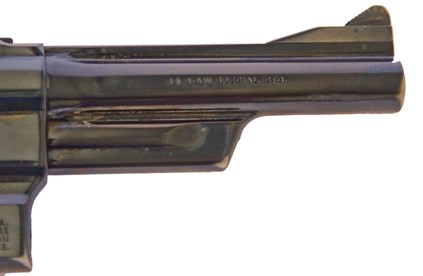
Like most good gunsmiths, LaFrance was backordered in work—four months, he said. Eight months later I still had not heard anything. I called him, and he said he would have it done in a month. Two months later I had the converted .44. LaFrance had fitted the barrel and rechambered the cylinder. I also had him shorten the barrel to 5″ to match my Model 27 and reattach the ramp and front sight. Fortunately, the barrel markings were centered at the 5″ length, so it looked almost factory made. I found another guy—whose name escapes me after four decades—to completely refinish, polish and blue the gun. I finally had my .44 about a month before I migrated to Wyoming.
First thing on the agenda was to acquire loading dies, a bullet mold and some .44-Spl. brass—a fairly tall order for a 25-year old on an extremely tight budget. I finally scrounged up what I needed. The dies were used and made by Eagle; the mold was a dual-cavity Lyman 429421 that threw 245-gr. semi-wadcutters. Then I got to cranking out some ammo. I tried several loads, but two were clearly standouts, and they were just about standard among .44-Spl. aficionados; 7.5 grains of Unique, a load that now is commonly known as “Skeeter’s load,” and 17.5 grains of 2400, which was Keith’s hunting load prior to the standardization of the .44 Mag. Both of these, I should point out, are no longer listed in any modern loading manual I am aware of. The claims that Alliant has changed its formulas or burn rates have not been substantiated, so I assume that it is more of an erring on the side of caution. I would not try either of these loads in a Smith & Wesson revolver made before 1950.
My custom .44 never got to be the centerpiece of any adventures paralleling Skeeter’s, but it did provide for an occasional meal on the trail, and it rode in the same Jordan holster during my short stint as a police officer in Afton, Wyo. I won a few informal pistol matches with it. One afternoon a friend and I were shooting revolvers—my custom .44 and his, an early post-war M&P which I now own.
After a while, shooting paper got to be a bit uninteresting. I was getting a bit cocky so I turned the .44 upside down and began shooting at a stick on the ground using my pinky to operate the trigger double action. The stick bounced at every shot. My friend—who has now long gone to his reward—snapped “Smart aleck!” or something similar. He picked up the stick and threw it in the air saying, “Hit this!” With the revolver right side up now, I tracked the stick and pulled the butter-smooth double-action trigger. To our mutual astonishment, the damn stick was severed in the middle.
Life’s tribulations forced me back to California a few years later, and one time I was bouncing along on a ranch in the western Sierras with another friend. My .44 was safely tucked away in the Jordan holster when suddenly a wild pig came boiling out of a shallow depression in the grass. The horse I was riding—not mine—was a bit unaccustomed to having wild pigs jump up nearly between its feet. I made a sort of flying dismount with assistance from that horse and drew the Smith, tracking the offending porcine at about 35 yards. The revolver bucked and the 90-lb. sow slid on her nose.
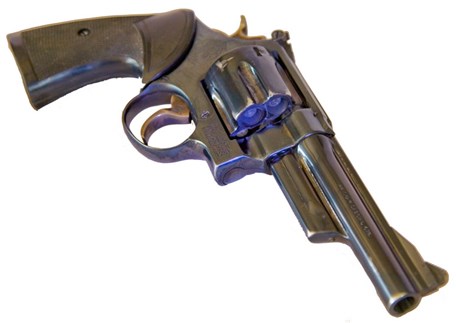
Smith & Wesson’s declaration of never producing the Model 24 (or 1950 Target) proved a bit premature. In the 1980s Lew Horton commissioned the company to make a limited run of Model 24-3 revolvers with a round-butt, K-frame grip profile. I wasn’t about to let this get away, and soon one of these became a regular companion. Still later, I found a 4″ barreled Model 24-3 in unfired condition on Gunbroker.com. When it arrived, I remedied the unfired condition situation quickly. Still later, I acquired a Colt SAA and a pair of Ruger Flat Tops in the proper caliber. The Colt has taken a pig and a deer, and I now feel adequately comfortable with my .44 S&W Spl. situation.
While not exactly commonplace, the dearth of .44-Spl. revolvers is not as dire as it was in the mid- to late ’70s. Charter Arms has its Bulldog, and here and there it is possible to find a Smith & Wesson or Ruger that does not force you to make the choice between the gun and a house payment. In fact, Ruger has the GP 100 available in .44 Spl. now. If you love revolvers but have not yet had the pleasure of an accurate, powerful and yet manageable revolver on your hip, better get one now. I bet you can’t stop with just one!
The .50 cal is heavy and needs a vehicle to carry it around unlike the compact, and relatively lightweight GPMG, but the venerable ‘ma deuce’ hits far harder at much longer ranges – 1.5 miles later your lead is still flying and your enemy is still ducking. A sustained burst of fire will shred a wall and stop most vehicles apart from advanced APCs or tanks.
Stick it up on a truck or even a Humvee and you have a truly powerful, mobile weapon for a fraction of the cost of other platforms.
That trusty M2HB is reliable as well as versatile.
It terrifies enemy infantry.
It can be used to range in your bigger guns on a target.
In a tight spot it can be used to take down a 20 million dollar, strafing aircraft just as granddad stopped bandits like the Focke Wulf 190 with it in WWII.
No GPMG is a good substitute in that role.
It has no circuit boards to fry in an electromagnetic pulse, no batteries to fail, and no guidance system to jam with electronics or a burst of chaff.
Even in our technological age there are few better ways to even out a fight than with a .50 calibre machine gun, a well-trained gunner, and a thousand rounds of ammunition.
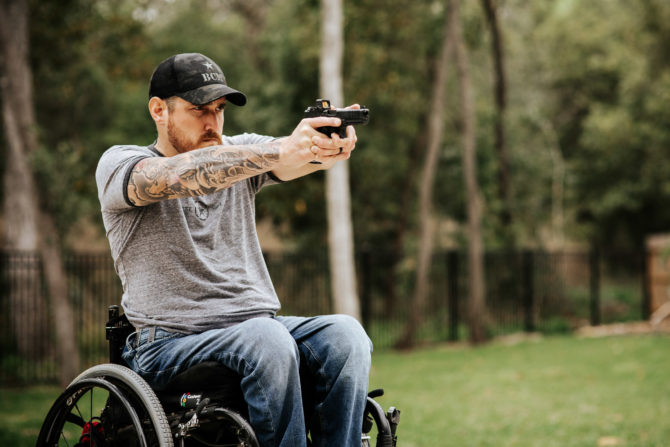
When selecting someone to victimize, criminals want the maximum return on investment with the least amount of effort and risk involved. People with disabilities, especially those who use wheelchairs for mobility, undoubtedly fall into the “soft target” category in the eyes of criminals. When it comes to wheelchair concealed carry, some special attention must be paid.
[Editor’s Note: Photography by Taylor Elizabeth Photography.]
I was shot and paralyzed from the waist down in a gunfight while serving as a U.S. Marine infantryman during the 2003 invasion of Iraq. I spent months recovering in the hospital before finally getting back into society again as a civilian with a severe disability, and I immediately felt physically vulnerable around shady-looking characters. So it made sense that I’d eventually want to start carrying a handgun for protection and become more self-defense minded in general.
However, I had no clue what type of concealment method or holster to use, or even how to set up the holster for my own personal needs, so I simply mimicked how my able-bodied peers were running theirs. Over a decade later, with knowledge gained in more than 100 training classes and 50 different firearms instructors, the end result is a box full of holsters that just didn’t work for me. That’s not to say they’re all bad; they just don’t suit my specific needs.
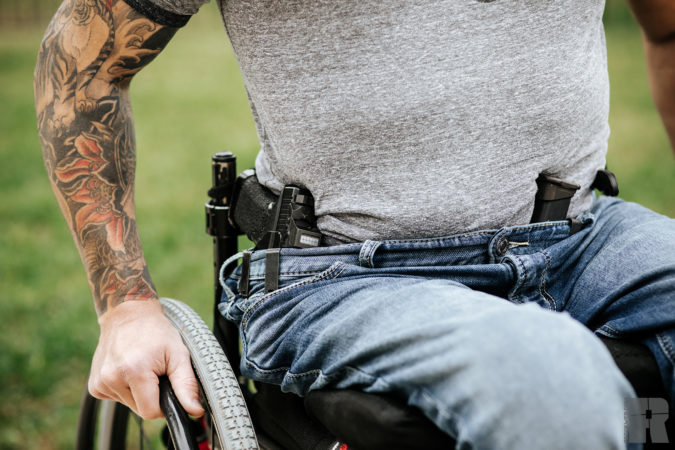
My goal here is to help prevent you, or someone else you know who’s in a wheelchair, from having to figure it out on your own like I had to.
First and foremost — regardless of your chosen carry method — your handgun needs to be inside of a holster, and that holster should actually be designed for your gun’s make and model. The trigger guard needs to be completely covered and the holster alone should effectively retain the pistol. Only use high-quality holsters made of rigid materials like Kydex or injection-molded polymer.
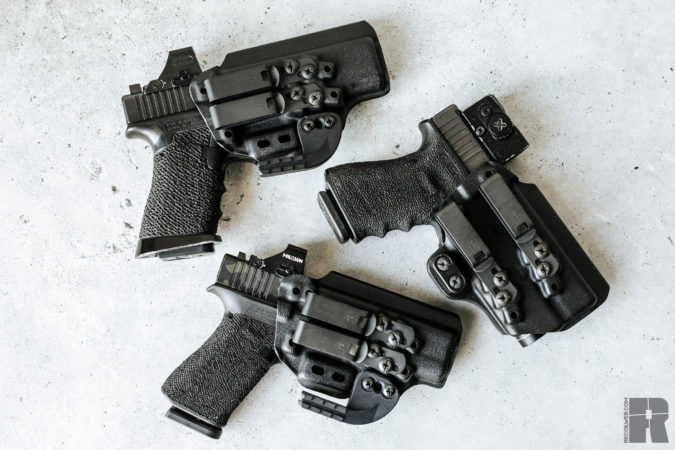
The ability to adjust the depth and angle the holster sits at can be very important when you’re always sitting in a wheelchair as well, because the waistline of your pants typically rides at an angle instead of being level. So it’s important to have a holster that allows you to adjust it to suit your specific needs. The holster itself should also stay in place wherever you attach it and not move around, so that when you go to draw the handgun it’s always going to be where you expect it to be.
Before I break down each wheelchair concealed carry method, allow me to explain the requirements that dictate my personal methods of concealment (for any self-defense tool). First, I want my gun to be easily accessible at all times, regardless of the context in which I may need it. I should also be able to quickly access and draw the pistol using just one hand (left or right) if forced to, no matter if the other hand is injured or just busy fending off an attacker, grasping another tool such as a handheld flashlight or fixed blade knife, or controlling my wheelchair.
I also need to be capable of achieving this whether I’m in my wheelchair, driving my vehicle, sitting on the couch with the wife, or even if I’m thrown from my chair and lying on the ground. Bottom line: If I have to draw my gun, I want to be able to access it as quickly as humanly possible.
Carrying your handgun on-body, in an IWB (inside the waistband) holster secured somewhere along your waistline, whether attached to your pants or belt, or even directly to your body using something like the new Phlster “Enigma” concealment chassis, is by far the most effective and efficient way to go about it. Carrying on-body checks all of the above considerations, and the gun also goes wherever your body goes. Imagine fighting or holding off an attacker with one hand, while simultaneously drawing your gun with the other … and doing both of these things while on the ground after having been thrown out of your chair. You ideally want your gun to go wherever your body goes, without ever being physically separated from it.
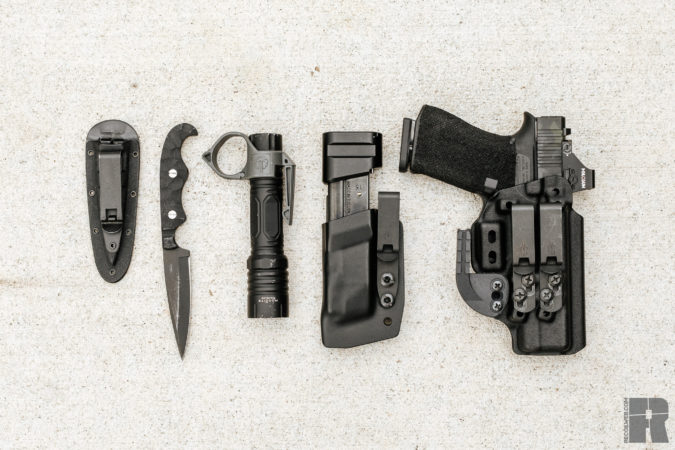
As an example, I carry on my “strong side” (right hip) at 3 o’clock. I typically carry either a Glock 17 or 48 in a Tenicor “Certum3” holster (not a typo), depending on what I’m wearing. Since I cannot wear a belt on a daily basis (they can break down my skin and give me a wound on my tailbone), I use Discreet Carry Concepts metal clips that really bite into any of the pants I wear. The DCC clips keep my holster in place all day long, and I’ve never once had the holster come out in addition to the gun in the thousands of draws I’ve done since I began using them several years ago. They are by far the best clips I’ve seen or used to date on my holsters, magazine pouches, and knife sheaths.
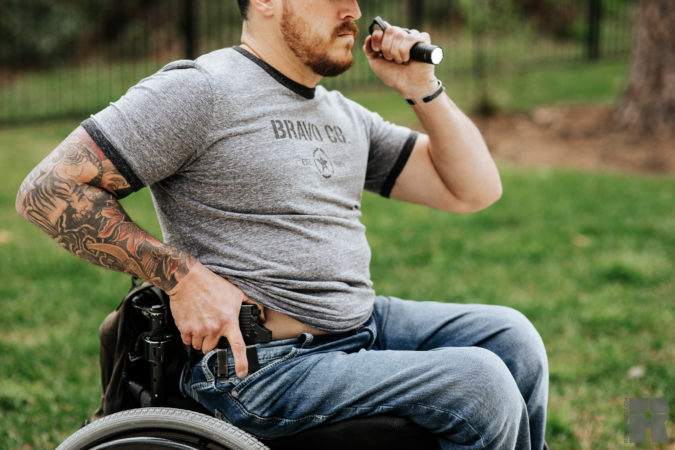
If you do wear a belt on a daily basis (and you should, if possible), make sure it’s a belt that’s actually designed for carrying the weight of a gun and your other tools. You can also use soft loops when wearing a belt if you prefer them over clips.
Carrying appendix IWB is also a great option if you’re able to do it (I can’t, or I probably would). Just keep in mind that it’s crucial to use a holster that’s truly designed for carrying AIWB. My friend Luke Cifka, an instructor for Sage Dynamics, is a double above-knee amputee in a wheelchair who carries AIWB every day. “Equipment setup will make or break your draw stroke from a chair,” he says. “Chair users may have limited use of trunk mobility, which can complicate the draw since the user may not be able to straighten up to achieve a good grip.”
I agree, completely. It’s unique challenges like that which will dictate your ideal carry gun, concealment method, and holster setup. You’ve already got to work around your disability, so don’t compromise on your equipment.
Let me also briefly address carrying on an ankle or small of the back. Both of these can actually be good for concealment, but they’re much slower and require more overt movements to draw (making a slow-draw far more challenging) and are suboptimal carry locations if thrown to the ground. They may have some utility for carrying backup guns, but not as primary methods of concealment.
Off-body wheelchair concealed carry (i.e. inside of a shoulder bag, purse, briefcase, etc.) is, of course, always better than carrying no gun at all, but isn’t ideal for multiple reasons. For one, you always have to maintain positive control of the bag at all times. If it’s not on your person, then it’s an unsecured gun and that’s a good way for someone to access it who shouldn’t, like a child or your intoxicated friend at the dinner party you’re attending.
Something else to keep in mind: If you get thrown out of your chair and are receiving blows from your opponent, your bag will move and twist every which way. You’ll potentially be trying to draw your handgun while both you and your bag are simultaneously shifting around as you’re defending yourself … and that’s assuming it even stays attached to you or isn’t pinned underneath your back.
If you do decide to carry in a bag, buy one that you can wear crossbody on your strong side that’s purpose-built for carrying a handgun and has the ability to mount a good holster inside. You can also buy your own hook and loop tape to securely attach the holster inside of a bag. But this only works if it’s mounted inside a pouch or another tight compartment, so that it’ll always stay in place and be where you expect it when you need it.
Whatever bag you choose, it needs to provide easy access to the gun under stress as fast as humanly possible.
Lastly, there’s the ability to mount a holster somewhere on your wheelchair itself. (Side note: This actually works great for competition shooting and home defense.) This is technically still off-body carry, but it’s unique in that it always stays attached to your wheelchair, which does almost feel like an extension of your body.
I’ve seen one guy online who mounts his gun in a Level 2 retention holster on the frame of his manual wheelchair (close to his right knee), and then places a general-purpose pouch of some kind over the top of his gun, which serves to camouflage it completely. It looks a bit odd having such a large “pouch” hanging off the front side of his wheelchair, but this is definitely the best execution I’ve seen thus far of a wheelchair-mounted concealed handgun. When he wants to draw the gun, he simply rips off the dummy pouch, which exposes his holstered handgun, giving him immediate access to it.
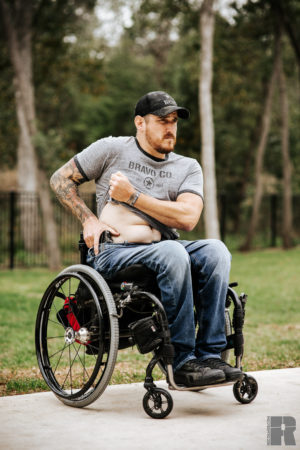
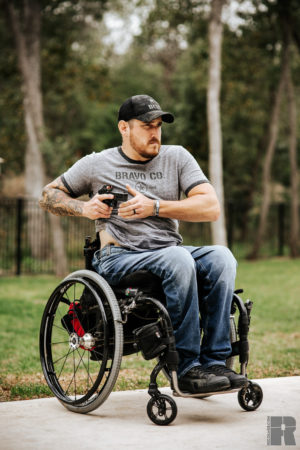
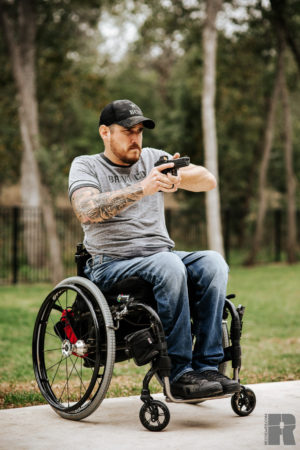
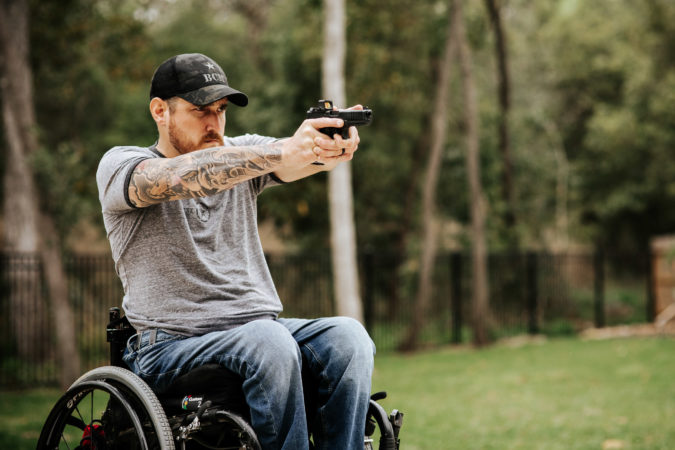
The biggest downsides with carrying your handgun in any wheelchair-mounted holster are:
Becoming completely separated from your lifesaving tool the moment you’re knocked out of your chair and need it most.
Mounting it will likely have to be done by you, because it’s such a niche product, and concealing it takes some creativity.
Every time you transfer to your vehicle (unless you sit and drive from your actual wheelchair), you’ll have to safely move your gun from your wheelchair-mounted holster and into the vehicle with you somewhere that it’s readily accessible and will stay put.
When you transfer to someone else’s vehicle and do not want them knowing you have a gun, you’ll have to figure out a way to stealthily transfer the gun out of your wheelchair-mounted holster and into the vehicle with you, be it inside a bag or elsewhere on your person. You’ll also have to achieve this out of sight from anyone passing by or potentially even helping you into the vehicle.
Although mounting firearms on your wheelchair isn’t usually the best method, mounting other tools can actually be very advantageous.
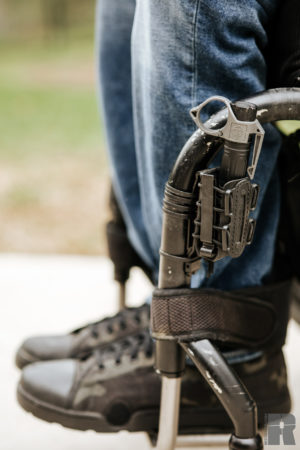
I have a handheld flashlight mounted on the left side of my wheelchair, which is my support-hand side. I’m able to quickly access it with my support hand, which keeps my strong hand free to always be staged and ready to draw my handgun. I just used zip-ties to mount a G-Code universal magazine pouch to the frame of my chair, so I can carry any flashlight I want in that.
You can also mount spare mags, knives, pepper spray, tourniquets, etc. to your chair. I’ve got a Benchmade SOCP knife mounted to the frame on the right side of my chair. Although I could certainly use it for self-defense, honestly for me it’s primarily a utility knife that’s readily accessible.
One item everyone should carry is a tourniquet, and there’s several different ways to carry one. You can wear one on your ankle if you choose, or mount it to your chair, or even stow one in your backpack. I actually have my Dark Angel Medical D.A.R.K. trauma kit attached to the right side of my backpack via MOLLE webbing. I also have three extra tourniquets in my backpack. Pretty much every person in a wheelchair has a small backpack hanging on the back of their chair, so there’s no reason not to carry items that could save your life or the lives of people you care about.
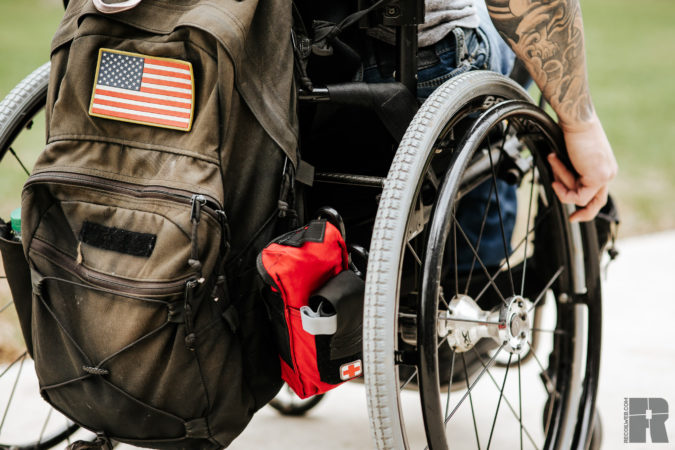
When it comes to carrying spare magazines, body type again comes into play. When I carry a spare magazine on my body, I use the Bawidamann Vertical Uber CC Mag Carrier, because it allows the magazine to sit very deep inside my pant line. My spinal cord injury is “complete,” so I have a gut that will always stick out right at the level where my paralysis begins (level T12). Because of this, a standard-depth mag pouch prints terribly on me, but you may not have this problem.
Like tourniquets, everyone should carry a fixed blade knife (local laws permitting). I carry a Headhunter Blades “Rat” fixed blade knife on the support-hand side of my waistline, around 10 o’clock. This blade is extremely concealable and is easy to draw from the high-quality Kydex sheath that accompanies it. You can also attach the sheath to any pants material you wear, thanks to its metal spring clip. Amtac Blades is another great knife company.
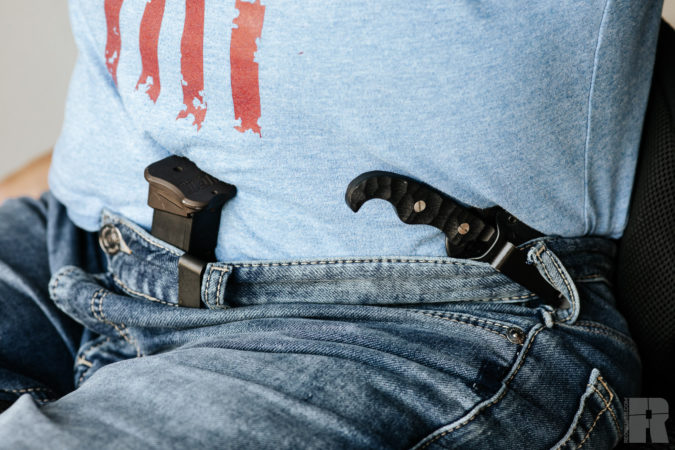
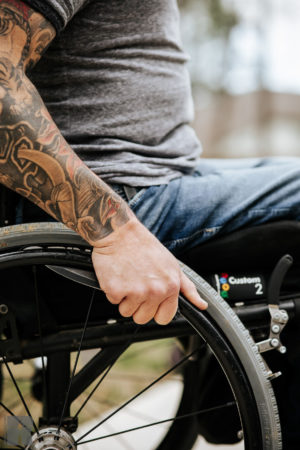
One of the advantages a fixed blade offers is that it’s very fast to draw and doesn’t require as much movement to do a stealthy slow-draw. I’ve been in places where I can’t carry a gun, and I’ll actually carry a fixed-blade knife on each hip. If I’m forced to roll past some shady-looking individuals, I may even slow-draw a blade and keep it staged in my hand and keep pushing my chair without anyone ever knowing I have a knife in hand as I pass by them, as my blade is camouflaged by my wheel.
The one common theme for wheelchair concealed carry is that you need to be able to access any of your self-defense tools as easily and quickly as possible, be it a gun, knife, pepper spray, spare magazine, etc. When you’re in a wheelchair you have to think outside the box to accomplish things that able-bodied people take for granted, and self-defense is no different.
Don’t simply decide on a method of wheelchair concealed carry, buy a holster and then immediately begin carrying a gun in it the next day. Practice drawing from concealment in both dry and live practice before deciding to carry your handgun using a preferred method. Lastly, always seek out quality training from highly qualified instructors in order to constantly get better and become harder to kill.
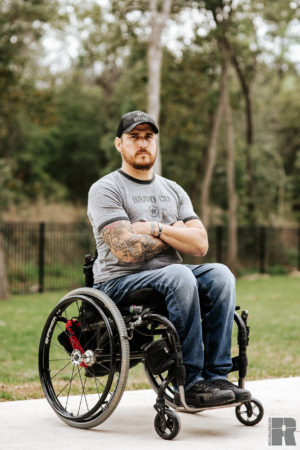
Paul Gardner is a former U.S. Marine Rifleman, firearms training junkie, and firearms instructor. He recently started his own training company, Strive Tactical. For now, he can be found on Instagram @Wheelchair_Technical.
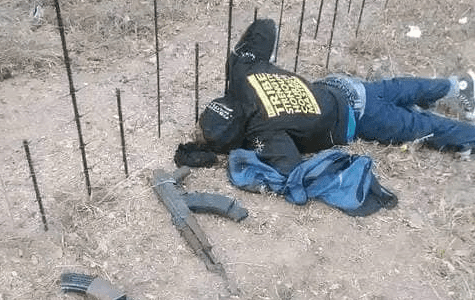
On Thursday, 9/21, local farmer militiamen in South Africa stopped a gang of 15 armed robbers armed with AK-47s who had just robbed an armored car, killing the driver. The local volunteers apprehended the fugitives after a high-speed chase, including a dangerous Mozambican criminal wanted for murder of a police officer.
The robbery took place in Hoedspruit (Hat Springs) outside Polokwane in Limpopo Province, which were named Pietersburg and North Transvaal by the original settlers before the campaign to ethnically cleanse the Afrikaner language and culture from South Africa.
Heavily armed attacks on armored cars are so common in South Africa they are known as Cash-in-Transit heists (CIT).
Hero farmers from Hoedspruit kills 4 CIT robbers and wounds 3 after police flee the scene.
Full story:
Today, 22/09/2023, 15 robbers armed with automatic rifles carried out a CIT heist in Hoedspruit, killing the driver Fidelity driver. Police fled the scene when the robbers… pic.twitter.com/QtHq8KsaYp
— Willem Petzer (@willempet) September 22, 2023
According to police spokesman Colonel Matimba Maluleke, the suspects shot at the escort vehicle before disarming the guards (a driver and crew) of their official rifle and pistol. “Unfortunately the two guards were shot at and sustained injuries that resulted in the death of the driver. The suspects then pursued the armoured vehicle while shooting at it until it stopped.
The driver of the armoured vehicle and his crew were allegedly ordered to disembark the vehicle, disarmed of two firearms and chased into the nearby bushes. The suspects used explosives to blast the vehicle and made off with an undisclosed amount of money,” Maluleke said.
“A community crime watch group, Hoedspruit Farmwatch, was alerted to the incident and went in pursuit of the robbers, putting obstacles on the road to prevent their escape. A shootout ensued,” Petzer writes.
It is further reported that the suspects started shooting at members of Hoedspruit Farmwatch who in self-defence returned fire. During the shootout, four suspects were killed and one (28) was injured and arrested on the spot. The other suspects ran into the nearby bushes and…
— Ian Cameron (@IanCameron23) September 23, 2023
“The Hoedspruit Farmwatch volunteers blocked the roads outside of Hoedspruit with boulders after they were alerted of the attack. A skirmish, lasting about 20 minutes, ensued at one of the blockades between the robbers and the farmers, who were armed with pistols. The farmers managed to kill 4 of the robbers and wound 3. No farmer was hurt. The other suspects fled into nearby bushes after the shootout on foot.”
“The Hoedspruit farmwatch tracked them down using their dogs and arrested the rest of them, recovering all the money from the heist. Great job by the farmers!” Petzer writes.
Hoedspruit Farmwatch denied that South African Police Service officers had fled the scene.
MESSAGE ON BEHALF OF HOEDSPRUIT FARMWATCH
Hoedspruit Farmwatch would like to thank everyone for the positive response and support being received so far. We are very proud to serve the community of Hoedspruit and our immediate surrounds and it is an honour to be part of such a…— Ian Cameron (@IanCameron23) September 23, 2023
Police spokesperson Colonel Malesela Ledwaba said the community protection team “returned fire and when the dust settled, four suspects were fatally shot, one injured and arrested while others managed to evade arrest by running into nearby bushes,” The Citizen reports.
The fleeing duo was “arrested while travelling to Acornhoek in a taxi following an intense search mission by the Hoedspruit Farmwatch, the Directorate for Priority Crime Investigation and a chopper,” Ledwaba stated.
“One of the arrested suspects is a highly wanted Mozambican suspect who has been on the run for some time for a spate of crimes he committed in the Free State in 2022 including the murder of a police officer. The injured suspects were found in possession of suspected stolen money, a rifle and a pistol,” the police spokesman said.
Several community safety organizations met Sept. 19 in Centurion to join forces to to curb farm attacks and rural crime, including AfriForum, Southern African Agri Initiative (SAAI), Transvaal Agricultual Union TLU SA, AgriSA, Forum Sekuriteit, Sakeliga, the South African Special Forces Association (SASFA) and the Association for South African Military veterans, AfriForum reported.
“AfriForum is excited about the fact that all these organisations are willing to join hands and make a difference against the wave of farm attacks and increasing rural crime. The SAPS itself has already admitted that it cannot fulfil its mandate, and this is obvious when one looks at the chaotic state of crime in the country. It is now time for communities to safeguard themselves,” said Jacques Broodryk, AfriForum’s spokesperson for Community Safety.
According to Dr. Theo de Jager, executive director of SAAI, the different organizations, civil structures and agricultural unions have feet on the ground when it comes to rural security: “Some organisations have farm watches in remote areas or camera systems, radio networks, emergency centres or response units. Others post guards, patrol national roads or establish and manage private fire services. Ultimately, everyone is in the same industry and has one goal in mind – to secure communities where the government can no longer do it,” said De Jager.
AfriForum’s Security Head Jacques Broodryk on Farm Murders: