Category: All About Guns


The Remington Model 8 and FN 1900 rifles were the brainchild of John Moses Browning. Originally patented in 1900, the design was the first successful high-powered semi-auto rifle made, and it is no surprise the great J.M.B. was the designer. While Remington built the U.S. market version, Browning contracted with FN to build the European market model 1900s as he already had a good relationship with the firm who already produced many of his designs.
The rifle is long-recoil operated and feeds from a fixed magazine. The Remington Model 8 was chambered in four different Remington rimless cartridges, they were the .25, .30, .32, and .35 Remington while the FN produced variant was only made in 9mm FN which for all intents and purposes is .35 Remington.
The 1900 models were offered starting in 1911 by FN retailers and were available as late as 1931-1932. Some believe that the rifles were mostly all built before the outbreak of WWI but there may have been a small parts clean-up run in the years following.
FN only produced 4,913 of these rifles and they were never officially imported into the United States, there was really no reason to do so when Remingotn was selling the model 8. Considering the price of the 1900 was also $17 dollars more than a Grade III Model 8, it was a wise business decision to not spend the time or money importing them when Americans could get, effectively, the same gun with a different roll mark.
Compared to its sibling made by Remington, the FN model has a few differences, namely the markings, the more elegant looking bolt knob, the lower tang locking screw…and most have a rib. This is an already rare rifle made even rarer by not having a rib and is an early variant with the proofs on the left side.
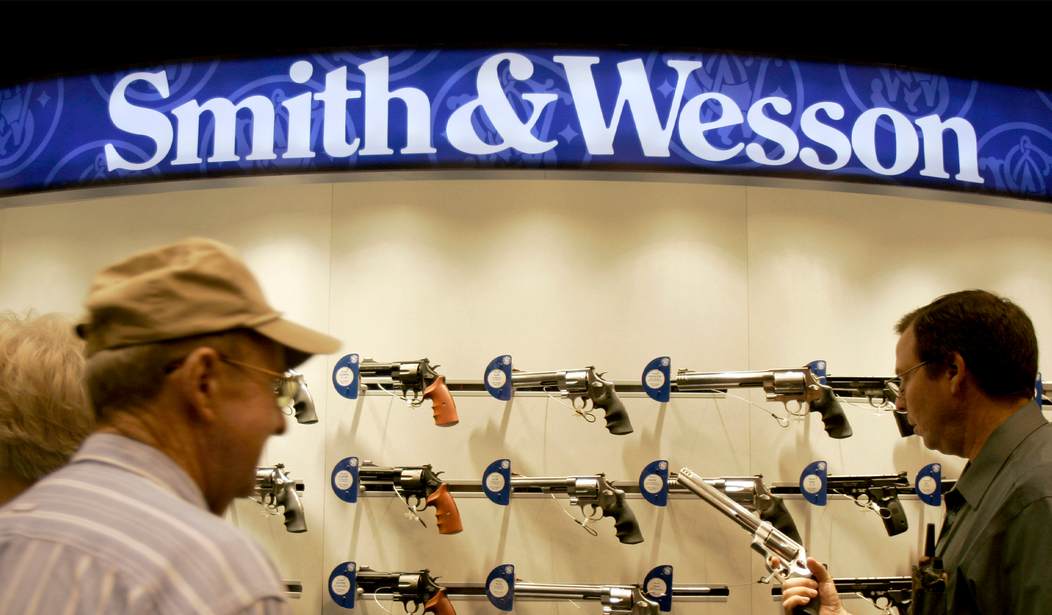
In a move that will surely make my colleagues Jeff Charles and Ward Clark happy, renowned firearms manufacturer Smith & Wesson ditched deep blue Massachusetts and moved its headquarters to friendlier pastures in Tennessee. Although the move was announced in 2021, it was on Saturday that the company officially opened its new 650,000-square feet building in Marysville as part of a $125 million relocation effort.
The company has been in New England since its founding in 1852, but Massachusetts’ strict gun laws are at least partly to blame for their exodus:
The gunmaker had been located in Springfield, Massachusetts, since the mid-19th century, but company officials have said legislative proposals in that state would prohibit them from manufacturing certain weapons. Massachusetts is known to have some of the country’s strictest gun laws.
I’m sure the high taxes didn’t help either; there’s a reason some call the state “Taxachusetts.” It’s also certainly not a coincidence that Tennessee is far friendlier to law-abiding gun owners than Mass.:
Smith & Wesson President and CEO Mark Smith spoke at the event Saturday, which drew a large crowd to the new facility, The Daily Times reported.
“From where I stand, the next 170 years of Smith & Wesson are looking pretty good,” Smith said. “It is something special here in Tennessee.”
He cited a welcoming regulatory environment and close collaboration with the Tennessee state government as a crucial piece of the plan to relocate. The company has said the new facility would create hundreds of jobs.
Tennessee has moved to loosen gun restrictions in recent years under Republican leadership. In 2021, the state passed a law to allow most adults 21 and older to carry handguns without a permit that requires first clearing a state-level background check and training.
The National Rifle Association applauded the move and congratulated the company on their ribbon-cutting ceremony:
“Congratulations to Smith & Wesson on their grand opening in Tennessee. This move is a testament to their enduring legacy, their commitment to firearm excellence, and to the importance of preserving America’s gun industry and Second Amendment rights in a fair environment,” NRA Executive Director of Advancement Tyler Schropp told Fox News Digital in an exclusive comment.
As part of the opening day ceremonies, guns were naturally fired, and shooter Jerry Miculek set a world record:
This is how it’s done, folks. If a state is treating a company badly, they should get the heck out of dodge and relocate to where they’re appreciated. California Gov. Gavin Newsom knows this all too well, as dozens of corporations have headed for the exits during his disastrous tenure. The full list is lengthy, but here are just who have fled the Golden State in just the last three years: McAfee (cybersecurity), Boingo Wireless, American Airlines (flight attendant base), Chevron, Tesla, Charles Schwab, Oracle…
Ok, you get the idea. The point is, just like Bud Light and Target learned, the power of the purse is tremendous. If you’re not wanted, then why not take your money and go elsewhere?
Nice shot, Smith & Wesson.

So-called “red flag laws” have become a recent favorite of gun control activists, who portray them as a way to keep firearms out of “dangerous hands.” The laws empower judges to issue case-by-case firearm prohibition and confiscation orders, upon a petitioner’s showing that the respondent of the order poses a danger to themselves or others.
The concept has at times held superficial appeal even to those who might normally support Second Amendment rights. But it’s constitutionality and efficacy wilt under close, critical scrutiny, which is why the NRA opposes the concept.
Last week, an unusually revealing article by Bridge Michigan, an independent news source from the Wolverine State, brought another critical voice to the debate: that of the police who will actually be tasked with executing the orders. Entitled “Michigan police agencies sweating enforcement of ‘red flag’ gun laws,” it vividly underscores the difference between theory and practice when it comes to gun control.
Among the officials quoted in the article is Robert Stevenson, executive director of the Michigan Association of Chiefs of Police. He said he supports the idea that people who are “not mentally balanced” should not have firearms, but he is concerned with the practicalities of how police will enforce Michigan’s new red flag law, which takes effect next spring. Stevenson offered several scenarios in which the supposedly “lifesaving” law could itself pose lethal risks.
As he explained to Bridge Michigan:
What happens if the person with the order tries to hurt the officers? What if the person who was deemed suicidal becomes overwhelmed and still poses harm to themselves when their guns are being seized? What if the individual with an order has to be detained by force or even be killed, due to the threat they pose?
From the citizen’s perspective, Stevenson said, it could be a case of: “We’re trying to save somebody in the family. We went to the police to save them, and they killed them.”
The legislator who spearheaded Michigan’s red flag effort, Sen. Mallory McMorrow (D-Royal Oak), claimed to Bridge Michigan she “studied the laws in other states, such as California and Florida” and “found no instances of a gun being fired during a seizure of weapons.”
Sen. McMorrow’s research, however, was seriously flawed.
A simple Internet inquiry should have revealed to her that Gary J. Willis, a 61-year-old African American man, was killed by police in Anne Arundel, Md., as they attempted to retrieve his firearm under a red flag order shortly after 5:00 a.m. on Nov. 5, 2018.
Willis’s wife, Dolly, was also home at the time. Police claim that Willis became increasingly agitated as officers explained the requirements of the order to him and that he reached for the gun after he had voluntarily set it aside at their request.
Willis died on the scene after being shot at least five times by police. A Baltimore Sun article quoted the local police chief as saying the execution of red flag orders involves, by definition, “a tense, dangerous situation,” one he would prefer to be handled by SWAT teams.
Gun control advocates like to claim any intrusion on constitutional rights is justified, if it “could save just one life.” Apparently, however, they don’t hold themselves to that same standard when promoting policies that themselves pose lethal risks.
Also expressing skepticism of the red flag concept to Bridge Michigan was Matt Saxton, the executive director of the Michigan Sheriffs’ Association. Sexton said his “organization was never asked to comment on conversations of how to enforce the new law.”
He described being “left in the dark, not sure what to strategize for and what to envision when [the new law] takes effect.” It appeared to him that localities would be left to figure out the logistics of implementation on their own, perhaps in collaboration with each other. Sexton told Bridge Michigan “he doesn’t believe that extreme risk protection [i.e., red flag] laws are the best laws that could be passed,” but he hopes for the best.
No wonder that the most consistent experience states have when passing red flag laws is to later discover they are little known, little utilized, and don’t live up to their billing as a game-changing way to prevent “gun violence.”
A Duke University sociologist who studies red flag laws and their effects told PBS, “It’s too small a pebble to make a ripple. … It’s as if the law doesn’t exist.”
When a law is almost universally treated as if it doesn’t exist, it may be because it should have never existed in the first place. Disuse, indeed, might be the best that could be hoped for when it comes to red flag laws.
Categories
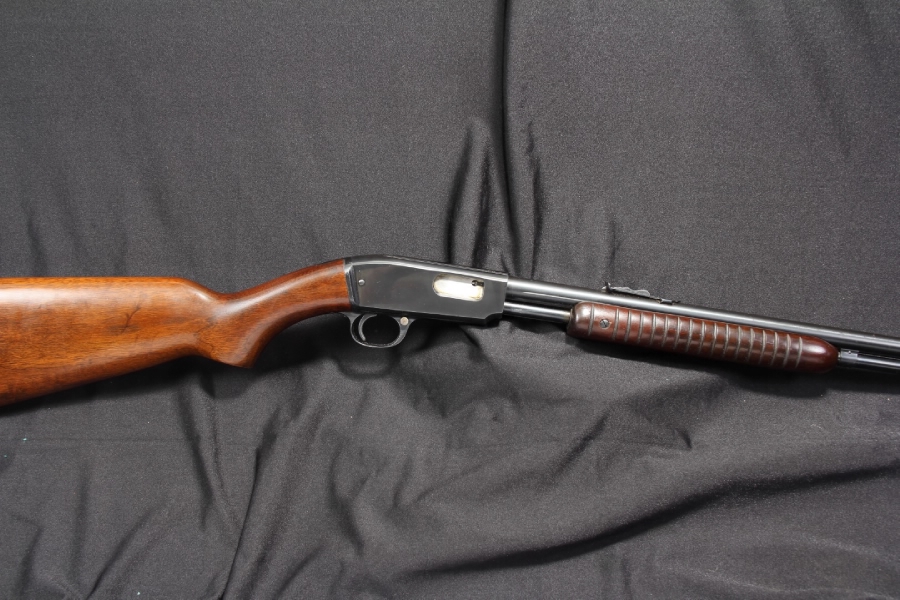
A Winchester Model 61 in 22 Magnum
Categories
The Timeless Winchester Model 54
Born out of post-World War I demand for bolt-action sporting rifles, Winchester’s Model 54 proved to be a successful marketplace competitor—one that still performs well.
by
- LAYNE SIMPSON
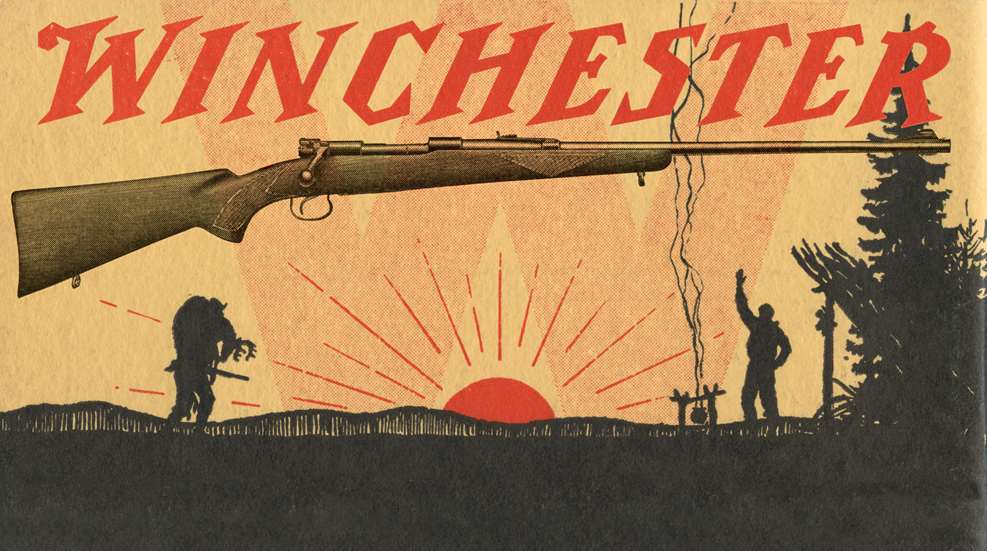
During World War I, Winchester and Remington built more than 2.25 million U.S. Model of 1917 rifles in .30-’06 Sprg. for the U.S. government. Cancellation of contracts toward the end of the conflict in 1918 left them with tons of parts in various stages of completion, not to mention acres of idle production machinery. Soon thereafter, both companies began to explore the possibility of building a bolt-action rifle for sporting use rather than for war. Remington beat Winchester to the punch in 1920 by utilizing modified M1917 parts on hand to create the Model 30 rifle in .30-’06 Sprg.
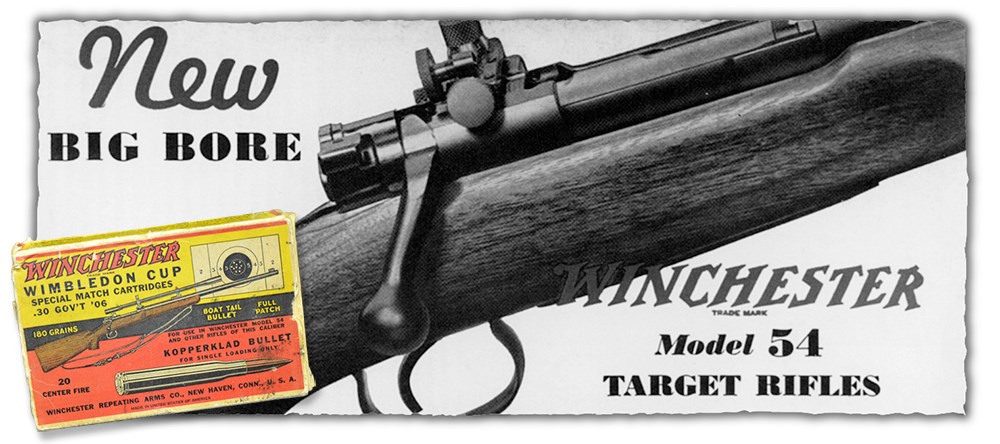
For several years, Winchester had been building target rifles in .30-’06 Sprg. on the Model of 1903 Springfield action for United States military rifle teams. The new Model 54 sporting rifle introduced in 1925 inherited several design details from that action.
The Model 54 was not the company’s first bolt-action rifle, but it was the first designed for use with high-intensity cartridges. Firearm writers of the day praised some of its features, with Philip Sharpe describing it as “standing high in a class by itself.” But other design details were thought to be less than perfect. At the top of that list was a one-piece steel stamping for the trigger guard and magazine cover. Another was the trigger serving double-duty as a bolt stop. As on the Springfield, the trigger was two-stage, and while Winchester claimed it was “necessary for safety reasons,” it did not belong on a target rifle or a rifle to be used for hunting big game.
A two-piece firing pin, much like that on the M1903 Springfield, also received its share of barbs. The same went for a three-position, Mauser-style wing safety on the bolt shroud that disengaged when rotated to the right rather than to the left. Despite those shortcomings, Model 54 sales were not bad until the beginning of the Great Depression in 1929 when many citizens began to become more concerned with putting bread on the table than with buying a new rifle.
The Model 54 was introduced in .30-’06 Sprg. as well as a brand-new cartridge called .270 Win. A young college professor by the name of Jack O’Connor was one of the first to purchase a .270 Win.-chambered Model 54.
Later added were the .30-30 Win. in 1928, the 7×57 mm Mauser, the 7.65×53 mm Argentine and the 9×57 mm Mauser in 1930, the .250 Sav. in 1931, the .22 Hornet in 1933 and the .220 Swift and .257 Roberts in 1936. Special-order rifles were built in .25-35 Win., .32 Win. Spl. and .35 Whelen, the latter making the Model 54 the first factory-built, bolt-action rifle chambered for a wildcat cartridge.
The only .35 Whelen Winchester Model 54 I’ve ever examined was in a collection at a gun show during the 1970s that had all the correct factory-applied markings.
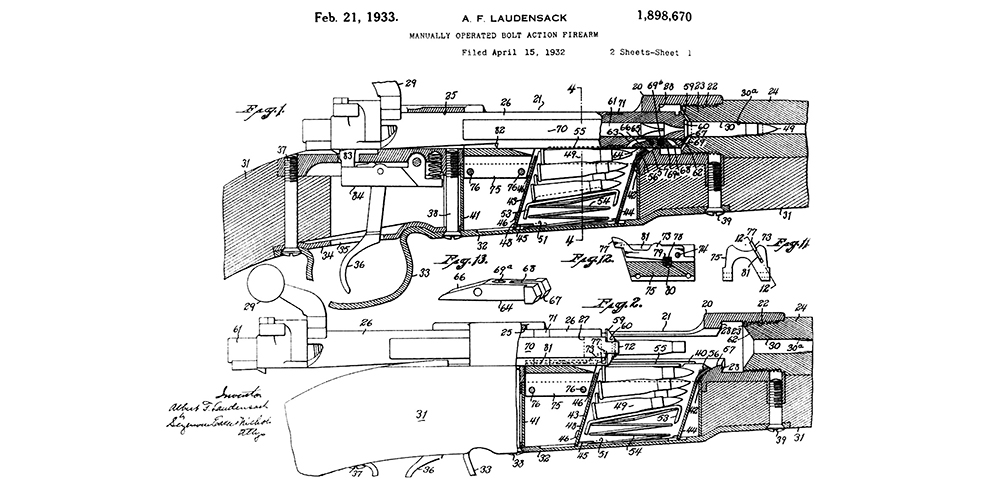 The specification drawing pictured contains the U.S. patent number attributed to Albert F. Laudensack for his modifications to the design of the Model 54 rifle that would allow it to fire the .22 Hornet cartridge.
Model variations eventually offered included the Standard Rifle with 20″ or 24″ barrel (26″ barrel in .220 Swift), Super Grade with 24″ barrel, Carbine with 20″ barrel, Sniper’s Rifle with heavy 26″ barrel, Target Rifle with heavy 24″ barrel and National Match with 24″ barrel.
The Super Grade sporter had a figured walnut stock with good checkering coverage, checkered steel buttplate, hard rubber grip cap, black fore-end tip and quick-detach sling swivels. Unlike the Standard Rifle with a 20″ barrel, the stock of the Carbine had no checkering, but both sides of its fore-end had a finger groove. Also missing were fore and aft steel eyes in the stock for hook-attachment of a sling.
The Carbine was promoted by Winchester as being perfect for carrying in a saddle scabbard while hunting from horseback. The NRA Standard Rifle, introduced in 1931 in .30-’06 Sprg. and .270 Win., had a select-grade walnut stock with checkering, a checkered steel buttplate and a Lyman 48W aperture attached to its receiver.
It was later available in other chamberings. The Lyman 48W was an extra-cost option on other models having open sights. For paper-punchers who used long, high-positioned scopes made by Stevens, J. W. Fecker and others, target rifles were drilled and tapped for a rear mount on the receiver ring and a front mount out on the barrel.
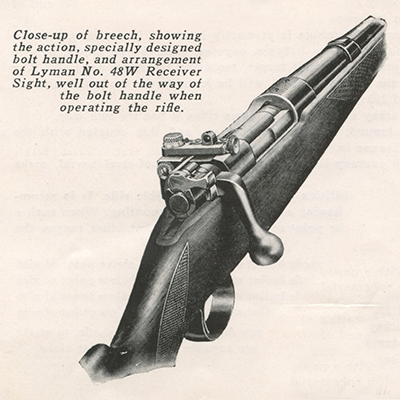 “The receiver has screw holes for attaching a Lyman No. 48W Receiver Sight, which will be furnished on the standard rifle on special order at an extra charge.” [vintage Winchester Model 54 pamphlet]
Like the Winchester Model 70 that replaced it in 1936, the Model 54 has three action bolts.
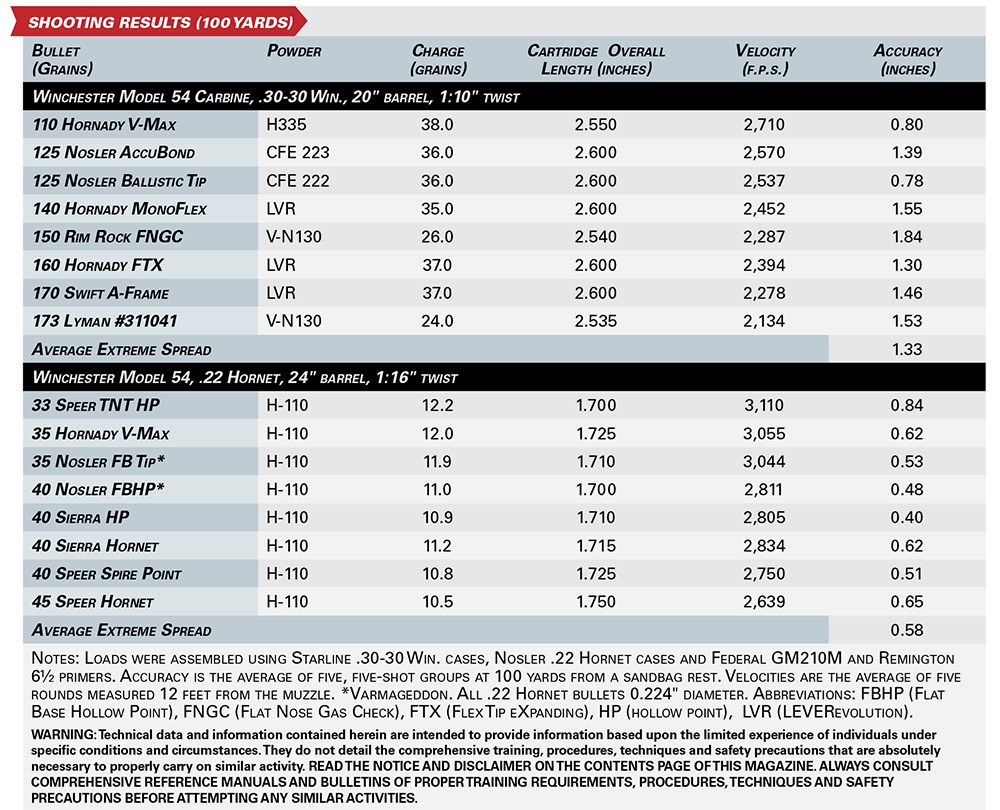
Beginning at the rear, one turns into the tang of the receiver, the next into the receiver just behind the magazine and the third into the recoil lug. Also like the Model 70, a screw out on the fore-end turns into a lug dovetailed to the bottom of the barrel. I have never fiddled around much with Model 54s in other chamberings, but my .22 Hornet is most accurate with the three action bolts tightened to 35 in.-lbs. and the barrel screw at 10 in.-lbs., all with a Real Avid torque wrench.
Once low-mounted, hunting-style scopes began to catch on, a modification made by owners of Model 54s became popular enough to make finding a rifle in totally original condition quite difficult today.
From his basement workshop in 1938, Maynard P. Buehler of Orinda, Calif., began selling a replacement, two-position, low-profile wing safety for the Mauser, Springfield and Model 54 rifles. In addition to eventually selling millions of those, Buehler became even more famous for his streamlined scope mounts.
The Winchester Model 54 action’s original lock time of 5.2 milliseconds was reduced to 3.1 milliseconds with the addition of the .22 Hornet in 1933. Called the Speed Lock, Winchester offered to convert earlier “plain lock” rifles for a nominal fee. This speed was quite incredible for the day, considering that lock time for the latest Model 70 action is 3.0 milliseconds.
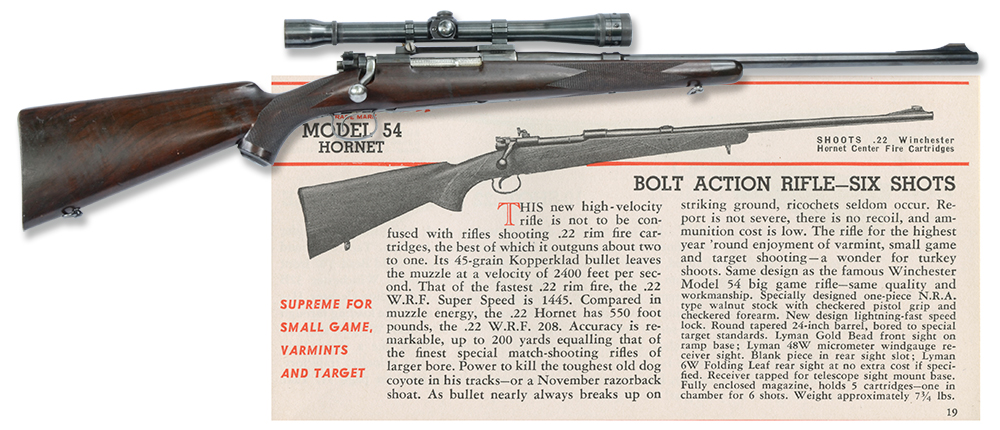 This Model 54 in .22 Hornet was built by Winchester in 1933, the year that cartridge was added. It was re-stocked by Hart Arms Co. of Cleveland, Ohio, during the 1940s, and through the years, it has taken its share of prairie dogs, groundhogs, crows and gobblers.
I used to have a collection of rifles in .22 Hornet from Winchester, Kimber, Brno, Charles Daly, Anschutz and several others. The most unusual was a Herter’s Hornet from the old mail-order firm of that name. My Winchester Model 54 was made in 1933, the year the .22 Hornet was added, and it consistently shot smaller groups than the others.
Except for a Buehler safety and a very good single-stage trigger, its barreled action is factory-original. The rifle was re-stocked by Hart Arms Co. of Cleveland, Ohio, sometime during the 1940s, and like all early rifles in .22 Hornet (including the Winchester Model 70), the rifling in its barrel has a 0.223″ groove diameter and a 1:16″ twist rate. As contrary as it might seem, both rifles are considerably more accurate with 0.224″ bullets than with those measuring 0.223″.
Altering the Model 54 action to handle the .22 Hornet was costly, but the price was the same as for the Standard Rifle chambered for other cartridges. In addition to shortening bolt travel, a five-round, top-loaded, double-column magazine sized for the tiny cartridge was fastened to the inside of the standard internal magazine box.
The follower is machined steel and its spring is of a wire-type rather than a flat-type. The rim of the top cartridge in the magazine rests below the front of the bolt. As the bolt moves forward, a spring-activated lever drops down to engage the head of the cartridge and pushes it far enough forward to allow the face of the bolt to take over and chamber the round.
At that point, the pusher retracts back into its slot in the bottom of the bolt. It sounds a bit complicated, and it is, but cartridge feeding in my Model 54 and Model 70 rifles has always been flawless. A spring-loaded, blade-style ejector is attached to the magazine box rather than to the receiver.
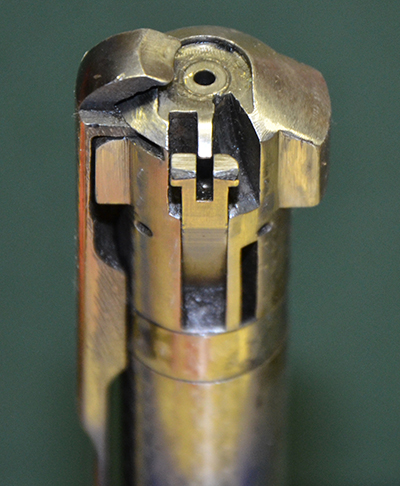 The rim of the top .22 Hornet cartridge in the magazine rests below the front of the retracted bolt. As the bolt moves forward, a spring-activated lever pinned to the bottom of the bolt drops down to engage the head of the cartridge and pushes it far enough forward to allow the face of the bolt to chamber the round. It has always worked flawlessly.
Back when rifles could be legally used for bumping off Thanksgiving dinner in my home state, I preferred the Model 54 because calling a gobbler in close and taking it with a body shot from the .22 Hornet was more fun and more challenging than saturating its head and neck with a swarm of pellets from a shotgun.
Through the years, the rifle has also accounted for its share of crows, groundhogs, prairie dogs and flickertails. For best accuracy, maximum bullet length for its 1:16″ twist has proven to be around 0.590″, but it is more accurate with shorter bullets, such as the Nosler Varmageddon 40-grain hollow point (0.570″), Sierra 40-grain hollow point (0.565″) and the Speer 40-grain spire point at 0.510″.
The basic Model 54 design was also modified in 1928 to handle another popular cartridge not usually chambered in full-size bolt-actions: the .30-30 Win. Mine is a Carbine made in 1929. Bolt throw was shortened and the magazine was blocked for the shorter cartridge. The feed ramp had to be modified to handle flat-nosed bullets commonly loaded in the .30-30 Win.
And whereas Model 54 barrels in all other chamberings have the coned breechface of the M1903 Springfield, it is flat for the .30-30 Win. and fully supports the case with only the rim protruding. As mentioned by Stuart Otteson in his excellent book The Bolt Action, “Smooth functioning from clips and box magazines, and not strength, accounts for the widespread application of rimless cartridges in bolt-action rifles.”
Unlike a .30-30 Win. rifle with a tubular magazine, the Model 54 allows the use of pointed bullets, but its magazine restricts cartridge length to a maximum of 2.60“. When the Nosler 125-grain Ballistic Tip and AccuBond bullets are seated accordingly, the mouth of the .30-30 Win. case is 0.80″ beyond the forward end of their full-diameter shanks.
Cartridges feed from magazine to chamber without a hitch, but the appearance bugs me, so I roll crimp the mouth of the case for light contact against the ogive of the bullet. Another option is to shorten case length to 1.955″, no big deal since the neck of the .30-30 Win. case is considerably longer than it has to be. Regardless of the option chosen, accuracy is quite good.
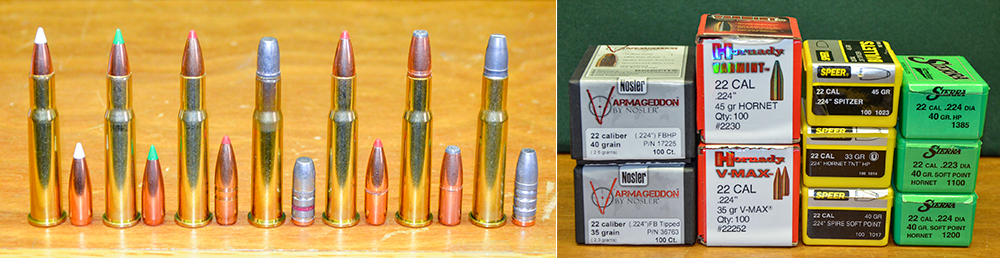 Maximum cartridge length for the magazine of the Model 54 Carbine in .30-30 Win. is 2.6″. The following bullets (l. to r.) are excellent choices for hunting deer and feral hogs: 125-grain Nosler AccuBond; 125-grain Nosler Ballistic Tip; 140-grain Hornady MonoFlex; 150-grain Rim Rock cast; 160-grain Hornady FTX; 170-grain Swift A-Frame; and 173-grain Lyman cast. For best accuracy, maximum bullet length for the 1:16″ twist of the .22 Hornet barrel has proven to be around 0.590″, but it is more accurate with shorter bullets such as the Nosler Varmageddon 40-grain hollow point (0.570″), Sierra 40-grain hollow point (0.565″) and the Speer 50-grain spire point at 0.510″. Despite the barrel’s 0.223″ groove diameter, the rifle is more accurate with 0.224″ bullets.
When I bought the .30-30, it was wearing a Model 330 scope of 2.75X magnification introduced by Bill Weaver in 1933. The rifle was originally purchased by one of my father’s friends in 1935 who installed the scope at that time. Internally adjustable, it has a 3/4″ tube and a 100-yard field of view of 35 feet. The 330 and its 4X mate (the 440) were not the first scopes of American make to be suitable for use on big-game rifles (Rudolph Noske was first in 1930), but a $25 price made them the most affordable.
Not long after buying the Model 54 in 1965, I sent the scope to Weaver for refurbishing, and while the company did a wonderful job, each time it is used, I am reminded of how much riflescopes have improved through the decades. I have taken a couple of deer and several feral pigs with the rifle wearing that scope, but most of my hunting and all group-shooting have been with more modern optics. According to Bob Bell’s Scopes & Mounts (1983), approximately 36,000 Weaver 330 scopes were purchased by the U.S. military during World War II, during which it was known as the M73B1.
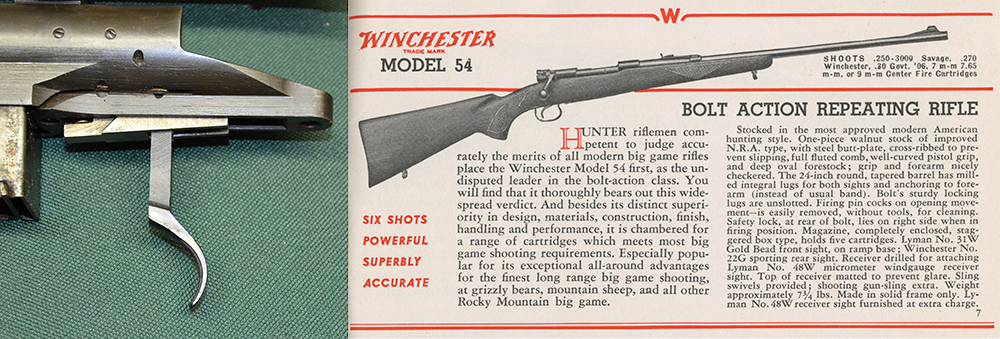 Perhaps the most criticized design detail of the Model 54 action is a military-style, two-stage trigger that also serves as a bolt stop.
The Model 54’s competition was the Savage Model 1920 and the Remington Model 30, both introduced about five years earlier. Having owned and hunted with all three for many years makes it easy for me to compare them. The Savage, with its short Mauser action and feathery weight, was a wonderful little mountain rifle long before hunters added the term to their vocabularies, but its action was too short for the .30-’06 Sprg. cartridge, so the race was lost before it started. Moving to the Model 54’s real nemesis, the safety of the Remington rifle allowed for the mounting of a scope low on the receiver, long before that type of instrument was readily available to the majority of hunters. It mattered not during the 1920s, but it probably began to make a difference toward the end of the production lives of both rifles.
The floorplate of the Remington was not hinged, but a push on its latch with the nose of a cartridge detached it for unloading the magazine. Not so for the Model 54. The Remington is also a bit lighter. In numbers sold, Winchester won, probably because Remington never offered target versions of the Model 30.
When the Model 54 was discontinued in 1936, more than 50,000 had been built versus about half that number for the Model 30 when it left production four years later. Whereas the Remington rifle would never be seen again, the Model 54 was greatly improved and re-introduced in 1936 as the Winchester Model 70.


Top image courtesy Colt.com
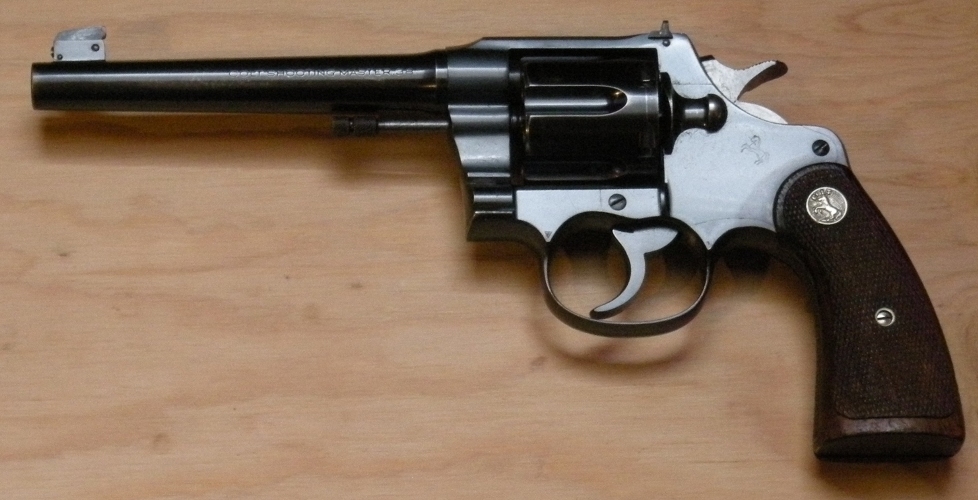
Colt—the name has stood for great firearms for nearly two centuries. From the first Paterson revolver of 1837 to the M16 rifle, millions of people have bought, bartered or stolen to acquire a Colt gun. With its long and storied history Colt conjures up a plethora of images at the mention of the name. Some wax nostalgic over the elegant cap-and-ball revolver models of 1836, ’51 and ’60. Others lean toward the notion that pistol development reached its pinnacle with the Browning-designed 1911.
Still others get giddy over the gorgeous Python. But there is no doubt that the one gun that has defined Colt for some 144 years is the Model 1873 Single Action Army (SAA) revolver, a.k.a Model P or Peacemaker. Twice the company has tried to jettison this revolver and focus its business on more modern arms, and thrice the demand from people from all over the world has compelled Colt to bring the SAA back into production. 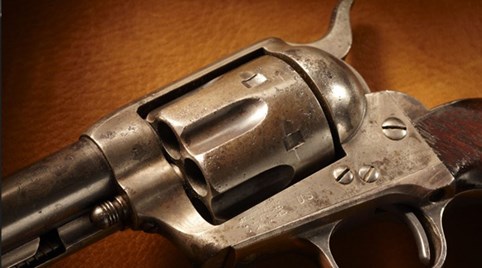
Many incorrectly credit Samuel Colt with inventing the revolver, citing the well-known tale of his time aboard the ship Corgo on a voyage to Calcutta where he observed the ship’s wheel could be locked into position via a capstan on the spokes. It is on that voyage that the 16-year-old seaman carved a wooden prototype of a pepperbox revolver.
However, the revolver was actually first invented in the late 16th century in Europe and was nothing more than expensive curiosity. What Colt did is take the concept and figure out how to manufacture it into a workable firearm. He was also the one who first made the use of interchangeable parts a practical reality in the manufacturing process. Colt died in 1862 of complications of gout.
His net worth at the time of his death was about $15 million—about $350 million in today’s dollars—and though his company had gone through several fits and spurts, the percussion revolvers made under the Colt name were used by militaries, lawmen, outlaws and citizens throughout the world.
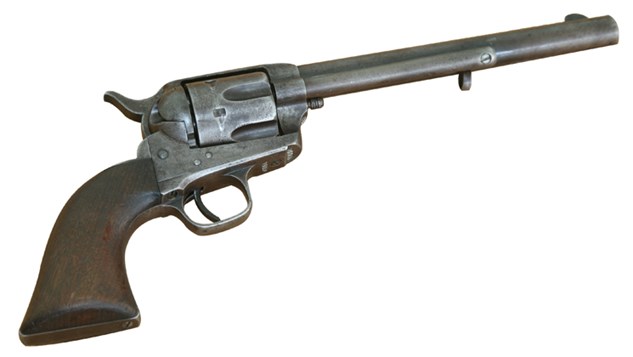
Image by author
In 1849 Rollin White went to work for Colt making revolver barrels one at a time on a lathe. While working at Colt he came up with the idea of a bored-through cylinder that could be loaded from the breech. In the meantime Colt had put White under contract to manufacture the lockworks of revolvers. Colt was reportedly more concerned with marketing its revolvers than improving them.
When White attempted to pursue an improvement on the Colt design he was summarily fired. In 1855 White patented his bore-through cylinder design. Though White’s patent was an ultimately futile attempt to improve on the cap-and-ball concept, Smith & Wesson realized that the bored-through cylinder deign would be necessary to allow the use of a self-contained, breech-loading cartridge. A year later White signed an exclusive agreement with rival Smith & Wesson to manufacture the first cartridge repeating revolvers.
Colt could not work on a bored-through cylinder for its revolvers without paying arch competitor S&W a royalty until 1869. During this time Colt engineers William Mason and Charles Richards put forth some conversion concepts resulting in the 1871-72 Open Top revolver chambered in .44 Henry rimfire. Colt submitted the revolver to the army for testing, but it was rejected. The army wanted a more powerful cartridge and a more robust revolver than an open-top. Mason is credited with adding the topstrap to the design.
Concurrently Colt and the Union Metallic Cartridge Co. were developing a new cartridge that had more power than anything produced thus far. This new cartridge featured an inside-lubricated bullet that would not pick up dirt and grit in the field.
The bullet was a .454-caliber weighing 255 grains and powered by 40 grains of black powder. It also featured a centerfire primer, a concept developed in 1855 and perfected by several inventors, including Col. Edward Mounier Boxer, a British artillery officer. The cartridge, .45 Colt, was chambered in the new revolver and submitted to the army in 1872. The army accepted both the revolver and the cartridge, and production began in 1873.
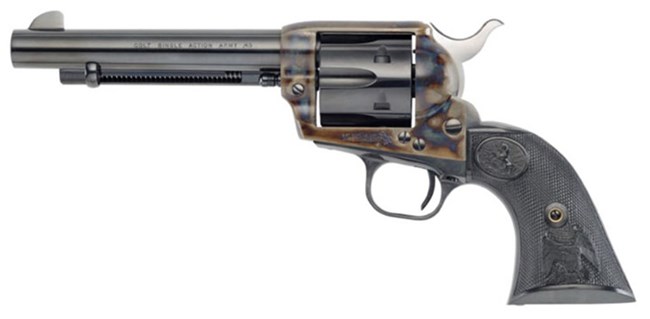
Image courtesy Colt.com
The SAA was an instant success, and civilians as well as the military clamored for the robust sidearm. Barrel lengths were 4 3/4″ (often referred to as Gunfighter), 5 1/2″(a.k.a Artillery) and 7 1/2″ (Cavalry or standard). Initially the frame and hammer were color casehardened with the remainder of the metal parts deeply blued. Stocks were either walnut or black hard rubber. Sights consisted of a blade front and a groove in the topstrap for the rear.
Its cylinder held six cartridges, but those who carried one daily soon learned to carry five cartridges with the hammer down on an empty chamber. There is no hammer or firing pin block on an SAA so the pin would rest directly on the primer of a cartridge under it, thus making the real possibility of an accidental blow to the hammer or dropping of the gun resulting in something perforated that was never intended to be perforated.
The correct method to load an SAA, by the way, is to bring the hammer to half-cock to free the cylinder, load one cartridge, skip one cylinder and load the remaining four. Then bring the hammer to full cock—this is important—and lower it onto the empty chamber.
Loading this way ensures the hammer will always be on an empty chamber and should prevent the user from looking at the front of the cylinder with the barrel pointed at his head to see bullet noses. Too, lowering the hammer from half-cock to its resting position does not allow the locking bolt to register in a cylinder notch. Not only is this not a safe way to pack the gun, it wears an unsightly groove in the cylinder.
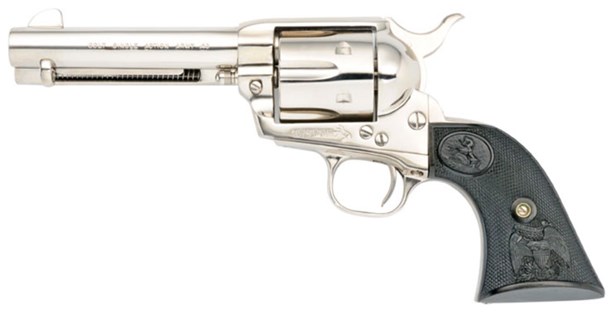
Image courtesy Colt.com
As Colt developed the SAA, Winchester also came out with an improved lever-action rifle that was introduced at the same time. The 1873 Winchester was chambered in an equally new center-fire cartridge developed by Winchester, the .44-40 Winchester Center Fire. Cowboys, frontiersmen, settlers and explorers of the west decided it would be real handy to have a rifle and six-gun chambered in identical cartridges, so in 1877 the first SAA was chambered in the Winchester round. It was called the Frontier Six-Shooter. Eventually the revolver would be chambered in some 36 different cartridges ranging from .22 LR to .476 Eley and including the .44 Magnum (very few—I’ve heard of just two examples).
Collectors have divvied the SAA into three generations. First-generation SAAs (1873 – 1941) were initially made with iron frames that were color casehardened to withstand the higher pressures of the cartridges that were being developed. They also have removable bushings in the cylinder that support the base pin. Up until 1896 the base pin latch was retained by a screw. After serial number 164,100 the base pin latch was spring loaded.
Four years later steel metallurgy had improved to the point that Colt certified the SAA capable of being used with smokeless powder. Today a relic, non-shooting example of a first-gen SAA will fetch as much as $8,000, and a near 100-percent sample will go for somewhere north of 50 grand. Those with historical provenance…well, the sky is the limit.
Colt first attempted to retire the SAA after World War II. The tooling was pretty much worn out, and the company wanted to focus on more modern designs. That made perfect sense until television renewed the interest in cowboys and rugged frontiersmen ways of life. An upstart by the name of Bill Ruger brought out a close copy of the SAA called the Blackhawk and began selling the pants off of Colt. Jumping like a gut-shot grizzly, Colt quickly retooled and brought out the Second-generation SAA in 1956.
Second-generation guns had some smaller improvements in manufacturing but are nearly identical to the first-generation guns. The hammers on second-generation revolvers are blued with polished white sides. Numerous variations including the long-barreled Buntline—cashing in on the television show “The Life and Legend of Wyatt Earp,” starring the recently departed Hugh O’Brien—Sheriff’s model and an adjustable sighted New Frontier model in 1961 were produced. By 1974 interest had waned again and Colt decided to cease further manufacture.
The shooting public would have no such nonsense regarding a favorite, though. Enough of us sunk the spurs into Colt to cause it to rethink that decision and in 1976 the third-generation SAA was brought out. Third-generation SAAs have a solid cylinder bushing press fitted to the cylinder and a different thread pitch for the barrel and frame. Though not the hot seller that modern polymer semi-autos are, the demand remains steady for the iconic SAA.
When it was first introduced the SAA could be bought with a $20 gold piece. The price is nearly the same. Today the MSRP of a Colt SAA is $1,499 for a blue model; $1,699 for an all-nickel-plated gun—which is about the same spot price for an ounce of gold.
Volumes have been written on the SAA—no surprise since anything that has been so much a part of a civilization for nearly a century and a half is bound to have had every nuance of it examined. It has been the tool of cavalrymen, cowboys, lawmen and outlaws. Whether used to protect and defend, an ersatz hammer to pound fence staples or as a movie star, the Colt Single Action Army has delivered every time. Rusty relic or pristine safe queen the SAA carries with it an elegance and panache few manmade objects could command.