Categories
Category: All About Guns
Categories
Winchester 54

Categories
Lee Harvey Oswald’s Rifle
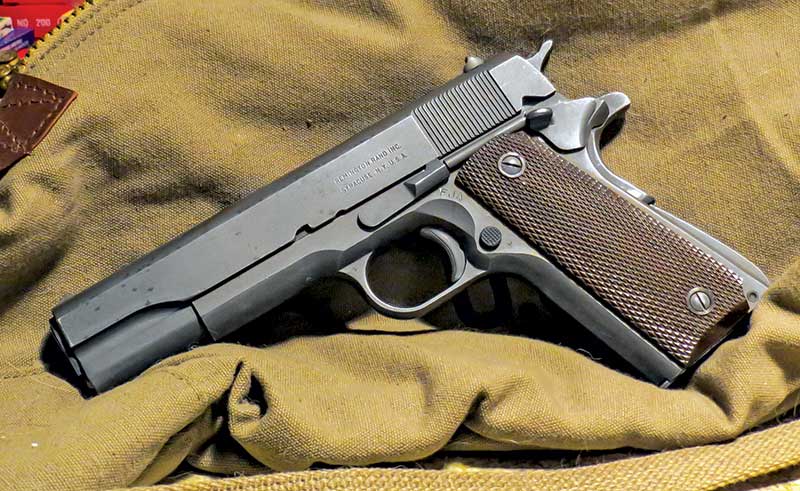
Situation: Famous as a leader in combat, Chesty Puller was a skillful pistol fighter as well.
Lesson: Training, skill and the best equipment are enormously helpful. Perhaps most important, though, is the fighting spirit that made General Puller a legend. And … a pre-war start in guns and hunting can shape a more survivable combatant.
Lewis “Chesty” Puller. In his time, his name was a household word, and if asked “Who was the most famous U.S. Marine?” — many people today would answer, “Chesty Puller.” He first made his mark in “police actions” in places like Haiti, rose to fame in the South Pacific campaign during World War II, and became solidified in legend by leading the Breakout in the Korean conflict.
There are many books about Puller. Most focus on his leadership and courage. One book is even devoted to his famous quotes. But most give short shrift to the general’s formidable pistol fighting skills.
Burke Davis (1913-2006) was the author of many historical non-fiction books, specializing in war and warriors. One of his trademarks was a personal touch, with deep insights into the heroes about whom he wrote. One of Davis’ classics is Marine! The Life of Chesty Puller, subtitled The Only Marine in History to Win Five Navy Crosses.
It is to Burke Davis we are primarily indebted for the following accounts of General Puller’s pistol fights, his training and background with guns and his general attitude toward related matters.
Puller In Combat
Puller’s first deployments were in Haiti and Nicaragua, supporting friendly governments who were fighting anti-American insurgents. In the latter country in 1929, he found himself traveling with a Thompson submachine gun, cased with ample spare ammunition.
Two years later, he found himself fighting for his life with his .45 pistol in Nicaragua. Davis tells us, “They were more than a hundred miles from Jinotega, Company M marching over open country on high ground beside the swift Cua River. Puller and (Col. William) Lee were not far apart when they saw, almost at the same instant, a native dugout canoe speed around a bend to their rear, bearing two men. One of these men fired, wildly. There was also a burst of rifle fire from across the river — another attempt at ambush.
“Puller reacted as usual. He ran at top speed toward the riverbank, straight for the canoe, pulling his pistol as he went. He fired in motion, and one of the canoeists fell across the gunwale. The patrol killed the other Indian, and when men splashed across the river, they found the band had fled.
“Lee thought Puller’s action a climax of the fighting in Nicaragua: ‘It was the greatest field shot I ever saw. He shot that bird from 15 to 25 yards away from that canoe, going at full speed, and the canoe moving, too. He drilled him right in the ear, so perfectly that we looked over the body for several minutes before finding the wound. He had shot him precisely in the opening of the ear. I don’t think such shooting was accidental.’” (1)
Some of the accounts of Puller’s personal engagement in combat are sketchy and short on details. Here is one, from when he was a Colonel on Guadalcanal: “A grenade fell near the Old Man — no more than eight yards away, Captain Zach Cox estimated, but Puller turned when he saw A Company scatter and yelled: ‘Oh, that damned thing ain’t going off.’ It helped steady the men. The grenade was a dud. Cockrell’s B Company was being cut up in the woods by snipers in trees with light machine guns, and fire from Puller’s front became spotty. The fight was now at close quarters: The Colonel had killed three men with his .45 — one of them a Japanese major.” (2)
There were many men in combat along with Puller who were glad they, too, were carrying pistols. One was Captain Regan Fuller, who spoke of an experience he had on Guadalcanal. “It was rough country, up and down everywhere, with plenty of cover. I sent one of my boys, Corporal Turner, up a grassy hill to our right, where we were trying to persuade the Old Man to stop for the night. I walked behind Turner — and we almost stepped on two Japs who were eating rice by a hidden fire at the base of a big tree. They were as astonished as we were, and we all scrambled. I fired three clips from my .45 and killed one of them, but the other ran down the trail toward our main body. Turner’s squad had deployed into line behind us. There was a little shooting, and then quiet …” (3)
The Guns Of Chesty Puller
Most of the time when an enemy was killed by Puller’s own hand, it appears to have been with his service pistol.
While there exists a photo of Puller shooting offhand with a very long barreled, non-issue DA revolver, virtually all the photos of him in the South Pacific and Korea depict him wearing a standard .45 auto. Burke Davis’ anecdotes all refer to him using a .45. I’ve been unable to find if or where Puller’s sidearm still exists today. Most photos of him wearing it are taken from the front, so we can’t see whether it wore a flat (1911) or arched (1911A1) mainspring housing.
There actually exists a chest holster named the Chesty Puller, but it appears to be a modern play on the great Marine’s nickname. In every photo I’ve seen of him in combat theaters, his .45 is in a standard issue flap holster on his right hip, backed up with a web double magazine pouch at the left front of his web belt. While many military officers did carry their .45s in the tanker-style chest holster during WWII, I’ve seen no indication Puller was one of them. He became a Marine early enough he was presumably issued a 1911, since the A1 dates to relatively late in the 1920s. Of course, if he preferred the 1911A1’s features (slightly better sights, longer grip tang to minimize hand bite, shorter trigger, arched housing), he had the “pull” to requisition one once they became available.
In any case, whenever Puller personally fought with a pistol in hand, it was the government-issue pistol known colloquially in his time as simply “the .45 automatic.”
Puller had specific opinions on other small arms. Pictures of him in the field almost invariably show him wearing a pistol and two spare magazines, and he expected fighting men to be constantly armed when in danger zones.
Davis writes of one day when Col. Puller was selecting staff members: “When he was choosing his intelligence officers, his exec pointed out a major sent in for the purpose by headquarters. Puller scoffed loudly, ‘Hell, that man hasn’t even got on a weapon. Find me another one.’” (4)
Only The Best For His Men
He also worked hard to make sure his troops had ample ammunition. Again, from Burke Davis: “As the time for a new campaign drew near, Puller drove his staff to complete the last detail in preparation. He warned the regimental supply officer, an Army Quartermaster general, was to check their requisitions. ‘Notify me at once when he arrives,’ Puller said. ‘I want to explain things in person.’
“The Army general arrived when Puller was out, and the lieutenant took the inspector to the supply dump. Puller found them there and overheard their conversation:
“‘Lieutenant, your requisitions are excessive.’
“‘I’m sure Colonel Puller would never have signed for more than we need, sir.’
“‘But he’s asked for 10,000 brass buckshot shells. What the devil does he want with those?’
“‘To kill Japs with, sir.’
“‘Doesn’t Colonel Puller know buckshot is prohibited by the Geneva Convention?’
“‘Sir, Colonel Puller doesn’t give a damn about the Geneva Convention — any more than the Japs did at Pearl Harbor.’” (5)
It should be noted short barrel pump shotguns were indeed used in the Pacific Theater. My late mentor, Bill Jordan, a veteran of that campaign, told me he used a Winchester slide-action trench gun and an S&W 1917 .45 revolver when clearing enemy pillboxes in the island campaign. The brass buckshot shells had been requisitioned because paper shells swelled up in the heat and humidity there, getting stuck in the magazines and chambers.
Puller’s demands for the best equipment for his Marines weren’t limited to guns and ammo. Wrote Davis, “(Puller) spoke to War Production Board officials in Washington: ‘I want to ask you why American troops shouldn’t have the world’s best fighting equipment. On Guadalcanal we saw our trenching shovels break at the first use. All of our men now have Jap shovels because they’re better and more dependable. Jap field glasses are better, too. I have good ones myself, German glasses I’ve carried for 20 years. Why should American glasses be so poor? Not worth a damn in the tropics. They fog up because they are improperly sealed, and once they get damp, they’re done for. I’ve seen hundreds of pairs tossed away in the jungle or the sea, because men know they can see as well with the naked eye. What kind of American ingenuity — or patriotism — produced those?’”
Yet, curiously, Puller wasn’t a fan of the M-1 Garand that George S. Patton had called “the best battle implement ever devised.” Davis reports the following:
“There was a squabble between A Company and some of the 164th Army men, for Regan Fuller’s men had bartered for, or stolen, some new M-1 rifles during the big night’s fighting, and Army officers wanted them returned. The Colonel was amused by the affair. For himself, he favored the old rifle they brought to Guadalcanal: ‘For sheer accuracy, if you want to kill men in battle, there has never been a rifle to equal the Springfield 1903. Others may give us more firepower, but in ability to hit a target, nothing touches the old ’03. In my opinion, nothing ever will. A perfect weapon, if ever there was one.’” (6)
The following seems contradictory to the above, but Davis noted, “… Puller was asked by Marine Corps Headquarters for a full report on his experiences with the Thompson submachine gun under field conditions and sent in an enthusiastic report on the weapon’s value on patrol.” (7)
Puller’s Training & Quals
While based in Hawaii, having shot Expert Rifleman five years running, Puller was affronted when a grizzled sergeant offered to teach him to shoot. When the sarge promised to bring his rifle score up 20 points in two weeks, Puller accepted the challenge. Davis reported, “Puller became the sergeant’s pupil, shooting when targets became vacant during the training, and shot an average of two bandoleers daily. He improved rapidly, and brought his record score from 306 to 326, of a possible 350. During all these years he qualified as expert with both rifle and pistol, and when a rifle team was sent from Pearl Harbor to a competition in San Diego in 1928, Puller was a member.” (8)
Davis adds, “… in the first report period, Puller posted an average score in bayonet drill; a fellow Marine, Lieutenant Gerald Thomas, finished 10 places ahead of him. But in marksmanship, with the automatic pistol, he ranked as expert, with a score of 91.13 out of 100 points. As a rifleman, he fired 335 of a possible 350, and stood 16th in the class of officers. He also ranked as expert with the machine gun, in which he stood high in the top third of the class, with a score of 340.” (9)
The quality of marksmanship training in the United States Marine Corps is, of course, legendary. That said, Puller famously credited his survival and many of his accomplishments in battle to having been a young armed citizen before he enlisted in the Marine Corps.
Born in Virginia, he learned guns and hunting early. He was about 10 years old when cancer took his father, and he supplemented the larder by shooting small game and wild turkeys. He became a trapper, selling muskrat pelts to pay for his ammunition. “Lewis learned both accuracy and frugality, for he bought his own ammunition,” biographer Davis wrote. (10)
Another writer, Michael Martin, wrote, “After his military fighting career was over many years later, Chesty noted he learned more about the art of war by hunting and trapping than he learned from any school. He insisted the skills he learned as a kid, living off the land, saved his life many times in combat.” (11)
Lessons
The constant presence of his sidearm saved Chesty Puller’s life more than once. It is no surprise you see his holstered .45 in almost every photograph taken of him in a combat environment, from his early days in the banana republics to the Pacific Theater to Korea. Note he insisted all his men be within reach of their guns in combat environments, at all times. It saved his life multiple times over … and, doubtless, the lives of many of his troops, including Captain Regan Fuller, as noted above.
Puller was a contemporary and friend of Herman Hanneken in his early combat days. Hanneken was the man who had killed the revolutionary leader Charlemagne Peralte in Haiti in 1919, with a single .45 slug to the heart from Hanneken’s USMC-issue Colt 1911. Puller had doubtless incorporated this knowledge into his trust in the same weapon, which he learned to keep constantly close.
His critics felt too many USMC casualties had accrued from Puller’s aggressive tactics, while his defenders argued those aggressive tactics were what won his major victories. Both sides need to remember Puller was a casualty himself, blown up on Guadalcanal with shrapnel savaging his legs, yet he returned to lead from the front sooner than his doctors wanted. Many who served under him were heard to say they’d follow him into Hell … and that he actually led them there and did his damnedest to get them back out after they’d won.
It is vital to remember this legendary Marine gave credit to his survival and victories to the hunting and shooting skills he learned in boyhood and adolescence. This sort of “pre-service preparation” has served American fighting men since the beginning of our nation. Woods-wise citizen soldiers with their own rifles and muskets won the Revolutionary War.
The National Rifle Association was founded in 1871 by Yankee officers who had noted the superior fighting ability of individual Confederate soldiers who had grown up hunting and shooting. Sergeant Alvin York in WWI, WWII’s most decorated soldier Audie Murphy, Carlos Hathcock in Vietnam and Chris Kyle in the most recent conflict all fit the same mold: super-soldiers whose skill at arms had been developed before they joined up.
This heritage is one reason why we at the Second Amendment Foundation where I currently serve as interim president have brought lawsuits to allow young Americans ages 18 to 20 to buy their own AR15s and prepare for a career defending their nation with firearms similar to the faster-shooting true assault rifles they’ll be issued when asked to die for their country.
There is much, much more to the history and legacy of Lewis “Chesty” Puller than can be presented in this short space. We conclude with thanks to the late biographer Burke Davis, who gave us so many valuable details from this particular side of the Puller legend. He is the one to thank for what you’ve just read; hell, I merely “wrote the book report.”
For more info: SAF.org. References: 1) Davis, Burke, Marine! The Life of Chesty Puller, P. 56. 2) Ibid., P. 118. 3) Ibid., P. 118. 4) Ibid., P. 181. 5) Ibid., Pp. 169–170. 6) Ibid., P. 148. 7) Ibid., P. 61. 8) Ibid., P. 46. 9) Ibid., P. 61. 10) Ibid., P. 9. 11) Martin, Michael. “Chesty” Puller and the Southern Military Tradition, Abbeville Institute Press, 2018.
Categories
Ithaca Auto & Burglar
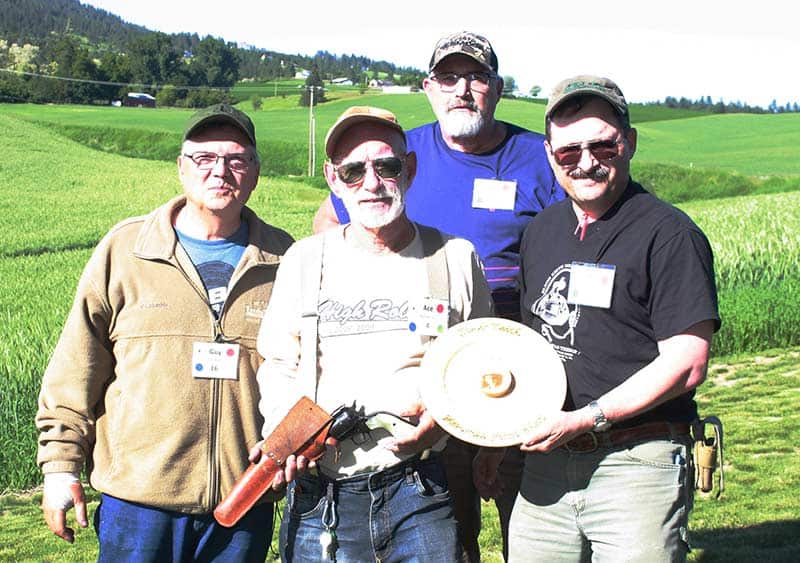
That’s Ace Fernandez, celebrating a win at one of the past Elmer Keith Long
Range handgun shoots. He’s holding a vintage Ruger Super Blackhawk in .44
Magnum, and he knows how to use it! He is flanked by Guy Maakad (left),
Ed Parry (right) and Bob Toppen to the rear.
Ace Fernandez is walking proof one should never compete with a guy named “Ace,” and never, ever, underestimate anybody on a shooting range who has a snow white beard, mild demeanor, affable disposition and a great, big hogleg.
I’ve known Ace for at least a decade and then some, and I can say without fear of contradiction — because he’s done it in front of witnesses — he is one of the most remarkable and annoyingly proficient long-range handgunners anywhere. Perhaps what I like most about this old gentleman is that he hasn’t made a career of running around bragging about it. Guys like Ace do what they do and then go about their business.
Fernandez is, or we should say was, a mainstay at the annual Elmer Keith Memorial Long Range Handgun Shoot, which I wrote about a few months ago under the headline “The Last Dance,” (add internal link to previous story) because after 20 years, this wonderful little gathering of handgunners from around the Northwest came to an end this year. I will miss watching him shoot.
So, when a nondescript padded envelope with something inside appeared in my office mail recently, with his return address label on the corner, it got my immediate attention. It felt kinda like a pocketknife, but wasn’t quite heavy enough. Out came my dangerously sharp Spyderco and with a quick swipe or two through layers of tape, what came out of an inner package was a stunner.
There, in my greasy little palm, was a pistol magazine for an original Ruger Standard semi-auto, about which I also wrote recently. Original magazines are fairly rare anymore, so a couple of days later, while taking a break from house painting (yeah, even writers have “normal” chores during the summer!), I called Ace to thank him and see what I owed him for this little treasure.
From the ‘Old School’
Me: “Do I owe you anything?”
Ace: “For what?”
Now there’s a guy from “the old school” with whom you could sit at a campfire, reminisce, share a tall tale or two, and burn powder most of an afternoon in the farmlands south of Spokane and never get tired. It is, after all, the “little things that count” in life, and guys like Ace are to be treasured, only if for the sake of saying you met them.
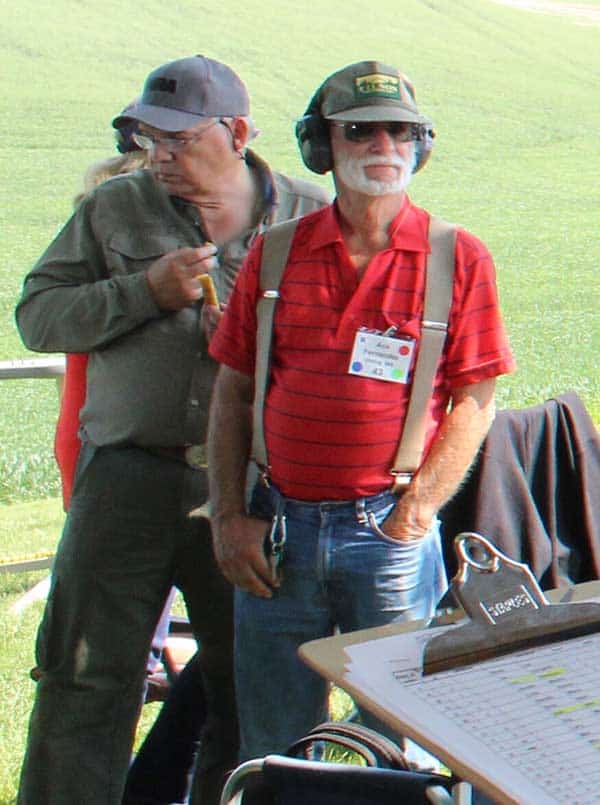
Ace Fernandez may look like an old guy who might shoot a little,
but don’t kid yourself. This particular old guy is one of the best long-range
handgunners I’ve ever seen. And he’s generous!
According to his brief narrative, Ace was sifting through some boxes of stuff (that’s what we call junk out here in the wilds) and came across this Ruger magazine. Apparently, there was no longer a gun for it in his safe, and I can only presume he had read my earlier piece on shooting grouse with .22 pistols — a horrid habit us westerners have developed over several generations, much to the chagrin I presume of haughty New Englanders who sit around the fireplace at the hunting lodge in the fall, reminiscing about all the great missed shots they’ve fired through their 28-gauge Purdeys, but at least we folks in the settlements eat well — and decided the magazine needed a new home.
It evidently occurred to Ace he knew this cantankerous, and frequently obnoxious gun scribe upon whom charity is probably a wasted effort. So, he explained, “I needed to get rid of some stuff.” Thus, his package with the treat inside landed on my desk. Well, it wasn’t my birthday and it wasn’t Christmas (in my case, they fall on the same day in December), so being the pitiful wretch that I am, I gratefully and most humbly accepted his generosity.
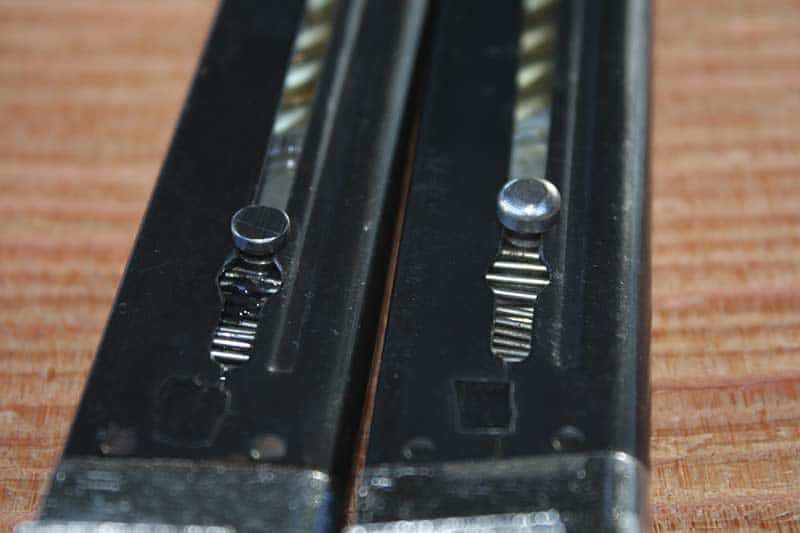
See the difference in follower buttons? The one on the left was sent to
Dave by Fernandez, who found it in a box of “stuff” and it fits an original
Ruger Standard pistol.
Now, this particular specimen must have been a really old original. I reached that conclusion because instead of a rounded head on the magazine follower button, the “Ace model” has a flat button. I cannot recall ever having previously seen one of those, but everything else about this magazine was true to form. The first thing I did was insert it into my pistol and it fit like a glove.
However, I quickly discovered the follower didn’t descend and rise smoothly, and it turned out the magazine was so dry inside — likely from sitting idle for years — I had to lube it up with some gun oil and Gunslick graphite compound. Works good, now! By the time you read this, I’ll have likely capped off a few rounds at fool hens, and hopefully will be dining this evening on grouse, barbecued or fried in a cast iron skillet, remembering Ace helped put it there.
The Moral
I guess the moral to this story is that one can never take for granted the friendships that spawn on a gun range, or around a campfire or any other place where camaraderie is always on the agenda.
Little gestures make big impressions because they are the sort of thing nobody ever has to do, but does so anyway. That is the sort of fellow Ace is, and there is usually somebody just like him in any fellowship. You know the type. The older guy with wrinkles he earned, probably the hard way, to whom there is much more than meets the eye.
But be wary of the ones called Ace. They can probably shoot rings around you on their worst day, and do it with such nonchalance it may drive you nuts.