Categories
All About Guns Real men The Green Machine War

Is the Chicom Type 56 SKS Rifle Worth the Investment?

The SKS has a powerful history across the world, but especially in Vietnam. Take a look at its history on the infamous “Hamburger Hill” and its potential today.

Is the Chicom Type 56 SKS Rifle Worth the Investment?

In 1969, an American soldier named Mike captured this Chicom SKS rifle in Vietnam. (Firearms News photo)

On May 10, 1969, ten Allied Infantry battalions launched Operation Apache Snow into the A Shau Valley in Vietnam’s Thura Thien-Hue Province west of the city of Hue. Friendly combat elements included portions of the ARVN 1st Division, the 9th Marine Regiment, and the 187th, 501st, and 506th Infantry Regiments of the 101st Airborne Division.

The storied 101st Airborne Division has deep historical roots reaching all the way back to the Second World War. The 506th Infantry Regiment, as an example, was the unit depicted in the powerful miniseries Band of Brothers. In Vietnam, the VC and NVA referred to 101st sky troopers as the “Chicken Men” based upon their distinctive Screaming Eagle shoulder patch. Enemy commanders were said to have avoided combat with the “Chicken Men” whenever possible due to their legendary fierceness in battle.

Chinese Type 56 SKS Rifle

This Type 56 SKS rifle is a tangible connection to the war in Vietnam. The SKS was a proven combat rifle found in Cold War hotspots around the globe. (Firearms News photo)

The mission of Operation Apache Snow was cold and calculating. The A Shau Valley was a conduit for troops and supplies infiltrating into South Vietnam from Laos. American forces had little use for terrain. With hundreds of helicopters at their disposal American commanders could seize most any piece of dirt they wished. Apache Snow was about corpses. The overarching plan was to block escape routes into Laos as well as to find, fix, and destroy enemy combat units in the valley.

This operation involved some of the fiercest ground combat of the war. American artillery, helicopter gunships, and close air support worked synergistically with the ground elements to crush NVA units when and where they could be found. Over a ten-day period the 3d Battalion of the 187th Infantry Regiment made eleven assaults up Hill 937, destroying NVA fortifications and grappling with enemy units at close range.

The men involved in this grueling pitiless fight came to refer to this often hand-to-hand conflict as the Battle for Hamburger Hill. After roughly four weeks of bitter combat American forces withdrew and abandoned their hard-fought territorial gains. American forces lost 113 killed while the ARVN 1st Division lost another 31. On the other side of the balance sheet American forces recovered the bodies of 977 NVA regulars and took five prisoners.

Mike was a typical American teenager. He enlisted in the U.S. Army at age eighteen in search of adventure, camaraderie, and relief from the drudgery of rural Michigan.

In late 1968, as an Infantryman in Vietnam, he found all those things and more. Mike was a rifleman with the Screaming Eagles during Operation Apache Snow. He fought in the A Shau Valley and became intimately familiar with the rich black dirt of Hamburger Hill. Some of those 113 young, strong, brave Americans lost on that forgotten hillside were his dearest friends.

At one point while assaulting through a trench line Mike and his buddies came under intense small arms fire. The NVA were masterful jungle fighters, and rooting them out of fixed defensive works was a formidable task. The 101st Sky Soldiers had been fighting these particular NVA for days. Mike’s rifle platoon pinned the NVA defenders in place with murderous suppressive fire from their M60 machineguns supported by M61A1 rifles and M79 grenade launchers.

Chinese Type 56 SKS Rifle

A grenade fragment penetrated the magazine of this SKS (top left). The rifle remains nonetheless operational. The pivoting safety lever is easily manipulated by the trigger finger (top right). Later Chinese-made SKS rifles featured a pivoting cruciform bayonet (bottom). (Firearms News photo)

Their attention held by the platoon’s steady base of fire, Mike slipped around the periphery of the fight and crouched behind a heavy tree trunk. He retrieved an M61 frag grenade from alongside his magazine pouch, thumbed off the safety clip, pulled the pin, and tossed it over the edge of the trench. Mike ducked back behind the heavy tree and, for a pregnant moment, just waited. Four seconds is an eternity when you’re waiting on a grenade to go off. The little bomb detonated with a dirty crump and gray-black smoke billowed up from the NVA trench. Mike leapt up and vaulted over the edge, his M16 tracking for movement.


There were three figures lying jumbled on the floor of the trench, their black pajamas torn and wet with gore. Two were inert, but the third moved. Mike reflexively pivoted his M16 and triggered an eighteen-round burst on rock and roll. Suddenly everything was still. (Troops in Vietnam frequently loaded their 20-round box magazines with eighteen rounds to improve reliability.) Mike’s breath came in ragged gasps, his ears rang, and his hands shook. He swapped out his empty magazine for a fresh box containing another eighteen rounds and studied the area around the trench for any signs of enemy activity. Satisfied that the area was secure, his squad consolidated the position, took stock of the weapons, equipment, and intelligence material, and held in place while the rest of the company assaulted forward.

The three NVA soldiers looked pitifully small. Most dead men seem small, but these were also young. The man Mike had killed with his last long burst had been carrying a Chicom SKS rifle. Mike lifted the weapon up from the chaos and filth of the trench and held it aloft. The weapon was mechanically intact, and the barrel was still uncomfortably hot to the touch. A fragment from his grenade had penetrated the side of the box magazine, and a portion of the stock was shattered. Despite this damage the weapon remained functional, a sour testament to the resilience of their foes and the firearms they wielded.

The upper handguard was literally burnt to a crisp, and the bottom of the trench was dirty with shell casings. There was no telling how many rounds this NVA soldier had fired through his weapon in the preceding few days. Mike laid claim to the gun and tagged it with the cooks for safe keeping. When his year-long tour was finally up he filled out the obligatory paperwork, begged his Company Commander for a signature, and brought the beat-up Chinese rifle home in his duffle bag, a poignant memento of the most horrible and exciting time of his young life.

The Rest of the Story

Chinese Type 56 SKS Rifle

The upper handguard on this particular SKS rifle has been badly burned. There is no telling how many rounds it fired in combat. The buttstock on the SKS is a wee bit short for many large-framed Americans (bottom left). This is the original sling captured with the weapon. (Firearms News photo)

Like so many combat veterans of that generation, Mike had a rocky return to the World. In 1969, America was sick of war in Southeast Asia, and misguided activists stupidly vented their frustrations on the young men who served there. After three years on active duty Mike married and transferred to the Michigan National Guard as the NBC NCO of an Infantry unit. Military service is nothing if not a brotherhood, and Mike made new friends in his Guard unit. Over time they grew close. Eventually in the late eighties Mike’s marriage went sour, and he fell on hard financial times.

Desperate for cash during the divorce, in 1987 Mike offered the beat-up Chinese rifle to a buddy in the Guard for $200. The friend accepted with the caveat that Mike could buy it back any time he wanted for its purchase price. Two years later Mike developed cancer from his exposure to Agent Orange during the war. In 1991, Vietnam ultimately killed Mike at age 41, a continent and a lifetime away from his tour in-country.

The Phone Call

Last year, my friend and editor here at Firearms News, Vince DeNiro, let me work up an article about a Japanese Type 99 rifle damaged during the island campaigns of the Pacific War in WWII. A gentleman read that article and tracked me down at the medical clinic where I work. This man, himself a Vietnam combat veteran, was the Michigan National Guardsman who bought the SKS rifle from Mike.

As is so often the case among gun guys, what began as a transaction ended as a friendship. He related the story behind the gun and explained that there wasn’t anyone in his life with a sufficiently deep interest in the weapon to venerate it with the respect it deserved. As such, we struck a deal, and I assumed stewardship of this most remarkable treasure.

The Gun

Chinese Type 56 SKS Rifle

The SKS loads from the top via ten-round stripper clips. (Firearms News photo)

The SKS was designed in 1943 by Sergei Gavrilovich Simonov and formally entered service in 1949. A rugged and maneuverable carbine, the SKS was actually obsolete at the time of its introduction. The AK47 that entered service around the same time offered everything the SKS did and more. The Soviets still ultimately produced some 2.7 million SKS Carbines. Variations were manufactured in China, Yugoslavia, Romania, Albania, North Vietnam, North Korea, and East Germany. More than fifteen million total copies were produced.

The SKS is a self-loading, semiautomatic rifle with a tilting bolt and a short-stroke gas piston action. The weapon features an integral 10-round box magazine, and the bolt locks to the rear automatically on the last round fired. To load the piece the operator opens the bolt, sets a 10-round stripper clip into the stripper clip guide on the top of the weapon, and presses the rounds into the magazine. With a little practice reloading the weapon is quick and intuitive.

The safety is a pivoting lever on the right side just behind the trigger. Forward is safe. Back is fire. It’s easy to manipulate the safety with your trigger finger. The charging handle is an integral part of the bolt carrier and reciprocates with the action. The magazine is fixed to the chassis of the weapon but can be readily pivoted forward for service via a sliding latch just ahead of the trigger guard.

The SKS is as much a cartridge as a rifle. Early in WWII it became obvious that the full-sized rifle rounds of the day were grossly overpowered for most Infantry combat engagements. Most soldiers in the field packed bolt-action rifles capable of delivering accurate fire out to two kilometers. However, typical infantry engagements were found to be executed at three hundred meters or less. This observation sparked a sea change in military weapons design. The Germans responded with the 7.92×33 kurz round and the StG44 rifle to fire it. Every modern Infantry weapon draws inspiration from this remarkable gun. Meanwhile, the Soviets developed the M43 7.62x39mm intermediate round.

A committee of experienced gun designers came together to craft this new round in 1943. From a possible 314 cartridge designs they winnowed the field down to the 7.62x39mm. This radical new intermediate round was originally intended to feed a semiautomatic carbine, a selective-fire assault rifle, and a belt-fed light machinegun. In the SKS, AK47, and RPD the Soviets filled those requirements.

Specifics

Chinese Type 56 SKS Rifle

The SKS was produced and employed by communist bloc countries around the world (left). (Wikipedia photo) This is a picture of my new buddy during his time in Vietnam (bottom right). (Firearms News photo)

Built in the Jianshe Arsenal in 1966, this particular SKS has had a fascinating life. The Chinese began production in 1956 and referred to the gun as the Type 56 as a result. This can be confusing as the Chicom AK47 is also referred to as the Type 56 as well. The Chicom Type 56 SKS went through a variety of tweaks between 1956 and the present. Sometimes you will find two examples from the same factory that differ significantly in their details. Milled versus stamped receivers, variations in safety levers, and sundry different stocks differentiate the various strata. Most military weapons feature stocks cut from a dark wood, while the civilian counterparts are built around stocks made from a blonde material called Qiu wood.

The buttstock on this rifle appears to be a locally made replacement for the factory original. The fit is good but not perfect, and the buttstock trap for the cleaning kit was never bored out. The wood is heavily varnished but relatively soft. Chicom Type 56 rifles with serial numbers less than 9 million typically sported the Soviet-style folding blade bayonet.

Most guns above that serial number cutoff were fitted with the spike-style cruciform bayonet. I’d sooner not get poked with either. The buttstock on the SKS is a bit short for many corn-fed Americans, but the gun remains nonetheless comfortable and pleasant on the range. Recoil is mild, and the trigger is good enough. The sights are optimistically graduated out to 1,000 meters.

While SKS rifles have appreciated markedly in value in the past couple of decades, they were once absolutely dirt cheap. I recall a time back in the eighties when you could walk out of an American gun show with a case of Chinese 7.62x39mm ammo and the dealer would throw in a brand-new Chicom SKS for free like a Happy Meal. In its heyday the SKS was the poor man’s Kalashnikov.

Chinese Type 56 SKS Rifle

The cleaning kit compartment was never bored out on this jungle-produced replacement buttstock (top left). The fit on this handmade stock is just a wee bit sloppy (top right). Soviet SKS rifles and early Chinese copies sported a pivoting blade bayonet like this one. Back in the eighties you could pick up a beautiful Chicom Type 56 SKS for around seventy-five bucks. (Firearms News photo)

There are scads of accessories all designed to enhance and upgrade the SKS. However, I like the original milspec ambience myself. At the time of this writing, J&G Sales had a supply of early Jianshe Chicom Type 56 SKS rifles in serviceable condition at a sweet price.

These guns are high mileage combat weapons with scads of character still awash in cosmoline. It is one thing to read about history from a safe, comfortable distance. Cold facts and dispassionate numbers conspire to excise the passion and emotion from some of history’s most significant episodes. However, hefting the guns that were actually there brings home the power of these events in a much more moving way.

A young man died clutching this battered old rifle. His lifeblood spilled out on the side of Hamburger Hill as he gave his last full measure of devotion for a cause he felt was just. Similarly, the young man who took his life was fighting for a cause of his own. At a certain level both men fought for their comrades alongside them. That one lived and the other died was a function of the cruel vagaries of Fate.

This rifle was fired in anger so profusely as to char the handguard. Through the fog of history there is literally no telling the mayhem it wreaked. Now it sits quietly with me, a mute testament to a most remarkable time. Want a surplus Chicom SKS rifle of your own? J&G Sales has them in stock at a reasonable price. They’re also C&R eligible. These veteran rifles show the cool stigmata of hard use and are slathered in cosmoline.

Chinese Type 56 SKS Rifle

This Soviet SKS rifle was built in 1953. (Firearms News photo)

About the Author

Will is a mechanical engineer who flew UH1H, OH58A/C, CH47D and AH1S aircraft as an Army Aviator. He is airborne and scuba qualified and summited Mount McKinley, Alaska, six times…at the controls of an Army helicopter. After eight years in the Regular Army, Major Dabbs attended medical school. He works in his urgent care clinic, shares a business building precision rifles and sound suppressors, and has written for the gun press since 1989.

Categories
All About Guns Ammo

44 S&W Ammo: The Forgotten Caliber History of 44 S&W Ammo Explained

Categories
All About Guns

I WANT ONE ASAP!!!

Categories
All About Guns

A Remington Model 50 in 12 gauge

Categories
All About Guns Allies Ammo

BRITISH BIG BORES .577 REVOLVERS NEVER SEND A TOY TO DO A MAN’S WORK WRITTEN BY HAMILTON BOWEN


Whether munitions drove the development of firearms or firearms drove the development of munitions is one of those chicken and egg questions which keeps coffee table philosophers busy and off the streets. There’s at least one case where we can make the argument that available munitions drove the development of the guns — with the great .577 revolvers produced in the late Victorian Era.

With the exception of the huge Dragoon and Walker Colts, percussion revolvers were typically anemic performers by today’s standards. Even the .44 1860 Army model, perhaps the most widely made and distributed of the Colt percussion revolvers, offered mediocre ballistic performance. The 148 grain conical ball ambling along at a stately 800 fps sounds suspiciously like the .38 Special round-nose factory load which nobody has ever accused of superior man-stopping prowess. Yes, you could kill somebody deader than a hammer with one, but not always right now.

The advent of cartridge revolvers and ammunition didn’t improve matters a great deal. Only the .45 Colt with its 250 gr. bullet at 900 fps was really an adequate performer. Pity the poor English whose concurrent revolver developments offered nothing nearly so useful. The early British cartridge revolvers were chambered for a variety of pathetic little numbers such as the .442 Webley and .450 Adams, most of which tossed along 200-220 gr. bullets at 550-650 fps, underwhelming to say the least. But lackluster performance was no academic question to users of these guns.
The British Empire spanned the globe and was, in many cases, peopled by reluctant participants in this imperial glory. Often as not, these folks did not domesticate well and caused all manner of trouble. Indeed, many offered spirited and effective resistance. Whether on a mission from God to expel the white devils, or simply fortified by locally manufactured pharmaceuticals, the locals often took a lot of killing.

Many a brave officer in the Queen’s service discovered this the hard way after emptying his token side arm to no effect, then getting gigged in the guts or sliced from crown to crotch. Didn’t take much of this for the brighter members of the officer corps to understand more stopping power was in order. Since officers provided their own side arms, those who could afford to procured better ones.

In those days, the only propellant was black powder. The only way to get more power was to use more powder. More powder, in turn required larger
cartridges which, not surprisingly, required larger guns. Out of the quest for effective man-stopping revolvers came some of the most fascinating revolvers ever made, the .577s. Doubtless, designers settled on the .577 caliber because of the familiar Enfield and Snider rifles of the day, figuring that a shortened case suitable to revolvers would do the trick. Regardless, in this instance black powder was the chicken that laid the revolver performance egg.


Cartridge Guns


While some .50 and .54 caliber percussion revolvers exist, the literature doesn’t show any .577s. Most known .577s are cartridge guns. Even so, these guns evolved some over their brief history. Early coiled-brass cartridge cases were not terribly dependable and caused function problems. The earliest known solid-frame specimens had complicated cylinder assemblies with backing plates with firing pin holes that fitted between
the case heads and standing breech to assure dependable cycling even in the event of a case failure.

Problem was that reloading was time-consuming and troublesome since you ended up with a handful of parts during the loading operation — cylinder, backing plate and axel, to say nothing of the ammo. Drop any one part and the gun was disabled, a real bummer in a square surrounded by dervishes intent on doing Allah’s work against the infidels.

Improvements in cartridge cases gave rise to the more conventional revolvers made along the lines of the familiar top-break ejector Webleys. In
their final iteration, .577 revolvers used a drawn brass cartridge case heaving a 400 gr. bullet at about 725 fps — by all accounts an effective manstopper. Determining who made the .577 revolvers is a bit tricky. Patent holders and retailers were not always manufacturers. While Webley and Tranter probably produced the earlier solid-frame guns with the backing-plate cylinders, it isn’t clear Webley ever produced any top-break .577s. Some were probably made by Pryse in England, and perhaps by other licensed English makers. Some were manufactured on the continent by August Francotte & Co. of Liege and retailed by outfitters such as the Army and Navy cooperative and various sporting arms makers.

All top-break ejector revolvers I’ve seen have been made on the Pryse patent, regardless of the retailer’s name. Distinguished from the Webley latch system, the Pryse top fastener between barrel extension and receiver consists of a couple of frame-mounted levers which retract a couple of pins from a hole in the barrel extension to permit opening. At least a couple variations in the guns exist with subtle differences in barrel
form, cylinder length and hammer fastener. One thing is for certain, .577 revolvers are extremely rare. Credible estimates suggest fewer than a hundred or so of all stripes were ever made.

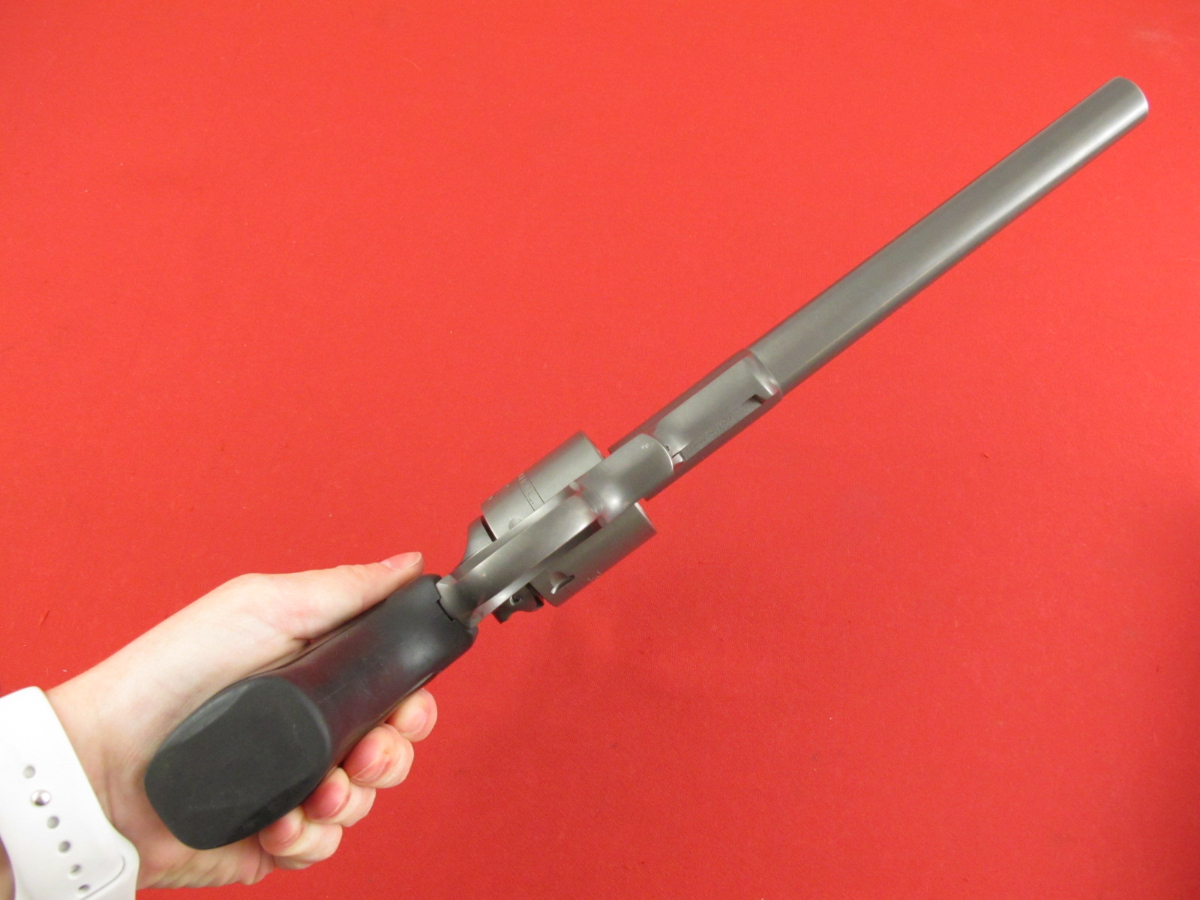
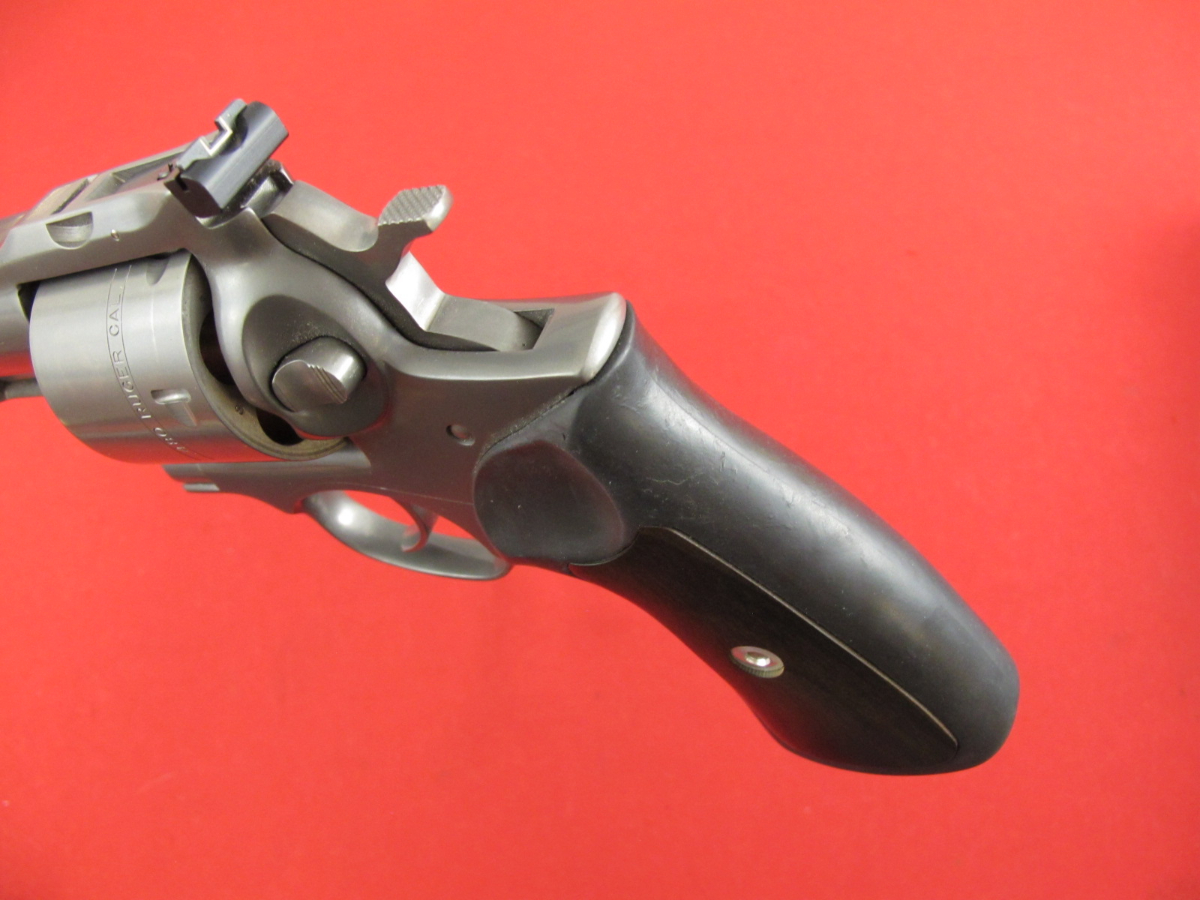
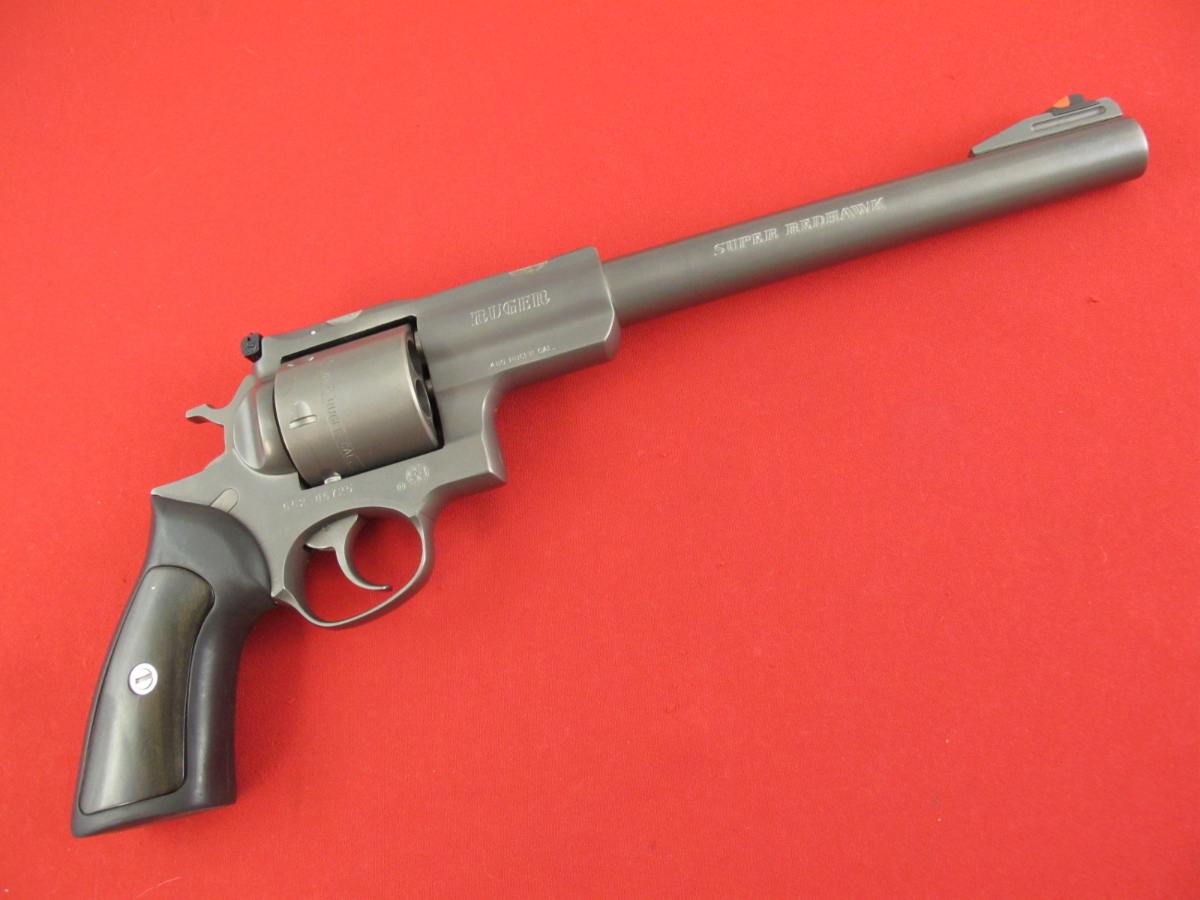
Rare or not, vintage .577 revolvers are magnificent arms. The examples we have here are very similar in size and weight to the contemporary Ruger Redhawk. They are perfectly handy and agile in their handling. Recoil, while not insubstantial, is a gentle heave and not bothersome. Sadly, most devout gun cranks will never have a chance to see, let alone shoot one of these marvels. That gave rise to the notion it might be nice to try and build a modern .577.


Ordinary?


In keeping with the character of the original .577s, we (“we” being the Bowen Classic Arms crew, shop dog, et al) wanted a revolver of relatively ordinary size and shape, not some outsized, eight-pound monstrosity with all the grace and handling of an anvil. The basic problem was the cartridge size. The original .577 revolver cartridges were based on shortened .577 Express cases. Since these cases were quite heavily tapered, the original .577 revolvers actually have groove diameters more on the order of .610″-.615″ rather than the usual .585″- .588″ for .577 rifles.

Our only hope of shoe-horning a .577 cartridge of some kind into a revolver lay in dramatically reducing its diameter. Pegging the groove diameter, rather than the bore diameter, at .577, was a good place to start. Even so, if you added in .015″ per side for the brass and a bit of cartridge taper, you’d still have a case with a head diameter of about .610″. For the smallest possible cartridge, the solution was a heeled bullet with a .577 front driving band in a .577″ diameter case, basically a giant .22 Long Rifle cartridge.

So far, so good. But if the groove diameter is .577″, how could the gun shoot well with a heel of only .547″ diameter? More head scratching offered the answer in the form of the Minie ball with its hollow base. In theory, the skirt would obdurate to driving-band diameter and give guidance on each end of the bullet. Since bullets would weigh around 400 grains and be subject to considerable recoil inertia, how to crimp them
firmly was the next question. Heeled bullets can’t be roll crimped because the case mouth is covered by the bullet. Time-tried technology in the form of collet crimping saved the day.

All that remained to complete the basic cartridge design was to procure a suitable parent case. Perusing spec sheets on virtually every known cartridge case turned up nothing useful. Alas, our baby was a bastard. Nothing would do but to make cases. Obviously, drawn brass would have been prohibitively expensive so we turned to the Ballard Rifle & Cartridge Company who, at the time, produced excellent turned brass (now produced by Rocky Mountain Cartridge Company). With the flexibility of CNC machinery, they could make cases of virtually any description. And thus was born the .577 No. 2 revolver cartridge.


Redhawk Rebore


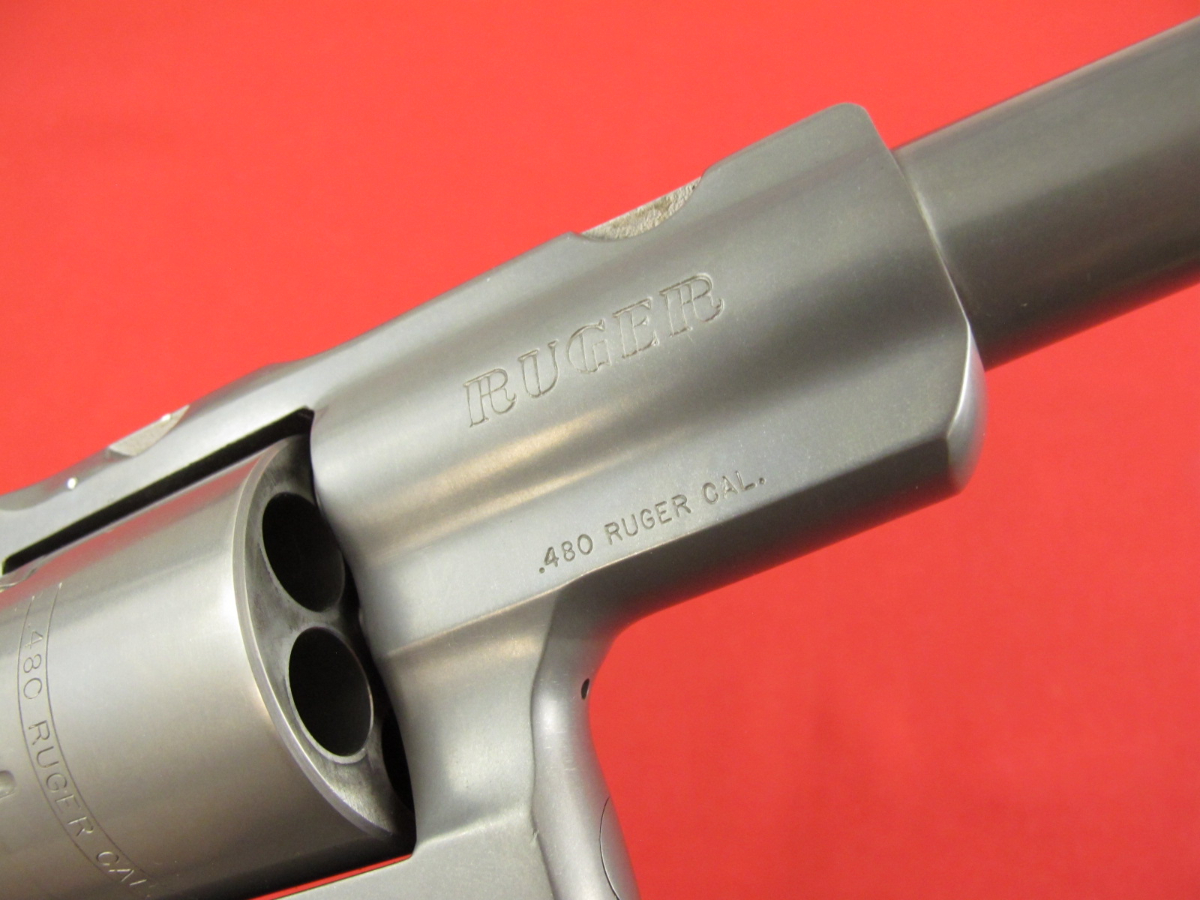
The smallest .577 revolver cartridge still required a substantial gun. At the time, the Ruger Redhawk was the obvious candidate since no other normal revolver had its cylinder and barrel shank diameters. Even then, the .577 No. 2 Revolver cartridge is a tight fit. The chamber walls and webs of the 5-shot cylinder are quite thin, limiting the gun to black powder pressures. Barrels with .565″ bore and .577″ groove diameters are not a size found in nature, so to speak, but we were able to gull our good friend Cliff LaBounty into making a rifling head to rebore the
original Redhawk barrel. In keeping with the vintage nature of the gun, the top strap and barrel were modified to resemble a Smith & Wesson M&P fixed-sight model. Building the gun was simple enough — ammunition proved to be much more troublesome.

Initial test firing was conducted with standard pistol primers, FFFg powder and a generic black powder lube. Muzzle velocity was about 725 fps but accuracy was disappointing. After 15- 20 rounds, powder and lead fouling were so bad bullets would not stay on the target paper at 20 yards. Consulting with an expert may be unmanly but, in this case, it saved the day.

Mike Venturino and his shooting cohorts had begun to unravel the lost secrets of sustainable black powder accuracy. Mike counseled there are
three basic elements: Use magnum primers, use a drop tube to charge the cases with powder and use SPG lube. Armed with this intelligence, we tried again. Muzzle velocities were still around 725 fps +/- 5 fps. Off-hand groups shrunk to a couple inches and fouling, even after 25-30 rounds, never impaired accuracy or function. Recovered bullets showed the skirts hadexpanded to engage the rifling as hoped.

With good ammo in hand, regulating the sights was a snap. The .577 Redhawk has performed flawlessly to date. Thanks to the weight reduction afforded by .577 chambers and bore, handling is light and quick. Recoil is substantial, much like a heavy .44 Magnum loading but without the bite and piercing report. Scientific penetration tests conducted against a handy fence post demonstrated very modest penetration but a great deal of whack. After two or three solid hits, the post stayed right where it was, unable to escape.

Sadly, the future for newly-made .577 revolvers is pretty bleak. The National Firearms Act of 1934 classifies rifled, breech-loading guns with
bores larger than .5″ as “destructive devices” and levies on the transfer of such arms a $200 tax. Production for resale of destructive devices requires a license costing thousands of dollars a year to maintain.

Big-bore sporting long arms are largely exempt but the BATF would not extend any such sympathy to a .577 revolver and treats the gun exactly the same as a 155MM howitzer. Quite a distinction for a revolver that was state of the art in 1885. Within a few years of their introduction, the .577
revolvers disappeared, usurped by smaller guns made possible by smokeless power — yet another argument in favor of ammunition as chicken and gun as egg.

Categories
All About Guns Ammo

The .32-20 Winchester Center Fire: History & Performance by DAVE CAMPBELL

Campbell .32 20WCF 1

During the last quarter of the 19th century, as the industrial revolution was flourishing, a great deal of experimentation occurred. The firearm industry was as big a player in this as anybody. Winchester’s Model 1873 rifle had virtually set the American West on fire; its .44-40 Winchester Center Fire (WCF) was the go-to cartridge of the day. Then, as now, there were always a few who sought minimization—a way to use less resources to achieve a similar end.

In 1874, Winchester reduced the neck of the .44-40 to accommodate a .40-cal. (.401″) bullet. Someone must have thought that “.40-40” didn’t have much of a marketing ring to it, so they looked at the bore diameter, .394″. Apparently, that didn’t have the “zing” they wanted either, so they came up with .38-40 WCF. As it did with the .44-40 WCF, Colt would chamber its Single Action Army (SAA) for the smaller bore some four years later.

In 1882, Winchester once again pared down its cartridge to .32 cal. (.3125″), reduced the charge of black powder to 20 grains and called it the .32-20 WCF. Originally touted as a combination cartridge suitable for varmints, small game and deer, the deer component was fairly quickly dismissed, save for shots less than 100 yards in the neck or head.

Two examples of a .32-20 WCF cartridge.

This was when 20 grains of FFFg black powder would generate 1,250 f.p.s. and just 399 ft.-lbs. of energy with a 115-gr. bullet. Compare that to a .30-30 Win.—considered by many to be the “floor” of deer cartridges—with a 150-gr. bullet at 2,390 f.p.s. and 1,903 ft.-lbs. of energy. Having said all that, Paco Kelly, of leverguns.com fame, says he shot some two dozen Virginia whitetail deer with a Model 92 Winchester chambered in .32-20 WCF in the 1970s.

As with its predecessors, it took Colt about five years to chamber its SAA in .32-20 WCF. Still later, it would chamber its double-action Frontier, Army Special and Police Positive revolvers in .32-20 WCF. Not to be outdone, Smith & Wesson chambered its .32-20 WCF Hand Ejector First Model in the Winchester cartridge. Martini chambered its single-shot Cadet rifle in .32-20 for use as a trainer and target rifle. Remington chambered its Model 25 and 25A rifles in .32-20 WCF from 1923 until 1935. With that, the .32-20 WCF remained popular throughout the first quarter of the 20th century.

That popularity is quite similar to the small and lightweight pistols of today. They are usually carried by one of two types, either more-or-less novice types that want some protection but are unwilling to dress around a full-size pistol, or the really savvy, deep-cover, gun guy (or gal) who is cool as ice under fire and can accurately place their shots. The former are more plentiful than the latter. Their logic is that no one wants to get shot with anything.

The .32-20 WCF (left) compared with the .44-40 WCF (center) and .45 Colt (right).

The accuracy of the .32-20 WCF is another reason for its popularity. Small game hunters and pest shooters found the cartridge to be very accurate within its range limitations. Hunters wanting to kill a rabbit or squirrel for the stove liked that the cartridge didn’t tear up too much meat.

By the time World War II rolled around, all three Winchester cartridges, .44-40 WCF, .38-40 WCF and .32-20 WCF were moribund. Winchester stopped chambering rifles for them, Colt was lowering the curtain on the SAA and hunters were becoming more fascinated with magnum cartridges. The general consensus on into the 1960s—even the ’70s—was that you couldn’t kill a prairie dog or a woodchuck unless the bullet was traveling at more than three times the speed of sound.

As with so many things, however, what goes around comes around. The sport of handgun metallic-silhouette shooting renewed some interest in the .32-20 WCF. Winners needed a flat-shooting, accurate cartridge that could tip over a steel target at 100 meters, and didn’t threaten to separate their hand from their wrist.

Older examples of .32-20 WCF revolvers were quickly swept up, and for a while the only feasible way to get one was to build it. More than a few Ruger Blackhawk revolvers chambered in .30 Carbine were converted to—or had another cylinder chambered—for the .32-20 WCF.


In reality, these were actually “.30-20 WCF” revolvers because the barrels remained .30 caliber, with a groove diameter of .308″, as opposed to .3125″. As such, in order to retain its accuracy reputation, handloaders had to use .30-cal. bullets. More than a few Thompson/Center Contender barrels chambered in .30 Carbine also got a reaming as well. Even in the stilted world of Schüetzen matches, the .32-20 WCF has made some inroads on the traditional .32-40 chamberings.

All of this resulted in a mild renaissance of the chambering in the Marlin 1894CL in 1988 and Ruger making a limited run of Blackhawk revolvers for Buckeye Sports, of Canton, Ohio, chambered in true .32-20 WCF. Both, sadly, are no longer produced. The .32-20 WCF has been fruitful and multiplied. Spinoffs include the .25-20 WCF (1895), the .218 Bee (1937) and its case has been modified slightly to produce usable ammo for the Nagant M1895 revolver with its 7.62×38 mm R cartridge, as well as the .310 Cadet rifle cartridge of British fame.

Today’s .32-20 WCF shooters are pretty much relegated to handloading the cartridge, though occasionally you’ll find a handful of factory ammo. Since it’s a bottlenecked cartridge, carbide dies are out, and because of its very thin neck and the necessity of being extra careful—read slow—in the reloading process to keep from ruining too many cases, producing ammo for it is not for the impatient.

An example of a Winchester Model 92 chambered in .32-20 WCF.

The first order of business is to determine whether you are loading for a .30-cal. or a true .32-cal. barrel. That, of course dictates bullet diameter, which may or may not limit your bullet selection.

Then you must decide what power level you can load, which is determined upon your gun type. Model 1873 rifles and first-generation Colt SAAs should not be subjected to hot loads. Their design and metallurgical makeup won’t hold up to that kind of abuse. Newer guns like the Marlin 1894CL, Ruger Blackhawk and T/C Contender can take hotter loads. The .32-20 WCF is inexpensive to load, especially if you use cast bullets.

The .32-20 WCF may not set the modern world on fire. It’s not a popular choice in the self-defense world anymore. Small game hunters wanting a .32-caliber rifle or pistol can choose the .32 H&R Magnum or .327 Federal Magnum can get the job done just as well. But for the traditional minded hunter, the gentleman who may choose to hide a short-barreled single action deep in his coat or the man who embraces history, they will find that the .32-20 WCF suit them right down to the ground.

Categories
All About Guns

First shot with the 1870 .577 Snider-Enfield rifle.

Categories
All About Guns

I SOLD My Winchester Model 75 22 Caliber Target Rifle

Categories
All About Guns Allies

Personal weapons (#VickersMG ‘reenactorisms’ series)

Categories
All About Guns Another potential ENEMY OF THE PEOPLE Anti Civil Rights ideas & "Friends"

Mexican-American Billionaire from New York Funds ‘Tennessee 11’ to Push Gun Control Agenda via ‘Citizen Solutions’ in 2024

The 2024 session of the Tennessee General Assembly is scheduled to convene in Nashville on Tuesday, January 9.

According to his personal website, Daniel Lubetzky was born in Mexico City in the late 1960s and came to the United States with his family as a teenager.

In 2004, Lubetzky is the founded the snack company Kind LLC. It was reportedly worth $5 billion when the company was sold to Mars Inc. in 2020. When the company was under his management, Lubetzky was named a Presidential Ambassador of Global Entrepreneurship by former President Barack Obama and his administration’s Commerce Secretary, Penny Pritzker.

His foundation received its tax-exempt status in 2017, and a federal tax filing from 2021 indicates the Lubetzky Family Foundation has offices at 3 Times Square, also known as the Thomson Reuters Building, in New York. The Lubetzky Family Foundation spent nearly $3.5 million in 2021, when its eight highest-earning employees were each paid more than $100,000, and collectively were compensated $1,294,410.

Lubetzky’s involvement in Tennessee politics comes through a group called Citizen Solutions, which is a project of Starts With Us, which in turn is a project of the Lubetzky Family Foundation. Citizen Solutions seems to exist to spread awareness of the suggestions made by the Tennessee 11, a group of 11 Tennessee residents affiliated with Citizen Solutions.

The Tennessee 11 apparently met for the first time in September, when the group held a “solution session” in Franklin.

In October, the Tennessee 11 announced eight proposals for new laws, regulations, and initiatives they claim would contribute toward the prevention of gun violence. Among the proposals, according to a press release by Citizen Solutions, are calls for Tennessee to pass a red flag law, which would allow courts to order the temporary suspension of an individual’s right to bear arms, require Student Resource Officers (SROs) be trained in “mental health first aid” and “trauma-informed care,” and create “an incentives-first approach to gun ownership rights and responsibilities.”

Another proposal includes Tennessee investing resources to prevent traumatic childhood experiences that could potentially precipitate gun violence.

The Tennessee 11 also proposed laws or regulations requiring Tennesseans obtain a license or permit to carry a handgun, though the group noted, “the TN11 reached a majority but not unanimous consensus on this proposal and now asks the public for feedback.”

In November, the Citizen Solutions “opened a public feedback platform,” according to The Daily Beacon, which reported the activists “are encouraging [University of Tennessee] students to give feedback on the proposals” made by the Tennessee 11.

On the Citizen Solutions website, the activists claim their gun control proposals were drafted by “Tennesseans with very different perspectives.” Citizen Solutions also bills itself as “an ambitious civic experiment empowering Americans to counteract the extreme voices dominating media and politics by elevating the will of the people.”

However, several of the activists who comprise the Tennessee 11 appear to be partisan, and some worked for the Democratic Party or are former Democratic political candidates.

One of the Tennessee 11, Brandi Kellett, is an Associate Professor at Lipscomb University, and her “areas of scholarship focus on culture, memory and faith as a resistance to oppression in the African disapora across the Americas,” according to her university biography.

Arriell Gipson, a Memphis Democrat who unsuccessfully ran for Shelby County Clerk in 2022, is another member of the Tennessee 11. A profile for her campaign revealed she is “the committee chair for the Mayor’s Young Professional Council, Violence Prevention and Criminal Justice Reform Committee, First Vice President for the Shelby County Young Democrats, a graduate of Leaders of Color, Organizing for Action, New Memphis Leadership Institute, and The University of Tennessee at Chattanooga with a Bachelor of Science in Psychology.”

Another member, former Tennessee state trooper Mark Proctor, wrote in a guest column for The Tennessean in August that “stricter gun regulations save lives.” The Tennessee 11 member specifically argued in favor of a “[s]trict permitting process” and new legislation to “[k]eep guns away from the wrong people.”

Therapist Adam Luke joined the Tennessee 11 from Columbia, Tennessee. In October, Starts With Us published a lengthy statement from Luke on social media. Luke lamented, “When we talk about guns, there’s so much division. Either we’re attacking traditions or we want people to be in harm’s way.”

He urged Tennesseans to “have that bigger discussion of recognizing that what you’re feeling is legitimate, but sometimes our feelings alone aren’t the only information we need to be taking in.” While Luke seemed hesitant to support a red flag law in his statement, the group’s proposal to “[a]llow courts to temporarily remove someone’s firearms if they are deemed a danger to themselves or others based on certain criteria showing they are at risk of committing violence” had the unanimous support of the Tennessee 11.

While Lubetzky funds the Tennessee 11 through his New York-based Lubetzky Family Foundation, he is also an Inaugural Board of Directors member for the controversial Anti-Defamation League (ADL). The ADL notes Lubetzky is the recipient of awards from the World Economic Forum, Skoll Foundation, Conscious Capitalism, and Hispanic Heritage Foundation.

It remains unclear if Lubetzsky’s efforts will bear fruit after a significant push for gun control failed in 2023, when Democrats were joined by Governor Bill Lee (R) in calls for restrictions following the Covenant School shooting.

Red flag legislation was unsuccessful during the regular session in 2023, and though Lee called a special session for the Tennessee General Assembly to pursue gun control initiatives, the governor did not back a red flag law proposal for a second time. Ultimately, no gun restrictions were passed during the special session, and Lee recently signaled that he does not intend to push for red flag legislation in 2024.

– – –

Tom Pappert is the lead reporter for The Tennessee Star, and also reports for The Georgia Star News, The Virginia Star, and the Arizona Sun Times