Categories
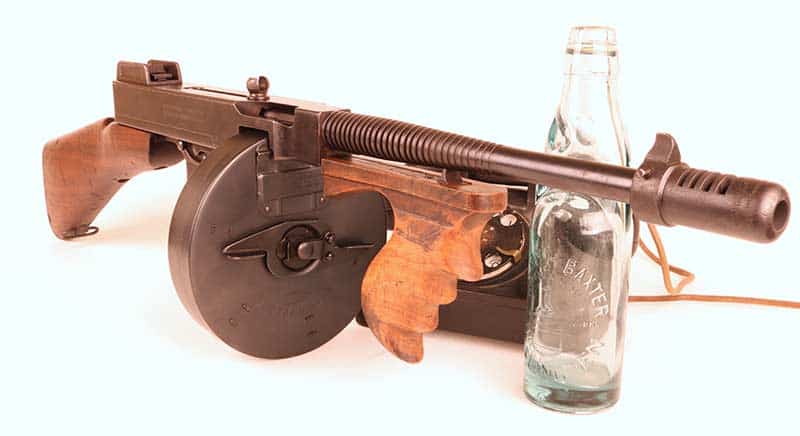
The M1921AC Thompson was the archetypal gangster gun. It spawned a genre.
Young men are hopelessly impressionable. It is this odd mystical combination of fitness, psychological malleability, and rank stupidity that makes 19-year-olds the best soldiers. With age comes wisdom. Wise men could not be cajoled into taking hills or clearing bombed-out buildings. Only young people do that.
One curious aspect of this bizarre character flaw was manifested during World War II. The kids who fought this unprecedented war were drawn predominantly from a few discrete year groups. Most of the American combatants were born between 1923 and 1925 inclusively. This generation was raised on Saturday afternoon movie serials.
While Hollywood offered the expected variety of Westerns, dramas, love stories and pirates, one of the most commercially reliable movie genres was that of the gangster. When the aforementioned generation piled into theaters, the nation was still reeling from the Great Depression. Watching James Cagney unlimber his Tommy gun kept young men enthralled.
When these young men answered their nation’s call and donned the uniform, they were trained on a variety of infantry weapons. One of these was the Thompson submachine gun. At 10 pounds empty and 32 inches long, the Thompson was ridiculously heavy in either of its major guises. Additionally, the design put the center of gravity much too far to the rear, while the ammo was both bulky and massive. Regardless, young soldiers coveted the things in a manner that, at times, approached unseemly.
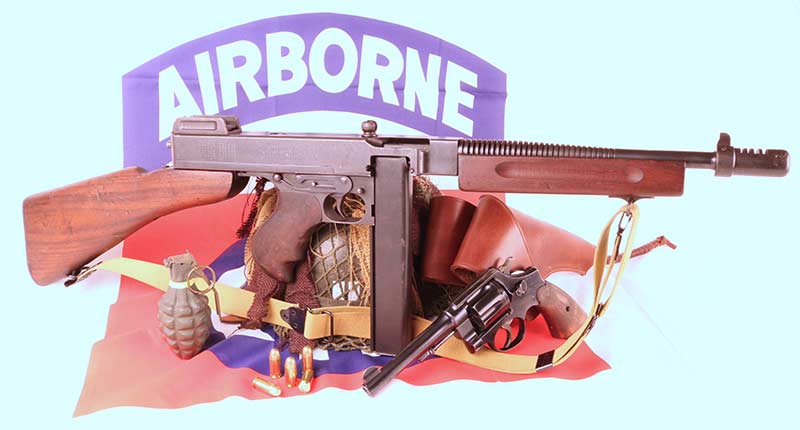
he M1928A1 Thompson looked just like the previous M1921 but differed in its internals.
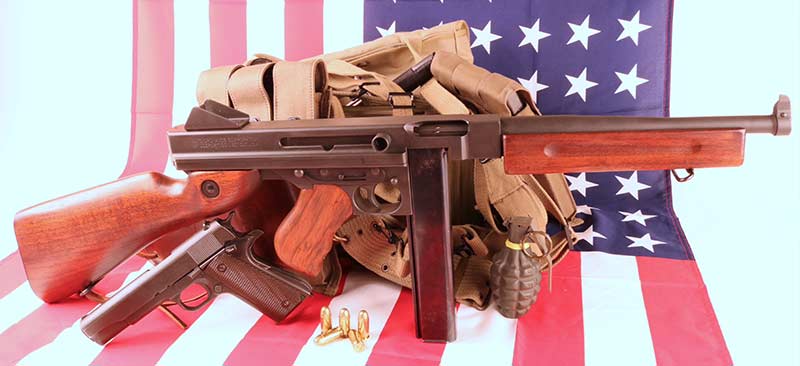
he M1A1 Thompson was the simplified military version used throughout World War II.
I had two buddies who did their time as grunts in Europe who said they never encountered a Thompson in the field. By contrast, one old hero I met in my medical clinic carried one for almost eight months at the very tip of the spear in Europe. He had originally been issued an M1 Garand. His Thompson was technically stolen.
My buddy got tagged for a night patrol and traded his M1 rifle out for an M1A1 Thompson from one of the gunners for the 37mm anti-tank gun that was attached to his infantry battalion. He said the 37mm gun was worthless against the advanced German tanks they faced, so the gun and its gunners spent all their time in the rear. When the patrol was complete, he just never gave it back.
The gun came with five 20-round magazines and no web gear. My buddy carried the magazines in the pockets of his field jacket along with a bunch of loose rounds. Whenever there was a lull in the action, he thumbed big fat .45 ACP cartridges into his magazines.
One of the more compelling anecdotes the man related was running his Thompson out of a moving half-track as his unit pushed through an occupied town. The engagement sounded strangely reminiscent of a similar scene in the epic war comedy movie “Kelly’s Heroes.” However, in my friend’s case, he was actually shooting people. He said the big stutter gun hit like a freight train downrange.
In one case, a German Landser rose from the rubble to draw a bead on the passing Americans. My friend said he triggered a burst that caught the man solidly amidship, throwing him backward like a rag doll. He said the German soldier was dead where he fell. They came back through the town the following day and passed by his corpse. He related this very matter-of-factly. This man helped liberate the death camps. He had very little use for Germans.
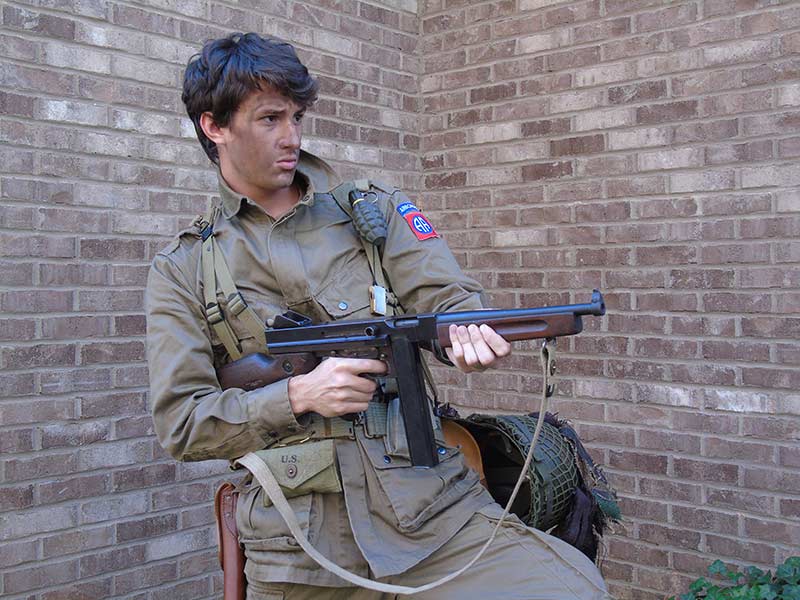
Young American men gravitated toward the Thompson for its sex appeal.
John Taliaferro Thompson was the youngest full Colonel in the U.S. Army at the time of his promotion. While in uniform, he spearheaded the development of the .45 ACP cartridge, the M1903 Springfield rifle and the M1911 pistol. His initials, “JTT,” adorn the sides of many period military weapons dating back to his time as a military acceptance inspector.
Thompson led a team that designed the submachine gun that bore his name in response to the exigencies of trench warfare during WWI. The initial trade name was the Annihilator. The Auto-Ordnance Company later christened the gun the Thompson as a marketing gimmick.
The M1921 version was produced in a single lot of 15,000 by Colt’s Manufacturing. This was the classic gangster version with the top-mounted actuator, finned barrel, blued finish, detachable buttstock, vertical foregrip, and Cutts compensator. The subsequent M1928 looked exactly the same but ran a bit more slowly. The definitive military version was adopted in April of 1942 as the M1.
The M1 Thompson had a fixed buttstock, horizontal foregrip, fixed sights, and a smooth barrel. It also lacked the compensator, would not accept a drum magazine, and sported a right-sided charging handle. The subsequent M1A1 was slightly simplified with a fixed firing pin milled into the bolt face for ease of manufacture. All Thompsons fired .45 ACP rounds from the open bolt.
American dogfaces willingly humped these monstrous things across Europe and the Pacific, using them to clean out derelict buildings, hostile caves and deadly pillboxes. In so doing, these young men helped free the planet. It was such a privilege to call a few of these old heroes friends.
Special thanks to World War Supply for the cool replica gear used by our reenactor.
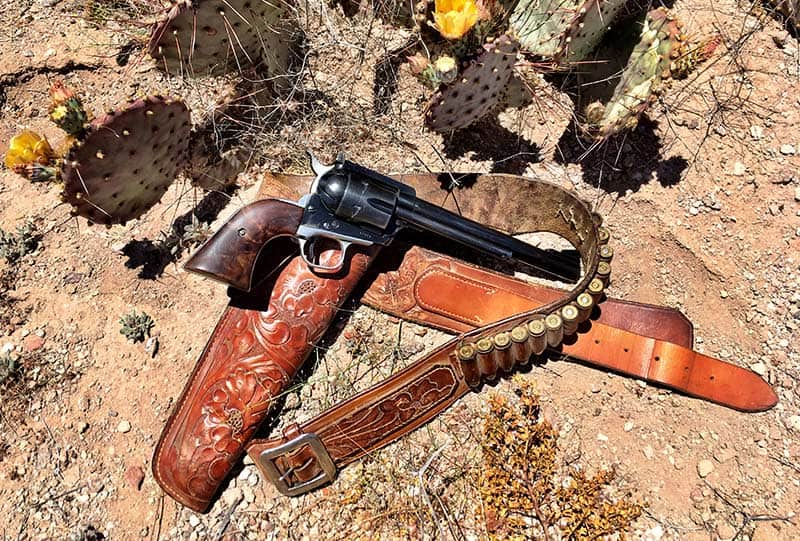
Here’s Skeeter’s 7.5-inch Flattop and rig Tank photographed
while visiting his son, Bart, a few years back.
Guns mean more to people like you and me than others could ever understand. Being sentimental links from our past, they remind us of the people who influenced, or made the biggest impact on us. For better, or worse, ‘til death do us part, guns connect us like no other with these idols. Far from being a way of expending ammunition, doing so with the right gun provides a bond between the shooter and gun, like no other.
You could even say we live vicariously through our shooting irons by emulating a hero every time we pick one up. Obtaining the same gun as our idol, or maybe having custom work done on a gun similar to theirs, deepens this connection. Some might simply build a gun on what they “think” our role model would appreciate.
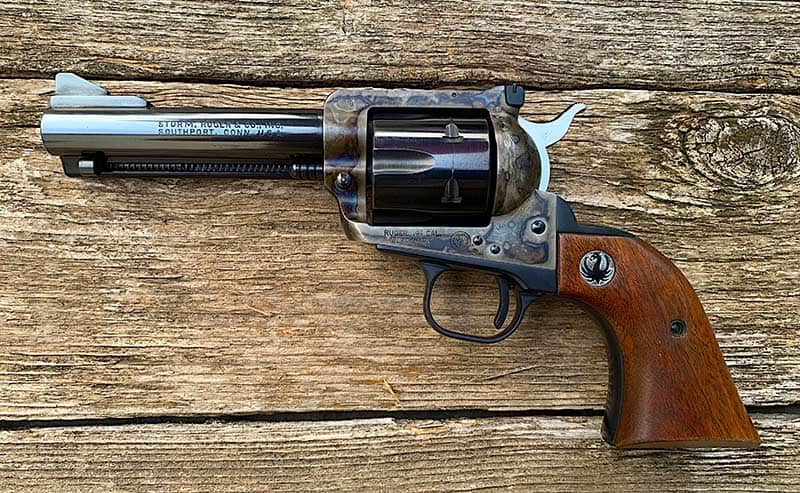
Alan Harton’s conversion from Ruger OM three-screw.
What true sixgunner wasn’t taken with Skeeter Skelton? Reading his works, he quickly became our amigo from days gone by while entertaining us with stories, knowledge and humor of the southwest. Reading his articles was reminiscent of catching up with an old friend, making us feel good while doing it, sad when finished and always wanting more.
Skeeter loved custom guns, having them built the way he thought they should have been in the first place. But he was no snob. Factory guns suited him just fine like Bill Ruger’s original Flattop Blackhawk .44 Magnum, the one with 7.5-inch barrel. Being Skeeter’s favorite sixgun for hunting, there were less than 1,000 made.
They weren’t common. He fashioned and fitted his own walnut stocks for his gun, sanding them thinner than factory grips. A simple action job completed the works. Once upon a time I got to shoot Skeeter’s Flattop, during a visit with his son, Bart. What an honor!
A few years later, I managed to wrangle my own 7.5-inch Flattop and gave it the same treatment. It is my “Skeeter” gun. Ole Skeet had a penchant for Ruger flat tops. When handling one, any sixgunner will quickly understand as to why.
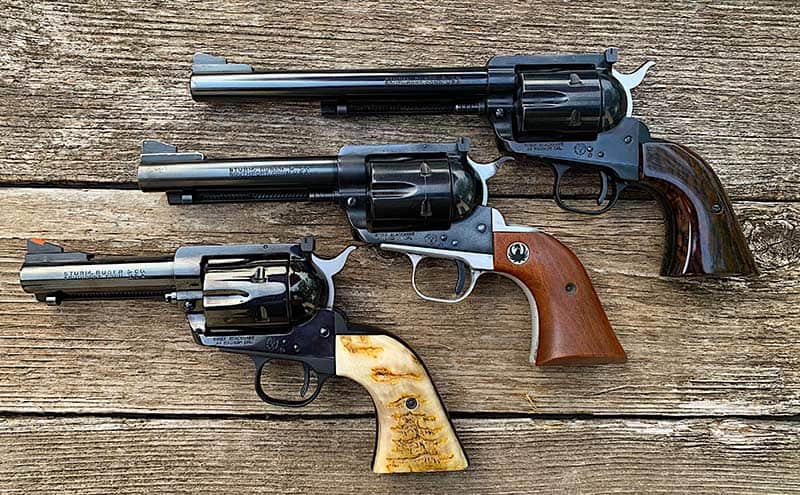
Tank’s trilogy of Skeeter guns (top to bottom): Ruger 7.5” Flattop, a
5” FT Tank rescued from a gun shop, and the “Skeeterito” Tank had
built by Ken Kelly of Mag-Na-Port.
Mi amigo, Doc Barranti, surprised me one New Year’s Eve when he gave me an old, tired Ruger Flattop Blackhawk with 6.5-inch barrel. Displaying a pretty patina, it needed a ‘makeover’ and Ken Kelly from Mag-Na-Port International was summoned.
The barrel was cut to 4 inches and received an 11-degree bull-nose crown, while the ejector rod housing was trimmed flush with the barrel. Ken expertly shortened the base-pin head, allowing the base pin to clear the cylinder for removal without having to remove the ejector rod housing.
The aluminum grip-frame and ejector rod housing were matte finished, while the barrel, frame, cylinder and trigger were given the second to none Mag-Na-Port high-luster blue job. Ken even managed to preserve the aged “plum” colored loading-gate Ruger aficionados love so much.
Cocking the hammer is a delight, with each audible “click” informing you the gun is timed and tuned like a Swiss watch. The trigger breaks at a measured 2 pounds, 4 ounces with positive ignition on every hammer drop.
I call it “Skeeterito.” This gun is a pure pleasure to pack, providing plenty of punch with a steady diet of powder coated Keith bullets, crimped over 10 grains of Unique. The load won’t overstress the gun, pushing the slug at 1,100 FPS. I had Bobby Tyler of Tyler Gun Works fit ram horn stocks to “Skeeterito” for a classic southwestern look that Skeeter would appreciate.
Build Your Own
If Skeeter couldn’t find it, he’d have one built. He was famous (or infamous?) for converting Ruger and S&W .357 revolvers into .44 Specials. The reason I mention infamous is because it was Skeeter’s writings that inspired many to have their guns converted to .44 Special as well. I’m sure there were a few upset wives wondering where the grocery money went for the month while hubby was having a .44 Special built.
I sent my grocery money, along with an old three-screw Ruger .357 to Alan Harton to work his magic, converting the gun to .44 Special. Sure, I ate frijoles for a month, but it was the best money I ever spent. Besides, I like beans.
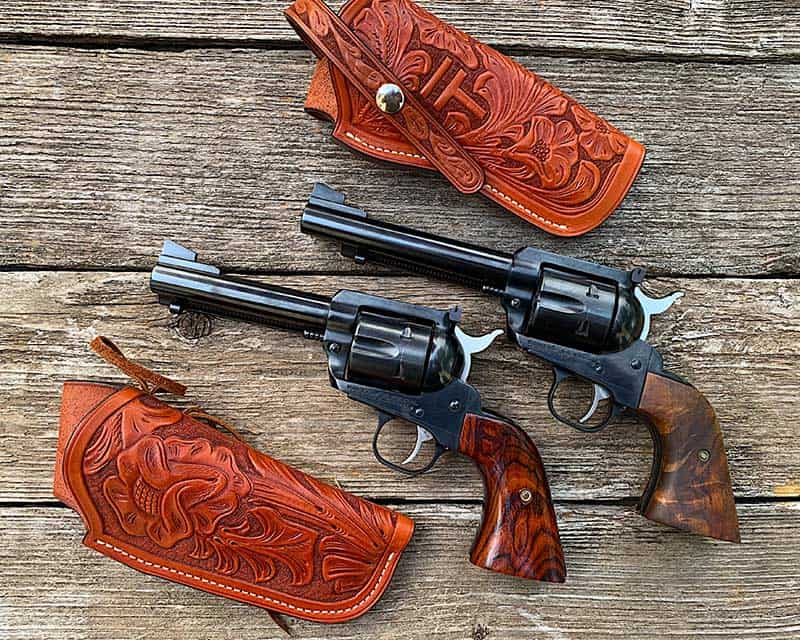
The Lipsey’s New Model mid-framed FT’s with 4 5/8 and 5.5-inch
barrels flaked by some Barranti/Myers shucks. Stocks are from
Dick Thompson fitted and finished by Tank.
In 2009, Jason Cloessner, vice president of product development at Lipsey’s, convinced Ruger to make what we all wanted for decades, a mid-framed flat top .44 Special. It came in barrel lengths of 4 5/8 and 5.5 inches. First, was the traditional plow handle version, eventually followed by Bisley grip frame. It didn’t matter that they were New Model Blackhawks. To say people wanted them was an understatement, being one of Lipsey’s most popular guns ever sold. I ordered both plow handled barrel lengths. It was back to beans for a while.
A Tribute
Guns, whether factory or custom, honor and bring life to our shooting idols. They embody our soul, triggering emotion every time we shoot them. Hell, simply picking one up makes us smile! And that’s a good thing. Cheaper in the long run than any medicine, without any bad side effects, the right gun will keep you smiling, no matter how many mouthfuls of beans you’ll need to endure.
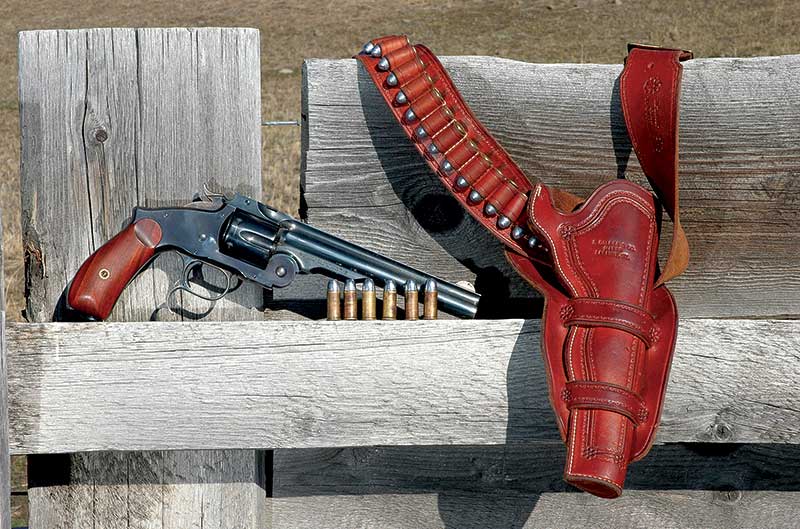
This is Duke’s Navy Arms 3rd Model .44 Russian. He did not even
consider selling it during Duke’s Great Gun Sale in 2008.
After writing a feature recently on why the .44 S&W Special isn’t so special, now I’m going to detail why I do like its ballistic twin, the .44 S&W Russian. At least I like it in this one particular revolver. That’s the Navy Arms’ replica of Smith & Wesson’s Model #3, 3rd Model .44 Russian.
Circa 1872 the Russian Government wanted to start buying Smith & Wesson’s new top break Model #3 revolvers. Very important to the company was the fact they were willing to pay in gold. But the Russians wanted nothing to do with Smith & Wesson’s own .44/100 cartridge because it used a heel-type bullet. That’s where a reduced diameter shank fits inside the cartridge case while the full diameter of the bullet is the same as the outside of the cartridge case. Just look at a round of .22 Long Rifle. They’re still made that way. The Russians explained if the bullet fit inside the cartridge case with revolver chambers bored accordingly things would work much better. They certainly did, and still do. Of course with all that gold in the balance Smith & Wesson said, “you bet!”
The result was the .44 S&W Russian. Smith & Wesson’s own cartridge then gained the name of .44 S&W American. Case length for the Ruskie one was set at .97″ with bullet diameter at .429″. Through the decades the .44 S&W Russian was loaded with bullets as heavy as 275 grains over black powder charges as heavy as 23 grains. By the smokeless powder era in the early 1900s, factory loads were standardized with a 246-grain roundnose bullet at about 755 fps. And when the .44 S&W Special came along in 1908 it was given the exact same bullet at the exact same speed but in a case 1.16″ long.
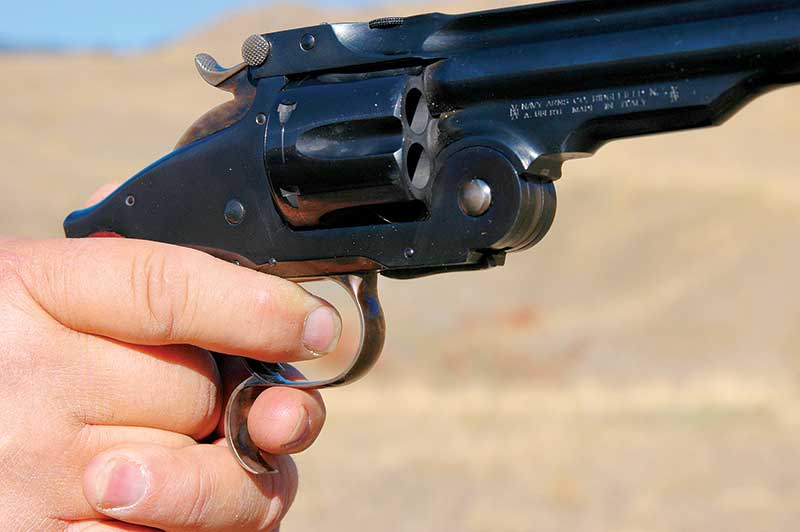
Why the odd hook on the trigger guard?
In its first 30 years of existence the .44 Russian cartridge gained a superb reputation for accuracy, of course as fired in the several versions of Smith & Wesson top break revolvers. It’s recorded some notable handgun target shots were able to keep five .44 Russian bullets inside a 3″ circle at 50 yards. That’s probably true, and it should be emphasized not many handguns made today will do that even with smokeless propellants.
Between 1872 and 1874 the Smith & Wesson Model #3 went through three revisions as requested by the Russians. Collectors named them 1st, 2nd and 3rd Models. With each, the Russians asked for design changes altering the Model #3’s appearance so much the company started to grouse — despite the gold.
By the 3rd Model .44 Russian, the S&W Model #3 had a “knuckle” at the top of the grip resulting in a saw-handle shaped grip frame, and that odd spur hanging off the trigger guard. Many theories have been thrown out as to the purpose for the spur. The most likely one is Russian Cavalry tactics called for horse mounted troopers to charge with their revolvers cocked and with the trigger finger resting on the spur. That likely saved a lot of horses from being shot in the back of the head as Lt. Col. George A. Custer did to his own horse once when chasing a bison. I’ve found the spur makes a dandy finger rest for two-handed shooting and the saw handle grip keeps the hand positioned on the revolver exactly the same from shot to shot.
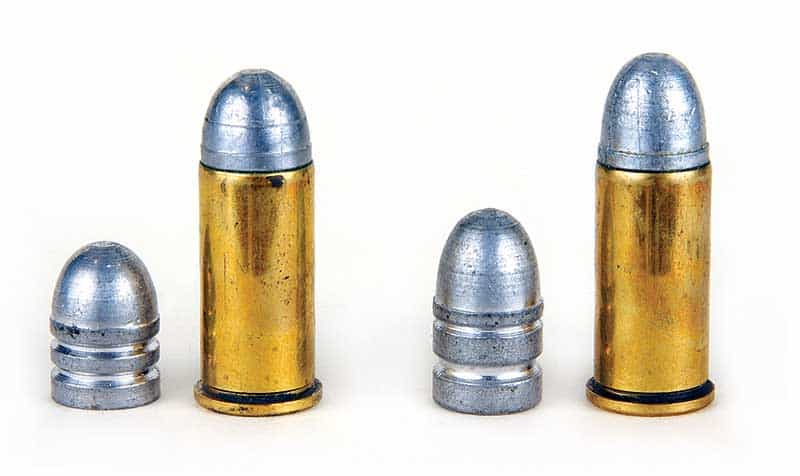
Left is Lyman #429478 (200 grains) and at right is Lyman #429383 (248 grains).
At one time I owned a sample of each of those vintage S&W .44 Russian revolvers but hardly ever fired them because they were very fragile and also very valuable. So when Navy Arms announced their replica of the 3rd Model .44 Russian about 10 years back, I jumped on it. While it is not an exact clone of the old S&W 3rd Model .44 Russians, it’s not bad, and the differences are minor. The Navy Arms’ version has a 7″ barrel as opposed to the original’s 6½”, and the original had a front sight forged integral with the barrel while the replica’s is pinned on. Oh, and some dimensions are slightly different by a few hundredths of an inch. So what.
My Navy 3rd Model .44 Russian is extremely accurate with either smokeless or black powder loads. I’ve settled on two loads: 248 grain roundnose bullets (Lyman #429383) or 200 grain roundnose bullets (Lyman #329478) over 4.0 grains of Bullseye or 19 grains of Swiss FFFg blackpowder. Its point of impact is about dead on with the latter bullet and about 2″ higher than point of aim at 50 feet with the former. Despite its tiny sights I’ve gotten one hole groups at 50 feet from a sandbag rest, and standing with two hands I can keep dueling tree paddles swinging. It doesn’t gum up with black powder fouling for at least 50 or so rounds.
When I had Duke’s Great Gun Sale in 2008 and disposed of 50 seldom used firearms, all my original S&W .44 Russian revolvers went. Putting the Navy Arms 3rd Model .44 Russian on the auction block was never even considered.