
Categories

By the late 19th century, Colt had entered the growing trend toward double-action revolvers with two guns that nonetheless mimicked the general configuration and sidegate-loading system of the company’s Single Action Army—the Model 1877 Lightning and the larger-framed Model 1878. But the company more fully embraced the modern double-action-revolver concept with its swing-out cylinder designs of the 1889 New Model Navy and the 1892 New Army and Navy (which featured mechanical and nomenclature upgrades through 1903).
Both of these latest guns—unlike previous Colts—had counterclockwise cylinder rotation; Colt quickly switched back to clockwise rotation in 1893 with its New Pocket Model. In fact, taking a swipe at Smith & Wesson, whose cylinders rotated counterclockwise, Colt’s ads boasted, “Colt Cylinders All Turn Right—To make certain that the cylinder is in perfect alignment with the barrel … .”
 This spotlighting of its mechanical improvements continued with the introduction of the Colt Positive Lock in 1905. An early form of transfer-bar safety, it was patented by Colt engineer George H. Tansley in 1905 and effectively prevented a double-action Colt from accidentally firing, should the gun be dropped. The Positive Lock eventually gave rise to one of Colt’s most prolific double-action revolvers: the Police Positive.
Introduced in 1907, it was available in nickel or blue finishes and priced at $14. Colt hard rubber stocks were standard until 1924, when checkered walnut took over. With initial barrel lengths of 4″, 5″ and 6″, it was chambered in .32 Long/Short Colt, .32 Colt New Police (the same as .32 S&W Long), .38 Colt New Police (the same as .38 S&W) and .22 rimfire.
Interestingly, Colt refrained from using S&W nomenclatures for its .32 and .38 chamberings, not wishing to promote the name of a competitor. And, of course, Colt catalogs had a call-out that stated the guns were equipped with the Colt Positive Safety Lock “… a solid bar of steel, 1/10 inch in thickness, rests directly between the hammer and the frame…except when the trigger is pulled.”
Being promoted as “light, compact … an ideal pocket or house arm,” a 2½”-barreled version was later offered in .32 caliber. A slightly larger version, the Police Positive Special, priced at $15 and chambered in .32-20 and .38 Spl., was brought out in 1908. A Police Positive Target, featuring adjustable sights, was made from 1907 until 1941, and the Banker’s Special, a Police Positive with a 2″ barrel and chambered in .22 LR or .38 Colt New Police, was produced from 1926 until 1940.
More than 750,000 Police Positives, in all versions (including the Police Positive Special), were produced until production halted in 1995. Needless to say, the little gun was adopted throughout its early existence by numerous law-enforcement agencies. In addition, a great many guns were procured by various express companies, including Wells Fargo and American Railway Express.
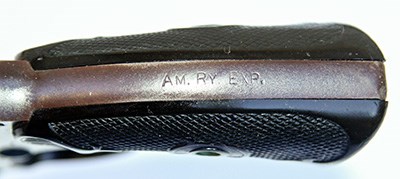
This well-carried First Issue blued example with a 4″ barrel was shipped on Nov. 28, 1922, as part of a two-gun shipment to H.C. Garner, who had recently been promoted as route agent at the American Railway Express Agency in Columbus, Ga. It is factory-rollmarked “Am. Ry. Exp.” on the backstrap and no doubt guarded many a railroad shipment during the Roaring ‘20s. In its NRA Good condition, it is worth between $950 and $1,150. Without the express company provenance, as verified by Colt factory letter (coltarchives.com), it would be worth only $275 to $350.
Gun: Colt Police Positive (backstrap factory-rollmarked “Am. Ry. Exp.”)
Chambering: .38 Colt New Police (.38 S&W)
Serial No.: 146XXX
Manufactured: 1922
Condition: NRA Good (Modern Gun Standards)
Value: $950 to $1,150 (with factory-verified express company provenance)

A History of the M1 Garand
During World War I, the United States Army experimented with a number of different machine gun designs, and the news reports of the tests got a young inventor thinking about, and eventually designing, a machine gun of his own. His initial attempt was a primer-actuated light machine gun he submitted to the National Bureau of Standards, which had instructed him to make a model of it. That design became the basis for what would, eventually, become the M1 rifle—commonly called the “Garand” after its inventor, John Cantius Garand.
Garand, who became a Springfield Armory employee in 1919, had an extensive background in design and production. Once at Springfield, he was tasked with designing a semi-automatic shoulder rifle based upon his earlier machine gun. He worked on and improved the design for the next 17 years. The now-familiar M1 was finally adopted on January 9, 1936, the rifle was adopted as the “U.S. Rifle, Cal. .30, M1.”
Early production rifles used a “gas trap” instead of the later “gas port” design and initially did not perform as well as expected, but once the “bugs” were worked out, the rifle was favorably received. It was fed by an eight-round en-bloc clip that was ejected along with the last spent casing, locking the bolt back and leaving the receiver open for a fresh clip to be inserted. User-friendly, accurate and chambered for the powerful .30-’06 Sprg. cartridge, the M1 gained a reputation as a hardy and well-made service rifle.
World War II was the rifle’s baptism of fire, and it performed admirably. To a man, the G.I.s put their faith in their M1 rifles and took them from North Africa to Okinawa. Along the way, Garand made more improvements to the rifle based upon field experience and soldiers’ comments.
Although late to adopt the rifle, the Marines liked it, too, and found it well-suited for jungle fighting. America was the only country to equip its fighting men with a semi-automatic rifle as a standard shoulder arm. The venerability of the rifle was further established in the Korean War.
The M1 rifle is not without faults. At just under 10 lbs. it is heavy and the en-bloc clip does not allow for easy “topping off.” Because of those drawbacks, America sought a high-capacity, fully automatic rifle for individual soldiers. Reliability and accuracy were paramount, however, and the M1 was the measuring stick. What later became the M14 was based upon the M1.
Combined, Springfield Armory and Winchester Repeating Arms manufactured more than 4 million M1s during World War II. International Harvester and Harrington & Richardson manufactured them as well, and, during the Korean War, more than 500,000 were made.
The rifle is considered one of the finest ever produced by American armories. Its popularity is evidenced by its representation on the firing line at Camp Perry and other highpower rifle matches to this day. It is accurate, robust and its service record speaks for itself.
Disassembly
Disassembly of the unloaded M1 rifle begins by pulling the bolt rearward until it locks back. Visually inspect the chamber to ensure it is not loaded, then press down on the slide and follower while holding the operating rod and ease the bolt forward. Do this carefully or you will end up with a case of “M1 thumb”—a highly unpleasant condition!
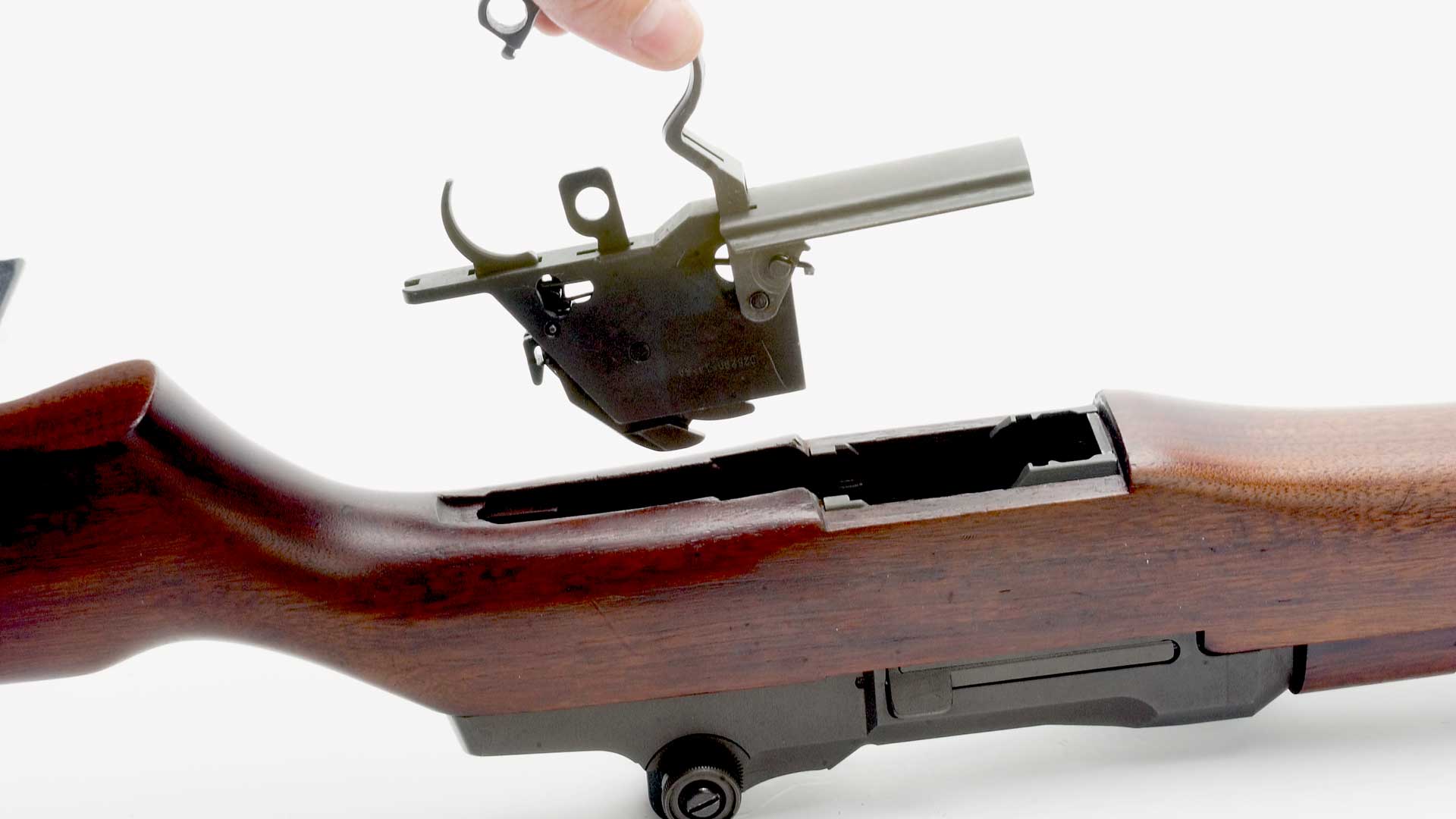
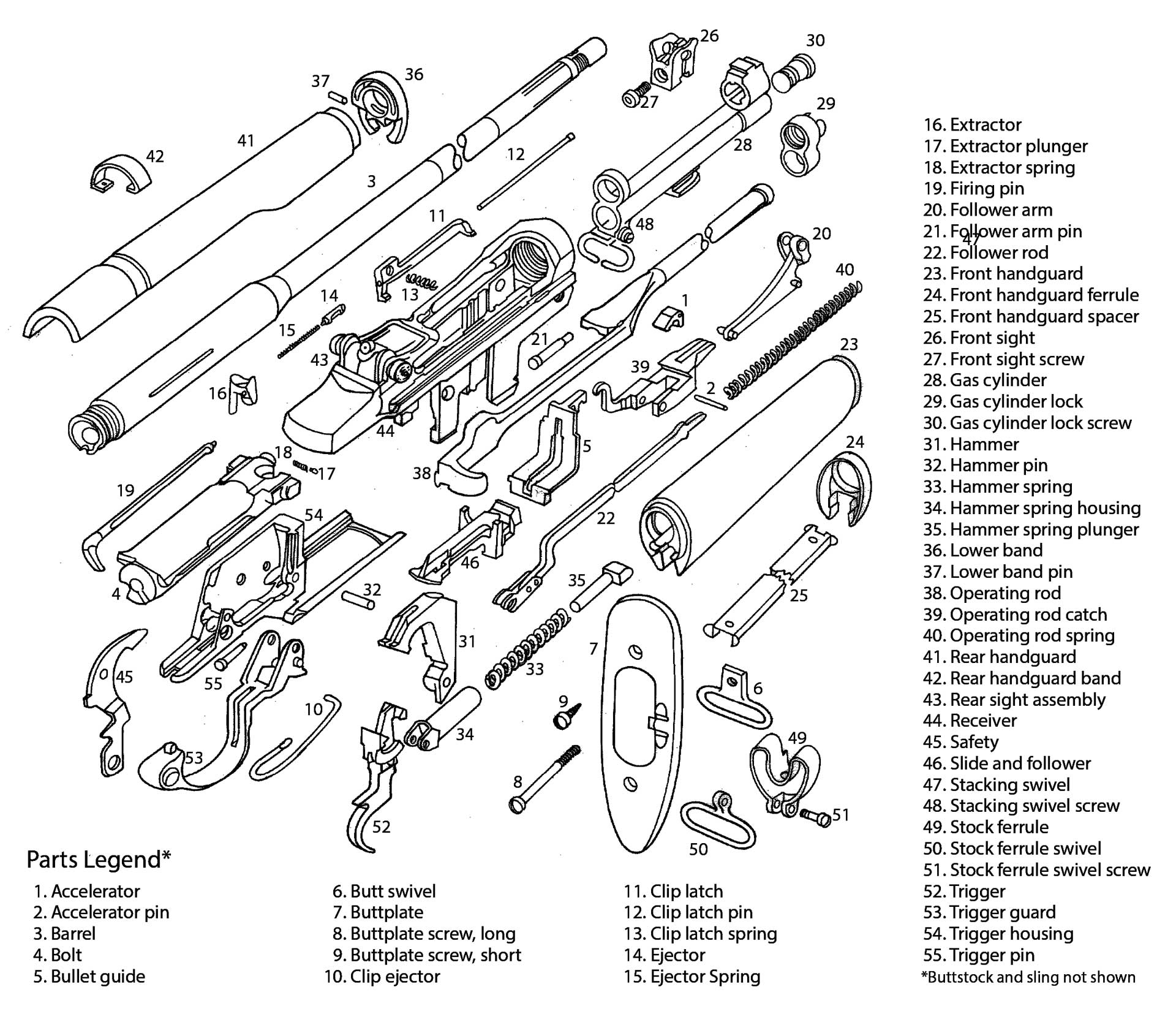
Once this is done, disassembly can begin. Pull rearward on the trigger guard (53) and then out and away from the stock. The entire trigger housing (54) and assembly will separate from the rifle (Fig. 1). Lift the receiver (44) and assembly away from the stock.
Disengage the follower rod (22) from the follower arm (20) by moving the rod toward the muzzle. Remove the rod and operating rod spring (40). Next, push out the follower arm pin (21) from the receiver’s left side. Then lift away the bullet guide (5),
follower arm and operating rod catch (39) (Fig. 2). Reach down into the receiver and lift out the slide and follower (46).
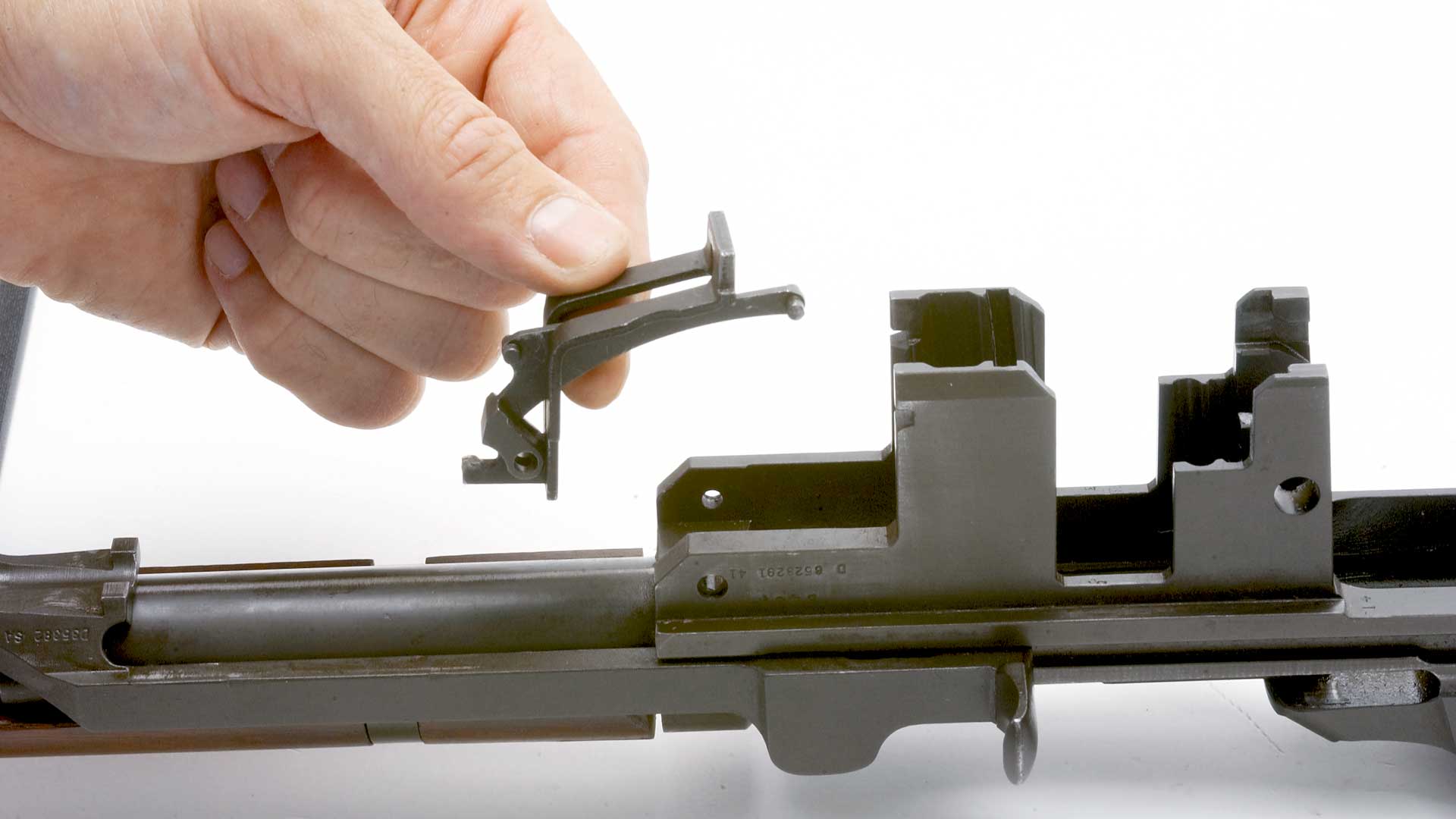
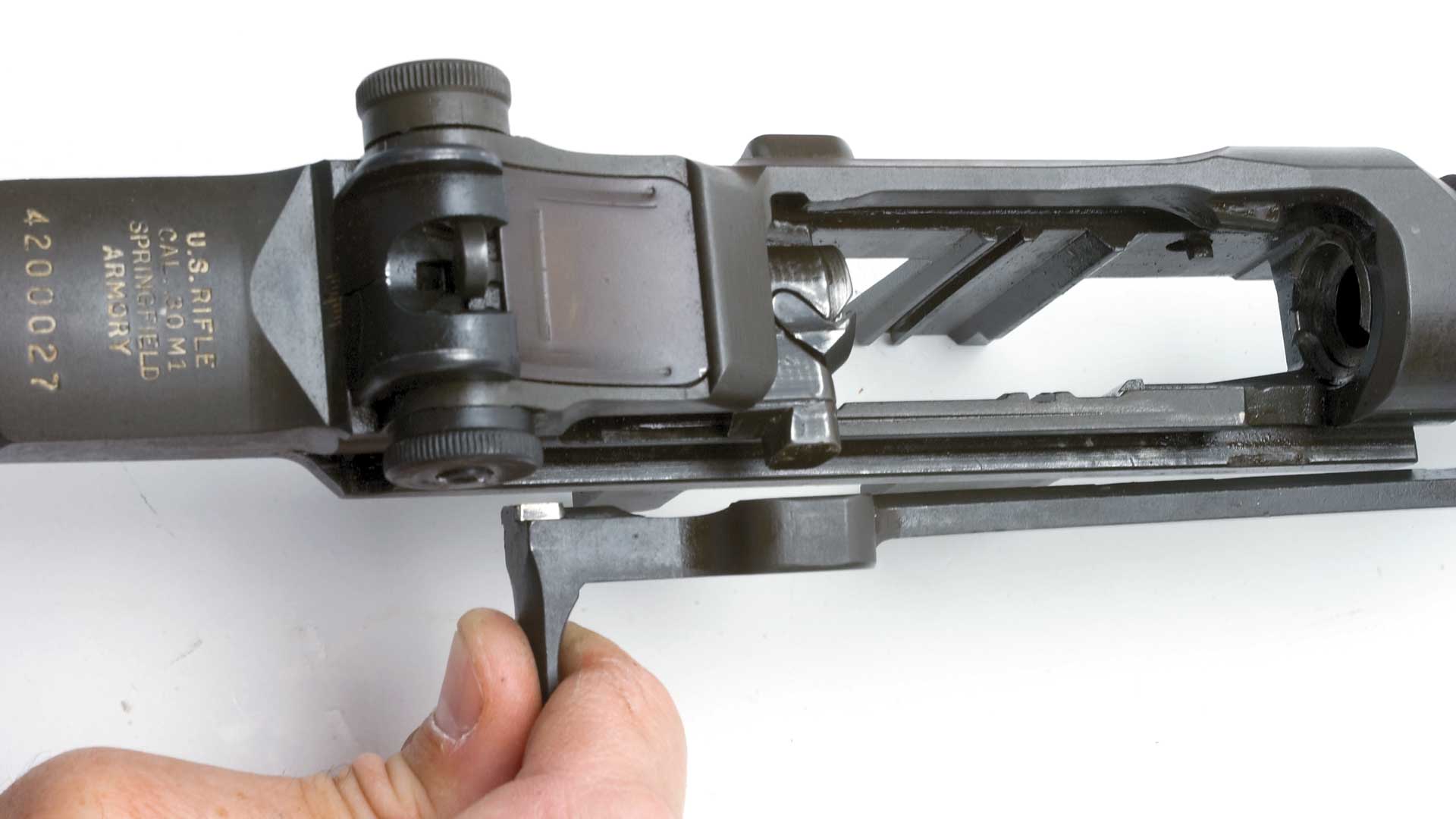
Continue disassembly by pulling the operating rod (38) rearward until the rear surface of the handle is directly under the forward edge of the windage knob on the rear sight. Disengage the guide lug on the operating rod through the dismount notch on the receiver with upward and outward pressure on the handle of the operating rod (Fig. 3). The rod should now come free from the receiver. Remove the bolt (4) by grasping it and sliding it forward while lifting upward and outward with a rotating motion (Fig. 4).
With a large, blunt screwdriver, unscrew and remove the gas cylinder lock screw (30). Unscrew and remove the gas cylinder lock (29). Next, remove the gas cylinder (28) by sliding it forward and off the barrel. If the gas cylinder is tightly attached, rap on the bayonet stud with a nylon hammer or piece of soft wood to loosen it. Do not burr or damage the internal splines. The front handguard (23) may then be moved forward and off the barrel.
This is all that is needed for basic cleaning. All other bolt and trigger housing disassembly and parts replacement should be done by a competent gunsmith. Reassembly of the M1 is in the reverse order.
A few precautions: The operating rod for the M1 has a bend that is intentional, and it should never be hammered on or straightened out. The crown of the operating rod should also be kept bright by using a solvent and nylon brush. Do not scrub with a metal brush or other harsh abrasive. The tolerances within the gas operating system are quite close and nothing should be used that can affect the system.
All operating parts should have a light coat of lubrication except the inside of the gas cylinder. This should be free of carbon deposits and other fouling, but should be kept dry.
Being on the back half of my seventh decade, there are a lot of things about contemporary society that I find perplexing. For example, service dogs are now almost ubiquitous. Not the kind of “service dog” that alerts of an onset seizure, helps the physically or visually disabled, sniffs out explosives and runs down escaping perpetrators, they are true gifts of God. As are the “service dogs” that point quail and retrieve ducks. The ones that perplex me are the little “Fluffies” whose supposed “gift” is that they calm the frayed nerves triggered by the perceived anxiety of a “victim” of some trendy contemporary angst.
These dogs are allowed by bureaucratic fiat to chaperone their convalescing victim on planes, in church, even at the SHOT Show. Other delusions of oppression like global warming and PTSD caused by non-combat events are difficult for my limited mind to wrap itself around. Everyone is a victim of someone or thing.
No disorder however is more perplexing than the nouveau defect of “Toxic Masculinity.” Apparently the entire 50’s, 60’s and 70’s were a petri-dish of perversion for those of us who identify as male. Attempting to find an objective definition of toxic masculinity is difficult; they all read like an Alexandria Ocasio-Cortez CNN interview, untethered and well…..sorta crazy.
Suffice it to say that if you like guns, shooting and are reading these words, you probably are a carrier. For sure the sport of “practical” shooting was initiated, administered and dominated by men that would be considered “exhibit A” of toxic masculinity by today’s emotive reformers. Most of the early pillars upon whom we’ve built are well known. One of the lesser known pioneers to whom we can proudly trace our lineage of toxic masculinity is Lt. Col. Bill McMillan.
Bill McMillan retired from the Marine Corps the same year that I joined, 1974. As a 6 time Olympian and Gold Medal winner in 1960 in the 25 meter rapid fire pistol event, he was and is a true icon of the Corps. In those days, McMillan stories ran rampant at Corps shooting events and Bill would occasionally attend and put on demos for aspiring competitive shooters. At one of the Western Division matches, he conducted a demo on trigger control using a Thompson submachine gun.
Taping a clay pigeon onto one of the green silhouette target backers, he backed off a number of paces (the distance is irrelevant to the story). Bill then emphasized that a shooter had to be able to feel and control the trigger of whatever firearm that they were shooting, even a fully automatic one. “For example, here’s a one shot burst, he said.” Bang. The clay pigeon shattered. “Here’s a two shot burst.” Bang, Bang. “Here’s three shots.” Bang, Bang, Bang. “Four shots.” Bang, Bang, Bang, Bang. You get the idea.
He kept going until the number of the shots could no longer be audibly distinguished. He then went down to the target with another clay pigeon and taped it on the backer; it covered every hole that he had shot during the demo!
An often told McMillan story relates an example of coaching that he performed in the mid-60’s for the 3rd Tank Battalion. After conducting a shooting demo he asked if any of the assembled Marines were unqualified with their standard-issued 1911A1. One reluctant Marine came forward. Bill loaded a magazine with 5 rounds and had the Marine shoot at a silhouette backer with a regulation bullseye target taped to it; the Marine missed the entire silhouette with all 5 rounds. Bill took him aside and spoke to him for just a few seconds, reloaded the pistol and had him repeat this exercise with the Marine hitting the target with all 5 rounds and putting 4 in the black!
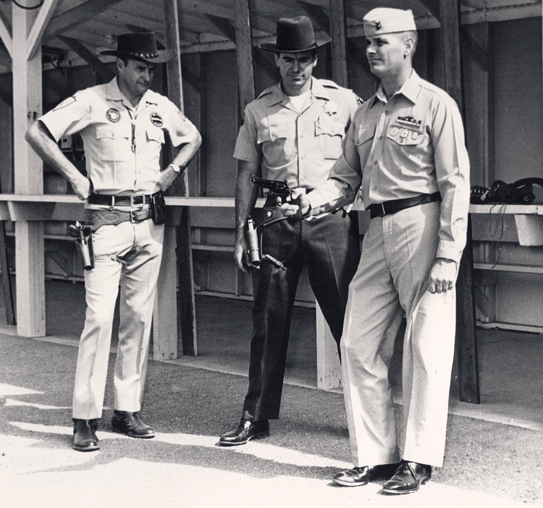
In 1964 he was made an honorary Deputy Sheriff with the San Diego County Sheriff’s Department during a ceremony and shooting exhibition conducted by Ray Chapman and Eldon Carl who worked for the Dept. After retiring from the Marine Corps in 1974, McMillan went to work for the Sheriff’s Department as the Weapons Training Coordinator.
In 1978 during the first class that Ray ever held at the new Chapman Academy, his curriculum included a segment on both strong and weak one-hand shooting. Ray taught a 5 o’clock hold with the right hand and a 7 o’clock hold with the left with the gun “tilted” in board. This was the first time that I was exposed to the 30 degree tilt which allowed for a more natural and strong hold on the handgun. The technique has become almost universally accepted in the “practical” shooting arena and has been taught by most of the famous practitioners of self-defense training.
Only recently have a few trainers like Dave Spaulding gotten away from the practice. Chapman credited McMillan with teaching him the technique which Bill said he originally saw being executed by a Russian bullseye shooter at one of the International games. The technique eventually became known as the “McMillan tilt” in bullseye circles.
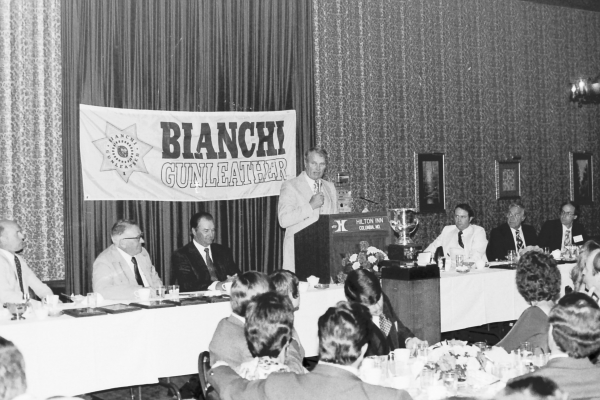
At the inaugural Bianchi Cup in 1979, Chapman and John Bianchi asked McMillan to be the guest of honor and speaker at the banquet. It was in keeping with the dignity of the event to have McMillan speak.
Almost exactly one year later, disaster struck. On May 21, 1980, Bill was supervising a “shoot/don’t shoot” exercise using duel-a-tron pivoting targets which he operated from behind a control panel. As a deputy worked his way thru a mock store set-up, McMillan activated two targets, one a “shoot,” one a “no-shoot.” The deputy correctly engaged the “shoot” target but out of the corner of his eye saw another “shoot” target against the wall behind the door thru which he had just exited. Turning, the officer fired two rounds back up-range into the target. The two rounds passed thru the target, wall, a glass window surrounding the control panel and struck McMillan in the upper chest. EMT’s arrived on the range within 4 minutes and found McMillan to have neither measurable blood pressure nor a pulse.
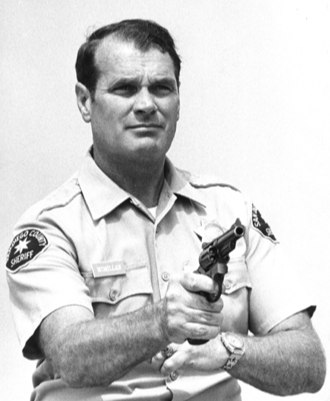
Publicity shot of Deputy Sheriff Bill McMillan.
|
They somehow managed to resuscitate Bill and transport him to the Emergency room where he endured 5 hours on the operating table and lost 11 pints of blood. Bill remained unconscious for 2 weeks while he endured multiple surgeries complicated by a blood clotting disorder. One slug was removed 5 days after the shooting and the second slug was removed almost a year later. Bill’s injuries left him very much like a stroke victim. He initially lost the use of his right arm and leg and had no feeling in his mouth. He had to relearn to walk and talk. He also suffered double vision which was helped by prescription bi-focals.
It’s difficult to imagine the impact that such a loss of bodily control would have on an Olympic shooter, Korea and Viet Nam combat veteran and law enforcement officer. Intestinal fortitude, stubbornness, character, determination or some combination of traits saw McMillan driving a vehicle and helping the San Diego Sheriff’s Range Master test ammunition and working with the Sheriff’s SWAT team within a year!
Refusing to buy into a victim mentality, McMillan commented that if this accident had to happen, he was glad that it happened on the downside of his career.
Col. McMillan passed away from congestive heart failure on June 10, 2000.
Every time I shoot one handed and tilt my handgun inboard, I think of Col. McMillan and thank God that men like him have enriched my life in some way. If that’s a nod to “toxic masculinity,” so be it.
– – Greg Moats
Greg Moats was one of the original IPSC Section Coordinators appointed by Jeff Cooper shortly after its inception at the Columbia Conference. In the early 1980’s, he worked briefly for Bianchi Gunleather and wrote for American Handgunner and Guns. He served as a reserve police officer in a firearms training role and was a Marine Corps Infantry Officer in the mid-1970’s. He claims neither snake-eater nor Serpico status but is a self-proclaimed “training junkie.”