Category: All About Guns
Categories
M48 SNEAK PEEK
Federal law enforcement officials have launched a new initiative to inform the public of what they say is a growing problem that involves the illegal modification of semi-automatic firearms into fully automatic weapons.
Officials from the United States Attorney’s Office for the Central District of California and the Bureau of Alcohol, Tobacco, Firearms and Explosives launched a series of public service announcements designed to raise awareness on the dangers of these machine gun conversion devices, which are often referred to as “switches,” “chips” or “auto sears.”
The devices can be 3D-printed at home, but are often sold online, sometimes under misleading names to avoid detection by law enforcement, and billed as being legal to possess.
But despite their seeming harmlessness on their own, simply owning one of the conversion devices carries the same legal penalty as carrying an illegal machine gun, even if you don’t even have a weapon to modify.
The public service announcements feature U.S. Attorney Martin Estrada and leadership from the ATF Los Angeles, highlighting the dangers of the illegal conversion devices and the stiff legal penalties for those found in possession of them.
“These devices are not gun accessories. They are illegal and considered machine guns under federal law,” says ATF LA Field Division Special Agent in Charge Christopher Bombardiere.
He adds that the ATF has recovered more than 31,000 of the devices in the last five years and compared the problem to the rise of ghost guns — untraceable firearms that are assembled using spare or 3D-printed parts and which have no serial number.
Law enforcement officials say the devices can switch a semi-automatic pistol or rifle into fully automatic in as little as 60 seconds. “One pull of the trigger can release all the ammunition in the magazine,” they said.
Estrada said simply possessing one of these “switches” can carry a sentence of up to 10 years in prison and federal law enforcement officials are being extra diligent to keep the devices off the streets.
If you know of anyone who may be purchasing, making or stockpiling these devices, you are urged to contact your local ATF office. They can also be safely turned over at a local office.
A machine gun is described under the National Firearms Act as follows:
- Any weapon which shoots, is designed to shoot, or can be readily restored to shoot, automatically more than one shot, without manual reloading, by a single function of the trigger.
- The combination of parts designed and intended for use in converting a weapon into a machine gun.
To view one of the public service announcements published by the ATF, click here.
 On Wednesday, State Senator Julie Morrison, the Majority Caucus Whip, introduced legislation that could result in Illinois gun owners’ losing their driver’s licenses without due process, less than two weeks after 2 million Firearm Owners Identification (FOID) card holders rebelled and chose not to register their firearms in protest of Gov. Pritzker’s assault weapons ban that he signed into law last January.

In a video statement released on Thursday evening, Illinois State Rifle Association president Doug Mayhall said, “Now the anti-gun legislators are coming after your Driver’s License!”
Mayhall went on to explain Senate Bill 2720, which “proposes that when a FOID card is revoked – and the FOID card holder does not comply with Section 9.5 of the FOID Act by surrendering their FOID card to authorities – the gun owner may not be issued a driver’s license; renew a driver’s license; retain a drivers license; or be issued a permit to drive under the Illinois Vehicle Code.”
The legislation also requires the Illinois State Police to notify the Secretary of State’s office and report anyone that fails to comply with Section 9.5.
But the issue is more troublesome than simply having your FOID card revoked according to Mayhall.
“Under the Red Flag Law – there can be an ex parte case filed against you. In other words, someone can say you are a problem and go before a judge without you present. You then can lose your FOID card and not get a hearing for at least two weeks.
So what’s the bottom line here? A person under this bill can be falsely accused and lose their right to drive without a single hearing.”
The loss of a driver’s license can have serious implications, and it has the potential of completely disrupting one’s livelihood – including someone’s ability to get to and from work.
The timing of the legislation to coincide with the January 1st deadline of Illinois’ gun registry and the one year anniversary of the assault weapons ban is not accidental, as Mayhall pointed out.
“After Governor Pritzker was left embarrassed when less than 2 percent of the 2.4 million FOID Card holders registered their firearms by the January 1st deadline, he’s now looking for new ways to target and harass gun owners.”
The legislation is awaiting a committee assignment, and the Democrats maintain a comfortable 40-19 supermajority in the state Senate.

Categories
Mossberg 590A1 18 inch Barrel

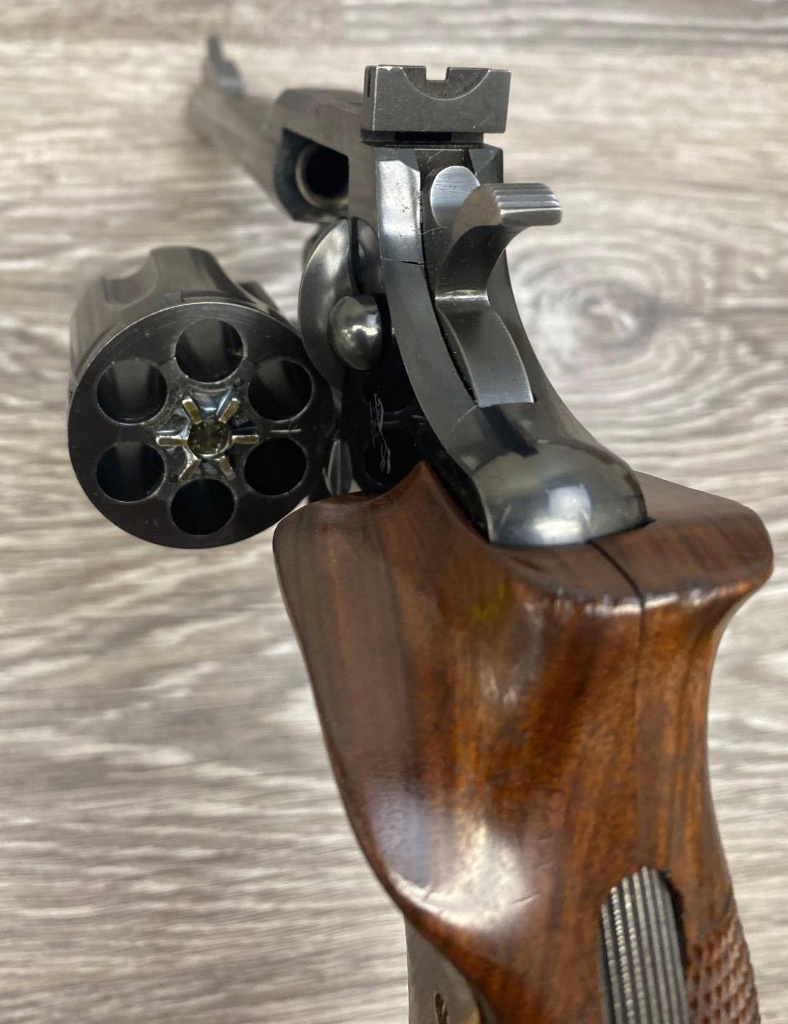
Many don’t realize it, but the double-action revolver dates back to the mid-19th century. One of the earliest was an English creation from the company of Deane and Adams, and was a .456-cal., five-shot cap-and-ball revolver. In America, Ebanezer Townsend Starr designed a .44-cal. double-action percussion revolver with a six-shot cylinder around 1856 and began producing it commercially in 1858, just in time to have it be a part of the American Civil War. When Rollin White patented the bore-through cylinder in April 1855, the concept of a repeating cartridge revolver would soon be combined with a trigger-cocking design that would be the foundation of revolvers to this day.
White—who once had been employed by Colt and had developed his bored-through patent while there—took that patent and several others with him when he parted company with Colt, eventually working out a deal with Smith & Wesson, which had been dabbling with the double-action revolver concept as early as 1872 in some top-break revolvers. Those early efforts had some problems—as do nearly all early designs. Single-action revolvers declined in popularity, the favor went to Colt’s 1878 double-action design and Forehand & Wadsworth double-action, top-break revolvers, which have a more-than-casual resemblance to Smith & Wesson top-breaks. In 1879, James H. Bullard worked up a break-top, double-action revolver design, first a .32-caliber, and later that year a .38-cal. design with a cartridge that became the .38 S&W.
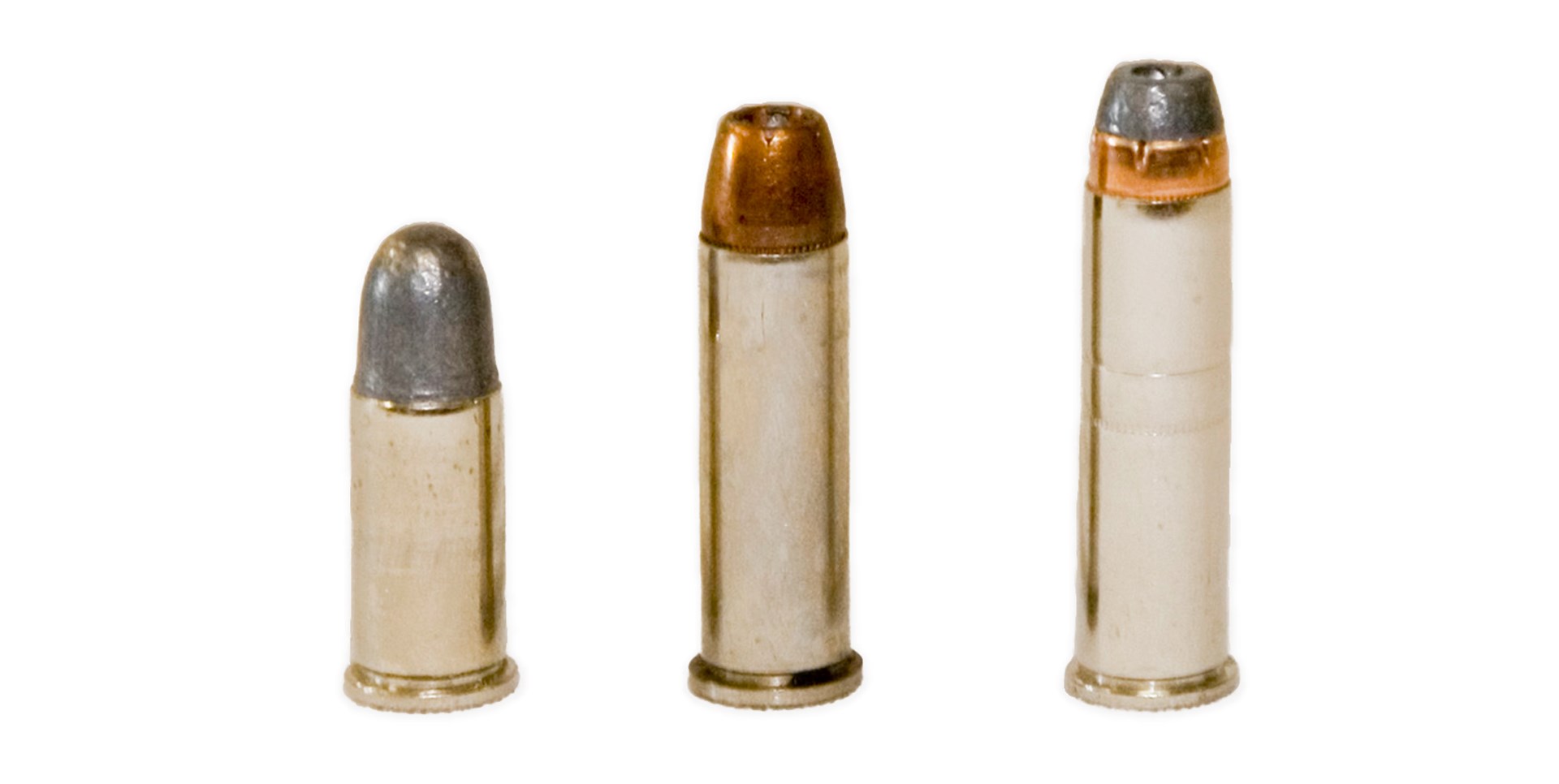
Shown (l. to r.): .38 S&W, .38 Spl. and .357 Mag. Image courtesy of author.
Like many firearms’ designs, the first efforts are for lower-powered cartridges in order to get the bugs and manufacturing mechanics worked out, but soon, the demand came for more power. Colt had less-than-acceptable results with its .38 Long Colt cartridge. However, Colt did have a superior—read stronger—design with its solid-frame, swing-out cylinder double action. Smith & Wesson started developing a solid-frame revolver in 1894 dubbed the Hand Ejector, the first of which were chambered in .32 S&W Long and .38 S&W.
Yielding to the demand for more power, Smith & Wesson beefed up and improved its solid-frame revolver it developed into the K-frame in 1899. It was called the Military and Police (M&P) model and was available in .32-20 Winchester Center Fire (WCF) and a new cartridge—designed in 1898—known as the .38 Smith & Wesson Special. Both the revolver and its .38-cal. cartridge would rock the handgun realm worldwide. It is, in a word, ubiquitous.
The .38 Special (Spl.) is dimensionally identical to the .38 Long Colt except for length; the .38 Spl. is 0.529″ longer. Too, the .38 Long Colt is derived from the .38 Short Colt, thereby meaning both of the Colt cartridges can be safely fired in a .38 Spl.-chambered firearm. Initially, the .38 Spl. was loaded with 21 grains of blackpowder for a velocity of 775 f.p.s. with a 158-grain lead, round-nose bullet, however, within a year, smokeless powder loads became available.
In 1900, the navy ordered 1,000 M&P revolvers, and the following year, the army did the same. Police departments and target shooters flocked to the M&P revolvers. Colt began chambering its revolvers to .38 Spl. in 1907 with the Police Positive. Just about every manufacturer making revolvers has made or is building .38 Spl. revolvers.
Barrel lengths run from 1 3/4″ in snubby revolvers to 10″ as the one used in the first-generation Thompson/Center Contender single-shot pistol. Profiles run from pencil-thin, straw-like tubes to massive barrels an inch or more in diameter. The fat barrels are most often custom jobs installed on dedicated target guns. The .38 Spl. made its way into the chambers of derringers and even a semi-automatic target pistol.
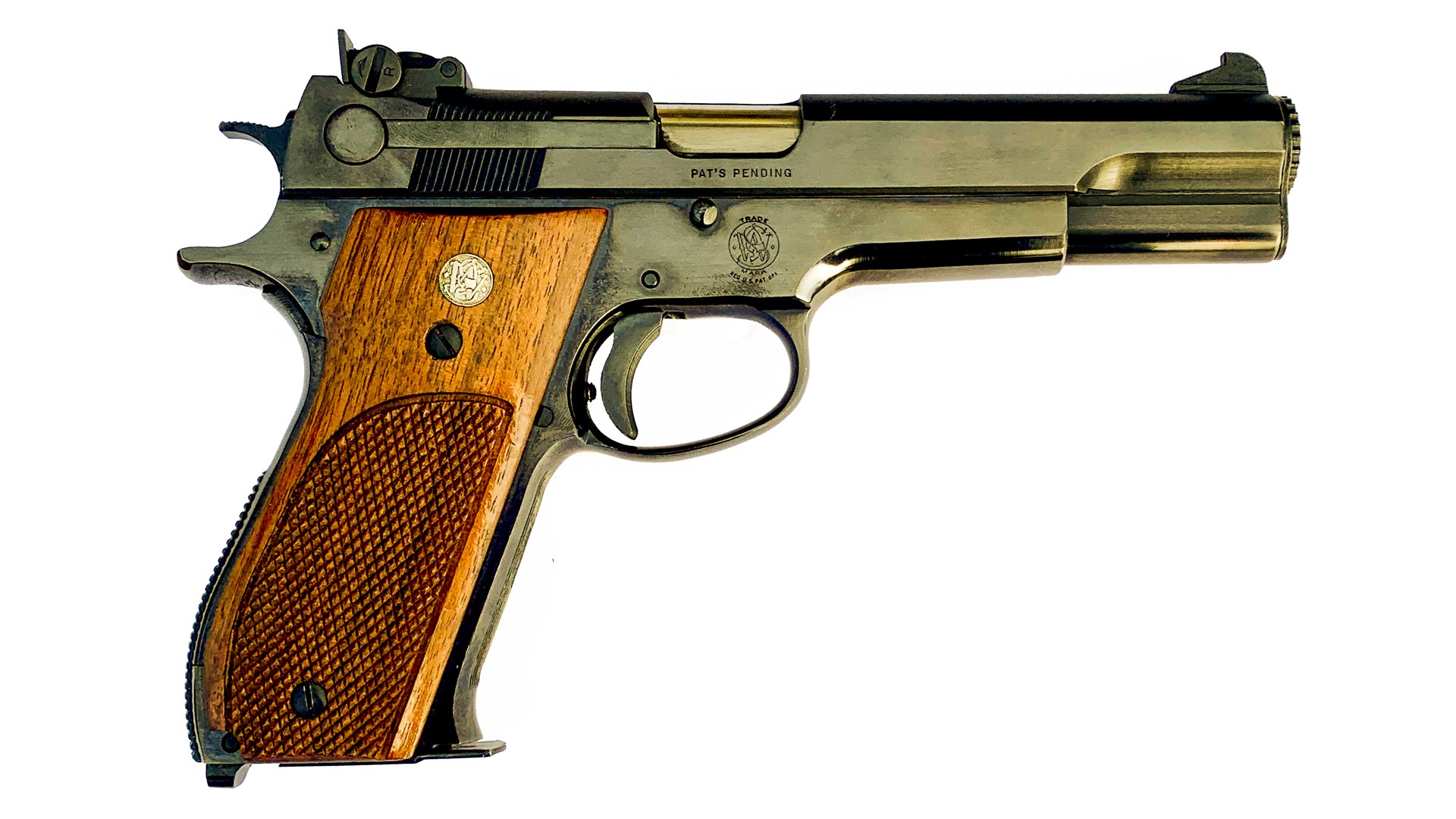
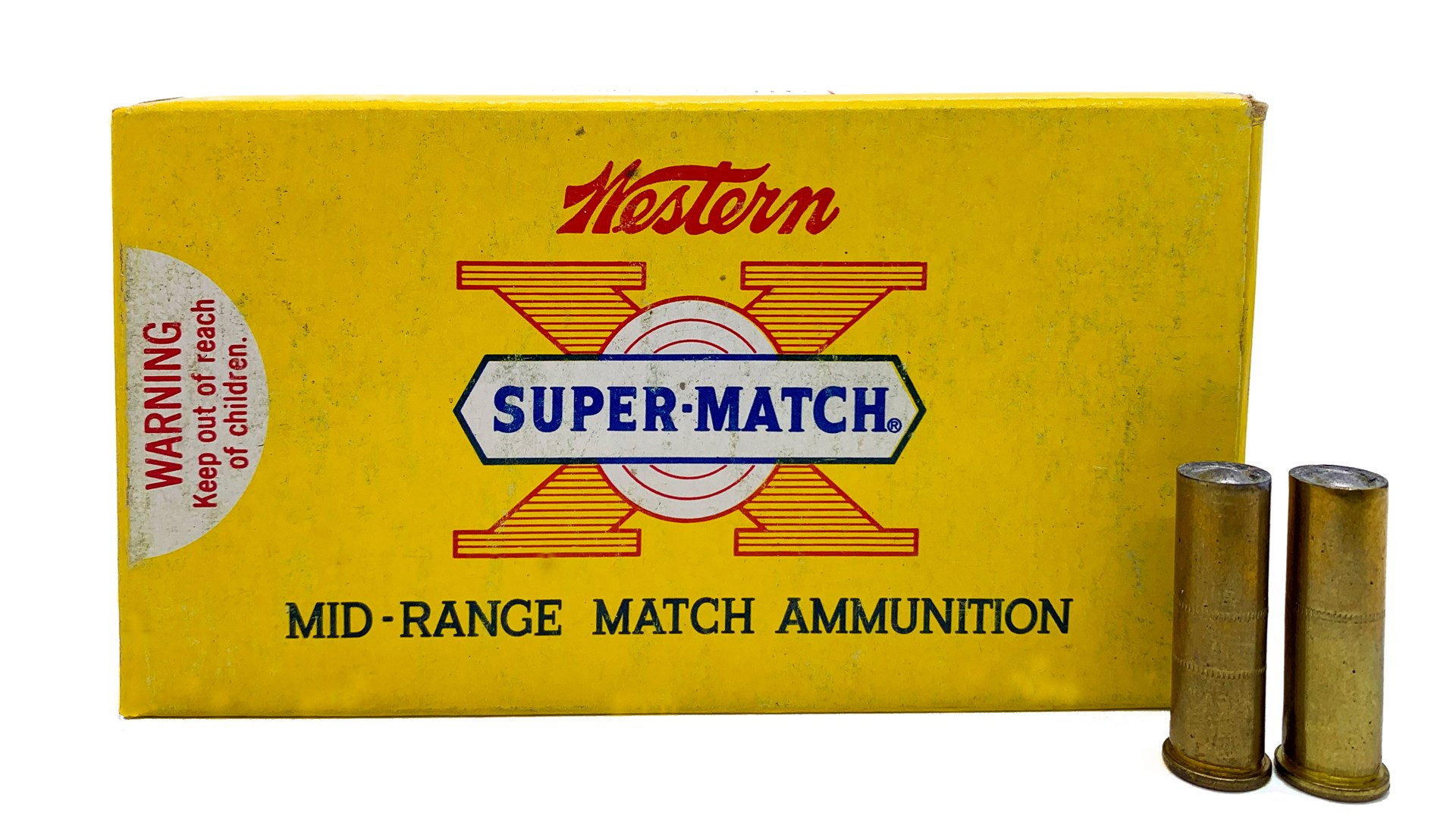
Interestingly, Smith & Wesson made a semi-automatic pistol for use with wadcutter bullets that had a frame based upon its Model 39 but was chambered for .38 Spl. from 1961 to 1993. The Model 52 was expensive to build because of the hand-fitting necessary to guarantee a five-shot group at 50 yards that was 2″ or less. Known also as the 38 Master, the Model 52 garnered a lot of championships in competitive bullseye shooting.
Colt also ventured into the wadcutter semi-auto market with its Gold Cup National Match .38 Spl. Mid Range based upon—not surprisingly—its M1911 pistol from 1960 to 1974. Just for grins, I looked up what these two competing semi-autos bring on the current market. Count on a Model 52 to clear $1,500 or so out of your pocket at the time of this writing, and the Colt is bringing $2,500 to $3,500 at the gun auctions.
The .38 Spl. is nothing if not versatile. Bullet weights for factory ammo range from the 90-grain Super Vel Super Snub to the old Winchester Super Police load featuring a 200 grain full-metal-jacket bullet. As a comparison, the Super Vel bullet comes screaming out of a 1 5/8″ barrel Smith & Wesson at 1,300 to 1,350 f.p.s. Out of a 4″ service revolver, it’s headed downrange at 1,530 f.p.s. The Super Police load was discontinued in the early 1980s, so no velocity quotes were available, but you can certainly figure a bullet twice as heavy as the Super Sub will be loafing along at a much slower pace.
Few, if any, police departments are using the .38 Spl. today. The various 9 mm Luger pistols have pretty much taken over that market. Nonetheless, many of today’s veteran officers slip a .38 Spl. snubby in a coat pocket for those “just-in-case” moments. Too, many concealed carry packers keep a .38 Spl. revolver handy. For those occasions that warrant it, I often have a Smith & Wesson Model 342PD in a pocket holster. Granted the 342PD is chambered in the big-brother .357 Mag., but I carry is stoked with Speer 135-grain, Gold Dot SB (short barrel) .38 Spl. ammo.
Handloaders can improve on factory loads a bit, but unless you are using it in a .357 Mag.-chambered revolver, it’s best to keep the loads sane. The vast majority of my loading experience with the .38 Spl. is in loading wadcutters for practice. In the last half century, I’ve probably loaded somewhere close to 50,000 rounds of these paper hole-punchers. I used to run the standard 3.2 grains of Bullseye in back of a 148-grain wadcutter. Now I use 3 grains of Trail Boss.
There have been literally millions of revolvers chambered in .38 Spl. over its 124-year lifespan. Manufacturing continues to this day from cheap to opulent. The first handgun many of us—including me—ever shot was a .38 Spl. I can’t imagine being without a few of them.