Categories
All About Guns Some Red Hot Gospel there! The Green Machine War

The First Rule of Cluster Munitions: Don’t Talk about Cluster Munitions By John Nagl and Dan Rice

On January 10, 2024, the Congressional Research Service published a thorough 91-page document “Great Power Competition: Implications for Defense- Issues for Congress”.  The report covers the past, present and future of the Competition between Russia, China and the United States.   The report includes grand strategy, geopolitics, nuclear weapons, deterrence, conventional weapons, research & development, acquisitions, and supply chain issues; it provides a framework by which the Congress can set priorities and allocate resources for our national defense.
The two words that are conspicuously absent from this entire document: “Cluster Munitions.”

Referencing one of the greatest movies from the 20th Century, “Fight Club”, the first rule of cluster munitions must be “Never talk about ‘cluster munitions.”  This study repeats the word “deter” 90 times, Russia 370 times, China 344, Ukraine 152 times, conventional 33 times, and cyber 24 times.  But artillery is named only once, and “Cluster Munitions” were mentioned ZERO times.


This narrative needs to change if we are to successfully deter Russia and China.  Artillery has long been the #1 killer on land battlefields, as it is in Ukraine.  While aircraft carriers, fighters, UAVs, cyber, electronic warfare, and hypersonic missiles are of course important, the Ukraine war brings into focus the importance of artillery, and especially cluster munitions, for the future deterrence of our enemies in a land war.


Cluster munitions were one of the main pillars of our Air-Land Battle defense plan against a massive Russian army with significant fire superiority in artillery, and deterrence worked from 1945-1991, when the Soviet Union finally collapsed.  But cluster munitions have disappeared from the literature on great power deterrence.


The reason likely dates to 2008, when a group of well-meaning but naïve leaders started the Cluster Munitions Convention in Olso, Norway.  The resulting Convention weakened the West and set the stage for a Russian invasion of Ukraine.  It did nothing to hurt the aggressor nations, who did not sign the Convention and have no intention of adhering to it, but the democracies that complied with it lost their best weapons to defend against an invasion.


Any country bordering Russia, China or North Korea should be heavily armed with cluster munitions and publicly make both China and Russia aware that they have significant quantities of these weapons and are prepared to use them.  If they arm themselves to be porcupines, they are less likely to be attractive.   The weaker they appear, the more attractive they will be.  Had Ukraine had the 50 HIMARS launchers with cluster rockets that it now possesses prior to February 24, 2022, it is doubtful the Russians would have advanced nearly as far as they did.  The Russian movement along known avenues of advance would have been impossible given HIMARS range, accuracy and lethality against armored columns.   Every country bordering Russia, China and North Korea should take particular note of the ability of DPICM and HIMARS cluster rockets/missiles to halt any advancing army.


The war in Ukraine is the first full scale war in Europe in 75 years, and although Ukraine is a much smaller country, it is destroying the Russian Army.  The #1 killer on the Ukrainian battlefield is artillery, with an estimated 80% of the casualties on both sides coming from indirect fire (artillery and mortars).  And the #1 killer of Russians is cluster munitions.  Cluster Munitions have essentially shut down any ability for the Russians to advance, as they are especially lethal to exposed troops and armor in the open, and they have dramatically increased combat losses to Russian troops in three inflection points during the nearly two years of the war.


The three inflection points for Russian casualties all occurred with the increased arrival of cluster munitions.  The first was the arrival of Turkish supplied 155mm Dual Purpose Improved Conventional Munitions (DPICM) in November 2022 at the Battle of Bakhmut. The second was the US approval of large quantities of 155mm DPICM on 7 July 2023 by the President of the United States. The third was the arrival of cluster rockets and missiles on October 17, 2023 that was announced on the battlefield when Ukraine hit two Russian airfields and destroyed 24 Russian “Alligator” attack helicopters.   The effective use of cluster munitions in the Battles of Bakhmut and Avdiivka show that taking ground, even with large, Russian armored forces, is incredibly costly and potentially impossible when advancing into cluster munitions, supported by accurate drone surveillance and adjusting of fires.  Cluster munitions are, essentially, the perfect deterrence against a land invasion.

Data from Ukraine Ministry of Defense


This result has been underreported, and as a result both our publics and our enemies are insufficiently advised about how effective cluster munitions have been in destroying the Russian army.  This super-weapon has what we call in marketing “a branding issue.”


The battlefield success of Cluster Munitions in Ukraine is not well known.  One reason is that Ukraine wants to maintain operational security  to avoid signaling to the Russians exactly how their army is being destroyed. American industry, which is usually happy to promote the effectiveness of new weapons systems, does not want to be anywhere near this topic of cluster munitions. Cluster munitions manufacturing in the West was discontinued in 2016 due to the Cluster Munitions Convention and negative press; currently Ukraine is using old cluster munitions from the US inventory.   The U.S. government needs to balance educating the public on the benefits of cluster munitions, to maintain U.S. public support and deter future aggressors around the world,  while limiting any backlash against their use, due to the negative branding issue surrounding the weapon.


This strategy of keeping the use of cluster munitions as quiet as possible, and if possible off the front page, has merit.  However, the second and third order result is that Cluster Munitions lack the widespread support needed to increase production and shipping of the quantities necessary for Ukraine to win the war.   Ukraine’s best strategy is that with enough cluster-munition-equipped HIMARS rockets Ukraine can increase Russian attrition to the point that the Russian army cannot remain in Ukraine.


History of the Cluster Munitions Convention


The well-meaning, yet naïve Cluster Munitions Convention, started in Oslo in 2008, bifurcated the world between those who need cluster munitions to defend against near-by aggressor nations and those far away from aggressor nations, who do not need cluster munitions.  The former used the Convention to dictate what weapons could be used to defeat aggressor nations, weakening aggressor nation neighbors- and hence weakening deterrence.


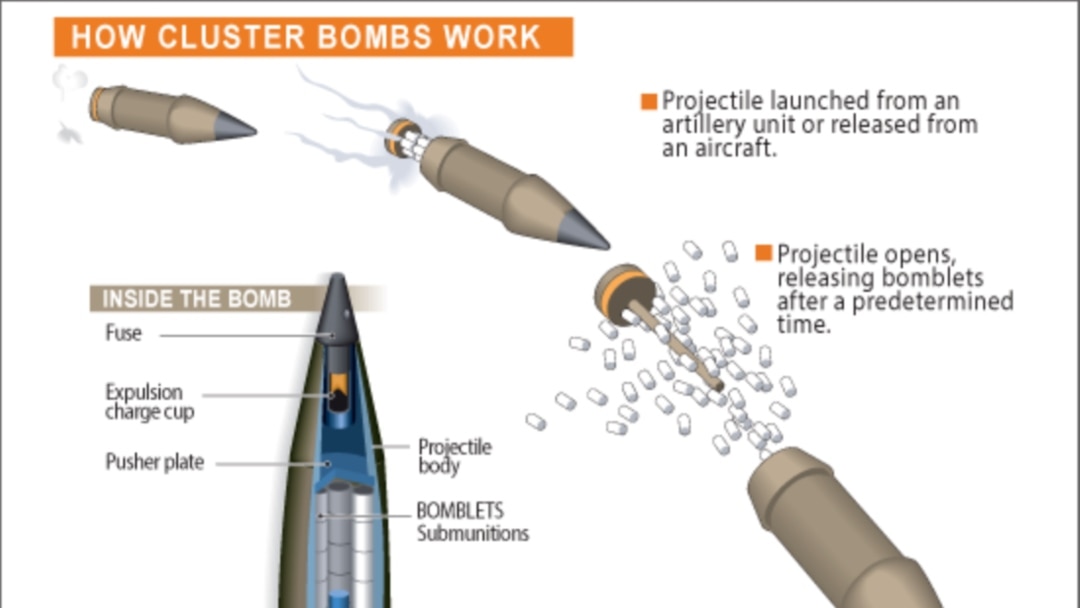
The concept initially had a mass appeal.  Landmines are still killing civilians in Laos, Cambodia, and many areas around the world; many of these victims are children.  Most people can agree that is a terrible legacy of those wars.  The challenge is the Convention confuses at least four major categories of weapons:  land mines, cluster bombs, cluster munitions, and munitions.  Cluster bombs are different than cluster munitions.  Cluster bombs are air dropped and scatter over a very large area.  Cluster munitions are delivered from artillery or rockets, and can be very accurate.  For any weapon, the “intent” can be the difference between a legal weapon and a war crime.  The Convention makes no distinction in these areas.


Russia and China most certainly appreciated the Cluster Munition Convention, which weakened the West by sidelining the best weapon to counter their artillery fire superiority; it is not implausible that they financed some of the Non-Governmental Organizations that promoted the Convention–because they were the beneficiaries.


The Convention arbitrarily set a 1% dud rate as the standard for banning cluster munitions, knowing the western cluster munitions had a 2% “dud rate”, and claiming that anyone who used a weapon with a dud rate greater than 1% was immoral.  It was brilliant marketing and strategy, and it was foolish for NATO countries to buy into it.   When the Russians invaded Ukraine, they were firing 63,000 artillery rounds per day with up to a 20% dud rate.  The Ukrainians were restricted from firing back at the invading Russians, on Ukrainian territory, with DPICM with 2% dud rates.  The argument against supplying a country to defend itself with DPICM is now moot, but the delay cost the lives of tens of thousands of Ukrainians.


While Ukrainians have paid a heavy price in blood for the limitations on warfare imposed by the Cluster Munitions Convention, it is past time to make sure this never happens again to a Ukraine, or a Norway, Lithuania, Poland, Taiwan or South Korea.   Which nations signed and did not sign the convention is of more than historical interest.


Fact #1:  None of the great powers have signed the Convention: not the United States, nor Russia, nor China.


Fact #2:  The majority of those countries who neighbor Russia, China and North Korea and are the most likely to need cluster munitions in the defense against an invading army with artillery fire superiority, did not sign.  There are 23 countries that neighbor Russia, China and North Korea, and only three signed the Convention:  Afghanistan, Norway and Lithuania.  86% of those countries bordering a likely aggressor neighbor did not sign the Convention.


Fact #3:  The vast majority of those that did sign, do not face an aggressor neighbor and therefore have no significant need to obtain cluster munitions, and many of those that did sign do not even have an army and therefore have no military expertise to weigh in on the defense of free nations against aggressors.   112 countries signed the Cluster Munitions Convention; only three border an aggressor neighbor of Russia, China or North Korea.  Stated bluntly 97% of the signatories do not face an aggressor neighbor.


Russia is bordered by fourteen countries.  Only two signed the Cluster Munitions Convention- Lithuania and Norway.   Yet Ukraine, Estonia, Finland, Poland, Latvia, Belarus, Georgia, Azerbaijan, Kazakhstan, China, Mongolia and North Korea did not sign.  .   If either Norway or Lithuania were attacked by Russia, they would not be able to use cluster munitions in their defense.   But the 12 neighbors that did not sign are harmed by those who did sign.  When war comes, as it did Ukraine, those countries that signed the Convention protested the use of cluster munitions in Ukraine and sent many Ukrainian soldiers to their deaths because they did not have the most lethal artillery munitions to defend themselves.


China borders 14 countries: North Korea, Russia, Mongolia, Kazakhstan, Kyrgyzstan, Tajikistan, Afghanistan, Pakistan, India, Nepal, Bhutan, Myanmar, Laos, and Vietnam.  None of these countries have signed the Cluster Munitions Convention and all reserve the right to defend themselves against an aggressor should they be attacked.   And of course, China has another neighbor across the straights- Taiwan.  Taiwan has not signed the Cluster Munitions Convention and is well armed with HIMARS launchers with cluster munitions.


North Korea borders three countries: Russia, China and South Korea. None of these have signed the cluster munitions Convention.


Of all Russia, China and North Korea’s neighbors- only Lithuania and Norway have signed the Cluster Munitions Convention.  Lithuania has already publicly stated that it is reconsidering removing itself from the Convention.   Norway should show leadership and do the same.


  1. Lithuania
  2. Norway
  3. Ukraine
  4. Estonia
  5. Finland
  6. Poland
  7. Latvia
  8. Belarus
  9. Georgia
  10. Azerbaijan
  11. Kazakhstan
  12. Mongolia
  13. Kyrgyzstan
  14. Tajikistan
  15. Afghanistan
  16. Pakistan
  17. India
  18. Nepal
  19. Bhutan
  20. Myanmar
  21. Laos
  22. Vietnam
  23. South Korea

*Red indicates the country is a signatory to the Cluster Munitions Convention.


On the other side of the coin, the press is always quick to point out that 112 countries around the world have signed the Convention. This usually is a compelling argument that is not challenged. But thoughtful military analysts should consider that the Cook Islands, Fiji, the Maldives, New Zealand, Palau, Philippines, Sri Lanka, Samoa, Antigua and Barbuda, Belize, Costa Rica, Cuba, Dominican Republic, Grenada, Saint Kitt and Nevis, Saint Lucia, Saint Vincent and the Grenadines, Trinidad and Tobago, Iceland, are Ireland are almost all islands, safe from any invading army.  Many of these countries do not even have an army, and should not be deciding what weapons should be used in defense against the aggressors of Russia, China, and North Korea.   Afghanistan is an anomaly.  Many of the examples used by the Cluster Munitions Convention of the intentional use of cluster bombs, cluster munitions, and land mines against civilians, were done by the Russians/Soviets in Afghanistan.  So it is understandable that although Afghanistan shares a border with Russia, it also signed the Convention.


All countries concerned with peace and wishing to deter aggression should revoke their signature on the Convention.  Norway in particular is very worried about an aggressive Russian invasion and should be arming themselves with cluster HIMARS ATACMs as their neighbors are doing.   Revoking Norway’s signature on the Cluster Munitions Convention would be a symbolic message to the world that might help repeal the entire naïve and foolish Convention.


Having many NATO Members as signatories causes problems for interoperability.   Article V of NATO agreement ensures that “an attack on one, is an attack on all”.  But with Lithuania and Norway being signatories to the Cluster Munitions Convention, NATO forces could be forced to risk their lives without their most powerful defensive weapons of cluster munitions.   This also makes Lithuania and Norway appear much weaker, and potentially more attractive for a Russian invasion.   Deterrence does not work well if NATO forces are restricted from using the most effective weapon against an invading Russian force.


Twenty-three NATO countries have signed the Cluster Munitions Convention, although only two of them border Russia. But the 21 who do not border Russia have put all of Europe in jeopardy by protesting the use of cluster munitions in Ukraine. Ukraine is facing an existential threat that threatens all of Europe.  The NATO countries that signed the Convention delayed Ukraine from being able to use cluster munitions on their own territory, allegedly to protect future generations of Ukrainians from “duds”.  These signatures also make it difficult to transport cluster munitions, and Ukrainians pay the price in blood for the delay.


The countries that have not signed the Cluster Munitions Convention should form an alternative Convention and invite all of NATO to join.   The “Responsible use of Cluster Munitions in the Defense of Democracy Convention” could help set goals and objectives for the safe use and cleanup of our most powerful weapon in the defense against an aggressor nation.  The American University Kyiv would be pleased to sponsor discussions on this subject.


Alfred Nobel is known for both inventing dynamite, which caused massive numbers of deaths in World War I after his death, and also for creating the Nobel Peace Prize, two seemingly diametrically opposed ideas and projects.   Yet, he believed strongly in deterrence and claimed “on the day that two army corps can mutually annihilate each other in a second, all civilized nations will surely recoil with horror and disband their troops.”   Cluster munitions are a powerful weapon that can annihilate a Russian brigade in a few seconds and they helped contribute to the deterrence of aggression that won the Cold War.  The incredible story of the lethal performance of Cluster Munitions on the modern battlefield in Ukraine, if told properly to our friends as well as our enemies, can help win the war in Ukraine by getting Ukraine more cluster munitions and help prevent future wars by acting as a deterrence against any aggressor in the future.   The time to act is now.

About the Author(s)

Dr. John Nagl is a 1988 graduate of West Point and a Professor of Warfighting Studies at the U.S. Army War College.  He holds a master’s and a PhD from Oxford in International Relations, and a Masters from the U.S. Army Command and General Staff College.

He served in combat in both Operation Desert Storm and Operation Iraqi Freedom and is the author of Learning to  Eat Soup with a Knife (Chicago 2005) and Knife Fights (Penguin 2014).   This article expresses his personal views and not those of the United States Army War College, the United States Army, or the Department of Defense.

Dan Rice is a 1988 graduate of West Point and is the President of the American University Kyiv and the Co-President of Thayer Leadership at West Point.  He holds an MBA from Kellogg/Northwestern, a master’s in journalism and Marketing from Medill/Northwestern, a Masters of Education from the University of Pennsylvania and has completed all doctoral classes in Leadership from the University of Pennsylvania.

He served in the Infantry in combat in Iraq in 2004-2005.  Dan served as Special Advisor to the Commander in Chief of Ukraine Armed Forces (May 2022-March 2023) as an unpaid volunteer. He has been the primary advocate for Cluster Munitions for Ukraine and received the Saint Barbara’s Medal in 2023 for his advocacy that helped gain cluster artillery shells in July 2023, and then cluster rockets and missiles in October 2023.

Categories
All About Guns

Sunday Shoot-a-Round # 188

Categories
All About Guns

Are Sawed Off Shotguns ACTUALLY More POWERFUL? (Movie Myth Or Legit ???)

Categories
All About Guns

Minute of Mae: Spanish Mauser 1895 Carbine

Categories
All About Guns

A COLT WOODSMAN MATCH TARGET 6″ in caliber 22LR

Categories
All About Guns

DUKE’S BLUNDER: RARE FIND .38 COLT SAA OR FRANKEN-GUN? WRITTEN BY MIKE “DUKE” VENTURINO

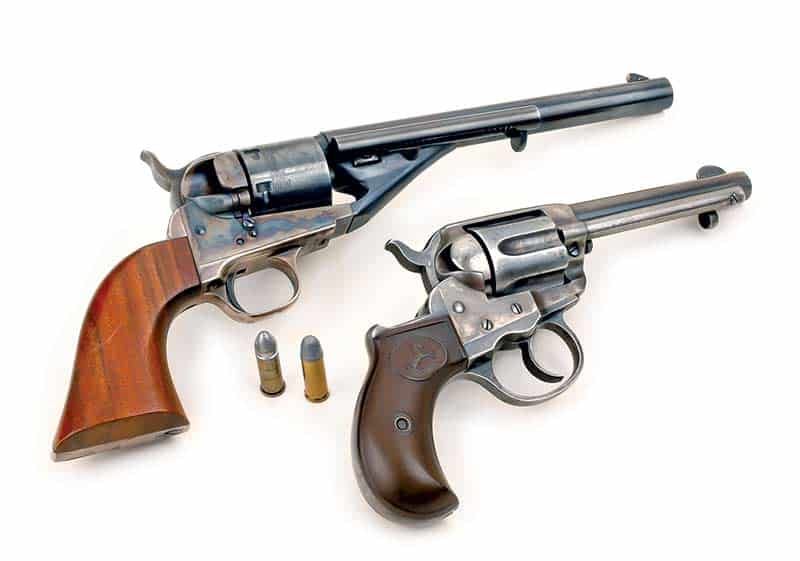
These are two other .38 Colts. At the top is the 2nd Generation Colt Model
1861 .36 caliber Duke had converted to fire metallic cartridges just as the
originals were done in the 1870s. At bottom is the .38 Colt Model 1877DA.


If you’ve read my articles much, you must be aware of my quests in which I develop a desire for certain firearms and strive to fulfill it. For example, once, I desired a sample of all S&W Model 20-somethings — including the identical ones with names before the U.S. government decreed S&W had to use model numbers on their handguns. Since only 1,200 S&W fixed-sight Model 21 .44 Specials were made before discontinuance in 1966, that collection was a tough one.

Also, I admit to having an impetuous nature. Yvonne says I’m inclined to jump before looking or, in my case, buy before knowing. Usually, I luck out — such as with the 1913 vintage Colt SAA .44-40 with a 71/2″ barrel — which I bought after seeing a single photo of it. It was a superb find!


Duke’s blunder was buying this expensive .38 Colt SAA and then finding
out it was a Frankenstein.

Many To Choose …


Not all of my quests have resulted in such sterling results. The .38 Colt SAA central to this article is an example. First, let me give a bit of history. Between 1873 and 1941, Colt SAAs were chambered for no less than 36 different cartridges. Some of these were so similar as to be identical for practical purposes.

For instance, there were SAA calibers stamped “.38 S&W Special” and others marked “Colt .38 Special.” The only real difference was the Colt ones had a definite step in chambers where the 1.16″ long cartridge case mouth seated. The S&W ones had more of a taper there. As for the ammunition, the rounds headstamped S&W had 0.357″, 158-grain roundnose bullets and those headstamped Colt had flatnose bullets of the same weight and diameter. Otherwise, both versions of “.38 Special” SAAs could fire either cartridge. This isn’t too big a factor because before 1941, only 89 of the “Colt Specials” and a mere 27 of the “S&W Specials” were made. This information is taken from the book The 36 Calibers of the Colt Single Action Army by David M. Brown.


Colt never stamped their .38 Colts as “short” or “long.” All were simply .38s.

More .38 Colt


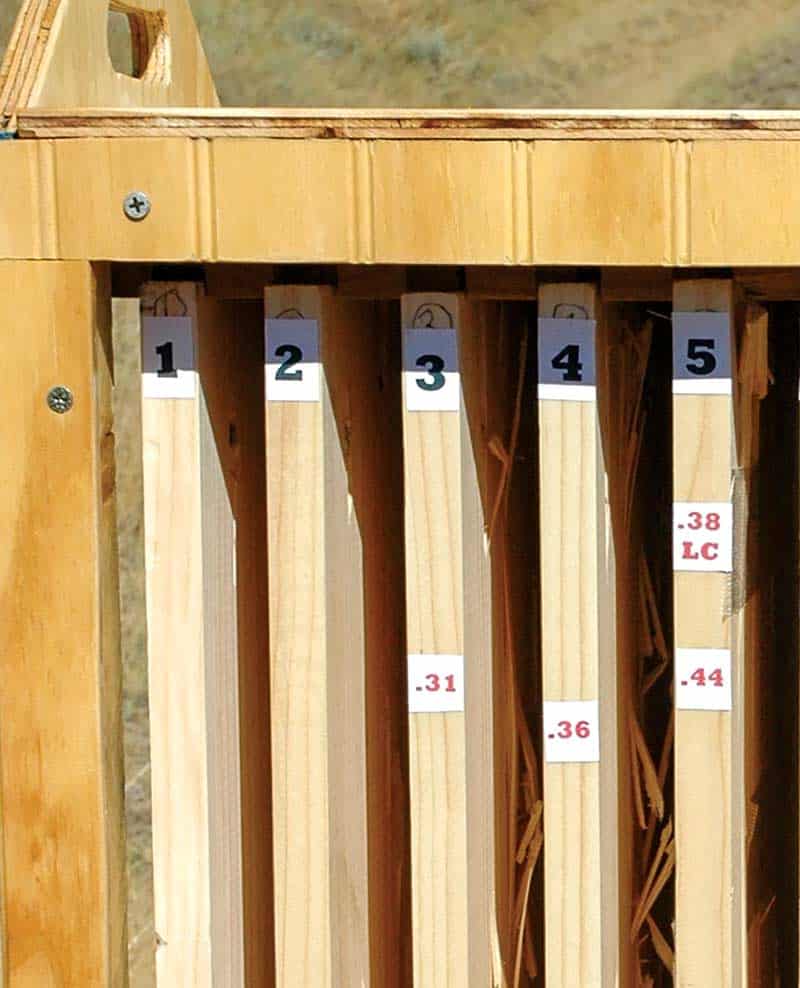
However, there was another .38 Colt cartridge in this confusion. It began in the 1870s with the cartridge used in Colt’s conversions of .36 percussion revolvers to fire metallic cartridges. It was also one of the introductory rounds in Colt’s Model 1877DA, aka Lightnings. At that time, .38 Colt cartridge cases were about 0.75″ long and loaded heel-type 130-grain, 0.375″ bullets over black powder. Colt began offering .38 Colt SAA revolvers circa 1886. The U.S. Army even adopted swing cylinder double-action Colt .38s starting in 1892. All these early Colt revolvers had barrel groove diameters nominally 0.375″ to accommodate heel-type bullets. The U.S. Army was upset with .38 Colt stopping power and eventually returned to .45s. However, when I fired a black powder powered, 145-grain, .38 Colt into my baffle box, it surprised me by penetrating into the fifth board.

As time passed, ammunition factories realized heel-type bullets were ridiculous. Therefore, they remodeled .38 Colt factory loads to have 1.03″ cases with full diameter 150-grain bullets fitting inside cartridge cases. This necessitated the reduction of .38 Colt bullets to 0.357″ diameter but with deep hollow bases so that when fired, bullets’ “skirts” would expand to grip barrel rifling. This sounds weird today, but it worked well.

Also, it must be noted the barrels in SAA .38 Colts from 1886 to 1914 had 0.375″ barrel groove diameters and chambers bored straight through. Only 1,641 SAA .38 Colt permutations were made in that period. Officially the first .38 Colts became the .38 Short Colt, and the longer ones became .38 Long Colt. However, the Colt factory never stamped anything but “.38 Colt” on their revolvers until the later advent of .38 Specials.


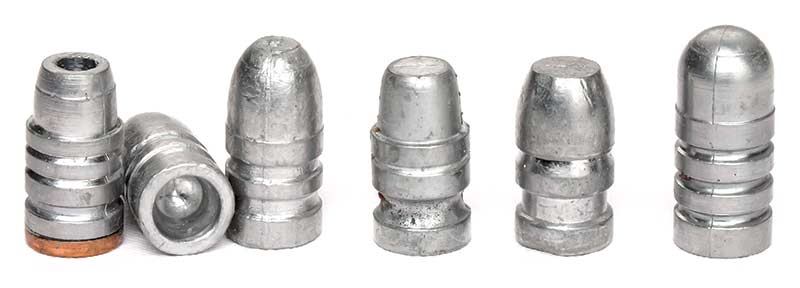
While Duke must use the hollowbase bullet (second from left) in his traditional .38 Colt
revolvers with their 0.375″-barrel groove diameters, he can load all the other solid rounds
for use in his Frankenstein .38 Colt. From left: Lyman #358156HP, Rapine 357-145HB,
Lyman #358477, RCBS .38-158CM and Lyman #358430.

Most of Duke’s .38 Colt handloading is done with these two cast bullets.
Left to right: Winchester factory load, 145-grain hollowbase cast bullet from
now discontinued Rapine Bullet Mould Company and loaded round, 145-grain
cast bullet from RCBS mold #.38-140CM and loaded round.

Confused Yet?


Here is more confusion. In 1922 Colt decided to reintroduce .38 Colt to their catalogs. Note that carefully. The guns were stamped .38 Colt, the same as those made between 1886 and 1914 — no “Special” in the name. However, Colt dispensed with the large 0.375″-barrel groove diameter and went to 0.354″ barrel groove diameter, which were their standard for .38/.357. Colt stuck with that 0.354″-barrel groove diameters on their .38s/.357s until revolver manufacture ceased. I have never been able to determine with certainty if the post-1922 SAAs had bored through chambers or if they were cut with a “neck or edge” for the 1.03″ .38 Long Colt case. Brown’s book says Colt made 1,365 of that second run of .38 Colts.


From Duke’s research, this .38 Colt barrel had to have been manufactured
between 1922 and 1931.

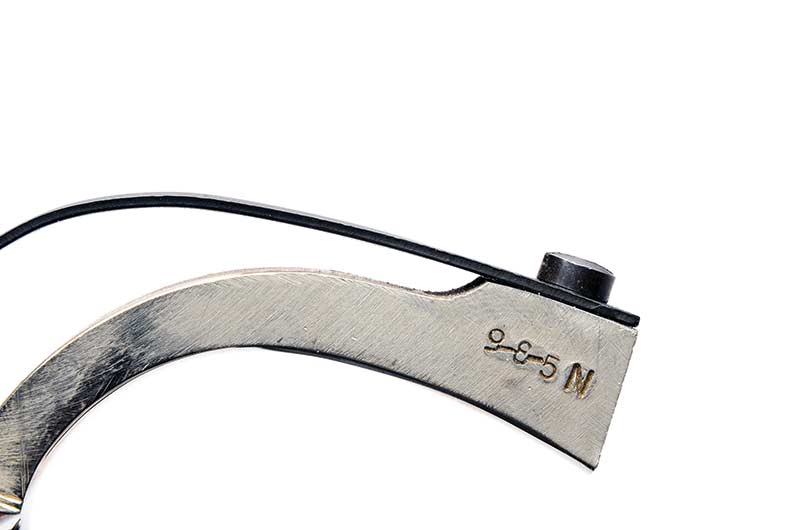
This mystery stamp on Duke’s .38 Colt trigger guard most likely was put there
by its restorer. Duke thinks the N stands for nickel-finish.

Back To The Quest


If you have managed to understand all of this so far, visualize me virtually wandering into the .38 Colt maze on internet buying sites and factor in my impetuous nature. What I wanted was one of the 1886–1914 .38 Colts. Why would I want to deal with that oversize barrel problem? Because I wanted the education on handloading for obsolete Colt cartridges.

Then, in mid-summer 2020, I spotted a very fine-looking SAA with its 51/2″ barrel clearly stamped .38 Colt. Brothers and sisters, did I jump without thinking, just as Yvonne says I do? By its serial number, the Colt dated to 1899, so it had to have had the large-diameter bore, right? Its nickel plating’s condition was too fine for 121 years old, so I figured it had been restored along the way and obviously, the job had been done professionally. The grips were some sort of silly-looking synthetic material with a big star in the middle of each panel. No sweat there; I’ve discarded lots of grips over the past 50 years.

When the .38 Colt arrived, I was more than pleased upon unpacking it. The nickel finish was unmarred in any way. When the grips were removed, I found stamped there “9-8-5 N” on the left side of the trigger guard. To me, it was a code of whoever restored this revolver with “N” standing for nickeled. My pleasure was short-lived. A 0.357/0.358″ bullet will drop right through a 0.375″ bore. One did not slide through this Colt’s bore. Slugging it resulted in a 0.354″ piece of lead, so obviously, this Colt’s barrel was post-1922. I sent for a factory letter before even shooting it.


Although Duke’s Frankenstein Colt SAA .38 wasn’t the collector’s item he
had hoped for, it turned out to be a finely accurate shooter.

Things Get Interesting


Initial shooting is when more evidence of my blunder appeared. After the first shot of .38 Long Colt factory ammo, the cylinder would not rotate. I had to dismount it, which revealed the firing pin hole in the frame had been wallowed out to the point primers extruded into it. That’s not good at all. When I looked into chambers, they were “necked,” but a glance showed they were much too long for the 1.03″ .38 Long Colt’s case. In fact, they would even accept .357 Magnum cases. Then I spotted a number on the cylinder. Most SAA cylinders have at least part of their frame’s serial number. This one’s didn’t match the frame and it had an M-prefix. So, I checked my Colt SAA .357 Magnum’s cylinder, which was made in 1969. It also has an M.

Needless to say, I was upset, for this revolver was sold with a “no return” policy and cost thousands — not hundreds. It needed salvation, so it was quickly packaged up and sent to my friend Bill Fuchs dba as Spring Creek Armory in Ten Sleep, Wyo. The firing pin hole was wallowed out, but it had also been shoddily converted from a rimfire firing pin hole. That was the bad news, but the good news was Bill could weld it so the Colt was functional again. I also told him to fit it with some nice one-piece style grips while it was there.


Duke fired a .38 (Long) Colt handload with black powder into this baffle box with 1″ pine boards and was surprised when it lodged into the fifth board.

The two types of early .38 Colt cartridges. Left is a .38 Colt (short) with
heel type bullet and right is a .38 Colt (long) with hollowbase bullet.

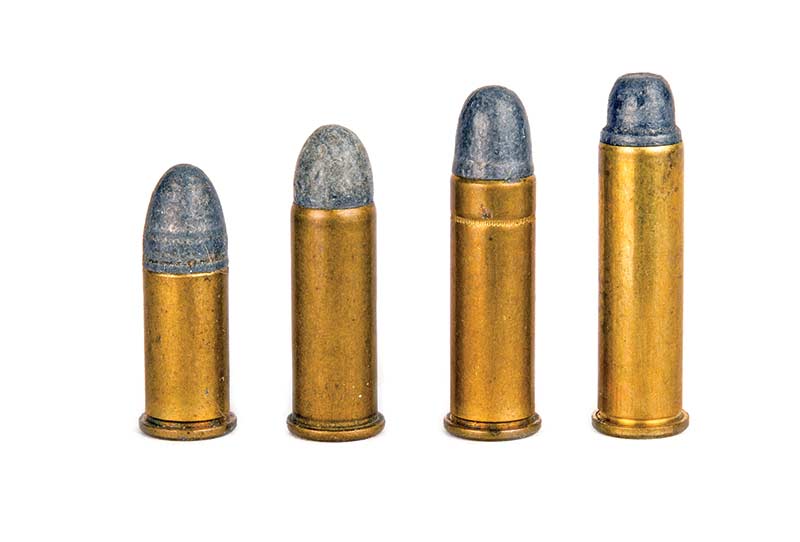
This photo shows the evolution of .38s. From left: the .38 Short Colt,
.38 Long Colt, .38 Special and .357 Magnum.

Franken-Colt


Then the Colt letter arrived and it certainly did not improve my mood. This Colt shipped from the factory in 1899 as a .38 WCF (.38-40) with a 71/2″ barrel. So, it started as a centerfire, was converted to a rimfire and then reconverted to a centerfire. And along the way, someone had fitted it with a .38 Colt barrel and Colt .357 Magnum cylinder and then had been renovated by someone else. My impetuous nature had netted me a Frankenstein Colt! Albeit a very handsome one.

When it returned from Spring Creek Armory, it sported a beautiful set of rosewood grips. Furthermore, it functions perfectly and shoots both accurately and to its sights. It eased the pain somewhat. I’ll never get back from it the bucks that went into it, but it’s a very eye-catching Colt six-shooter. And at least it’s easy to handload for. For my other .38 Colts, I load hollowbase bullets because of their 0.375″-barrel groove diameters. Those loads will work just fine in this revolver. And, seeing as how it will accept any .38 Special bullets for which I have a plentitude of molds, reloading for it will be a cinch. So, this Frankenstein Colt will stay with me.

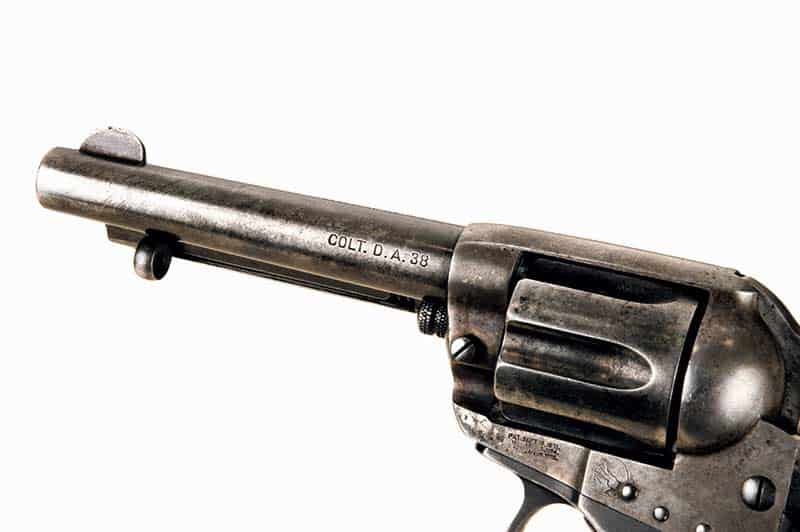
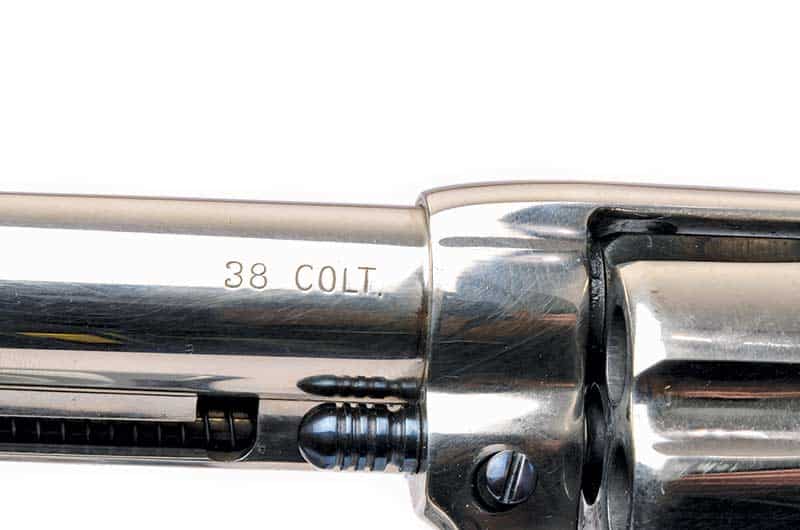
Someday if anyone asks what I’m shooting, I’ll tell them to look right there on the barrel; it’s a .38 Colt!

Categories
All About Guns The Green Machine

The US Army beat every other service in losing track of weapons over the past decade BY HALEY BRITZKY

The US Army beat every other service in losing track of weapons over the past decade

At least 1,900 total military weapons were lost or stolen from 2010 to 2019.

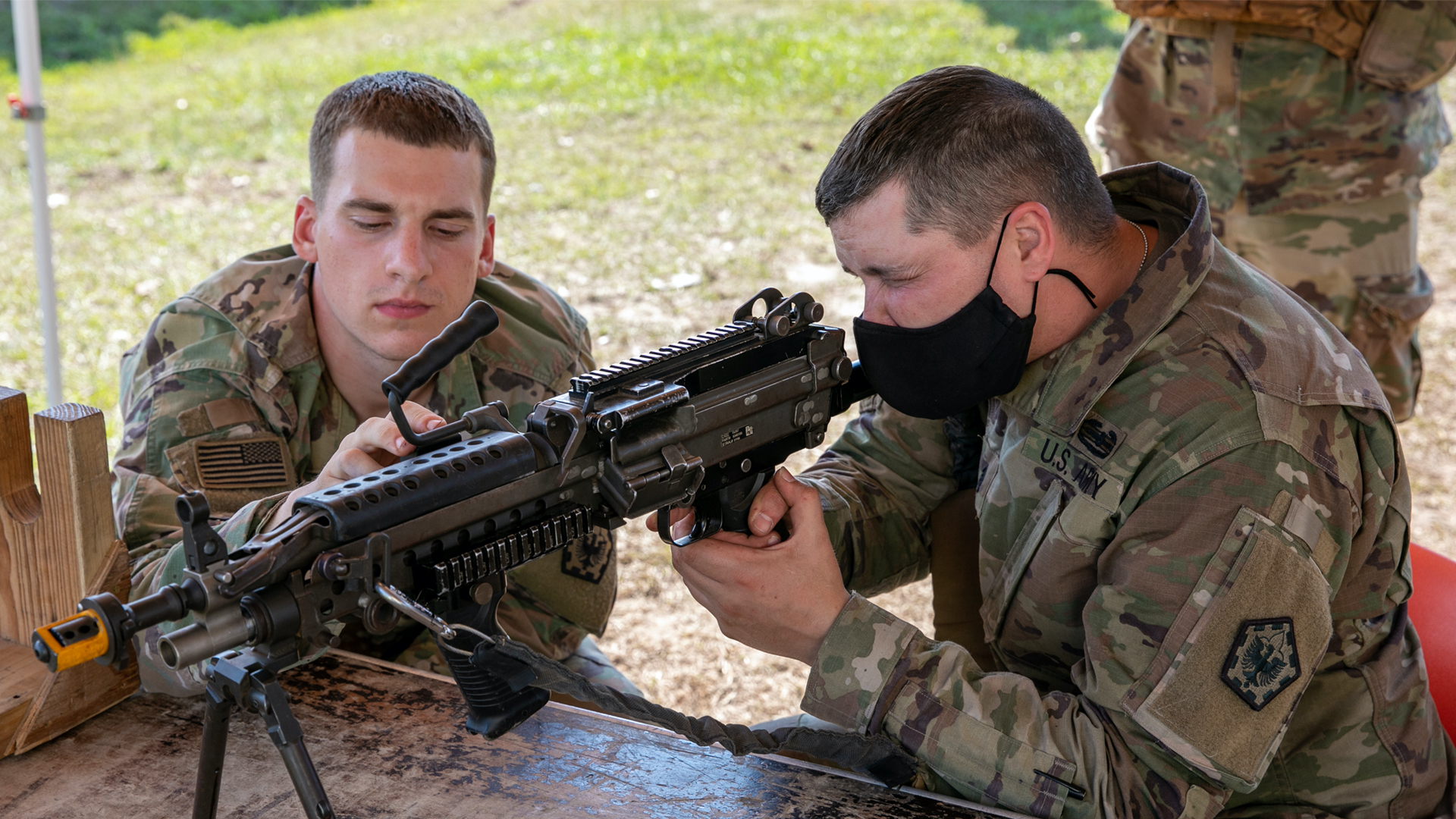
Soldiers confirm the laser for a Code 27 Small Arms Transmitter attached to an M249 machine gun during an exercise at the Joint Readiness Training Center at Fort Polk, Louisiana, Oct. 11, 2020. (U.S. Army/Sgt. Ezra Camarena, 28th Public Affairs Detachment).

At least 1,900 firearms belonging to the U.S. military were lost or stolen in the last decade — the vast majority having come from the Army, the Associated Press reports.

The new, years-long exclusive report from the AP found that at least 1,900 weapons have gone missing or been stolen from the military between 2010 and 2019. That tally includes 1,179 rifles, 694 handguns, 74 machine guns, 36 grenade launchers, 34 rocket launchers, 25 mortars, 11 shotguns, and seven weapons listed as “others.”

Roughly 1,300 of those are from the Army alone, the military’s largest branch; but the AP’s report shows none of the services are innocent, with weapons going missing from military installations around the world, and some eventually ending up on civilian streets.

Army Secretary Christine Wormuth was asked to address AP’s report during a Senate hearing on Tuesday by Sen. Richard Blumenthal (D-Conn.), who called the article “absolutely blood curdling.”

“The idea that pistols, assault weapons, grenade launchers are missing from armories of the United States military because they have been lost or stolen, without any apparent accounting, without any reporting to Congress or to the FBI … is just incredibly alarming and astonishing,” he said.

Wormuth responded that the number of missing weapons that end up in the hands of civilians is “likely to be a small number,” but said it is “something we will look into.”

The definitive tally of how many firearms are actually missing is unclear due to gaps of information from the Pentagon, which has stopped giving Congress updates on the issue. The AP said that the Army provided “conflicting information” over the last decade for this report and “sought to suppress information on missing weapons and gave misleading numbers.”

Pentagon spokesman John Kirby told the AP the military accounted for 99.999% of its firearms last year, saying while the Pentagon has a “very large inventory of several million of these weapons … That doesn’t mean that there aren’t losses. It doesn’t mean that there aren’t mistakes made.”

But the AP report reveals the scale at which it’s happening, filling in gaps of information that the Pentagon has not provided, and pinpoints several instances in which the missing firearms resurface in civilian crimes.

There was an instance in 2017 involving a man who “started wildly shooting an M9 pistol into the air during an argument with his girlfriend,” the AP reported. That pistol was traced back to a National Guard armory, where someone made off with six automatic weapons, five M9s, and a grenade launcher through an unlocked door, AP reported.

While some weapons have been recovered over the years — the AP reports that 63 of 211 Navy firearms which were previously reported missing have been recovered — many cases go unresolved. After looking at 45 Navy investigations, the AP found that no suspects were discovered and no weapons were recovered in 55% of cases. In those same cases, “investigators found records were destroyed or falsified, armories lacked basic security and inventories weren’t completed for weeks or months.”

In 2018 when an Army Beretta M9 pistol was used in a crime in New York, the U.S. Bureau of Alcohol, Tobacco, Firearms and Explosives found that the Army didn’t even know the pistol was missing, the AP reports, and didn’t know who took it or when.

They still don’t.

The issue of missing or stolen firearms isn’t necessarily a new one; there have been several documented accounts over the years. There was the time the Air Force put out a cash reward to help find an ammunition container of MK 19 grenades, which fell off a truck. The same unit later lost an M240 machine gun. Or there was the time that a Marine sergeant was accused of stealing more than 10,000 ammunition rounds and dumping them in a ravine in California. Last year, a former Special Forces soldier was sentenced to two years in prison after stealing 43 enhanced night vision goggles.

And lest we forget the time just months ago when roughly 10 pounds of C4 explosives were reported missing from the Marine Corps Air Ground Combat Center Twentynine Palms in California.

But as the district attorney for Albany County, New York, told the AP, missing weapons can become more than just a military-specific problem after ending up on American streets, at which point they become the responsibility of civilian law enforcement.

“One gun creates a ton of devastation,” said David Soares, the Albany County district attorney. “And then it puts it on local officials, local law enforcement, to have to work extra hard to remove those guns from the community.”

Categories
All About Guns The Green Machine You have to be kidding, right!?!

Could you imagine carrying this beast on a 20 K route marcch!?!

Categories
All About Guns Gun Fearing Wussies You have to be kidding, right!?!

Why Are White Men Stockpiling Guns? By Jeremy Adam Smith on March 14, 2018 (Some good BS here! Grumpy)

Research suggests it’s largely because they’re anxious about their ability to protect their families, insecure about their place in the job market and beset by racial fears

Since the 2008 election of President Obama, the number of firearms manufactured in the U.S. has tripled, while imports have doubled. This doesn’t mean more households have guns than ever before—that percentage has stayed fairly steady for decades. Rather, more guns are being stockpiled by a small number of individuals. Three percent of the population now owns half of the country’s firearms, says a recent, definitive study from the Injury Control Research Center at Harvard University.

So, who is buying all these guns—and why?

The short, broad-brush answer to the first part of that question is this: men, who on average possess almost twice the number of guns female owners do. But not all men. Some groups of men are much more avid gun consumers than others. The American citizen most likely to own a gun is a white male—but not just any white guy. According to a growing number of scientific studies, the kind of man who stockpiles weapons or applies for a concealed-carry license meets a very specific profile.

These are men who are anxious about their ability to protect their families, insecure about their place in the job market, and beset by racial fears. They tend to be less educated. For the most part, they don’t appear to be religious—and, suggests one study, faith seems to reduce their attachment to guns. In fact, stockpiling guns seems to be a symptom of a much deeper crisis in meaning and purpose in their lives. Taken together, these studies describe a population that is struggling to find a new story—one in which they are once again the heroes.

WHATEVER HAPPENED TO HARD WORK?

When Northland College sociologist Angela Stroud studied applications for licenses to carry concealed firearms in Texas, which exploded after President Obama was elected, she found applicants were overwhelmingly dominated by white men. In interviews, they told her that they wanted to protect themselves and the people they love.

“When men became fathers or got married, they started to feel very vulnerable, like they couldn’t protect families,” she says. “For them, owning a weapon is part of what it means to be a good husband and a good father.” That meaning is “rooted in fear and vulnerability—very motivating emotions.”

But Stroud also discovered another motivation: racial anxiety. “A lot of people talked about how important Obama was to get a concealed-carry license: ‘He’s for free health care, he’s for welfare.’ They were asking, ‘Whatever happened to hard work?’” Obama’s presidency, they feared, would empower minorities to threaten their property and families.

The insight Stroud gained from her interviews is backed up by many, many studies. A 2013 paper by a team of United Kingdom researchers found that a one-point jump in the scale they used to measure racism increased the odds of owning a gun by 50 percent. A 2016 study from the University of Illinois at Chicago found that racial resentment among whites fueled opposition to gun control. This drives political affiliations: A 2017 study in the Social Studies Quarterly found that gun owners had become 50 percent more likely to vote Republican since 1972—and that gun culture had become strongly associated with explicit racism.

For many conservative men, the gun feels like a force for order in a chaotic world, suggests a study published in December of last year. In a series of three experiments, Steven Shepherd and Aaron C. Kay asked hundreds of liberals and conservatives to imagine holding a handgun—and found that conservatives felt less risk and greater personal control than liberal counterparts.

This wasn’t about familiarity with real-world guns—gun ownership and experience did not affect results. Instead, conservative attachment to guns was based entirely on ideology and emotions.

WHO WANTS TO BE A HERO?

That’s an insight echoed by another study published last year. Baylor University sociologists Paul Froese and F. Carson Mencken created a “gun empowerment scale” designed to measure how a nationally representative sample of almost 600 owners felt about their weapons. Their study found that people at the highest level of their scale—the ones who felt most emotionally and morally attached to their guns—were 78 percent white and 65 percent male.

“We found that white men who have experienced economic setbacks or worry about their economic futures are the group of owners most attached to their guns,” says Froese. “Those with high attachment felt that having a gun made them a better and more respected member of their communities.”

That wasn’t true for women and non-whites. In other words, they may have suffered setbacks—but women and people of color weren’t turning to guns to make themselves feel better. “This suggests that these owners have other sources of meaning and coping when facing hard times,” notes Froese—often, religion. Indeed, Froese and Mencken found that religious faith seemed to put the brakes on white men’s attachment to guns.

For these economically insecure, irreligious white men, “the gun is a ubiquitous symbol of power and independence, two things white males are worried about,” says Froese. “Guns, therefore, provide a way to regain their masculinity, which they perceive has been eroded by increasing economic impotency.”

Both Froese and Stroud found pervasive anti-government sentiments among their study participants. “This is interesting because these men tend to see themselves as devoted patriots, but make a distinction between the federal government and the ‘nation,’ says Froese. “On that point, I expect that many in this group see the ‘nation’ as being white.”

Investing guns with this kind of moral and emotional meaning has many consequences, the researchers say. “Put simply, owners who are more attached to their guns are most likely to believe that guns are a solution to our social ills,” says Froese. “For them, more ‘good’ people with guns would drastically reduce violence and increase civility. Again, it reflects a hero narrative, which many white men long to feel a part of.”

Stroud’s work echoes this conclusion. “They tell themselves all kinds of stories about criminals and criminal victimization,” she says. “But the story isn’t just about criminals. It’s about the good guy—and that’s how they see themselves: ‘I work hard, I take care of my family, and there are people who aren’t like that.’ When we tell stories about the Other, we’re really telling stories about ourselves.”

HOW TO SAVE A WHITE MAN’S LIFE

Unfortunately, the people most likely to be killed by the guns of white men aren’t the “bad guys,” presumably criminals or terrorists. It’s themselves—and their families.

White men aren’t just the Americans most likely to own guns; according to the Centers for Disease Control and Prevention, they’re also the people most likely to put them in their own mouths and pull the trigger, especially when they’re in some kind of economic distress. A white man is three times more likely to shoot himself than a black man—while the chances that a white man will be killed by a black man are extremely slight. Most murders and shoot-outs don’t happen between strangers. They unfold within social networks, among people of the same race.

A gun in the home is far more likely to kill or wound the people who live there than is a burglar or serial killer. Most of the time, according to every single study that’s ever been done about interpersonal gun violence, the dead and wounded know the people who shot them. A gun in the home makes it five times more likely that a woman will be killed by her husband. Every week in America, 136 children and teenagers are shot—and more often than not, it’s a sibling, friend, parent, or relative who holds the gun. For every homicide deemed justified by the police, guns are used in 78 suicides. As a new study published this month in JAMA Internal Medicine once again shows us, restrictive gun laws don’t prevent white men from defending themselves and their families. Instead, those laws stop them from shooting themselves and each other.

What are the solutions? That and many other studies suggest that restricting the flow of guns and ammunition would certainly save lives. But no law can address the absence of meaning and purpose that many white men appear to feel, which they might be able to gain through social connection to people who never expected to have the economic security and social power that white men once enjoyed.

“Ridicule of working-class white people is not helpful,” says Angela Stroud. “We need to push the ‘good guys’ to have a deeper connection to other people. We need to reimagine who we are in relation to each other.”

The views expressed are those of the author(s) and are not necessarily those of Scientific American.

Rights & Permissions
Categories
All About Guns

Me too especially of its pointed me or loved ones!