The state’s toughened voting rights restoration policy requires people convicted of a felony to get their gun rights restored before they can become eligible to cast a ballot again, Tennessee’s elections office said Tuesday, confirming a mandate that officials had been debating internally.
Last summer, election officials interpreted a state Supreme Court ruling as requiring that all convicted felons applying for reinstated voting rights first get their full citizenship rights restored by a judge or show they were pardoned. Voting rights advocates have argued the legal interpretation was way off-base.
The change, instituted by elections officials in July, has since halted almost all voting rights restorations: More than 60 people were denied and just one person approved. In the nearly seven months before it was implemented, about 200 people were approved and 120 denied, according to data from the secretary of state’s office.
State Elections Coordinator Mark Goins revealed the gun rights decision Tuesday when asked about it by The Associated Press. Pointing to the court’s ruling, he reiterated that someone’s full citizenship rights must be restored before they can regain the right to vote, and added, “Under the Tennessee Constitution, the right to bear arms is a right of citizenship.”
As recently as last month, Tennessee election officials expressed uncertainty about restoring the vote to convicted felons who hadn’t regained their gun rights, saying in court depositions that they were holding up 12 such applications while consulting with the state attorney general’s office.
All Tennessee felony drug crimes and felonies involving violence specifically strip away someone’s gun rights, and high-level action such as a pardon by a governor is needed to restore their voting rights, according to the Campaign Legal Center.
The center, a nonprofit, nonpartisan advocacy group, had already filed a federal class-action lawsuit against the state over its previous voting rights restoration process — before the new rules even took place — arguing that it amounted to the suppression of Black voters.
FILE – TINLEY PARK, IL – DECEMBER 17: A customer shops for a pistol at Freddie Bear Sports sporting goods store on December 17, 2012 in Tinley Park, Illinois. Americans purchased a record number of guns in 2012 and gun makers have reported a record high in demand. Firearm sales have surged recently as speculation of stricter gun laws and a re-instatement of the assault weapons ban following the mass school shooting in Connecticut . (Photo by Scott Olson/Getty Images)
The suit argues that the state fails to make clear which officials can sign the necessary forms, provides no criteria for denial, and offers no avenue for appeal. Tennessee also requires that applicants are up to date on restitution, court costs and child support payments. The state also already bars voting rights restoration for certain categories of crimes, if they were committed within certain date ranges.
The lawsuit was scheduled to go to trial last November. The policy change sparked by the high court’s decision spurred delays in court, making it unlikely that a trial will take place until after this year’s elections.
Despite the Tennessee legislature’s clear intent to create meaningful pathways for voting rights restoration, the Elections Division, with help from the Attorney General’s office, continues to twist the law into tortured knots to prevent the 475,000 Tennesseans, including over 20% of voting age Black Tennesseans, with past felony convictions from voting,” said Blair Bowie, director of Campaign Legal Center’s Restore Your Vote.
In its June decision, the high court ruled against a man who sought to register to vote in the state after receiving clemency for a crime committed decades ago in Virginia. The court ruled that he still had to go through the process of restoring his voting rights.
Though Tennessee elections officials have acknowledged that the court ruling applied only to the specific circumstances of that case, they have said the wording was close enough to the requirements under state law to necessitate the broad policy change.
Even as lawmakers returned to work at the Capitol early this month, it remained unclear whether supermajority Republicans would push to return to the old reinstatement system. Senate Speaker Randy McNally, for one, would prefer even more restrictions, showing how tough it is to sell the issue in Tennessee.
“Overall, I’m not in favor of felons voting. I think they’ve committed a serious crime, serious offense against the state,” McNally told the AP earlier this month. “And until they’re out of jail and either been pardoned or exonerated for what they did, then they forfeit that right.”
The only person approved for voting rights restoration under the new system didn’t hit any snags in court, at least. A judge restored his “full rights of citizenship” in September, and the state elections office restored his voting rights in November.
Criminal defense attorney John Pellegrin said he helped his client get a judge to reinstate his citizenship rights, but wasn’t involved in helping him submit voting restoration documents. The new stricter requirements were news to him.
“I didn’t really find out about the change until after we had already done it,” Pellegrin told the AP.
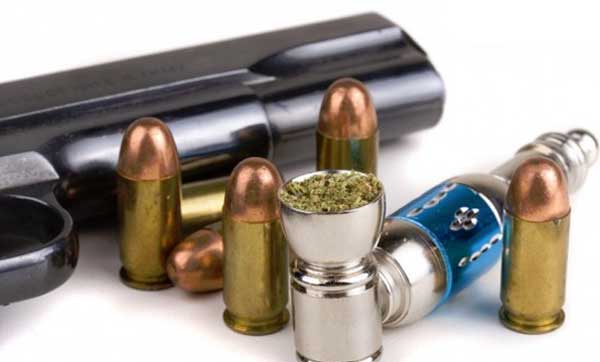
The Second Amendment Foundation and a District Attorney in Pennsylvania have filed a federal lawsuit against Attorney General Merrick Garland, the heads of the FBI and ATF, and the U.S. Government, challenging the federal prohibition on gun ownership by medical marijuana users.
The lawsuit was filed in U.S. District Court for the Western District of Pennsylvania. In addition to Garland, the lawsuit names FBI Director Christopher Wray and ATF Director Steven Dettelbach as defendants. SAF is joined by Warren County, Pa. District Attorney Robert Greene, who has served in that office since 2013 and currently possesses a medical marijuana ID card under Pennsylvania law. They are represented by attorneys Adam Kraut, who serves as SAF executive director, and Joshua Prince of Bechtelsville, Pa.
The lawsuit challenges restrictions contained in 18 U.S.C. §§ 922(g)(3), (d)(3), which prohibit firearms purchases and possession by persons who use marijuana or other controlled substances.
“Medicinal marijuana has been adopted by 38 states despite federal inaction on the issue,” said Kraut, who is also a practicing attorney in Pennsylvania. “With the increasing acceptance of medical cannabis, millions of Americans are forced to choose between the exercise of their Second Amendment rights or treating their symptoms with a substance that disenfranchises them from their constitutionally guaranteed right to keep and bear arms.
Such a choice is incompatible with the constitution and finds no basis in this country’s history and tradition. We look forward to vindicating the rights of medical marijuana users.”
“The use of medical marijuana should not translate to an automatic surrender of one’s Second Amendment rights,” added SAF founder and Executive Vice President Alan M. Gottlieb. “The current restrictions unquestionably and arbitrarily infringe on the right to keep and bear arms, and the restriction lacks any director or analogous historical support, as required by the Supreme Court’s 2022 Bruen ruling.”
Second Amendment Foundation
The Second Amendment Foundation (www.saf.org) is the nation’s oldest and largest tax-exempt education, research, publishing and legal action group focusing on the Constitutional right and heritage to privately own and possess firearms. Founded in 1974, The Foundation has grown to more than 720,000 members and supporters and conducts many programs designed to better inform the public about the consequences of gun control.
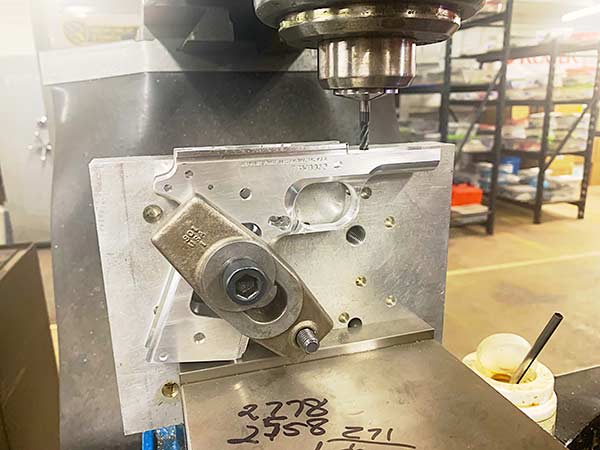
A 1911 receiver is clamped and ready to have its rails fitted for its slide.
Bobby was waiting for me in his new red pickup outside the baggage claim doors at the Amarillo airport. Driving through Hereford, the beef capitol of the world, then through Deaf Smith County rekindled stories by Skeeter Skelton. Bobby noticed my smile as I mentioned it, as true pistolero’s know the significance of these locations.
A Quick Hunt
The hour-plus trip to his shop was quick, and before you knew it, we were in Friona, Texas, home of Tyler Gun Works. After checking into my room and a fine Mexican meal with his family, Bobby and I went scouting for antelope, as we would squeeze in a hunt in two days for the opener. During the interim, I would be taking pictures of Bobby’s shop for an article.
Jason Cloessner of Lipsey’s and his son, Evan, joined us on Saturday. The hunt was a success. Evan got his goat first, and I followed two hours later. More on the hunt in another article.
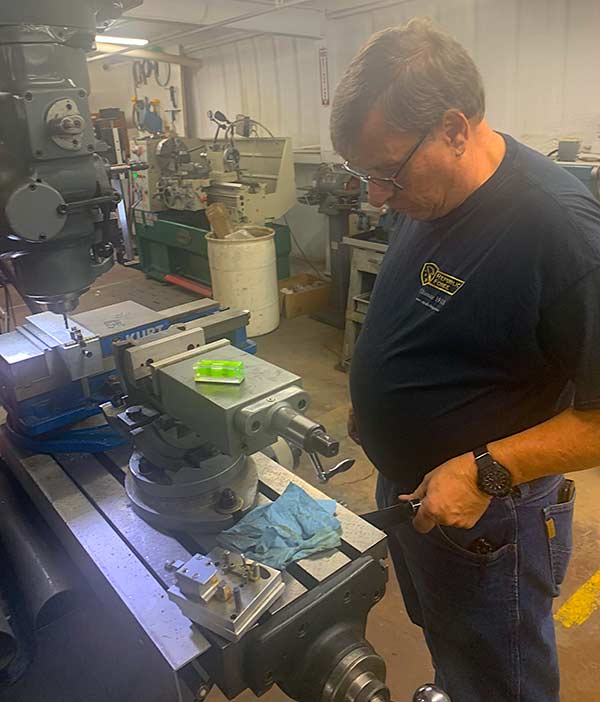
Bob Maw, owner of Republic Forge, working on the Bridgeport milling machine.
Republic Forge
It was Monday morning, and you never know who you might bump into in Texas, it’s that small. After coffee and Tereza sausage, egg and cheese tortillas at Bobby’s house, it was off to the Friona, Texas shop for more pictures. After greeting Dusty, Bobby’s lead gunsmith, I see Bob Maw, owner of Republic Forge running his Bridgeport milling machine.
Bob’s shop is very close to Bobby’s in proximity, making it a kind of two-for-one deal. Knowing Bob for years, we exchange greetings, handshakes, hugs and insults. He then explains to me, in great detail, how he was meticulously tweaking the rails of a new build he was working on. I’ve handled several of Bob’s guns over the years, and they are, without a doubt, some of the most beautiful pistols in existence, as well as the most accurate 1911’s I’ve ever had the privilege to shoot.
Every Republic Forge 1911 starts out as a 6.5-pound 4140 steel billet
and is rough forged to shape. Once the steel is forged to its rough shape,
it’s then hand fitted using Bridgeport milling machines.
It’s In the Details
What separates Republic Forge from everyone else is their attention to detail. Every gun starts out as 6.5 pounds of 4140 forged billet, then heated to 1,400 degrees and pounded to rough shape, strengthening the steel. Then, they are machined oversized to be hand-fitted using Bridgeport milling machines. No CNC machining here! Or MIMS parts, for that matter! Being hand fit, a personal feel is obtained that CNC machines can’t produce. After milling comes the deliberate and delicate ministration of files and stones for that “custom” feel everyone loves. This is followed by hand polishing.
Tolerances are kept to a bare minimum, with no two guns being the same. Hand-fit parts mean they are not interchangeable with other guns — which is no secret to Republic Forge’s cult-like followers, who know how accurate and beautiful they are. As a matter of fact, most of Republic Forge’s business is from repeat customers wanting another gun. All this personal attention to detail means a higher quality custom pistol but obviously also a lower production rate, which is just fine.
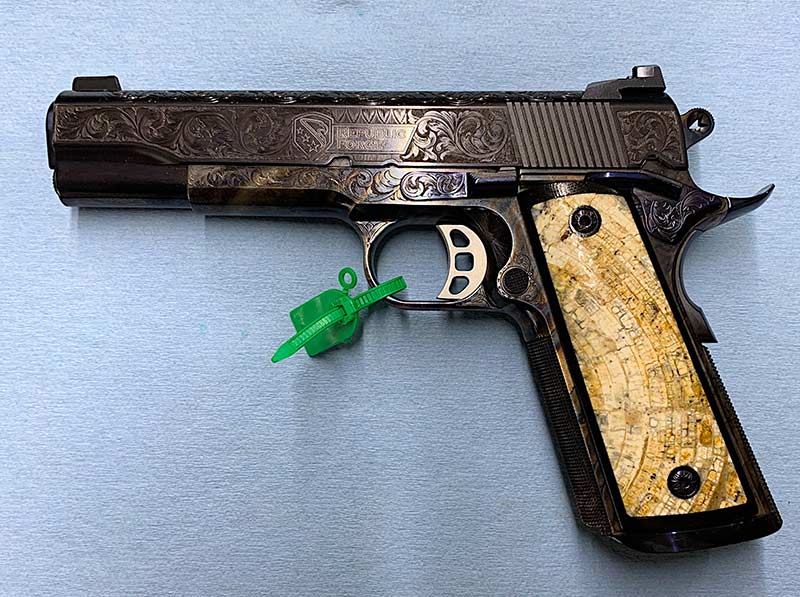
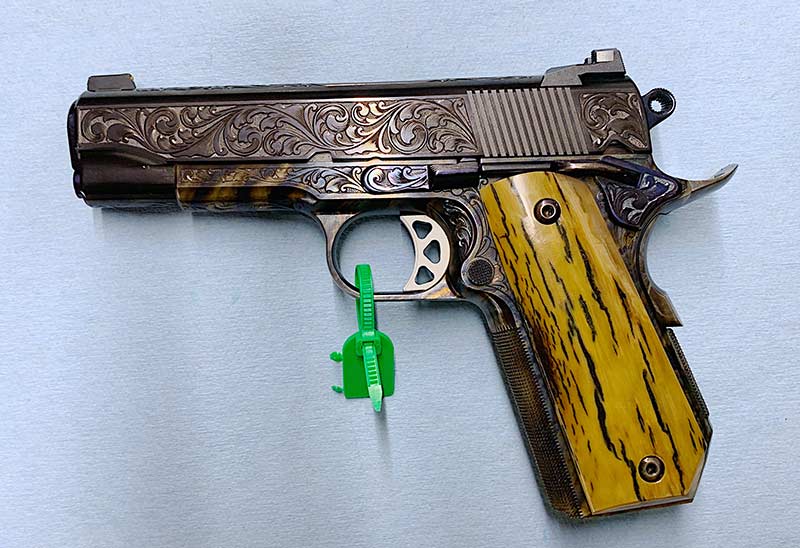
After the guns are polished to perfection, they are blued or color cased by Tyler Gun Works and then fitted for stocks, many times also by TGW, with either gorgeous mastodon ivory, ram horn or exhibition-grade walnut.
I got to watch Bob fit a slide to its receiver and also fit its oversized barrel to the slide. With calipers, pin gauges and gauge blocks, Bob masterfully had everything fitted and running smoothly with absolutely no play to the moving parts. You can’t get tolerances this tight without skilled hand-fitting throughout the entire gun.
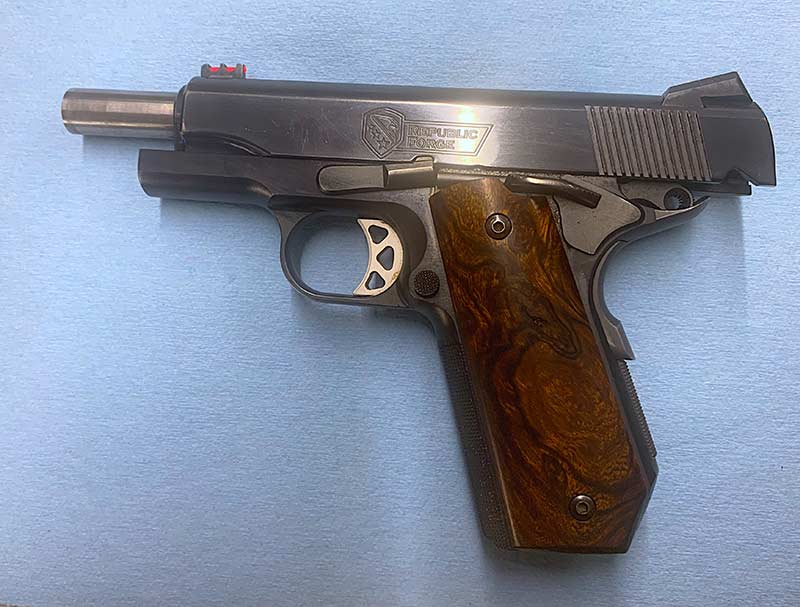
An up-close look of Bob’s personal gun he’s carried over 10 years.
A typical full-size Republic Forge 1911 with full engraving, color cased
lower and mastodon ivory stocks. Check out that Texas star hammer!
A Commander-sized 1911 with full engraving, color cased lower,
mastodon stocks and Zia pattern in hammer.
Bob Maw
Bob is a Vietnam-era Apache helicopter pilot, making his company veteran owned. His passion for John Browning’s 1911 is the drive for Republic Forge’s existence. He bought the company in December of 2017, wanting to simply build the best 1911 possible. Many people believe he has succeeded in this quest. Bob was also a competitive shooter and knows the mechanics to wring out all the accuracy humanly possible from a 1911.
Republic Forge has a reasonable turnaround from order to delivery. We’re talking months, not years. And their customer service is flawless. In the unlikely probability anything should go wrong, it will be handled professionally. So, if you’re looking to have a museum-quality 1911 that shoots accurately, check out Republic Forge in Friona, Texas.