Categories
Category: All About Guns
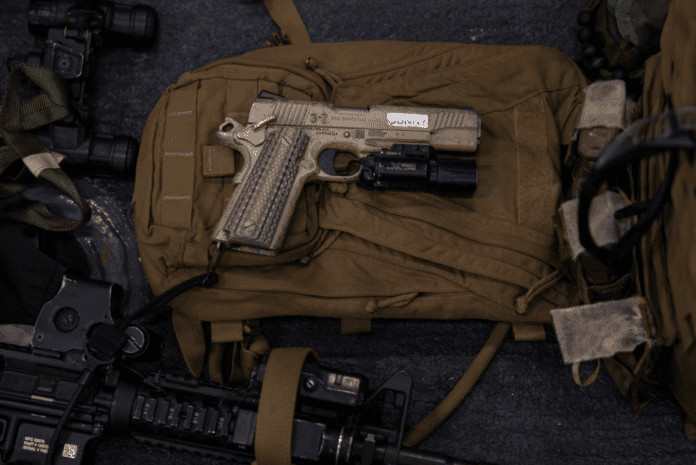
Choosing the right caliber for self-defense can be daunting, especially with so many options available. One round that consistently stands out is the .45 ACP. Trusted for over a century by military personnel, law enforcement and civilians, the .45 ACP has earned its reputation for delivering powerful stopping power in critical moments. But is it the best option for protecting yourself and your loved ones?
Let’s break down the key advantages of the .45 ACP for self-defense, addressing common concerns like capacity and recoil, while highlighting why it remains a go-to choice for many experts. Whether new to firearms or a seasoned shooter, you’ll learn how this trusted round can enhance your personal protection.
The History of the .45 ACP
The .45 ACP has a rich and compelling history that adds to its appeal as a self-defense round. Developed in 1905 by the legendary firearms designer John Moses Browning, the .45 ACP was created to meet the U.S. military’s need for a more powerful sidearm. The result was a round providing significantly more stopping power than its predecessors. This led to adopting the M1911, a .45 ACP handgun, which became a staple for the U.S. military from World War I through Vietnam and beyond.
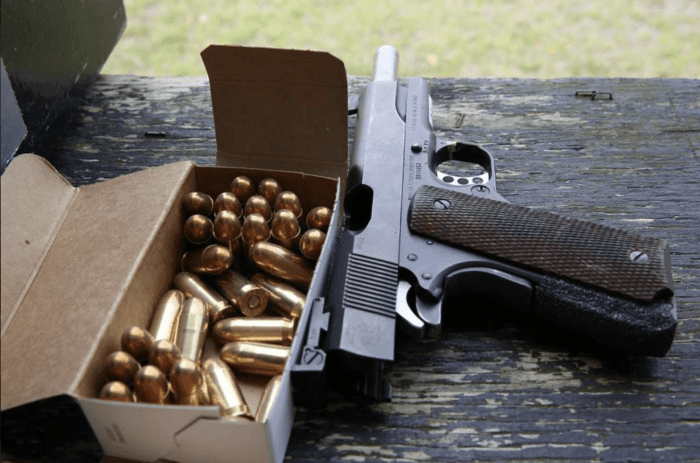
The .45 ACP’s battlefield performance solidified its reputation as a hard-hitting, reliable round that could neutralize threats with minimal shots. Its larger, slower-moving bullet made it particularly effective at close range, where self-defense situations often occur. Despite the rise of smaller, higher-velocity rounds like the 9mm, the .45 ACP has maintained popularity due to its historical success in real-world combat scenarios.
Stopping Power: The Main Advantage of the 45 ACP
When discussing self-defense calibers, the term “stopping power” is often a key consideration, and the .45 ACP is renowned for its ability to stop threats quickly. The cartridge typically fires a larger and heavier bullet weighing 185 to 230 grains, which transfers significant energy upon impact. This energy transfer can incapacitate an assailant more effectively than smaller, faster rounds. This stopping power can be critical in life-threatening situations where the goal is to neutralize the threat as quickly as possible.
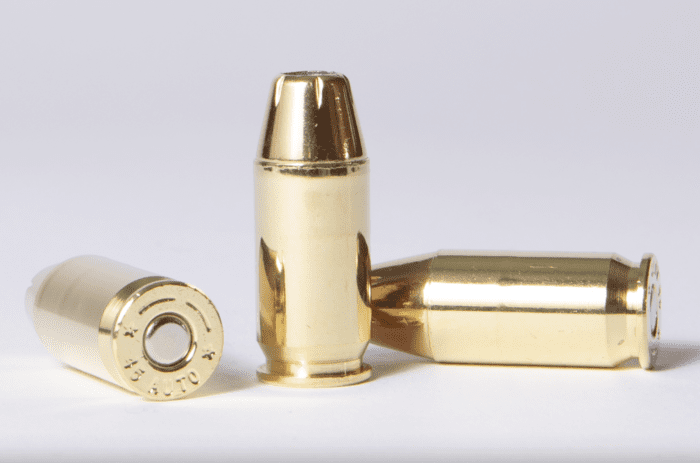 (Photo: HOP Munitions – 230 grain JHP)
The .45 ACP’s larger diameter also creates a wider wound channel, causing more tissue damage. This often leads to faster incapacitation, even if only one or two rounds are fired. Many proponents of the .45 ACP argue that it requires fewer shots to stop a threat than smaller calibers like the 9mm, making it a strong candidate for personal defense.
Moreover, modern ammunition advancements, such as jacketed hollow points (JHP), have further enhanced the stopping power of the .45 ACP. These rounds are designed to expand upon impact, reducing the risk of over-penetration and increasing the likelihood of the round staying within the target—an important factor in self-defense to avoid unintended harm.
Accuracy and Controllability
While the .45 ACP is known for its stopping power, it also offers a surprising level of accuracy and controllability, making it a solid choice for self-defense. One might assume that a larger, heavier round would produce excessive recoil, but this isn’t always true. The .45 ACP operates at a relatively low muzzle velocity (typically around 830 feet per second for a 230-grain bullet), which helps manage recoil and makes it easier for the shooter to stay on target.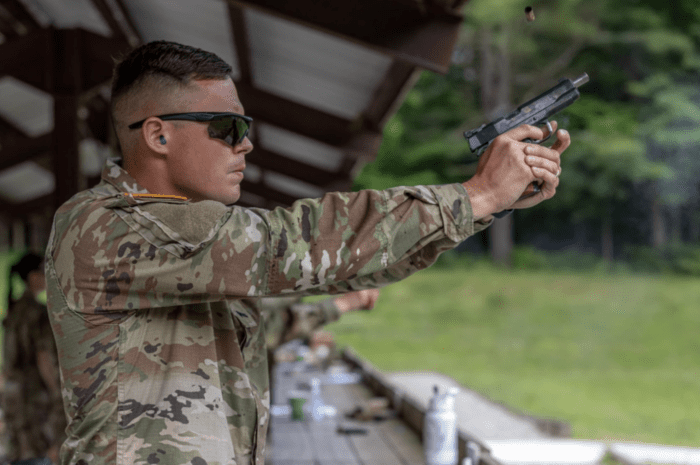
For many shooters, especially those with experience, the .45 ACP can feel more controllable compared to smaller, faster rounds like the 9mm. The slower recoil impulse allows for better follow-up shots, a critical factor in self-defense scenarios where accuracy and quick reaction times are essential.
Additionally, many .45 ACP pistols are built with ergonomics and weight distribution in mind, further aiding in recoil control. Guns like the 1911, a popular platform for the .45 ACP, are often praised for their balance, which can help shooters maintain precision even under stressful situations.
While novice shooters may initially find the .45 ACP’s recoil more challenging, proper training can mitigate this concern. Once a shooter is accustomed to the feel of the .45 ACP, they often appreciate its manageable recoil and accuracy at close to medium distances, the most common ranges for self-defense encounters.
Reliability: Trusted for Self-Defense
Reliability is one of the most critical factors when choosing a self-defense caliber, and the .45 ACP shines. Whether used in military, law enforcement, or civilian applications, the .45 ACP has a proven track record of dependable performance. In high-stress, life-or-death situations, the last thing you want is a firearm malfunction, and the .45 ACP’s reputation for reliability makes it a trustworthy choice.
One reason for this reliability is the round’s low-pressure design, which helps reduce wear and tear on firearms. Many pistols chambered in .45 ACP, such as the iconic 1911, or modern polymer-frame handguns like the Glock 21, are designed to be durable. These handguns are tested rigorously to ensure they function consistently, even in harsh conditions. This is why many law enforcement officers and military personnel have relied on .45 ACP pistols for decades.
Additionally, the wide variety of ammunition types available for the .45 ACP adds to its reliability. Whether using full metal jacket (FMJ) rounds for practice or jacketed hollow points (JHP) for personal defense, you can find a reliable load that functions well in your firearm. Modern ammunition manufacturers have optimized .45 ACP rounds to ensure smooth feeding, reduced misfires, and enhanced performance, making them a round you can count on when it matters most.
Addressing Common Criticisms: Capacity and Recoil
While the .45 ACP offers many benefits, a few common criticisms are often raised when discussing its suitability for self-defense—primarily its lower capacity and higher recoil compared to smaller calibers like the 9mm.
Magazine Capacity
One of the main trade-offs of carrying a .45 ACP handgun is its reduced magazine capacity. Due to the larger size of the .45 ACP round, most handguns chambered for it hold fewer rounds per magazine. For example, a standard 9mm pistol might hold 15 to 17 rounds, while a .45 ACP pistol typically holds between 7 and 10 rounds.
However, it’s important to note that the need for high capacity can be mitigated with proper training and practice. In many self-defense situations, accuracy and shot placement are far more important than the number of rounds. With the stopping power of the .45 ACP, fewer rounds may be needed to neutralize a threat. Many modern pistols, like the Glock 21, offer extended magazines, bridging the capacity gap between .45 ACP and 9mm handguns.
Recoil
Recoil is another factor that often deters some shooters from using the .45 ACP. The larger round produces more felt recoil than a 9mm, which can be intimidating for novice shooters. However, this disadvantage can be overcome with training. Many experienced shooters find the recoil of the .45 ACP to be manageable, especially when using pistols designed with recoil mitigation features.
The relatively slow velocity of the .45 ACP, combined with modern advancements in handgun design, has made it easier for shooters to maintain control and fire accurate follow-up shots. Guns with recoil springs, weight distribution and ergonomic grips help manage the recoil and keep the firearm on target.
Shooters Weigh in on using .45 ACP for Self Defense
The .45 ACP has been a popular self-defense round for decades, but opinions on its effectiveness and practicality vary widely. Here’s a look at what experienced shooters and firearms enthusiasts think about using the .45 ACP for self-defense, based on real-world feedback.
Training and Familiarity Matter More Than Caliber
One consistent theme among users is that your proficiency with a firearm is more important than the caliber. As one person put it, “If you can shoot it often enough to get good with it, then caliber becomes less important as training and skill increase.” This sentiment underscores that practice and familiarity with your chosen firearm will have a greater impact on self-defense outcomes than whether you’re using a .45 ACP or a 9mm.
Capacity and Ammunition Availability
While .45 ACP is seen as effective, many users highlight its limitations in capacity compared to 9mm. A .45 ACP handgun typically holds fewer rounds, which can be a concern in high-stress self-defense scenarios. As one user noted, “You’ll have less ammo in the mag than a similarly sized 9mm, and ammo to train with will be more expensive”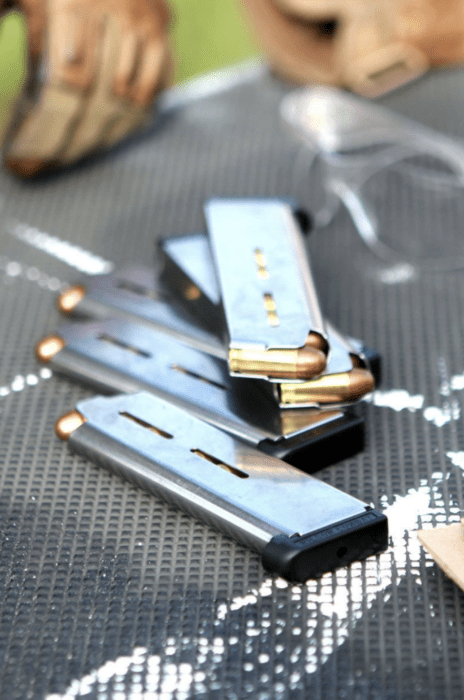 Magazines of .45-Caliber rounds are layed out as they are loaded during an exercise for Special Reaction Team, Provost Marshal’s Office, Marine Corps Air Station Beaufort, Aug. 21. The exercise was intended to familiarize the Marines of the team with the M45 1911 A1 pistol as they transition over from the standard issue Beretta M9A1 pistol.
Ballistics and “Bigger Holes”
One of the selling points of the .45 ACP is its ability to create larger wounds due to its larger diameter bullet. However, modern advancements in ballistics have narrowed the gap between the effectiveness of different calibers. One experienced user explained, “I used to be way into .45 ACP because, as people like to say, ‘it makes bigger holes.’ But most modern handgun cartridges have very similar ballistics“
The Role of Overpenetration
Concerns about overpenetration are common in home defense. One shooter remarked that the .45 ACP’s slower velocity could make it less likely to penetrate walls or other barriers, making it a safer choice in some situations
Suppression and Recoil Considerations
The naturally subsonic nature of .45 ACP rounds makes them a popular choice for suppressed firearms, with some users specifically mentioning their preference for .45 ACP in home defense setups that include a suppressor
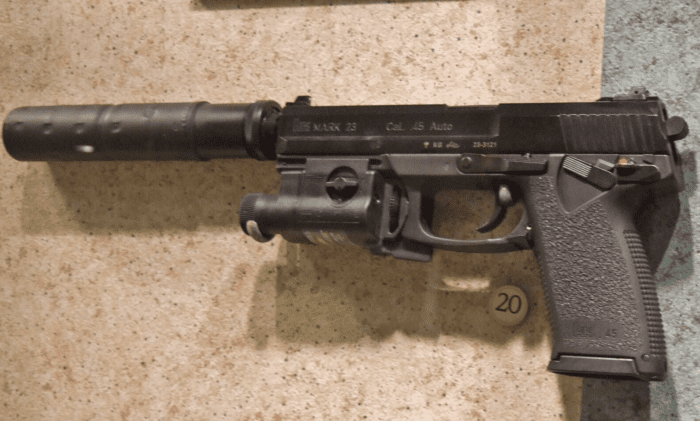 Heckler & Koch Mark 23 .45 cal SOCOM pistol (Photo: Creative Commons)
Overall, the .45 ACP is still considered a viable self-defense option, especially for those familiar with and confident in using the caliber. However, for many, the higher capacity, lower recoil, and cheaper training costs of 9mm handguns make them the preferred choice for everyday carry and home defense. As one user put it, “Regardless of which is actually better, how well it’s used is going to be vastly more important“
It remains a solid self-defense option for those comfortable with the .45 ACP and willing to practice regularly. However, modern 9mm offerings provide capacity, recoil management, and affordability advantages, making them a more well-rounded choice for most situations.
Why the 45 ACP Is a Strong Choice for Self-Defense
When it comes to self-defense, choosing the right caliber is essential, and the .45 ACP makes a strong case for itself. Its combination of historical reliability, stopping power and accuracy makes it one of the most trusted rounds for personal protection. While the criticisms regarding magazine capacity and recoil are valid, they are manageable with the right training and firearm selection. For those prioritizing a proven round that can quickly stop a threat, the .45 ACP remains a top contender.
Ultimately, the best self-defense round is the one you feel most comfortable and confident with, but the .45 ACP offers a balance of power and performance that few other calibers can match. With modern advancements in ammunition and firearm design, the .45 ACP continues to evolve, making it an even more formidable option for those looking to protect themselves and their loved ones.
 Within any given cohort of humanity, a few folks being a bit outside the norm is a statistical inevitability. However, sometimes you find a lunatic who takes it to extremes.
Eccentric. That’s typically just a euphemism for crazy. In ages past, someone whose actions were outside of accepted norms was frequently just compassionately referred to as eccentric.
David Bowie dressed like a woman back when a man dressing like a woman wasn’t cool. He once said of himself, “I find only freedom in the realms of eccentricity.”
Michael Jackson was always kind of weird. Paul Reuben aka Pee-Wee Herman was just a benign sort of quirky kid’s star right up until the cops caught him pleasuring himself in a movie theater. Frank Zappa looked like an anorexic Sasquatch and was bold enough to name his three kids Moon, Dweezil, and Diva. That all sounds pretty eccentric.
Table of contents
- Responding to Fear
- Digby
- Things Get Real…
- The Fine Line Between Brave and Nuts…
- READ MORE: Martin Bryant and the Port Arthur Massacre: The Homicidal Lunatic That Disarmed a Nation
- The Desperate Measures In Question
- Down but Not Out…
- Saving The Lunatic Digby
- The Rest of the Story…
- READ M ORE: The Life and Times of the Brain-Damaged Gunslinger Clay Allison
- Some Are Brave, Some Just Stupid

Let us consider Howard Hughes. Howard Hughes personified eccentricity. When Baskin-Robbins discontinued his favorite ice cream, he paid to have them make up 350 gallons of Banana Nut just for him.
He custom designed a brassiere for actress Jane Russell to get her boobs to defy gravity in some specific way for a movie he was making called Outlaw. In 1958, Hughes rented out a Santa Monica theater and binge watched movies…for four months straight. All the while he saved his urine in jars. At the time of his death, Hughes weighed 87 pounds. Now hold that thought…
Responding to Fear
Think back to the last time you were truly afraid. I don’t mean you were concerned you might miss a deadline at work or forget to feed the fish. Cerebrate on the last time you actually feared for your life. Ponder how that made you feel.
Most adults have had a near-death experience or two on American roadways. Military service is dangerous, and, like most soldiers, I had a couple of close calls while in uniform. In each case, the beta response/fight-or-flight reaction kicked in and I instinctively sought refuge and sanctuary. That’s how most normal people respond to a potentially deadly situation. And then there was Allison Digby Tatham-Warter.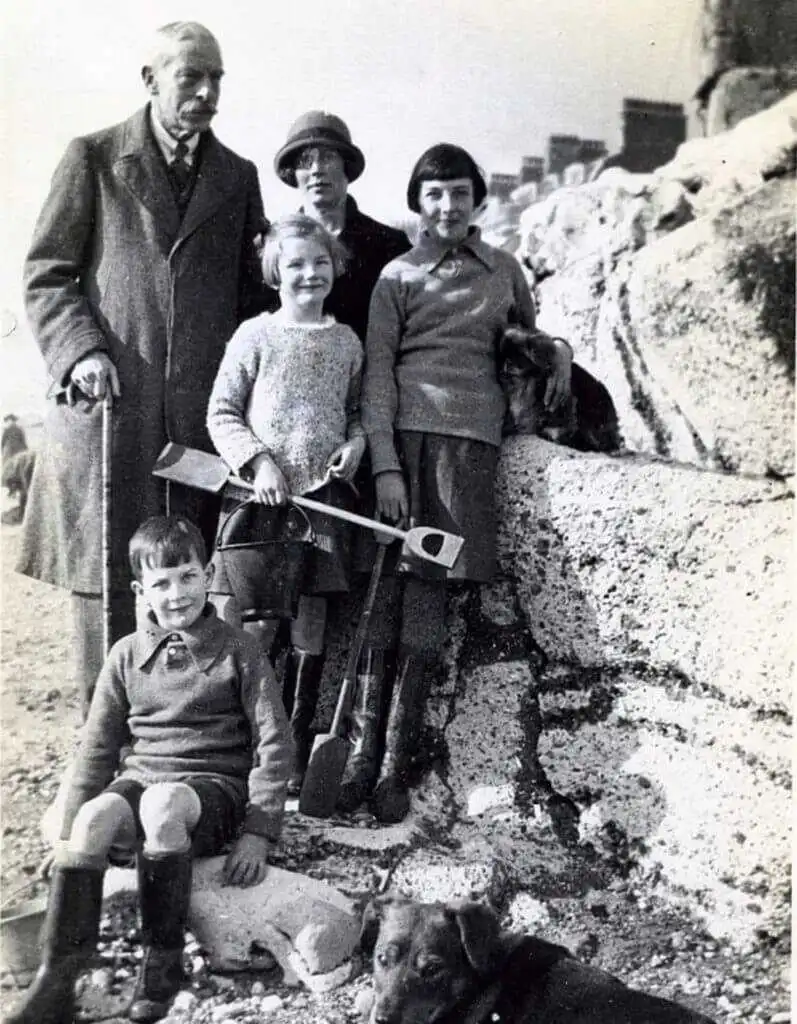
Digby
Allison Digby Tatham-Warter was just Digby to his friends. This guy was a genuine piece of work. Born into some proper money in Atcham, Shropshire, England, in 1917, Digby was the second son of Henry de Grey Tatham-Warner. Digby’s father was gassed during the trench fighting in the First World War and tragically rendered hors de combat when the little boy was only 11. Digby subsequently matriculated into Wellington College in Berkshire before attending the British Royal Military College at Sandhurst.
Digby was commissioned as a Second Lieutenant in 1937 and was assigned to the Oxfordshire and Buckinghamshire Light Infantry posted in India. His family connections to India ran deep, so this was a natural billet. Digby sought out this posting so he could pursue the fine art of recreational tiger hunting and pig sticking.
Things Get Real…
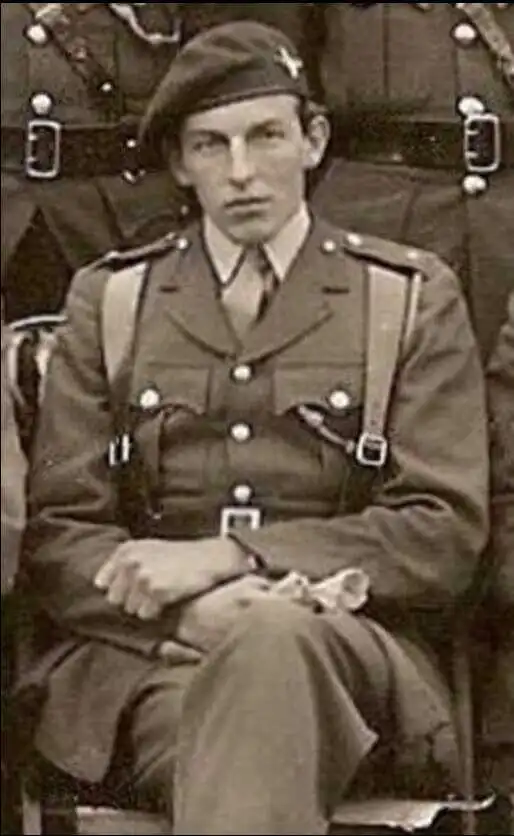
With the onset of WW2, Digby’s sister Kit actually deployed to the North African desert, earning the French Croix de guerre. His brother John perished at the Second Battle of El Alamein with the 2d Dragoon Guards, the Queens Bays. Determined to get some payback, Digby volunteered for the Parachute Regiment. In short order he was company commander of A Company, 2d Battalion, 1st Parachute Brigade, 1st Airborne Division.
Now amidst the company of some serious warriors, Digby’s reputation shone even more brightly than his peers. His past experience as a tiger hunter set the tone. When he commandeered an Allied C47 cargo plane and flew all of the company-grade officers in their encampment to London for a party at the Ritz his social stock went through the roof.
His commanding officer, LTC John Dutton Frost, appreciated the refined young man’s audacity and aggressiveness. As a result, Digby was placed in command of the 2d Parachute Battalion for its assault into Arnhem during Operation Market Garden in 1944. Appreciating that military radios of the era were unreliable, Digby procured a small bugle and schooled his men on responding to commands in combat via bugle calls. This method of command and control had not been used since the Napoleonic Wars, but his reliance upon it was to be critical in the grueling battle to come.
The Fine Line Between Brave and Nuts…
You recall we kicked off this party talking about eccentric crazy people. Here’s why. Despite a litany of truly laudable character traits that cumulatively produced a superb combat leader, Digby was notoriously forgetful. He was legendarily calm in a crisis, but he struggled to recall details under pressure, particularly tedious stuff like challenges and passwords. As a result, he adopted a curious method of setting himself apart on the battlefield.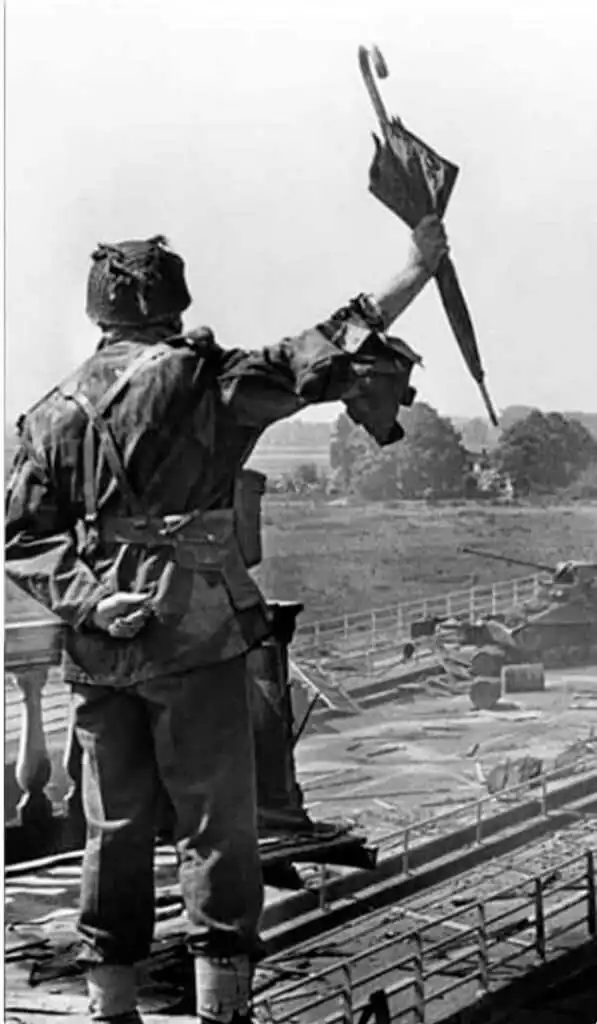
Airborne troops were trained and equipped to drop deep behind enemy lines and then hold until relieved. This meant fluid battlefield geometry and a commensurate increased risk for fratricide. Considering Digby’s job would have him moving back and forth in and around both friendly and German forces, he packed an English bowler hat and umbrella alongside his battledress, maroon beret, and Webley revolver. When queried concerning his motivations, Digby replied, “They will think, who is that bloody fool wearing a bowler hat and carrying an umbrella, and they will immediately know it’s me!”
At one point in the battle, Digby led his A Company some eight miles through contested Arnhem in 7 hours, collecting 150 Heer and Waffen SS prisoners along the way. For this part of the fight, he wore his standard issue Airborne beret. However, when things got truly bleak, it was time for desperate measures.
The Desperate Measures In Question
Running low on ammunition and facing a determined enemy in a built-up battlespace, Digby ordered a desperate bayonet charge. Before he led his men in the assault he put away his beret and replaced it with the bowler hat. This made it easy for his men to spot him leading from the front amidst the din.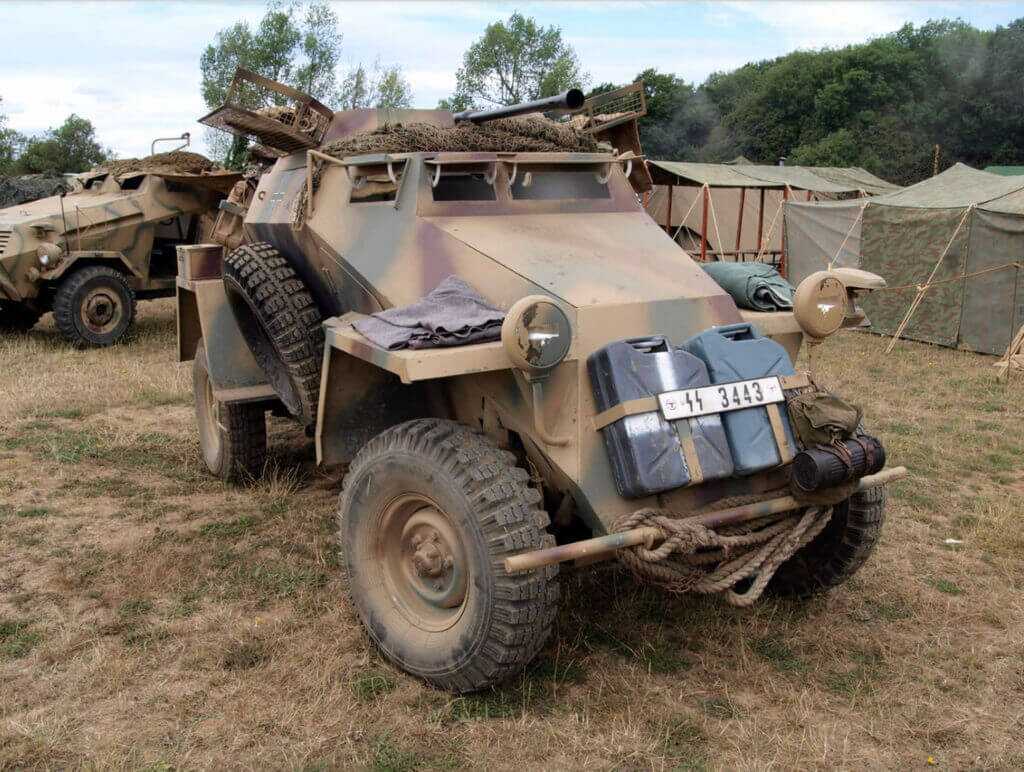
Military Operations in Urban Terrain (MOUT) are some of the most dangerous undertakings in the infantry pantheon. Make your enemy a fully tooled-up Waffen SS Panzer Division, and this borders upon suicidal. At one point, Digby and his men came upon a German armored car equipped with a fast-firing 20mm autocannon. Without hesitation, Digby leapt up onto the vehicle and shoved his collapsed umbrella through the driver’s vision slit. In so doing he caught the German soldier in the eye. Digby subsequently immobilized the vehicle long enough for his men to take it out.
Down but Not Out…
As the combat wore on, Digby singlehandedly rescued several of his soldiers under fire as well as the unit chaplain, all the while wielding that beat-up umbrella. He was eventually struck by shrapnel that left a generous gash in his trousers as well as his butt. Finally at the end of his rope, his last radio call said simply, “Out of ammo, God save the King.” He was subsequently captured and transferred to the local St Elizabeth’s Hospital for treatment of his injuries.
German nurses dressed his wounds and left the room to attend to other patients. Digby and his 2IC CPT Tony Frank used the distraction to escape through a nearby window. By using a micro compass disguised in a button on his uniform, Digby and his mate broke out towards Mariendaal. Enroute they encountered a friendly Dutch woman who spoke no English but connected them with the underground.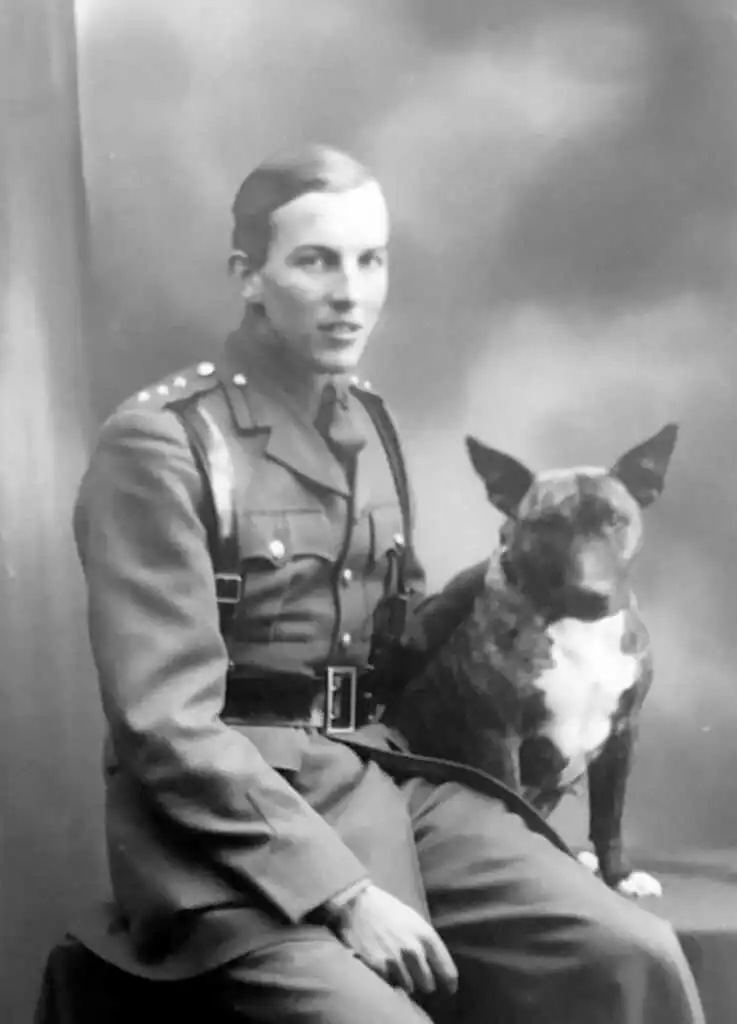
Saving The Lunatic Digby
The Dutch Resistance bodged up papers describing Digby as the deaf-mute son of a local lawyer and gave him a bicycle. He used the bike to make contract with other British paratroopers in hiding after the disastrous culmination of Market Garden. At one point he was press-ganged by the Germans into helping to push a staff car out of a ditch. German soldiers were eventually billeted in the same house where he was staying, yet he still pulled off the deaf-mute charade throughout.
Eventually, Digby bicycled all the way to the Rhine River where he flashed the V-for-Victory signal with his flashlight and successfully connected with the British XXX Corps and freedom. He had spent more than a month on the run behind enemy lines and was personally responsible for the safe repatriation of some 150 Allied soldiers. His motley band included British paratroopers, downed aviators and even two lost Russians.
The Rest of the Story…
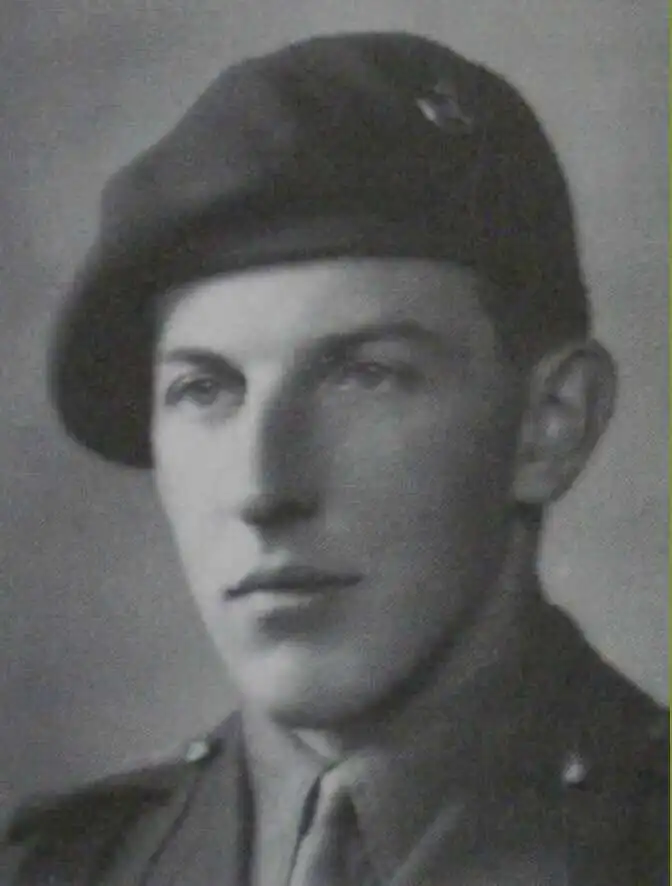
After the war, Digby was posted to Mandatory Palestine as part of the British military contingent. In 1946 he was transferred to the 5th King’s African Rifles in British Kenya. He found Africa to his liking and bought two wilderness estates, one in Nanyuki and another in Eburre. During the Mau Mau Uprising, Digby raised a mounted militia force on his own nickel and led them in combat. Once that brushfire war simmered down, Digby embraced a well-deserved retirement.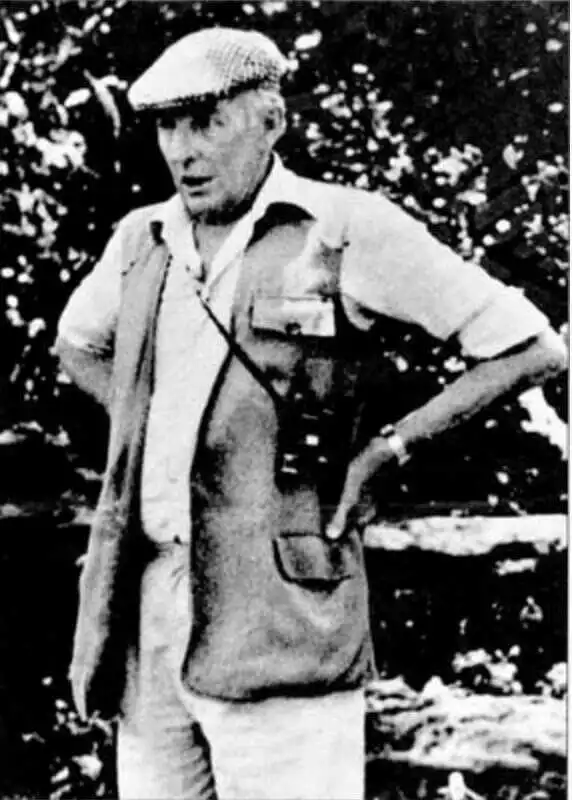
When he grew too old for military service, Allison Digby Tatham-Warter moved to Africa to try his hand at safaris.
Allison Digby Tatham-Warter pioneered the concept of the photo safari wherein paying customers would stalk animals and then photograph rather than kill them. Such stuff is commonplace now, but he’s the one who started it. He was also an outspoken advocate of African nationalism, lobbying for the Africans’ right to self-government and suffrage. During Kenyan Independence in 1962, Digby’s was an effective voice for native Africans.
Some Are Brave, Some Just Stupid
Digby married Jane Boyd, herself also an aristocrat, in 1949. Together they had three daughters and a plethora of grandchildren. One of his daughters, Belinda Rose, went on to marry a prominent member of the German aristocracy. Digby died in Nanyuki, Kenya, in 1993 at the age of 75.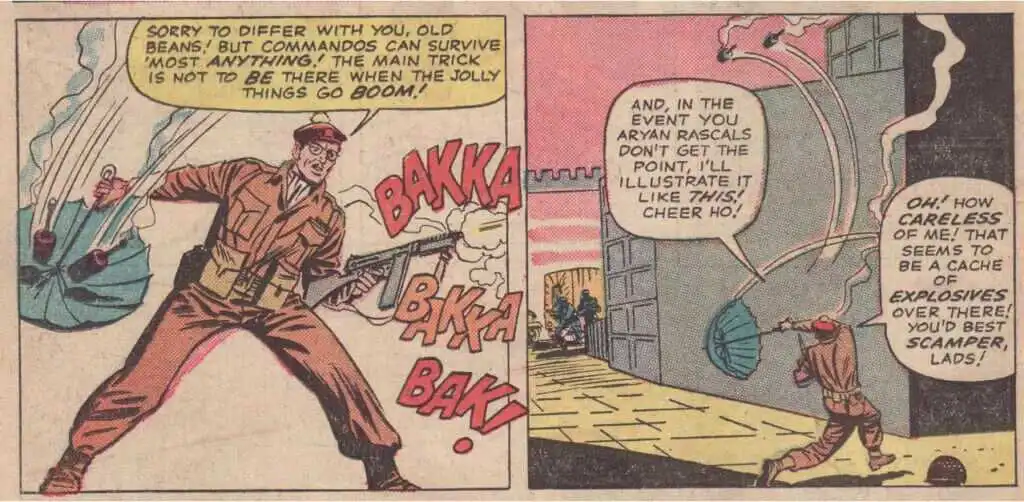
Countless men have worn their nations’ uniforms and tasted war. Some were unimaginably brave, while others were rank cowards. Most fall someplace in between. Allison Digby Tatham-Warter, however, was a legit wild man.
When the chips were down and death seemed inevitable, this lunatic just took up his umbrella, donned his favorite bowler hat, and neutralized a German armored combat vehicle via a stiff poke in the eye. They really don’t make them like that anymore.

Categories
Bren Gun at the Range
BELLEVUE, Wash. — Oct. 22, 2024 — A federal judge in New York has issued a permanent injunction against the Cortland Housing Authority (CHA) prohibiting any sort of firearms ban against CHA tenants, in a victory for the Second Amendment Foundation (SAF) and its fellow plaintiffs.
SAF was joined in this action by three private citizens, Robert Hunter, Elmer Irwin and Doug Merrin. They are represented by attorneys Edward Andrew Paltzik, Serge Krimnus and Meredith Lloyd at Bochner PLLC in New York City. U.S. District Judge Glenn T. Suddaby with the U.S. District Court for the Northern District of New York signed the order.
“Pursuant to Plaintiffs’ claims as set forth in the First Amended Complaint, Defendants, and their respective employees, agents, representatives, service providers and/or contractors, are enjoined from prohibiting Plaintiffs and all other CHA tenants from owning, possessing, transporting, or using firearms for lawful purposes, provided they are otherwise qualified and in compliance with all federal, state, and local laws applicable to the ownership, possession, transportation and use of firearms,” Judge Suddaby wrote.
He also ordered the defendants — CHA and Executive Director Ella M. Diiorio — to pay plaintiffs’ counsel $150,000 for attorney’s fees and costs.
“This is not the first time SAF has successfully challenged a gun ban in a public housing authority facility,” recalled SAF founder and Executive Vice President Alan M. Gottlieb. “Whenever we are alerted to this sort of thing, we are prepared to challenge it. Bringing these cases simply fulfills our effort to win firearms freedom one lawsuit at a time.”
“At some point,” SAF Executive Director Adam Kraut observed, “it should become abundantly clear to various public housing authorities that gun bans are not allowed. Residents do not leave their constitutional rights at the entrance, as each of our victories over the years have affirmed.”
Categories
Sunday Shoot-a-Round #250
Do we need them all? Of course not. But clearly, shooters want them. So which to choose? Which offers the best all-around capabilities? Inherent accuracy? Long-range reach? Which are best for hunting? Here’s a look at 10 of the top 6.5 rifles available. We’ll go more or less chronologically, starting with the Scandinavian favorite introduced 110 years ago.
6.5×55 Swedish Mauser
Undoubtedly the best of a flurry of 6.5mm military cartridges engineered over a century ago, the 6.5×55 provided excellent ballistic performance coupled with moderate recoil. It capably made the transition to modern times, although American ammo companies governed by SAAMI load it gently out of caution for vintage rifles with potentially weak actions.
If you want the best out of the 6.5×55, you must either handload it or purchase European-loaded ammo by Norma, Lapua or the like. It has about 11 percent greater case capacity than the 6.5 Creedmoor—the current gold standard—so when loaded to similar pressures, it produces a step up in velocity. It goes without saying that these loads are suitable only for use in strong actions in good condition.
Because of its 3.15-inch overall cartridge length, the 6.5×55 must be paired with a long action. On the plus side, this makes it easy to seat long, highly aerodynamic bullets well out of the case so they don’t intrude on propellant capacity. Magazine capacity runs four or five, plus one in the chamber.
Paired with a tough bullet, the 6.5×55 is adequate for elk, but hunters must place shots carefully. As many proponents point out, the cartridge has been used successfully on tens of thousands of Scandinavian moose. This is true, but keep in mind that Scandinavian moose are much smaller than our North American species, and they are typically shot at close ranges, where the 6.5×55 has adequate energy.
Of course, the “Swede” is superb for deer-size game. For deer, pick a 120- to 143-grain bullet. For bigger, tougher game, opt for monometal versions or heavy Nosler Partitions, Swift A-Frames or the like.
My current favorite all-around 6.5×55 hunting load pushes a 129-grain Hornady InterBond at 3,030 fps. I took several plains game species in Mozambique with it, including a sable. Fired from a Ruger M77 Hawkeye African, it groups under an inch at 100 yards.
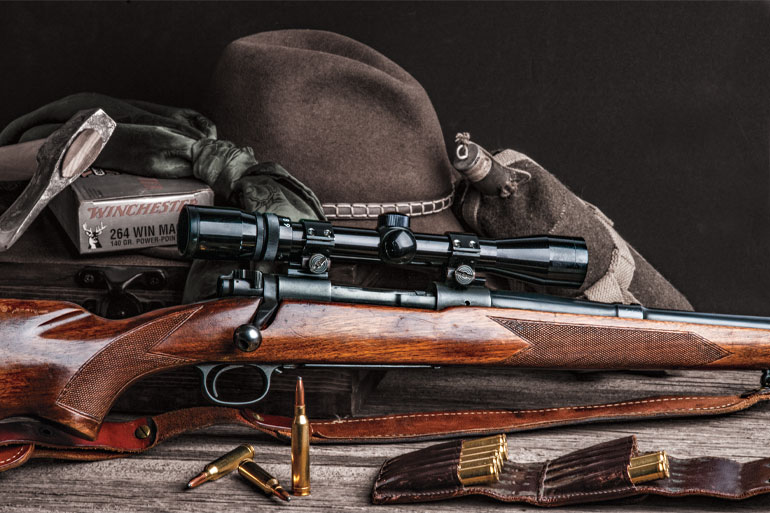
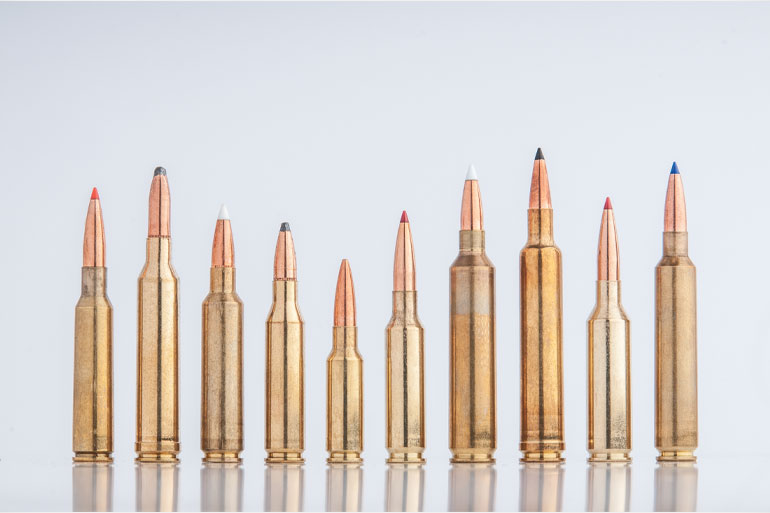
.264 Win. Mag.
This half-century-old cartridge was the first proper 6.5mm hot rod. Based on a shortened, necked-down version of the .375 H&H case, it was advertised to drive 140-grain bullets at 3,200 fps. Velocity was rarely quite that high, but it did provide impressive downrange results.
Created to fit into standard .30-06-length actions, the belted magnum case dictates that capacity in most bolt-action rifles is three in the magazine plus one in the chamber.
Remington’s 7mm magnum essentially killed off the .264, and today the .264 Win. Mag. is a cartridge for traditionalists with a flair for the unusual. Ballistically, it’s still a good cartridge, but it’s no more capable than modern 6.5s such as the 6.5 PRC and 6.5 Wby RPM, which have superior design characteristics to recommend them.
Only Nosler’s current factory ammo features good long-range bullets. Handloaders can achieve best performance by loading aerodynamic projectiles like the Hornady ELD-X, Barnes LRX and Federal Terminal Ascent.
This cartridge crosses into the high-velocity territory that necessitates a tough, controlled-expansion bullet to prevent excessive fragmentation on impact, particularly for use on big-bodied game. That said, with savvy bullet selection, the .264 Win. Mag. works wonderfully on all North American big game up to and including elk.

6.5-.284 Norma
Consisting of a .284 Win. case necked down to hold 6.5mm bullets, this wildcatters’ favorite quickly became more popular than its parent cartridge, and it was eventually legitimized by Norma ammunition in 1999. While it can be shoehorned into some short-action rifle models, it’s at its best in long actions where bullets can be handloaded long so bases don’t intrude into the powder reservoir.
It’s a tad slower than the .264 Win. Mag. and 6.5 PRC, but the 6.5-.284 Norma still provides significantly more velocity than the 6.5 Creedmoor. Most 140-grain bullets exit the muzzle at around 2,950 fps.
Of rebated-rim design, the 6.5-.284 features a case head that fits standard bolt faces, with an expanded body diameter that enables the cartridge to hold more gunpowder. Most rifles contain four or five rounds in the magazine, plus one in the chamber.
For a time, the 6.5-.284 was the darling of long-range benchrest competitors, and at least one 1,000-yard world record was set with it. Its popularity has faded a bit, mostly due to the 6.5 PRC cartridge, which offers a trace more velocity and fits into short-magnum-action rifles.
However, the 6.5-.284 is still a superb choice for the discerning open-country hunter and is adequate for all hooved game up to and including elk. Pick a tough, bullet with a high ballistic coefficient to get the best out of it.
.260 Rem.
Introduced in 1997, the .260 Rem. presaged the 6.5mm frenzy. Simply a .308 case necked down to hold 6.5mm bullets, it was a popular wildcat before being adopted by Remington.
It’s often been compared to the 6.5 Creedmoor. Proponents assert that the .260 has a bit more capacity and produces a shade more velocity. On the downside, it’s not optimized for long, high-BC bullets like the Creedmoor is. Plus, the .260 has gained a reputation for picky accuracy—probably due to varying and often sloppy chamber throat dimensions—while the 6.5 Creedmoor has the opposite reputation. At this point, the .260 appears to be on a rapid slide into obscurity.
Most bolt-operated actions contain four or five in the magazine, plus one in the chamber. The .260 Rem. has also been successfully adapted to large-frame AR-type semiauto rifles.
Typical 140-grain bullets exit the muzzle at about 2,750 fps. Lighter 120-grain versions offer about 2,900 fps. It’s an outstanding deer cartridge, and it serves adequately as a crossover for elk as long as a tough, heavy bullet is chosen and ranges are kept moderate.
6.5 Grendel
Introduced in 2003 by Alexander Arms, the 6.5 Grendel was designed to help the AR-15 be all it can be. Based on a .220 Russian case shortened and necked up to 6.5mm, it’s optimized for use with 6.5mm bullets in the 120- to 130-grain range. Velocity is highly dependent on barrel length, and with bullets in the 120- to 130-grain range, the Grendel generates about 2,600 fps in a 24-inch barrel.
In a bolt-action rifle it’s the wimpiest of all the popular 6.5mms. However, when compared to the .223 or 6.8 SPC in an AR-15, it offers profoundly better energy and downrange capability. It hits significantly harder than any 7.62×39 bullet out of an AK-47. Plus, it’s got reach. I’ve shot magazine-compatible 6.5 Grendel factory ammo to 1,000 yards with great results using a 24-inch-barreled AR-15.
As a hunting cartridge, the Grendel is lacking on larger game like elk because it simply doesn’t drive heavy enough bullets fast enough. But if you want a very moderate recoiler for close hunting on deer-size game, it’s wonderful.
6.5 Creedmoor
Ah, the “Creed”—the cartridge responsible for the current 6.5mm feeding frenzy. Introduced as a 1,000-yard competitive cartridge in 2008, the 6.5 Creedmoor is a result of the combined efforts of Hornady’s lead ballistician David Emary and champion long-range shooter Dennis DeMille. It crawled away from the starting line and then meteorically launched to cartridge stardom—opening American shooters’ eyes to a new world of long-range precision ability.
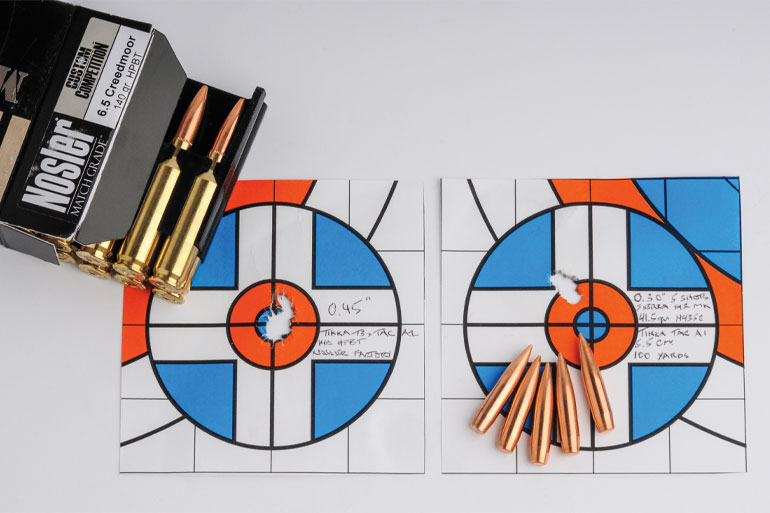
Stringent chamber throat design and dimensions make the 6.5 Creedmoor arguably the single most inherently accurate factory cartridge available today. Most hunting rifles contain four or five in the magazine plus one in the chamber.
Because it’s designed specifically for long, aerodynamic projectiles, the 6.5 Creedmoor is most comfortable with 135- to 150-grain bullets. Velocity with common 140-grain bullets runs about 2,700 fps. Handloads achieve a bit more. While the Creedmoor is at its best inside about 1,200 yards, depending on altitude and other environmentals, I’ve shot it to 1,400 yards with quite good success. For hunting, Hornady’s 143-grain ELD-X is probably the single best all-around bullet for the 6.5 Creedmoor.
Although it’s an outstanding hunting cartridge for deer-size game and is certainly adequate for elk—assuming careful bullet choice, precise shot placement, and moderate range limitations—the 6.5 Creedmoor isn’t the dragon-slayer many suggest it is. While it may not be just a cartridge like any other, it cannot escape the realities of physics—particularly velocity and energy constraints.
.26 Nosler
Announced in 2013, this was the first cartridge to wear the Nosler name. At the time, it was the fastest factory 6.5mm cartridge in existence. Utilizing a .300 Rem. Ultra Mag case shortened and necked down to hold 6.5mm projectiles, the .26 Nosler is rated to produce 3,300 fps with 140-grain bullets. Pair those speeds with modern ultra-high-BC bullets, and you’ve got eyebrow-raising long-range potential. Most rifles hold two or three rounds in the magazine.
I worked with a .26 Nosler the fall before it was introduced, and hitting steel targets out to 800 yards was almost laughably easy. Wind drift and time of flight was shockingly low. It’s a truly capable extended-range hunting cartridge.
There are some significant downsides, though. Because the .26 Nosler is so overbore (the relationship of propellant reservoir to bore diameter), it’s a bit finicky accuracy-wise. And don’t bother to try to develop reduced loads. You’ll just find inconsistency and potentially some odd pressure spikes that are understandable only to ballistic engineers. The .26 Nosler was built for speed, and it likes to be run hot.
Stoked with heavy-for-caliber Partition or E-Tip Nosler bullets, the .26 Nosler is good for elk. Loaded with 120- to 140-grain AccuBonds, it’s a deer-dropping death ray.
6.5-.300 Wby. Mag.
When Nosler claimed the title of fastest 6.5mm factory cartridge, Weatherby responded with the 6.5-.300. As you’ve guessed, it’s a .300 Wby. necked down to 6.5mm. With massive propellant capacity in that full-magnum-length case, the 6.5-.300 Wby. drives bullets with amazing speed. Light 100-grain projectiles hit 3,900 fps. Midweight 130-grainers achieve 3,475 fps, and all-around 140-grainers make 3,395 fps.
When the 6.5-.300 Wby. was introduced, I shot the rifle to 1,100 yards and hunted wild hogs with it. I took a good boar at 70 yards, driving a 127-grain Barnes LRX through the quartering-away hog and dropping it in its tracks.
Although massively overbored and a bit temperamental like the .26 Nosler, it’s an accurate cartridge. Loaded with a tough, high-BC bullet, it’s a bona fide extended-range hunting cartridge ideal for deer, pronghorn, sheep and the like.
Beware of soft, rapid-expansion bullets. At 6.5-.300 velocities, they’ll likely pancake on impact and fail to penetrate adequately. Choose bonded-core or mono-metal bullets for hunting. Adam Weatherby’s choice for elk is a 140-grain Swift A-Frame. Yes, it gives up that coveted super-high BC, but it can be counted on to hold together and kill cleanly at any reasonable distance.
6.5 PRC
The 6.5 PRC (Precision Rifle Cartridge) made its debut two years ago. It is a short-action magnum created by necking down the .300 RCM. Importantly, it’s engineered to hold long, aerodynamic projectiles seated well out and to fit into standard short-magnum actions. All things considered—efficiency, barrel life, inherent accuracy and adequate authority—it’s arguably the single best 6.5mm hunting cartridge ever devised.
Generating nearly 3,000 fps with popular bullets in the 140-grain range, it provides a great deal of downrange performance without crossing the line into the temperamental territory of overbore 6.5s. The 6.5 PRC trounces the milder 6.5mms such as the 6.5 Creedmoor, shades the 6.5-.284 and matches the .264 Win. Mag.—and it fits into light, compact, fast-cycling short-magnum actions. It’s superb for deer-size game and adequate for elk.
It’s debatably already the second-most popular of all the 6.5mms. Only the Creedmoor is available in more different rifle models from more different manufacturers. Most rifles hold three in the magazine, and high-capacity, detachable-box rifles are available.
Loaded with a heavy 140- to 156-grain high-BC match bullet, the 6.5 PRC is capable to a mile on large steel targets. For hunting, few things are more versatile than a midweight, controlled-expansion bullet such as a Barnes LRX, Nosler AccuBond, Swift Scirocco II or Federal Terminal Ascent driven to 3,100 fps.
6.5 Wby. RPM
Introduced just a few months ago, the RPM (Rebated Precision Magnum) is a complete departure from traditional Weatherby design, and it has made a tremendous splash among the mountain-rifle community. Why? Because it’s the first 6.5mm that both fits into an extremely sleek action and offers true magnum-6.5 ballistic performance.
Most hot-rod 6.5s have large cases with large case heads. They require actions of robust diameter and bolts with magnum bolt faces. This new 6.5 magnum utilizes a rebated rim, so it plays nice with standard bolt faces and fits into svelte actions. Weatherby’s introductory Backcountry Ti chambered in 6.5 Wby. RPM weighs less than five pounds. Rifles hold four rounds in the magazine.
As for ballistics, the 6.5 Wby. RPM pushes 140-grain Nosler AccuBond bullets at 3,075 fps. Lighter 127-grain Barnes LRX’s exit at 3,225 fps. That’s proper mountain-hunting medicine and edges into good elk-cartridge territory.
Capacity is four in the magazine plus one in the chamber. Recoil is zesty but polite. On-impact performance should prove excellent for many big game species.
Only Weatherby rifles will be available chambered in 6.5 Wby. RPM. However, the company offers a broad selection of rifles built for different purposes and guarantees one m.o.a. accuracy in every one of them.
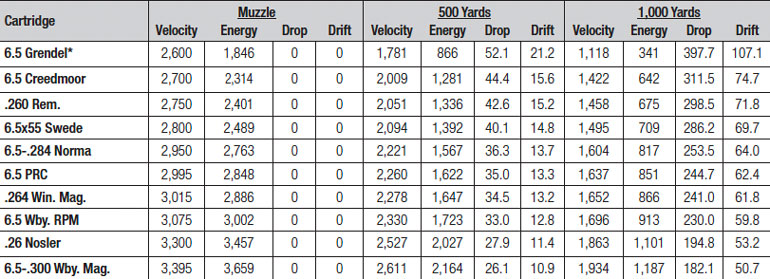
6.5mm Cartridge Spec Comparison
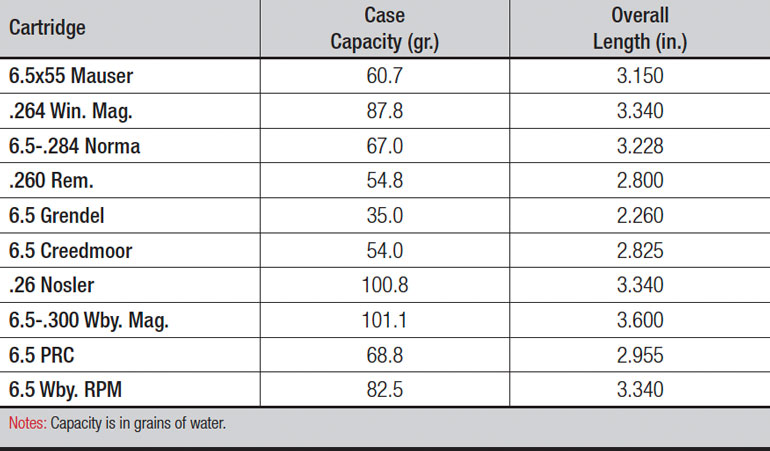
6.5mm Ballistic Comparison