Category: All About Guns
I also heard a rumor that he got robbed too! Anyone out there know more about this? Thanks Grumpy
Categories
Union Automatic Revolver
Categories
SCAR-H/MK17 Full Auto
Categories
The Ultimate Drone maybe?

Categories
John Wick does tactical shopping
In a shocking turn of events, Fort Wayne, Indiana, police have determined that a high school football player, initially reported as a tragic victim and the lone person to die from a mass shooting at a weekend Halloween party, was in fact the aggressor who entered the party and began shooting. Willie Ivy III, 17, opened fire after forcing his way into the crowded party, injuring nine people ranging in ages from 14 to 20 before an armed partygoer returned fire, killing him in what authorities have determined was an act of justifiable self-defense. Interestingly, despite the intense initial coverage surrounding Ivy’s death portraying him as a loving, ambitious member of his school football team and another tragic case of an innocent black youth caught up in gun violence, when it was learned he was the one who opened fire first, media attention of the case went comparatively dark.
Follow-up articles merely mentioned he was the shooter and noted that police weren’t going to charge the man who shot him. Was it a case of the narrative no longer fit what the media wanted to sell or had the news cycle merely gone cold on the topic? It’s hard to say. But after all the positive coverage of the young “victim,” once the truth was discovered, an examination of what caused this otherwise seemingly good kid to carry a gun into a party and begin gunning down innocent victims begs for some follow-up from the local media.
The incident began this past Saturday night at a home in Fort Wayne, where dozens of teenagers had gathered for a Halloween party promoted on social media. With the party already out of control, the homeowner reportedly locked herself in her room, opting not to call the police. Partygoers were patted down for weapons at the front entrance, but Ivy and a group of friends bypassed the check by entering through the back door. When two attendees attempted to stop them from entering, Ivy allegedly pulled a handgun and began firing as he moved from the back door through the kitchen and into the living room, where more partygoers were gathered. He reportedly continued firing indiscriminately as he moved through the house.
“Shots were fired at random,” Captain Jeremy Webb of the Fort Wayne Police Department told local news, describing the “utter chaos” that greeted first responders.
“As Ivy continued shooting, one partygoer, also armed, returned fire, fatally striking Ivy and ending the attack,” Webb said. Evidence confirmed that Ivy’s weapon was responsible for all nine injuries.
In a statement, the Allen County Prosecutor’s Office confirmed that no charges would be filed against the partygoer who shot Ivy, citing Indiana’s clear self-defense laws.
“This was an undeniable act of self-defense in a life-threatening situation,” said Webb, highlighting that Ivy’s death prevented further bloodshed.
Initially, media coverage centered on Ivy’s death and his identity as a North Side High School football player, with statements from family members grieving his passing. Ivy’s father, who traveled from Memphis, reflected on a final phone conversation with his son, where they said “I love you” before he left for the party.
“He was supposed to make it—he was supposed to go to college, he was supposed to watch over his sisters,” Ivy’s father told 21 Alive News.
“There’s no doubt about him being a loved child and he showed that in his actions with his friends and his family,” Vickii Ivy, the shooter’s aunt, said. “He just had this spirit of love for everybody that was around him.” She noted that he “did not follow or go to trouble.”
It’s clear the kid was loved and had the opportunity to do something with his life, and no doubt it can only be one extreme level of pain to lose a child to violence and an entirely different level of pain to discover the child you loved and thought you knew, was the one who initiated the violence that led to his end. It must be particularly painful to learn he caused undue pain and suffering among so many others in his final moments.
But that is the real story in Fort Wayne. That is the story the media needs to be covering. But until today’s journalists, as well as leaders, are willing to discuss the painful truths behind the extreme violence in many of our communities, no amount of gun laws they might want to pass will solve a single problem. What made a young man from a loving family engage in such violence when he apparently had so much going for him? How did he get the gun at 17, and why did he carry it into a party? These are the questions that need to be answered. Where’s the media when the real questions need to be asked?
Categories
Expert Grade Garands
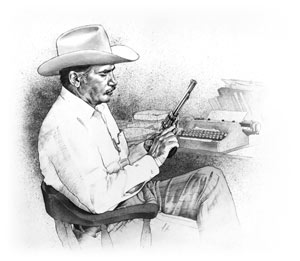
Written by Skeeter in the mid-1960s, the following article was found by his wife Sally shortly after his death in January 1988. It was published for the first time in the June 1988 issue of Shooting Times in its unedited version. We present it again unedited in two parts as a special tribute to Skeeter.
— The Editors
— The Editors
You can make remarks about the ancestry of my dog. Have your doubts about the gas mileage toted up by my family sedan. Spread the story, if you wish, that my backyard barbecues could best be digested by a brood of Arkansas razorbacks. But if you cast aspersions on my .357 Magnum sixgun, get somebody to hold your coat. We’ll continue the discussion in the alley.
I can hoist on his own petard the writer who claimed that the .357 cartridge has never achieved significance as a hunting round. The police brass who deny the usefulness of this gun and cartridge for law-enforcement purposes can be set straight with a few terse observations. Experts who say the load is too powerful and experts who proclaim it is less potent than a river rock from little David’s slingshot will scurry for their ballistics tables if confronted by factual data on the private life of this great load.
It was conceived as a hunting cartridge by Douglas B. Wesson, one of the heirs to the giant Smith & Wesson firm. With the aid of ballistician Phil Sharpe, Wesson discovered that the S&W .38-44 Outdoorsman, a .38 Special mounted on the old .44 Special frame, would withstand extraordinarily high pressures.
This quality was not a mysterious one; it was the simple sum of the thick cylinder walls and modern metals that made up the handsome, target-sighted Outdoorsman.
Sharpe’s handloads, featuring a semiwadcutter cast bullet over a heavy helping of Hercules 2400 rifle powder, gave velocity and long-range accuracy that had never before been realized in a revolver. During the experimental stages, Wesson killed almost every type of North American big game with his brainchild, justifying it as a hunting arm even before it went into production.
The .357 Magnum was formally introduced in 1935, along with a cartridge by Winchester. Bullet weight was 158 grains and diameter .357 inch–same as the .38 Special. The .357 cartridge case was approximately 1/10 inch longer than that of the .38 Special to prevent the more powerful round from being chambered in skimpier .38 Special cylinders.
The Smith & Wesson Magnum was initially offered with a selection of 31„2-, four-, five-, six-, 61„2-, 71„2-, and 83„4-inch barrels. It featured a deluxe, high-polish blue job and checkering along its topstrap and barrel rib. The rear sight, slightly different from the S&W micrometer design of today, was adjustable for windage and elevation by means of opposing setscrews.
A selection of front sight styles was available, including bead insert Patridge types and the then-new sloping Baughman quick-draw model mounted on a King ramp. The action was of the pre-World War II type, which had a longer hammer throw than the short-action S&W revolver of today. A “humpbacked” hammer was offered on a special-order basis and was preferred by many who had difficulty in manipulating the rather small, standard hammer spur.
The first Winchester cartridges were hot as a depot stove, with pressures running higher than 40,000 ft-lbs. Velocity of these powerhouses ran around 1,425 fps when fired from an 83„4-inch revolver, higher in unvented pressure barrels. Today’s factory loadings generally fall short of the initial Winchester offerings, both in the velocity and pressure departments.
The factory .357 cartridge has done a lot to encourage handloading. It is a notorious barrel leader, leaving thick, accuracy-spoiling deposits of bullet metal scabbed up in the rifling after a very few shots. Serious shooters who want to be able to fire long strings without scrubbing the bore after every eight or 10 rounds have turned to putting together their own loads.
These feature well-lubricated cast bullets of extra-hard bullet metal. My favorite answer to the .357 leading bugaboo has been the use of Lyman’s 358156 gascheck bullet, a Ray Thompson design. Properly cast, sized, and lubricated, this semiwadcutter slug approximates the shape of the Phil Sharpe original and sports a copper-shielded base that resists the hot gases of the magnum powder charges. It is an exceptionally clean-shooting, accurate bullet for both light and heavily stoked .357 cartridges.
With this bullet, in both solid and hollowpoint form, I have proven to my own satisfaction that the .357 is a fine hunting pistol. Shooting a variety of Smith & Wesson, Ruger, and Colt magnums, I have killed mule deer and javelina in Mexico, antelope and turkey in Texas. My .357 has put the coup de grace to a great many head of heavy slaughter steers and hamburger bulls, top hogs, sheep, and goats. With proper bullets, I have put ducks, Canadian geese, cottontail rabbits, and bullfrogs on my table.
I once ate a tough old White Leghorn rooster who had the misfortune to be left at an abandoned farmhouse where I made a dry camp. My .357 took his head off.
Turning to varmint hunting, I can testify that the .357 Magnum loaded with hollowpoint bullets offers all the destructive qualities needed at ranges up to 100 yards. Jackrabbits hit solidly with such a load are turned to mush. The plains coyotes I have killed with it have required no second shot when the first was placed anywhere in the thorax or abdominal cavity. One eagle and perhaps a hundred chicken hawks have dropped to my magnum bullets.
And my experience with this cartridge is by no means unusual. My friend, the late Dewey Hicks, was a fine pistol shot and avid hunter. Dewey killed both deer and coyotes with my .357 handloads. He once took an outing with a northern New Mexico rancher. Dewey wanted an elk, but the cowboy was looking for a muley buck for camp meat. He toted a worn, six-inch Smith .357 in a brush-scarred hip holster but was a little worried about his ability to kill a deer with the only loads he had: six rounds of .38 Special wadcutters.
My friend presented him with a double handful of my favorite handloads, made from a recipe of the 358156 hollowpoint bullet held in its lower crimping groove by a Remington .38 Special case. The powder charge was 13.5 grains of 2400 fused with CCI Small Pistol primers. A few hours after loading up with these homebrews, the cowboy tumbled a running buck with a single shot through the spine at 50 yards.
These tall-but-true tales could continue, but for what? Saying the .357 is insignificant as a hunting round is like saying that sourmash bourbon constitutes an unimportant factor in the diet of man. Maybe, but ain’t there lots of it being put to use?
Be sure to check this space again next month for Skeeter’s iron-clad reasoning for his unparalleled fondness for this great cartridge as well as a chart of his best handloads.
My Friend, The .357 (Part 2)
Almost all the objections to the .357 Magnum as a police weapon come from city police departments. It is argued, with some justification, that an officer who fires a magnum in a crowded city is more likely to kill innocent noncombatives than he would be if armed with a standard .38 Special. Not much mention is given to the fact that the same officer runs a hell of a lot more risk of being killed himself when his low-powered .38 fails to put an armed opponent out of action.
The .357 can, when necessary, be loaded down to any desired velocity level that will preclude unwanted penetration and yet offer a very good stopping power with proper bullets.
The Texas Department of Public Safety and the U.S. Border Patrol have accepted the .357 as standard for the patrol officers. Many of these well-trained cops frequently work in crowded, metropolitan areas.
Those that do find it a simple thing to load their magnums with medium-velocity handloads, sometimes with expanding bullets that are good manstoppers but which won’t penetrate dangerously. These thinking cops carry full-powered “maggie” loads in the bullet loops of their Sam Browne belts. If the need arises to stop a car or rouse out a barricaded gunman, they can do it.
I have used many different bullet styles besides the Lyman 358156, although it has remained nearest my heart. A flatnosed semiwadcutter bullet performs best in the .357, especially in heavier loads, and several other good designs are available. In preparing to load for this caliber, some thought should be given to the use of the swaged half-jacket bullets, although I have found them to be generally less satisfactory than good cast bullets, due to their leading qualities and to their greater expense.
The long suit of the .357 is its versatility in handling a wide range of special-purpose cartridges. These range from powder-puff .38 Special target loads to full-powered hunting rounds of up to 1600 fps velocity.
Below is a table of my favorite .357 loads, separated into three categories. The first two sections, light loads and medium loads, can be put up in either .38 Special or .357 Magnum cases. I generally load these in .38 Special cases so they can be readily identified and also because .38 brass is cheaper. The third section, heavy loads, should be assembled in sound, clean .357 cases. While not each is a maximum load, they perform better than any other combinations of the same bullet and powder that I have tried. Bullets used are .357-inch diameter. Velocities are estimated to be those obtained in an 83„8-inch-barreled revolver.
table#specialTable {padding: none;background: black; font-family: Arial,Helvetica, sans-serif;text-align: left;font-size: 11px;}table#specialTable tr {color: red; background:blue;}#specialTable td {margin: 2px; padding: 2px; background: #cccccc; color:black;border-right: 1px solid black; border-bottom: 1px solid black;}#specialTable td.noright {margin: 2px; padding: 2px; background: #adadad;color: black;border-right: none;border-left: none; border-bottom: 1px solidblack;}#specialTable td.noleft {margin: 2px; padding: 2px; background: #adadad;color: black;border-right: 1px solid black;border-left: none; border-bottom:1px solid black;}#specialTable td.noborder {margin: 2px; padding: 2px; background: #669966;color: black ;border-right: none; border-bottom: 1px solid black;}#specialTable th {margin: 2px; padding: 2px; background: #ffffff; color:black;font-family: Verdana, Arial, Helvetica, sans-serif;text-align:left;font-size: 9px;}#specialTable tr.offcolor td { background: #ffffff;}#specialTable tr.footer {}#specialTable td.footer {}#specialTable h3 { margin: 0; padding:0;font-size: 15px; border-bottom: 2pxsolid #669966;}.bottom { 2px solid black;}
Skeeter’s Favorite .357 Magnum Handloads |
|||
|---|---|---|---|
| BULLET | POWDER | VELOCITY | |
| (grs.) | (Type) | (fps) | |
| Light Loads | |||
| Lyman 158-gr. 358156 | 5.3 | Unique | 900 |
| Lyman 150-gr. 357446 HP | 5.0 | 5066 | 950 |
| Lyman 170-gr. 358429 | 3.5 | Bullseye | 850 |
| 150-gr. swaged half jacket | 5.0 | Unique | 900 |
| Medium Loads | |||
| Lyman 158-gr. 358156 | 13.5 | 2400 | 1200 |
| Lyman 150-gr 358156 HP | 13.5 | 2400 | 1250 |
| Lyman 150-gr. 358156 HP | 7.0 | Unique | 1250 |
| Lyman 170-gr. 358429 | 6.0 | Unique | 1150 |
| Lyman 158-gr. 357446 | 5.0 | Red Dot | 1000 |
| Lyman 158-gr. 357446 | 12.0 | 4759 | 1250 |
| 150-gr. swaged half jacket | 7.5 | Unique | 1300 |
| Heavy Loads | |||
| Lyman 150-gr. 358156 HP | 15.5 | 2400 | 1500 |
| Lyman 158-gr. 358156 | 15.0 | 2400 | 1450 |
| Lyman 150-gr. 358156 HP | 15.0 | 4227 | 1400 |
| Lyman 158-gr. 358156 | 8.0 | Unique | 1400 |
| Lyman 150-gr. 358156 HP | 14.0 | Sharpshooter | 1600 |
| Lyman 158-gr. 357446 | 14.5 | 2400 | 1450 |
| Lyman 170-gr. 358429 | 14.5 | 2400 | 1400 |
| Lyman 170-gr. 358429 | 13.5 | H240 | 1350 |
| 150-gr. swaged half jacket | 14.5 | 2400 | 1400 |
| NOTE: All load data should be used with caution. Always start with reduced loads first and make sure they are safe in each of your guns before proceeding to the high test loads listed. Since Shooting Times has no control over your choice of components, guns, or actual loadings, neither Shooting Times nor the various firearms and components manufacturers assume any responsibility for the use of this data. | |||
Since so many varying factors apply to make the results of handloading good, indifferent, or disastrous, neither Shooting Times nor I can be responsible for results obtained by the reader. I can only say that these loads have been safe and useful in my guns.
This list, of course, is by no means a comprehensive selection of .357 loads. It merely represents some that have worked well in my experience. Powder charges listed here may be used with other bullets of the same weight and similar design, but it is well to remember that a plainbase bullet, such as the 357446, will give higher pressures with the same powder charge than the gaschecked 358156. Too, a bullet case of soft alloy will show higher pressures and more barrel leading than one composed of a hard mixture, such as 1:10 tin to lead.
Barrel lengths affect muzzle velocities, but not as much as you may think. Longer barrels do a better job of burning the slow powders necessary for magnum loads, and many hunters buy guns with uncomfortably long barrels in order to squeeze the last foot-second of velocity from their loads.
Tests have shown that in cutting an 83„8-inch-barreled Smith .357 off one inch at a time, only about 35 fps velocity is lost for each inch removed when factory or high-velocity handloads are fired. This means that the shooter who carries an 83„8-inch model that gives 1500 fps would still get 1415 fps out of a six-inch revolver and 1345 fps if he chopped her down to four inches. The game he shoots isn’t likely to know the difference, and the maggie man should pick the barrel length that he can shoot best and carry most comfortably.
In the middle ’30s, the Smith & Wesson was the only sixgun chambered in .357. Colt didn’t seem especially interested in the cartridge but did produce a few Model P single actions in that caliber, along with a sprinkling of New Service and Shooting Master double actions with its .45 frame. These prewar Colts are now collector’s items.
Today Smith & Wesson offers its old original model, slightly refined, as well as a less highly finished version of the same gun, called the Highway Patrolman. Advances in metallurgy have enabled Smith & Wesson to chamber its .38 Special revolver for the .357 cartridge, and it holds forth as the Combat Magnum, filled up with target sights and a heavy, ribbed barrel.
Colt sells sixguns in the form of the old Model P single action and its target-sighted offspring, the New Frontier. The Python, an improved version of the famous .38 Officer’s Model target revolver, is the top gun in the Colt line and one of the most popular .357s used by police. The Trooper is a less fancy version, competing with the S&W Highway Patrolman in price.
Sturm, Ruger & Co. came out with its .357 Blackhawk in 1955, and it is an extremely practical, durable hunting arm. Intercontinental Arms of Los Angeles imports the Dakota, a good replica of the Colt single action from Italy that can be had in .357. Intercontinental also sells a sturdy derringer in the same caliber.
All of these handguns are strong and accurate. At one time or another, I have carried each of them at my side on hunting trips or in law-enforcement work. If I had to choose just one gun to side me for the rest of my life, be it handgun, rifle, or shotgun, I would select a .357 Magnum revolver.
So if you’re in a critical mood, pal, lay off my .357–it’s an old friend of mine.
Categories