
Becauseeof this brave charge King George honored them by making them a Royal Regiment. Grumpy
Becauseeof this brave charge King George honored them by making them a Royal Regiment. Grumpy

According to US officials, Kash Patel, who was sworn in as FBI Director on February 21 and named acting ATF director three days later, has been removed from his later appointment and replaced by Army Secretary Daniel Driscoll. The leadership change, initially reported by Reuters, had not yet been disclosed publically by the DOJ. Patel remains at the helm of the FBI, and as I write this article, his photo is still listed as acting Director on the ATF’s website.
Although no official reason has been given for Patel’s removal, a Justice Department official has reportedly confirmed the departure saying it “had nothing to do with his job performance,” according to the NBC. The Daily Beast seems to infer that Patel was let go because “he stopped showing up” and had not been “seen inside an ATF facility for weeks.”
Meanwhile, Glenn Thrush of the New York Times reports Patel was removed because he is inundated with his duties at the FBI. Fox News Digital claims a close source told them that Patel was removed because he wanted to focus on the FBI.
“It was never supposed to be a long-term thing. He was happy to serve, of course, but his job is the director of the FBI,” according to the source.
It is unknown how or when the decision was made or when either Patel or Driscoll was notified, however, the move comes at an interesting time as senior Justice Department officials are currently considering merging the ATF with the DEA to streamline government spending. Multiple sources familiar with the decision confirm that Driscoll will remain in his post as US Army Secretary while taking on his new role, a unique circumstance but certainly not relative to sitting at the head of two major Justice Department agencies simultaneously.
Also on the relevant agenda is the DOJ’s surge to protect Second Amendment rights under Attorney General Pam Bondi, who recently launched a task force to enforce the Constitutionally enshrined right to bear arms which she said would consist of ATF personnel, the Justice Department’s Civil Rights Division, and additional representatives from the DOJ. Formation of the task force along with the hiring of Second Amendment scholar and law professor
Robert Leider as ATF Chief Counsel and Assistant Director, the reversal of acting U.S. Attorney Michael Simpson’s argument against silencers being protected by the Second Amendment, the reinstatement of the Second Amendment rights restoration provision for the first time since 1992, the DOJ opening of an investigation into the Los Angeles County Sheriff’s Department over CCW wait times, and the repeal of the ATF’s “Zero Tolerance Policy” all follow President Trump’s February 7 Executive Order, Protecting Second Amendment Rights.
Driscoll served as an officer in the Army for approximately four years, during which he served as an armor officer between August 2007 and March 2011 and a cavalry scout platoon leader with the 10th Mountain Division at Fort Drum. He deployed to Iraq for nine months in October 2009. After retiring as a first lieutenant, Driscoll went on to receive a law degree from Yale University and worked in private equity and venture capital.
It’s unclear how this leadership change at the ATF will affect the agency’s regulation of the firearms industry or why Driscoll got the call, however, CBS reports that the Army Secretary is a close friend and former adviser to Vice President JD Vance.
Additional information is sure to be released in the coming days as we learn more about his background and views on the Second Amendment. With any luck, his appointment will reveal a focused mission to participate in Pam Bondi and the DOJ’s initiative to restore and defend American gun rights.
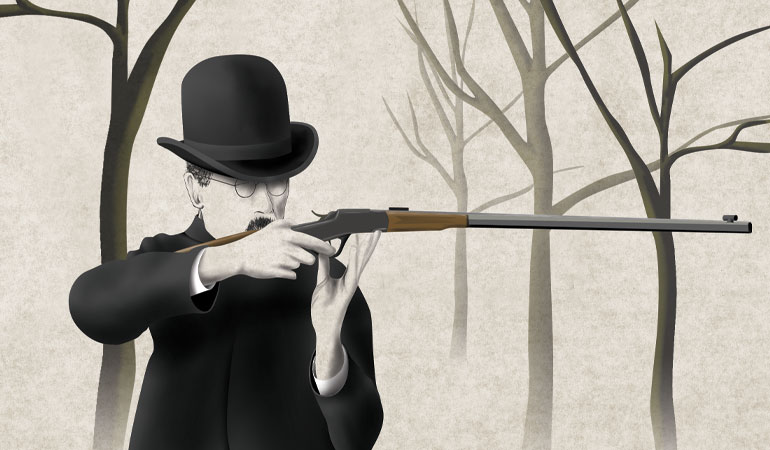 Best known as a premier precision barrelmaker, Harry M. Pope also was an accomplished inventor, writer, and competition shooter.
As Terry Wieland mentioned in his “Gunsmoke” column this month, C.W. Rowland produced an amazing 0.721-inch, 10-shot group at 200 yards with a Ballard-Pope Schützen rifle chambered for .32-40. That shooting feat was accomplished in 1901, and the name Pope in reference to that rifle belonged to Harry M. Pope. He was known for producing accurate rifle barrels. In fact, he was driven to make the best barrels in the world.
Harry Melville Pope was born on August 15, 1861, in Walpole, New Hampshire, and moved with his family to Worcester, Massachusetts, in 1862. By age six, his mother, his father, and his sister had died, and he was being raised by an aunt. He learned about mechanical things by working in his uncle’s bicycle shop. It was there that he, at the age of 12, rifled his first barrel—a brass barrel for an air-powered dart gun—using a foot lathe and barrel broach that he fashioned himself.
At 20, Harry enrolled at the Massachusetts Institute of Technology, where he studied mechanical engineering. At 26, he made a .25-caliber rifle barrel that he used to win a shooting contest. His load was 25 grains of blackpowder under 100-grain bullets, and he handcrafted the cartridge cases used for that rifle by turning them from solid brass. He soon became obsessed with making the perfect rifle barrel and took up offhand competition shooting.
In his quest to produce the best rifle barrels in the world, he did a fair amount of benchrest shooting, although he stated that he preferred shooting offhand. He was an innovator and invented a special machine rest to eliminate the human factor when testing his barrels. Eventually, he worked with many top shooters, wildcatters, and riflemakers of the time, including Dr. F.W. Mann, Harvey Donaldson, W.V. Lowe, Townsend Whelen, C.W. Rowland, and Ned Roberts, among others.
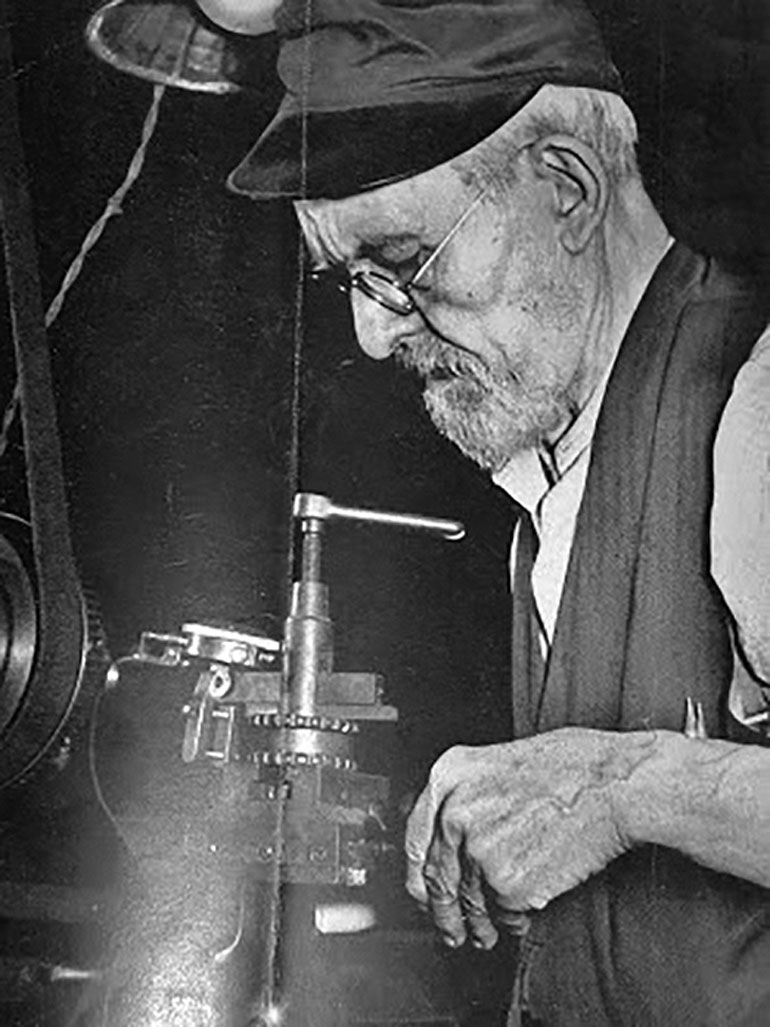
According to writer Sam Fadala, Harry’s barrels were so accurate due to two factors. One was the special style of rifling Harry used. The other was Harry’s practice of loading the breechloading rifles from the muzzle.
Harry used an 8/8 rifling system. That means he used eight grooves and eight lands. The grooves were wide, flat, and shallow. Groove depth was approximately 0.004 inch. The lands were narrow with the corners rounded off.
Loading the breechloaders from the muzzle fostered better accuracy because it allowed the bullets to be perfectly centered in the bore when they were seated. It also provided more efficient and effective burning of the powder.
As related by Harvey Donaldson, Harry’s method of loading a breechloader from the muzzle was as follows: First insert a dummy cartridge (with the mouth of the case plugged) into the rifle’s chamber. Then carefully place the bullet into the rifle’s muzzle and push it down until it touches the dummy round. Withdraw the ramrod slowly so as not to suck the bullet part way up the barrel. Replace the dummy cartridge with a loaded one that had a grease wad on top.
Some writers have reported that some individual Pope rifles were in use for more than 40 years—after having been fired 35,000 to 40,000 times—and were still able to produce perfect scores at 200 yards. Incredibly, one Harry Pope rifle was reported to have been fired 125,000 times with 700 pounds of powder and 4,000 pounds of lead going through its bore, and it was still accurate.
Harry produced barrels for more than six decades, but he also invented shooting-related products. In addition to his machine rest, he produced a universal bullet mold, a lead melting pot, and an iron front sight that shooters prized. Articles and books have been written about Harry, and he even wrote an article or two himself for various shooting magazines.
Driven to produce the best barrels in the world, Harry often referred to himself as a mechanical engineer, but he also was a self-confessed “gun crank.” Harry M. Pope passed away on October 11, 1950. He was 89 years old.