Category: All About Guns

by Terry Wieland
The name “von Atzigen” is not familiar to most, but in my opinion it should be: My friend Edwin von Atzigen, who died in early July, was the finest restorer of vintage firearms I have ever met, bar none.
Probably the name that springs to mind when you think of restoring an old gun is Doug Turnbull, and Doug certainly deserves all the accolades he receives. He has done some work for me, and it has all been excellent. But the rifles and shotguns I got back from Edy were in a class by themselves.

The name deserves a bit of explanation. As Edy (pronounced Eddy) explained it to me, the diminutive of Edwin is Edy, not Eddy, as it is with Edward. Most people, seeing it, think it’s Edy (pronounced “Eedy,” as in Eydie Gormé) and wonder at a woman doing gunsmithing work. And, Edy being Swiss, he was as exact when it came to his name as he was to everything else.
Edy had a few years on me, so he was in his early 80s when he died, but it’s only now I realize how little I really knew about him despite our long association: 35 years, now I think back. He was born and trained in Switzerland, worked for Flaig’s for some years, then emigrated to Canada and, by coincidence, settled in my home town in southern Ontario. There he stayed, working out of his shop in the basement of a small bungalow.
We had several friends in common, among them Siegfried Trillus, an old-school German gunmaker who lived near Toronto, and who built one of the finest rifles I own. Siegfried died in 1993 and Edy, who had worked with him, and learned from him, on several projects, acquired many of his tools and jigs and whatnot.
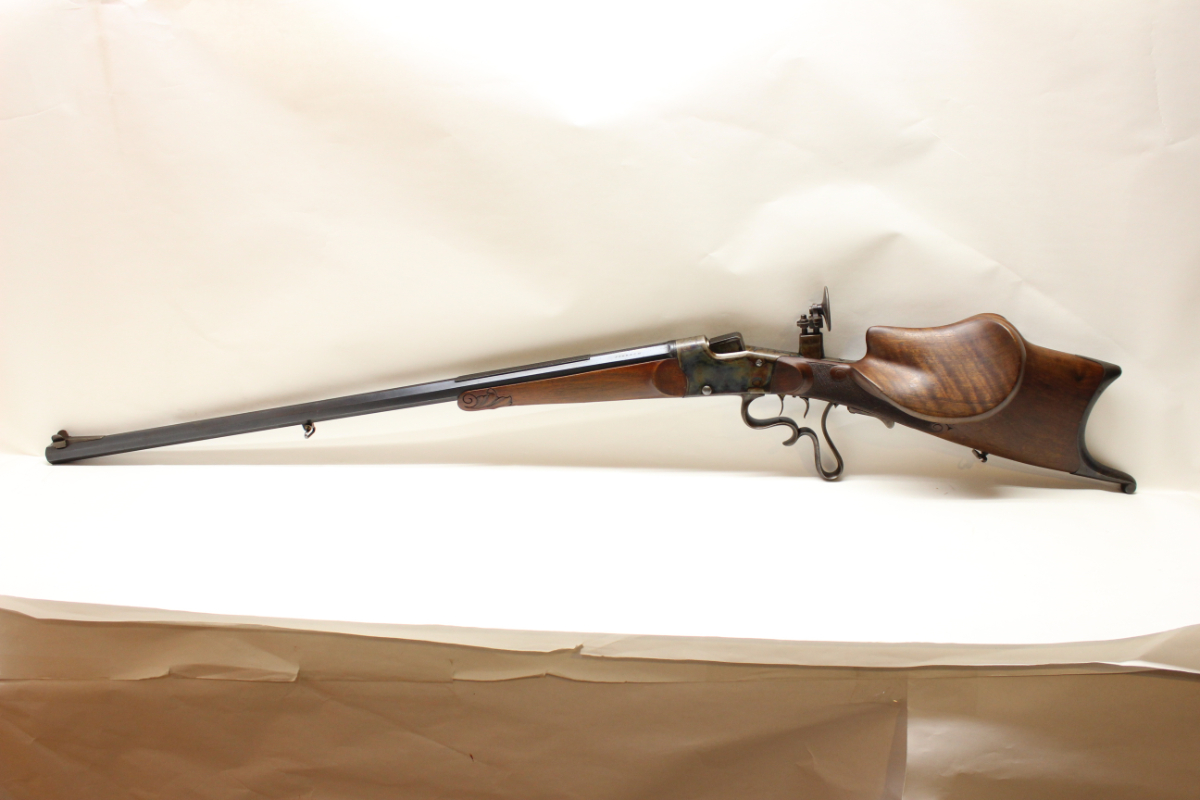
The first restoration job he did for me was on a Savage Model 1899, circa 1916, originally special-ordered as a Schützen-type rifle. I was open-mouthed when I saw the finished article, but for Edy it was child’s play.
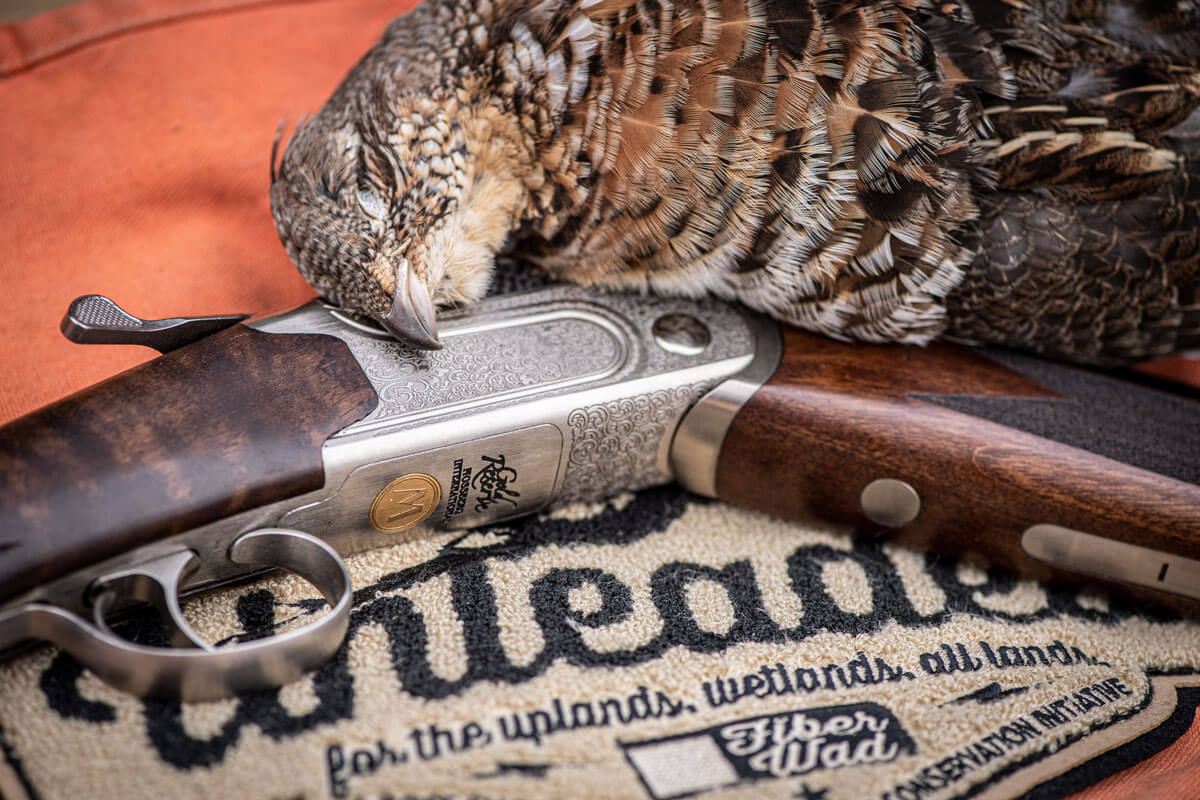
Much more difficult was an E.M. Reilly side-by-side I acquired in 2004, which had spent 35 years in the rafters of a henhouse and was an unholy mess. The stock was black with age, some external metal parts were corroded beyond repair, the checkering was completely worn off. I bought it for the action (a P. Webley screw-grip treble-bit) and never expected to see it shoot. Edy took it into his care and, about three years later, I picked up a beautifully restored English double with the most beautiful French walnut stock I have ever seen, anywhere, before or since.
Along the way, Edy had coaxed the oil out of the stock (18 months), bent it from cast-on to cast-off, lengthened it with a piece of ebony-like German rubber he’d been saving for a special project, reshaped the side panels, recut the checkering, made new metal bits for the forend, along with some new screws, inlet some ebony pieces where he’d removed rotted wood, applied a London oil finish to the walnut, and delivered a 6 lb., 4 oz. masterpiece that’s been my lucky bird gun ever since.
Later, he restored a Schultz & Larsen Model 65 DL in 7×61 Sharpe & Hart, which he found for me — he knew I’d wanted one since childhood — and a lovely thing it once again is. Around the same time, I found a side-lever W&C Scott & Son hammergun, which was in abysmal shape. I turned it over to Edy and, a year or so later, he called with the breathless news that the walnut on the Scott was even better than on the Reilly. As it turned out, it really wasn’t as nice in my opinion, but it’s certainly right up there.
Edy could do virtually anything on a gun or rifle that required doing. He could buy a chunk of walnut and a barreled action in the white, and deliver you a finished rifle in a year or two. He could re-lay the barrels of a double gun, or fine-tune a trigger or, for that matter, make a new trigger.
Edy von Atzigen was a big-game hunter and dearly loved rifles but, although he never said as much, I think his favorite activity was taking a once-fine gun someone had badly neglected or written off, and returning it to vibrant life. He did it with my Reilly, my Scott, two Savage 99s, and the Schultz & Larsen. If you have a copy of my book, Vintage British Shotguns, the P. Webley on the dust jacket was one he restored for Dick Stephens; Edy also restored for Dick an Ithaca 4E trap gun, which Dick later traded to me when he could no longer shoot trap.
Dick and Edy are both now gone, but the above-mentioned guns and rifles live on, and a good portion of my declining years is being spent trying to figure where I can find good homes for them. I figure part of Edy von Atzigen lives on in each one of them, and I want him to be remembered.
As he ages, Gray’s shooting editor Terry Wieland finds himself increasingly grateful no such restoration is possible with humans. Don’t ask why.
(Photo-illustration from licensed Shutterstock account).by Lee Williams
The government’s case against Patrick “Tate” Adamiak was led by two Assistant U.S. Attorneys, but their main witness became the real reason why a jury found Adamiak guilty, and a federal judge sentenced him to 20 years in prison.
To be clear, Adamiak was railroaded by Jeffrey R. Bodell, who works out of a small ATF office in Martinsburg, West Virginia.
According to documents obtained by the Second Amendment Foundation, Bodell is an ATF Firearms Enforcement Officer, or FEO, who has worked in ATF’s Firearms and Ammunition Technology Division since he was hired in November 2020.
When he took the stand to testify falsely about what he did to Adamiak’s firearms, Bodell had been an ATF employee for less than two years.
Most damning was the fact that this was the first time Bodell had ever testified at any trial.
Bodell’s inexperience was not missed by Adamiak’s defense attorney, Larry Woodward, according to a transcript of the trial:
- MR. WOODWARD: Good morning, sir. My name is Larry Woodward and I represent Mr. Adamiak. My question is have you ever testified as a witness, expert witness before?
- THE WITNESS (Bodell): I have not. This is my first time.
- MR. WOODWARD: This is your first time?
- THE WITNESS (Bodell): Yes, sir.
- MR. WOODWARD: Okay. Thank you.
Background
According to his Curriculum Vitae, in December 2011 Bodell earned a Bachelor of Science in Criminal Justice from Shippensburg University, which is located in Shippensburg, Pennsylvania. However, school officials did not return calls seeking to verify his degree.
Bodell also states he obtained a diploma from a “Master Gunsmithing Program” in May 2017 at the Pennsylvania Gunsmith School, which is located in Pittsburgh. However, school officials did not return calls seeking verification.
After earning his gunsmithing degree, Bodell’s CV shows he worked at three gun shops but for short periods of time.
He claims to have worked for Lebo’s Gunsmithing in Shippensburg for 10 months, Legendary Arms Works in Harrisburg for 16 months, and then he ran his own gun shop called Bodell Custom, LLC, for 17 months in Shippensburg. After closing his own gun shop, Bodell went to work for the ATF.
According to a transcript from Adamiak’s trial, Bodell described his career rather quickly.
“I attended Pennsylvania Gunsmith School where I, upon graduation I worked for a small gunsmithing shop for good, a year and a half, conducting general gunsmithing. After that I worked for a semi-custom production bolt-action rifle company making rifles for a year and a half. And then after that I had my own gunsmithing business based out of my house,” the excerpt from the trial states.
It should be noted that Bodell’s six-page Curriculum Vitae is loaded with long lists of the firearms on which he was trained, but it is also chock-full of nonessential information, including legislation he has studied, historic information he received, museums he has toured, and trade shows he attended.
Bodell did not respond to calls or messages left on his cell phone or with his employer. No photo of Bodell could be found.
Problems
Adamiak, who is now 31, was just a 28-year-old E-6 in the U.S. Navy prior to his arrest. He enjoyed firearms and ran a private website that sold gun parts—not guns. He was always extremely careful about what he sold. After all, he had to protect his naval career, which was doing extremely well.
Adamiak was unprepared for Bodell or his incredible deceptions, which have become almost legendary. Bodell actually turned toys into firearms and legal semi-autos into machineguns.
Bodell inserted a real STEN action and a real STEN barrel into Adamiak’s toy STEN submachinegun and got it to fire one round, even though the toy’s receiver wouldn’t accept a real STEN magazine. Bodell actually classified the toy, which are very popular, as a machinegun.
Bodell fired five of Adamiak’s very expensive and extremely collectible legal semi-autos, which fire from an open bolt. All the ATF technician could achieve was semi-auto fire, but that didn’t stop him. He classified all five highly sought after firearms as machineguns.
Bodell ruled that several receivers that had been cut in half were actually machineguns. The same parts are still legally sold online and do not require an FFL or any paperwork.
RPGs
The worst thing Bodell told the court were his misconceptions about two inert RPGs.
Bodell took the inert rocket launchers to the ATF’s lab and added missing fire-control components including a firing pin from a functional RPG from the ATF’s collection. The agent also added a sub-caliber training device that resembles a warhead, which can fire 7.62x39mm rounds on its own without even loading it into an RPG.
“He fired a 7.62x39mm rifle cartridge through it utilizing the sub-caliber training device, which is a standalone rifle that can be fired independently on its own,” Adamiak said last week.
Bodell falsely testified that the missing parts didn’t matter, legally.
“It doesn’t matter whether it fires or not, and if it’s missing some component parts, it wouldn’t be relevant to the classification of a destructive device,” Bodell told the court, which is not what the statute or case law state.
Bodell even made a video of him and an assistant firing one rifle round from Adamiak’s heavily converted RPG.
“An RPG is a very simple and crude device,” Adamiak said. “Taking a piece of metal pipe and hose clamping a fire control mechanism to it would effectively duplicate what Bodell did in his testing.”
Takeaways
Because the ATF screwed up, kicked down Adamiak’s door and then created a multitude of fake charges, it proves they would rather prosecute an innocent man and force him to serve two decades behind bars than admit the truth—that their special agents don’t have a clue about what they’re doing. That’s why the ATF was forced to call in their ringer, Bodell, to help make their fake case.
Once the ATF turned the case over to Bodell, Adamiak’s innocence no longer mattered. Bodell would break all the rules.
All of what Bodell insisted were illegal items are still sold legally online: Inert RPGs, toy STENs, submachinegun receivers and especially open-bolt semi-autos. The RPGs, toy STENs and submachinegun receivers don’t require any paperwork to purchase.
Bodell is not alone. His opinions, and those of his colleagues, other Firearm Enforcement Officers, are fed to them by senior ATF officials. That is why Adamiak received such a stiff two-decade sentence, because these FEOs are paid liars. In many cases, it’s like they are the half-educated leading the blind.
Despite Bodell’s and the ATF’s untruths, an anti-gun judge crippled Adamiak’s defense. One of his defense experts, former ATF senior official Daniel G. O’Kelly, wasn’t even allowed to testify much despite his vast knowledge.
O’Kelly joined the ATF as a Special Agent in 1988 after serving 10 years as a police officer. He became a legend within the agency, including a stint as the lead instructor of Firearm Technology on staff at the ATF National Academy. O’Kelly has taught internationally and co-wrote the program establishing the Certified Firearm Specialist for the ATF, while he was at the U.S. Military Academy at West Point.
After lengthy testimony from both Bodell and O’Kelly on one issue, the judge sided with O’Kelly, and denied the prosecutors’ attempt to penalize Adamiak for 977 additional “machineguns,” which were just flat pieces of metal. The additional 10 years prosecutors wanted for the flats were not added to Adamiak’s 20-year sentence.
O’Kelly, and Adamiak, wishes he could have testified about the other false claims prosecutors made in the case. Even though his testimony was very limited by the court, O’Kelly still wishes Adamiak well.
“The ATF teaches its agents the minimum about guns. If they encounter something they don’t understand, they’re supposed to ask the (Firearms Enforcement Officer), but the answer they get is a directed response from the administration.
These FEOs are not allowed to give their opinions,” O’Kelly said Thursday afternoon. “The FEO’s testimony is a substance of the opinion that was forced by official ATF opinion on any firearm issue. That official opinion is based upon what an anti-gun administration has told them is should be. I’ve proven that, in terms of what the ATF has suffered on a number of issues.”
The Second Amendment Foundation’s Investigative Journalism Project wouldn’t be possible without you. Click here to make a tax-deductible donation to support pro-gun stories like this.
Gustloff-Werke K98 22LR

The HK P30L is the elongated version of their standard P30, itself an evolutionary development of the USP.
In a free market economy, manufacturers craft their wares to accommodate consumers of various means. As a result, the gun options available to American shooters are byzantine, to say the least. There will always be some companies producing sub-$250 handguns. However, for those who want something a bit higher end, there will always be a handgun waiting out there marketed for the discriminating shooter. The HK P30L is one of those types of guns.
Origins
The author found the P30L to be a good carry gun, even with the elongated barrel and slide.
The German firm of Heckler and Koch (HK) has its origins in the detritus of the Second World War, and they now equip some of the most capable armed professionals on the planet. For a time immediately after the war, HK produced machine tools and bicycles. Once they won the competition to supply the German Army with the G3 battle rifle in 1959, however, they converted solely to weapons production. This has remained their forte ever since.
Roller-locked HK long guns like the G3, HK33 and MP5 dominated the tactical scene in their day, and their modern offerings continue to set the standard for small arms excellence. The last thing Osama bin Laden reportedly saw in this life was the nasty end of an HK416 rifle wielded by an American Navy SEAL. I can personally think of no higher accolade.
In my opinion, one of the finest HK combat pistols is the P30. The hammer-fired P30 was developed from the Universal Self-Loading Pistol (or USP), itself a superb combat handgun. The P30 takes all that is wholesome and good about the USP and bumps it up a notch. During factory testing a single P30 fired more than 91,000 rounds without a component failure. The P30 is available in three different trigger configurations as well as compact, standard, and elongated versions.
The P30L (left) is an elongated version of the standard P30 (right). Image courtesy of manufacturer.
SPECS
- Chambering: 9mm
- Barrel Length: 4.45 inches
- Overall Length: 7.71 inches
- Weight: 27.52 ounces
- Grips: Integral, with interchangeable side plates and backstraps
- Sights: Fixed, open square notch with contrast points
- Action: Semi-automatic short recoil
- Finish: Matte black
- Capacity: 15+1
- MSRP: $1,149
Pertinent Particulars
The gun I evaluated for this article is the P30L stretched version with a V3 trigger. The “L” indicates “lengthened” and reflects the fact that the pistol has a longer slide and 4.45-inch barrel (as opposed to the 3.85-inch barrel of the P30). The P30L has three interchangeable backstraps as well as six different side panels of various widths. Customizing the grip requires that you punch out a small pin, but anyone even remotely handy could manage this chore in maybe five minutes. In the absence of a proper punch, a nail of appropriate diameter will do. By mixing and matching you can optimize the position of the finger on the trigger while bulking up one side of the grip or thinning down the other. There are lots of guns with interchangeable backstraps on the market today, but nobody even approaches the level of customization offered by the HK P30.

All of the P30L pistol’s controls are perfectly replicated on both sides of the gun. Note the frame-mounted safety on this variant.
The P30 series of guns incorporates interchangeable backstraps as well as side grip panels.
There are three different trigger options available on the P30: V1, V2 and V3. The V1 and V2 Law Enforcement Modification (LEM) triggers are long and predictable double-action-only rigs designed originally for Law Enforcement customers. Europeans refer to this configuration as the Combat Defense Action (CDA) system. The V2 is a conventional heavy “double action” throughout every shot. The V1, however, is markedly different.
Striker-fired handguns like the Glock typically eschew an external manual safety. In the case of a Glock, the primary safety is built into the trigger face, and the pull is a consistent 5.5 pounds from start to finish. Glock pistols are sufficiently safe and proven to occupy fully 65% of the holsters of American Law Enforcement officers. HK offers something a little bit different and equally appealing with the V1.
The decocker on the P30-series guns so-equipped is a tab oriented to the left of the hammer. This device is easy enough to master with a little practice.
With the V1 “Light Strike” LEM trigger, the device breaks at the end of a relatively long and weightless travel at 5.4 pounds from a pre-cocked mainspring. In this configuration, there are no manual external safeties, and the trigger operates at a comfortable and consistent weight from the first round to the last. However, the relatively long takeup of the V1 trigger adds an additional element of safety to the system. This means the V1 trigger requires a bit more intentionality to operate than those of striker-fired guns. In practice on the range you never notice the extra travel on the first round. My daily carry gun underneath my scrubs at work is a P30SK (Sub Compact) with a V1 trigger.
The V3 trigger is the most flexible option, however. The V3 is a more conventional single action/double action design available either with or without an external safety. The single action/double action trigger was pioneered in the Walther PP-series pistols in the 1930s. It offers the safety of a long heavy double-action pull when the weapon is first fired that cocks and releases the hammer, followed by a lighter single-action pull for subsequent shots with the slide’s cycling cocking the hammer. While this system characterizes most modern military handguns, it does require a fair amount of experience to shoot to precisely the same point of aim in both modes. The V3 version also sports a clever little decocker tab that sticks out of the back of the slide allowing the hammer to be dropped safely on a live round.
The P30L comes with a set of high-quality three-dot sights atop the lengthened slide.
With the frame-mounted external safety engaged, the gun can also be carried cocked and locked with the hammer back in Condition 1. With the hammer down the gun performs just like a classic single action/double action pistol along the lines of the military-issue M9 Beretta. The safety can be engaged with the hammer either cocked or at rest. These trigger systems are not really interchangeable at the user level but the gun can be ordered with any one of the three.
The P30L has a 4.45-inch polygonally rifled barrel. Sights are non-nuclear luminescent, and the dust cover is cut for standard Picatinny accessories. The magazine release is a thumb-operated bilateral lever. The safety and slide release levers are mirrored identically on both sides of the gun. Unlike most modern combat handguns, the controls on the HK P30L are literally indistinguishable on both sides of the weapon.
One of the unique aspects of the P30L design is a sliding counterweight that moves freely across the recoil spring as the gun cycles. This brilliant little accouterment dampens out the recoil cycle and makes the gun smoother in action. You are paying a proper premium for this gun. It is in little mechanical gems such as this that you get your money’s worth.
Real World Range Work
The barrel of the HK P30L is indeed about 0.6 inches longer than that of the P30, itself a typical service-sized handgun. While this makes the gun an innately more stable and accurate platform, it also makes the gun bulkier to tote. My gold standard is always whether I can work through my busy 14-hour clinic days successfully packing a pistol underneath an untucked set of surgical scrubs. In the case of the P30L, it is indeed bulkier than my compact P30SK or a slim Glock 43. However, I toted the gun for a couple weeks at work in an Alien Gear IWB rig on a thin but stiff belt with no one being the wiser.
The author carried the P30L in an Alien Gear IWB holster that he found to be comfortable and easy to use.The ambidextrous magazine release on the HK P30L is unique. You press it down to engage it.
The ambidextrous magazine release on the HK P30L is unique. You press it down to engage it.
The first round double action trigger pull is about what you might encounter with a Beretta M9. The pull is long and heavy but smooth from start to finish with a predictable terminus. Subsequent rounds require a light takeup followed by a conventional and unobjectionable break at the end with just a spot of creep. The pull is not as crisp as that of your tuned 1911 yet remains pleasant throughout.
On the range, that extra half-inch indeed paid dividends in the accuracy department for me. Muzzle flip is minimized on rapid strings, and the extra sight radius offers better precision that you might find on a more abbreviated heater. Once the grips are customized the gun feels better in my hand than any other polymer-framed pistol I’ve ever hefted.
Ruminations
The HK P30-series guns feed from the same magazines as the VP series. The 9mm carries 15+1, while .40 S&W packs 13+1.
There are frequently multiple right ways to reach a common destination. If your mission is to bore 9mm holes downrange then lots of guns can get you there. However, in the HK P30L you find top-flight quality, unrivaled ergonomics, and simply superb shootability, if that is even a word.
Frugality is a desirable trait with such stuff as plastic cups or disposable garbage bags. In the event of a failure, the worst thing that can happen is that you have to gather up a little trash. Aside from maybe cursing the dog there’s no harm, no foul. When it is my life that’s on the line, however, only the best will do.
Ponder what you are looking for in a defensive handgun, and then balance that against what you are willing to spend. There have been many times in my life when I had to just make do. My very first concealed carry gun was an FIE Titan in .25ACP. At $50, that’s all the gun I could afford at the time. Nowadays, however, I’m looking for something a bit more refined. The HK P30L runs great on the range, rides as comfortably on my hip as any comparable smoke pole, and shoots predictably every single time I stroke the trigger.
The experience is truly unparalleled. If you are the sort of gunman who covets the finer things, this is it.