Category: All About Guns

We all know that firearms require maintenance and cleaning, but how often should you clean your firearms? Some insist that gun cleaning should occur every time one is fired, as well as every few months — whether they’ve been used or not. Others insist that it is fine to leave your rifle or pistol uncleaned, even after multiple trips to the range.
Who’s right? The answer depends on the type of firearm, what it is primarily used for, and what ammunition or elements it has been exposed to.
When Gun Cleaning Is a Good Idea
There are times when you should clean your gun immediately after use. If you are shooting corrosive ammunition, or the firearm is exposed to water, moisture or other damaging elements, you should always clean your gun as soon as possible.
Corrosive ammunition, water, salts, dust and dirt can all lead to rust, corrosion, excess wear and tear and eventually the early failure of the rifle or pistol. For example, last week I went out hunting with my trusty Remington 700 in .30-06. It’s not a fancy rifle. It has a synthetic stock and factory blued barrel topped with a Nikon 4–12x40mm scope.
The weather was cold and damp. I didn’t see the wild hogs I was hunting for, but it was rainy and drizzling. Even though I didn’t fire a shot, I cleaned my rifle when I got home.
Why? Moisture in the barrel could lead to pitting and premature barrel wear. I also made sure to run a lightly-oiled cloth between the barrel and the stock bed to clear out any trapped moisture, or dirt and oil the barrel.
You say, “I’ve got a stainless steel barrel and receiver. I don’t need to worry about moisture.” To a certain extent, that is true. Stainless steel components help slow corrosion and the effects of the elements that cause it, but such parts are more susceptible to excess wear from dirt, dust, and fouling. Stainless steel is softer than other steel used in firearms. As such, it can experience faster wear.
Different Gun Cleaning Techniques for Different Guns
If you’ve got a gun that is only used for plinking, target clays, or punching holes in paper, it’s probably OK to let a few months and 3–4 trips to the range lapse before doing an in-depth cleaning. You should note that semi-automatics and rimfire firearms may begin to show performance and reliability issues with excessive fouling.
My Walther G22, my favorite semi-automatic plinker, tends to run fine for about 500 rounds before it begins to have problems cycling dirty .22 rimfire ammunition. Because of this, I like to keep a bore snake, CLP, and a brush in my range bag to give the action a quick once-over should it start to hiccup. Even so, it sometimes makes it through a couple of bricks of Federal .22 LR before it sees a good scrubbing. You can typically find all of these items inside a cleaning kit available here or at your local gun shop.
On the other hand, if you’re shooting a match gun or a firearm that is relied upon for personal defense, you should always keep it clean, oiled, and ready to go. As mentioned above, fouling, dirt, and dust can cause reliability issues in semiautomatic firearms. Any primary defensive firearm should, in this writer’s opinion, always be kept clean and well-oiled.
Revolvers are not immune to fouling either. Carbon build up on the cylinder can make a double-action trigger nearly impossible to pull as the cylinder gap becomes clogged.
For match guns, most semiautomatics run more accurately and more reliably when clean. Bolt-action rifles, on the other hand, often require a fouling shot for the best consistency out of a cold bore. For this reason, it is sometimes easier to clean these rifles at the range where you can then fire a fouling shot (from non-corrosive ammunition), so the bore is ready to go.
Some ranges won’t allow you to clean a gun at the range and that’s fine. You can clean it at home and store it without a fouling shot; just remember that your bore will need a fouling shot to prep the bore prior to competition.
The Big Gun Cleaning Question: How Often?
Depending on how often they are used, all firearms should periodically undergo a detailed cleaning where the firearm is torn down and thoroughly cleaned, oiled and reassembled.
How often this is necessary depends on the number of rounds fired through the gun and the role it typically is used for. I like to detail strip and clean all my firearms at least once a year, regardless of whether they ever made it out of the gun safe at all.
On firearms that are just being stored in a safe, ambient moisture in the air and humidity can cause some small rust spots to show up. Desiccants and drying silica gel will help reduce the humidity in your safe and cut down on rust caused by this moisture in the air.
An annual cleaning not only makes sure that all your guns are clean and stored properly, but also gives you the chance to inspect each firearm for problems that you may not normally notice. While you’ve got the gun broken down, look for cracks, rust and corrosion, erosion or other signs that a part may need replacing.
More than once while detail stripping my firearms, I’ve found pins, springs, and other small parts that were wearing and could soon fail. By replacing them early, an unexpected failure was prevented.
Final Note
Always be sure to wear the proper safety gear when cleaning your firearms, and always clean in a well-lit and well-ventilated area. Some chemicals and solvents are dangerous and have fumes that can be unsafe to breathe. Proper eye protection, gloves and a respirator are always recommended when working with gun cleaning chemicals.
TWO BANKS, TOO LONG, FOUR DEAD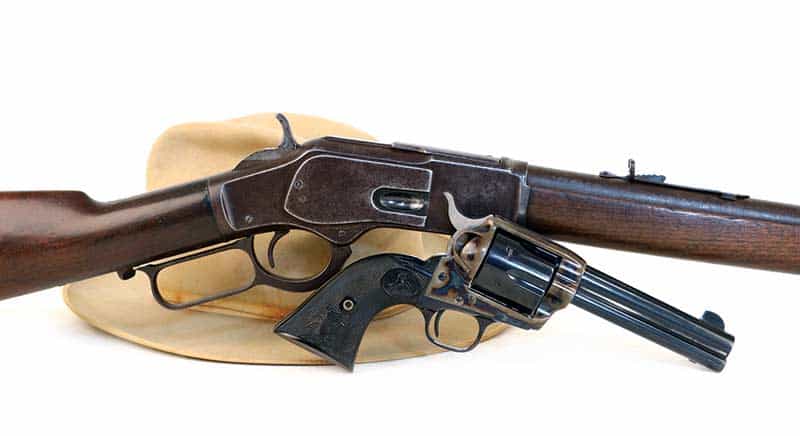
The combination of the Winchester rifle and the Colt
Peacemaker revolver helped define this remarkable era.
Nature versus nurture. It’s a question as old as humanity. Are some people bad because they are imbued with faulty DNA, or is it that their mothers just didn’t love them enough? In the final analysis, most experts believe the end result is some toxic combination.
James Lewis Dalton and his wife, Adeline Lee Younger, had 12 children in all. Adeline was aunt to Cole and Jim Younger, the notorious outlaws who made up the famed James-Younger gang. However, by the time the Dalton kids came of age, their nefarious cousins were either in jail or dead. Of the 12, Bob, Grat, Emmett and Bill were the really bad eggs.
Grat and Bob at least started out on the straight and narrow. Grat served as a deputy marshal and used his brother Bob as a member of his posse. Along the way, they spilled a little blood but generally made the world a better place. By January 1889, Bob and Grat were both deputies serving at the whim of Marshal RL Walker in Wichita, Kansas. Bob had a side hustle working as part of the Osage Nation police force. They eventually brought on their brother Emmett to help guard prisoners.
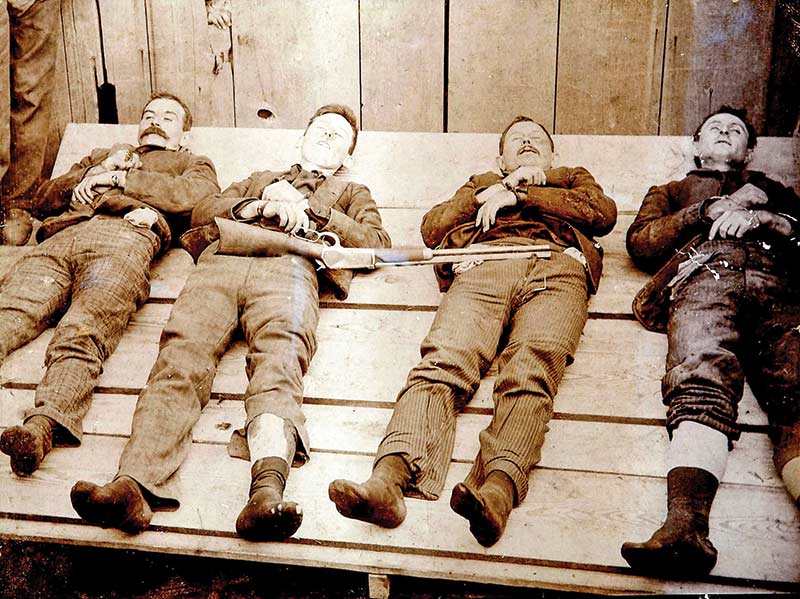
Left to right, we see Bill Powers, Bob Dalton, Grat Dalton, and
Dick Broadwell cooling after the Coffeyville shootout.
Photo: Public Domain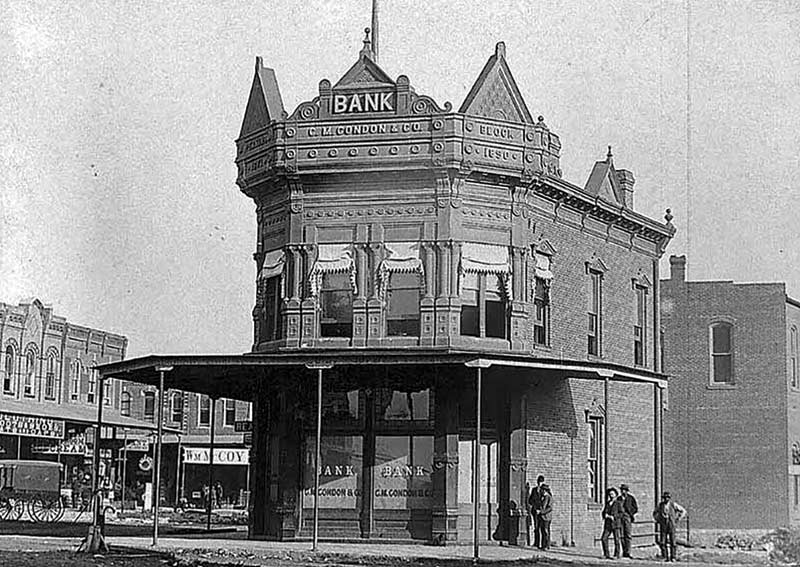
This is a vintage photograph of the Condon Bank around
the time of the robbery. Photo: Public Domain
The Dark Side
In February of 1891, Bob and Emmett Dalton robbed their first train, a Southern Pacific passenger rig near Alila, Calif. They both wore masks and wielded .44-caliber Colt revolvers. Their identities were not firmly established until years later when their brother Lit admitted they had confided they had robbed the train.
There resulted a long string of bar fights, robberies, horse thefts, and assaults of various flavors. However, all the while, the specter of that first train robbery followed the boys around. During the robbery, the locomotive fireman had been shot and killed. Though it was assumed that Emmett had done the killing, reality is that the unfortunate man was inadvertently shot by the Expressman on board. Regardless, that made this a capital case and, therefore, quite serious. Grat was eventually caught but escaped before he could be shipped to San Quentin.
There were ultimately nine members of the Dalton gang. These miscreants robbed trains and banks as the opportunities allowed, shooting it out with lawmen and frequently escaping only in the nick of time. Their protracted crime spree spanned more than two years from 1890 through 1892. However, as always seems to be the case, the guys eventually got greedy. In a world driven by graft and a weird thirst for notoriety, the Dalton gang aspired to be on top. To do so, they decided they should rob two banks at one time. This turned out to be a really bad idea.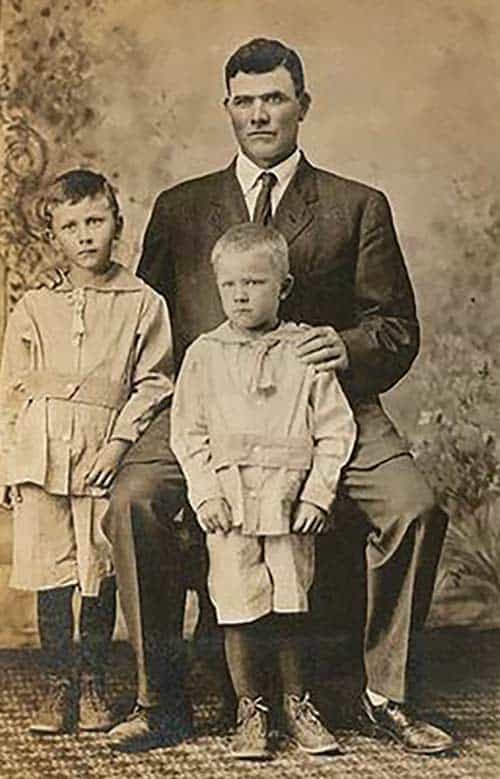
The Dalton Gang earned widespread publicity for their
merciless reign of terror. Image: Public Domain
The Setting
In scheming out this ambitious robbery, Bob Dalton claimed they would “Beat anything Jesse James ever did — rob two banks at once, in broad daylight.” Such hubris does not generally make for a long, fruitful retirement within the sorts of circles that defined the Dalton Gang. All that came to a head on 5 October, 1892, in Coffeyville, Kansas.
There were five villains in total — Bob and Emmett Dalton were tasked to take the First National Bank. Grat Dalton, Dick Broadwell and Bill Powers were to take the Condon Bank across the street. Their weapons of choice were lever-action Winchester rifles.
This part of Kansas was familiar to the Dalton boys, and many of the folks in town knew them. In fact, Emmett had originally objected to the location out of concern some of his old friends might get hurt. However, Bob lied and assured him there would be no shooting.
The men stashed their horses nearby and tried to stroll down the crowded street without being recognized.
Grat had even donned some fake whiskers to help preserve his anonymity. A local street repair worker spotted the men strolling purposefully, trying to hide their ample Winchesters and shouted, “The Daltons are robbing the bank!” At that point, everything came to pieces.
Prussian military genius Helmut Moltke once opined, “No plan survives first contact with the enemy.” However, in October of 1892, apparently, the Daltons had not read that book. Despite the alarm having been raised, these five men in two groups just barged into their respective banks and executed the plan.
Grat, Broadwell and Powers immediately got control of the Condon Bank and directed the manager to open the safe housing the gold. The quick-thinking administrator lied and claimed the safe was on a time lock and could not be opened for 10 minutes. Grat and company took the man at his word and just decided to wait. Meanwhile, outside, pretty much everybody in town had descended upon two nearby hardware stores and emptied them of weapons and ammunition. The stage was set for an epic scrap.
Across the street, Bob and Emmett were having a better time of it at the Condon Bank. They got into the safe easily enough but ran into trouble when they headed back out the front door to rendezvous with their mates. A nearby American Express agent engaged the two bank robbers with his sidearm, forcing them back into the building. The Dalton brothers then grabbed a pair of customers as hostages and headed out the back door.
Bob and Emmett left the back of the Condon Bank and ran into a local citizen named Lucius Baldwin. Baldwin had a weapon but hesitated, so Bob shot him dead with his rifle. The two robbers then made their way along an alley toward the ever-growing gunfire that was peppering the bank across the street, where their brother Grat was still waiting for the imaginary time lock to open on the safe.
Eventually, the bank manager did indeed open the safe and burdened the three bank robbers down with gold and cash. By the time they left through a side door, Powers was wounded in the arm, and the entire town was blazing away at them. The five gang members rendezvoused and then made for their horses.
Along the way, they shot and killed several townspeople. A clerk from the First National Bank named Thomas Ayres made it to a hardware store and retrieved a rifle only to have Bob Dalton shoot him in the head through a window with his Winchester from a range of 200 feet. Ayers was not killed, but he was rendered paralyzed for the rest of his days.
As the gang made their escape, they encountered Town Marshal Charles Connelly and cut him down. In response, an armed citizen named John Kloehr shot Grat Dalton through the throat.
Armed citizens firing from one of the hardware stores shot Bob Dalton through the head and chest, killing him where he stood. Bill Powers made it onto his horse only to be shot out of his saddle, where he bled out. Emmett made it onto his horse without being hit and proceeded to ride away. When he realized that his brothers were down, he turned around to help and caught a load of 12-gauge buckshot for his trouble. Dick Broadwell was hit multiple times but escaped. Authorities found his body some two miles away.

Categories
56 Cal. Colt Revolving Carbine
